
Day: November 17, 2018

  • Crash Vs Spyro: Who Aged Better?

    Crash Vs Spyro: Who Aged Better?

    Both the Crash Bandicoot and Spyro The Dragon video game series were a hit throughout the nineties, becoming iconic games for Sony’s first home console. Their memorable characters were considered to be Sony Playstation’s mascots back in day. These games received excellent reviews and were considered must-haves for owners of the Playstation.

    However, much like other technologies, these games have aged with the passing of time. Unfortunately, if you grew up in the late 90’s, you too grew up in an awkward time for games. Developers had just entered the “3D world” of gaming. 3D games were just arriving on the scene, and many developers had to learn how to make 3D games for the first time. What seemed ground-breaking at the time now looks like an unpolished mess of sharp polygons. Clearly, out of any generation, the Nintendo 64 and Playstation have aged the worst (well… maybe excluding Atari).

    That doesn’t mean they’re bad games anymore. In fact, ugly games can still be fun, right? Some companies had a harder time figuring out how to make a solid 3D game. Both Crash and Spyro are 3D platformers, but they both take a different approach. The Crash Bandicoot series can be described as a “hallway platformer,” meaning that Crash plays pretty much in a narrow hallway for the majority of the game. There’s really never any room to explore because you can see exactly where everything is in any given direction. It almost played like a literal translation of a 2D game into 3D. Spyro, on the other hand, pretty much plays like Super Mario 64 or any traditional “collect-a-thon” platformer that came about during that era. Unlike Crash, you couldn’t see what the world offered you all at once. You had the explore the areas around you and go in multiple directions to find and collect items that would help you progress through the level. This is how we can tell if a game stands the test of time.

    The Crash Bandicoot series was definitely unique, and I have yet to play a game that plays similar to the original series. Unfortunately, because of its many quirks and ideas for how a game should be played, the Bandicoot series has aged more than Spyro. Remember how I mentioned that Bandicoot feels like a 2D game being translated into 3D? This because of the clear lack of thought behind how a 3D game should play. For instance, jumping in Crash Bandicoot can be horrendous at times: the precision required to land a jump in this game is one of the worst experiences I’ve ever had with a 3D platformer. This is because the developers at the time lacked an understanding of depth perception. There are many times in the series where you can over or undershoot a jump, because it’s very hard to tell where exactly you need to land. There are even cases where players can’t see a pit until they accidentally fall into it and die. Later, game developers gained a better understanding of depth perception – and yeah, it’s a bit unfair to compare early games to modern games, but there were still better platformers that had mastered the mechanics on how depth perception and jumping works at the time Crash Bandicoot was made. A few examples: Super Mario 64, Banjo-Kazooie, and even the Spyro series. These games have better mechanics and highlight how badly Crash Bandicoot has aged.

    The reason Crash has aged so poorly is the initial design of the game itself. As a result, I can’t see a brand-new crash game in the style of the original trilogy actually working in today’s age. Gaming has changed quite a bit since the late 90’s: it has become more mainstream and thus has appealed to people who like to play games casually. I’m not saying hard games don’t appeal to gamers anymore (ahem… Darksouls), however, Crash games can be hard in an artificial way. Deaths can happen because of the way the game is designed rather than the way the game is played. This makes the game unforgiving and frustrating at times and could turn off many newcomers to the series. Additionally, Crash’s linear gameplay is totally out of touch with where the gaming industry is headed. More games today are becoming “open-world” and encourage the player to explore that world. Crash, on the other hand, has none of that. Its gameplay doesn’t work in today’s age, and if the developers tried to slightly alter it to make it work in modern times, it just wouldn’t be Crash anymore. They have already attempted to change gameplay in games like Twinsanity and Clash of the Titans, but fans and critics complained that it veered too much off course from the original formula.

    The Spyro series on the other hand has a lot of breathing room in today’s age. Yes, the game has aged as well, but most of the aging come more from aesthetics and sound design. There is nothing really notable in the way the gameplays have aged. The Spyro series was designed to be an actual 3D game and that’s why I think it has aged better. I’m not saying a brand-new game with the same style as the original game would 100% percent work. However, Spyro has already implemented open world elements in the game itself, the hub world, and even the levels had some exploration. If they were to use the same formula and simply expand on it then it wouldn’t feel like a completely different game. However, just like Crash, the Spyro series have had games released after their original trilogies, and just like Crash, those games also received bad reviews from fans and critics: the only difference is that the games received complaints because they were bad on a technical level (long loading times, bugs/glitches, etc.) and made some poor design choices.

    Looking back on these games is pretty funny, in a way. Both Spyro and Crash were popular mascots, but Crash was more popular than Spyro. However, times have changed and not only have the Spyro games aged better, but they’re more popular now than our Bandicoot friend. Even though Spyro isn’t technically in his own game anymore, he’s still a main character in the Skylander series and even though I wouldn’t touch those games with a 5-foot pole, the games have made Activision a butt-ton of money and received decent reviews. Crash was recently added to Skylanders, but it was pretty obvious that this was done to help promote the N Sane trilogy that was announced at the same time. Next week, both remakes of the trilogy will be out. Activision has stated several times that they want these remakes to appeal to both veterans and newcomers to the series. I’m not sure if Activision is testing the waters to see if they want to continue both series after releasing the remakes, but I have a feeling that if one series was planning to continue after the remakes the Spyro series would work better than the Crash series by a landslide. I strongly believe the new remake will do better in review scores and in sales.  

    Brandon De Aguiar is a fifth year Computer Science student and Co-Coordinator of Axe Radio

  • A Guide to some Common late-season Nova Scotia Mushrooms

    A Guide to some Common late-season Nova Scotia Mushrooms

    Although known for containing some tasty edible species, the fascinating Kingdom Fungi also play crucial ecological roles in our environment. Most notable is their role as decomposers, as they can degrade wood much more efficiently than other organisms like bacteria. Fungal tissues are easier to digest than plant tissues, so fungi are critically important in making energy locked away in tough plant material like wood available to the rest of the food web. Fungi also play a very important role as predators of animals such as insects. Many insect-attacking species even seem to influence their targets’ minds, causing them to fly or crawl up to high branches and leaves, and sticking to their undersides so spores released by the fungi are more likely to be caught by winds. An example of a species that predates on other organisms is the oyster mushroom. Prized as an edible, this mushroom traps and consumes microscopic roundworms as a source of nitrogen! However, most mushroom species are not known to predate animals, and instead get most of their nutrients by decomposing plants.

    Winter is just around the corner, but a surprising number of mushroom species can still be found this late in the year. Identifying mushrooms can seem daunting, as there are hundreds of species in Nova Scotia, but if you know what traits to look for and have the right book in hand, it can be done! This guide will cover 11 commonly encountered seasonal mushroom species, describing the structural features that are important for identification should you come across them in the woods.

    Gilled mushrooms

    Probably the most familiar type of mushrooms are those with gills underneath the cap, such as Cortinarius traganus:

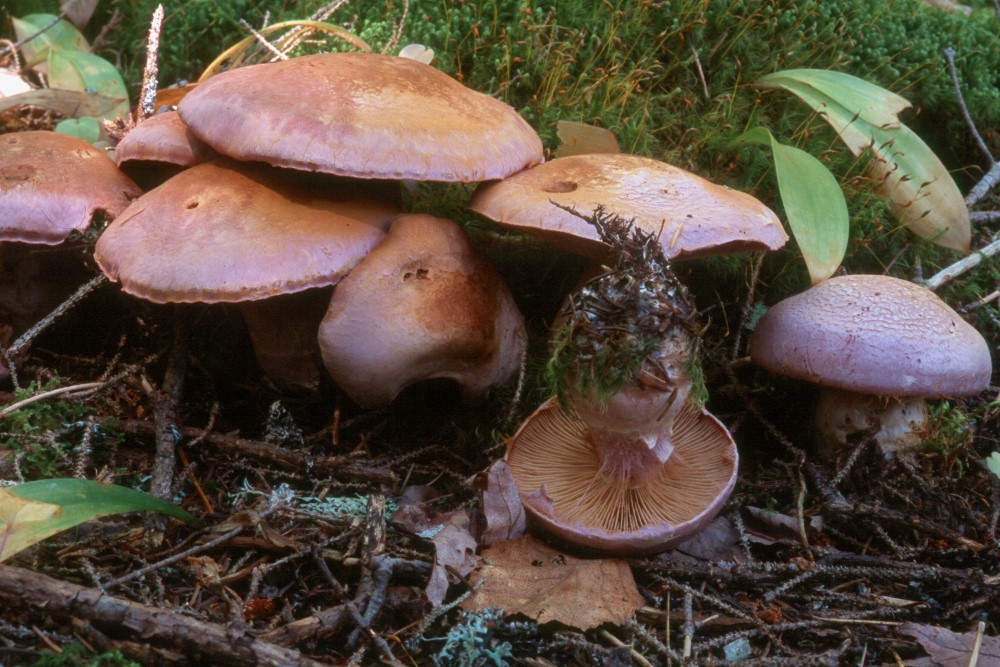
    Cortinarius traganus

    This mushroom is very commonly found late in the season and is identified by its striking purplish hues and brown gills, as well as its thick stem which widens to a bulb at the base. Younger specimens may also have a webby mesh over the gills called a cortina, which is pictured in the image above. This species forms a mutually beneficial partnership with conifer trees referred to as a mycorrhiza, where the fungus provides nutrients to the plant in exchange for a portion of the sugars the plant derives from photosynthesis. In general, mushrooms are very good at obtaining nutrients from soil, where they produce very fine root-like structures called hyphae. These are much finer than plant roots and allow for more efficient nutrient uptake. Cortinarius traganus are not edible.


    Coprinus comatus 

    Coprinus comatus, also known as the shaggy mane, is a frequent sight in lawns and mulch. This species is often white when young, with a long, bell-shaped cap. As they get older, the mushrooms release enzymes that effectively digest the mushrooms themselves, resulting in what looks like black ink. Several species in this group show this liquifying behavior and are together known as inky caps. These are considered edible but contain a toxin which reacts with alcohol up to a week after consumption. This can cause unpleasant symptoms such as vomiting, so eating this type of mushroom is not recommended.

    Amanita bisporigera

    Another white mushroom commonly found this time of year is Amanita bisporigera, also known as the Destroying Angel. As the name suggests, they are deadly poisonous. They are identified by their tall stem with a bulbous base, a ring around the middle of the stem, and a round cap when young that expands to become flat with age. Like Cortinarius traganus mentioned above, this species is mycorrhizal with oak trees, so they will only be found in forests where this tree is present.


    Connopus acervatus

    Connopus acervatus can be found growing on rotting conifer wood. Unlike the other species covered so far, this species forms dense clusters of mushrooms with reddish-brown caps up to the size of a toonie that become lighter towards the edge. The stem is long and slender with slightly pinkish hues. This species is not known to be edible.


    Pored mushrooms

    Suillus cavipes

    Some mushrooms don’t have gills at all, and instead have pores underneath their caps, such as Suillus cavipes. The fuzzy reddish-purple to brown cap, and pale-yellow pore surface help distinguish this species from other pored mushrooms. It only grows with larch trees, and sometimes several meters away from the host tree. Because of this, it is easy to overlook its tree associate. This species is not known to be edible.


    Fomitopsis pinicola

    Fomitopsis pinicola, also known as the red banded polypore, is a very common sight in coniferous and mixed forests where it can be found decomposing dead trees. Mushrooms in this group are called polypores or bracket fungi, which form a sort of disk off the side of a piece of wood, allowing the spores produced on the underside to fall out and blow away with the wind. Unlike the other mushrooms covered so far, which may have shorter life spans, this type of mushroom grows and produces spores over the course of many years. This species has a woody texture and is thus only edible to the adventurous (not tasty!).

    Toothed mushrooms

    Hydnum repandum

    Hydnum repandum, or Hedgehog mushroom, gets its common name from the teeth underneath the cap. This mushroom is identified by its brown to orange cap and whitish stem. It forms a mycorrhizal relationship with conifer trees and likes to grow in wet seepage areas with dense moss cover. It is a prized edible with a mild taste.

    Jelly fungi

    Pseudohydnum gelatinosum


    Pseudohydnum gelatinosum looks superficially similar to the Hedgehog mushroom because of its teeth but is actually only very distantly related. It is one of the jelly fungi, a group whose name is unsurprisingly derived from their gelatinous texture. The teeth of this mushroom are generally grey to white and translucent, while the cap can range from pale grey to brown. This species can be found growing on rotting conifer wood on the forest floor. Jelly fungi are not valued as edibles.

    Dacrymyces chrysospermus

    Dacrymyces chrysospermus, also known as ‘Witches’ Butter’, is a very common sight throughout the year. This species does not form a cap and stem, but rather it looks like a mass of bright yellow or orange folds growing on the surface of dead and rotting wood.


    Puffballs

    Calvatia gigantea

    Another type of mushroom is the puffball, which is usually round, with the spores being produced on the inside. While many mushrooms often rely on wind to disperse their spores, puffballs need to be disturbed in some way, such as being squashed by animals, in order for their spores to shoot out in a cloud of smoke. A common late season puffball is Calvatia gigantea, which can grow in lawns to enormous sizes, often up to 50 cm or more in diameter, and contain trillions of spores when mature. This species is white on the outside and white on the inside when young, but the interior turns brown with maturity. They are edible while they are still white inside. A related species, Calvatia cyathiformis, looks similar when young, but

    is rougher and its outer surface turns brown with age.

    Sac fungi

    Leotia lubrica

    Leotia lubrica, also known as ‘Jelly Babies’, are a member of a group called sac fungi that are about as closely related to other mushrooms as humans are to earthworms. Species in this group are usually microscopic, but a few species have grown to a conspicuous size. Jelly babies are identified by their yellow stalks supporting a wrinkled, brown head that may take on greenish colours. They are not known to be toxic but supposedly have little flavour.

    To delve further into the world of mushrooms, a good field guide is critical. George Barron’s Mushrooms of Ontario and Eastern Canada is a great place to start, available in Wolfville at the Box of Delights bookstore on Main St. The website mushroomexpert.com is an invaluable free resource covering over 1000 North American mushroom species, but it is generally more technical than a field guide. Not only is collecting and identifying mushrooms a lot of fun, but there are likely many species that have yet to be discovered in Nova Scotia. The next time you go for a walk through the woods, you might just find something new!


    Thanks to Dr. David Malloch for giving his permission to use some of his photographs. To learn more about fungi, consider taking Dr Allison Walker’s BIOL3663 Mycology course at Acadia (follow her @FungalDreamTeam) and check out blomidonnaturalists.ca or nsmycologicalsociety.org for information on mushroom walks in the province.


    Bruce Malloch is completing is MSc. in Biology with Dr. Allison Walker researching the succession of decomposers in salt marshes. His project looks at  the idea that the decomposition of a plant species is a complex process involving many species that are functionally unique. Some may decompose leaves and shoots, others roots. Some may be decomposers of freshly killed grasses while others will decompose older material. His research is focused on determining which fungal species are present in the Wolfville marsh, and how these communities change over the course of a year.

Betzillo positions itself as a versatile gaming hub where structured bonuses and adaptive gameplay mechanics support both short sessions and extended play.

Built with a focus on innovation, Spinbit integrates modern casino architecture with rapid transactions, appealing to players who value speed and digital efficiency.

Ripper Casino emphasizes bold entertainment through high-impact slot titles and competitive promotions crafted for risk-oriented players.

A friendly interface and stable performance define Ricky Casino, offering a casual yet reliable environment for a wide spectrum of gaming preferences.

King Billy Casino channels classic casino spirit into a modern platform, delivering recognizable themes supported by contemporary reward systems.

Immersive visuals and layered slot mechanics are at the core of Dragonslots, creating a narrative-driven casino experience.

Lukki Casino appeals to players seeking direct access and minimal friction, focusing on fast loading times and intuitive controls.

Casinonic provides a structured and dependable gaming framework, blending modern slots with transparent operational standards.