




Blog

  • When Does It Get Better? The making of the Acadia Theater Company’s Devised Theater piece.

    When Does It Get Better? The making of the Acadia Theater Company’s Devised Theater piece.

    The theater class of Fall 2025 walked into their first day of class with no play. 

    The Acadia Theater Company has not had an easy go of it the last few years. Losses to the group budget and limited access to facilities have meant that only one professor, Dr. Micheal Devine, is left on the performance side of the theater company, which is responsible for selecting what show the class will work on for the semester. So instead, the faculty reached out to the students over the summer to ask what they would like to do. This led to the November debut of When Does It Get Better? 

    Instead of the Theater company’s usual route of selecting an existing play and building a presentation from that, they instead opted to create a piece of devised theater. In devised theater the work of scriptwriter, production designer, and stage performer are spread across the whole cast. Everyone does a bit of everything, and at the start nothing was off the table. The earliest iteration of the play was a mass of sticky notes outlining thematic ideas and scripts the students brought in every week.  Much of the early process was focused on the class learning about each other and what they wanted to do. 

    The original material started out much more light-hearted than the final performance. It was the first drafts of what would become the segments “Funeral” and “Conversation” that lead the shift in tone. Then one of the sticky notes, anonymously posted, gave the group the title When Does It Get Better? The team describes the motivating factor behind creating the performance as a “fuck it, let’s have fun” attitude. Devised theater was a structure some of the class had prior experience with, and the group embraced this new format as an opportunity to make more choices and creative decisions they had not been able to in previous years. The collaborative, iterative nature of the production led to a lot of friendly competition, with cast members being inspired by each other and trying to one up their peers.  

    The result is a series of vignettes that are linked together by visuals and tone. The play is composed of six self-contained scenes, each with their own writer, director, and characters. The scenes have casts of around three to four characters each, apart from the solo performance of Grayson Hudson in “Bunker.” This solo performance breaks up the segments around it and jumps through time as it’s protagonist slowly deteriorates in an isolated bunker. It’s easy to connect this scene to the anxieties and isolation many endured throughout the COVID-19 pandemic, and the rest of the segments focus on similarly dark material. “Hospital” is about a three people’s experiences with chronic health problems, “Choose” evokes the repeal of Roe vs. Wade, and “The Conversation” is about accepting the death of an elderly loved one.  

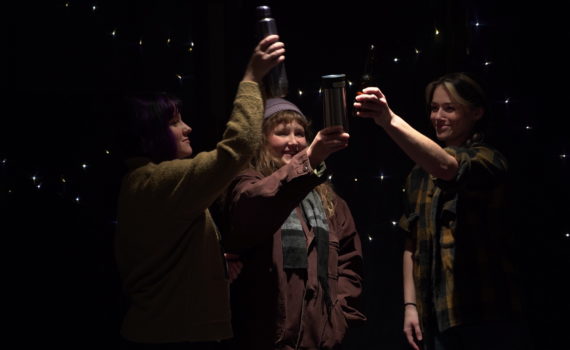
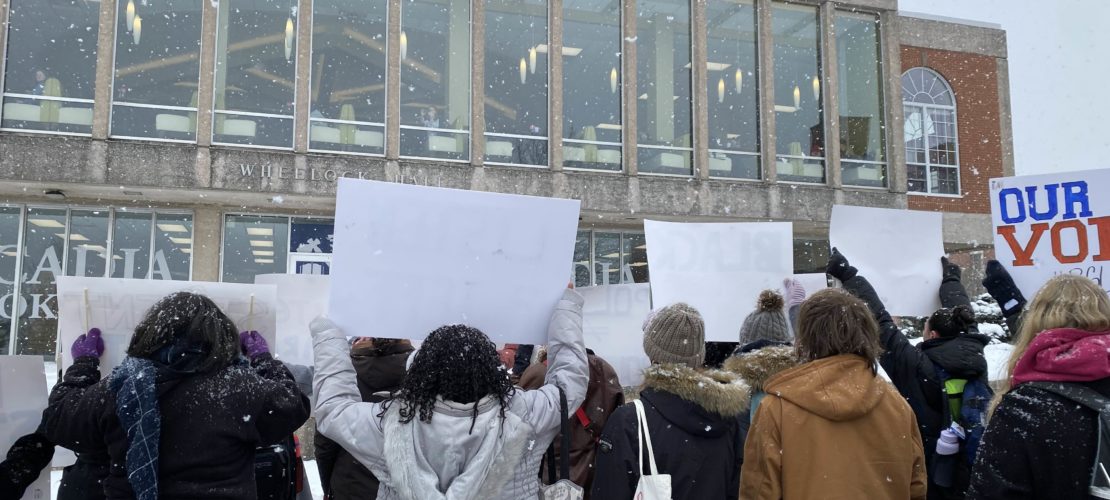
    The production design adds to the experience. “Ritual,” the first segment of the production, starts in the Lobby of the Denton building and then moves down to the stage in the basement. The audience seating was in two rows on either side of an open space, as well as two small sets on the sides of the seats, one for the “Bunker” segments, and the other mainly used for “Hospital.” This set up ensures that you are always seeing your fellow audience members, and sometimes not seeing every aspect of a scene. For example, a conversation in “Choice” is framed so that one half of this audience sees the face of one participant but not the other. The scenes in the basement additionally make intentional use of light. This includes focused spotlights in “Choice,” handheld light sources in “Ritual,” and “Bunkers” harsh double lighting.  


    All these aspects of the production build to the finale of “Funeral.” The audience is led back upstairs to the lobby where the actors give eulogies to themselves before asking if the audience would like to share any words of their own. My audience didn’t take them up on this offer, but other shows have had members of the audience share either their own self eulogies or words for passed loved ones.  

    Getting to see When Does It Get Better was an experience I’m glad I was able to have, and one that I’m not sure if I’ll ever have again. The play is heavily built around people in this specific place and time. The production makes extensive use of the specific environment around it, such as the moving of the audience through Denton Hall, and the copyright for the material is spread amongst the creatives. The writer of each section owns the rights to that script, so a new performance would require bringing the entire team back together in some capacity. When I asked the team if they had any interest in returning to the material, Avery, the writer of “Ritual” responded with, “Yes, but you’d have to hold a gun to my head.” Others were more optimistic but overall, the team behind When Does It Get Better? are looking towards future projects.  

    Credit and thanks to Neil Silcox for all photos in this article

  • 58 Years Drained: Effects of Acadia Pool Closure

    58 Years Drained: Effects of Acadia Pool Closure

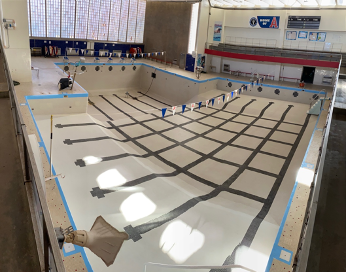
    Earlier this year, Acadia University announced the difficult decision to close its nearly 6-decade old pool and all programs associated effective June 15, 2025. The primary reason for the shutdown is consecutive annual budget gaps, with the latest roughly $400,000. A large part of the figure consists of the annual budget for Acadia’s swimming team, including expenses like travel costs, athlete scholarships and coaching fees. These annual expenses are dwarfed in comparison to the cost of fixing the old pool, with estimates being in the $5-to-7-million range. This decision was faced with immense backlash from both the student and local community. An online petition calling for the reopening of the pool that began shortly before its closure now has over 8,300 signatures. However, despite outrage in the local community and public calls, petitions and rallies, the university held its ground and continued with the planned shutdown on June 15.

    Closing the pool has also meant disbanding the university’s swim team. Acadia’s roster included nearly 50 students who used the pool to fulfill their passion and represent their university in sports. This decision has disrupted the academic journey of many of these athletes, with some taking hasty transfers to swim teams of other universities to avoid having to give up their passion. Such transfers can mean emotional and social stress for athletes, especially those who ended up quitting their studies at Acadia midway and leaving their friends and family in the valley to pursue their passion elsewhere.

    Local organizations like the Wolfville Tritons Swim Club have felt the impact of the pool closure. The Acadia Pool served as a closer and cheaper alternative to surrounding facilities in the area. S.M.I.L.E, the Sensory Motor Instructional Leadership Experience, is just one program facing the effects of the pool closure. S.M.I.L.E. is a community run nonprofit program in Annapolis Valley that provides affordable sensory motor activities and swimming lessons for children with disabilities.

    The university in its announcement implied that the shutdown would not affect the program much due to its successful history of operating without the pool during previous extended closures. However, previous closures were temporary and had much more prior notice than the current permanent and hastily announced shutdown. This will affect the program as there is a limit to how much the program can adjust for a short term planned closure compared to a permanent one.

    The shutdown also had a toll on the large community of seniors who saw the pool as a way of life, and key to maintaining their health.  These effects were voiced on major national news outlets like the CBC news by Shirley Marston, a 91-year-old, who had been regularly swimming at the pool for nearly four decades, and now will have to seek a farther away option to maintain her routine and health. This will pose a challenge as the nearest indoor pool facilities are in Windsor, Waterville and Greenwood.

    The Save Acadia Pool petition has gained more than 8,300 signatures, demonstrating that there is support for a pool in the Annapolis Valley. A no cost option was offered by Swim Nova Scotia, the governing body for all the swim clubs in the province, to keep the pool open while a new facility is planned.

    However, this offer was declined by Acadia.

    While the closure of Acadia’s pool has had its toll on many communities. This decision reflects the gravity of the financial challenges faced by not only Acadia but all post-secondary institutions in the province in managing their aging facilities.

    Whether the future brings efforts to revive and preserve our invaluable facilities like the Acadia Pool across the province or investment in new public infrastructure, it brings into focus the importance of discussing the financial stability of our post-secondary institutions so that both community needs and institutional stability are taken into account while developing and enforcing policy.

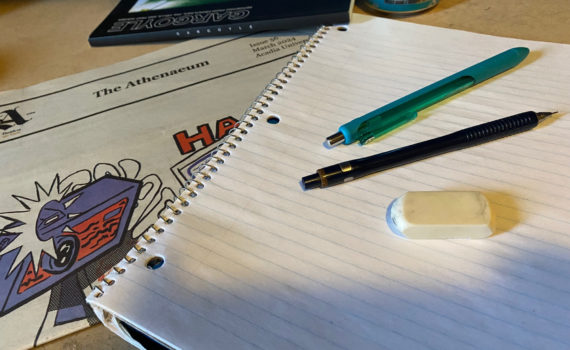
  • What is the Athenaeum? And why you should care

    What is the Athenaeum? And why you should care

    “Athenaeum” is a latin word, derived from the name of the Greek goddess Athena. In its modern
    usage “Athenaeum” refers to a building where books and newspapers are stored, or
    alternatively, a “literary or scientific association” according to Merriam-Webster. The word is said
    to have first been coined in its modern usage in 1799. Sixty-one years later, in 1860, Acadia’s
    Athenaeum Literary Society was formed, and in 1874 they would start the Athenaeum Journal.
    Today known simply as the Athenaeum, it has been Acadia’s student newspaper for over
    one-hundred-and-fifty years, more or less.

    If you were to look through old issues of the Ath (short for Athenaeum), which I had the
    privilege of doing while working with the archives team to create digital copies of them, you
    would come away with the conclusion that the Ath has an eclectic history. The early issues are
    formatted more like the digest magazines you walk past, and likely ignore, with small pages
    bunched together into little booklets of poetry, essays, and short fiction. This was the format of
    the Ath from its inception in 1874 through The First World War and heading into The Second
    World War. I began with issues from the 1930’s while I was working through the archives, and
    had the weird experience of reading an essay discussing Germany starting a war in Europe as
    something that could happen.

    Post war the Ath transitioned to a weekly paper, and shifted towards focusing on current news in
    Canada and on Campus. Additionally, there was a growing selection of comic strips, including
    running titles that were part of the underground comic movement. This has evolved into the
    current status of the Ath where, especially after the 2020 pandemic, we post most of our
    material directly to our website. We also compile themed print editions once a year, or semester,
    depending on how the wind blows.

    The purpose of this history is to answer a question you may be asking if you’re curious about
    writing for the Athenaeum; what are we looking for? The answer is we’re looking for pretty much
    everything. We’ve run local news, national news, global news, essays, short fiction, poetry,
    photography, comics and more. If you want to create it, and think people want to read it; we’d
    love to hear from you.

    I believe that one of the most important aspects of the Ath within the Acadia community is
    serving as a place to make things for the sake of making them. Most of the people who write for
    us are involved in the arts, whether through their education or simply personal passion, and the
    Ath is an opportunity to write things without a grade attached. The Ath is a space to share your
    writing, and make something good for the sake of making something good. Sure, there are ways
    that if you angle it right the Ath could be a career boon, I’m definitely putting “Editor in Chief for
    The Athenaeum” on my resume, but I started working for the Ath because I wanted an outlet for
    my writing, drawing, and creativity. If you’re also looking for that, come swing by

  • Benefits of Martial Arts for Students

    Benefits of Martial Arts for Students

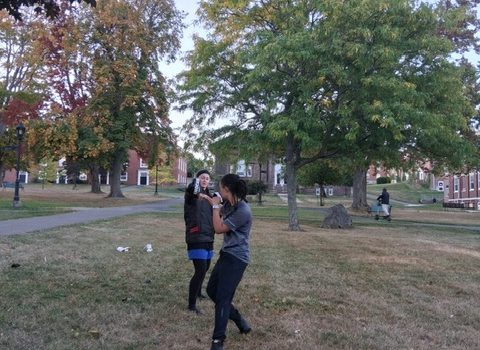
    A new series of martial arts-based exercise sessions hosted on campus
    present students with not only a chance to learn some of the physical skills key to
    martial arts, but dive into the philosophy and ethics which are essential to
    Taekwondo. Taekwondo is a Korean martial art that has its roots in earlier practices
    including Taekkyon and Karate. The sessions are being led by Allison Whritenour
    in collaboration with the Manning Memorial Chapel and Acadia Student Services.
    Allison graduated from Acadia in 2010 with a bachelor’s degree in kinesiology.
    She is an athletics and sailing coach, as well as a personal trainer, and has a first
    degree black belt in Taekwondo. The sessions take place in the chapel basement
    from 7:00 to 8:00 AM on Wednesdays, and will run from September the 17th to
    November the 26th.

    The series aims to be beginner friendly and provide a supportive learning
    space. Students focus on techniques for blocking, kicking and striking while
    building strength, balance and flexibility. Building these physical skills can have a
    longer lasting positive impact. In our conversation, Allison noted that “physically,
    martial arts build strength, balance, and posture that support healthy movement
    patterns for life. I’ve found that my skills have served me well in unexpected
    moments.”

    Beyond just physical practice, the series incorporates self-awareness,
    mindfulness and the ethics of martial arts through reflections and journaling
    prompts. Allison reflected on the importance of this part of Taekwondo practice
    during my conversation with her, writing, “I’ve loved bringing creativity into
    traditional Taekwondo practice by incorporating elements of personal development
    from my own lived experience. It’s helping me connect to the practice in new ways
    while also learning a lot in the process. One of the most meaningful parts has been
    creating reflection and journaling resources that show how training can benefit
    aspects of everyday life—things like self-awareness, body language, mindfulness,
    strategies for threat mitigation, translating our internal sensory language and
    learning to navigate discomfort and self-doubt. Learning how to harness the
    empowering energy that we experience while practicing martial arts to benefit us
    on personal and professional levels has been a powerful breakthrough and it means
    so much to me to get the opportunity to offer what I’ve learned to the community.”
    A primary goal of this martial arts practice is to develop a sense of
    self-confidence and resiliency in participants. A strong sense of self-worth is
    important to maintaining positive relationships with other people and overcoming
    challenges in a variety of environments, including educational, work and social
    settings. Allison writes, “Beyond that, martial arts practice fosters positive body
    image and self-worth – the personal, relational and professional impacts of such are
    enormous and not always obvious. Partner exercises in particular help people
    understand their personal power and boundaries. These skills are essential in the
    workplace: whether it’s standing up to injustice, navigating subtle abuses of power,
    or preparing to enter professional environments where resilience is
    essential—especially for women and marginalized groups. For me, these skills
    were most helpful while working in the marine world, which was both exciting and
    extremely challenging. I was able to lean on my training for the confidence to use
    my voice, take responsibility for safety in dangerous environments, and trust
    myself to handle high-stakes situations.”

    Another primary aspect of the sessions is building self-awareness and
    mindfulness. These practices can be beneficial for improved emotional regulation,
    focus, and memory. Allison writes, “Practices like mindfulness and meditation
    bring stillness, clarity, and mental focus, while also enhancing self- and situational
    awareness. Regular training also helps us to stay calm under pressure and to
    regulate our emotional reactions.”

    For students seeking a supportive space to try a new form of exercise,
    hoping to challenge themselves with a practice that supports reflection and
    personal-growth, or simply looking to try something new, martial arts has
    something to offer. As a final note on her ambitions for the sessions Allison writes,
    “What I most hope students take away is that martial arts practice isn’t just about
    physical training – it’s about cultivating courage and confidence, and building our
    capacities for responsibility and leadership. This foundation impacts every area of
    life from personal and professional relationships, to trusting ourselves to pursue
    our dreams and visions for a full, rich life.

  • 2025 AcadiaU Indigenous Film Mawio’mi: A Student-Led Film Festival at AcadiaU Addressing the 3Rs, Resistance, Resilience and Resurgence.

    2025 AcadiaU Indigenous Film Mawio’mi: A Student-Led Film Festival at AcadiaU Addressing the 3Rs, Resistance, Resilience and Resurgence.

    The weather may be getting cooler in Wolfville, but the AcadiaU campus is about to warm up, becoming a place where Indigenous stories and teachings are shared, and students learn more about what it means to work together, as young leaders stepping up to fill a gap on our campus, hoping to contribute to the advancement of truth, reconciliation, and democracy in our own backyard.

    Do you remember where you were and what you did last year on September 30th? Let’s be honest: September 30th often seems to students like a long weekend bonus – no class, a chance to sleep in, and catch some rays. But what if, this year, you do something that matters? Something ‘event’ful? Perhaps this year, that date will be particularly memorable if you take up this opportunity!

    From Sunday, September 28th to Saturday, October 4th, AcadiaU students are inviting you, students, faculty, community and local members to show up for something different that will illuminate Indigenous histories and contemporary realities: the first-ever Indigenous Film Mawio’mi at our University, THE 2025 ACADIA UNIVERSITY INDIGENOUS FILM MAWIO’MI.

    Including the National Day for Truth and Reconciliation on September 30th, Treaty Day in Nova Scotia on October 1st, and concluding with the annual National Sisters in Spirit Day of Vigils for Missing and Murdered Indigenous Women and Girls and Two Spirits on the afternoon of Saturday, October 4th, the Mawio’mi will be a student-powered film festival centred on stories of resistance, resilience, and resurgence. It’s free. It’s on campus. And the best part is that it’s an

    opportunity to learn from and listen to Indigenous people through incredible movies and stories that challenge, inspire, and, if we let them, transform us.

    Hosted in partnership with the AcadiaU Welkaqnik Indigenous Gathering Space, the Town of Wolfville, and the Department of Community Development, Nutrition and Dietetics, Politics, Sociology, Women & Gender Studies, and the Vaughn Memorial Library, the 2025 Indigenous Film Mawio’mi provides an opportunity to watch, reflect and choose to fill the gap.

    Importantly, this is a student-led initiative! Students from across the campus community wanted to do something together for our campus and the local community. Given that sharing our stories with each other is at the heART of being human, they’ve co-organized this event, which runs for an entire week. They’re hoping that sharing screen time together will move our campus and local community into an individual and collective discovery about the First Peoples of this land… and move us towards the recovery of ‘right relations’ with Indigenous peoples in Canada and elsewhere. Yes, there will be films, but also conversations. Yes, there will be free refreshments, but also a chance to reflect and reconnect with each other, with the land, and with history.

    Amplifying Indigenous voices reveals a legacy of intergenerational trauma and equally important, stories of resistance, resilience and resurgence… the 3Rs you might not have heard much about, yet! Students co-organizing and co-hosting this special week-long event are showcasing Indigenous films, including powerful documentaries that take us behind the scenes and behind the headlines of mainstream media. These films focus on contemporary crises, both past and current, near and local, and taking us into the hearts of Indigenous homes and communities across Canada, sharing profoundly moving personal stories.

    Some of our sister universities in the region have showcased Indigenous film festivals on their campuses. So why should Acadia join them now? In a feature story in The Medium, the

    University of Toronto Professor Ken Dorry explains that “when examining Indigenous literature or film as a non-Indigenous person, he wants to try and see it as much as possible through the lens of Indigenous ways of thinking and understanding stories.” With this in mind, he borrowed inspiration from Dr. Jo-Ann Episkenew, a Métis writer and scholar who passed away in 2016, and her book ‘Taking Back Our Spirits’. In her book, she shares that most of her university courses are “predominantly centred around European settler traditions and culture”. Dr. Derry noted, “That mirrors my experience too!”

    How about you? How many of your courses have centered Indigenous perspectives? Whose stories have shaped your education? Whose voices have you yet to hear?

    Every person in Canada has a role to play in reconciliation, including you. The film festival is an opportunity to come watch a film and reflect on our role in reconciliation. It’s a chance to pause, reflect, and ask yourself: What does my role in reconciliation look like? Attending Indigenous Film Mawio’mi 2025 is one answer. It might be your first step, ever. Campus life is about being part of a community that’s willing to learn, unlearn, and grow together. This free, week-long film festival is your invitation to do that.

    Wherever we call home, as members of Acadia’s campus, on September 30th, the annual National Day for Truth and Reconciliation across Canada, we have an obligation to think about what reconciliation looks like in practice. It is an opportunity to engage with Indigenous perspectives as lived realities. These films challenge us to confront uncomfortable truths, to consider our role in systems of inequity, and to imagine how we can contribute to the realization of more just futures. Brynn Niblett, a WGST student at the U of Alberta, shares some insights on what you can learn by doing so:

    By reclaiming their narratives and their humanity, Indigenous filmmakers engage in a powerful act of decolonization. They imagine and embody a world in which change isn’t just possible, it is necessary. Through a variety of genres and filmmaking styles,

    these films provide powerful glimpses into the strength and resilience of Indigenous communities who continue on in spite of the violence of colonialism.

    This is your opportunity to engage with Indigenous voices on their own terms. To be moved. To be challenged. And perhaps, to begin imagining what meaningful change could look like on this campus.

    Since 2009, the Mawio’mi, a Mi’kmaw word meaning “gathering”, has become a vibrant community celebration, an opportunity for reflection, and an opportunity for expression in the face of ongoing human rights violations in Canada. For over two decades, our campus community has invited Indigenous peoples from across Canada to share their experiences and priorities on diverse issues via keynote talks, sharing circles, memorials and vigils, art exhibits, and storytelling.

    Last year, the Kesalul! ReconciliACTION Mawio’mi in Fall 2024 reminded us that reconciliation is about listening and learning from Indigenous peoples, finding courage to face unsettling historic truths and unacceptable contemporary socio-economic and political realities, and taking up the opportunity to foster new relationships with Indigenous peoples.

    This year, the 2025 Indigenous Film Mawio’mi continues our university’s tradition of making space to come together via campus-community partnership. Students are co-hosts and co-organizers of the festival; their collaborative action to fill a gap in our community fits these unprecedented times, given that, across time and space, youth have long been agents of change, seeking opportunities to unsettle the status quo to advance human rights, equity and social justice and more recently, eco-justice.

    Mark your calendars, gather your friends, family, roommates, and fellow athletes and take part in this historic, timely Indigenous Film Mawio’mi. Whether you attend one screening or the whole week, you will walk away with stories that stay with you, questions that push you, and the possibility of transformation.

    The program follows below and is also available, thanks to the Town of Wolfville, on Valley Events Website (https://valleyevents.ca)

  • The Weight of Silence: The Urgent Need for Action to Confront Systemic Racism

    The Weight of Silence: The Urgent Need for Action to Confront Systemic Racism

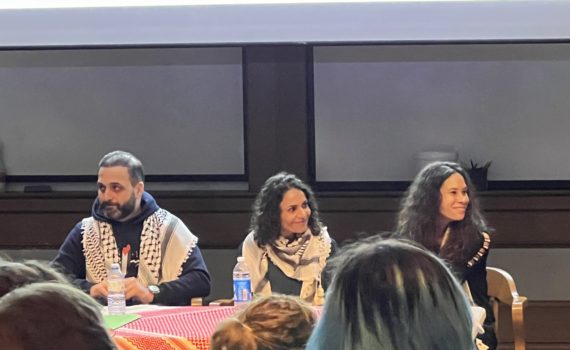
    “I never learned – and I hope to never learn – to stay silent about injustice” emphasizes the author, poet, educator, and advocate Dr. El Jones in her speech as she received an honorary degree from Acadia University at last year’s spring convocation ceremony. I was fortunate to hear from her again on March 21st during the “Confronting Systemic Racism and Medical Colonialism in Health Care” policy dialogue, co-hosted by the Institute for Public Administration of Canada – Nova Scotia and Acadia University Department of Politics. Alongside Dr. El Jones, the panel featured powerful voices that highlighted the daily injustices perpetuated by racial discrimination, particularly within health systems. 

    Attending this  eye-opening experience, allowed me to reflect deeply on the issues of colonialism, race, and the systemic challenges faced by marginalized communities. While I could provide an overview of the entire event in this reflection, I want to focus on the perspectives that resonated with me the most: those shared by Dr. Samir Shaheen-Hussain and Dr. El Jones. These two individuals didn’t just speak knowledgeably about their fields—they conveyed an emotional depth and passion that made their words stick with me long after the event concluded. 

    Dr. Shaheen-Hussain is an associate professor in the Department of Pediatrics and an associate member of the School of Population and Global Health, both in the Faculty of Medicine and Health Sciences at McGill University. He works as a pediatric emergency physician in Tio’tia:ke (Montreal) and has been involved in anti-authoritarian social justice movements – including Indigenous solidarity, anti-police brutality and migrant-justice organizing – for over two decades. His insights into medical colonialism were particularly striking. He focused on the ongoing, devastating impact of colonial structures on Indigenous peoples, particularly within the healthcare system. One of the most impactful points he made was that false narratives and stereotypes are still, to this day, being used to justify the mistreatment of Indigenous people. When these biases are confronted, they’re often weaponized to claim that Indigenous people “deserve” this mistreatment because of their supposed inferiority. This sense of entitlement to dehumanize, justified by long-standing prejudices, is something that continues to permeate the medical field. 

    Dr. Shaheen-Hussain also shared a quote from an Indigenous woman before her death that resonated deeply with me: “No ID in Montreal, you may as well be an immigrant in Alabama.” At first, this statement elicited a chuckle from me, but it’s deeply unsettling once you think about it. The truth behind her words is both painfully accurate and enraging. From the moment you step into a hospital, and you’re not white-passing, you’re often treated like an outsider, an alien. The healthcare system, like so many other institutions, is permeated by biases that continue to structure and distort the experiences of Indigenous peoples. 

    Dr. El Jones, whose work focuses on the intersection of incarceration, education, and social justice, also made a profound impression on me. As someone who works in youth detention centres, hearing her speak about the conditions in male adult detention centres was sickening. The bleak reality of what happens to incarcerated individuals, particularly those who are marginalized, is something I’ve felt in my own work, but Dr. Jones’s words made that feeling of heartache even more acute. One of her key points was that literacy and education are, in fact, health issues. I couldn’t agree more. The lack of access to education and the barriers it creates are a significant determinant of an individual’s overall health, both physical and mental.  

    Dr. Cynthia Alexander, whom I’ve also had the privilege of learning from, echoed a similar sentiment: “All policy is health policy.” These concepts connected me in ways I hadn’t fully appreciated before. Without education, people are ill-equipped to take care of themselves, and this directly affects their well-being.  

    As I listened to Dr. Shaheen-Hussain and Dr. Jones speak, I couldn’t help but think about a statement said by Dr. Can Mutlu from the Politics Department just a few days prior, during a roundtable talk. Dr. Mutlu made an important point about how people often like to think of themselves as bystanders in situations where racism or discrimination is unfolding. However, he reminded us that we are all actors in these situations, whether we choose to engage or not. This message echoed in my mind as I absorbed the information presented by these powerful speakers.  

    It also made me realize just how interconnected everything is. The power dynamics we witness in healthcare, prisons, and education are not isolated—they are part of the same complex system that perpetuates inequality and injustice. 

    This reflection was further compounded by an unsettling observation I made during the event. In the span of just three days, I attended three events—each providing new insights and perspectives on issues that directly impact marginalized communities. These three events, totalling no more than three hours of my time, left me feeling more informed and more aware than ever before. Yet, what struck me even more profoundly was the absence of my peers at these events. I was left wondering, how can we expect people outside of political fields to care about these issues if even those of us studying politics, who are supposed to be the ones advocating for change, don’t seem to think it’s worth attending? 

    This realization stirred a deep sense of frustration and anger in me. It’s not just that we’re missing out on important conversations—it’s that the very professionals who will eventually make decisions about our healthcare, our prisons, and our educational systems are often so disconnected from the realities faced by marginalized people. How can we trust healthcare professionals to provide equitable care when they haven’t even been taught about the history of medical colonialism? How can we trust a system that fails to acknowledge the deep-rooted biases it’s built upon? In particular, I thought about my own experiences as a Black woman and how these systems—be they medical, educational, or judicial—are stacked against people like me. The reality is that I am at risk of becoming just another statistic in the tragic list of Black women who die in childbirth because of systemic racism within the healthcare system. That reality feels all too close. 

    This is why the lack of engagement from my peers is so deeply troubling. These issues aren’t just theoretical—they are real, lived experiences that directly impact people’s lives. If those of us who are studying politics and policy aren’t even bothering to show up and engage in these conversations, what hope do we have for the rest of society? Attending this policy dialogue was another wake-up call for me.  

    The experiences shared by Dr. Shaheen-Hussain and Dr. Jones highlighted just how deep and pervasive the issues of racism and colonialism run within our institutions. Their passion and their drive to effect change were palpable, but the frustration I felt as I realized how little engagement there was from my peers was almost overwhelming. It’s clear that the work of addressing these injustices isn’t just about gathering knowledge—it’s about translating that knowledge into action. And if we, as future leaders, and policymakers, don’t start showing up, both in the classroom and in real-world conversations, we’ll continue to perpetuate the systems of oppression we claim to want to dismantle. 

  • The Drone in Craftwood Plaza

    The Drone in Craftwood Plaza

    The rent for Craftwood Plaza was seventy dollars a month and for that alone, Hester was tempted to move in on the spot. However, she had to see the building first. Her mother came with her and commented on how Hester was wearing horizontal orange stripes with vertical black striped tights that day, as if Hester hadn’t worn clashing stripes every day her entire life.

    “If I’m comfortable, it shouldn’t matter,” Hester said when they entered the red-carpeted apartment lobby. “And look, see that woman there? You see her?”
    “Yes, on the sofa? It’s rude to point –”
    “Look. She’s wearing 3D glasses. And for what? Because she can. We’re all adults here.”

    Hester waved cheerfully to the doorman at the high desk. He wore a red vest and bowtie. He was also her age with light-brown skin, a wide nose, curly black hair, and large, almost bulbous brown eyes – quite similar to Hester’s own. He had an awkward smile.

    “Hi,” he said.
    “Hi!” Hester said. She hopped over to him. Her wild, dirty blonde bounced atop her shoulders. “Hi, I’m Hester Lorne? I’m here to about apartment 22? Is Mr Berry here?”
    “Mr Berry’s my boss. He’s away but he passed on the message. I’m Truro.”
    “Trur…oh… Like Truro the place?”

    He nodded slowly, lips thinned. “Yup. I usually get ahead of that question… Been a weird day. I’ll, uh, show you up.”

    On the inside, Craftwood Plaza was old. It had clean, varnished dark wooden floors, bannisters, railings, doorframes, and ceilings – black wall-phones with circular dials which still worked, stairs that creaked, and it had its own Wi-Fi, which fell more in-line with its modern, brick and glass exterior. Shaded lamps lined the paneled walls partnered by a variety of small, thrift store-style paintings of meadows and golden retrievers. The elevators had grated gates and dials to indicate each floor.

    Apartment 22 was on the second floor. It had one bedroom, one bathroom, and a large living room with a bay window. Truro the doorman showed Hester every inch of the space. Her major concerns were well-looked after: the plumbing worked fine, the water was drinkable and hot on command, and the heater was easily adjustable.

    “You don’t shut the heat off at night, do you?” Hester’s mother asked.
    “No, no, nothing like that,” said Truro.
    “Oh! It’s just so cheap, I thought…”
    “Well, it’s cheap because we have some pest problems,” Truro said carefully.
    “Oh, Hester, I don’t like that.”
    “Mom, my last dorm had a mouse who camped out in the shower. Is it, like, serious?”
    “We’ve been able to handle…almost all of it so far,” said Truro.

    When Hester’s mother left for the bathroom, Hester asked, “Anything else I should know? Legally or other?”

    “Pets aren’t recommended.”
    “Is that a polite way of saying ‘not allowed’?”
    “No, they’re allowed. Just not recommended. They don’t get along with the pests. And the man who lives two doors down from here is allergic to basically anything with fur. Do you have any pets?”
    Hester shook her head. “No,” she said.

    When Hester’s mother returned from the bathroom, that bathroom was officially Hester’s… as long as she paid the seventy per month.
    Hester fell in love with Craftwood Plaza immediately. It was quiet, close to her new university, and nicely tucked away from the street by neatly planted trees. But she didn’t know anyone. So when she was feeling down, she sat in the lobby to do her homework and bother Truro.

    “Do you mind?” she asked him, kicking her feet up on a red, pleather sofa. “Am I distracting you or what?”
    “Nah, nobody new really comes in here.”
    “Do you know everyone in the building?”

    “Oh yeah,” said Truro. “Kinda have to.”
    “Good. If I see anyone I don’t know, I’m gonna expect you to tell me everything about them.”
    “How many people in the building have you met so far?”
    Hester grinned out at him from behind her laptop. “None,” she said.
    Truro’s lips thinned again. “Awesome.”

    But this ended up being a good deal for both of them. Hester and Truro became fairly close over the span of a few days simply by discussing the people Hester stumbled upon in the building.
    While heading out for a morning class, Hester crossed paths with the woman in the 3D glasses again. The woman was in her late thirties with striking red hair and was crawling along the wall with her cheek pressed against it.

    “Morning!” Hester offered. “What’re you…doing over there?”
    The woman stopped and stared at her. “I am looking for the pests,” she said.
    Hester slapped her own forehead. “Oh yeah. Duh,” she said. Then, when she turned away, her brow furrowed and she mouthed, What?
    “That’s Holly Hollander,” said Truro over lunch.

    Hester was making herself a blueberry bagel in the plaza’s shared kitchen next to the lobby. “She’s a little weird but everyone here is. Her husband’s pretty nice. And she kinda has a right to be worried about the walls. I’m pretty sure something in the vents got to Chester. He lives two doors down from you. He’s already pretty paranoid and one day, he just walked out of his apartment a different man.”
    “Something in the vents? What was it?”
    “I dunno. It was, like, four years ago. But I remember it banging around in there.”
    “Damn,” Hester breathed. She glanced up at the ceiling nervously. Then, her bagel popped up with a ding and she forgot everything Truro had said to her.

    Hester met Chester Tolly in the middle of the week, two days after seeing Mrs Hollander. She was trying to unlock her door with an armful of groceries. Truro stood behind her with more groceries as a way to conquer his boredom.

    “You should invest in, like, one of those rolling shopping bags,” he suggested.
    “For old ladies? Are you serious right now?” Hester asked through her teeth, trying to turn the key and doorknob with one hand.
    “Hey, don’t knock it ‘til you try it.”
    “Couldn’t…fit it all in there…anyway –”

    She was caught off guard by the rattling and clicking of someone else trying their own door handle. She and Truro looked two doors down from them to see a man in his late fifties or early sixties with large, rimless glasses, hair the colour of dying straw, and a nose that resembled a parrot’s beak if the parrot had been punched in the face and its beak had swollen.

    “Hey, Chester,” said Truro.
    The man looked up with startled green eyes. Truro gave his awkward smile and wave.
    “Hey. Have you met Hester yet? Hester, Chester. Hester?”
    Hester was trying her lock again. Truro nudged her and she abruptly grinned up at the man.
    “Hallooo!” she said.
    The man blinked. His head jerked in a sort of half-nod. Then, he leaned back, turned away, and sneezed loudly three times into the arm of his windbreaker before he slipped away into his room. Truro exhaled.
    “He’s from England. Nice guy…. I think.”
    “You think?”
    “Well, he’s pretty quiet. Makes Lester look like a mosh pit regular. And he has the worst hay fever I’ve ever seen in a man.”
    “It’s September.”
    “I know.”
    Hester sucked air in through her teeth. “Yikes. And who’s Lester?”
    “Oh, Lester Luthor. He lives at the end there, behind us. Next to the window.”
    “Oh. I haven’t talked to him yet.”
    “Yeah, you’d know if you did. He’s… he’s a little like you, I guess. Writes a lot, got a lotta books.”

    “Oh yeah? That’s cool. Has he done any library work?” That was what Hester had been working on at school.
    “To be honest, I dunno. I’ve never really had the desire to ask him. Come on, lemme try that.” And he took over the door handle.

    Lester Luthor and Hester crossed paths the day after she saw Mr Tolly. It turned out Truro had a very good reason for having no desire to ask Lester Luthor anything. She was returning from an afternoon class, standing by her door, when he passed by. He was short with naturally pinched lips, large dark eyes like Hester and Truro’s, a thin nose that turned up and round at the end, and a forehead that looked high because of the line of his dark hair. He was carrying a large grey rubber bin and stopped at the door Truro had indicated to her the day before.

    “Hey!” she called out. “Hi! Need any help?”
    “No, no. I’m perfectly fine,” said the man. He had a soft voice which bordered on an English accent.
    “You’re Mr Luthor, right?”
    “That’s right,” said the man, picking up his bin after unlocking his door. He smiled and suddenly, his small mouth was huge with large teeth and lips. Hester smiled back.
    “Hi. I’m Hester, by the way. I just moved in a week ago.”
    “Ahhh. So you’re the new meat.”
    Hester froze. “Excuse me?”
    “I only call it like I see it,” said Lester Luthor and he raised his eyebrows.
    Hester looked down at her jean shorts and fishnet tights. She wrinkled her nose at him. “Uhhh, fuck you?”
    “No, no, no. You’re saying it wrong,” said Lester Luthor, his back against his door. “You have to say it with gusto, like this. Ahem. Fuck you.”
    And he backed away into his apartment, cackling.
    “He’s writing a book about the building,” Truro explained to Hester in the lobby that evening. He was playing with an early 2000s PSP. “He’s American.”
    “He’s American?”
    “Yes. And he does, in fact, think he’s smarter than everyone else.”
    “Okay, so he’s an idiot.”
    “Well… he’s fairly smart. He reads a lot.”
    “Hey, you’re supposed to be on my side!”
    “I am! No one really likes him. Laney thinks he’s okay but she’s nine. She and her mom – the Childs – they live directly across the hall from you. They’re pretty cool. You should say ‘hi’ sometime.”

    Miss Childs got to Hester first. She and her daughter Laney knocked on her door with a pack of store-bought cupcakes. Miss Childs was a forty-year-old woman with black hair that clung to her long face, dark blue doleful and bulbous eyes (Hester wondered if Craftwood Plaza had an unwritten rule for the eye-size in its tenants), and large front teeth. Her daughter Laney had the same teeth and dark but reddish hair.

    “Hello, are you Hester Lorne?” asked Miss Childs in an airy voice. “I’m sorry I didn’t say hello earlier. We wanted to do something special for you. Not many tenants stay long enough for us to welcome them…”
    “Damn, not even a week?” Hester asked, taking the cupcakes. They were vanilla with rainbow sprinkles.
    “No, no. I don’t think they really…got along with us,” Ainsley laughed uncomfortably. “I think they thought we were all crazy.”
    “Well, they’re missing out,” said Hester with a smile. “And judgy people are boring anyway. Hear that, Laney? Judgy people are boring. Don’t give ‘em the time of day.”

    Laney smiled shyly from behind her mother’s legs. Behind them, Mrs Hollander slunk across the wall.
    Miss Childs worked at a gas station as a cashier so Laney was often looked after in the afternoon by Miss Childs’ sister across town. However, there were times where Hester – at the end of the day – could walk home with Miss Childs and Laney when she was able to pick Laney up. For the next week, the Childs became an extended family. Hester bought them thank-you cupcakes, went grocery shopping with then, and offered book recommendations for Laney whenever she devoured the ten books she got from the city library.

    Miss Childs was also a better cook than Hester. So, on the off chance she was home and could look after Laney, she offered to cook for all three of them. They would pool their ingredients together, cook and chat about Laney’s school day in the plaza’s shared kitchen, and eat in Hester’s living room – as it was nicer and Laney liked the film posters on the walls – while listening to Hester’s Tragically Hip CDs. Hester didn’t neglect Truro but it was nice to have another friend, even if Ainsley was older.

    “Question. I saw this sign,” Hester said to Ainsley, one day on her futon couch with her knees against her sternum. “…for the laundry? In the basement? Do I have to pay for it?”
    Ainsley watched Laney hit two of Hester’s Star Wars action figures together on the floor. Her brow furrowed as she sipped some tea.
    “No, no, honey. Don’t use those. Go to the laundromat down the street. No one goes into the basement. Theresa does. Theresa Muhoza. She’s from Rwanda. She’s so kind but my goodness, I don’t know how she does it.”
    “What’s wrong with the basement?”
    “All the…pests come up from down there. We have part of it blocked off.”
    “Mr Tolly is scared of the basement,” said Laney, looking up. “I know because he gets really sweaty when you ask him about it. He was by the basement stairs one day and I asked him about it and he got all sweaty. But I’m not scared of it.”
    Ainsley laughed. “No, no, Laney’s not scared of a lotta things. Except new people.” She leaned over to Hester and whispered, “And Aiken Drum.”
    “The…the song?” Hester asked. “Damn, that’s a name I’ve not heard in a while. Seriously? I thought kids loved that song! We used to make him out of underwear as kids, it was like peak comedy for us.”
    “No….no, for whatever reason, it makes her really uncomfortable. She was crying about it to her aunt the other day,” Ainsley said. “Food shouldn’t move. That’s what she said.”
    “Reasonable. But has she tried making him out of underwear?”

    Ainsley laughed. “Oh, I don’t…Oh! Oh, Hester, I meant to ask you! This Friday, I have a late shift. It just came up and my boss…Oh, he just plopped me in there and my sister is out and – Oh, I know this is short notice and we don’t know you too well but I was wondering, from 2 to 10, would you be willing to look after Laney? When I have the money to pay you, I will, I swear, I just –”

    “Yes! Holy crap, yes! Of course! I just have homework. You want me to put her to bed?”
    “Would you? Her bedtime’s at 8.”
    “She can sleep here on the futon.”
    “Oh, you are a godsend. I’ll give you my key in the morning. I’ll be away all day. Laney?”

    Laney looked up from making Boba Fett jump on Greedo’s back.

    “You wanna spend Friday evening with Hester?”
    Laney’s eyes lit up. “Yes, yes yes!” she cried. “Please!”

    That Friday, at the end of Hester’s second week at Craftwood Plaza, Hester picked up Laney from her elementary school. Laney was so overjoyed to see her that she thrust herself directly around Hester’s middle. All the way back, Laney chatted about the crosswords she had to do in class and how she couldn’t draw a maple leaf to save her life.

    “Hey, that’s alright. I can’t either,” said Hester. “Do you have any homework?”
    “Uh, yeah. I have to do a sheet of multiplication equations. I’m not supposed to count on my fingers…”
    “Eh, do it anyway. I still count on my fingers. If you’re figuring it out yourself, who cares how you do it? Drawing it out works too. They’re gonna be obsessed with you showing your work anyway. What do you want for supper?”
    “Pizza?”
    “Done.”

    While sitting on the futon and listening to some of her new vinyls, Hester tapped away at quotations for her class paper and Laney drew circles and lines on her homework sheet to plot out the equations she couldn’t count off on her fingers. When she got frustrated, she would ask Hester questions about the film posters on her walls and Hester would have to find an explanation for Back to the Future that did not involve the incest. When Laney finished her homework, Hester let Laney play with her action figures again. However, around six, when they sat together and shared some pizza from the oven, it was clear that Laney had gotten bored.

    “Can’t you please play with me?” she whined.
    “I really can’t, I’m so sorry. I gotta sh- heck ton to do tonight.”
    Laney slumped into the futon. “I just want someone to play with,” she said.
    “I’m sorry, but there’s no…” Hester paused. Then, her eyes lit up and she smiled. “Come on. Get up. Come with me. You’re gonna love this.”
    She took Laney by the hand and led her into the bedroom. Even before she switched on the light, Laney saw the terrarium at the foot of the bed and gasped.
    “You have an iguana?!” she shouted and rushed directly to the glass. Mr Stevens, Hester’s large green and striped iguana, looked over at her lazily from a branch. “You’re so lucky! You get a pet! I wanted a dog but Mom says we can’t afford one and we’re not supposed to have them anyway because Mr Tolly is allergic to them…”
    “Well, this is not a dog. You wanna pet him?”
    “Can I, can I?”
    “Oh, sure. But this has to be between us. Okay? Laney, are you listening? This has to be a secret. Promise?”
    Laney nodded. “Promise.”
    Hester beamed and opened the terrarium. “Come here, buddy,” she said. She picked up the iguana and held him down so Laney could touch him on the back and scratch under his chin.
    “He’s so soft! I didn’t think he’d be soft! What’s his name?”
    “Mr Stevens,” said Hester. Laney gave her a look. “Ha! It’s complicated. It’s the name of a butler. He looks kinda like a butler, doesn’t he?”
    “You could’ve named him Alfred.”
    Hester laughed. “That’s true, actually! Come on, we’ll take him into the living room and you can hang out with him. He doesn’t move a lot so you have to be patient.”

    For the next two hours, Laney lay on the carpeted floor of the apartment and watched the iguana, utterly enraptured. She pet him, watched him scramble around on the floor, and helped feed him a bowl of strawberries. At one point, she opted to lie still so he could crawl onto her chest, blinking with his unamused expression. Hester was also so fond of Mr Stevens and so engrossed in her homework that she was nothing short of horrified when she saw, in the small corner of her laptop, that it was past eight.

    “Shiiioot,” Hester hissed. “Laney? Laney, it’s past your bedtime. You gotta take a bath and get to bed.”
    “Awww,” said Laney, staring at the ceiling while Mr Stevens still lay on her chest. “I’m not tired! Honest!”
    “Yeah, you’re not tired now. You will be tomorrow. I’m gonna run you a bath, alright? You can stay there for the time being. He looks pretty comfortable on you there.”

    Hester hopped into her small bathroom and pushed back her black and white zig-zagging shower curtain. She sat on the edge of the yellowish tub and turned the opaque knob to the left. A loud rushing sound filled the bathroom as water poured from the tap, striking the tub floor with spattering splashes. As Hester ran her fingers beneath the rushing water, she could’ve sworn she heard something that resembled a low droning. It tickled the top of her head, as if emanating from within the ceiling. Hester never ran the tap for this long so the easy assumption was that it was the pipes groaning. Sure enough, when there were about two inches of water, the droning stopped.

    Then Laney started screaming.

    Hester almost fell into the tub from shock.
    “Laney? LANEY?”

    “HESTER! HELP ME! HELP ME!”

    Hester scrambled up from the side of the tub and threw open the bathroom door. She stumbled backwards, clinging to the doorframe, and stared into her living room, completely frozen.
    The ceiling was lumpy and yellowish, like curds and cream cheese. It had stretched downwards in an upside-down funnel shape towards Laney, who was still lying on the ground and screaming with Mr Stevens on her chest. And then it ate her. Laney’s screams snapped out of existence as soon as the funnel enveloped her before it retreated back to the ceiling where it rumbled like a waterbed. It flattened back into its original white plaster in the blink of an eye.

    That was when Hester started screaming. She screamed in the doorway for a few seconds before tearing out of her room and down the hallway. She clawed at her face and hair, half-staggering, screaming for help, almost falling down the staircase that led into the lobby. It was empty, leading Hester to run into any open door she could find – including the bathroom – shrieking Truro’s name. When she stumbled into the shared kitchen, Chester Tolly, in a green shawl-collar cardigan, was sitting with his back to her at the end of the long wooden table. He had been eating mac and cheese and now stared at her with wide eyes.

    Hester slammed her fists against the table, spluttering and sobbing at him. He leaned far back away from her as she reached out to him –
    “Hello?!” An elderly Black woman with a round face, rose pink housecoat and hair bonnet rushed into the kitchen. She spoke with a smooth, songlike accent. “What is it? What’s happened?”

    Hester spun on her and gasped out, “IT – ATE – THE CEILING – IT – LANEY – CREAM CHEESE – CEILING – ATE HER!”
    “The ceiling…”
    “Hester?!” Truro now entered the room in a black t-shirt and plaid pajama pants. “What is – Mrs Muhoza – what’s going on?”
    “The Drone ate Laney Childs,” said the old woman. Truro shook his head.
    “No – no, that’s not possible! The Drone only eats pets! Hester, you said you didn’t have any pets!”
    “I LIED!” Hester bellowed. “FUCK! I LIED!”
    “Oh land,” muttered Mr Tolly.
    “What the ever-loving fuck is a Drone?! What do you know? Truro, what the fuck do you know?!” Hester launched towards him but Mrs Muhoza held her back.
    “Sit down here, sit. Truro, dear, get the rest of her section down here. Where’s Ainsley?”
    “She’s at work, she’s…” Truro looked back into the lobby and his eyes almost glazed over. “…right there.”

    The next ten minutes or so, for Hester, were a haze of angry, confused, and distraught screaming – now also from Ainsley Childs. She had gotten off work early and her relief was transformed into horror, as she accused Hester of leaving Laney with a secret pet to be prey for The Drone, whatever that was. Hester screamed back at her for not telling her there was any such thing as a “Drone” in the building at all and then, she did the same to Truro when he came back followed by the rest of her section. Soon, the kitchen was filled by Mrs Hollander and her red-haired husband, a blonde woman and her two ghostly-looking paternal twins, a middle-aged Indian couple in floral prints, and Lester Luthor in a sweater vest. Everyone argued and chattered except for Chester Tolly, who was staring at his mac and cheese, very pale.

    “You knew there weren’t pets allowed!” Ainsley blubbered. “And you brought one anyway!”
    “So it’s your fault then,” said Lester from a corner, looking at Hester.
    “Shut up, Lester! I wasn’t told that pets weren’t allowed! I was told they weren’t recommended!”
    “Why did you tell her that?!” Ainsley yelled, spinning on Truro.
    “Because we hadn’t discussed making ‘no pets’ a rule!” Truro said.

    “We had five tenants in the past year lose their pets to that thing! Why the hell isn’t it a rule?”
    “This has happened before?!” Hester yelled.
    “Five times!” Ainsley repeated. “Five times!”
    “Didn’t Truro mention the pests?” asked Mrs Hollander. Hester scoffed.
    “That? That was not a pest! That was an abomi-fucking-NATION! And all of you knew!”
    “So it’s Mr Williams’ fault then.”
    “Shut up, Lester, it is not my fault! We never tell anyone about this crap!” Truro snapped. “We’d sound freaking batshit!”
    “It is batshit!” Hester yelled. “The ceiling ATE LANEY!
    “Not the ceiling. The Drone.” said Lester.
    “What is –”
    “We call it the Drone because of the sound it makes,” Mrs Muhoza said. “But the Drone is not the only creature that lives in the building. There’s quite a number of beings from other worlds that exist here.”
    “And none of you told me!”
    “How were we supposed to tell you?” Truro cried. “Like, how would that conversation go?”
    “If I’d met you earlier, dear,” said Mrs Muhoza. “I’d have told you. I tell everyone.”
    “So really, it’s your fault that you didn’t –”
    And the entire room, minus Chester Tolly, shouted, “Shut up, Lester!”

    In the brief silence, Ainsley fell her knees and sobbed into the floorboards, arms clasped over her head.
    “Muh-my daughter is dead!” she wept. “My baby! My baby is duh-dead! Some-wuh-one is to blame! Someone! My baby…”
    “Then you do not hear her.”
    Ainsley’s crying ceased. The room stilled. Hester lifted her eyes from the palms of her hands. Every head in the room stared towards her but she hadn’t spoken. The voice was male. It was strong, deep, but familiar… In a delayed reaction, Hester looked to her right.
    “Mr Tolly?” she whispered. “Mr Tohooh. Whh – what the fuhhh –”
    Mr Tolly’s nose was running or bleeding. Or both. Or neither. But regardless, whatever was coming out of him was blue.
    Hester spluttered. “Wuh – wh –”
    Mrs Hollander shushed her. Truro leaned in.
    “Chester? Chester, can you say that again?”

    Mr Tolly’s head swiveled towards him. His anxious brow was forgotten, replaced by a brow of utmost, complete certainty – as if he perfectly was certain of everything in the universe. His eyes watered beneath his drooping lids and his tears had a dark, bluish tinge to them.
    “Do you hear her?” he repeated slowly.
    “What her, Mr Tolly?” asked Mrs Muhoza. “Do you mean…”
    From the floor, Ainsley gasped and clutched Mr Tolly’s hand. “Chester, do you mean Laney? She’s still alive?”

    He looked down upon her, no change to his expression.
    “I hear her,” he said.
    Ainsley sobbed and kissed his hand.
    “Do you know where she is?” asked Truro.
    “She is down,” said Mr Tolly. “You must go down.”
    “But the ceiling…” Hester whispered.
    “The basement,” Lester said. His eyes were shining hungrily. “The sinkhole.”

    Mr Tolly nodded. Bluish tears ran down his cheeks, blue ooze from his nose. He did not blink.
    “The origin of the thing you call the Drone, and the origin of me,” he said. “Down. You must follow it. That is where she is.”
    “He wants us to jump into the sinkhole,” whispered Mrs Hollander to her husband.
    “Which is all fine and dandy and even possible. But if we just throw ourselves into it, there’s no telling where we’ll end up. How do we find the Drone’s dimension?” Lester asked.
    Hester shook her head. “Possible?”

    Mr Tolly lifted his plate of mac and cheese before him.
    “This,” he said. “Give this.”
    He tipped the plate. Some of the mac and cheese spilled out onto the table with a splat. Then, he took his finger and wiped away the blue ooze from his nostrils. He drew a blue ring around the mac and cheese. It stained the table like blood. 

    “The thing you call The Drone has never eaten your kind before,” said Mr Tolly. “It tries tonight.”
    Then, he collapsed face first into the rest of the mac and cheese with a squelch. Hester yelped but saw that everyone was else was still silent, waiting for more. Sure enough, Mr Tolly’s body toppled back in his chair – face smeared with cheese and ooze – and hit the floor, completely passed out.

    Air flooded into the room. Truro quickly ran a cloth under the sink and passed it down to Ainsley. She pressed it to Mr Tolly’s forehead.
    Lester clapped his hands together. “Well, you all heard him. Let’s quit lallygagging and get into that sinkhole, shall we? I have just the supplies to do it and –”
    “Oh, do you?” Mrs Hollander said impatiently.
    “Yes, I do. I happen to have been waiting for this moment for a while now. What have you been doing, Holly? Sniffing the wallpaper?”
    “I will bite you,” hissed Mrs Hollander.
    “She will,” said Mr Hollander.
    “And you’re not going, Lester.” said Truro.
    “What? Why not?”
    “Because I’m on duty. And you just want material for your stupid book. So…I’m going.”
    “Me too,” said Ainsley from the floor. “I have to – She’s my baby –”
    “No.” Hester said in a daze. “No. Miss Childs – if…if we go down there into another…gosh, dimension, we should try and bring out Laney first. You should be there for her in case we…freaking die. I guess.”
    Ainsley considered this and nodded. Truro looked down at Hester.
    “Sorry, we?”
    “Yeah. I’m going too. It’s my fault. And there are eldritch horrors in the basement, anyway. So.” Hester exhaled. “Fuck it.”

    The basement was accessed by a set of grey concrete steps. Mrs Muhoza went down first, praying under her breath as she went. The basement itself, also concrete, was chill and musty, filled with mops and buckets. A line of washers and dryers were along the wall. All of it was illuminated by a single LED bulb which hung over a circle outlined by large, old and peeling wooden road-blockers. Hester and Truro stared down into the circle.

    “How did you get these?” Hester asked.
    “Yes, because that’s a question that really matters at the moment,” Lester said from behind. He had brought down his big grey rubber bin, in which there were two harnesses, ropes, and military-issued gas masks, in case the Drone’s world wasn’t safe to breathe in. He grinned, holding up the harnesses. “Ever seen Poltergeist?”

    They had nothing to tie the harnesses to, so the capable adults opted to split up and hold onto them when Hester and Truro jumped into what was currently solid concrete. Unfortunately for Mr Tolly, he had come around just in time. Hester and Truro could hear Lester pushing him down the basement steps (“What’s to be so afraid of, Chester, really?” “EVERYTHING!”). and Hester deduced that based on his wild look when he finally entered the basement, Mr Tolly had no memory of his episode in the kitchen.

    The adults picked up the ropes to their respective harnesses. Mr Tolly stood at the front of Hester’s and Lester stood at the front of Truro’s. Mr Tolly, whilst getting a grip on the rope, sneezed into his arm loudly. Lester started to make a comment about what would happen if he did that while Hester and Truro were in the sinkhole but Mrs Hollander kicked the back of his leg to stop him.

    Hester spotted Mr Tolly wiping some blue ooze onto his sleeve and decided, if she was going to die, she may as well ask: “How, uh, long have you been doing…that?”
    “I’d rather not discuss it.”
    “Right. But, uh, did it start before or after you moved into Craftwood?”
    “Oh heavens. After.”
    “Yeah, that sounds about right.”

    Truro moved the road blockers and slid on his gas mask. His voice emerged gravelly and muffled. “Okay. let’s try this. Miss Childs?”
    Shaking like Mr Tolly, Ainsley approached the circle with the plate of now cold mac and cheese and a spoon. She stood at the edge of the circle and scraped the food into it. It splattered onto the concrete floor. After a few moments of waiting, Hester heard the droning sound from the bathroom, now beneath her feet.
    “Oh…my gosh,” she said.
    The floor cracked beneath the mac and cheese and gave way with a droning that shook the basement. They were hit with bright, swirling lights of pink, blue, and white which blasted up from the crumbling floor – now a great circular pit.
    “Oh geez,” Truro said. “I didn’t think this through at all…”
    “Send her up!” Ainsley called. “When you find her, send her up!”
    “Yeah,” said Hester, pulling her mask on. “We’ll find her…we’d better. Holy crap.”
    “Bend your knees!” Lester shouted to the adults holding the ropes.
    Hester took a deep breath and kept her eyes on the light. She linked arms with Truro.
    “Okay,” said Truro. “On three. One –”

    And Hester dove into the pit.

    If either of them was screaming, they couldn’t hear it. Everywhere was white. No air, no sound, no gravity. And then there was no light at all. There was nothing. It was black but the black was arbitrary, likely something the brain identified because nothingness was not compatible to a human being. In the nothing, Hester felt something in her legs – like someone was actively grabbing her ankles and pulling her downwards. She was pulled down faster and faster, mouth agape in a silent scream, until her feet and knees hit real, solid ground. And as quick as there was nothing, there was suddenly everything.
    “Shit!” she gasped out.

    She and Truro were kneeling in what looked like an eternal, living tunnel as it moved and shifted. The ground, walls, and ceiling were a whitish yellow, lumpy like the cream cheese ceiling but with bits shaped very much like curled macaroni. The low droning noise surrounded them.
    “Oh, this is awful,” said Hester over the kssh-haa of her breathing mask.
    “Yeah, this…this sucks.”
    “Sucks? This is foul! Look at this shit!” Her stripey tights were stained with lumpy yellow.
    “The good news is that we had these monsters in the plaza before that left this green mold and that came out with some Shout –”
    “Don’t you dare good news me! I’m still mad at you! Not telling anyone about this is crazy!”
    “Can we do this after we find Laney?”
    “And how are we supposed to get out of here once we do that?”
    “I don’t know! Tug the rope or something?”
    “But we didn’t tell them about –” Hester reached up to grasp the rope and her stomach dropped. It wasn’t there. “Oh no – oh no – Truro, there’s no rope.”
    “What do you mean there’s no rope?”
    “I mean there’s no rope! We have harnesses and no rope! They’re gone, Truro!”
    Truro waved his hand over his head and stamped his foot. “Shit!”
    “If we get out of here, can I kill Lester Luthor? Before I kill you, I mean,” Hester said because sarcasm was the only thing preventing her from breaking down into hysterical laughter.
    “Hello? Mom? Hello?!”
    Hester and Truro’s heads snapped from left to right at the small voice.
    “That’s her!” Hester said.
    “Mom? Is that you? I’m down here!”
    “Laney! It’s Truro and Hester!” Truro yelled. “We’re here! Where are you?”
    “Over here! Here!”
    Hester’s head wheeled around. She spotted – down the tunnel on the left – a part of the floor where something was protruding with a slightly pinkish shade. It looked like fingers.
    Hester gasped and pulled on Truro’s sleeve.
    “There!” she said, pointing.

    They half-ran, half-trudged across the floor until they came upon Laney’s fingers. They slid to their knees and looked down. Laney was pale and covered in the tunnel’s substance but alive. She held Mr Stevens the iguana in her left arm and with the other, reached up through what looked like jail bars made from the tunnel’s substance.
    “Hester?” she asked.
    “Yeah, it’s me! We’re here to bring you home! Laney, can you breathe okay?”
    “Yuh-yeah but my legs – this stuff keeps rising – he’s trying to drown me! Get us out!”

    Hester lifted her gas mask and was hit with cool, musty air like the basement’s. She reached down into the makeshift bars.
    “Laney, you’re okay. You’re gonna be okay. Hand me Mr Stevens…Truro, can you try and pull her up… Here, baby. Good boy.”
    Hester clutched Mr Stevens, still looking around unamused, while Truro reached down into the floor towards Laney. But there was then a loud groan far down the tunnel behind them. Hester and Truro turned and saw a large mound of tunnel substance starting towards them. Laney screamed and started to cry.
    “He’s coming, he’s coming!”
    “Him? What is that?” Truro cried.
    “Aiken Drum!” Laney cried. “Help me!”
    “Aiken…” Hester hesitated. “His hat was made of good cream cheese. Shit. Truro! Pull her up!”
    “What do you think I’m trying to do?”

    Hester watched, hardly breathing, as the mound in the tunnel stopped a few meters away. It bulged and bubbled and then spread into a great wall, blocking them in on one side. In tandem with the wall’s movements, a low groaning voice erupted from within the tunnel around them.
    “WHAT IS YOUR PURPOSE HERE?”

    Hester shook her head, silently.
    “YOU ARE INTERUPPTING THE INTAKE OF MY SUSTENANCE,” said the Drone. “SUCH A THING HAS NOT HAPPENED BEFORE.”
    “Y-yeah? Yeah?” Hester said, nervously but now, honestly and angrily. “Well -well, maybe that’s because you hadn’t been eating kids before!”
    “Hester! Shit!” Truro hissed.
    “YOUR YOUTH WAS IN MY WAY,” said the Drone. “BUT IT IS HARDLY AN ISSUE. I HAVE NEVER TRIED YOUR KIND. I NEEDED A CHANGE.”
    “A change? Then eat a Big Mac! That youth is nine! She has a mother!”
    “WHAT IS A MOTHER?”
    Hester scoffed and spluttered. “Someone who loves her! Who takes care of her! Who brought her into this crazy world and is losing their mind that she’s missing! Because you took her away! Where did you come from then?”
    “WHERE I COME FROM, WE DO NOT CONCERN OURSELVES WITH MOTHERS. WE EAT. WE EAT AND WE LIVE.”
    “Yeah, and it looks like you do fuck-all of anything else!”
    “Hester, stop!” Truro said.
    “No! This is stupid! So what? You sit around all day and eat people and pets! That’s it?”
    “THAT’S ALL THERE IS.”
    “And that’s fulfilling for you, is it? You sit around all day with your friends and eat and that’s a good day for you.”
    “MY KIND AND I ARE CURRENTLY SEPERATED. I AM AWAITING THEIR RETURN. NOW. PUT MY FOOD BACK.”

    Truro had managed to pull Laney up from the floor. The three of them stood, Laney behind them, the bottom half of her torso and legs covered in substance. Hester glowered.
    “No,” she said.
    “NO?”
    “Yeah! In fact, why don’t you make me?”
    “MAKE YOU?”
    “Uh, no!” Truro said quickly. “No, no, that’s fine!”
    Hester hoisted Mr Stevens onto her shoulder. “Yeah! Make me! Come on! Is that all you got? A gross Kraft Dinner-ass looking wall?

    Why don’t you come out and face me like a man?”
    The Drone rippled and rumbled.
    “FINE,” it said.

    A man stepped out of the wall. He looked perfectly human – white skin, sixty or so with some age weight around the middle, light grey and white hair pushed back from his round face, black eyes – wearing a black suit and trench coat with a dull yellow spotted tie.
    “How is this?” he asked in a quieter voice.
    Hester jumped against Truro and started slapping his arm.
    “Truro – Truro, he’s a person now.”
    “He was always a person! He’s – he’s just an…an us person now…”
    “I assumed this would be satisfactory,” said the Drone with a cutting smile. “Now put back my food.”
    Hester shook herself. “I – no! You’re telling me you could turn yourself into a human this whole time? And you’re still sucking up pets and kids into the ceiling?”
    “To live is to eat. To eat is to live. Your youth is, thus, my reason to live. As will you be when I tire of our conversation,” said the Drone.
    “And who said eating was the only reason you had to live?” Hester snapped.
    “It has been this way for us since the beginning and will continue to be so when my kind and I are reunited.”
    “Oh yeah? And where’s the rest of your kind anyway?”
    “As if you could understand.”
    “My ability to understand is hanging on for dear life! So what, you’re just waiting for them to come back from wherever? How do you know they’re even coming back?”
    The Drone’s jaw tightened. “You don’t understand as I do not understand. Why are you so insistent that I do not eat you now?”
    “We’re food now too. Perfect,” said Truro.
    “You can’t just eat people like that! Are you getting this? You shouldn’t be sucking people out of their dimension to eat them! Okay? It’s sick!” said Hester.
    “And what of your…pets? The food resting there on your shoulder.”
    “You shouldn’t eat them either! They belong to people like us! We love them! Just like we love youth like her!” Hester said, pointing to Laney.
    “But what exactly makes this food –” The Drone pointed at Mr Stevens. “– different from this food?” It pointed at Laney. “You’ve come for this food. You’re protecting the youth.”
    “First off, her name is Laney,” snapped Hester. “And what makes her different – geez, she’s human! And humans and animals – we’re – well – ugh, I didn’t sign up for this.”
    “Between the pet and the youth, who called for help? Laney did. She felt scared,” said Truro.
    “And your pets don’t feel? Do you not have a common creator? Don’t you all feel?”
    “He believes in a creator?” whispered Truro.
    “And you don’t?” asked the Drone.
    “Of course!” said Truro.
    “It’s complicated,” Hester added.
    “But look,” said Truro. “We feel differently than animals! We don’t feel instinctually.”
    “Laney has a mother she misses,” said Hester. “Someone she is really connected to. Mr Stevens – my pet – he doesn’t miss me in the same way.”
    “Your kind is not connected. You are individual organisms,” said the Drone. “Do you see the end there?” It pointed to the end of the tunnel behind them. “When my kind is here, that tunnel lasts forever, connecting me to them.”
    “And where are they?” Hester asked.

    The Drone paled a little and scowled. “They stepped away from the life the Creator gave us. I stayed.”
    “Did the Creator command you to stay?” Truro asked.
    “Your kind went to experience other dimensions and you stayed to do nothing but eat,” Hester said. “Is that it?”
    “Yes,” said the Drone.
    “And now you’re not connected to them physically,” said Truro.
    “No, but –”

    “Well, Laney’s connected to her family! Emotionally!” Hester cried.
    The Drone’s dark eyes darted to them.
    “Family,” it said. “I don’t understand.”
    “My kind,” Laney whispered.

    Hester and Truro looked down at her. She cleared her throat and looked at the Drone. “My family is the closest kind I have. My mommy made me and we were connected once, like you and your kind were. So I want to see her again.”
    The Drone’s face was pasty. The wall it had emerged from crumbled behind it. The Drone looked behind itself at the tunnel’s other end.
    “They will come back,” it said.
    “When?” asked Hester.

    The Drone did not answer.
    “See? If you could just turn into us and come into our universe any time you want, then what’s stopping you from trying all the food we try? Like, what about pizza? Or sushi? You can eat anything you want without separating people from their kind. And if the rest of your kind have gone off…” Hester shrugged. “Why can’t you?”

    The Drone was still staring down the tunnel. Hester groaned and looked to Truro, who shrugged.
    “Look,” she said. “We just wanna take Laney home to her connected kind and, ideally, avoid anyone else getting eaten by you in the future. Can we do that?”
    The Drone looked at Laney. It swallowed.
    “Your home. You eat things that don’t move,” it said.
    “Yes! Yes, exactly! Why don’t you try what we try? Why not? Why don’t…” She hesitated, closed her eyes, and said, “Why don’t you come with us?”
    “What?” Truro exclaimed.
    “I mean, we can’t kill him!” Hester hissed “He’s – it’s – whatever! We can’t force them to stop eating if it’s what they live for, right? And if they come with us, they can try anything they want while doing what they think they’re called to do!” She turned to the Drone. “Seriously! Why don’t you visit our dimension?”
    “Mom wouldn’t like that,” said Laney.
    “And if the Drone comes with us, they can find out why,” said Hester. “Right?”
    Laney paused but nodded. “Right.”
    “Right! So why not?”

    The Drone’s eyes focused and unfocused. “Why not…” they repeated. “They’ll come back. They said they would.”
    “And if – when they do, you’ll be right here,” said Hester. “And you can tell them what our food tastes like.”
    “We did give you that mac and cheese,” said Truro.
    “You have more of that?” the Drone asked.
    “Lots more,” Laney said, nodding.
    The Drone thought about this for about thirty seconds or so. Truro’s head craned forwards and he shifted back and forth on his face.
    “So…can we go home?” he asked.
    “Yes,” said the Drone. “You are home.”

    Hester’s body was pulled upwards by the shoulders. Her head had a feeling of cold scrambled eggs being dropped over her hair. There was nothing again, the light returned, and then, she was back staring at Mr Tolly, Lester Luthor, and the others in the basement. They were still holding the ropes, which had reappeared, and stared with open mouths. Ainsley dropped the plate of remaining mac and cheese to the ground where it shattered.
    “MOM!” Laney cried out.
    Ainsley sobbed and met Laney halfway at the edge of the circle. Despite being covered in the tunnel’s substance, Ainsley kissed every inch of Laney’s face, weeping.
    “He let me go, Mom! Hester and Truro got Aiken Drum to let me go!”
    “Aiken – Baby, who –”
    Ainsley’s eyes fell on the Drone, who watched her unblinking. She gasped and clutched Laney protectively.
    “Who is that?” she whispered.
    From across the room, Lester Luthor grinned. His eyes glittered hungrily once again.
    “Who is that indeed,” he said.

    The Drone looked at him, blinked a few times, and slowly – almost like a child – mirrored his expression.

  • Woman

    Curve of hips

    To the sway of bust

    From man’s rib

    Crafted from dust

    Meant to be cherished

    Not understood

    No trophy

    But a gift

    No reward

    But stars that shine

    Through the longest nights, infinite

    Diamonds at the meeting of thighs

    Buds that bloom without spring

    Eyes that dance

    Lips that sing

    And woman

    To the bone

  • A Quest into the Clouds – Cycling the Height of Mt. Everest

    A Quest into the Clouds – Cycling the Height of Mt. Everest

    Photo By Tom Zhai Valley Sunrise on Greenfield Road, Gaspereau, NS

    “Inspired by the highest mountain on Earth, Everesting tops the list as the world’s most difficult climbing challenge. The rule is simple – ‘pick a hill, climb up and down it in one activity with no sleep until reaching the vertical elevation of Mt. Everest: 8,848 metres, or 29,029 feet.’” – Hells 500

    Mountains asleep. Morning mists blanket the hillside vineyard. Roaming through darkness under the glimmering moonlight, my bicycle lights illuminate the asphalts on Wolfville Ridge. After a short descent, I drop down to the community of Gaspereau, arriving at the base of Greenfield Road. In the next 2.2 kilometres, I will wind my way up 196 vertical metres, cresting the South Mountain. Since there is no landmark that signifies the top, an interesting-looking pothole becomes my cue for return. If my body holds up, the South Mountain will keep me company until the next sunrise.

    Pedalling out of Wolfville for the Everesting Challenge

    8,848 metres (46 laps) is astronomical. I struggle to put into perspective the sheer magnitude of racking up this much climb in one single ride. Prior to this day, my biggest distance and elevation profile – 422 kilometres coupled with 4,795 metres of ascent – occurred on day 1 of the 2024 Transcontinental Race (TCR), where I rode through the night from Roubaix in northern France to Saarbrücken in southwestern Germany. Everesting requires twice the ascent.

    Just as I was about to begin after dropping last-minute kits at the Gaspereau Community Centre (shoutouts to Chris Gertridge for lending me the venue), a car pulls into the driveway.

    “Who in the world is this?” I mumbled.

    There comes Matthew Hazel and Keeli Smith.

    “6:30 AM on a Sunday?” I shouted. Matt teaches Biology at Acadia – kind, funny, and supportive. Kind-hearted, Keeli works in healthcare, always volunteering to take on holiday shifts so that her teammates can enjoy family time. Matt and Keeli are no strangers to the 6:30 AM crew at the Acadia Fitness Centre. However, turning up at the crack of dawn on a Sunday was still a surprise.

    “We thought we’d stop by to cheer you on,” Matt said. “How do you feel?”

    “Oh, quite nervous,” I bantered, “It made a difference knowing that I was not off to a pitch-black start alone, hah.”

    With the synchronous sounds of helmet locking, Wahoo recording, and cleats clipping, I set off. That first leg out of the Community Centre, that first metre of ascent, I feel unstoppable.

    How am I supposed to comprehend the absurdity of climbing the height of Mt. Everest? I make sense of it by breaking the ride down into manageable one-thousand-metre segments so I can seek confidence from familiar experiences.

    0 – 1,000 metres (6:50 AM)
    Shouldn’t feel a thing
    In no time, I am about to summit the first lap. My motto is, at least within the first thousand metres (roughly 5 laps), my legs shouldn’t feel a thing. In other words, I ride with a mental brake on because doing the most intuitive thing – hammering hard when legs are fresh – will make me pay later. Seeing the sky brighten up and the majestic sea of clouds hover over the valley basin and then dissipate is an experience I will never forget.

    Peaceful Morning in Gaspereau, NS (shots from Greenfield Road)

    1,000 – 2,000 metres
    Morning paradise
    I am on track, if not a bit faster, according to my planned elevation to time ratio – 500 metres of ascent per hour of riding. My pace has been steady, 18 minutes of ascent and 3 minutes of descent. Legs are all warmed up and far from fatigue. Bird chirping and valley breeze keep me company – I am simply riding in heaven. What a time to be out!

    2,000 – 3,000 metres
    Been there before – business as usual
    The sun is directly above me. Clinging to my ears – “Daylight” by Sheppard on repeat. My longer rides before this point routinely feature elevation profile of around 2,000 metres. As such, the 2,000-3,000-metre segment represents a transition point from comfort zone to the unknown. As I approach 3,000 metres, fatigue eventually finds its way to my legs. To reset, I begin taking small refueling breaks. Hilariously, it is also during this segment that I lost count of my lap number and, therefore, resorted to looking at the altimeter number recorded on the Wahoo Roam to monitor my progress.

    3,000 – 4,000 metres (12:30 PM)
    Roadside Party
    At the bottom of Greenfield Road, Alan Power rolls in effortlessly. Alan is a long-distance cyclist here in the province and currently serves as the VP for the NS Randonneurs Team. Prior to the attempt, I asked Alan to keep it low-key so that there would not be a crowd of people gathering in case I could not finish the challenge. Alan and I catch up while I barbarically gulp down spring water coming from a roadside faucet – the afternoon sun is getting to me. We ride side by side for 3 climbs, throughout which we discuss our mentors in endurance cycling, set-up for bike races, and future challenges.

    “They say ‘your legs are supposed to get you to 6,000 metres and your mind will get you the rest of the way,’” I laughed, “but I am already running on my mental reserve 3,000 metres in.”

    As we are chatting, Keeli returns, honking cheerfully and cruising by us. With funky honks and out-of-the-car-window cheers, the road never feels so alive. What’s more? Once we descend, Keeli and Faith are there holding the cutest home-made signs of encouragement! Such roadside festivity gives me so much mental boost that giving up is not on my mind anymore – bring on the climbs!

    Keeli and Faith Cheering (Photo Credit: Alan Power)
    Everesting (Photo Credit: Alan Power)

    4,000 – 5,000 metres
    Oh boy…
    Unlike what I anticipated, the most challenging stretch of my Everesting attempt turns out to be the 4,000-5,000-metre segment. Without Keeli, Faith, and Alan’s company, I have to sit with solitude. Under the scorching sun, I take on the climb one pedal stroke at a time. As my body and metabolism (struggle to) respond to the relentless ascent amidst the afternoon heat, I want to take shelter from many things – muscle soreness, heat shock, hunger episodes, appetite loss, and, of course, the endlessly remote finish line.

    When life gives you lemons, make lemonade. So, I tune into uplifting podcasts, starting with Meaghan Hackinen’s Tour Divide podcast, then “Lael Rides Around the World”, and finally the “Women Who Race” series by Lost Dot. I drown out the crippling exhaustion with inspiring people and their resilient stories. When fatigue hits me, I use my aerobars as arm rest (most riders leave aerobars at home for Everesting to lighten up the load, but I was too lazy to take mine off). When cars pass by, I give each driver a big smile. Some drivers return a wave, which is enough to keep me motivated and grateful to take on this challenge.

    5,000 – 6,000 metres (7:40 PM)
    Reveling in the night shift
    Crimson sky fades into navy-blue infinity, which then morphs into pitch-black abyss that fuses with the expansive field of trees up on Greenfield Road. As temperature plummets, sweat accumulated during the day begins to settle. According to my most ideal pacing plan, I would wave goodbye to daylight upon hitting 6,000 metres, leaving a bit over two thousand metres for the night shift. However, since I fell behind my schedule, I only reached 5,400 vertical by sunset. Nevertheless, one of the many perks of ultra-cycling is intimately experiencing the golden hours. Today, I get to ride into a magical sunset, viewing the blazing skyline transition into calming dusk – Mother Nature’s masterpiece.

    6,000 – 7,000 metres
    Making it to safety
    With the night fully set in, I must descend carefully and watch out for wildlife. The sense of alertness outweighs fatigue. At this point, my body has adapted to the demand of this ride and has long tuned into the conditions. Right after hitting the 6,000-metre mark, cars begin to pull into the Gaspereau Valley Elementary School. Seeing discombobulated drivers express interest or concern of seeing a cyclist’s flashing taillight heading into the dense dark woods is an amusing scene, making this adventure all the while light-hearted.

    In endurance challenges, DNF stands for “did not finish.” Even though only successful Everesting attempts are reported, Andy van Bergen, Founder of Everesting, revealed, in a podcast, that DNFs typically happen before 7,000 metres. As such, the 7,000-metre mark is my mental safety net. In other words, all I need is to get to 7,000 metres. The notion that I am approaching the safety zone keeps me grateful for how far I have come. With steadfast determination, I wage war at the road ahead and up.

    7,000 – 8,000 metres:
    Flipping the script – all eyes on the descent
    Deep into the night, cold sets in. My sweat-and-sunscreen-marinated jersey begins to harden. With nothing but my bib shorts, cycling jersey along with a thin jacket, I am battling single-digit temperature. With the insides soaked, I feel the chill down every descent.

    7,000 vertical metres is a monumental step. Although I worry about colliding with wildlife during descent, I quickly realize that Mother Nature has always kept me safe, from adventures in my backyard here in the valley to the arduous Transcontinental Race. The wind picks up. Leaves begin to rustle and dance in the air. I see these as subtle cues that Mother Nature is cheering me on. How can I be lonely when nature is on my side? Mentally refreshed and physically on par, I only have to brace for the cold.

    8,000 – 8,848 metres:
    Final moments
    It is hard to describe the feeling of hitting 8,000 metres. Even though my climbing pace has dropped from the initial 7.5 km/hour to the 4.5 km /hour, I am still in high spirits, and surprisingly so. Am I supposed to suffer at this point? The night shift has treated me so well that I feel excited and capable of finishing this challenge – a challenge that I struggled to put into perspective in the beginning. Yes, I am wobbling on my bike, doing the serpentine to alleviate the climbing gradient. Nevertheless, I feel grateful for the valley landscape that reinvigorates my soul; I feel grateful for people who have supported me before and during the event; I feel grateful for my body for holding up so well; I feel grateful for Meaghan Hackinen for her dedicated mentorship; and I am indebted, most importantly, to my mom for reminding me to smell the flowers when I am out there.

    8,849 – 9,012 metres (5:34 AM)
    Capping it off

    On a remote, high-mountain village in Kosovo, I saw a little boy riding his bicycle. I asked him how he liked riding his bike. He shouted, with the sweetest smile: “I feel very good!” His tone was so passionate, eyes so fresh, and smile angelically pure. That little boy’s endearing innocence hit close to home and is exactly how I find myself in this very moment. When I got on a bicycle a year and a half ago, I never knew that bicycles could show me the world – the heart-warming humanities, the jaw-dropping vistas, and the profound gratitude that comes from simply pushing the pedals.

    9,012 metres – the highest Everesting cycling attempt to date in Nova Scotia. In this little corner of Nova Scotia, dreams become reality. Before the sun comes up and every other creature awakes, I listen to the sound of the Earth.

    Nutrition:
    I received an overwhelming amount of love from the Acadia Dining Services for this Everesting attempt:

    • 10 sandwiches (3 ham, 3 turkey, 2 egg, and 2 chicken mustard)
    • 1 large bag of snacks, including yogurt, fruit bars, and Oreos
    • 8 bottles of Aquafina water (500 ml)
    • 8 OASIS juice
    • 1 dozen bananas
    • 1 dozen apples

    Gosh, they were heavy to carry up the mountain. You gotta love Nova Scotians, eh.

    Hydration:
    Gaspereau Valley Spring (roadside faucet) and water from the Acadia Dining Services

    Hill Selection:
    I chose Greenfield Road as my Everesting spot for the following reasons:

    • Close to my home in Wolfville (ease of logistics)
    • Smooth pavement (pleasant riding experience)
    • Calm traffic (safety consideration)
    • No prior Everesting history (to qualify for the “First Known Ascent” badge)
    • Ideal gradient (steep grades near the top and bottom, gradual grades in between, offering respite)
    • Close to a convenience store at the bottom (say no more)

    Training:
    1 month prior to Everesting: a good base from the TCR (about 4,200 kms and 48,000 metres of ascent)
    Decision to Everest / Hill Selection: September 8
    Shakedown ride on Greenfield Road #1: September 10 (949 metres)
    Shakedown ride on Greenfield Road #2: September 14 (744 metres)
    Shakedown ride on Greenfield Road #3: September 16 (2,077 metres)
    Everesting: September 29 (9,012 metres)
    I live on top of a hill in Wolfville. Out of necessity, I climb 55 vertical metres to get home, rain or snow.

  • Wolfvile Essentials – The Farmer’s Market

    Wolfvile Essentials – The Farmer’s Market

    The farmer’s market has long been a staple community hub in Wolfville. Recently,
    Emma, one of our staff writers at the Athenaeum, was able to meet with Kelly Marie Redcliffe,
    executive director of the market, for an interview. This was an excellent opportunity to learn
    more about the market’s history, present, future, and overall importance to the community.

    As someone who’s parent is a small-scale vegetable and fruit producer, some of my best
    memories of Wolfville are at the farmer’s market. As a young child I remember walking around
    the market with my sister, listening to the music and visiting vendors while our parents were
    busy running their stand. My parents moved their business to other farmer’s markets quite a long
    time ago, but the Wolfville market continued to stick with me and I was happy to be able to start
    visiting more regularly after beginning my studies at Acadia University last semester.

    The Wolfville Farmers Market planted roots in the local community in 1992, with 3
    vendors setting up shop in the Parking lot besides Robie Tufts Park. As the popularity of the
    market, and number of vendors, grew in the following years new locations that could
    accommodate this growth were required. In 2005 the market moved into the Acadia Student
    Union Building, then in 2011 opened doors in its current home, the DeWolfe building. During
    this time there were a variety of other developments and additions to the market, such as the
    renting out of the Community Room to host events and programs, and the building of a
    commercial community kitchen. In 2020, initially as part of a Covid-19 pandemic response, the
    market opened its online store, WFM2Go. WFM2Go provides the option for shoppers to order
    market products online, then pick-up their order during pre-arranged times at a variety of
    locations.

    Currently, the Saturday market provides a space for 74 vendors to support their
    businesses in the local community, including farms, bakeries, prepared food vendors and
    artisans. It runs from 8:30 AM to 1:00 PM. Additionally, the Saturday market features live
    music from local artists. For Acadia students, the market offers a variety of opportunities through
    employment, co-op, and volunteer positions.

    So why shop at local farmer’s markets? They can provide important spaces for
    community building, promote more sustainable models of production, and support local
    businesses. As Kelly pointed out, it’s more than just an economic venture, “a market is a social
    enterprise.” The Wolfville Farmers Market can be found on Instagram @wolfvillefarmersmarket
    and at wolfvillefarmersmarket.ca.

  • Lead the Narrative: Editor-in-Chief Wanted

    Lead the Narrative: Editor-in-Chief Wanted

    Photo by ian dooley on Unsplash

    So you think you got what it takes to be the next EIC? Apply and find out:

    The Athenaeum Editor-in-Chief Application


    The Role of Editor-in-Chief at The Athenaeum: Responsibilities, Challenges, and Rewards

    The position of Editor-in-Chief (EIC) at The Athenaeum is one of the most prestigious and demanding roles within Acadia University’s student community. As the chief executive officer of the newspaper, the EIC is responsible for overseeing all aspects of its production, from editorial content to financial management. This article will explore the overall responsibilities that come with the role.

    Key Responsibilities:

     1. Leadership and Management:
    As the EIC, you will serve as the primary leader of The Athenaeum, responsible for hiring and managing a team of editors, writers, and designers. This includes fostering a positive and collaborative work environment, ensuring effective communication among staff, and providing guidance and mentorship to team members. 

     2. Editorial Oversight: 
    The EIC sets the editorial direction of the newspaper, ensuring that all content aligns with the mission and values of The Athenaeum. This involves reviewing and approving articles, maintaining journalistic integrity, and upholding ethical standards as outlined by the Canadian University Press (CUP)

     3. Financial Management:
    The EIC is responsible for the financial stability of the newspaper, you will have to oversee the budget, seek advertising opportunities, and manage expenses. This requires a strong understanding of financial planning and resource allocation, if this isn’t your strong suit, you can also always find a financial manager.

     4. Community Engagement:
    As the public face of The Athenaeum, the EIC represents the newspaper to the university community and beyond. This includes building relationships with faculty, administration, and external organizations, as well as addressing reader feedback and managing public relations. This means taking responsibility for the good and the bad that is being done.

    Challenges of the Role:

     1. High Workload:
    The EIC role is highly demanding, requiring a significant time commitment. From managing the editorial calendar to overseeing production deadlines, the EIC must be prepared to dedicate long hours to ensure the newspaper’s success.

     2. Decision-Making Pressure:
    The EIC is ultimately responsible for the content published in The Athenaeum. This includes making difficult decisions about controversial topics, handling criticism, and addressing any ethical concerns that may arise.

     3. Team Management:
    Leading a diverse team of student journalists and creatives can be challenging. The EIC must navigate interpersonal conflicts, ensure accountability, and maintain morale, all while keeping the team focused on meeting deadlines.

     4. Balancing Priorities:
    The EIC must juggle multiple responsibilities, from editorial oversight to financial management, while also balancing academic and personal commitments. Effective time management and organizational skills are essential.

    Rewards of the Role:

     1. Professional Growth:
    The EIC role offers numerous opportunities for professional development. From honing your leadership and management skills to gaining hands-on experience in journalism and financial planning, the position provides valuable experience that can benefit future career prospects, not to mention the Athenaeum is a very old organization, a lot of people love it and want to see it flourish, so being the EIC gives you the chance to network with all these people ranging from professionals, faculty members and alumni, and establish invaluable connections with them for future career opportunities and personal growth. 

     2. Making an Impact:
    As the leader of The Athenaeum, the EIC has the power to shape the narrative of the student community. This includes amplifying underrepresented voices, addressing important issues, and fostering a culture of open dialogue and expression.

     3. Building a Legacy:
    The Athenaeum has a long and storied history at Acadia University. As EIC, you have the opportunity to contribute to this legacy, leaving a lasting impact on the newspaper and the broader university community.

    So to sum up:

    The role of Editor-in-Chief at The Athenaeum is both challenging and rewarding, it all depends on how you approach it. It requires strong leadership skills, and a passion for journalism. For those willing to take on the responsibility, the position allows you to really make a meaningful contribution to Acadia, helping you find your voice, empowering you to bring change and direct attention to the what really matters. You’ll have a chance to contribute to the legacy of one of Acadia’s most important student institutions. If you are ready to embrace the challenges and seize the opportunities, the role of EIC could be the one for you.

    *Deadline to submit the form is 25th March

  • First Year Chronicles: Tips and Tricks for Incoming First Years

    First Year Chronicles: Tips and Tricks for Incoming First Years

    Photo from: https://www2.acadiau.ca/alumni-friends/development/heritage-acadia.html

    As my first year is coming to an end and I reflect on my time here at Acadia, I hope to be able to help incoming new students to have a comfortable, smooth transition to university life. The first week living on campus is the hardest with a new room, new schedule and being away from home. The first obstacle to face is setting up your dorm room in a way that makes you feel comfortable. This room will become your home for the next eight months so making sure you like your space is very important. The second obstacle is navigating O-Week to get the most out of the events before the busy-ness of classes hits. This article will outline dorm room hacks to optimize your small space, and how to navigate O-Week to get the most out of your first week on campus.

    Dorm Rooms:
    I chose to stay in Christofor Hall for my first year. While not all the facts stated about my residence room will hold true for every building on campus, if you have any questions regarding a specific aspect of your building’s room, reaching out to Residence Life is a great way to sort out any confusion. I picked my residence building because of a recommendation from a second year Acadia student I knew. She told me about the atmosphere of all the buildings on campus and made a recommendation on what I would like based on my personality. She told me that ‘the quad’ (referring to Christofor, Eaton, and Roy Jodrey) are relatively calm and quiet buildings and picking one of those three would be a good fit for me. If you are an incoming first year student and know any upper year students, I would recommend reaching out to them for advice as they would know the ins and outs of residence buildings that might not be advertised online. Another great thing to ask an upper year student is the layout of the building’s floor. Online you can find a blueprint of what each building’s floor is roughly structured as but it doesn’t provide a lot of detail. Asking things about if the bathrooms are individual or stalled, or if there is a laundry room per floor or just the ground level are also great ways to get a better understanding of the buildings you’re interested in. Those two factors also contributed to my choice of Christofor Hall. While Tower has one large laundry room on the main level, Christofor has one washer and dryer per floor reducing your journey on laundry days. Christofor also has around five bathrooms per floor, all of which are single person bathrooms opposed to bathrooms with stalls such as in Tower. All of these factors are great things to learn ahead of time, before selecting your building.

    Storage:
    When I first arrived at my residence building, I was a bit surprised at how small my room was compared to my room back home, however a smaller space does not mean it can’t be just as homey. My first recommendation to first years is to maximize your ‘under-the-bed’ storage area if your room has it. There isn’t a lot of floor space in your dorm room, and even less shelf space, but a wonderful, hidden from the eyes storage area is under the bed. You can fit shoe racks, storage containers, and even a suitcase if you are coming from a different province. Maximizing your ‘under-the-bed’ space can help make your small room feel less cluttered and appear bigger. On the same topic of storage, I recommend bringing a shelving unit for yourself. Currently my Ikea RÅSKOG (three-tiered shelving unit with wheels) houses my hair products, bathroom caddy, and a charging station for all my devices. While your Acadia room won’t have as much shelving as your room back home does, there are plenty of spaces that you’ll be surprised can function as storage areas. In addition to those two hacks, I also recommend using the top of your wardrobe to store cleaning products, a great way to keep them separate from your food and bed area, while also out of sight and reducing visual clutter.

    Decor:
    Before I made my drive down to campus, I took a trip over to my local Walmart, and I printed about fifty different photos from my camera roll of memories with friends and family that I wanted to put up in my dorm. While posters are also a great way to decorate your walls and brighten up the space, a photo wall is a nice way to bring a touch of home into your dorm room. If you are looking to bring posters to Acadia but don’t have any suitcase room, Acadia typically holds a poster sale in the Student Union Building during the fall semester so you can alway purchase room decor once you are here. Another great purchase for your new room is fairy lights. Every Acadia dorm room has a ceiling light, but if you’re ever looking to keep your room a bit dimmer, fairy lights to hang up around the border of your room is a great way to go. It allows for you to still have a source of light for doing homework, but one which is a bit less harsh on the eyes.


    Navigating O-Week:

    General:
    My biggest piece of advice for first year students coming to Acadia during O-week is to not be scared to start up conversations with new people. During this week you will meet a lot of new people, and you’ll have a lot of conversations following the same script of questions: Where are you from? What is your major? What building are you staying in? It’s important to not get discouraged during this time. Making deeper connections with a person and getting past the surface level information takes time. Don’t be scared to invite them to join you at the football game, or an event being hosted in the SUB. O-week is also a great time to get to know your campus a little bit better. A great way to take off some stress when classes start is to make sure you know where all of your class rooms are located. Take some time and tour around the campus buildings to figure out what your first two days will look like.

    Events:
    O-week is the best opportunity to meet new people and figure out what activities you may want to take part in during the rest of your time at Acadia. O-week has back to back social events, allowing for you to get to know so many different people. As well, many of these events help you to get to your campus and the resources available. The library runs informational sessions, the university runs a mini scavenger hunt which acts as a way to tour the buildings, and each residence typically runs events so that you can get to know your floor mates.
    An event I think is one of the most important to attend is the club fair. This fair has almost every club at Acadia in attendance and allows for you to pick organizations that you are passionate about, and want to continue to attend throughout the rest of your years at Acadia. Each club will have a sign-up sheet so you can stay in the loop on when the first meeting will be, and talking directly to the club reps helps you to understand what they are all about.
    During O-week, Acadia also offers a themed event for numerous different degrees which will allow you as a first year student to get to know people in your major before classes start. This can help reduce a bit of the pressure of starting class, as you may meet someone with a similar schedule.

    Overall, make sure to enjoy your time during O-week. Soon you’ll be preparing to take your first midterms, and then finals. As I am heading towards the end of my first year, my biggest piece of advice is to enjoy your time. It goes by so fast, and before you know it you’ll find yourself heading home for summer break.

  • For Better or Worse: The Evolution of the Resident Assistant position from the 1990s to the 2020s

    For Better or Worse: The Evolution of the Resident Assistant position from the 1990s to the 2020s

    Photo taken by Olivia Jodrey

    The Resident Assistant position is fundamental for the positive and welcoming atmosphere that persists year after year in Acadia dorms. The RA position has existed for years, but many changes have been made to improve the position, so that residents can have the best experience on campus.

    I interviewed an Acadia alumna who held an RA posting in 1989 to 1990 in Chase Court. She was able to offer unique insight into how the foundation of the RA position has remained the same, however there have been many changes to both improve the experience of the RA, and their residents.

    One fundamental feature of the RA position is that they are compensated. This position is a time consuming job, and to make it an enticing position, there are financial incentives. This Acadia alumna pointed out the differences in compensation for this job from the 90s, to present day. During her time as an RA, they were given a $1500 stipend to be applied to their Acadia fees, however this stipend did not cover the cost of their rooms, and only chipped away at their fees. In 2025, the financial incentive to be an RA is significantly more, with the financial stipend covering the cost of their room completely. Could this increase in financial support for the position be due to a lack of interest in students to fill this role. Once work starts to outweigh the reward, interest in the position would inevitably decline, and Acadia could have been left without any RAs.

    This Acadia Alumna also offered insight into building events. Like today, RAs were required to host section events for their residence, but the type of events have changed significantly. In the 90s, these events were typically movie nights in the dorm lounge, and occasionally hikes at Cape Split depending on the number of residents with cars, who would be able to carpool to the trail. Currently RAs will host events ranging from ice cream socials, to pumpkin carving, or craft nights. Given this shift, to have a wider range of events to include residents with a variety of interests, it seems like the university may have allocated more funds to RAs to create a more diverse profile of events.

    Finally, the application process to be an RA has changed in numerous ways. With the rise of technology, inevitably the RA application has shifted from paper in the 90s, to online in the 2000s. When asked about the application process in the 90s, she wasn’t certain on all the details, but it wasn’t nearly as comprehensive as the applications in 2025 are. She remembers a resume being included on the 90s application, however, now a resume, headshot, and audio recording of why you would make a good fit as an RA are all required to be submitted online, as well as a reference letter to accompany your application. As technology has evolved, Acadia has changed the RA application process to incorporate newer and more efficient methods of communication.

    I feel that the changes made to the RA position by the University has allowed for students to have a significantly better experience while in dorms, specifically first year students who do not have experience in communal living or university life. Additionally, the increase in the variety of events has offered an important third space, a place where students can socialize outside of their work and classes. There is a wide variety of events that RAs are now offering that allow for many more people to attend a social event where they can meet others and do so in a safe and sober environment. I feel that because the RAs of the 2020s offer a larger variety of events, they are able to create a very inclusive atmosphere within the residents buildings on campus.

    Additionally, I believe the increase in compensation for the RAs reflects how the job description has widened. In 1989 the compensation was around $1500, a fee applied to the student’s account and did not cover their full room cost. When converted with inflation, it would be worth around $3800 in 2025. In reality, RAs in 2025 have their room fees covered which ranges from $6000 to $9000 depending on your building. I believe this increase in pay correlates to the increase in job description. Over the two week August training session that current RAs attend in preparation for the position, they learn how to cultivate a positive atmosphere within a building, and first aid skills in the event of an emergency, including naloxone administration. During the 1990s training, naloxone kit training was not included in the training session leading up to the position. RAs are no longer just here to make the residences atmosphere comfortable, they are also there to ensure physical safety of students and act as the first responder on the scene.


  • Craft Nights for Palestine

    Craft Nights for Palestine

    On a cold winter night earlier this month I had the opportunity to take part in a craft night initiative taking place on campus, which is in association with Acadia Collective for the Liberation of Palestine. The student association advocates for an liberated Palestine, and Acadia University’s divestment from companies complicit in the genocide. This has included a scholar strike, teach-ins, two open letters to Acadia administration and now recurring weekly protests, taking place outside the Student Union Building on Thursdays from 12:30 to 1:00 pm. The university administration’s lack of action reveals the infuriating reality of student activists demanding change for institutions that just can’t seem to bring themselves to care. Despite these obstacles the group is not backing down or quieting their voices.

    A ceasefire agreement was reached on January 17th, but Palestinians continue to suffer and the agreement sits in peril. Israel has continually broken the terms of the ceasefire agreement. Israeli airstrikes and shootings continue to be reported, and Israel has prevented the entrance of urgently needed basic aid items and shelter into Gaza. Al Jazeera reports that only 8 500 of 12 000 trucks carrying food and other basic aid have been let into Gaza, and only 10% of the promised 200 000 tents. This has been compounded by the threats of United States President, Donald Trump. Trump’s heinous comments include discussion of forcing Palestinians out of Gaza to facilitate a US “take over” and the creation of a “Riviera of the Middle East.”

    The weekly craft nights are taking place every Monday from 7:00 to 9:00 pm in the BAC, room 203. Students and community members are invited to come and participate in creating crafts, which can then be sold to help raise awareness as well as funds for Palestinian relief efforts. Craft materials are supplied but participants are also welcome to bring their own. Completed crafts are posted to the group Instagram account, art4.gaza, and students can DM the account to ask for a certain item to be reserved for them when they make a donation of any amount of money to whichever relief organization they choose. The group linktree offers a list of recommended foundations to donate to. Students and community members can pick up items at the following craft night or arrange for another time. Acadia Collective for the Liberation of Palestine can be found on Instagram at acadia4liberatedpalestine.

  • Protesting the Protest Policy: What you need to know and how to get involved

    Protesting the Protest Policy: What you need to know and how to get involved

    This past Tuesday, Acadia students and members of the ASU gathered at the Axe to join a forum and Q&A session related to Acadia’s newly instated protest policy. 

    The gathering comes amid calls for reform and deeper consultation by concerned students. Since the policy was quietly passed right before the start of the 2024/25 year, student organizers and students from marginalized groups – including 2SLGBTQIA+, BIPOC, and international students – have expressed concern over the policy’s strict yet vague wording.


    What is the Acadia Student Protest Policy?

    Officially titled as the policy on Campus Protests and Demonstrations, the Protest Policy outlines rules and regulations for on-campus protests organized by students. Sources tell the Athenaeum that the policy was created after a wave of pro-Palestine student encampments erupted on campuses across North America. The university’s official position on the intent of the policy is to protect students and stop encampments, according to a member from the ASU.

    The official policy statement asserts that it intends to support “the right to peaceful and lawful protest and demonstration as a vital part of freedom of expression and the democratic process.” 

    But the policy covers more than just encampments. As it stands, the vague wording of many subsections of the policy has raised concern that the university would have the power to disperse and discipline participants in any form of protest – including peaceful, non-violent ones.


    What Sections? 

     Subsection 3.2 and 3.3 were routinely mentioned and critiqued during the discussion. 3.2 – No Impediment to Regular University Business, states that “demonstrations must not substantially and materially impede or disrupt the regular business of the university.” Some examples it lists include disrupting classes, deplatforming speakers, disrupting ‘academic activities’ (which is never defined), or interfering with scheduled events. 

    This means that many forms of non-violent protest – such as student sit-ins, student strikes, or student walk-outs – are also banned under this policy. Students note that banning ‘disruptive’ protesting, even if non-violent, seems counterintuitive. One student, exasperated, asked “What do they think a protest is?”. 

    Another example includes ‘deplatforming,’ was strongly questioned by students. The policy defines this as any activity – vocal or visual (such as holding up signs) – that “substantially interfere with a speaker’s ability to be heard.” Acadia professor Dr. Shelley Price, who attended the Q&A session, wondered how this policy would affect Indigenous student protesters. “Can we drum?”

    It was also questioned how holding up signs interferes with someone’s ability to speak or be heard. Critics argued that it should be taken out of the policy’s definition of deplatforming completely.


    Things are further confused with the following subsection, 3.3 which places time restrictions on when protests are allowed to occur. The section states that protests and demonstrations are only allowed to happen during regular university hours. Austin, one of the students in attendance, argued that this contradicted the previous subsection. “As it currently stands, you’re not allowed to impede regular university business. But at the same time, you’re only allowed to protest during regular university business.” 

    Section 4 outlines the responsibilities of people participating in demonstrations. There was a fair amount of criticism over the use of the term ‘neutrally’ in subsection 4.2, University Administration, which states “The university administration is responsible for ensuring that this policy is applied neutrally and communicated clearly to all members of the university community.” Students question if neutrality in the context of protest is possible, especially if the vagueness of the policy leaves it up for interpretation and at the whims of university administration. 

    Subsection 4.3, Safety and Security, “Participants in a protest or demonstration may not impede Safety and Security personnel in any way” was highlighted by students for its vagueness. “What do they mean by that,” said one student, “are we not allowed to disagree with them?” 

    Section 5, Compliance, leads to student concerns about Safety and Security’s training. Some are questioning if Safety and Security are actually trained on how to handle a demonstration. If that training does exist, what does it look like? 


    Who is Most Affected by this Policy?

    Dr. Jones and students criticize the emphasis of ‘neutrality’ in section 4 of the policy. They argue that it makes it so that marginalized students and student groups are the most likely to be impacted by this policy. “Neutrality always defers to the status quo,” said Dr. Jones.

    An international student present at the forum argued that the policy has negative implications for other international students. He cites that the international students are already in a precarious situation, as standing up for themselves carries more risk if being expelled also means being deported. “International students don’t fight for their rights because they’re afraid.” 

    Students also mentioned that the policy fails to discuss students who are also employed by the school. If punishment for employees is different from punishment for students, then how are those students impacted by this policy?


    Why Vagueness Matters.

    Writer, activist, and prison abolitionist Dr. El Jones was in attendance at the Q&A session to talk to students about protesting and navigating policy. The vagueness of the language in the document was the chiefest concern for her. 

    “They like to say things vaguely and not have to clarify so that they have a lot of power,” she stated. “The policy they’ve given you is incomplete and unclear.”

    Dr. Shelley Price had similar comments about the language of the policy. She criticised it as a “colonial policy with threatening language.” She cited the compliance section specifically, as it asserts the university’s right to “restore order” without any clarification of what a compliance procedure would look like in practice.   

    Both Dr. Jones and Dr. Price note that keeping the language of the policy vague ensures that the university retains the ability to interpret the policy however they like. It provides students who may face disciplinary action with no ability to argue or defend themselves. 


    One student stated “It isn’t very clear what our rights actually are on campus.”

    While the subject of the policy is entirely around protesting, it never actually clarifies what a protest is. Members of Acadia Pride asked “Are we still allowed to have a pride parade? Will we be disciplined if we’re technically protesting?”  

    Another student asked “What is defined as violence? How come we’re not allowed to hold up signs when it’s allowed outside of campus as a normal human right? What do you mean by restoring order? What does the process look like when we don’t comply? What does compliance even mean?”


    Students want a definition section. “I feel like if they want to use this as a quasi-legal document, then they have to write it as such.”


    Failure to Meet Duty of Consultation.

    At the beginning of the meeting, members of the ASU were asked by students about their participation in the making of the policy. 

    The ASU implied that the Acadia administration dropped the ball on meeting their duty to consult with the student body. The ASU did not receive a copy of the policy until four days before it was passed. 

    It was also sent to them at the end of the summer, when no students were on campus.This meant consultation between the ASU and the larger student body was largely impossible. The ASU alleges that they were not given the proper opportunity to review the document and respond with feedback. 

    Some members of the ASU did not even find out about the protest policy until the current Acadia Pride Coordinator discovered it while trying to organize a pride march last semester. 

    Section 6 of the policy, Review and Amendments, highlights that the policy will be reviewed annually with consultation with the ASU and employee groups, but there’s still no mention of effort for consultation with the larger student body. Students would like to see mandatory consultation from administration with students directly, or additional offices that work with students regularly, such as the Human Rights and Equity Office.  


    Problem of Low Student Engagement.

    The ASU, and other students at the meeting, also had a discussion surrounding low student engagement on campus when it comes to Acadia policy. 

    Some argued that low student engagement is what makes it possible for policies like this to be passed without notice. While the ASU is committed to bringing student concerns forward and listening to student voices, they highlight that it isn’t possible if students aren’t aware and involved. 


    “This is not just a senate issue, it’s a council issue … it’s an engagement problem.” 

    The Athenaeum is committed to posting updates and developments about the protest policy.  


Betzillo positions itself as a versatile gaming hub where structured bonuses and adaptive gameplay mechanics support both short sessions and extended play.

Built with a focus on innovation, Spinbit integrates modern casino architecture with rapid transactions, appealing to players who value speed and digital efficiency.

Ripper Casino emphasizes bold entertainment through high-impact slot titles and competitive promotions crafted for risk-oriented players.

A friendly interface and stable performance define Ricky Casino, offering a casual yet reliable environment for a wide spectrum of gaming preferences.

King Billy Casino channels classic casino spirit into a modern platform, delivering recognizable themes supported by contemporary reward systems.

Immersive visuals and layered slot mechanics are at the core of Dragonslots, creating a narrative-driven casino experience.

Lukki Casino appeals to players seeking direct access and minimal friction, focusing on fast loading times and intuitive controls.

Casinonic provides a structured and dependable gaming framework, blending modern slots with transparent operational standards.