Tag: college

  • The Case for Residential Colleges

    The Case for Residential Colleges

    Our university has always been a residential one. If you come to Acadia you live in residence. That was part of the deal at least for the first year or two. Living in residence is one of the quintessential tenants of the university experience, along with embarrassing dances during Welcome Week, late night pizza runs, and raucous end of class celebrations. The way residence has been done hasn’t changed at Acadia for a while, simply because it’s been done well.

    Beginning as a primarily residential university, Acadia almost always housed undergraduates on its campus. Some of the first students lived in the Horton Academy Boarding House, then a separate entity from Acadia College. Situated right behind University Hall’s predecessor, which burned down in 1877, it was only supposed to be a temporary measure supplemented by the completion of Acadia’s boarding house. This building suffered a similar fate and burned down in 1887. By then Chipman Hall existed, built near Horton Academy to support the influx of students.

    The Acadia Ladies’ Seminary was opened in 1879 with the intent to house the growing number of female students. Both Seminary and the new College Hall were built approximately the same time, with Seminary described as “without a rival of its kind in the Lower Provinces, perhaps in the Dominions” by Albert Coldwell, Wolfville town clerk and university professor. When Acadia College became Acadia University in 1891 the fledgling university was building its residential capacity. The Academy Residence, now Horton Hall, Whitman Hall (Tully) and Willett House all opened in 1915 to help ease the strain of new students.

    Little building occurred until the end of the Second World War, when War Memorial House (Barrax) was opened. A building spree began at Acadia in the 1960s, injected by generous funds from the provincial government. Chipman House, Dennis House, Eaton House, Chase Court, Crowell Tower, and Cutten House were all opened within a 25-year period. Christofor Hall and Roy Jodrey Hall were recent additions, opening in 2002 and 2003 respectively.

    Challenges have emerged with the system. Some describe their residences as overwhelming, others as isolating. There is a chronic lack of student supports on campus, necessitating appointments at the student clinic and mental health centre be booked months in advance. Some residences have even been declared uninhabitable- Raymond House was evacuated early in the 2017-18 academic year due to exposed wiring and living hazards. Students who move off campus report a disconnect with their on-campus counterparts. Numerous residences suffer from underequipped facilities and a chronic lack of funding to address key issues.

    The residential college system gives us an answer.

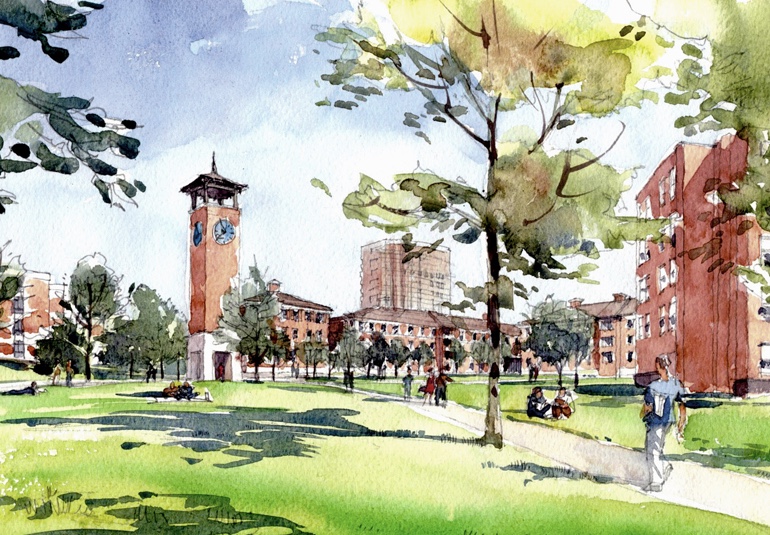
    The move to a residential college system was one envisioned in the early 2000s by then-President Kelvin Ogilvie. The Campus Master Plan envisioned a grand total of 5-6 colleges at Acadia, each one composed several halls for a grand total of 400 students per college. Colleges are not buildings- they are societies. The goal of each is to create a decentralized self-sustaining community within the university that has the resources to take care of its students. With a central administration that is at times strapped for cash the time is now to take matters into our own hands and work for our own wellbeing.

    This is not to say that the system does not work. Rather, this is to say that the system can be better. Ask our Director of Student Services, James Sanford.

    In a Spring 2003 edition of the Acadia Bulletin, he wrote about the exciting next step in Acadia’s future. He noted that “the college system is intended to create small communities- ‘colleges’- within the broader university community. The college promotes the University’s mission, goals and objectives while tending to the specific needs of the students who live within the college. Each college has a distinct physical space, its own administrative structure and a social rhythm.”

    Despite Acadia’s small size, he noted that “the residential college system will allow us to bring our hands-on approach to an even more manageable level”. The first envisioned college on campus was ‘West College’, composed of Eaton House, Christofor House, Roy Jodrey Hall, and Chipman House. Coupled with the creation of Clark Commons, the goal was to provide a hub for fitness, recreation, and social activities within the wider university. It was supposed to open in 2003.

    The proposed development of a residential college system under the Residence Advantage Program would have seen the construction of six new residences and five new commons buildings across campus from 2003-2008. Ideally 75-80% of all Acadia students would stay on campus for all four years, working their way up through different styles of residences. In creating such a system, the goal was to become North America’s premier residential university modelled after the finest universities in the United Kingdom and the United States.

    Our university has since evolved. President Gail Dinter-Gotlieb halted any changes to the proposed residential college system and since then the project has stalled.

    I propose we pick it up.

    The process would start with the creation of 5-6 college organizations. Each would be led by a Head, who would be a faculty member that oversees the administrative functions of the college and report to the administration. An advisor would work within the residence and be responsible for student welfare, ensuring that students are simply doing well. Naming the colleges would be easy- Ogilvie, Burnham, Ivany, DeWolfe, Perkin, and Oliver are only a few of many names to choose from.

    Next would be creating the physical space. After all, the same architects who redesigned Yale’s newest residential colleges also designed the KCIC. West College already has all the facilities they need. It would be up to the administration, donors, and students to decide how the remaining colleges looked. The construction of new residences in the fields between Chase Court and Crowell Tower provide the opportunity for brand new colleges to be constructed and bring more students on campus through apartment style living or suites.

    Each college would have a variety of living arrangements, so older students could live in on-campus apartments undisturbed by nosy RAs. Because a college is more than a building, but a society, each student would move from first year residence to a second-year residence, to upper year private apartments with friends of their choosing, while staying on campus.

    Each college would be unique, tailored to its history, culture, and traditions. Endowments would be set up for each college, with students paying a small College Fee at the beginning of the year. Within ten years each college would have a flourishing endowment that would be able to sustain its students through scholarships, continued infrastructure improvements, and social supports. Existing residences would come together to build their own college communities. Tully and Seminary? Cutten and Tower? Chase Court and Raymond? The possibilities are endless.

    Developing an academic culture would be crucial. Every student at Acadia, regardless of whether they were on or off campus or first or fourth year, would be made a member of a college. This would give all students a community spanning across the entire university community and beyond, in addition to giving them privileges to use each college’s respective facilities. Colleges would represent a microcosm of the university, composed of first to fourth years from all regions and all programs to ensure genuine diversity.

    I believe that a college system represents the future of Acadia. Even if it doesn’t take the form envisioned 15 years ago, a gradual shift that encompasses greater academic involvement with residences, establishment of endowments, and resources available to each community would be beneficial to the university as a whole. If Acadia still desires to be North America’s premiere residential university then we must dare to dream and do something different.

    If we want to be great, let’s stop saying it and start doing it.

    Colin Mitchell is a fourth year (Honours) Politics student and Editor in Chief of The Athenaeum 

  • No Regrets: Why I Am Leaving University

    Most of our time is spent in school, and we have yet to make any real choices in life. During my second year at Acadia I began to doubt what it was that I wanted to get out of my education and had no idea what I wanted to do for a career, so I decided to take a year off for the 2015-2016 term. The year I spent working at home was interesting, and I guess you could call it a learning experience. I knew for sure that I didn’t want to work at a menial minimum-wage job forever, and it gave me initiative to come back this fall. But upon my return, I found that it was a challenge to fit back into student life. At first, I thought that it was Acadia and my friends that had changed and moved on without me. But then I realized it was me who had changed.

    One of my professors called university a bubble, and I absolutely agree with him. Many of us are bubbled off and separated from the real world here, especially while living in residence with no real knowledge of what it’s like to pay bills or to have true independence in general. I think that this realization is what has driven me to drop out after this semester. Don’t get me wrong, I’m not telling you to drop out and play video games at your parent’s house for the rest of your life. What I mean is this: university just isn’t meant for everyone. For most of us, our bachelor’s degree is the first step in attaining a career,. But what do you do when you can’t even get a job in your field after graduating? What do you do when you realize that you’ll need multiple degrees and specializations to have a decent enough career to be able to afford having a family later on? I applaud the people who strive to do this because their dream and their goal is to go into education, to have a Masters or PhD, but when it’s a necessity to be a successful human being, it becomes an overbearing weight on your shoulders.

    Education is absolutely important in our society, but there is a stigma around higher education and I think it’s time for it to go. If someone had asked me in twelfth grade if I was going to community college or university, I wouldn’t have hesitated in saying university. I was given the impression that if you’re smart, then you need to go to university. But that notion is complete bullshit. People learn in different ways, and from my time at Acadia I’ve learned a lot of great and interesting things. However, I haven’t learned anything that I feel will benefit me that greatly later in the work force. I don’t feel like I’ve been prepared for any job at all, and it’s been two and a half years. If nothing else, that was my sign that university just isn’t working for me. Also, from what I see around me, people in our generation who have gone to community college are more successful now than the ones who have graduated with their Bachelors; they all have jobs in their field while those that have gone to university are working at Starbucks. For me this just isn’t worth it, especially when the price for a semester at university is the price for a year at a college.

    Again, by asserting all of this I am not trying to say that university isn’t worth doing and graduating from. What I am suggesting is that it is not the only way to get a decent education. I am trying to give you insight from a position that is not commonly heard from for the students who are unsure of what they’re doing. For those of you who may be on the fence about whether it is the right place for you, or if you’re only doing it because it is what you feel you are expected to do, you should put the same effort in any decision about leaving school as you did to get into your program. To elaborate, don’t spontaneously decide to leave because you’re scared or homesick. It should be something that you weigh heavily upon. You should not take your education lightly. As Nelson Mandela said, “education is the most powerful weapon which you can use to change the world.”

Betzillo positions itself as a versatile gaming hub where structured bonuses and adaptive gameplay mechanics support both short sessions and extended play.

Built with a focus on innovation, Spinbit integrates modern casino architecture with rapid transactions, appealing to players who value speed and digital efficiency.

Ripper Casino emphasizes bold entertainment through high-impact slot titles and competitive promotions crafted for risk-oriented players.

A friendly interface and stable performance define Ricky Casino, offering a casual yet reliable environment for a wide spectrum of gaming preferences.

King Billy Casino channels classic casino spirit into a modern platform, delivering recognizable themes supported by contemporary reward systems.

Immersive visuals and layered slot mechanics are at the core of Dragonslots, creating a narrative-driven casino experience.

Lukki Casino appeals to players seeking direct access and minimal friction, focusing on fast loading times and intuitive controls.

Casinonic provides a structured and dependable gaming framework, blending modern slots with transparent operational standards.