
Tag: Noble Prize

  • Genetic Scissors, The Tool That Will Serve to Rewrite the Code of Life: Nobel Prize in Chemistry 2020

    Genetic Scissors, The Tool That Will Serve to Rewrite the Code of Life: Nobel Prize in Chemistry 2020

    This year, our scientists did not fail to amaze us with yet another fascinating discovery. Emmanuelle Charpentier and Jennifer A. Doudna received Nobel Prize in Chemistry 2020 for the discovery of one of the gene world’s essential and sharpest tools; The CRISPR/ Cas9 genetic scissors. Science has come a long way by developing these scissors which no one ever imagined could be made. These scissors would contribute to enhancing the quality of life not only for humans but also for animals, plants, and microorganisms.

    Researchers and Scientists modify the gene cells in order to find out how life functions. This process, however, used to be really difficult as well as being time-consuming and in some cases, impossible. Thanks to the new era of science, we have such modern tools as the CRISPR Scissors which would not only make these tasks possible but also quicker. Genetics itself is a very commanding department of the sciences and now with the discovery of their sharpest tool, the scientific specialty has gained enormous power which affects everyone as it not only alters human and animal genomes, but also those of plants. Thus, it is not only the medical sciences who benefitted from this discovery which has also broken ground for the possibility of new and innovative crops.

    Emmanuelle Charpentier was born in 1968 in Juvisy-Sur-Orge in France and got her Ph.D. in the year 1995. She is currently serving as the Director of the Max Planck Unit for the Science of Pathogens in Berlin, Germany.

    Jennifer A. Doudna was born in the year 1964 in Washington D.C. in the USA and received her Ph.D. in the year 1989 from Harvard Medical School. She is currently a professor at the University of California in the USA and is also an investigator at the Howard Hughes Medical Institute.

    During Emmanuelle Charpentier’s studies of the bacteria that is widely regarded as the one which causes the most harm to humanity, called Streptococcus pyogenes, she discovered a previously unknown tracrRNA. She concluded that tracrRNA is a part of this bacteria’s ancient immune system wherein CRISPR/Cas disarms the viruses by creating a cleavage in their DNA.

    She published her finding in the year 2011 which was the same year she started her collaboration with Jennifer Doudna who had a vast knowledge in the field of RNA. Together as a team, they recreated the bacteria’s genetic scissors in a test tube and later simplified the scissor’s molecular components to make it easier to use.

    They reprogrammed the scissors in the momentous experiment. In the natural form, the scissors recognize the DNA apart from the virus. The two laureates proved that they could control this factor in order to cut any DNA molecule at any predetermined site. Once the DNA is cut, it is easier to rewrite the code sequence.

    Using these scissors, researchers can not only change the DNA of animals, plants, and microorganisms with high precision but also help in contributing towards curing some deadly illnesses in humans that have been incurable to date. This discovery has proven to have a revolutionary impact on the life sciences which would also be contributing to new cancer therapies, a possible dream come true for the patients suffering from this deadly disease. The discovery of these genetic scissors has brought great benefits to humankind.

  • Mystery of Black hole and Milky Way: Nobel Prize in Physics in 2020

    Mystery of Black hole and Milky Way: Nobel Prize in Physics in 2020

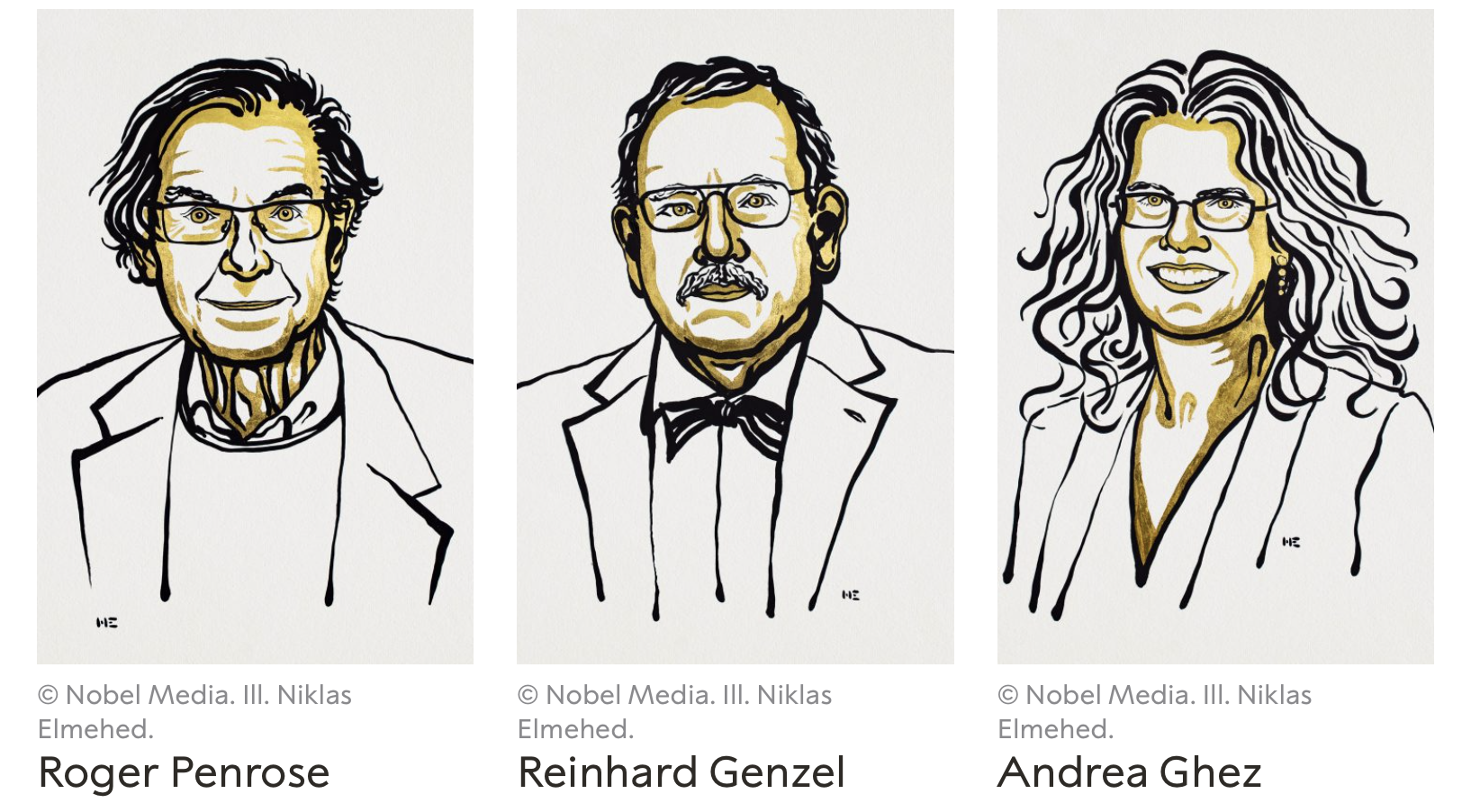
    The Nobel Prize in Physics this year was shared amongst three laureates for their discoveries concerning one of the most searched mysteries in the Universe, the black hole and the Milky Way. Roger Penrose, one of the three Nobel prize Winners proposed the general theory of relativity leads to the formation of black holes. The other two winners, Reinhard Genzel and Andrea Ghez found out that there is an invisible and extremely heavy object governing the orbits of stars right in the centre of our galaxy, The Milky Way. The only known explanation currently is that it is a black hole.

    Roger Penrose was born in 1931in Colchester, UK. He received his PhD. In 1957 from the University of Cambridge and is now a Professor at the University of Oxford.

    Reinhard Genzel was born in 1952 in Bad Homburg vor der Höhe, Germany. He got his Ph.D. in 1978 from the University of Bonn in Germany. Director at Max Planck Institute for Extraterrestrial Physics, in Garching, Germany, He is currently Professor at the University of California, Berkeley.

    Andrea Ghez was born in 1965 in the city of New York, USA. She received her PhD in 1992 from the California Institute of Technology, Pasadena, USA. She is currently a professor at the University of California, Los Angeles, USA.

    The total prize amount was 10 million out of which one half was given to Roger Penrose and the other half was subsequently split between Reinhard Genzel and Andrea Ghez.

    Roger Penrose proved that black holes are a direct consequence of Albert Einstein’s general theory of relativity using mathematical methods, which is pretty fascinating since Einstein himself did not believe in the existence of black holes. Black holes are thought to be heavyweight monstrosities that engulf everything which enters them, not even light can escape a black hole. Dr Penrose proved that black holes can form in reality and he described them in detail in his ground-breaking article which is considered as one of the most essential contributions to the theory of relativity, post-Einstein.

    Reinhard Genzel and Andrea Ghez each had a group of astronomers that they were leading since the early 1990s which focused on a region called Sagittarius A* at the centre of our galaxy. The orbits of the brightest stars which are closest to the middle of the milky way were mapped with increased precision. Both the group’s measurements match in terms of findings, both of the groups found an extremely heavy, invisible object that pulls on the jumble of stars which causes them to run around at dizzy speeds. There are around four million solar masses which are packed together in a region which is as big as our Solar System.

    Using the World’s largest Telescopes, Reinhard and Andrea came up with methods to see through the huge clouds made of interstellar gases and dust which come between the centre of the milky way and hinder our vision of it. The refined new techniques to compensate for distortions caused by the Earth’s atmosphere. They built unique instruments to carry out this process which has given the world one of the most convincing evidence of a supermassive black hole at the centre of the Milky Way.

    This year’s discoveries have decidedly broken new ground in the field of compact and supermassive objects. These new discoveries have created more questions to be answered and have generated the future potential for further research. It is very impressive to see how Laureates have pushed the concept forward and how they have gotten closer to deciphering of one the greatest scientific mysteries of all time.

  • Discovery of Hepatitis C: Noble Prize in Medicine/Physiology 2020

    Discovery of Hepatitis C: Noble Prize in Medicine/Physiology 2020

    It’s October, which is also known as the Nobel Prize season amongst scholars. The Nobel prize winner’s announcements began on Monday, October 5th, 2020, with the Physiology and Medicine category. The announcements began in Sweden, though due to the ongoing pandemic, some events usually organized by the Nobel Prize committee were cancelled.

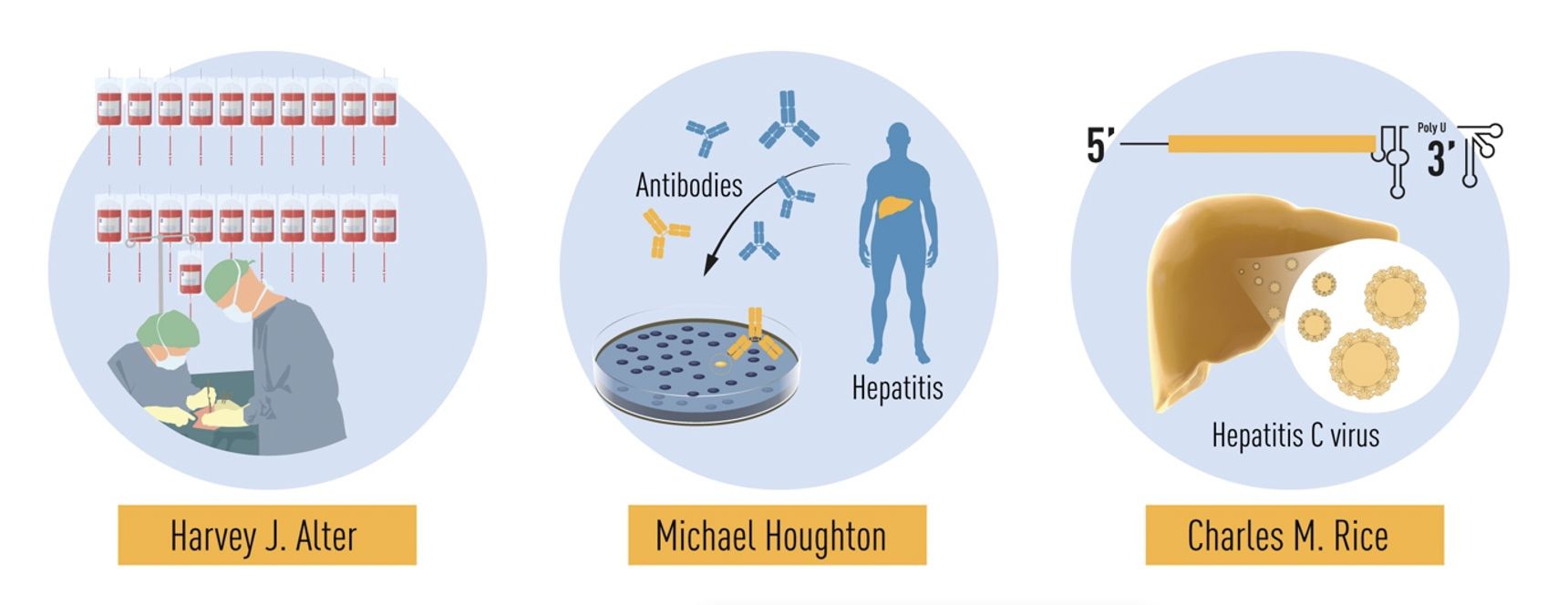
    This year’s Nobel prize winners for the category of Physiology or Medicine were Harvey J. Alter, Michael. Houghton and Charles M. Rice. They were jointly awarded the prize for their discovery of the Hepatitis C virus. They made a significant contribution to fight against the blood-borne disease. The discovery of Hepatitis C virus has definitely helped in unfolding the remaining cases of chronic hepatitis which has made it possible to save millions of lives and improve overall global health.

    Harvey J Alter was born in 1953 in New York and graduated from Rochester Medical School. In the year 1961, he became a part of the National Institute of Health (NIH) team as a clinical associate. He joined NIH back in 1969 as a senior investigator in the Clinic Centre’s Department of Transfusion Medicine.

    Michael Houghton is a British born doctorate degree holder from King’s College in London. He moved to California in the year 1982 and came to the University of Alberta in the year 2010. He is currently the Director and Research chair in Li Ka Shing Applied Virology Institute, as well as research chair at Canada Excellence.

    Charles M. Rice was born in the year 1952 in Sacramento and got his PhD in the year 1981 from the California Institute of Technology. He founded his own research group at Washington University School of Medicine. He was the Scientific and Executive Director at the Centre for the study of Hepatitis C at Rockefeller University where he is currently active.

    Hepatitis is looked at as a global threat to human health as it can cause cirrhosis, liver failure, liver damage, liver cancer or even death in severe cases. Hepatitis is also referred to as liver inflammation which is mainly caused by viral infections, although some other major disease-causing factors include alcohol abuse, autoimmune disease, environmental toxins, some medications etc. There are three most common hepatitis viruses Hepatitis A, Hepatitis B and Hepatitis C. Hepatitis B and C are transmitted via blood and bodily fluids and are considered pretty serious as in severe cases/chronic stages the development of cirrhosis and liver cancer can occur. This is because in some cases after a short-term infection, the virus stays in the body and causes a chronic infection. While on the other hand, Hepatitis A is transmitted through polluted food and water and is usually considered a short-term infection, depending on the cause and severity. Although the three types of viruses can show similar symptoms, the way they spread and affect an individual is different.

    Bloodborne Hepatitis-C is considered dangerous since a healthy individual could be infected and would not necessarily be aware of its presence for several years until serious effects start showing up. Hepatitis C is also linked to morbidity and mortality at times because it causes more than a million deaths worldwide each year. It can range from mild to acute illness. Acute Hepatitis C usually occurs within 6 months of exposure to the Hepatitis C virus and is usually a short-term illness if not converted into the chronic infection. Chronic Hepatitis C on the contrary can be a life-long infection if it remains undetected, and could lead to serious diseases like cirrhosis, liver damage, liver cancer or death.

    Identification was the first step to attain the goal. Michael Houghton isolated the genetic sequence of the virus and collected a collection of DNA fragments from nucleic acids found in the blood of an infected chimpanzee. Most of the fragments were taken from the genome of the chimpanzees but the research team suspected some to come from the unknown virus. The scientists used the hepatitis infected patient’s blood to identify cloned viral DNA fragments encoding viral proteins. After a lot of in-depth research, one positive clone was found. This clone was derived from an RNA virus which in turn was from the Flavivirus family and got named as the Hepatitis C virus.

    The major hurdle in the process was to determine if the virus alone is causing hepatitis. Investigations were done on cloned viruses to check if the virus is able to replicate itself and Charles M. Rice, along with his team, while working on the RNA virus observed a very essential piece of information. They saw that there exists an uncharacterised region at the end of the Hepatitis C virus genome. The thought that it might be an essential component for virus replication. He also happened to notice some genetic variations in the isolated sample of the virus and suspected that some of them might be hindering virus replication. Using Genetic engineering Charles came up with a variant RNA of the virus which included a new region and was devoid of inactivating genetic variations. He then injected this newly formed RNA into the liver of chimpanzees. The virus was detected in the blood and pathological changes were similar to ones observed in humans who were suffering from chronic diseases. This made them believe that the virus alone can cause deadly disease.

    Discovery of the Hepatitis C virus has made it possible to conduct highly sensitive blood tests, as well as rapidly develop an antiviral drug directed at Hepatitis C. It is now possible to cure this disease which can be seen as the final milestone in the journey of eradication of the Hepatitis C virus globally.


Betzillo positions itself as a versatile gaming hub where structured bonuses and adaptive gameplay mechanics support both short sessions and extended play.

Built with a focus on innovation, Spinbit integrates modern casino architecture with rapid transactions, appealing to players who value speed and digital efficiency.

Ripper Casino emphasizes bold entertainment through high-impact slot titles and competitive promotions crafted for risk-oriented players.

A friendly interface and stable performance define Ricky Casino, offering a casual yet reliable environment for a wide spectrum of gaming preferences.

King Billy Casino channels classic casino spirit into a modern platform, delivering recognizable themes supported by contemporary reward systems.

Immersive visuals and layered slot mechanics are at the core of Dragonslots, creating a narrative-driven casino experience.

Lukki Casino appeals to players seeking direct access and minimal friction, focusing on fast loading times and intuitive controls.

Casinonic provides a structured and dependable gaming framework, blending modern slots with transparent operational standards.