
Tag: sustainability

  • Consumption Culture & Why It’s an Issue

    Consumption Culture & Why It’s an Issue

    Recently, a lot of businesses and organizations have received backlash for not being ethically conscious with their products. Issues within clothing companies especially are being brought to consumers’ attention, since clothing stores so often manufacture unethically sourced products. This impacts the people who are making those products, the environment, and our wallets through fast fashion. People are left feeling as though there is no right answer, since sustainable brands are often extremely expensive, whereas shopping second-hand sometimes feels greedy since items in those stores are all that some people can afford.

    With quarantine came people spending a lot more time at home, which led to higher levels of online shopping. The environmental impacts of online shopping are higher than in-person, due to the carbon dioxide emissions caused by flying the products, the large amount of packaging that shipping products requires, and the fact that more online purchases means more first-time consumption, rather than reusing old products or clothing. Other times when online shopping is at its peak are Black Friday and the Christmas season. It’s important to be aware not only of the environmental impacts of your shopping habits, but also where those products are coming from. Fast fashion – clothing that is made cheaply and for short-term use – is often produced by underpaid workers in poor working conditions. This allows the clothing to be cheaper for us to purchase, making it difficult to boycott, especially if we are left unaware of its source.

    If the facts that consumption culture is bad for the environment and so often produced unethically weren’t enough to convince you that there is an issue within the fashion industry, fast fashion is also bad for the wallet. We’re constantly seeing messages saying “Buy me!”, making us think that we need the newest iPhone, winter coat, or beauty product. This culture of being perceived as outdated when your possessions are outdated is difficult to reject, but incredibly wasteful and costly.

    So, what is the right answer?

    One solution that’s been suggested to help ourselves and our world – since both the planet and our bank accounts take a hit when we overspend – is buying clothes or products second-hand. This also has an enormous impact on unethically sourced products, since less demand means less workers producing them in poor conditions. Buying second-hand might look different for everyone, but some examples include thrift shopping, trading with friends, or purchasing from any kind of second-hand store. These options give you a variety of things to buy at a discounted price – clothes, shoes, jewelry, furniture, home décor, books, knick-knacks and toys, and pretty much anything else you can think of to trade.

    Some experts have suggested that a possible answer to these issues is having government mandated regulations about the sourcing of clothes and other products. Similar to the food industry, businesses would have to explicitly state where and how their products were made. If it’s within your budget, buying clothes or products from brands that you appreciate as sustainable companies is also a great idea. It’s important to do your own research, but there are many ethical brands out there. Some popular choices include Patagonia, Levi’s, TenTree, and many others.

    In all honesty, I’m not sure if there is one right answer. I do think, though, that every little difference counts. So, whether you occasionally shop at your local thrift store for new sweaters trade books with your neighbour, or make an Instagram account to sell old clothes, find a way to help stop consumption culture and fast fashion. You might just find you like the products better, and that you and your bank account are happier, too!

  • New Kid on Campus: Hydroponics

    New Kid on Campus: Hydroponics

    You may have heard about the new hydroponic unit that’s been established on campus up by meal hall, but maybe you’ve wondered: what is a hydroponic system? 

    Hydroponic systems use water, light, aeration and nutrients to grow plants in a controlled environment. Chemical nutrient solutions must be properly balanced, and ideally be customized to the crop being grown for optimal growth. These systems can overcome the obstacles of pest and soil management that plague traditional farming and can make land that would be otherwise unproductive into abundant agricultural zones. Hydroponics is not a new innovation, but recent technological developments have made managing lighting, monitoring oxygen and customizing fertilizers in hydroponic systems easier to execute successfully.

    A similar system we could be using is an Aquaponics. Aquaponic systems grow both plants and fish simultaneously in one integrated system, combining hydroponics with aquaculture. Aquaculture is the practice of raising fish or other aquatic organisms, so the waste produced by the fish in the system provides nutrients to the plants, while the plants provide a natural water filter for the fish, in turn providing them with a clean environment. This mutually beneficial relationship efficiently produces both a quality protein source and fresh, healthy plants with minimal interference needed for crop/animal management. This system is currently being implemented in Liverpool, NS, in the Aqualitas cannabis growing operation. Aqualitas grows Koi fish alongside their cannabis crop, a method they claim uses 90% less water and 50% less power than traditional production.  

    While here in NS we can source our produce from local farmers when crops are in season, and then use our hydroponics system to have fresh greens during the winter, hydroponics can help communities where that is not an option. Hydroponic systems like Acadia’s Growcer are currently bringing fresh produce to Canada’s Arctic where food insecurity is a major issue. Hydroponic systems allow these communities to supplement their diets with locally produced healthy food that comes at a much lower cost and carbon footprint than produce that must be shipped in. 

    The utility of these systems in extreme environments such as deserts and tundra may seem impressive, but the implementation of hydroponic systems has even been suggested to have potential use in space exploration to supply astronauts with additional food supplies, other than the rations they bring aboard. 


    To learn more about the specific hydroponic unit being used at Acadia, information can be found here: https://www.thegrowcer.ca/growing-systems

  • SRC Decoded: What You Missed September 25th

    SRC Decoded: What You Missed September 25th

    The Students’ Representative Council (SRC) is a council composed of a body of students elected by their peers, who are in charge of running the Acadia Students’ Union. The Council meets weekly on Wednesdays at 5:00 PM in the Beveridge Forum which is located off of the Michener Lounge in the old Students’ Union Building (SUB). Every meeting is open to the public and students are encouraged to attend the meetings to learn more about the decisions being made on their behalf.

    On September 25th the council had a short meeting primarily to hear the ASU’s Auditors report. After the report the council then discussed the deferred matters from last week and went over points of new business including the Town of Wolfville Grant and members fall goal documents, amongst a few others.

    Auditors Findings

     Auditors Michael Stevens and Jessica Skinner from BDO Canada LLP joined council this evening to present an overview of the 2018/2019 draft financial statements. Stevens noted that this report is a lot longer than past reports and explained to council that they do these audits on a test basis and if they find something missing or wrong, they investigate but if nothing is wrong, they don’t. It was found that there was no material missing regarding the financial statements for the last fiscal year.

    Skinner then briefly went over the report and explained to the council that the report was a picture of the ASU’s finances until March 31st, 2019. She discussed a good increase in the ASU’s long-term investments which she credited to the market being particularly good at the moment. Capital assets were slightly down from last year, but Skinner explained that it isn’t necessarily a bad thing as some assets were made up in other areas. Liabilities, net assets and deferred revenue were a couple of additional things discussed during the meeting, with none of them raising major concern from what was expected. Skinner also noted that the revenue the ASU is bringing was consistent throughout the whole year however retail outlets were not making as much as was budgeted for them to make.

    Both Stevens and Skinner noted to council that the ASU seems to be running very smoothly and out of all their clients the ASU is very tight on controls around finances which was highly impressive and allows them as auditors to do their job as effectively and efficiently as possible.

    Deferred Matters

     Last week a few committees that required members of council were deferred due to the number of empty positions within the council at this time. This week the council voted to defer the filling of the Occupational Health Committee and the Diversity and Inclusion Committee until after the by-election, at which point they will have more members to help serve.

    New Business

     Executive members of the SRC are required to only take four classes a semester due to the strenuous workload of their position. Mackenzie Jarvin, VP Academic and External, explained to the council that she is just one course shy of graduating this spring and expressed that it seems silly of her to return next year for one class. She then explained she will try to take an online class over Christmas break in order to solve this problem, however, if that option is unavailable, she requested that council allow her to take a fifth-class next semester. The council took the matter to a vote which was unanimous.

    Max Abu-Laban, Sustainability Officer, informed the council that the town of Wolfville was applying for a low carbon community grant with the provincial government. He went on to explain that applications featuring partnerships look a lot better and the town would like to partner with the University. If the grant were to be given to Wolfville, Abu-Laban stated that the partnership would work towards hosting an event during Orientation Week to educate incoming students about climate change and what they can do to help the climate crisis.

    Additionally, Abu-Laban also proposed to the council a ‘Sustainability Newsletter’ which would be sent around campus bi-monthly or even monthly to alert the students of climate opportunities to get involved as well as keeping students up to date with Acadia’s efforts regarding the climate crisis. VP Events and Promotions, Gabrielle Bailey, told him that he could reach out to James Sanford or herself in order to discuss the distribution of this newsletter. Council agreed that this newsletter seemed like an excellent idea.

    Before beginning the closed session, the council individually went around and read out their fall goal documents to be adopted. Each member had different goals, but all the goals brought up were very ambitious and forward goals that will increase support and opportunity for the students on campus that each member represents.

  • Research Feature: Chaiti Seth

    Research Feature: Chaiti Seth

    My research aims to identify key leverage points for shifting towards more healthy, just, and sustainable institutional food systems, using Acadia University as a case study, and examining findings in the broader provincial context. This research builds on my prior work and relationships at Acadia investigating food system issues and university food culture.

    Food is fundamental to all human life, and food systems – the ways that our food is produced, processed, distributed and consumed – have significant social, cultural, health, ecological and economic implications. The shift towards industrial food production has resulted in massive loss of knowledge and biodiversity, soil erosion, deforestation and habitat destruction, pollution, animal welfare concerns, waste production, as well as significant greenhouse gas emissions. The health crisis in relation to food is growing – societies are facing both over- and under-nutrition and diet-related diseases are prevalent amongst all populations. Most Canadians eat food that is neither healthy nor sustainably produced, and many face food insecurity or inequitable access to food.

    Just as current food systems have many detrimental impacts, their potential for improving quality of life is also immense.  Sustainable pasture and farmland management strategies can support biodiversity, conserve soil and water, and help sequester carbon. Combined with other lifestyle factors, nutritious food has enormous preventative and healing potential. The market for food represents a source of positive and sustainable economic activity and community-based food systems have the potential to contribute to local economic development and provide meaningful employment. Last, but not least, is the magic of food in bringing people together – for everyday gathering and special occasions, for nourishment and healing and celebration. Food is powerful, and the decisions we make about what we eat, and how we produce it, matter.

    Studies assessing individual behaviours identify the most effective food choices and habits for a shift to a healthy and sustainable food culture. At a societal level, national and regional organizations are currently advocating for a strong national food policy, and the federal government is engaging citizens in an ongoing consultation process. Bridging the space between individual and policy levels, institutions play a key role in food systems. They are large enough to have significant impact but do not typically have internal policies or a strong vision for food systems. In this gap, food services providers (FSPs) – multinational for-profit companies that typically run institutional food services – often unofficially dictate food policy. Due to the standardization and scale of institutional food systems, FSPs wield significant influence on food production, processing and consumption patterns. Research shows that institutions can strategically leverage their purchasing power to generate greater wealth and health in their communities. Despite a few individual success stories, there are significant barriers to broadly shifting institutional food practices.

    Universities can play an essential role in facilitating change in institutional food culture. They serve and can critically engage young adults as both eaters and future leaders in food systems, and invest in economic and community health through food procurement. There is a growing demand for healthy and sustainable food services at universities. Research shows a critical need for effective strategies that address systemic and cultural barriers to change.

    For this research, I use critical social science and transdisciplinary methodologies, incorporating mixed methods with four primary components: semi-structured stakeholder interviews, participant observation, document analysis of food services contracts, and numerical analysis of procurement data. I have conducted 14 interviews with internal stakeholders including students, faculty, staff and administration as well as external stakeholders such as change makers at other institutions, public policy-makers and non-profit advocates to gather rich data from a diversity of perspectives. I will integrate findings based on thematic coding and analysis of these interviews with information about strengths and gaps in existing contract language from other post-secondary institutions. Numerical analysis of procurement data will help determine relative impact and feasibility of specific interventions.

    My research aims to build knowledge for shifting towards healthy, sustainable and just university food systems and is intended to support institutions to find creative and innovative solutions that can contribute to building more sustainable and resilient local communities through food systems change.  

  • Acadia Designated Fair Trade Campus

    Acadia Designated Fair Trade Campus

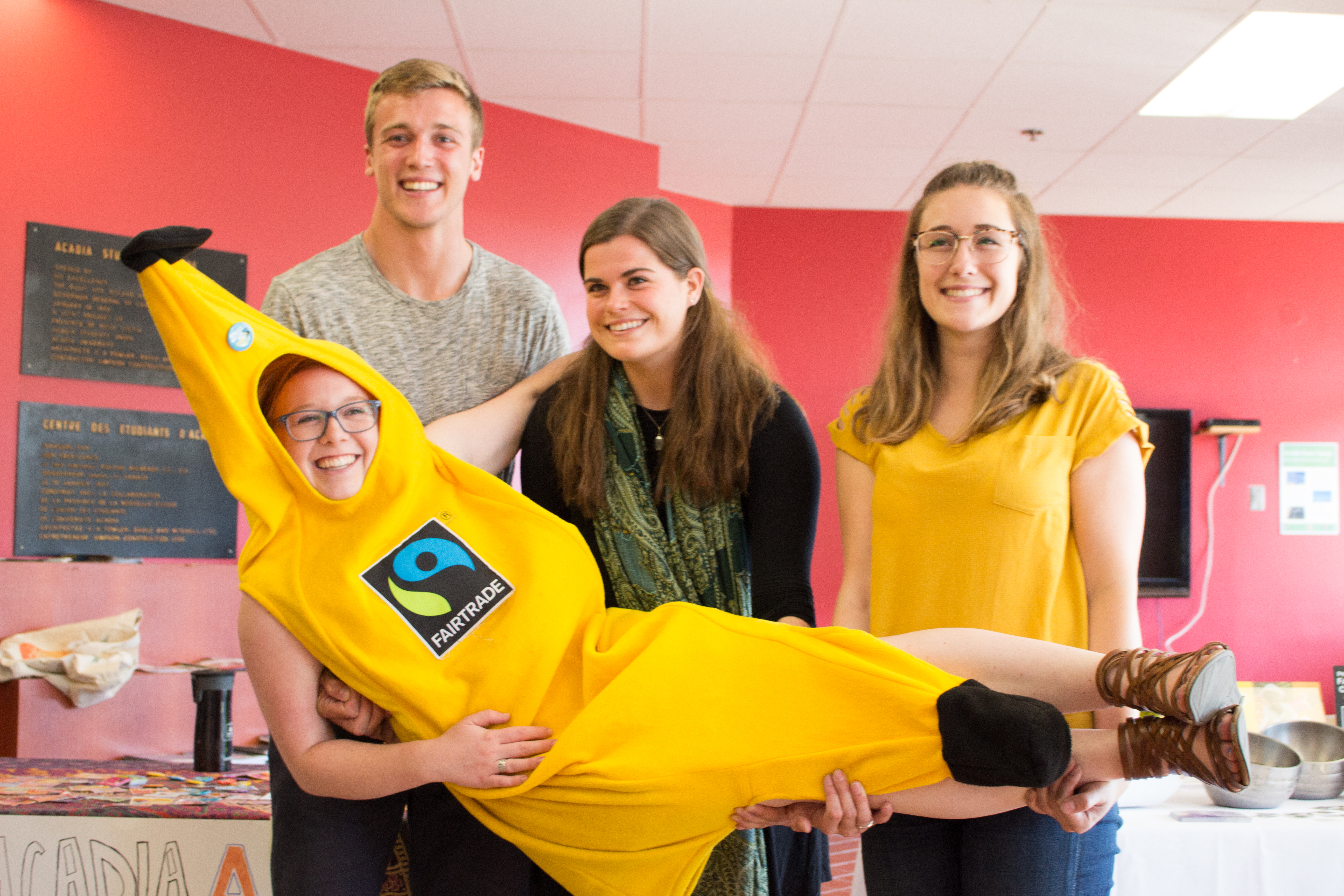
    Acadia has achieved its designation as a Fair Trade Campus. The announcement came from ASU President Grace HB and Acadia President Dr. Peter Ricketts on September 25th in the ASU Students’ Centre.

    “Students are engaging in ethical discussions as part of their education and the Fair Trade program instills the values we learn in the classroom” Grace said. “Paying people fairly for the work they provide is something students support.”

    Acadia is the first school in the Maritimes to attain a Fair Trade designation. Fair trade means that farmers are paid fair prices, have decent working conditions, and business is conducted on fair terms, unlike many multinational corporations.

    To earn this certification all coffee, three teas, and one chocolate that are Fair Trade certified must be available for consumption at retail outlets across campus. The range of products available will expand as time goes on, with a committee being established to oversee the program.

    Last year Just Us! worked with Acadia to develop a fair trade coffee and held an open design competition for the blend’s logo. Hacha Java the winner, submitted by fourth year kinesiology student Quentin Hovarth.

    ASU Sustainability Officer George Philp was overwhelmingly positive about the news. “Becoming a Fair Trade campus means that Acadia and the ASU’s product offerings reflect their visions to foster a more sustainable and socially responsible campus community”. More importantly, Philp notes that “in the long-term it sets a precedent that really big ideas and initiatives can succeed at Acadia. The success of this project proves that a small group of Acadia students, who care a whole lot about something, can make a massive difference in our community.”

    Acadia now joins UBC, McGill, the University of Western Ontario, and 25 other campuses as part of the fair trade movement. UBC Vancouver was the first campus in Canada to go fair trade in 2011.

    Fair trade products will now be offered at various outlets on campus, including the ASU Students’ Centre, BAC, and Huggins.

  • Selling a Sustainable Future: What Individuals Could Create

    Selling a Sustainable Future: What Individuals Could Create

    Fear, facts, and the seemingly uncontrollable big picture will not motivate individuals to make a change for sustainability. Climate change has positioned the global community at a turning point and there are only two ways to go: continue business as usual to crash and burn or make the challenging changes and sacrifices for a prosperous future of the generations to follow. Both options do not sound ideal. Business as usual may lead to wars, economic uncertainty or prosperity, but at what cost? Lifestyle sacrifices for the potential future of generations to follow also does not sound appealing. It is important for optimist activists to sell change with positive and beneficial lens.

    The average middle class North American family may not be the first to jump on board with the idea of replacing their home heating with solar power or redesigning suburbia to introduce more public transportation, in order to reduce environmental impact. The average middle-class family may be more attracted to the idea of lowering their heating bills and shorting their commute to work. Understanding the market you are trying to convince is key in selling sustainability.  Climate change facts no longer change the actions of individuals. In North America’s consumer culture, it is important to adjust the consumer world so that it benefits climate change action. Marketing the benefits of sustainable home design, public transportation, community design, trading currency and community collaboration will be key in moving towards a more sustainable future.

    Imagine a community where neighbours come together for meals regularly. Imagine a community where people from all walks of life don’t feel isolated because it a social norm to check-in and ask people how others are doing. Imagine a community where kids run from house to house playing with kids of all ages and there is trust that, as a community, all members will keep an key on the children. Imagine a community where food is grown locally and equally dispersed, where children don’t go to school hungry. Imagine a community where mothers don’t have to work three jobs to support their kids because their neighbours are willing to help provide for each other, as the community supports strength is in numbers. The foundation value of community is support. Working together allows communities to reach further than working apart.

    A sustainable future is attractive and aligns with core human values, such as connection, success, and stability. A community that has created meaning and appreciation of what they have, will natural also protect the environment that surrounds it. Sell the sustainable future individuals can imagine accomplishing, make it possible. Living sustainably together is the future each citizen can create, climate change action activist must sell it, promote it and live it, then others will follow. Show the generations to follow what sustainable communities can be, then watch as the value of sustainability transitions from an unrealistic ideal of “delusional activists” to a valued and supported mindset.

  • A Greener Acadia: A Look at the Sustainability Initiatives Around Campus

    A Greener Acadia: A Look at the Sustainability Initiatives Around Campus

    Note from the Editor: Marcel Falkenham is the Director of Facilities at Acadia University. During his tenure here, the university has seen some remarkable improvements in sustainability efforts across campus. Through this piece, the Athenaeum hopes to illuminate some of those improvements as well as open some discussion on what the future might look like.

    1. Tell me a little bit about the sustainability projects that you have overseen at Acadia since you’ve been here. What are you most proud of?

    I arrived at Acadia in the summer of 2007 as the university was in the early implementation stages of a “Sustainability through Facilities Innovation” performance contract with Johnson Control Inc. This project consisted of multiple improvement measures targeted towards improving energy efficiencies while reducing deferred maintenance and renewing some key capital equipment.

    Some of the campus wide initiatives included lighting upgrades from T12 and incandescent lamps to T8 and compact fluorescents in areas that had not been renovated, and upgrading plumbing fixtures to reduce water consumption or going water free where possible. There were several building specific initiatives such as installing a new ice plant for the arena that sent rejected heat from the compressors to be used in preheating incoming ventilation air and pool water. Other building projects that were part of that contract included heat recovery in the Huggins and Elliott Hall labs and a number of heating system flushes in larger buildings to remove scale and improve heat transfer. All in all, annual cost savings were calculated to be $600,000 which was used to pay for the capital costs of implementation.

    Since that broader initiative I have been able to complete a number of other sustainability projects on campus by working with other agencies including Efficiency Nova Scotia. We have been able to achieve real energy savings while also reducing maintenance requirements and in many cases improved the aesthetic and functionality of the systems we addressed. Probably the most visible would be the exterior lighting upgrades to LED as technology came available and improved to the point where paybacks were measured in months instead of years. We had participated in some smaller retrofits in partnership with Efficiency NS in several areas on campus including the Student Union Building, Michener and MacKeen Rooms, as well as Clark Commons with early generations of LED lamps – building on the success of those small projects to justify moving larger scopes.

    The Grad Class of 2013 then used their class gift to help us upgrade the 8 pathway lights in the main Quad behind University Hall to new LED post tops, taking advantage of a supplier incentive which allowed us to get the fixtures at about half the regular price. The impact of the quality of light from these new fixtures and the improved aesthetic was a huge win and we were able to use it to help justify a continuation across campus with help from Efficiency NS. The gains on this were threefold: Energy savings were at least 50% per fixture at 75W vs 150W previously, the lifespan of the lamps were increased by a factor of ten – 100,000 hours vs 10,000 hours previously – and the quality of the light was dramatically improved. You could actually recognize people’s faces after dark instead of the “blob” that was visible with the old high pressure sodium lighting. As a side, the new fixtures were night sky compliant with no spill over to obstruct star visibility which is also a win. By the end of the summer of 2013 we were able to retrofit about 90% of the outdoor fixtures resulting in an annual savings of over 500,000 kWh, which while always a win was almost a side note when compared to the improved feel of campus after dark. The running joke is that we won’t need to change a lamp until at least after I retire which is still a way off at best.

    Probably the highest impact project on sustainability that we have successfully implemented in my time here has to be the conversion of our Central Heating Plant from Bunker C oil fired to Natural Gas. While not obvious to many and operating in the background, this was a huge undertaking that required the complete retrofit of all four boilers and construction of a Natural Gas delivery site and pipeline to the boiler room… all while maintaining steam production uninterrupted year round to our entire campus. Obviously, Natural Gas is still a fossil fuel and therefore not renewable, but the improvement in overall emissions profile when compared to the Bunker C oil that had been used since the 1950s is something we should be proud of. In the first year alone of using Natural Gas (which actually had a fair bit of light oil usage in the early part as we were commissioning the new systems), our Sulfur Dioxide emissions dropped over 60% which is almost 45 tonnes while our Particulate and Nitrogen Oxide emissions dropped about 25%. Carbon Dioxide emissions were reduced almost 30% which equates to almost 4000 metric tonnes for the year. For reference, that is equivalent to taking almost 1000 cars off the road. We are expecting even more reductions in this past year as we were able to run almost exclusively on natural gas as the initial conversion challenges were overcome. While not as high profile or visually impressive as some of the other measures we have made on campus, this has to be hands down the most significant improvement in sustainability.

    2. Tell me a little bit more about the design of the new biology building, and the initiatives that it has underwent to become LEED-certified. What exactly does LEED-certified mean?


    LEED stands for Leadership in Energy and Environmental Design and is a rating system for green buildings. Essentially there are points available across a variety of categories from site selection to materials used for construction to indoor air quality. Some of the points are fairly simple to earn such as having bicycle racks and designated carpool parking spots to encourage alternative transportation, while others can be much more involved. An example of the more difficult points to achieve would be tracking of construction waste which required every load of waste and recycling to be weighed and tracked to ensure diversion targets were met. All points need to be validated and awarded by a LEED accredited third party consultant.

    The Biology building was designed to the LEED Gold standard and as such would have been one of the first science buildings in Canada to target such a goal. It was about 50% complete when I arrived on campus in 2007 and I was able to be involved in the fitout and commissioning phases of the new facility. There were many features incorporated in the Biology Building that were at least partially driven by the LEED process. The use of geothermal cooling, the capture and use of rainwater for non-potable water in the building, realtime monitoring of indoor air quality in all spaces and extensive use of natural and high recycled material content products for construction. Overall the LEED standard has some very good principles that we try to apply in all projects going forward but as with any consultant intensive initiative there are significant costs associated with the process that I feel can sometimes be better applied to actual sustainable projects and practices.

    3. Apart from obvious funding limits, what are some challenges to making Acadia a green campus?

    One of the bigger challenges with our beautiful campus is the age and variety of buildings and infrastructure. Our buildings range in age from 8 years old to almost 200 years old, so obviously the construction type varies widely. Strategies for sustainability therefore need to be tailored to the target areas and what works in one building doesn’t always work in another. As a fully operational campus, even if funding were unlimited it is not as simple as flicking a switch and being green. Everything needs to work around our ongoing campus activities and be planned and implemented in such a manner as to minimize disruption to our core mission as an institution of higher learning. While not always easy, we have had great track record of making incremental improvements while minimizing impact on day to day operations and plan to continue in this way moving forward.

    Keeping up to date with emerging technology trends that may have significant impacts on sustainability is also a challenge. We were early adopters on the LED lighting front as highlighted earlier, but we have also been working on more “behind the scenes” initiatives as opportunities arise from new technologies. One of the more recent examples of this is the availability of hybrid heat pump hot water heaters. While most of our buildings rely on our steam system to provide hot water, several buildings with lower consumption are actually more efficient to run with electric hot water heaters. The hybrid hot water heaters use an integral heat pump to heat the water instead of a straight electric resistance element and use less than half the amount of electricity to do this. We have retrofit a couple dozen of these units in buildings ranging from smaller academic facilities like Rhodes Hall up to larger facilities such as the Beveridge Arts Centre. We were one of the only institutions that I am aware of to take advantage of this technology and it has been very successful to date.

    The biggest challenge aside from resource availability is education and awareness. Keeping incoming students, staff and visitors educated on things as simple as waste sorting and reducing energy consumption is something that is ongoing and requires a lot of work. On the bright side efforts have been paying off, our diversion rates from landfills have consistently tracked over 70% which is well above the provincially legislated goal of 50%. Every year we see the trend where the numbers dip at the start of the term and then steadily improve as the year progresses and new members of the campus community become more knowledgeable on how to sort and recycle.

    4. In the future, where do you see Acadia going in terms of sustainability? What sort of projects are you working on now, and hope to accomplish?

    We have made some great progress but obviously have a way to go to becoming truly green. With the current funding constraints that all universities are facing, I expect to continue on the incremental improvement path but there are some exciting technology developments on the horizon. We are currently working to continue upgrades to LED lighting as opportunities arise and efficiency improvements in mechanical systems are always on our mind. We do try to keep sustainability in mind for all projects and incorporate energy efficiency improvement in the planning stages. One case and point is the new Stevens High Performance Centre varsity locker room project at the Athletics Complex which we plan to start this spring. While this is an addition to the existing complex it requires largely independent mechanical systems for heating and ventilating, but we are working with the consultant engineers to use the glycol lines that are heated by waste heat from the adjacent ice plant to provide the heat source for the in floor radiant heat and ventilation units. This would provide the majority of the heat for the almost 8000 ft2 facility for virtually free. As renewables such as solar become more efficient readily available I hope that we can incorporate them more into our facilities as the paybacks shorten but this will take time given the capital requirements associated. In the interim, managing and improving our consumption has the better payback and we will continue to identify and implement as opportunities come up.

  • Understanding Climate Change: Fact Sheet

    Understanding Climate Change: Fact Sheet

    Climate change is a huge topic right now, as it should be, but all the information can be a little overwhelming and hard to understand. Let these facts and terms, compiled by Acadia Talks, help you navigate your way through understanding our future living with climate change.

    Climate Mitigation: efforts to reduce or prevent emission of greenhouse gases (new technologies, renewable energy, improving efficiency, or changing management practices or consumer behavior)

    *Climate Adaptation: adjustment in natural or human systems in response to actual or expected climatic effects

    *During the end Permian mass extinction event (252mya) there was a global temperature rise of 6°C. The environmental implications eradicated 90% of the species on Earth.

    -At COP16, countries promised a $100 billion/year Green Climate Fund for 2020 through 2025 to help developing countries to adapt to climate change (although specific contributions have not been established)

    -As temperatures increase, tropical diseases will spread to new areas as the range of carrier organisms expands (MosquitosàMalaria)

    -Rising seas means coastal infrastructure will need to adapt (Ex. Confederation bridge (NBàPEI) needs to be raised so ships can still fit)

    • This threatens roughly 1 billion people in coastal cities around the world (What could this mean for mass-relocations?)

    -Genetically Modified Crops are one possible solution to world hunger (drought resistant, pest resistant, higher yield) but potential unintended consequences on ecosystems cloud public opinion

    -One unconventional solution to desertification could be herding massive groups of livestock to simulate mass migration of grazers.

    -From 1980-2014, land fall tropical cyclones caused $545 billion in damages (avg. cost of $16 billion per event). Drought caused $213 billion, severe storms $156 billion and inland flooding $89 billion

    -Climate Change effects have been shown to lead to political instability and conflict

    Four IPCC Climate Scenarios to 2100

    RCP 2.6: Global annual GHG emissions (peak between 2010-2020, with emissions declining substantially thereafter (Avg. temp rise 0.3 – 0.9°C)

    RCP 4.5: Emissions assumed to peak around 2040, then decline (Avg. temp rise 1.1 – 2.9 °C)

    RCP 6: Emissions peak around 2080, then decline (Avg. temp rise 1.7 – 4.4°C)

    RCP 8.5: Emissions continue to rise throughout the 21st century (Avg. temp rise 2.0 – 5.4°C or more)


    Geoengineering/Climate Engineering: deliberate, large-scale intervention in the Earth’s climatic system with aim of limiting adverse climate change. (extent of effects still unknown, more research and $$$ needed)

    1. Solar radiation management – reduce sunlight absorbed by deflecting sunlight away from the Earth, or by increasing the reflectivity (albedo) of the atmosphere or the Earth’s surface. (Ex. marine cloud brightening, which would spray fine sea water to whiten clouds and thus increase cloud reflectivity, stratospheric sulfate aerosols, obstructing solar radiation with space-based mirrors, dust, etc.)
    • Would produce quick results and comparatively low implementation costs. (Note: does NOT reduce greenhouse gas concentrations in the atmosphere, and thus would NOT address problems such as the ocean acidification)
    1. Carbon Dioxide Removal – remove CO2 from the atmosphere via afforestation, using technology to remove carbon dioxide from ambient air, iron fertilization of oceans, use of biochar (which can improve water quality, increase soil fertility, raise agricultural productivity, and reduce pressure on forests), create artificial upwelling’s in oceans to stimulate surface productivity


    Discussion questions:

    Should we be taking steps now as a globe to research and implement global geo engineering techniques to alter the global climate and reduce heating?

    • What are the pros and cons and how should we do it? Is it ethical?

    Should developed (industrialized) countries feel an obligation to help poorer countries deal with climate change?

    What role do you see Climate Change playing in the stability of future international politics?

    What are some ways you think humanity will benefit from learning to tackle and live with Climate Change?

    Do you enjoy discussing world events? Then join Acadia Talks!!

    We are a club that meets every 2 weeks on Tuesday evenings to have an open, round-table discussion about important global issues.

    When/where? 6-8pm in the KCIC seminar room (More details posted on Facebook before each talk https://www.facebook.com/AcadiaTalks)

    Add us on Facebook or contact Luke at [email protected] for info

Betzillo positions itself as a versatile gaming hub where structured bonuses and adaptive gameplay mechanics support both short sessions and extended play.

Built with a focus on innovation, Spinbit integrates modern casino architecture with rapid transactions, appealing to players who value speed and digital efficiency.

Ripper Casino emphasizes bold entertainment through high-impact slot titles and competitive promotions crafted for risk-oriented players.

A friendly interface and stable performance define Ricky Casino, offering a casual yet reliable environment for a wide spectrum of gaming preferences.

King Billy Casino channels classic casino spirit into a modern platform, delivering recognizable themes supported by contemporary reward systems.

Immersive visuals and layered slot mechanics are at the core of Dragonslots, creating a narrative-driven casino experience.

Lukki Casino appeals to players seeking direct access and minimal friction, focusing on fast loading times and intuitive controls.

Casinonic provides a structured and dependable gaming framework, blending modern slots with transparent operational standards.