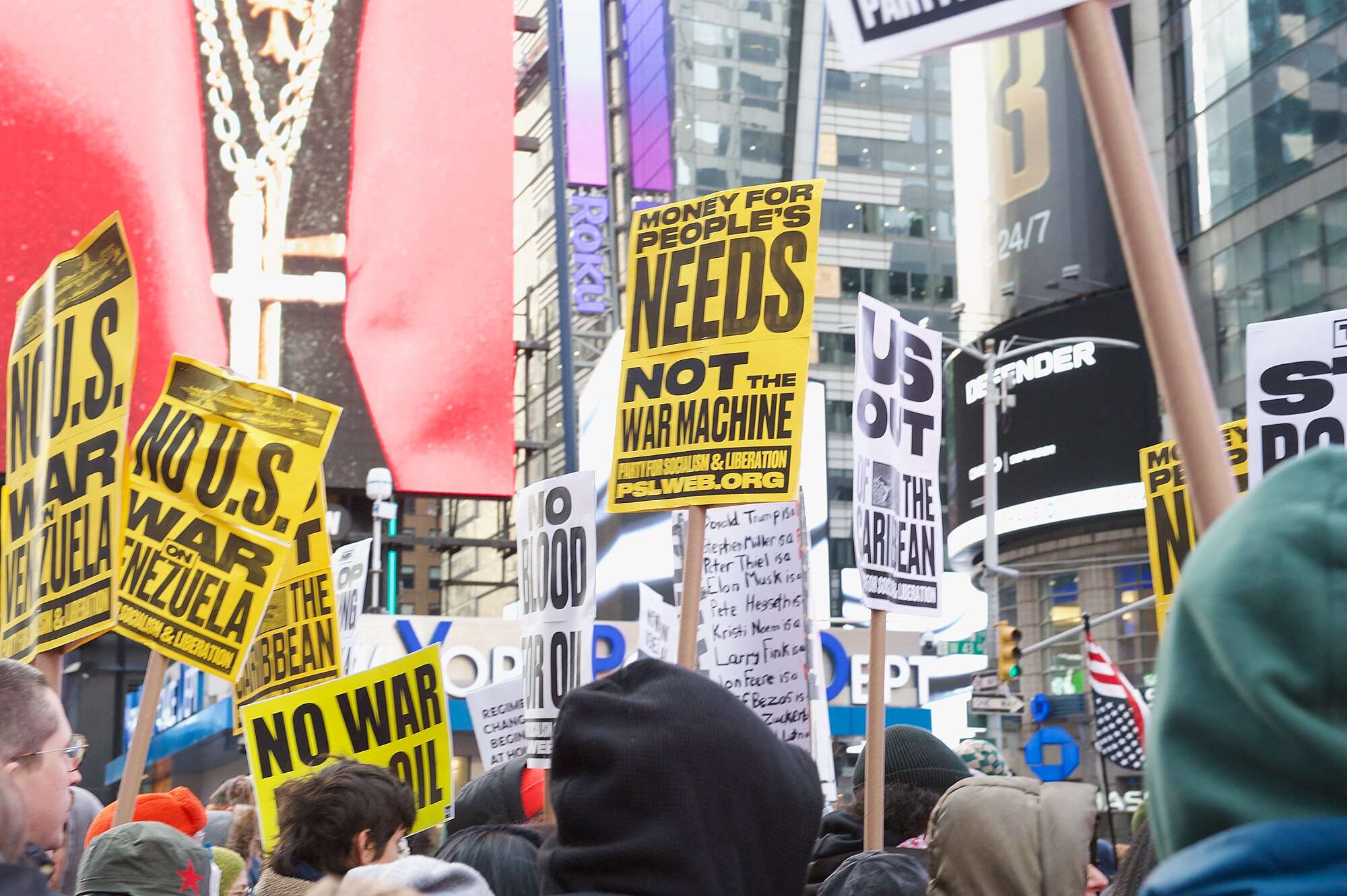
At the beginning of 2026, the US undertook a dramatic military operation on Venezuelan soil, which concluded in the capture of then-President Nicolás Maduro and the US government taking on an open-ended role in the country’s political and economic future. When asked about the length of the time his government would be overseeing Venezuelan affairs, whether it be three months, six months, a year, or longer, Trump vaguely remarked that he thinks it would be much longer than that.
What made this intervention so unprecedented was not the intent of toppling Venezuela’s regime, which is consistent with the history of previous US interference in Latin American countries, but the brazen abandonment of the country’s previous nation-building model in favor of a “resource extraction model.” Through this intervention, and the visible change in the country’s mode of interference, Washington has displayed a clear sign of the erosion of the rules-based international order which originated in the post-cold war power vacuum left by the fall of the USSR. This order held up fairly strongly, with the exception of certain hurdles, over the years until the start of Donald Trump’s second presidency, which has resulted in the US distancing itself from its key allies both economically and militarily.
As mentioned previously, the US intervention in Venezuela represents a shift of policy from diplomatic and economic statecraft to resource-driven gunboat diplomacy. Historically, Washington relied on a combination of non-military options such as sanctions, covert operations, and diplomatic pressure to exert its influence on foreign governments. These strategies were used both to achieve the country’s personal objectives as well as maintain perceptions of legitimacy and moral superiority on the international stage. However, the capture of Maduro through a military operation and Trump’s constant rhetoric about the US government “running” Venezuela indefinitely mark a return of the use of direct force. This is reminiscent of US operations in Iraq and Afghanistan, which have repeatedly been shown to be fatal for their respective populations.
The consequences of this intervention go far beyond South America, or even a single Hemisphere, but resonate globally, ranging from the disruption of the world oil trade to impacts on the expansionist ambitions of China and Russia in Taiwan and Ukraine respectively.
This article argues that while the US-led international system has seen a gradual erosion of its rules-based order over many years, this intervention represents a massive blow that signals its potential end. However, some academic perspectives suggest the “order” itself was always an illusion. Byron Peacock, a teaching affiliate in the Department of Politics at Acadia University, argues there is “little evidence that any such thing has ever really existed outside of the minds of propagandists.” He suggests that the current administration isn’t breaking new ground so much as it is finally admitting the “hard truth” of American interests: “controlling access to and the profits from [Venezuela’s] vast oil reserves.”
While oil reserves seem to have played a major role in shaping US interests behind this intervention, this is unlikely to be the only motivation as Venezuela also possesses a significant global percentage of other resources, including being a leader in reserves of gold, iron ore, bauxite, and thorium.
This concentration of potential mineral wealth, combined with a corrupt regime, made Venezuela a valuable partner for Cuba, Russia, China, and other countries which are perceived as rivals or adversaries by Washington and other Western countries.
Control over these critical resources strengthens US energy security while simultaneously restricting access for its rivals. This is especially true for China, which had previously been steadily deepening its foothold in the area. China’s influence saw an even faster expansion under Maduro after intense US sanctions limited the Regime’s reach on the global stage.
This intervention can also be viewed as a response to China’s counter to Trump’s own tariffs, which took the form of restrictions on rare earth minerals. Rare earth minerals have become increasingly more important for the US economy in recent years due to the country’s dependence on the growth of artificial intelligence and its related infrastructure, as well as Trump’s stated plans to increase US military spending by over 600 billion dollars; an unprecedented increase of more than 65 percent. A restriction on Chinese rare earth minerals severely undermines this historic budget increase, as everything from a simple radio to a fighter jet requires rare earth minerals to manufacture.
Another major outcome of this intervention is the birth of the “Donroe Doctrine.” This is a name given to the aggressive foreign policy of the Trump government in the Western Hemisphere, and was first popularized by the New York Post. “Donroe Doctrine” policy can be seen as a reboot of the Monroe Doctrine of 1823, which endorsed the idea that the Western Hemisphere had to be defended from European influence. That original doctrine has now been repurposed under Trump to assert American dominance and secure resources for the country’s own interests.
Due to the erosion of the rules-based international order, smaller and less powerful states are now more vulnerable than ever due to the deterioration of international law as a protection against aggression. This dangerous dynamic accelerates the onset of a multi-polar world where global powers start to abandon international norms due to regime change becoming normalised.
The invasion of Venezuela has also made it easier for Moscow to attempt to justify its own invasion of Ukraine. By declaring its sphere of influence in the Western Hemisphere, Washington has weakened the perceived moral authority it once held to criticize expansionist projects undertaken by other states.
Parallel to the geopolitical shifts in Eastern Europe, the “Donroe Doctrine” has also managed to disrupt the future of security in the Pacific—particularly in the case of Taiwan which now faces an increasingly ambitious Chinese regime. The Chinese regime claims a sphere of influence over the ‘First Island Chain’ similar to the dominance the US government exerts over Latin America.
In the case of Taiwan, this US intervention also sends a double-edged signal. On one hand, the seizure of Venezuelan oil shipments bound for China demonstrates the willingness of Washington to sabotage Beijing’s global supply chains and directly challenge its dominance, therefore potentially deterring China from annexing Taiwan. On the other hand, the normalization of regime change operations on a global scale without any significant reasoning could be viewed as validating Beijing’s long-standing argument that global powers are justified in asserting control over other states when deemed vital to their national interests. Additionally, if the United States continues to increase its military presence in multiple regions including Iran in the Middle East, Cuba and Venezuela in Latin America, and Europe all simultaneously, Beijing might perceive the US resources being spread thin and exploit the lack of attention in Taiwan to accelerate efforts to realize its ambition of reunification.
Overall, the intervention in Venezuela has led to a new rise in global tensions, the upheaval of global trade and international relations, and pushed us closer to a new multipolar world order.
Canadian Prime Minister Mark Carney emphasized this shift in polarity during his internationally well-received speech at the World Economic Forum 2026. He described the shift as being “a rupture, not a transition” in the global order.
Carney urged the middle powers to unite against the great powers, which have begun using economic integration as weapons, tariffs as leverage, financial infrastructure as coercion, and supply chains as vulnerabilities to be exploited.
The speech also seemed to address recent US actions under the Trump administration. Carney described how the anchor of the rules-based international order has been upheaved by “transactional hegemony,” and commented on great powers distancing themselves from the same order that benefited them most.
However, it would be foolish to reach the conclusion that the position of a global anchor will be lost by the United States anytime soon. What has been lost is the willingness of individual states to play by Washington’s rules due to the federal government’s increasing reliance on hard power. This weakens Washington’s soft power, which had previously been a point of differentiation from other great powers like China or Russia.
To conclude, the intervention in Venezuela has expanded its impact far beyond Latin America, as it represents the deterioration of the US-led international system since the post-Cold War era. This intervention opens doors for new conflicts while simultaneously fueling current ones. Smaller and middle powers like Canada, India, etc., now enter a world where they must be increasingly cautious while making new alliances and realise that historic precedents can be broken and rewritten by their own allies. As Mark Carney warned at Davos, the long running story of the rules-based international order is breaking down. The question now is not if, but how the world order will change.