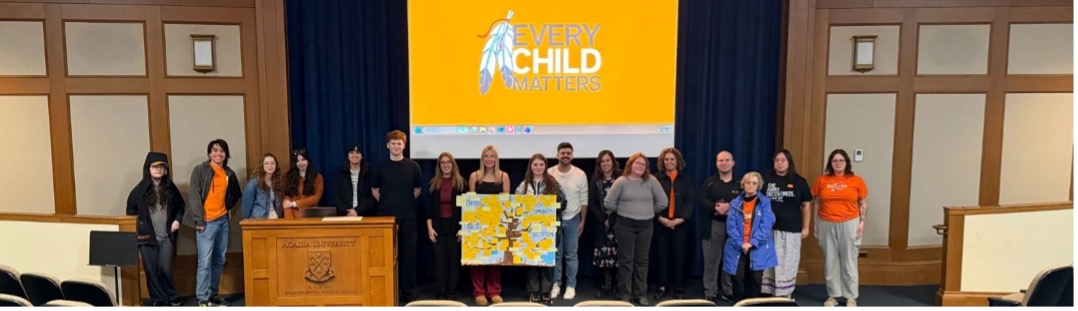
On September 29th and 30th, Acadia students and members of the Wolfville community gathered on the university campus to reflect on Canadian history and reconciliation through the Debbie Toney Indigenous Film Festival. Debbie Toney was a proud member of the Annapolis Valley First Nations and Mi’kmaq Nation, a dedicated university student, and a highly respected Indigenous student leader. In 2021, she received the Nova Scotia Council of the Federation of Literacy Award in recognition for her strength, resilience and dedication. Furthermore, she contributed to Acadia’s first Indigenous Strategy Plan, co-founded the Indigenous Student’s Society Association (ISSA), and the Indigenous Gathering Space. This is just to name a few of her contributions to Acadia and the Town of Wolfville. Through a series of films, the Debbie Toney Indigenous Film Festival, a student-led event in collaboration with the Town of Wolfville, brought together members of the community as well as Acadia students and was an excellent opportunity for reflection. The main event took place on the National Day for Truth and Reconciliation and was more than just a nonstop movie screening. Students and community members who took part had the opportunity to engage with each other and reflect on what they were learning, or as we should say, unlearning.
For the students in Dr. Cynthia Alexander’s introduction to law and politics class, co-hosting the Debbie Toney Indigenous Film Festival meant more than just being another guest in the audience. Students divided themselves into groups and took on different tasks to prepare for the festival. One group was in charge of promotion, another was in charge of the technical side of things and making sure that the films all ran smoothly. Even more groups were in charge of introducing the films and leading discussions afterwards. I think it is safe to say that over the two days, we, as students, succeeded in creating an interactive environment for other students and community members to engage with, and reflect on, an exceedingly difficult yet important topic.
For our part of the festival, Izzy and I oversaw a 20-minute post film discussion after the Tuesday screening of Elsipogtog: The Fire over Water. To encourage the audience to be engaged and reflect deeper on what they had just watched, we led our discussion through what’s often called the iceberg method. We first asked the audience to take a minute and think about the obvious conflicts that they saw in the film. After hearing their answers, we then asked them to turn to each other once again and think about what the deeper causes for these conflicts may have been. This gave us a unique opportunity to hear different perspectives and consider how the issues in the film connect to broader issues concerning Indigenous rights. Our discussion led us to the concluding question: To what extent do Canada’s current legal and political systems recognize Indigenous sovereignty? Furthermore, do they ensure that Indigenous peoples have decision-making authority and that meaningful consultation has been had before going forward with projects on unceded territories?
In this film, we learn of the controversy that ensued when SWN Resources decided to start fracking on the traditional territory of the Elsipogtog first nations. The land was never formally surrendered to the crown, making it unceded territory, which as we previously mentioned, raises questions about Indigenous sovereignty and land rights.
The students who helped run the Debby Toni Film Festival noted that the experience was about more than simply watching the films. One student on the art committee spent the day working on the festival’s canvas, the 4C’s Civic Commitment Portrait, while also welcoming guests, answering questions, and interacting with members of the community.
“I wasn’t expecting as many people to show up to the festival or [for] there to be as much going on,” she said. She also noted that, “The length of the day with all the films, even how big the canvas was for our portrait” was larger than she had expected. She also shared that balancing her different responsibilities was one of the biggest challenges throughout the day. She had to, “make sure I paid attention to the films, but also get the artwork done, [while] being welcoming to the guests and being respectful to the Toney family and other Indigenous members of the community.”
One of the most memorable moments she recalled came from a conversation with a young girl connected to the Toney family. While working on the artwork, they talked about art, school, and Mi’kmaw language and culture. They also discussed the significance of eagles in the Toney family, as well as within Mi’kmaw culture more generally, and how an eagle flying past or circling a home can represent a deceased relative. “There’s one that circles her house all the time which is her papa”, she recalled.
The festival also gave students the chance to learn through direct interactions and conversations. “By running an in-person festival, you were able to learn through others, through their emotion, their life experiences, and their outlooks,” another student commented.
Overall, helping lead the Debbie Toney Indigenous Film Festival was an amazing opportunity. The discussions, which included members of the local community as well as the Mayor and Deputy Mayor of the Town of Wolfville, gave everyone involved an opportunity to question our understanding of history and connect the films to issues about Indigenous rights that continue to affect people today. For us, the most valuable part of the experience came from facilitating a discussion with the audience, rather than just sitting in the crowd. Beyond just demonstrating how student-led initiatives can inspire greater conversation within the wider community, the Debbie Toney Indigenous Film Festival showed the importance of education in standing against the unfair treatment of Indigenous peoples and how community actions can create change.