
Author: athscience

  • Will the Moon Belong to China?


    American and Soviet forces have dominated space activity for the last couple of decades, and China will soon join them. The solar system represents a political and economic source of power. The nations that have successfully explored the moon are honored on earth with more prowess. Space exploration is seen as a symbol of success and a reflection of scientific development.

    To truly understand the beginning of Chinese rocketry, it is important to understand Qian Xuesen. Xuesen attended MIT in America after finishing at Shanghai Jiaotong University. He moved to Caltech to finish his PhD in the 1940’s. He helped to study jet propulsion when the U.S. went to war, and produced technology to counter German rockets. He also co-founded Caltech’s jet propulsion lab. After being accused of being a Communist sympathizer (he firmly denied political involvement) he was denied an application for U.S. citizenship. He was detained from America, and lost his U.S. security clearance. His trip back to China was the beginning of China’s assent into spatial power. Unfortunately, it was also the beginning of China’s opportunity to surpass the United States.

    In the current age, China is doing many things to increase their solar power. In the next 10 years, China is planning to reach the dark side of the moon, something that both American and Soviet space agencies have failed to do. The Chang’e 4 lunar mission is taking shape rapidly and will be a highlight of solar exploration in coming years. The mission team is currently deciding on a landing location as well as an instrument package. Human objects have not gone that far to date, and this will catapult China’s stance on a global level. This mission will hopefully lead to a ‘South Pole-Aitkin Basin’ sample return. The Chang’e 4 will focus more on Physics than Geochemistry, which was the primary focus of the Chang’e 3. When the Shenzhou 5 went into space for 21 hours, China began its rein.

    While NASA’s space budget is roughly 19.3 billion and widely outshines China, China had 19 successful space launches in the last year, which was the second highest in the world. Russia pulled ahead with 26, and America fell behind with 18. It is a very realistic possibility that China will surpass NASA in a couple of decades. James Lewis, a director at the Center for Strategic and International Studies, says that he, “… doesn’t worry about China suddenly leapfrogging [America] I worry about us being distracted and waking up to realize that they have a much more powerful position in space.” The QUESS satellite will likely be in orbit by the time this article is published. Standing for ‘Quantum Experiments at Space Scale’, QUESS marks a first in quantum encrypted information successfully passing between an orbiting satellite and the earth. By encrypting information in quantum states of particles like photons, all security threats are immediately visible to both the sender and receiver. Quantum encryption is academically unbreakable.  During a time of immense global surveillance, the sort of attack that this network could withstand would be immensely strong. It would allow the Chinese military to keep an eye on spies and to swap information. Since China is the only nation using quantum communications in the atmosphere, it puts them ahead by a lot.

    China’s rising spatial capabilities have lead to a conflict between Beijing and Washington. China’s space program is repeatedly cited in U.S. security reports as a growing source of trouble. China might have people walking around on the moon sooner than the U.S. China has also been interested in aligning with nations that aren’t as directly tied to Washington. Nigeria, Venezuela, and Pakistan have all used China’s military satellite navigation system, and this may lead to China aligning with these nations further in the future. Since NASA is unable to cooperate with China due to a congressional ban, it’s unlikely that the U.S. will benefit from these strides. However, many current partners of the U.S. may realign with China if it continues invite other countries to take part in its projects. In addition, if the expiring International Space Station closes in 2024, China will be the only nation up there. It is possible that these activities could be a catalyst for international peace. Since the solar system is becoming increasingly crowded, new decisions will need to be made to navigate a common frontier.

  • The Importance of a Field Course

    The Importance of a Field Course

    In my mind, I am the type of biology major who knows they are going to medical school. I am the type of biology major who has this deep, profound interest in microbiology rather than macrobiology. I am the type of biology major who is inclined to focus upon the complex and intricate world of tiny things as opposed to the way that multicellular organisms relate to one another. I am the type to pride oneself in the ability to distinguish between the convoluted biological processes of cellular communication as compared to the somewhat indeterminate science of how organisms relate to one another. Or so, I thought.

    Try as I might to ignore it, we exist in the world as it is, living, breathing, and decomposing. Though we cannot exist without our microscopic determinants – the large field is where we gain our credibility and therefore our existence. One tends to forget this, as we are focused in the academic pursuit of science and knowledge. As budding scientists, we have a tendency to focus more on smaller and smaller particles. However, science exists at all stages of complexity, whether it be the smallest stages of life, or the large, multicellular organisms that constitute the study of biology as we know it today. While it is important to understand our origins, we exist in a larger ecological picture, and we affect said environment as we move through our world each and every day.

    I was first drawn toward the Bon Portage field course at the persuasion of a close friend.  As BIOL 3013 counted as a full three hour a week class, an additional fall credit, and as it was apart of the biology core as a biodiversity course, what more could I ask for? All that was required of me was two weeks sacrifice of my summer, and the course enrollment fee.  What I drew from the course was more than I had bargained for.

    Bon Portage renewed my passion in biology, the passion that had me signing up to dedicate 100+ hours to the course load. When you are removed from the real world experience, one tends to forget the real world applications of a biologist’s actions  When thinking from a purely scientific approach, it is easy to remove yourself from the natural world. However when immersed in the field, one can visibly see the interactions between our objective understandings and the living, breathing ecological world. The Bon Portage field course reminded me of the reasons why I fell in love with the scientific study of life in the first place.

    Bon Portage gave me hands on experience to view biological processes that I would have only had the privilege of learning the theory of in class. Before, the idea of waking up before the sun to tag birds trapped in towering nets among the forest’s understory would have unsettled me. I could not have pictured myself stomping through worn down mossy trails hunting mycorrhizal fungi fruiting bodies and actually enjoying myself.  Never would I have seen myself reaching into a dark, damp, mysterious burrow in search of a fluffy petrel chick and measuring its physical properties for population estimates. Bon Portage showed me how to be comfortable sleeping in the confines of arachnids despite my initial unrest. The island taught me how to live without taking a shower for fourteen days and still remain completely at-ease in a worn out baseball cap and a sweater that I had not changed for three days on end.

    I expected myself to finish the Bon Portage field course with an additional credit to my diploma and extra time on my fall course load agenda. Instead, the Bon Portage field course taught me how to remain immersed in the field as compared to comfortable in the realm of theory. For all Acadia Biology majors looking to extend their realm of understanding, I implore you to enroll. Bon Portage not only left me with a newfound understanding of my own environment, but with a renewed context of myself in relation to my environment.

  • Habit Formation


    “A man who can’t bear to share his habits is a man who needs to quit them.” 

    Stephen King, The Dark Tower


    Personally, I am a creature of habit, as are most people to some degree or another. This is generally considered to be a good thing by our culture, as it implies reliability, if not anal retentiveness. What does this mean, however, if your most common habit is to procrastinate? I can attest to this (as I am furiously typing this article far too near the deadline), and so am writing this article to not only potentially help a few of my fellow students perhaps pick up a few good habits, but also to help acquire some of my own (Mostly the latter).

    habitformation


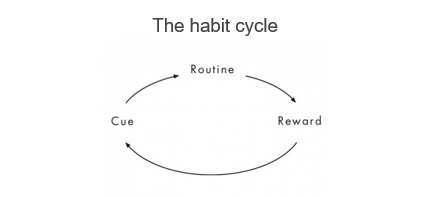
    The habit cycle
    Above is the ‘habit cycle’ as shown in Charles Duhiggs book ‘The Power of Habit’. Duhiggs states that habits are formed as a result of a three part process:Cue – Routine – Reward. Firstly is the ‘Cue’ stage in which some external stimulus prompts the routine in question. Secondly, there is the is the actual habit itself, or the ‘Routine’. And thirdly, and most importantly, is the ‘Reward’ which is why those immediately gratifying ‘bad’ habits stick so easily, yet and habits where the benefits are not immediately apparent do not stick as readily.


    So what can one do with this information? Firstly, let’s look into forming new, positive habits. One would obviously begin by determining the habit to be adopted. Next comes the need to need to determine the Cue and Reward portions, which can be a touch more tricky. The Cue could be anything from a reminder set on a cell phone, to a physical sensation such as fatigue or stress. Then one should determine an appropriate reward, in some cases the activity itself can be viewed as the reward, but in others outside motivation may be necessary. An example could be as follows:


    Cue: Waking up

    Routine: Reviewing one’s course materials for the day

    Reward: Coffee

    As you can see the Cue is simple and regular, the routine is attainable and the reward is reasonable and something the person was going to do anyway. The following is a bad example:

    Cue: Whenever I feel like it

    Routine: Run 1km

    Reward: McDonalds


    In this example the cue is unclear, if existent at all, and the reward itself negates the positive effects of the routine being adopted.


    However, eliminating an old habit is far harder than not forming the habit in the first place. Habits are formed in the brain as a way of, in overly simplified terms, freeing up space in your head so you can occupy yourself with other more novel things. Therefore one should not seek to eliminate old habits, but to modify them into positive ones. So you could look at a (completely hypothetical, of course) negative habit loop like this:


    Cue: Notice an assignment is due soon

    Routine: Look at the assignment after ‘a couple’ of episodes of garbage television

    Reward: Watching television until 3 in the morning


    And adjust it to something like this:


    Cue: Notice an assignment is due soon

    Routine: Do the assignment

    Reward: Watch slightly less garbage television


    All this being said, this process is far easier said than done, that I can personally attest to.


    Sources/Further reading


    [1]http://www.npr.org/2012/03/05/147192599/habits-how-they-form-and-how-to-break-them

    [2]http://charlesduhigg.com/how-habits-work/

  • Sex Trafficking and Data Mining

    Harvard Computer Science graduate Chris White has recently applied data mining tools to make huge leaps in eradicating sex trafficking. In September 2010, Dr. White travelled to Afghanistan to bust an online financial system and confront al-Qaida. While at Harvard, White had studied the intersection between big data, statistics and machine learning.


    Defense Advanced Research Projects Agency

    A mentor introduced Dr. White to DARPA, the Pentagon’s scientific development agency. DARPA stands for the “Defense Advanced Research Projects Agency”. This agency focuses on making huge investments to technology that advances U.S. security. The very first project DARPA completed was the launch of Sputnik in 1957, with the goal being to increase the national security of the United States. Most of their workers are part of the government, but they also employ students who are new to the field. They created not only advanced military technology, such as precision weapons and stealth utilities, but also created a lot of the technology that civilians use today. Such technology includes the Internet, voice recognition, and the Global Positioning System, also known as the GPS. They also created night vision, Agent Orange, and weather satellites. DARPA currently employs about 220 government officials, and nearly 100 managers. It currently has 250 research programs. DARPA aims to help the US stay at the top of the technological game, and releases huge advancements in tech every five to ten years for the rest of the world to enjoy.


    The Birth of Memex

    Attending a DARPA conference taught White about the world and the wars that are taking place. He learned top-level information on the brutality of the tactics used for killing, terrorizing, and defensive mechanisms. This was White’s first introduction to the idea that big data could be used to combat dark problems. While working for DARPA, White learned that the U.S. had too much information on things that were happening in Afghanistan, and that they had a problem with sorting through all of the data they had collected. This problem lead to the development of tools that could help with sorting through huge amounts of information. After leaving DARPA, White decided to take on making these tools easier to use. He called his project Memex, combining the words Memory and Index. The project took three years and around $50 million dollars. The search-engine tool box contained units coded by both industry and university professionals.  The purpose of the project was to mine through data that couldn’t be easily reached on a platform such as Google, Firefox, or Safari. This tool would become helpful in making associations between different ideas and facts, therefore making huge amounts of data visual. The tool would start by going into the dark side of the web.

    The Onion Router

    There are a lot of things that regular internet users don’t know. Only about 5-20% of the internet is open to the public. For example, there are pieces of data that are protected by passwords via social media. However, the lesser known area of the internet isn’t an untraveled place. Most of this lesser known area is accessed through something called The Onion Router (or the “TOR”).  TOR is a free software that allows people to communicate with each other in an anonymous way. It is capable of concealing a location and keeps people from being discovered through traffic analysis. The software is intended to help protect people’s privacy, and also to encourage confidential communication. It was originally developed by DARPA to protect U.S. intelligence communications. However, it has also become popular for people who wish to hide their activity from the government. There are about 2.5 million daily visitors, including ISIS planners and hacktivists. Sex trafficking is unique, as buyers must be able to find their products. This is the exact reason why human traffickers don’t use regular search engines.

    Memex Applications

    Memex is able to search the Onion Router and present hidden sites in a simple list. This sort of accomplishment created huge waves in the possibilities of data mining. Usually, detectives and private investigators would normally spend two weeks working twelve hour shifts every day to search through the same amount of data that Memex is able to search through in moments. These detectives would need to search page by page on Google and write down new information to search (such as an email address), thus losing other pages that came up on the same search page. A tool called Datawake in Memex represents search results as a series of circles. It organizes information in a way that is easy to follow, and allows detectives to look at all of the results all at once without neglecting certain areas first. Old cases lead to new cases, the pattern continues. With these revolutionary changes in the ability to mine huge amounts of data, detectives are making huge breakthroughs on crime stopping technology.


    The power of the internet is only three clicks away.


    For further reading:

    https://www.devex.com/news/how-technology-is-taking-down-human-trafficking-87658

    http://www.popsci.com/man-who-lit-dark-web

    http://www.darpa.mil/about-us/about-darpa

    http://www.memex.ca/

    https://www.torproject.org/


  • Beer and Science

    It’s safe to assume that many of us enjoy drinking beer. However, what we may not know is that beer and science go hand in hand. Humans have been brewing beer for millennia, shaping society as we know today. Believe it or not, many scientific advancements were discovered whilst brewing beer. Another surprising fact is that beer was unknowingly keeping people alive and saving them from disease.

    The Tiny Friends and Enemies of Beer

    As you may or may not already know, yeast ferment the sugars in grains to give us the alcoholic component of beer. But how was beer made in ancient and medieval times if microorganisms were not known about until the 1800’s? In short, the answer is wild yeast. Most historians and scientists agree that beer was discovered by accident. It is hypothesized that grains left in pots would fill with rain water and begin to germinate producing fermentable sugars. Luckily, wild yeast then makes a home in the unfermented beer and converts the sugars into carbon dioxide and alcohol. A brave man or woman decided to consume this new liquid and obviously enjoyed it. Waiting for wild yeast to develop took a lot more time. Medieval brewers unknowingly cultured their yeast by taking the krausen (yeast suspension) and added it to future beers.   Today, much of what we know about microbiology is related closely to beer. In 1857 Louis Pasteur discovered that yeast was responsible for fermentation. Perhaps Louis Pasteur is best known for inventing pasteurization, the process that keeps milk from spoiling. But what you may not know is that Pasteur was originally studying why beer and wine spoiled. Pasteur discovered that tiny microorganisms lived in the beer; yeast and bacteria. Additionally he showed that it was the bacteria converting ethanol into acetic acid (vinegar) which caused the beer to spoil. Pasteur suggested that heating the beer after it was fermented to kill off any bacteria and eventually this process was adopted to help preserve milk. But more importantly from this experiment Pasteur devised germ theory, the theory that disease was caused by pathogens and not from supernatural forces and “bad air”. He concluded that if bacteria could cause disease in beer perhaps it could also cause disease in humans.

    Beer as Medicine?

    Many people would say that the first antibiotic used was in 1928, with the advent of penicillin. However, recent discoveries show that ancient Egyptians consumed beer that contained a natural antibiotic known as tetracycline. In 1980 traces of tetracycline were found in the bones of ancient Egyptians. Scientists were dumbfounded by this discovery as the antibiotic was not discovered until 1948. It was determined by researchers that grains used to make the Egyptian beer contained the soil bacterium Streptomyces, which naturally produces tetracycline. Furthermore, evidence showed that Egyptians knew about their beer’s healing properties because tetracycline was even found in the remains of children. Likely given to the child to cure them of his or her illness. In the middle ages clean drinking water was often hard to come by. Often time’s drinking water would give people diseases such as cholera. In order to prevent people from getting sick they often turned to beer for their water needs. During the brewing process the unfermented beer is boiled, killing off any bacteria living in the water. Additionally hops added for flavour contain alpha and beta acids. We now know today that these acids can inhibit the growth of certain gram-negative bacteria. This information was not known at the time, but people knew that if they drank beer using contaminated water that they would not get sick. We know today that drinking too much beer can make you sick and that chronic drinking can cause liver damage. But who would have thought that at some point in history drinking beer was like drinking medicine or clean water? It is important to note that beer at the time was sometimes as low as 2-3% ABV (Alcohol By Volume) so it could safely be consumed in larger amounts.

    So let us take a minute to appreciate beer and raise a glass for all its contributions. Cheers!

Betzillo positions itself as a versatile gaming hub where structured bonuses and adaptive gameplay mechanics support both short sessions and extended play.

Built with a focus on innovation, Spinbit integrates modern casino architecture with rapid transactions, appealing to players who value speed and digital efficiency.

Ripper Casino emphasizes bold entertainment through high-impact slot titles and competitive promotions crafted for risk-oriented players.

A friendly interface and stable performance define Ricky Casino, offering a casual yet reliable environment for a wide spectrum of gaming preferences.

King Billy Casino channels classic casino spirit into a modern platform, delivering recognizable themes supported by contemporary reward systems.

Immersive visuals and layered slot mechanics are at the core of Dragonslots, creating a narrative-driven casino experience.

Lukki Casino appeals to players seeking direct access and minimal friction, focusing on fast loading times and intuitive controls.

Casinonic provides a structured and dependable gaming framework, blending modern slots with transparent operational standards.