There were two, there were once three
oceans which adjoined the shores of Lake Ontario.
Our pasts:
they drank its fresh water and swam together,
they (they) they.
Lake Ontario,
two lived on its northern border.
Where the winters once bit off innocent ankles, where
we threw the sticks into suspension.
Men will love you: Lake Erie or Lake Superior,
Lake Michigan, Lake Someone.
They will love you and you will love them.
Men will love you, after we laughed.
After we walked on floating trees,
broke up super-still water.
[ Three oceans: you're a Physics professor,
and you find time to read novels. Your kids have deftly
learned to feed the cats. You once saw me on a
train and I was doing laundry and you thought I was
sexy. ]
Yours
was the first face that I saw.
Yours
was a freezing open window
Of course,
there will be Monday mornings and car trips in the backseat
and endless Novembers in the Zoo, where little Martin
tries not to bite at his fingers.
Lake Ontario,
she lived under your arms. And she lived around your twisting coasts.
She breathed the night air and pinkyswore; she loved you like I loved you.
She was crying into the endless nocturne, she sung down the windows and whistled.
She plays the game where you pretend to be a kid again when noone is watching,
And she (she), she didn't cry with the lowest rains. She stands under a radio tower and yells.
She kisses you the night she should have and nothing else has ever happened. Tag: Ontario

Lake Ontario

Acadia Student Elected in 2018 Municipal Election
After a long and contentious election campaign, Acadia student Oliver Jacob has been elected as a Councillor in the Township of McNab/Braeside for the upcoming term (2018-2022) alongside Councillors Heather Lang and Scott Brum, Deputy Mayor Brian Armsden and Mayor Tom Peckett.
Elected at the age of 20, Jacob has become one of the youngest Municipal Councillors in the history of McNab/Braeside and one of the youngest municipal politicians in Ontario today.
Running on a platform of positive politics and building a better community, Jacob was elected with 1212 votes with an estimated turnout of 42%. His election platform included an primary emphasis on community engagement through the implementation of a Community Engagement Strategy and the addition of a Community Development Officer to the staff roster.
“This election has been one of the most rewarding experiences of my life” said Jacob, “There is no doubt that the next four years will be a challenge; however, it will also be our greatest opportunity to build the stronger McNab/Braeside community that we all deserve – together”.
Jacob previously served as a Member of the Ontario Minister of Education’s Student Advisory Council (MSAC), the inaugural Co-Chair of the Renfrew County Youth Network, and the 2017/2018 Chairperson of the Acadia Students’ Union.
Jacob will take office on December 1st, 2018 and will serve until November 15th, 2022.
Colin Mitchell is a fourth year (Honours) Politics student and Editor in Chief of The Athenaeum.

Ontario Municipal Elections Explained
Local governments across Ontario, including the City of Toronto, are currently undergoing municipal elections, in which voters will choose local candidates to serve during the next term.
Every four years, Ontario voters go to the polls on the third Monday in October to choose their local representatives, who will defend their interests and values while in office. Every resident who is at least 18 years of age and a Canadian citizen is eligible to cast a ballot.
Municipal governments focus on issues of local importance, including garbage and recycling collection, animal control, land use planning and development, public transit and recreation.
The City of Toronto
In the City of Toronto, the election is progressing much differently than anticipated when the nomination period opened in May. Toronto is a particularity in Ontario since it is not governed in the same way as the province’s other 443 municipalities. The City of Toronto has greater power and jurisdiction over local issues and covers a much larger area than a typical municipality.

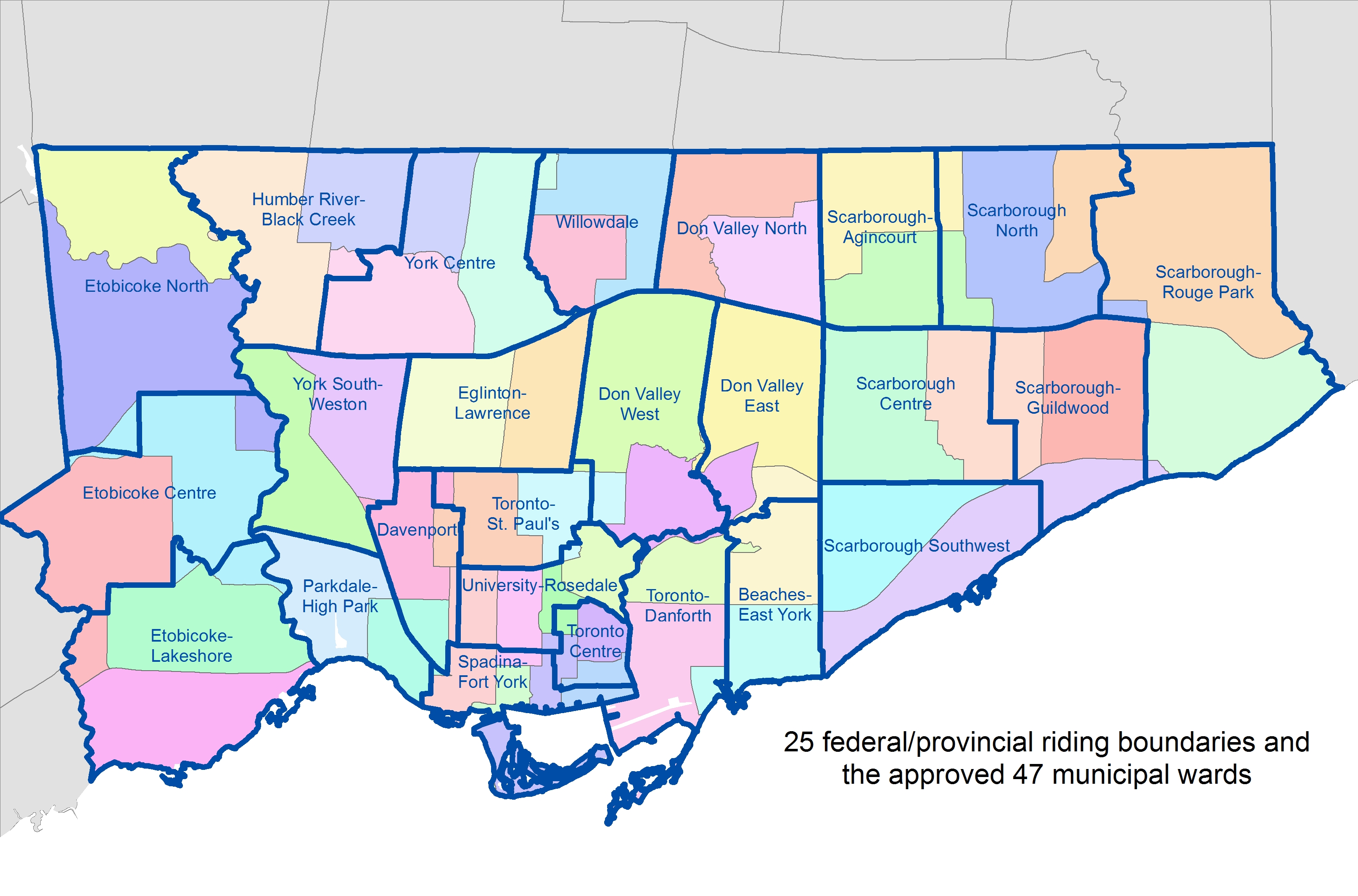
Existing City of Toronto Ward Boundaries Map 47-Ward City Council Map
Over the last three years, Toronto City Council has conducted extensive public consultations and discussions on the size of Council as a body. It currently contains forty-four councillors and one mayor. The finalized ward map, approved by City Council on November 9th, 2016, changed ward boundaries for forty wards and created three new wards. Therefore, the map approved by City Council would have had forty-seven councillors and one mayor.
The changes were then unsuccessfully appealed to the Ontario Municipal Board (OMB), the body that reviews municipal by-laws to ensure that they are in accordance with provincial policy. In the OMB decision, the majority of members agreed that “[…] there are no clear and compelling reasons to interfere with the decision of council.”
The provincial government at the time, led by former Premier Kathleen Wynne, acknowledged that the decision was the prerogative of the City of Toronto and that they would not interfere.

Proposed 47-Seat City of Toronto Ward Map 25-Ward City Council Map
Following the defeat of Wynne’s Liberal government on June 9th, 2018, newly elected Premier Doug Ford and his Progressive Conservative government announced that it would bring forward legislation to circumvent Toronto’s new ward changes and institute a new ward map aligning municipal ward boundaries with their federal and provincial counterparts, reducing the number of City Councillors to twenty-five, plus the mayor.
“We ran on a commitment to restore accountability and trust, to reduce the size and cost of government, including an end to the culture of waste and mismanagement,” Ford said. “Because one thing every politician at every level and in every region needs to remember, is that we all share the same boss. We all work for the people.”

Provincial Plan Map for 25-Seat City of Toronto Ward Map (with underlying 47-seat map for reference) Public Outrage Intensifies
Toronto Mayor John Tory, who is running for re-election this fall, took a hardline approach to the Province’s announcement and called a special meeting of City Council to respond. On August 23rd, 2018, City Council agreed to challenge the legality of Bill 5 (Better Local Government Act, 2018) before the courts by a 33-9 vote.
Ontario Superior Court Justice Edward Belobaba ruled that the Bill 5 (Better Local Government Act, 2018) was unconstitutional on the basis that it contravened the freedom of expression rights of candidates and Toronto residents as guaranteed under the Canadian Charter of Rights and Freedoms. Justice Belobaba further directed the City of Toronto to proceed on the 47-ward map that City Council had approved.
Premier Ford responded by appealing Justice Belobaba’s decision to the Ontario Court of Appeal and by pledging to invoke Section 33 (the “notwithstanding clause”) of the Canadian Charter of Rights and Freedoms should the appeal not be successful.
Opposition politicians blasted Premier Ford for using the seldom-used notwithstanding clause, which allows federal and provincial governments to circumvent the Charter rights of Canadians.
Andrea Horwath, Leader of the Official Opposition, questioned Ford’s intentions and concluded that “we have a power-hungry premier (Ford) who obviously doesn’t care about people’s Charter rights”.
The independent Liberal members slammed Ford for focusing on upending Toronto’s municipal election rather than tackling the real issues affecting Ontarians.
Like his opposition colleagues, Green Party Leader Mike Schneider expressed that “we are debating the premier’s personal grudge match against the City of Toronto” and many of its progressive Councillors.
Final Decision for Torontonians
Ultimately, the provincial government’s appeal to the Ontario Court of Appeal was successful with the Justices granting a stay to suspend Justice Belobaba’s ruling while it is appealed later this fall. As a result, the municipal election will proceed under the 25-ward map that was approved by the provincial government, the first big win for Ford since taking office in June.
Student Eligibility to Vote in Ontario’s Municipal Election
Students from Ontario are eligible to vote in the municipal and school board elections this October, provided that they intend to return following the completion of their education. Check your voter registration status online at www.voterlookup.ca or by contacting your local municipal clerk’s office.
Oliver Jacob is a third year Politics and History major and News Editor of The Athenaeum

Ontario: The New Minimum Wage is Killing Your Jobs
“These new policies will be a genocide on minimum wage jobs”
“A living wage” is what you hear from its supporters, “A genocide on employment” is what you hear from its critics. If you’re from Ontario then you know what I’m talking about. The Wynne Liberal government recently announced that the minimum wage would “gradually” increase to fifteen dollars an hour from eleven dollars and forty cents an hour. This has most people, even those not earning minimum wage, expecting an increase soon. The government of Ontario plans to increase the minimum wage to fourteen dollars an hour by January 1, 2018, then to 15$ an hour by January 1, 2019. That means that on January 1, 2018 Ontario will have a 22.8 percent increase in its minimum wage. As the Globe and Mail states it: “The largest one-year increase in the minimum wage rate of any province over the past two decades”. The implications of the new minimum wage, at least in my opinion, have been underestimated by nearly everyone. The results of this massive increase are going to be catastrophic. “Ontario’s Financial Accountability Office — an independent and impartial agency — published a report predicting 50,000 job losses due to the increase to $15 per hour”. This alone should be enough to persuade you that this increase is not only unnecessary but will be detrimental to the job market provincially. These job losses will not be construction labourers’ or landscapers’, they will be people like you. The issue when discussing minimum wage seems to be that those who earn minimum wage believe that their labour is somehow worth more. While that is a fair opinion to have, I can tell you that it simply is not true. I’ve worked several minimum wage jobs in my life, from floral delivery to pushing shopping carts at a grocery store, all when minimum wage was far less, and those jobs were barely worth what I was paid. There has also been a clear indication that the supporters of this policy think it will alleviate poverty, a premise that is also incorrect, the Financial Accountability Office has said that increasing the minimum wage is not an effective way to eliminate poverty.
Let me tell you something, you will not see a proportionate wage increase if you already work a job at a rate at or greater than fifteen dollars an hour. It’s just not going to happen. The best illustration of that is found when considering how many people will now be working for minimum wage. The number of Ontarians paid the minimum wage would balloon from about 500,000 to 1.6 million. You did read that correctly, the number of people earning minimum wage is estimated to increase by more than a million, that means one of two things: either more than a million people won’t be seeing a raise, or there are that many people currently not earning the new minimum, which would have profound results. On this issue, the deeper you dig, the more abysmal things look. The Fraser Institute, an independent and non-partisan research institute, has this to say about the new wage: “the relationship between the minimum wage and median wage is often expressed as a ratio between 0 and 1. The higher the minimum wage increases relative to the median wage, the closer the ratio gets to 1, and the more likely there will be ‘severe adverse employment effects’ from further increases”. After the minimum wage increase, Ontario will have “one of the highest minimum wages in the world relative to the median wage a local economy can support”. This will be particularly hard for those in the grocery industry, an industry with notoriously small margins. Metro Incorporated is bracing for fifty million dollars in additional costs as a result, Loblaw Incorporated, another large grocer in Ontario, is preparing itself for 190 million in additional costs due to increases in both Ontario and Alberta. These bread and butter industries, no pun intended, are where plenty of people are employed and where plenty will soon be losing their jobs. On a more personal note, this wage hike has affected my own business. After five years of running a small landscaping business that is entirely student-operated, I’ve had to put a freeze on hiring and wages. After combatting some of the latest Liberal changes on the federal and provincial level this policy choice has been the final nail in my coffin. The Canadian Federation for Independent Business has stated rather furiously that they cannot support this minimum wage increase, especially without consulting business owners or considering the ripple effect this will have on small businesses. What once was a fight for a “living wage” has become something that will decimate jobs and increase the cost of living for everyone. There are clear and adverse effects to this new minimum wage. The Ontario Chamber of Commerce is yet another institution that has strong objections to this policy “These sweeping changes will tip our economic balance in a profoundly negative way”. I don’t possess the time or the words to describe exactly how angered the private sector is by these proposed changes. However, I do have an official prediction, these new policies will be a genocide on minimum wage jobs.
Disagree with me? Write for The Ath.
Counting Calories in Canada
Apparently, Ontario has the same New Year’s Resolution as your roommate: to shed a few pounds. As of January 1, 2017, Ontario’s new Healthy Menu Choices Act, 2015, requires that all food service providers within the province with 20 or more locations post the caloric value of all menu items (including drinks) right on the menu. This act is a part of a larger piece of legislation, the Making Healthy Choices Act, passed on May 26, 2015, and effects not just fast-food restaurants, but includes movie theatres, coffee shops, and ‘fast casual’ restaurants as well. The Healthy Menu Choices Act was designed to combat obesity, and create more awareness about ingredients in food so as to encourage more informed decision-making concerning food.
But will it work? Dr. Yoni Freedhoff, assistant professor at the University of Ottawa, sees this act as a quick-fix solution to a more complex problem, stating, “singular interventions don’t solve complex problems. When it comes to diet-related disease, like Type 2 diabetes, obesity, hypertension […] these are not caused by single problems. We need a myriad of interventions designed to help deal with it.” In addition, there is concern that while calorie counting on menus may make a very small impact on the lives of those who suffer from obesity and related diseases, it may bring more harm than good on an already overly food critical society, and may be triggering to those suffering from eating disorders such as anorexia and bulimia.
In New York City, where food-labeling laws at restaurants have been required since 2008, they have found (in a 2012 study in the American Journal of Public Health) that there was little to no difference in food consumption choices in New Yorkers since their laws came into effect. Though Ontario is the only province to have undertaken these measures, Nova Scotia and
Quebec has expressed similar interests. According to Statistics Canada data, 54.6% of Ontario residents over the age of 18 were overweight or obese in 2014, whereas Nova Scotia’s rate stood at 62.6% — among the highest in the country. The chief public health officer of Nova Scotia, Dr. Robert Strang, has strongly supported the Ontario legislation, stating that “I think we do need to look at…having better information on there to allow consumers to make better informed choices around the nutritional or health value of the food they’re looking to buy.” Despite his support for the Ontario HealthyMenu Choices Act, Dr. Strang proposes a more comprehensive approach for Nova Scotia, including not just the amount of calories in a food item, but the amounts of sodium, fat, sugar, and other important components which contribute to an item’s nutritional value. This program has the potential to be more successful than that of New York or Ontario.
Whether you agree with the measures Ontario has taken to combat their province’s obesity rates or not, it is hard to disagree that Nova Scotia’s own high obesity rate is concerning, and needs to be addressed.