
Tag: psychology

  • Psychology is weirder than you thought

    Psychology is weirder than you thought

    When many people think of psychology, there is an immediate mental image of a client on a couch and a therapist with a hovering speech bubble asking, “and how do you feel about that?” Numerous studies over the years, have examined misconceptions of psychology. One such misconception is that psychology is not a science. After all, as humans, we tend to gain confidence in our abilities to understand and predict the behaviour and mental states of others – simply based on our lived experience. And fair enough, but there must be more to it…where does the science come in?

    Whether you want to understand treatment effectiveness, why people develop certain fears, or simply why people persist in actions that cause themselves or others pain, there is an experiment, a study, or most likely an entire academic journal, providing insight based on, well, science.

    Most definitions of “science” will include the word systematic. That is, it is an ordered system under which researchers operate to formulate scientific laws and theories. Given that science requires evidence and critical exposure to scrutiny, it can be tempting to assume it is unbiased. It would be nice if that were true!

    In the case of psychology, some have argued that the discipline has inadvertently presented a skewed view of the human mind. A popular University of British Columbia paper asserted that although a significant portion of the discipline’s trusted research is drawn from Western, Industrialized, Educated, Rich, and Democratic (WEIRD) societies, this population represents a “thin, and rather unusual, slice of humanity.”

    That is, people who grew up in so-called “WEIRD” societies often act, think, and process quite differently than people who grew up in other areas of the world. If you step back from the science lens for a moment and think instead about your personal experience, this is an obvious point.  Whether by watching the news or by engaging with people from different backgrounds, it is apparent that despite our shared humanity, there is significant diversity in behaviour, thinking, and perception.

    In fact, some studies have demonstrated how “WEIRD” subjects tend to be outliers on domains such as visual perception, fairness, and cooperation when compared to subjects from other societies. For example, certain optical illusions that tend to fool people from industrialized contexts do not have the same effect on those who grew up in rural, nonindustrialized contexts.

    This is not to suggest that the aim should be to pit certain groups against one another. A pertinent word of caution, given a bleak history of some scientists seeking to bolster racist, xenophobic sentiments by positing differences between groups that were not backed by evidence. Rather, it is an assertion that research should account for nationality, class, gender, sexuality, race and other identities so that the bulk of psychological insight is not purely derived from a narrow dominant cultural lens.

    A 2018 study examined the geographical diversity of samples in research published in three 2017 issues of Psychological Science, a leading academic journal – and the results were staggering. Not a single study sampled people from Africa, the Middle East, or Latin America, and less than 7% sampled people from Asia, leaving the vast majority of those studied from “WEIRD” societies. So, almost 85% of the world’s population comprised less than 7% of the samples in this leading journal. Researchers tend to acknowledge the extent to which their research can be generalized, but the issue is that when the majority of research shares the same lack of generalizability, at some point, those findings when replicated enough, generally become accepted as the norm.

    The bottom line is that yes – despite misconceptions, Psychology is a science. But perhaps the greatest misconception of all, is one that is taken for granted, even among many at the top of the field. Psychology is the study of mind and behaviour, but until deliberate steps are taken by the field as a whole, the picture that the discipline paints of the human experience is limited at best and flawed at worst.

    Note: This article was produced for our Black and Indigenous print edition from March 2020. The edition was postponed due to COVID-19 and is just being released now.

  • Dr. Rick Mehta on his Teaching Style, Research and Thoughts on Free Speech

    Dr. Rick Mehta is well-known on the Acadia campus for teaching Acadia’s biggest course, Introductory Psychology, but also for being a friendly and active member of the Acadia community. He can often be found going on a run around campus or singing in the Acadia University Chorus. In light of Dr. Mehta’s upcoming talk on “Free Speech in Universities: Threats and Opportunities”, I sat down with him to get some insight into his research interests, teaching style and thoughts on issues university students are facing today. 

    Dr. Mehta began his post-secondary education with his B.Sc. at the University of Toronto in Scarborough from 1989 to 1993. He debated doing a biology and psychology double major but settled instead on a neuroscience degree which he felt was the best of both worlds. From 1994 to 1996, he did his M.Sc. in psychopharmacology at McGill University to study the effects of drugs on rats’ brains. This was challenging due to a very uncomfortable allergy to rats and so he then switched to studying how people learn about correlations between events (and their role in decision making) as his Ph.D. project at McGill. After completing a three year Post-Doctoral Fellowship at the University of Winnipeg, Dr. Mehta came to Acadia in 2003.  

    When asked about what he finds special about Acadia, he remarked at how, even being in a class in Acadia’s biggest classroom, Huggins 10, one can still feel a sense of community with those around you. This sense of community and belonging in a group appeals to him and, along with the pure joy of creating music, is the reason why he takes part in the Acadia chorus. He enjoys this opportunity to be equals with his students and to interact with them as peers rather than as a professor standing in front of them in a classroom. 

    Introductory Psychology is a course that many students find themselves taking at one point throughout their Acadia career, and Dr. Mehta’s teaching of it has helped to make it quite popular. He always arrives a few minutes early to chat with students and plays a song at the beginning of every class. To him, the necessary formula of a good lecture incorporates content that is both accessible and structured above all else but woven as much as possible with breaks for humour. Indeed, when I asked him if there was someone he’d encountered throughout his career who’d inspired him to teach in the unique style he’s adopted, his answer was to show me his forearms. Tattooed on his arms, are the faces of Rush band members. He explained to me that he tries to integrate what Rush does in their music and concerts into his teaching. The band member Neil Peart is the serious one in the group who writes the lyrics, while Geddy Lee adds structure and Alex Lifeson infuses humour and improvisation into Rush’s songs and concerts. To Dr. Mehta, these are the three most important elements he wants to incorporate into his teaching. Like Rush, he has something serious to share but wants to deliver it with as much joy and accessibility as possible.  

    Dr. Mehta’s research interests lie in the field of decision making. Recently, he’s been looking into the role of various predictors that play a role in decision making tasks. One predictor that he described was the Cognitive Reflection Test. This is a test where a question may be worded such that there seems to be an intuitive answer but it’s actually incorrect. An example question looks like this: “A bat and a ball cost $1.10 in total. The bat costs a $1.00 more than the ball. How much does the ball cost?” Many people would say ¢10 whereas if you really think about it, the answer is ¢5. Recent research suggests that low scores on this task are associated with real-life outcomes such as  increased credit card debt and failing to secure our computers (e.g., not being careful about our privacy settings when using social media). 

    Other predictors he has studied include the ways people process information, how much they enjoy being challenged, how much faith they put into intuition and how they reason with numbers in relation to decision making. These types of studies are relevant because there are plenty of everyday examples where quick decision making is necessary but can have consequences on a person’s well-being. For example, nutrition labels are supposed to be easily accessible to the public, and yet his research group has found that complex numerical and reading comprehension skills are actually needed to fully understand them.  

    I asked him if he had any advice to share with students who may be interested in also pursuing a career in research and his advice was to follow your strengths and to think creatively about your options. While the high level of competition for research jobs in the academic context may make a career in research seem daunting, there are plenty of alternative places to look to gain interesting experience. For example, research jobs in the private industry, government or military may have less competition and be just as interesting and rewarding. 

    Since Dr. Mehta’s upcoming talk on free speech has been a highly controversial topic in universities in Canada and the United States, I asked him for a preview of his stance and objectives in giving it. I learned that his goal is to address a persisting issue and to provide an outlet for a discussion that avoids setting off a rally or further polarization of viewpoints. He plans to provide evidence of a growing lack of civil discourse in universities and so a polarization of viewpoints leading to a new kind of discrimination. As he put it, “throughout human history, people have had a tendency to separate ourselves into us versus them groups, and the growing trend now is for people to discriminate against each other based on their views or ideas.”  

    His hope in giving this talk is to reach out to people who disagree with him so as to be able to follow up his talk later with a well-rounded panel discussion that has the potential to start a conversation within the university community. He plans to bring evidence from studies and incidents on Canadian and American University campuses to discuss how to approach this challenging subject. He feels that suppressing hate speech will not be the most effective way to eliminate hate and will bring ideas for how else to address this problem. He plans to discuss the shift in political ideologies on campuses across Canada that have inadvertently shifted to become disconnected with the rest of society. His concern with this being, that if viewpoints go very far in one direction, it can lead to a polarization that creates a rebellion for polarization in the opposite direction. This issue and debate exists in university campuses across North America, and if you can’t talk about it in university, then where can you talk about it? 

    To hear more about Dr. Mehta’s impressions of the factors affecting free speech in universities, join him for his talk “Free Speech in Universities: Threats and Opportunities” from 7 to 8:30pm in BAC 132 on September 27th, 2017. 


  • Your Resolution: The Psychology of Habit Formation

    “New Year, new me,” or so the expression goes. You’ve made a resolution and this time you’ve sworn to see it through. But as the new semester starts and the assignments start rolling in, that today’s the day mentality starts to turn into I’ll start tomorrow. There’s no shame in not achieving your New Year’s resolution. In fact, you’re probably not alone. A recent public survey found that only an approximate 40% of adults complete their New Year’s resolutions. But what if I told you that there was an easier way to achieve your goals and make that resolution of yours a reality? With a little help and understanding of the psychology of habit formation, this could very well be.

    Like many motivated individuals, you’ve probably decided to go all out in the pursuit of achieving your New Year’s resolution. I want to quit smoking, so I’ll go cold turkey. I want to lose weight, so I’ll go to the gym seven days a week. I want to eat healthier, so I’m going vegetarian this year. Your resolve is certainly admirable, but not necessarily set up for success. Drastic changes in behaviour are not sustainable for long-term objectives because of lacking foundational habits. Quitting smoking is difficult if you’re used to smoking several times a day. Going to the gym seven days a week is difficult if you’re simply starting out of the blue. Eating a primarily vegetarian diet can be difficult if you haven’t done your research on what nutrients you need and haven’t planned out meals that are filling. If it is not a regular behaviour, you are more likely to return to your old habits.

    Habits are defined as a settled tendency or practices in response to environmental cues. Habit formation is the process of replacing these certain behaviours with new ones. As many of us may know, developing new habits can be rather difficult. As the adage goes, you can’t teach old dogs new tricks … unless you have the patience for it. One of the first steps of habit formation is to be aware of the habit you are trying to replace. If you are a repeat offender of biting your nails, the first step is to realize when you are biting them. These bad habits occur often mindlessly, so to recognize and acknowledge these actions will be the first steps to habit formation.

    “But it’s hard!” may be a complaint that you have. Changing habits has a tendency to be so. This is where step two comes in. Initiate reminders to help motivate you to stick with your new habit. If you want to go to the gym first thing in the morning, set an alarm. If you’re prone to snoozing, set multiple alarms. Pack your gym bag the night before and place it directly across from you so that in the morning it’s the first thing you see. Set your coffee maker to automatic and start your day with a good old Cup o’ Joe. Put your sneakers directly by the door. Develop your environment so that it is a constant reminder of your goal and leave yourself no excuse to break the habit.

    This being said, it’s important to do this in stages. There is a difference between training yourself into go into the gym more frequently and forcing yourself to go seven days a week. This is the easiest way to burn yourself out, and the fastest way to disturb habit formation. Going all out for the first week will most likely see you relapse into your old ways because you have failed to establish a habit. You are going to the gym with a feeling of reluctance, not because you have trained yourself to want to go. If you develop a habit over time, the likelihood that you will relapse to old habits is significantly less and will help you achieve your goal in the long run. It is better to teach yourself to go to the gym twice a week for an entire year than it is to go everyday for the first two weeks of January.

    The last step is to actually have a goal. Many of us start the New Year by saying that want to lose weight. But how much weight, and by when? You want to quit smoking, but by when? Having an actual goal in mind will help with your overall levels of motivation over the year. By setting small goals to achieve over a longer period of time, you will feel rewarded each time a smaller goal is met. A resolution is a marathon, not a sprint.

    With these things in mind, good luck in the New Year!


  • How do we Process Speech?: Recognizing and Processing the Spoken Word

    How do we Process Speech?: Recognizing and Processing the Spoken Word

    How do we process speech, taking small features of the sounds emitted from one person and somehow finding meaning in them? Psycholinguistics seeks to illuminate how this process occurs by producing models that break down its steps and elements.

    Recognizing spoken words is different than reading because the auditory input reaches the ear over time, and is not processed as a whole. The Cohort model suggests that when we hear the first part of a word, our minds make a list of candidates that start with that sound, called “cohorts.” As we hear more of the word, these candidates are ruled out one by one until only the correct word (the target) is left. In the TRACE model, however, sounds that are consistent with a candidate give it “activation” and when a candidate has been activated enough, we correctly identify it as the word we are hearing. No candidate is ever ruled out entirely, only activated or deactivated based on how consistent it is with the incoming speech sounds.

    One way to determine which model is better is to look for rhyme effects. Since the Cohort model (representing the category of feed-forward models) rules out any possible candidates that don’t sound the same as the perceived word at the beginning (words that aren’t cohorts), words that rhyme shouldn’t ever be considered. In TRACE (representing the category of continuous-mapping models), because words that rhyme with the correct word share the same word-end, they should become activated once the end of the word has been heard, and thus briefly considered as candidates. Rhyme effects refer to just that: these candidates (called rhyme competitors) being considered in the processing of spoken words.

    Past studies using behavioural methods such as priming and reaction time have failed to find rhyme effects, which is evidence in favour of the Cohort model. But recently, researchers have started using electroencephalogram (EEG; recording the electrical activity on the scalp) and eye tracking methodologies to look at the issue. They have been able to show that people react differently to rhyme competitors than they do competitors that don’t sound at all like the target word, which supports the idea of rhyme effects, and thus the TRACE model.

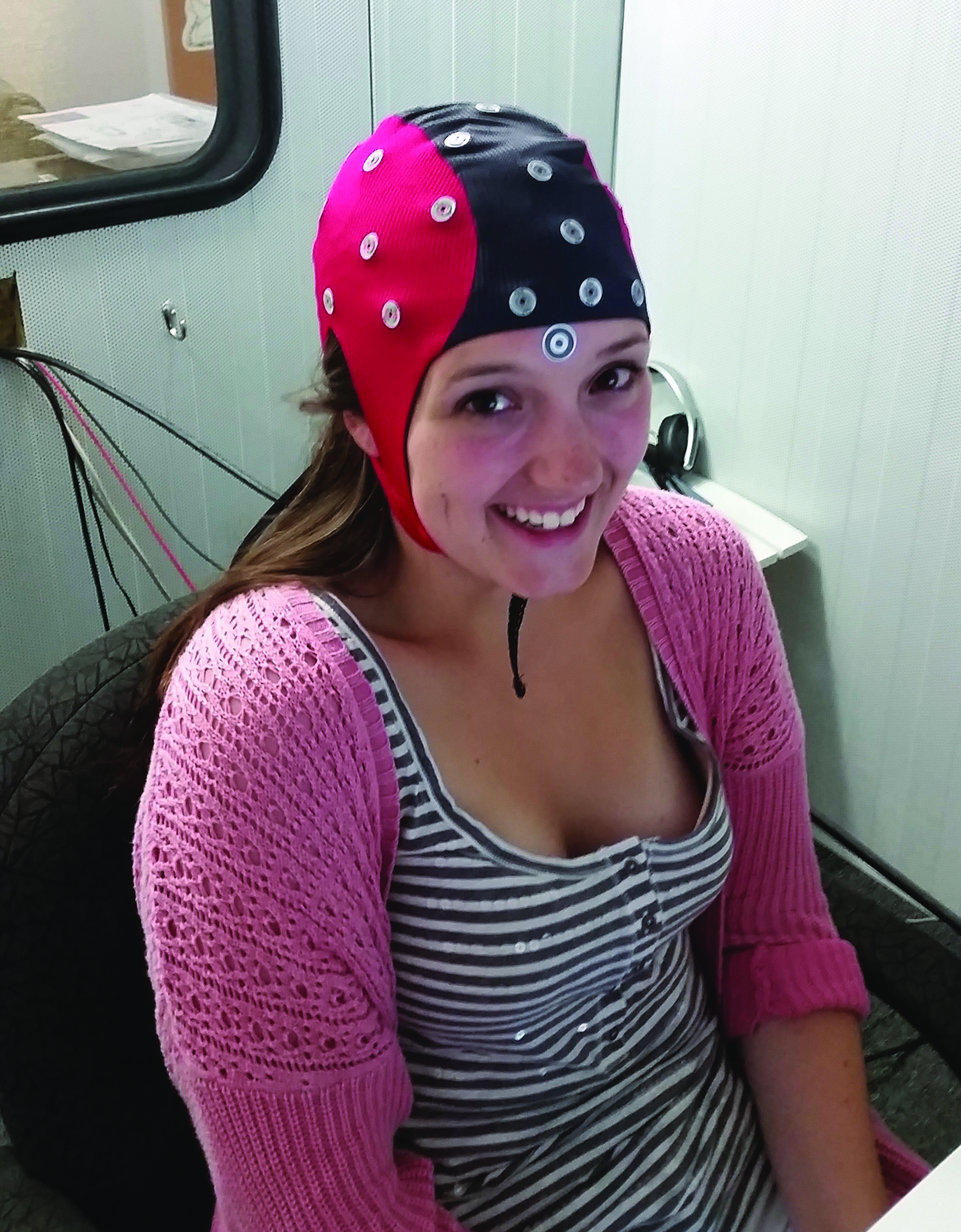
    Neither EEG nor eye tracking are perfect, but research in other areas of psychology has been able to use them simultaneously to cover some of their limitations. In order to provide better evidence for rhyme effects, my research recorded scalp activity and eye movements at the same time, so that the scalp activity that occurs directly after a person’s eyes fixate on a picture representing different types of competitors (target word, cohort, rhyme, unrelated) can be analysed. In an audiometric (soundproof) chamber at the Cognitive Neuroscience Laboratory of Acadia University, participants were set up with an EEG cap and calibrated for the eye tracking camera. They were shown sets of four pictures and were instructed to click on the one that matched a spoken word they heard played. Each set of pictures always included a target (e.g. cone) and an unrelated competitor (e.g. fox), and depending on the trial, it might include cohort (e.g. comb) and/or rhyme (e.g. bone) competitors.

    The EEG results were inconclusive. Although the overall analysis indicated that there were significant differences between scalp activity following fixations to different competitors, the statistical power was not great enough to fully distinguish between them. However, analysis using more liberal statistical tests did find an indication that fixations to the competitors that started with the same sounds as the spoken word (target and cohort) were different from the competitors that started differently (rhyme and unrelated). The eye tracking results were more definitive, finding that people were significantly more likely to fixate on the rhyme competitor than the unrelated competitor after they heard the last portion of the spoken word. Additionally, people were slower to fixate on the target when a rhyme competitor was present in the picture set, indicating that they were distracted by the rhyming word. Both of these results provide support for rhyme effects.

    The combined eye tracking/EEG methodology has a great deal of potential to explore topics in cognition as a whole, not just in psycholinguistics. My current study failed to find the anticipated rhyme effects in the fixation-related EEG signals but it did validate the method by finding alternate effects and identified several limitations and suggestions for future studies using the same technique to take into account. As for the models, evidence is mounting that we process language in a continuous fashion, taking into account all aspects of the word. Models like TRACE are more complicated than alternatives such as Cohort, but they are flexible and can better explain the results seen in the current study and the rest of the literature.

Betzillo positions itself as a versatile gaming hub where structured bonuses and adaptive gameplay mechanics support both short sessions and extended play.

Built with a focus on innovation, Spinbit integrates modern casino architecture with rapid transactions, appealing to players who value speed and digital efficiency.

Ripper Casino emphasizes bold entertainment through high-impact slot titles and competitive promotions crafted for risk-oriented players.

A friendly interface and stable performance define Ricky Casino, offering a casual yet reliable environment for a wide spectrum of gaming preferences.

King Billy Casino channels classic casino spirit into a modern platform, delivering recognizable themes supported by contemporary reward systems.

Immersive visuals and layered slot mechanics are at the core of Dragonslots, creating a narrative-driven casino experience.

Lukki Casino appeals to players seeking direct access and minimal friction, focusing on fast loading times and intuitive controls.

Casinonic provides a structured and dependable gaming framework, blending modern slots with transparent operational standards.