Tag: computer science

  • Robofest 2019

    Robofest 2019

    Robofest is a robotics programming and building event created by Lawrence Technological University. Acadia University is one of their many partners, and as such, we host a Robofest event every year here on campus. This year, it will be held on Saturday, February 16th. Robofest is aims to encourage high school students to take part in building and programming robots. Each year, there is a unique game for Robofest – this year, the game is called “Binary Blocks”. The objective is for each team’s robot to be able to construct a binary number using black and white tissue boxes to represent “0” and “1” respectively, then stack the remaining boxes vertically. This year, the world champions “Royal Robots” from Annapolis Royal, N.S. will be looking to defend their world champion title. The team placed 1st in the Unknown Mission Challenge and 2nd in the Robot Game, at the ROBOFEST World Festival in Michigan in May 2018.


    Robofest is important to the community as it provides a hands-on opportunity for high school students to learn skills they would otherwise not be exposed to in the classroom. Academically, it teaches engineering through the building of the robot itself, and computer science is used to program it. The event also teaches them to work together and cooperate as a team. Teams come from all over the Maritimes to Acadia University to compete, and they all come with innovative solutions for robot building and programming. The energy and ingenuity the students can bring to this event is unrivaled, and it will be amazing to see what they come up with to solve this year’s challenge. Acadia University and its surrounding community members/organizations supply over one hundred volunteers for this event. It is an exciting day that brings many people of all ages, backgrounds and fields of study together.


    For more information see : https://www.facebook.com/AcadiaRobotics/ or https://robots.acadiau.ca/id-2016-17-championships-information.html


  • Acadia Hosts 12th Annual Robot Programming Competition

    Acadia was the host of the 12th Annual Robot Programming Competitions on March 4th, 2017. The Robotics Championship includes students from all grades, and is a great way to increase awareness of Computer Science and the Acadia facilities. Groups must go through a pre-Championship round of competition before they are able to progress to the Acadia event. The day included an appearance of the Michelin Man, lots of candy, and more enthusiasm for Computer Science. Key people involved with the event include Gary Walsh, Jenna Watson-Findley, Sidi Yang, Dr. Danny Silver, and Bailin He. Young people are provided with robot pieces in the fall, and must construct it according to a designated design plan. After that, they learn about Computer Science concepts such as loops, variables, and repetition. Robots are programmed to detect changes in color, changes in distance, and other fun things. This years theme was Animal Kingdom, and different events focused on things such as farming and wildlife protection. The competition is a great way to engage young people with developing programs in a supportive and team-oriented environment. The day consists of a Core Values competition, the main event, and a Sumo Challenge. The event took place in the Beverage Arts Centre and the Acadia Gym.

    Winners of the 2016/17 Robot Programming Competition

    FIRST® LEGO® League (ages 9 to 14):

    • Champion 1stPlace – Royal Robots – Annapolis West Educational Centre
    • Champion 2ndPlace – Techsperts – East St. Margaret’s Elementary
    • Robot Performance Award 1st Place – Royal Robots – Annapolis West Educational Centre
    • Robot Performance Award 2ndPlace – 21st Century Space Guys – Kentville Neighbourhood Team
    • Mechanical Design Award – Armbrae Dragonites – Armbrae Academy
    • Programming Award – Clayton Park Wildcats – Clayton Park Jr. High
    • Strategy and Innovation Award – Robo Lobo Wired – Wolfville School
    • Core Values Inspiration Award – LEGO Intelligence – Colchester East Hants Library
    • Core Values Teamwork Award – Trurobotics – Truro Public Library
    • Gracious Professionalism Award – 21stCentury Space Guys – Kentville Neighbourhood Team
    • Project Research Award – Dynamic Robotic Duo – Halifax Community Group
    • Project Innovative Solution Award – Legos R Us – Imhotep Legacy Academy
    • Project Presentation Award – Hippie lEgo loV3rs –Halifax Neighbourhood Team
    • Judges’ Award Against All Odds – Robotic Roadrunners – Sydney Community Team
    • Judges’ Award- Honourable Mention Award – Sisters of Science – Kingston Community Team

    Global Innovation Award Team Nominee (certificate) – Legos R Us – Imhotep Legacy Academy

    ROBOFEST® High School Robotics Competition:

    Game Competition (RoboHit)

    • 1stPlace – King’s-Edgehill School 5 – King’s-Edgehill School
    • 2ndPlace – SJA Team A – Sir John A. MacDonald High School
    • 3rdPlace – Robats – Horton Community Team
    • 4thPlace – Royal Robots – Annapolis West Educational Centre


    BottleSumo

    • 1stPlace – King’s-Edgehill School 6 – King’s-Edgehill School
    • 2ndPlace – Robats – Horton Community Team
    • 3rdPlace – SJA Team A – Sir John A. MacDonald High School


    Outstanding Rookie Coach Award:

    (FIRST® LEGO® League) – Juan Carlos López & Eduardo Vaz – Axe Robotics – Wolfville

    (ROBOFEST®) – Nevin Pick – Lockview

    Outstanding Coach Awards:

    (FIRST® LEGO® League) – Andy Pitter – Robo Lobo Wired – Wolfville School

    (ROBOFEST®) – Chris MacDonald – SJA Team A – Sir John A. MacDonald High School

    The Lynn Chipman Memorial Outstanding Volunteer Award: Sidi Yang

    Karen Wilder Award – In recognition of perseverance, resilience and courage in overcoming challenges. (named after the former Director of the Program): Martin Main


  • Acadia Computer Science Begins a Presidential Election Period

    On January 30th, 2017, the Acadia Computer Science Society opened a Presidential Election period for Computer Science students and society members. To vote, students were asked to email [email protected] with their selection for president. The deadline to vote was Feb. 3rd, 2017, leaving a week for presidential nominees to campaign for a spot as the society president. Below are profiles of the teams running.


    Colin Mackenzie and James Hally as Co-Presidents:

    Hello! We, Colin and James, are running for co-presidents of the ACSS next year. We would be a great choice as co-presidents because we are experienced leaders actively involved in our department and community. We have the privilege of being the two Junior Executives of this years Computer Science Society which gives us insight into the challenges of running the society. I (Colin) have had a lot of leadership experience: I was the president for my high school Interact team, worked very closely with Rotary and Rotary International, and participated in the internationally recognized leadership camp R.Y.L.A. It taught me a lot about specific and general ways to become an effective leader. I (James) have extensive experience in teams, participating actively in dozens throughout high school and my time here. I’ve learned a lot about working with others and encouraging involvement. We plan to build on the current success of the society with new ideas and fun events for next year.


    Hope Latta and Sid Kondapuram as Co-Presidents:

    Sid’s been involved in the community ever since high school. He’s volunteered at hospitals, and libraries. Since coming to Acadia, he’s been a columnist and subsequently the editor for the school newspaper. He’s dying for an opportunity to be part of a student executive team. Hope won the President of the Year Award last spring for her work with Musical Theatre. She’s also been a Section Editor for the school newspaper, a Comp Science Rep. at WISE Acadia, and Vice-President Internal at the Acadia Pre-Law and Legal Society. We both think Computer Science is really awesome and we have lots of fun ideas for next year!


    To learn more about the Computer Science society, check out the Acadia Computer Science Society on Facebook, or email [email protected].

  • Acadia Computer Science Presents a Text Editor Seminar Series

    On January 13th and January 20th, the Acadia Computer Science Society (ACSS) and Jodrey School of Computer Science (JSOCS) hosted a seminar on how to use text editors. This seminar was put together for students in Computer Science and for anyone who is interested in coding. The importance of learning how to use a good text editor could be compared to the importance of strength and endurance training for athletes. Competing in a game for the athlete is like coding for a computer scientist, the training part is learning to use the editor! In the same way that there are different programs that manipulate documents, such as Microsoft Word, PowerPoint, or Excel, there are different editors that exist to make coding easier. These programs include text editors such as Vim, Emacs, and Sublime Text. The seminar took place every Friday at 2:30pm. During the seminars, students learned how they could program efficiently, and about the advantages and disadvantages of different editors. During the first week, the society arranged a “Battle of the Editors” where the competitors: Jim Diamond, Duane Currie, and Samuel Coleman (and Edwin Kravčenka as a sub) each picked a different editor and tried to sell it to the group. It was a fun seminar, with a great turnout and lots of enthusiastic participants. The speakers attempted to time themselves when coding passages to show the difference in efficiency between editors. Samuel Coleman joined the room (in the K.C. Irving Centre) via Virtual Network Computing (VNC). During the second week, Jim Diamond and Duane Currie continued to teach Computer Science students about keyboard shortcuts at the Beveridge Arts Centre. Handouts were provided, as well as lots of additional information. This occasion was a fun experience for all, and was very useful. It was a great way to learn more about different educational tools in an enjoyable style. The Computer Science Society will be hosting a LAN party on February 3rd from 7:00pm-12:00am at Carnegie Hall for anyone that would like to learn more about the University’s Computer Science Society. To learn more, search for the “Acadia Computer Science Society” on Facebook.


  • Acadia Computer Science Society Teaches Acadia Students HTML

    189087_137606902976995_5646164_n

    On November 3rd, the Acadia Computer Science Society presented an Introduction to Programming workshop for non-Computer Science majors. The workshop allowed people to explore HTML without the commitment of signing up for an introductory computer science class. The workshop took place on the second floor of Patterson Hall, and provided a warm and friendly environment. Acadia Computer Science Co-Presidents Hayly Thackeray and Mrugakshee Palwe led the event and encouraged everybody to discuss why they chose to come, and talk to the people around them. The program allowed students (and some faculty members) to explore programming in a nice environment. The event also provided catering which was kindly received by the participants.

    Participants learned how to code a website and learned how to change font, headings, and pictures. They also learned how to read basic HTML, what headings were, and how to transfer code into a website. The project allowed for lots of creativity and gave people a way to express their interests via a website. While some made autobiographical websites, others made websites based on their interests, such as music, theatre, and sports. The interactive nature of the learning environment contributed to a fast paced exploration that brought people together. The program also discussed ways that people learn, and allowed people to design what felt familiar for them. After the workshop, it was interesting to see all of the ways that people could approach the same task differently. It was also interesting to see how many people found the event exciting and inviting. There are lots of great ways to get into computer science without taking a course in the field. Using websites to learn how to code is a great way to start.

    HTML is especially fun, because it can show you a visual representation of what you have figured out to complement intuitive instructions. The event represented a combination of computer science and general learning aids, and enriched the Acadia campus. Such events promote inter-disciplinary education, allowing majors from sociology, English, and physics to come together to experience the same education. Such a simple workshop shows that it’s possible to combine lots of areas of study and that people can work together when it comes to computer science. The Computer Science Society is a great way for people to learn about what is happening in the scientific world, and for people to access education that could really help them in the future. Allowing people to gain hands on experience with coding opens doors for anybody that might want to pursue the field in later years.

    Getting into computer science can be hard, because there aren’t a lot of ways for people to learn about code through the current education system. Elementary schools and middle schools are working on implementing computer science studies, but it is a difficult process. Attending a pop-up workshop with a local computer science group is a great way to learn more about the process of creating a website, or a piece of code. It’s also a great way to meet like-minded people. The event was fantastic, and received great turnout.

    To learn more, email [email protected] or message the Society on Facebook (“Acadia Computer Science Society”).

  • Girls in Technology

    girls-in-technology-picture

    Hayly Thackeray watched the feature documentary with excitement. She sat in the audience at a girls-in-technology event in the Annapolis Valley. The room was full of excited viewers; however, Hayly noticed that she was the only female that was within the target age group (18-20). The luxurious film left Hayly wondering if there was a way she could change that. After watching the film, a spokesperson for the event asked her to answer some questions about the content of the film and eagerly waited for her response. With uncertainty and surprise, Hayly answered each question. In that moment, she realized that the lack other young women at the event provides her with a spotlight for discussing her experience.  The excitement of the film and the urgency of its content inspired Hayly to take action.

    Five years later, Hayly is working on an honours thesis at Acadia. Her work with Girls Get WISE and the Acadia Computer Science Department addresses the gender gap and works to change it. Given that the number of available Computer Science jobs will surpass the number of people expected to graduate with a Computer Science degree, Canada will be at a disadvantage. A country that isn’t utilizing half of its population is one that will be left behind. Studies show that girls and boys are equally good at math. Young women shouldn’t be left behind.

    During the summer, Hayly and a team of Acadia faculty members, put together a curriculum for young girls. “Girls already feel like they don’t belong in Computer Science, and so if you put a bunch of guys in the room, girls will try to use their gender as a way of making themselves unique. Instead of making something cool, like a dancing taco game (which we had), they create ‘pink games’. Everyone wants to be unique in their own way. You want to have something that makes you stand out. Women feel the need to make themselves stand out in a room full of men through gender. We want to avoid that [at the camp] and tell women that they are unique without just being a women,” says Hayly.

    This is what makes the summer program so special. It gives girls a way to both learn about coding and also explore their individuality. The best part? 75% of girls who attended said they would continue programming after the program. The current percentage of girls in Computer Science is 8% at Acadia. In most universities, it’s 20%. Acadia needs to recruit more women and has been doing so with organizations such as WISE (Women in Science and Engineering) and through projects like the summer program. With so many great resource on campus, we need to get more women excited about programming.

    While there are many things that need to change, being part of the Acadia community can lead to positive improvements in coming years. Keeping programs exclusive and starting kids young improves their ability to create unique games. Being cautious not to allow girls to use their gender as a starting block, and instead encouraging them to focus on other aspects of their personality, allows for positive progress. For more information on Computer Science events for women, check out the Acadia Computer Science Society and WISE (Women in Science and Engineering) Acadia.

  • WISE Acadia Celebrates Diversity in Computer Science

    On Tuesday, October 18th, WISE (Women in Science and Engineering) Acadia presented a collection of poster presentations bringing together a variety of researchers from across campus. Each poster represented a unique way to look at how technology can be applied to different fields. In addition, the event included a talk by Dr. Anne Condon titled, “It All Computes: Celebrating Diversity in Computing”.  The event took place in Fountain Commons, and brought together women from all scientific disciplines to address women in Computer Science. Each poster brought a good topic to the conversation, and the event overall encouraged female scientists to continue pursuing their degree of choice.

    Some of the projects featured in the event include:

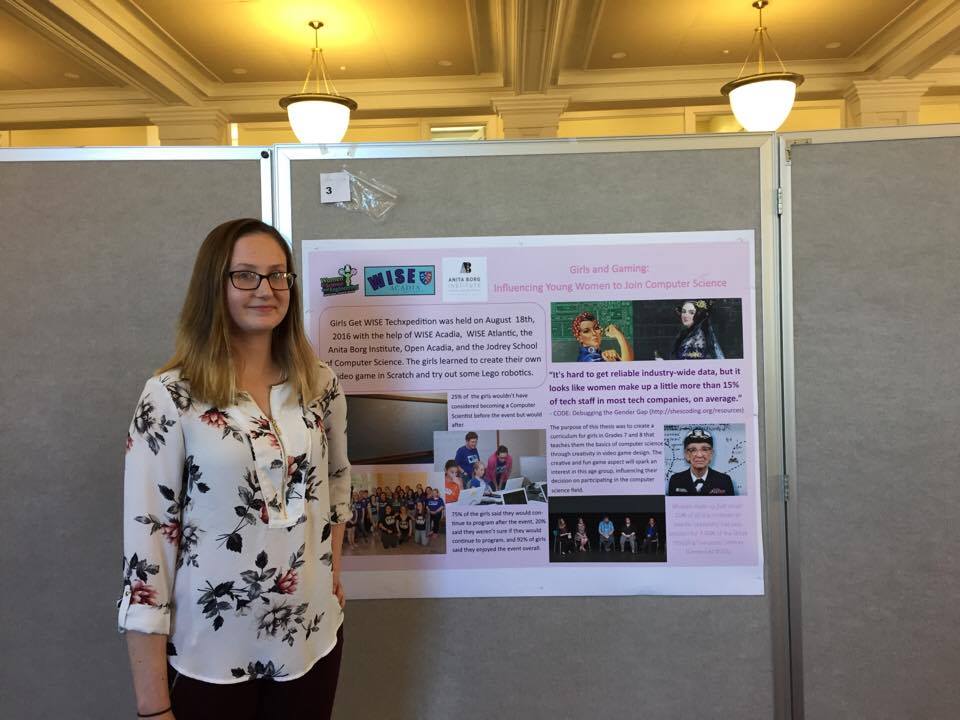
    Girls and Gaming: Influencing Young Women to Join Computer Science (Hayly Thackeray)

    The purpose of this thesis was to create a curriculum for girls in Grades 7 and 8 that teaches them the basics of Computer Science through creativity in video game design. The creative and fun game aspect will spark an interest in this age group, influencing their decision on participating in the Computer Science field. The Girls Get WISE Techxpedition was held on August 18th, 2016 with the help of WISE Acadia, WISE Atlantic, the Anita Borg Institute, Open Acadia, and the Jodrey School of Computer Science. The girls learned to create their own video game in Scratch and try out some Lego robotics. 25% of the girls that attended the program said they wouldn’t have considered becoming a Computer Scientist before the event, but are now. In addition, 75% of the girls said they would continue to program after the event, 20% said they weren’t sure if they would continue to program, and 92% of the girls said they enjoyed the event overall.

    New Radial (Jon Saklofske, Marc Muschler, Ian Brunton and the INKE Research Team)

    New Radial is a data visualization environment that offers an alternative digital workspace for visualizing images and text. It encourages users to contribute to ongoing academic dialogue via connections and operates as a middle ground between large datasets and a close reading environment. Radials are circular arrangements of related nodes that play a central role in a user’s exploration, collection, curation and connection of database objects for humanities-based scholarship. They allow users to work within a middle ground between large datasets and a close reading environment, providing an alternative scale of interpretation within a digitized framework.

    Monitoring Mammal Movement Through Terrestrial and Aquatic Passageways in Antigonish, Nova Scotia Using Remote Camera Sensing (Stephanie White, Randy Milton, Trevor Avery)

    Nova Scotia is gradually expanding its major 100-series highways in response to safety concerns. Highway twinning along a stretch of the Trans-Canada Highway intersects with an ecologically sensitive watershed, disconnecting wildlife movement in the area. To mitigate highway impact, wildlife terrestrial and aquatic passageways were installed along with 4 km of fencing and four one-way control gates. Passageways are >50 m long, and the terrestrial passageway has a central atrium. These passageways are the first to be studied in Nova Scotia, as well as the only to integrate both fencing and an atrium into the design. The highway is set to open late fall 2016, providing an opportunity to study wildlife movements before construction, during construction, and after installation. The scope of this 4-year project covers monitoring the movement of mammals through the passageways using remote camera sensing with a focus on medium-sized mammals (i.e. smaller than deer). Quantifying activity through images will be used to identify drivers of wildlife movement within the passageways. Factors under consideration include fencing, light intensity, moon phase, temperature and weather conditions. Select factors are manipulated to identify which may have a greater effect, including altering light levels by covering the atrium for extended periods connected to moon phases. Findings will be used as a baseline for future passageway design in Nova Scotia.

    Escaping Local Minima with Symbols (Ahmed Galila)

    This concept was inspired by how the brain processes sensory input. Inputs are propagated through the network one layer at a time. Each layer learns a certain representation of the input data. Each representation is more abstract than the layer below. This allows deep architectures to provide better generalization. The goal behind training deep architectures is to reduce the error in the model’s output as much as feasibly possible. Deep architectures have complex error functions with many local minima. Deep models tend to be trapped in these local minima.

    In addition, the event included topics such as: Rethinking Time Course Data: Growth Curve Analysis in Spoken Word Recognition Research (Alexander Sproul, Randy Lyn Newman), Data Mining and Machine Learning at the Acadia Institute for Data Analytics (Danny Silver), and Unsupervised Multi-modal Learning (Mohammed Shameer Iqbal)

    “I really liked the poster session because it gave people the chance to talk to people and ask questions, instead of going to a lecture.” – Acadia Computer Science major

    The poster session was followed by a talk given by Dr. Anne Condon (a professor of Computer Science at U British Colombia). Her enlightening portion of the event discussed the difference between male and female enrollment in the area of Computer Science, and suggested some ways to combat this problem. Her discussion pulled together the importance of having programs such as WISE, and made the event even more exciting.

    “If you get the chance, she’s [Dr. Condon] really nice to talk to, and she’s really smart. She really loves what she does, which I think is amazing because I’m struggling myself to figure out what I actually want to do with my Computer Science Degree… She has found her niche and she loves it. I went to her talk earlier, and it’s incredible how much she loves what she does. She’s really amazing, and I like that a lot.” – Hayly Thackeray


  • Agriculture and Computer Science

    Computer Science Honours student Yonghong Chen developed an app that can be used to predict the amount of crop yield that an agricultural field will produce using only a picture. This startlingly accurate system is inexpensive and meets a huge demand within the farm industry. Since farmers often have to wait to measure their crops after they have been harvested, this technology will help them make important decisions sooner. A key component of the app is that it allows a user to take a picture of a section of produce, and gives the user the number of crops in the section based on that picture. The development is known as the “Estimage” system. Interestingly, it was developed by first placing coins on a table and asking the app to count the number of coins. This system was also used to count the number of logs stacked in a pile. Eventually it was able to count the number of blueberries on a bush, as well as other agricultural applications. The system is very effective and saves a lot of time and money in the amount of effort it takes to count objects. This clever app combines counting and agriculture in a new and ground breaking way. The surprisingly simple, yet previously underdeveloped idea, has many other features as well. The Estimage system consists of an Android client app for interacting with users, a PHP server app for handling requests, and an Octave program for image normalization. It also consists of an open-source ML software package ilastik that is used to apply a predictive model to an image. The Estimage system is very good at detecting shape, color, and size, and is also good at distinguishing between backgrounds and objects, provided that the background is similar to that which was used to train the model.


Betzillo positions itself as a versatile gaming hub where structured bonuses and adaptive gameplay mechanics support both short sessions and extended play.

Built with a focus on innovation, Spinbit integrates modern casino architecture with rapid transactions, appealing to players who value speed and digital efficiency.

Ripper Casino emphasizes bold entertainment through high-impact slot titles and competitive promotions crafted for risk-oriented players.

A friendly interface and stable performance define Ricky Casino, offering a casual yet reliable environment for a wide spectrum of gaming preferences.

King Billy Casino channels classic casino spirit into a modern platform, delivering recognizable themes supported by contemporary reward systems.

Immersive visuals and layered slot mechanics are at the core of Dragonslots, creating a narrative-driven casino experience.

Lukki Casino appeals to players seeking direct access and minimal friction, focusing on fast loading times and intuitive controls.

Casinonic provides a structured and dependable gaming framework, blending modern slots with transparent operational standards.