Tag: social media

  • A World of Opposition: How a Few Words Can Quickly Lead to Animosity

    A World of Opposition: How a Few Words Can Quickly Lead to Animosity

    Earlier this month, the Humans of Acadia Instagram and Facebook pages published a short blurb written by an Acadia student that was almost instantly deleted from both accounts. The post was the student’s response to this question: “If money were no object, what would you do?” The student’s words quickly seemed to get lost in translation, resulting in numerous upset comments, and, eventually, the post being taken down. Conflicting responses wondered whether or not the student had said something genuinely offensive, as he wrote about his personal beliefs regarding one of our world’s most important issues.

    This student, a third year Kinesiology major at Acadia, had expressed his thoughts on obesity. He claimed that, if money were no object, he would help fight this global issue which leads to so many other health problems. He also said that, based on the education he’s receiving on the topic at Acadia, he feels as though a great solution to a lot of these issues is exercise and other small changes. His post said that he believes that many chronic diseases will be severely changed if people “watch what they are eating and perform physical activity regularly”. When asked if he meant any offense by encouraging people to live active lives, he said that, based on the fact that obesity is linked with the leading cause of death in America, he simply wanted to help.

    Neglecting to discuss social determinants of health, such as education, income, and others, this student hurt some people in the process of expressing his thoughts on the issue, since they felt as though he was shaming overweight people. His quick write up also left out some other details that he later said were important to him, such as the real answer to the question: “If I had all the money in the world, I would donate it to families who can’t afford healthier foods”. He also added that he’d love the opportunity to help educate others about the “importance of having a healthy lifestyle”. While most of the comments scolded the writer for how hurtful his words were, the post’s feedback was a great reminder of why it’s so important to listen to others and to choose our words carefully.

    The writer of the post on Humans of Acadia meant no harm in the words he wrote, yet the backlash was harsh. Some readers were unwilling to understand that he was writing with a desire to help. In a world increasingly full of political and social polarization, we seem to be quick to anger and slow to listen. Constructive arguments are important, but angry backlash is rarely productive. This article isn’t to tell anyone when they can and can’t be offended, but the post on Humans of Acadia is a good reminder that it’s okay to be hurt by something and to let it be. We’re so often encouraged to stand up for what we believe in, but if we stand up for everything, people will stop listening. 

    Why was something controversial deleted so quickly? Is it because we know that we are becoming less and less capable of having civil, educational conversations about our disagreements? If that’s the case, then how can anyone be expected to share their opinions, especially when they think they’re sharing helpful ones? In a world with so much opposition, hate, and arguing, it’s easy to feel like we’re always walking on eggshells, unsure of when we’ll offend someone next. Even as I’m writing this article, I’m catching myself being overly careful with my words. We shouldn’t have to fear this, though; if we can make it our main priority to educate others, rather than to call them out, then we won’t need to delete posts or be afraid to speak our minds. And as humans, I think it is our duty to educate others. 


  • Why Inappropriate Content Shouldn’t Be Our Parents’ Biggest Fear with Social Media

    Why Inappropriate Content Shouldn’t Be Our Parents’ Biggest Fear with Social Media

    If you haven’t already seen the 2020 film The Social Dilemma, stop reading this article, go watch it (yes, it’s on Netflix), and then come back.

    For those of you that don’t want to watch it, or just need a recap, the documentary outlines the thought processes behind creating most social media platforms, the techniques the creators use to keep users interested, and the effects those sites have on users (let me stop myself right here… As the movie points out, social media platforms and drug dealers are the only two industries that call their clients users. What does that say about social media? For the rest of this article, I’ll call them social media interactors, rather than users). When I first watched The Social Dilemma, I was horrified, but not surprised by the things it was telling me. I deleted my Facebook account and several other social media apps, encouraging all of my friends to do the same. Admittingly, I had Instagram and TikTok back on my phone within the week, but a break felt good all the same.

    The main reason I wasn’t surprised by what the documentary had to say was because I’d already seen social media affecting my friends’ and my own mental wellbeing in more ways than one. Having any information you want at your fingertips is a huge benefit of social media. And don’t get me wrong – I don’t think that social media platforms are inherently bad. But the documentary got me thinking… how beneficial or detrimental is the nonstop influx of photos and messages that we receive?

    One of the first issues with social media that I’ve noticed affecting my own life is unrealistic body and beauty standards. These impractical ideas are constantly pumped into people’s phones with the help of the right camera angles, editing tools, and the fact that people tend to only post the photos they look best in. I’m guilty of these habits just as much as the next person, but it causes the bar for beauty standards to be set higher than ever. This quickly leads to unrealistic expectations. Not only that, but when people have access to pictures of nearly anyone in the world so easily, subconscious comparisons become much more common.

    Comparison isn’t only an issue with beauty standards. Social media also makes interactors feel like they always need to be doing something. So often, we only see pictures and posts form people who are travelling, spending time with friends, learning new hobbies, spending money, going to the gym, go, go, go. This can lead social media interactors to feel guilty for taking a day to do nothing. Understandably, people have forgotten how to be still in the midst of such a busy, rapidly changing world. But when FOMO leads to being unable to slow down, higher stress and anxiety levels are provoked.

    I’m not going to be the person who tells you to get rid of your social media accounts. That would be extremely hypocritical of me. But I hope that you take something away from this. Whether that’s being more deliberate in spending down-time with yourself, researching different ways social media affects our brains, or choosing to spend less time on social media, I encourage you all to take a step back and think about how your social media interactions are affecting your mental wellbeing.

  • Boss Babes Busted

    Boss Babes Busted

    Everyone, especially girls, with a social media account has received a message like this one:

    Hey girl!! You seem like a really awesome gal, I love your page! I’ve got an amazing business opportunity that you would just make a killing at! Let me know if you’re ready to become a boss babe and own your own business!

    ‘Boss babe’ is the term that has been given to these people that reach out to advertise an ‘amazing business opportunity’, that opportunity being a place in an MLM. MLM stands for multi-level marketing, and these companies are everywhere. Herbalife. Mary Kay. Younique. Avon. Monet. LuLaRoe. BeachBody. I could go on. But, when you type ‘MLM’ into oh-so-useful Google, the words that also appear are ‘pyramid scheme’ and ‘scam’. The term ‘pyramid scheme’ is so often tossed around, yet few know what it actually means other than the fact that it’s illegal, and how it differentiates from multi-level marketing companies, which are legal. We’ll come back to the difference in a moment.

    So, you may be asking yourself, how does one own their own business while in a company? The attraction of MLM’s for many, especially stay-at-home moms, is that you are able to set your own hours, and work when you choose, in the same way that owning your own business might work. But, that is where the similarities mostly end. Because, in an MLM, you do have someone above you. This is your upline, most likely the person that recruited you in the first place. In many cases, you are likely part of a ‘team’, which that person leads. Your job is to sell the product that the company sells, which could be anything. Herbalife sells supplements, BeachBody sells workout plans and associated products, Mary Kay and Younique sell cosmetics. When you become a ‘boss babe’ and make a sale, you earn commission off the sale. Your upline also makes a commission, as does their upline, and their upline, etc. But their commission doesn’t only come from your sales, it also comes from your purchases, as many of these companies require their salespeople to hold their own inventory. So you purchase your inventory which you then sell to the public, and your upline and their uplines make commission off it all.

    However, you and all those uplines often must make a certain minimum of sales each month to be able to claim your commission to begin with. This is why the people at the top of MLM’s, and pyramid schemes, make so much money. This is also where the difference between an MLM and a pyramid scheme becomes apparent. The Federal Trade Commission writes: “If the money you make is based on your sales to the public, it may be a legitimate multilevel marketing plan. If the money you make is based on the number of people you recruit and your sales to them, it’s probably not.”

    So, the question then becomes: is the majority of your profit, and the company’s profit, made from recruiting others? Or from direct sales?

    But, the difference between the two is not the point of this article. Just because an MLM is legal, doesn’t mean that it’s the ‘amazing business opportunity’ the boss babes would have you believe. Dr. Jon Taylor of the Consumer Awareness Institute writes that less than 1% of people make a profit in MLM’s. His study relied on the findings of an investigation into Amway operations in Wisconsin. The investigation found that the average yearly income for this 1% was $12,500. However, to be able to continue to participate in an MLM, salespeople must continue to invest any profit they make back into ordering inventory to sell, because one cannot make a profit if they do not have inventory to sell.  Furthermore, this is during the duration of one’s ‘employment’, when you are in the company.

    Often, MLM’s will require that you ‘pay to play’, meaning that potential salespeople will have to purchase an onboarding package to be able to begin their work in the first place. Prices range from BeachBody’s $50 fee (plus $18 monthly), to LuLaRoe’s $9,000 fee (this is only one of the several onboarding packages they offer). When taking this investment and re-investment into account, the average yearly income for the 1% of people generating a profit in an MLM was $900 or less. This is well below what is considered to be low-level income, and is not a liveable wage by itself. Dr. Taylor also noted that MLM’s, ‘amazing business opportunities’, are notoriously hostile to publishing income statistics, though it is important to note that it is not a legal requirement to do so. That being said, many businesses will publish this information voluntarily. VICE created a documentary on YouTube focusing on three different women dealing with the fallout of having been in an MLM, entitled ‘Why Women Are Quitting Their Side Hustle’, which I highly recommend.

    So, that’s the monetary side of MLM’s. But what about the people that they ‘employ’? MLM’s have often come under fire for misrepresentation: whether it be of the effects of the product they sell, or the income they claim their representatives rake in. This extends to the way the representatives are displayed. For example, when you hire a personal trainer at a gym, you expect that they have gone through the relevant training necessary to help you make a positive, healthy change. But personal trainers are expensive. So, it is not the least bit surprising that the less-expensive BeachBody has erupted over the last several years. Their ‘coaches’ also claim to possess the tools to help you make a positive, healthy change. But how would you feel putting your health in the hands of a BeachBody ‘coach’ if you knew that the only requirement to apply to be a coach is that one be a minimum of 18 years of age, and possess a SIN?

    Our skin is the largest organ on our body, so it stands to reason that if you purchase cosmetics or skincare to put on it, you would want to purchase from someone with the knowledge to make knowledgeable, safe recommendations. Younique is an MLM that that sells makeup and skincare through their consultants. However, Younique does not require that consultants be trained makeup artists or estheticians, professions that teach not only the application of makeup and skincare but also the importance of sound hygiene.[1]Fueling our bodies is also a top priority for many. Supplement and nutrition MLM Herbalife, perhaps one of the most notorious MLM’s out there, does not require that its salespeople have a degree or any certification in nutrition[2].

    With all this information in mind, you may be wondering how these companies continue to operate and destroy the lives of many. After all, the university student writing this in her bedroom at 1AM can’t be the only person who knows all these dismal facts. The news isn’t all bleak: prosecutors are beginning to move on MLM’s, and hold them accountable for taking advantage of people simply looking to make some extra income. Journalists are also taking action, drawing attention to the injustices of MLM practices.

    In 2019, the Washington State Attorney General’s office filed a lawsuit against LuLaRoe, accusing them of being a pyramid scheme. Their clothing supplier has also sued them, claiming that bills have not been paid in close to a year and that the owners are hiding their assets in shell companies. The Better Business Bureau has assigned the company an F grade.

    Following an FTC investigation beginning in 2014, in 2016 Herbalife was ordered to pay a $200 million settlement for violation of anti-pyramid scheme legislation, citing the company’s heads pushing the downlines to recruit more salespeople rather than sell Herbalife’s products. Compensation from the $200 million settlement was awarded to 350,000 consultants in the United States. Herbalife was also ordered to restructure their business model. A video targeting Herbalife posted by comedian John Oliver to YouTube also went viral this year. Herbalife has many Better Business Bureau webpages, however, the grades given to each page are not consistent.

    In 2011, physician and medical journalist Dr. Harriet Hall published an article, debunking many of the claims supplement MLM Isagenix made about its products. She warned that the amounts of Vitamin A in some of the products were dangerously high. Australian consumer organization CHOICE reported that unqualified distributors were also giving medical advice to customers, despite not having the education or training to do so. It also drew attention to the fact that the claims Isagenix makes about its ‘detox’ products are not scientifically supported. Isagenix has several Better Business Bureau pages, most of which are relatively empty.

    In 2018, the Philadelphia Enquirer published the results of an investigation into Beachbody, and found that the average yearly income for a BeachBody coach was $2,600, not accounting for mandatory expenses ($18 coaching fee per month, and a mandatory $130 per month shipment of Shakeology health shakes). The keynote speaker at this past year’s BeachBody Summit, Rachel Hollis, has been accused by Buzzfeed News and others of plagiarizing work, though it is important to note that these are not claims that have been taken up in court.

    Anyway has also seen its fair share of legal trouble. In the 1990’s, several Amway distributors were involved in a lawsuit after committing defamation against the then-CEO of Proctor and Gamble. The distributors claimed that the CEO was a practicing Satanist and made regular donations to the Church of Satan, as well as claiming that the logo of Proctor and Gamble was a Satanic symbol. The case dragged on for years and was finally settled in 2008, with Proctor and Gamble being awarded a $19.25 million dollar settlement. In 2006, a class action lawsuit was filed against Dr. Phil, who at one point had had a supplement line within Amway, by individuals who claimed that the products did nothing to support their marketing claims. They were awarded a $4.5 million dollar settlement.

    I want to end on a positive note. It is worth noting that not all leaders in MLM’s wish to take advantage of their salespeople and customers. Cosmetics and skincare company Beauty Counter has been making waves for breaking from the traditional MLM setup. There are two main differences between Beauty Counter and traditional MLM’s: the first is that salespeople are not required to make monthly purchases in order to receive their commission cheque. The second is that the products are available for purchase from the company’s website, meaning that consultants are not the only way a customer can purchase. I share this with you for encouragement: not all MLM’s are conniving, and there is nothing wrong with wanting to add to your income. As the main audience for this publication is students, you yourself may feel this need more than others. But, the age-old saying remains true: if something seems too good to be true, it likely is. Protect yourself (and your bank account), and do your research. No ‘amazing business opportunity’ is worth losing what you’ve already worked for.

    Sources:

    Federal Trade Commission’s page on pyramid schemes: https://www.ftc.gov/public-statements/1998/05/pyramid-schemes

    Federal Trade Commission’s page on multi-level marketing companies: https://www.ftc.gov/tips-advice/business-center/guidance/multilevel-marketing

    Dr. John Taylor’s work:

    https://www.ftc.gov/sites/default/files/documents/public_comments/trade-regulation-rule-disclosure-requirements-and-prohibitions-concerning-business-opportunities-ftc.r511993-00017%C2%A0/00017-57317.pdf

    https://www.ftc.gov/sites/default/files/documents/public_comments/trade-regulation-rule-disclosure-requirements-and-prohibitions-concerning-business-opportunities-ftc.r511993-00008%C2%A0/00008-57281.pdf

    VICE’s ‘Why Women Are Quitting Their Side Hustle’: https://www.youtube.com/watch?v=L6eujSJ0-RU

    The State of Washington v. LuLaRoe, Mark Stidham, Deanne Brady/Deanne Stidham, and Jordan Brady: https://www.truthinadvertising.org/wp-content/uploads/2019/01/Lularoe-WA-Pyramid-Complaint.pdf

    FTC Investigation into Herbalife: https://www.ftc.gov/news-events/press-releases/2017/01/ftc-sends-checks-nearly-350000-victims-herbalifes-multi-level

    May 2019 Update on the FTC Investigation into Herbalife: https://www.ftc.gov/enforcement/cases-proceedings/refunds/herbalife-refunds

    Dr. Harriet Hall’s Article on Isagenix: http://junkfoodscience.blogspot.com/2006/11/can-you-really-cleanse-your-way-to.html

    CHOICE’s Article on Isagenix: https://www.choice.com.au/health-and-body/diet-and-fitness/weight-loss/articles/isagenix

    Philadelphia Enquirer Article on BeachBody: https://www.inquirer.com/philly/news/beachbody-shakeology-isagenix-instagram-pyramid-schemes-20180521.html

    BuzzFeed News’s Claims about Rachel Hollis: https://www.buzzfeednews.com/article/stephaniemcneal/rachel-hollis-girl-wash-face-accused-plagiarizing-quotes

    Result of Proctor and Gamble v Amway case: https://www.nytimes.com/2007/03/20/business/worldbusiness/20iht-satan.4966053.html

    Result of Class Action Lawsuit against Phil McGraw, Amway/Nutrilite: https://www.latimes.com/archives/la-xpm-2006-sep-26-fi-drphil26-story.html

    [1]Younique does have a training program for consultants centering on their products, after which they may be referred to as ‘Younique makeup artists’, however, this should not be confused with cosmetology school.

    [2]Literature on Herbalife products is provided to consultants/salespeople, but this is not equivalent to a nutrition degree.

  • Things That Should Have Been Curbed in 2016

    Things That Should Have Been Curbed in 2016


    1) The notion that “White Privilege” is offensive and racist towards White People.

    Racism, cultural appropriation, and discrimination have been a hot-button issue throughout history. With the rise of social media platforms, along with the recent election of Donald Trump, there is a plethora of conversation online (and in print) about the hateful rhetoric that seems to be plaguing today’s society. Unfortunately, when people feel that their privilege is being threatened, they enter an automatic defense mode. It is often presented in such a manner where the defendant makes claims of innocence, justifying their feelings of discomfort by exclaiming that they are not guilty of racism, and that if their race is being questioned, that they are automatically being discriminated against. White privilege is not racist; it is not offensive in any way. It is a method of explaining the favorable treatment that white people often receive. There are no systems of oppression designed against white people. Thinking that reverse racism exists is what perpetuates the notion of white privilege further into the foundations of our society. It is a mechanism that is used to validate the comfortable position white people hold in society. Validating your own comfortable position by attacking a marginalized group (by saying white privilege is offensive, racist etc.) is a subtle way of invalidating and shutting down any group who’s LIVED EXPERIENCE has ever been one of systemic oppression. In extension, these feelings can often be described as “white fragility,” a state in which minimum amounts of racial stress becomes intolerable, triggering outward displays of emotion, such as anger, and behaviours such as argumentation. Yeah, this definitely could have been left behind in 2016.

    2) That any Indigenous culture should just “get over” colonization.

    Really? This one amazes me every time I hear it. Let us take a brief moment to recall Canadian History because we are not innocent in the ways or racism and cultural oppression. Residential schools were opened in conjunction with the Catholic and Protestant Churches and the government. Their aim was to remove any form of Indigenous culture from Indigenous children by forcefully removing them from their homes, placing them in schools where they would be taught Western values. As such, a cultural genocide was committed. Often, when hearing the word “genocide,” events such as the Holocaust, Bosnian, and Rwandan genocides. That is because Canada has attempted to repress its history. The horrors of the Residential schools did not end until 1996. Yes, most of us were living when the last school shut its doors. During their time in the Residential schools, Indigenous children were beaten, sexually assaulted, and mentally abused by their instructors. Often, these traumas were difficult to cope with. A stigma surrounds Indigenous peoples in Canada. Many people chose to believe that status cards, funding, government aid, and the Truth and Reconciliation Committee should all be abolished. They question why we should continue to apologize, and why we should continue to work towards mending our relationship with Indigenous peoples. What does it take to get over something like this? How could you possibly put a numerical value on an apology, how can you, a white person, get to dictate the appropriate measures for reconciliation after a cultural genocide has been committed? When you say these things, you act as though you assume the role of the oppressed, you may think you understand their oppression, but you simply do not. I know I do not understand, I never could. However, it is important to listen, to engage in conversation, and to be respectful of what you cannot understand. Please read the above statement about white privilege and then rethink your questions and sweeping generalizations about Indigenous peoples and Indigenous culture.

    3) “She was asking for it”- REALLY?

    For God sakes. How is this type of conversation STILL taking place? Did we not learn after Jian Ghomeshi and Brock Allen-Turner? I simply do not understand. The legal process further victimizes rape victims. Belittlement and slut-shaming occur in the courtroom in order to find loopholes in the victim’s statement. By asking her, “did you say no?” you are questioning her pain and her experience. By asking her, “how much did you drink?” you are assuming that all drunk women are ‘asking for it’, by asking her “what were you wearing” or “how many men have you slept with in the past”, you are slut-shaming her. Although there are false reports of rape, the treatment of victims in the courtroom is inexcusable. This is the reason that rape and sexual assault are so underreported. This process favours the accused, often bringing into play irrelevant aspects of his character, his achievements, and what he strives for in life. However, this does not take into account aspects of the victim’s character, her (or his) achievements in life, and how what she/he had strived for may feel as though it has become so out of reach. It’s simple, folks. If you can’t say no, you can’t say yes. There is no in-between; there is no grey area. There is yes, and there is no. Stop blaming the victim. Stop validating your need for supremacy. Stop questioning the pain of others, instead, start regarding it.

    4) Feelings of self-doubt, as brought on by Instagram and other forms of Social Media.

    I am guilty of this. Most people are guilty of this. It is so easy to feel self-doubt, and it is so easy to think that your value decreases based on the perceived notion of “perfection” in the others who you see on social media. In the last 10 years, we have “networking” apps explode. The original purpose of these apps was to stay in touch with your friends, to be able to connect with people you haven’t seen in a long time and to keep others updated on what is going on in your own life. However, it feels as though there has been a shift in the dynamic, a change in the way we behave on the Internet. Often, all we see is the picture. We believe that everybody’s lives are perfect and full of happiness based on how they display themselves on social media. Getting the “perfect picture” and pairing it with a “fire” caption that will get you over 300 likes is often a goal of most people. I know I am not innocent. There have been multiple occasions where I have found myself thinking, “if I went to the gym more maybe I would look like her and then I would be as happy as she appears.” I know this is wrong. After a conversation with one of my roommates, I found out that she was feeling the same way. She talked to me about how miserable looking at Instagram makes her. It caused her to question her own happiness by constantly comparing it to other girls’ social media pages. So, she slowly began to stop looking as much. As did I. I’ll leave this point here: everybody has their issues, but we have been conditioned to try and keep our problems to yourself. A picture is just that: a picture. You see what the poster wants you to see, just remember that your self-worth should not be determined by a like or how the world views your Instagram page.

    5) Islamophobia.

    Islam is a religion of peace. Often, people do not believe this when it is brought up in conversation. The first time I heard this was in my 11th grade world religion class. Our teacher told us that Islam was the closest religion to Christianity. She was right. It is not Islam you are afraid of, it is the “otherness.” The sense that you see something different, and that you are uncomfortable within a realm of your own privilege is what sets you off. This rhetoric gained prominence after 9/11. We were scared of them. They were scared of us. Although I am not an expert in Islamic studies, I know many men and women from the Arab world who identify as Muslims, and I can honestly say that they are much nicer than many other people I know. If we remove the concept of the “other,” perhaps we will all be able to see each other as we are: human.

  • Are Millennials Too Sensitive?

    There once was a boy who was told that everyone that should be nice to everyone and that if they were not kind, they were bad people. He then grew up to find that’s not how the world works.

    As a society adapts, the mindset of the people within it change. This is also true in the change of a generation. They have learnt from the mistakes and triumphs of previous generation and use this information to change and base their lives upon. The education around them adapts to these new changes and shapes children. With the increase in mental health warning and bullying campaigns, are they really being shaped to deal with the rest of the world, or is it that the world has not yet to accept the changes that the new generation is bring? I believe that the new generations are not taught to be prepared for what the world will throw at them. They are only told that people will change and that they should not have to face the problems that occur in the world.

    In my political science class, we were discussing our upcoming presentations for our research assignments. Our TA requested that if we are planning on showing any “graphic images” we get them checked prior to putting them into our visual for our assignment. This is a ridiculous sign of how sheltered this generation is: we know violent things are happening around the world but we play a blind eye to them. Not showing these images does not make them go away and does not solve the problems that they are causing them.

    Now bullying is a topic that has only been under scrutiny for the past 20 years. It is now viewed as a national epidemic instead of a common fact of life. The young generations are now beginning to expect that everyone in life will be nice to them and if they are not there are a bully. But that is not how it works in life. You will be put down by people for making a mistake at work or for bumping into someone on the street. People will talk about you behind your back. You cannot change that. If anything, you should be taught to how ignore these comment and fight back, compared to just reporting them to the principal. You can’t report your boss in the future for yelling at you, so learn how to take criticism.

    Previous generations have been built and thrived upon the “tough love” method. People would discipline their child to a certain extent, be that verbally or physically. But now, parents are actually being arrested for spanking their children with actual reasons. The school system does not tell the students the difference between abuse and discipline so they grow up with the belief that this is wrong and that their parents are not good people.

    It is a generation under the veil of ignorance – they all imagine the world to be perfect, where everything happens their way. If things are happening outside of their community to other people it doesn’t matter. All that matters is what happens to them and that they are happy. When things that they don’t like occur, they don’t know how to handle it. They have been so shelter from the sadness and violence of the world, they when they get a large dose of if, it leads people to believe they have a mental illness.

    Now the thing about mental illness is that it is something that is very real, many people are suffering from it. The statistics show that the rate of people who report suffering from depression have increased by 6% over just this year. Now I am not saying that these people’s claims are false, but the rate shows that the recent generation cannot handle the pressure that society has put upon them because they were not trained to handle stress. They were only told that the things that cause them stress are not right.

    When any topics concerning race, sexuality, politics, or gender come into play, they become extremely agitated. They are brought up to think about living in a world when everyone should think the same way. But that is not how the world works. People have different opinions and are entitled to have those opinions, why must people be put down for not conforming to what views their society has. These generations have been told they everything should go their way, so when it doesn’t of course they don’t do how to handle it. Is it true that millennials and Gen Zs are overly sensitive? Yes it is. But who can blame them when they grow up in an environment like this one.

  • Rihanna and JK Rowling “Clap Back”

    In recent months, politics has become a buzzword. Some people relish in discussing politics, while others are deeply opposed. From classrooms to coffee shops, it has become increasingly rare to stay away from the subject. Even celebrities, such as Rihanna and JK Rowling, are turning to social media sites such as Twitter, Instagram, and Facebook to express their views. It’s not too difficult to notice a pattern emerging in the comments section of these sites: while many people support their political commentary, there is also great and often antagonistic resistance to it.

    On January 28th, in response to President Trump’s executive order of the so-called Muslim ban, Rihanna exclaimed on Twitter: “Disgusted! The news is devastating! America is being ruined right before our eyes! What an immoral pig you have to be to implement such BS!!” Earning 150,000 retweets and nearly 400,000 likes, it was clear that she expressed an opinion that resonated with many. However, fellow singer Azealia Banks thought differently about Rihanna’s comment, responded (on what are now deleted posts): “As far as [R]ihanna (who isn’t a citizen, and can’t vote) and all the rest of the celebrities who are using their influence to stir the public, you lot really REALLY need to shut up and sit down…. Stop chastising the president. It’s stupid and pathetic to watch… Hoping the president fails is like getting on an airplane and hoping the pilot crashes.”

    In a similar way, JK Rowling was also told to “shut up and sit down.” Commenting on the Muslim ban and the experiences of those being detained at American airports, she posted on Twitter: “When I worked for Amnesty International in the 80s, these were the kind of stories told by political prisoners in dictatorships.” In response, an individual known as Mr. America on Twitter responded: “You’re a grown ass woman whose entire career is based on stories about a nerd who turns people into frogs. Stay out of politics.”

    “Shut up and sit down.” “Stay out of politics.” Do celebrities like Rihanna and JK Rowling warrant such responses because the realm of politics isn’t necessarily their expertise? If you’re a singer or an author, does that automatically make your political opinions and engagement moot? Isn’t Azealia Banks, a fellow singer, being hypocritical in her response due to it’s political nature? Telling people to “stop chastising the president” is political commentary. Should she practice what she preaches? What makes “Mr. America” qualified to tell a person to stay out of politics? What makes his opinion any more valid?

    Taking the high road, Rihanna posted an image on Instagram with the caption: “the face you make when you an immigrant. #stayawayfromourchickens”. Comments telling people to remain silent only promote ignorance and shallow discussion. Now, more than ever, individuals should engage in open discussion to hold those in power accountable and to understand different points of view. JK Rowling says it best: “In – Free – Countries – Anyone – Can – Talk – About – Politics.”

  • Social Media in an Age of Awareness

    “Why use Social Media? Marketing is no longer about the stuff that you make, but about the stories you tell.” – Seth Godin

    Karen* (name changed), sat at her computer scrolling through her Facebook feed and watching Netflix when she started to see a similarity between the pixelated world of her favourite TV Show, and the pixelated world of her Facebook feed. She began to question how real social media is, and how much of it is a self-directed version of our own TV shows.  When talking with Karen, she says:

    “I first started using Facebook in 2010. I remember this very specifically because it was the first time my mother told me that she thought I was responsible enough to handle myself with social media. I was thrilled, of course, because it meant sharing and connecting with friends. We used Facebook as a sort of photo hub, posting pictures of our daily shenanigans and tagging one another. I came to use Facebook as an interactive photo album. This, of course, and the games. Now that I’m in university, Facebook remained an important tool to help me communicate with my old high school friends. I now live far from home, so the possibility of communication that Facebook offered was very important for me. However, over time I realized that Facebook was becoming less and less about photo sharing and playing games with friends. As I grew older, I like to think that I gained more perspective and maturity. I no longer had the time to partake in games like Farmville. I noticed something problematic from the get go, specifically with the games.”

    “The majority of online and mobile games are now heavily time-based, requiring you to wait extended periods of time before you can make your next move. But of course, there are ways around this. You can pay money to buy turns. As a fifteen year old in 2010, I didn’t exactly have much to spend on these games and quickly became disinterested. That was one aspect of Facebook that quickly turned me off. I’ve noticed that my Facebook feed as progressively become littered with advertisements. I suppose I shouldn’t be surprised. Facebook is just another business that relies on ad revenue in order to generate profit. But in my opinion, it only ads to the clutter, to the noise of social media. I see more advertisements and click bait links than I do of the latest happenings of my friends. And what I’ve noticed is that even contributions from my friends are ill thought out and only adds to the clutter. Facebook, in my opinion, is just a messy stream of consciousness that I’m drowning in. From people telling me to click on a link because it will somehow save animals to the latest Buzzfeed survey on which Disney princess I am, Facebook has become a hub of uneducated, ill researched, and quite frankly unimportant content. People change their profile picture selfies frequently, desperately fishing for more likes, for more online validation. People post more pictures of themselves partying, in what I have noticed has become a repetitive stencil of duck lips, hands on hips, “laughing” at each other candidly as the picture is taken.”

    “These kinds of pictures eventually become duplicates of one another, nothing to contribute, lacking substance and meaning. They become another “look at me and how happy I am with my life.” A boast. But what I wonder is if these are truly genuine feelings. I have to admit, though, that these images of partying lifestyles and all smiles had me questioning my own confidence and place in life. Why were all my friends so happy? All the time? Wearing new clothing that I could never afford, with time that I never seemed to have. One of the reasons I stepped away from Facebook was because it started to have a negative impact on my life. I started comparing myself against everyone else, increasingly getting frustrated with what little I had in comparison to what they flaunted. I found that Facebook was becoming toxic. I began to unfollow many people, feeling that they did not contribute to conversations and reflection. In the end, I just had to leave. I didn’t want to be a part of a network that made me feel like I wasn’t aspiring to be my best.”

    “Now, perhaps this was on me. My confidence issues are clearly my own, people would say. I shouldn’t blame others for how I feel. But it’s hard to feel good about yourself when people openly flaunt their excess on social media. I put off leaving from Facebook because I thought, “What if somebody needs to contact me?” I realized that if people really did care, they’d call or text me. I didn’t need to give the occasional like to photos to remind people that I was alive. And that was when I realized that Facebook was no longer the social media that I had once believed it to be. There was nothing social about it anymore. My decision to leave Facebook lasted almost a year, and I’m glad I took the time away. It gave me time to reflect on what I truly wanted without comparing my success to somebody else’s. Taking the time away helped me recognize truly who my friends were, and those who didn’t even notice my absence.”

    Perhaps leaving was for the best. We are a generation that is engaging with social media and the implications of dealing with it, for the first time in history. Only time will tell how to changes our self perceptions, and the way that we perceive others.

  • Ways to Stay in Touch

    Ways to Stay in Touch

    After being free of classes for nearly a month and goofing around with all of your friends from high school, it can be pretty difficult to say goodbye. At the end of winter break we bid farewell to those people who knew us during our younger years and we promise to talk to them more often than the semester before. Here are some ways to make staying in contact a lot easier:
    1. Write A Letter– I know it sounds absurd, but there’s a lot of cool things about putting pen to paper and sending your homie a real letter. You could use cursive writing or your favourite gel pens; or maybe you could train a raven to fly the letter to its destination like we live in Westeros. The options are truly endless. It’s a lot cooler than it sounds, and just imagine the surprise on their faces when your friend gets something in the mail that isn’t a power bill or coupons for McDonalds.
    2. Video Chat – For those of you who aren’t into antiquated methods of communication, or who are too embarrassed to ask your friend what their postal code is, hit them up on Skype or FaceTime.It’s the second best thing to seeing your friend in real life, and complimenting them on their hair over video chat is a step above leaving an emoji comment on their latest Instagram picture.
    3. Texting – When it comes to simple ways to keep in touch,texting is by far the fastest. The easiest thing you can do is send your friend a quick text and ask them what’s going on. To amp it up a level, make a group chat with all of your old squad. If you do this you can send each other screenshots of stupid things that others in your graduating class are posting on Facebook.It provides hours of entertainment, and the fact that none of you are trying to become famous rappers will make you feel a lot better about your own lives.The ways in which we stay in touch with the people from our past have changed immensely with the introduction of new technology. Most of the people we know and love are merely a click away. This makes staying in touch with our friends who are far away a lot easier than it might have been for our parents and grandparents. With all of this technology at our disposal we can feel closer than ever to those who are the farthest way from us.
  • To Yik, or To Yak?

    To Yik, or To Yak?

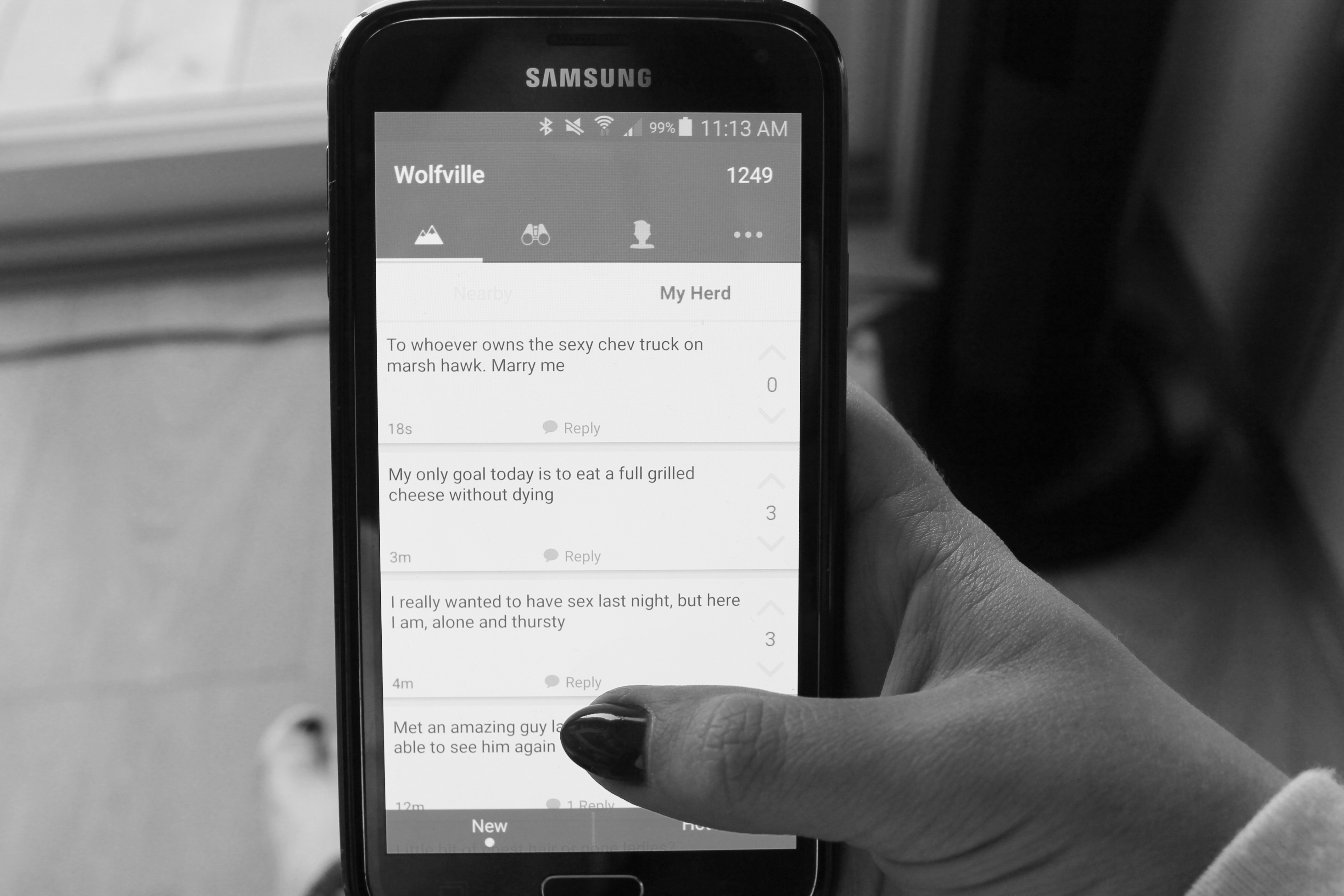
    Yik Yak is an anonymous app that lets you post random comments in your area. People are able to post anything from complaints, hopes, and questions with the knowledge that only local viewers will be able to comment.

    While Yik Yak is able to connect people in new and exciting ways, it also has major drawbacks. The anonymous nature of Yik Yak can lead to people being ruder than they normally would be. Negative reactions to statements such as, “So tired of this,” or, “Does anyone else think that res is too loud?” can lead to people thinking that responders represent a majority opinion instead of a minority one. There are many ways that the weight of comments expressed can be disoriented. There are a lot of cases that suggest that this belief is core to explaining why social media insults can have an immense impact on people.

    Majority opinions are valued more heavily than minority opinions, in most cases, and this can cause a change in the way that people see certain belief sets. The anonymous and impersonal nature of such Apps can change the way that the person sees their position in relation to their critical responders. While responses and comments made by one person can seem daunting, responses that come from a single anonymous person can have a bigger impact. Not knowing who has stated what can lead people to misunderstand other important factors that should be taken into account when receiving hurtful information.

    Another key element of Yik Yak criticism comes from the fact that you are unable to choose who you are talking to. If you knew that someone had a stance on something that fought against your own, you would decide ahead of time not to ask this person what they thought. Knowing ahead of time how something you ask will impact a viewer is crucial to ensuring that you get information that is helpful and not hurtful.

    Despite the fact that people from other areas are able to view Yaks, our Herd members can be reassured that only locals are able to respond to questions. This limitation also prevents foreign people from filled Yik Yak feeds with spam and otherwise useless information. Yik Yak has taken steps to ensure that only Teens are viewing feeds, and has dedicated research into ensuring that Yik Yak won’t be usable near Elementary and Middle Schools.

    Although it may cause some negative consequences to occur, it can also help to connect students of the Acadia community in very different, and sometimes personal, ways. This App is able to foster a sense of Acadia spirit and relatable posts help to unite us as a student body. While there may be some drawbacks that result from any form of social media, Yik Yak, overall, is able to unite us all in a personal and immediate medium with which we can express our thoughts.

Betzillo positions itself as a versatile gaming hub where structured bonuses and adaptive gameplay mechanics support both short sessions and extended play.

Built with a focus on innovation, Spinbit integrates modern casino architecture with rapid transactions, appealing to players who value speed and digital efficiency.

Ripper Casino emphasizes bold entertainment through high-impact slot titles and competitive promotions crafted for risk-oriented players.

A friendly interface and stable performance define Ricky Casino, offering a casual yet reliable environment for a wide spectrum of gaming preferences.

King Billy Casino channels classic casino spirit into a modern platform, delivering recognizable themes supported by contemporary reward systems.

Immersive visuals and layered slot mechanics are at the core of Dragonslots, creating a narrative-driven casino experience.

Lukki Casino appeals to players seeking direct access and minimal friction, focusing on fast loading times and intuitive controls.

Casinonic provides a structured and dependable gaming framework, blending modern slots with transparent operational standards.