Tag: space

  • Traveling to space may potentially be harmful for the powerhouse of our cells

    Traveling to space may potentially be harmful for the powerhouse of our cells

    Astronauts face a lot of risks when they travel in space including a number of health risks. In the past, there have been reports of loss of bone and muscle, some reported to have developed immune disorders and heart and liver issues. A new study has found that energy-producing structures in our cells might also be to blame for the development of these conditions. The findings also serve as a guide to treating these problems for future astronauts who may travel to far-away places such as mars in the future.


    A researcher team consulted NASA’s Gene lab which has a collection of data from the past experiments conducted by space biologists. The scientists studied cells and tissues of both mice and people and we’re looking for a possible chemical fingerprint of space travel. To conduct this study, they compared the results of space travelers with those who remained on Earth.


    Afshin Beheshti is a systems biologist who works for KRB at the NASA Ames research center where he is a part of the team conducting this study. Beheshti said the idea is not only to look at one type of chemical but look at the system as a whole. While doing that, they found a common theme which is the Mitochondria. 


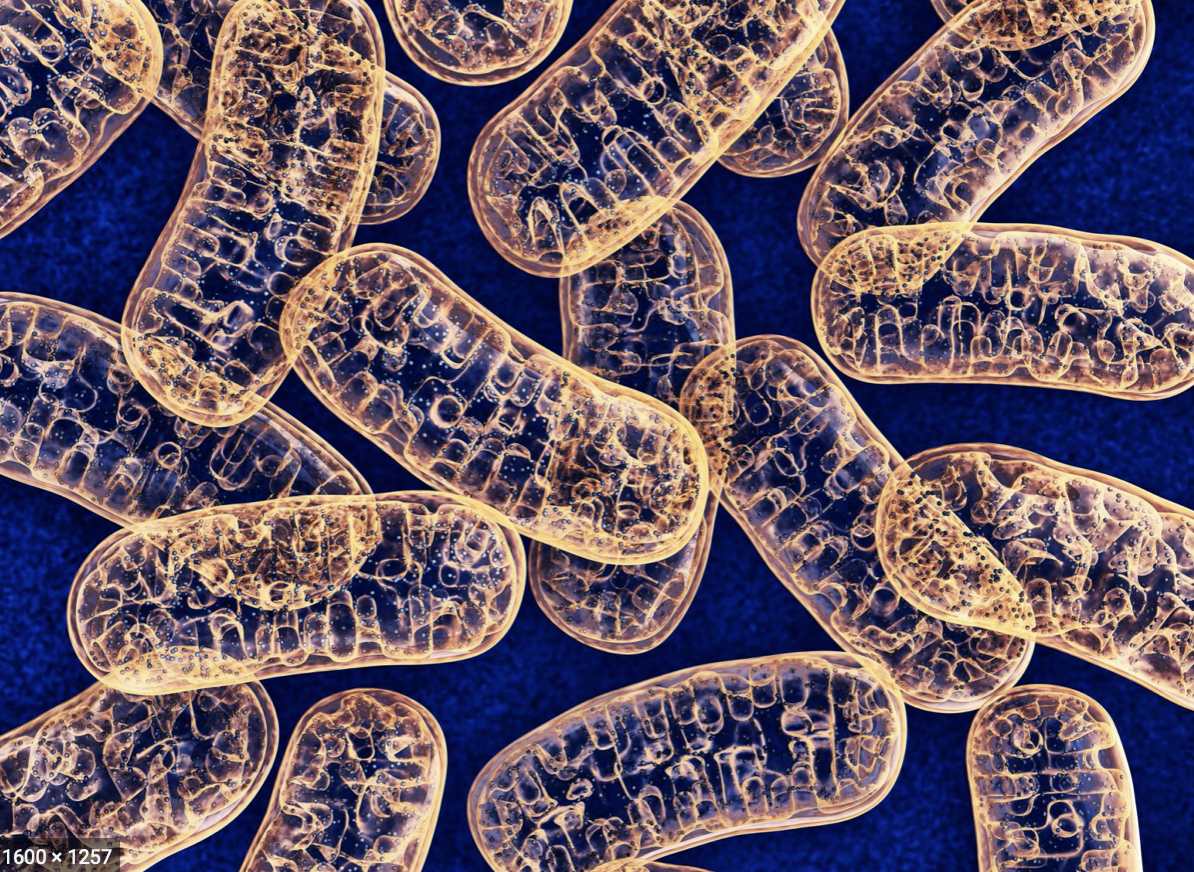
    Mitochondria are also known as the energy powerhouse of the cell. After time in space, mitochondria often did not work the way they should and that’s what made the scientists concluding mitochondria as the common cause. The findings were consistent with samples from NASA’s twin study where astronaut Scott Kelly spent about a year abroad in the international space station while his twin Mark stayed on the ground. Later the blood samples from the two showed a discrepancy in mitochondrial activity. 

    For the latest study, Beheshti and his team studied gene lab data for many types of cells and tissues and looked at proteins and RNA in each sample. The researchers also looked for epigenetic changes to DNA which are the chemical switches that can develop outside of the genes. They might inappropriately turn genes on or off or affect how well they work.

    Another focus was on the molecules related to metabolism. The process to study molecules related to metabolism includes a mix of chemical activities which support life in cells, organs, and the whole organism. These activities can range from eating (energy consumption) to burning calories, making new cells, and shedding wastes. 

    The research team also examined blood and urine samples of around 59 astronauts to check if spaceflight caused biochemical changes in them. Space travelers had increased levels of chemicals that are known to trigger inflammation and were also found to have signs of oxidative stress which is a type of cell damage. That damage might occur due to poorly functioning mitochondria.

    These chemical findings reflect the common types of health issues seen in astronauts, for instance, an astronaut has developed a liver problem. The team has concluded that damage to mitochondria may be a common factor in spaceflight health risk.  If mitochondria are the culprit then it is easy to target them to help protect astronauts in the future. Drugs that are used to treat mitochondrial defects can be used to reduce these potential health risks for astronauts. 


  • China’s Chang’e-5 Set to Bring Back Lunar Specimens by Mid-December: a Goal Since 1976

    China’s Chang’e-5 Set to Bring Back Lunar Specimens by Mid-December: a Goal Since 1976

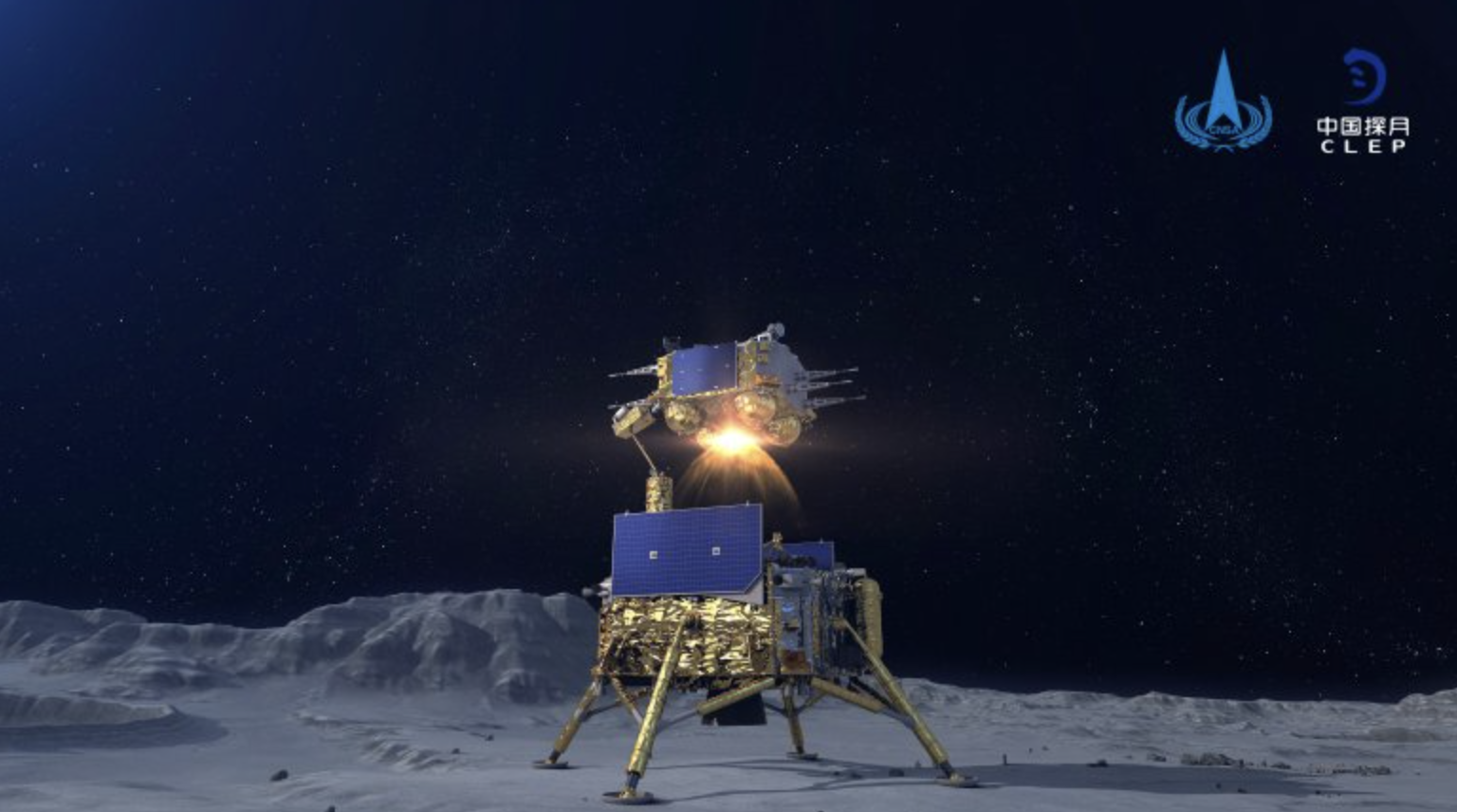
    Chang’e-5, China’s third successful uncrewed moon landing, has reached another milestone by not only landing on the Moon but also by spending two days on it, gathering rocks and dirt from the lunar surface. The goal of the spacecraft was to get the Moon samples to the Earth, which has been a goal of theirs since the year 1976.

    The spacecraft was launched from Hainan Island, which is located in the south of China, on November 24th 2020. The spacecraft, upon entry into the moon’s orbit, would split in two; the lander and the orbiter, where the lander will be on the surface and the orbiter will await its return. The spacecraft successfully carried out this procedure on Saturday, according to various sources. The lander is reported to have touched down at Mons Rümker which is a volcanic plain located on the Moon’s near side which is estimated to be around 1.2billion years old. However, this is considered much younger than the places which were explored by NASA’s Apollo mission and the Soviet Union’s Luna mission, as the places they explored were all more than three billion years old. 

    The lander of Chang’e-5 will need to accomplish its drilling and scooping tasks within one lunar day, which is equivalent to 14 days on Earth. The lander is not designed to survive the dark and frigid lunar night which can cause it to reach temperatures of -170° Celsius as there is no heating mechanism built-in the spacecraft. 

    The Chang’e-5 also includes a rocket attachment which before the Sunset would blast off with the lunar samples. The rocket will then dock with the orbiter to transfer the lunar samples and make its way back to Earth. The samples are expected to land in China’s Mongolia region by the middle of December. 

    The specimens which would potentially be researched by the scientists would be a great source of understanding of the Solar System’s evolution and the planetary scientists have been eagerly awaiting the additional samples. These samples would be of great value to scientists in order to calibrate techniques for estimation of the age of geological surfaces in the solar system’s; moon, planets, asteroids etc.  The Lunar samples would also help in testing hypotheses about the causes of volcanic eruptions which are evident in the region of the moon where the Chang’e-5 landed.


  • Existence – A somewhat pseudoscientific approach towards reality

    Existence – A somewhat pseudoscientific approach towards reality

    The concept of “Tomorrow” implies the event of sunrise and sunset.

    However, the sun doesn’t rise nor set, the earth rotates alternately and elliptically by its axis thus creating the illusions of these events, with seasons as a bonus depending on the amount of solar radiation received on specific areas at a specific time of the rotation with specific durations and conditions.

    Such events inspired the invention of day-night measuring devices. Such as the sundial, which draws from shadows casted by the sun’s powerful beams of protons, determining the approximate time. With light, we determined second and minute. A minute is “one Mississippi” times sixty. Another sixty folds for an hour then a twenty-four for a day. The result, a year equivalent to 365 days, is merely a rough approximation derived from trials and errors, which is constantly being improved upon, all from studying shadows and seasons.

    So, it is safe to say time was not invented, it was perceived, a unit, by mankind. From the sundial, on an elliptically orbiting planet, from the star, to the solar system as one singularity orbiting a supermassive blackhole at the center of the milky way. There to the local group of galaxies to the superclusters… A distance so unfathomably wide where all of a sudden, the speed of light becomes completely meaningless. Almost as though a dying old man is tediously limping his way through the Sahara Desert, on foot, WHILE DYING ON LIFE SUPPORT.

    Now zoom out a little more and we’re at the cosmic microwave background, the observable universe, the light from the big bang. Or was there even one? Best to say the energy from the infant universe expanding from its finest singular point. Fast forward that by 13.8 billion years. That’s:

    “one Mississippi” x 60 x 60 x 24 x 365 x 13,800,000,000 (and don’t even get me started with logarithms)

    If you’re wondering, that’s how many Mississippis the universe has spoken and still speaketh.

    (Honestly not sure how they came up with this answer)

    (Again, 365 days in a year was built upon approximation)

    A doppler shift just happened, it has been happening since the beginning of 1 divided by log x(∞) of one-Mississippi. Also, “1” is a unit perceived as one singularity. As though the universe is so perfectly shaped to allow such a unit to even exist. Zoom in on one* drop of water, does the tardigrade belong to the one* drop of so-called singularity or does it resemble a byproduct of a singularity? What about the billion microscopic entities with a small population of e-coli that gives us nasty diarrhea? All in one* single drop of water?

    Get it?

    1 + 0 is still = 1 because of a general account, with a bit of imagination. It is a testimony of how incapable we are at perceiving imperfections.

    Look, the tardigrade is leaving the tiny puddle

    I guess 1 + 0 is hardly one* at all. Yeah Math is weird, definitively, unreal.

    What is real? You? Me? That tardigrade? This text you’re reading on a 4k device with over 8 million pixels? Or your best friend who is literally a movable chain of proteins consisting of atoms and stardust? Don’t we just love this objective reality? What about the objective unreality? Dreams and imaginations? Visions painted with neurons firing at light speed. Well, metaphysically speaking, it’s there, it happened.

    We are obsessed with the objective reality to an extent: it has to be something we can hold onto that counts. To turn vision into concrete is like taking your finger and smudging air particulates onto a blank canvas, hoping to catch some charred particles along the way.

    Wait, there’s red. Looks like you smudged too hard and now you’re oozing blood, but at least you’re getting some colors. What do you mean it’s intended??

    Fucking loopholes

    Fucking definitive loopholes

    Fucking

    Fu…

    Oh fuck! A solid noun, verb, adjective. Let’s try this:

    “A fucking fuck fucking a fucking fuck”

    It literally makes no fucking sense but sensibly means:

    “An adjective noun verbing an adjective noun”

    Let’s dig deeper:

    We’re taking the actions of prolonging our existence as a joke we use to put shame on another individual.

    Like “Fuck you”, says a male individual to another male individual, without the intention to mate. Yet magically triggers a chain of events. Now, rather than throwing sex organs, throwing fists is almost guaranteed, physically, verbally, or metaphorically, both ideas almost eventually dart towards a certain resolve.

    Unless one got to the point of taking another’s life. Well, we’re all predators and prey, we kill for the sake of sport and food, we kill to gain, and we kill to cover up. Yet nobody wants to be killed. The one thing we all have and is a true novelty also happens to be objectively unreal, life itself.

    I mean, how else are you reading this text, you corpse-to-be? i.e. how much longer can you go before your heart feels like it’s given enough? That is, if you’re lucky enough to outlive the average 80% while the proteins and cells in you remain faithful and do the only job nature has for them, Ahem, for you.

    Wait, that’s confusing. Does your body even belong to you?

    To belong indicates possession; to possess implies absolute control. Why did great emperors and dictators fall? If they had all the powers one could ever conjure, yet still succumbed to the same, plain, boring eventuality of the peasants.

    Death, we fear it, we loathe it, some people yearn for it when life in that moment ceases to exist in their eyes. A metaphysical novelty that lets us hang on to our dear life, forcing us to think as a species, and not with our ego. It is the biggest research topic still on an open status quo. What’s in the hereafter? What comes when ego ceases to exist?

    The First Law of Thermodynamics tells us that energy can neither be created nor destroyed. So, this begs the questions. What keeps our chain of proteins and atoms together? Why can’t our brain comprehend itself, when it’s clearly ours to will? What are the gears and mechanics, the nuts and bolts behind consciousness? What’s the bridge between physicality and the unseen? Our ego? A name tag worn on the shirt the same way a Starbucks barista would.

    I wager once our proteins and atoms give out, we, petty insignificant beings, shall convert once more to the miniscule energy that has always belonged to the universe. The same energy from the big bang, is coursing through our veins. The light that cannot be seen, the energy, that fundamentally makes you, you.

    That said, we never died, and dictators never fell, because in a broad sense, we never really lived. This romance of living and dying is nothing but a codependent, semi-toxic relationship between construct and perception where one side is always in denial.

    Therefore, a universe born tomorrow is merely based on the construct of time perceived by mankind, their planet and the light from their parent star, as well as its luminosity, density, and size. This pure hogwash is inapplicable outside of the solar system, because time, life and death, are nothing but units

    In this ever so little, tiny blue dot.

    In an ever so massive, expanding universe.

    A doppler shift just happened, and the universe has grown bigger.

    Well, I’m gonna end here, or does the finale ever exist?

    Ad Finem.

    Ad infinitum.

  • Water traced on Moon: Another Achievement by NASA

    Water traced on Moon: Another Achievement by NASA

    For a long time, the moon has been thought of as waterless, though recently, numerous researchers have discovered water in some parts of the moon. New observations by the SOFIA telescope and Lunar Reconnaissance Orbiter by NASA reveal traces of water in some small dark craters as well as sun-baked lunar soil. Earlier large shadowed craters were thought to be a significant source of water storage.

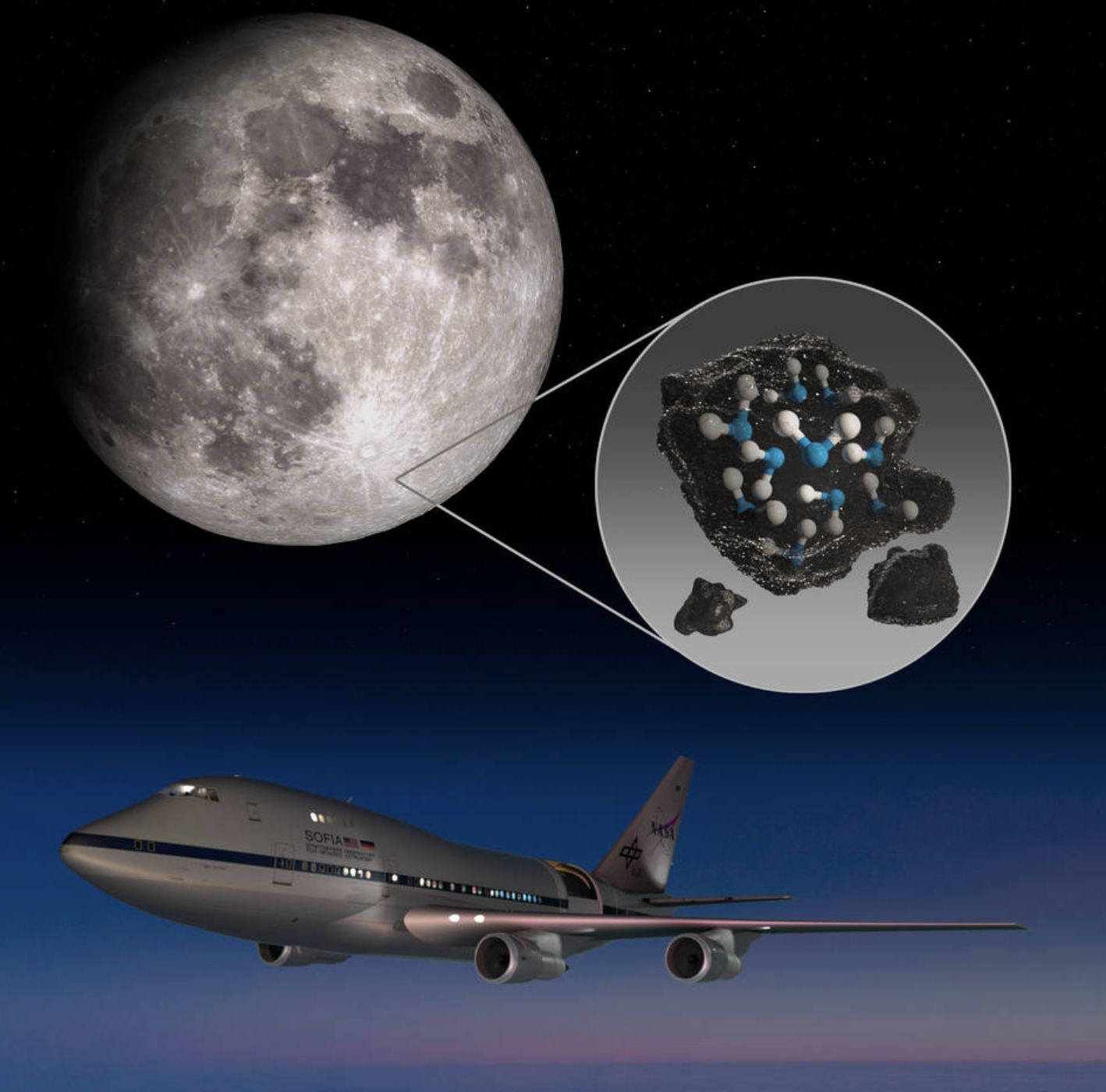
     This discovery has proved itself to be a milestone in the mission to discover possible life on the Moon. SOFIA is a very innovative and unique approach by NASA in the field of lunar science. SOFIA- Stratospheric Observatory for Infrared Astronomy, is a modified Boeing 747SP jet which gives its telescope, which is 2.7 meter, a view above 99% of the atmosphere’s obstructive water vapor which helps in more precise observations.
    NASA’s SOFIA confirmed the presence of water on the sunlit surface of the Moon.
    Water molecules were detected on the Clavius Crater located on the southern hemisphere of the Moon, which is one of the largest craters visible from the Earth. Previous research and missions towards the Moon have revealed hydrogen molecules but some were not able to spot the difference between water (H 2 O) and hydroxyl (OH) since hydroxyl is a close chemical relative of water. The data from the location (Clavius Crater) has revealed the presence of a water concentration equivalent to 12-ounces of water trapped in a cubic meter of lunar soil which is
    spread throughout the lunar surface.

    The observations on the 10-minute span focused merely on the region in the southern hemisphere of the moon since it is the largest crater (Clavius) which revealed a very strong emission of infrared rays with a wavelength of six microns. The area warmed by the Sun was reemitting the absorbed radiation exactly how water (H 2 O) would.

    The researchers who led the project at NASA, also said that they aren’t familiar with any other material on the Moon that can emit single feature rays at 6 microns other than water. It is thought that the water might be stored in either the naturally occurring volcanic glass or is that it is between microscopic grains of rock dusk, in which case it suggests that it is getting shielded from the extreme conditions on the Moon’s surface, that is, high temperature and vacuum conditions. This would allow water to persistently exist, though there are no further answers to how water came to be there in the first place. The assumption is that water could have formed by the free oxygen and hydrogen which are liberated from the lunar rocks by the impact of the micrometeorites.
    Earlier in 1969, observations by astronomers G.R. Hunt and J.W. Salisbury, show how much they focused on the characterization of minerals on the lunar surface instead of water, despite noticing the spectral emission, not realizing their huge discovery.

    Now the Astronomers and scientists are planning to map the vast lunar surface in order to get some answers to questions concerning the characterization of the behavior of water, a variation of water behavior across the lunar surface in accordance with specific days, latitude, etc., source of water, etc. There are also some doubts within this discovery that this might also be just weak bonding of solar wind hydrogen with oxygen at the surface of grains of silicate glasses and minerals in the regolith as per Jack Schmitt who is a geologist and member of Apollo 17’s crew
    who are the last astronauts to have walked on the moon.

  • Mystery of Black hole and Milky Way: Nobel Prize in Physics in 2020

    Mystery of Black hole and Milky Way: Nobel Prize in Physics in 2020

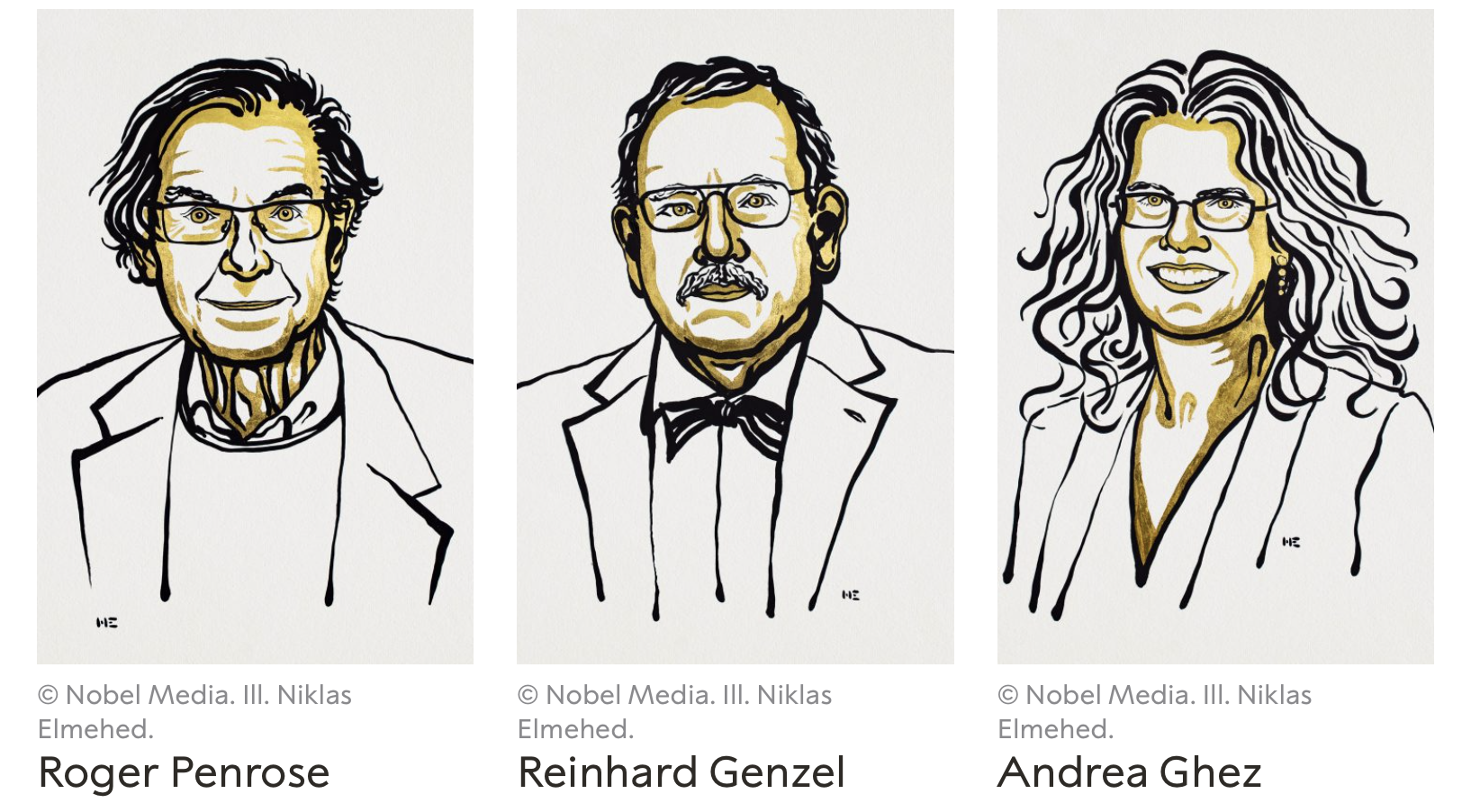
    The Nobel Prize in Physics this year was shared amongst three laureates for their discoveries concerning one of the most searched mysteries in the Universe, the black hole and the Milky Way. Roger Penrose, one of the three Nobel prize Winners proposed the general theory of relativity leads to the formation of black holes. The other two winners, Reinhard Genzel and Andrea Ghez found out that there is an invisible and extremely heavy object governing the orbits of stars right in the centre of our galaxy, The Milky Way. The only known explanation currently is that it is a black hole.

    Roger Penrose was born in 1931in Colchester, UK. He received his PhD. In 1957 from the University of Cambridge and is now a Professor at the University of Oxford.

    Reinhard Genzel was born in 1952 in Bad Homburg vor der Höhe, Germany. He got his Ph.D. in 1978 from the University of Bonn in Germany. Director at Max Planck Institute for Extraterrestrial Physics, in Garching, Germany, He is currently Professor at the University of California, Berkeley.

    Andrea Ghez was born in 1965 in the city of New York, USA. She received her PhD in 1992 from the California Institute of Technology, Pasadena, USA. She is currently a professor at the University of California, Los Angeles, USA.

    The total prize amount was 10 million out of which one half was given to Roger Penrose and the other half was subsequently split between Reinhard Genzel and Andrea Ghez.

    Roger Penrose proved that black holes are a direct consequence of Albert Einstein’s general theory of relativity using mathematical methods, which is pretty fascinating since Einstein himself did not believe in the existence of black holes. Black holes are thought to be heavyweight monstrosities that engulf everything which enters them, not even light can escape a black hole. Dr Penrose proved that black holes can form in reality and he described them in detail in his ground-breaking article which is considered as one of the most essential contributions to the theory of relativity, post-Einstein.

    Reinhard Genzel and Andrea Ghez each had a group of astronomers that they were leading since the early 1990s which focused on a region called Sagittarius A* at the centre of our galaxy. The orbits of the brightest stars which are closest to the middle of the milky way were mapped with increased precision. Both the group’s measurements match in terms of findings, both of the groups found an extremely heavy, invisible object that pulls on the jumble of stars which causes them to run around at dizzy speeds. There are around four million solar masses which are packed together in a region which is as big as our Solar System.

    Using the World’s largest Telescopes, Reinhard and Andrea came up with methods to see through the huge clouds made of interstellar gases and dust which come between the centre of the milky way and hinder our vision of it. The refined new techniques to compensate for distortions caused by the Earth’s atmosphere. They built unique instruments to carry out this process which has given the world one of the most convincing evidence of a supermassive black hole at the centre of the Milky Way.

    This year’s discoveries have decidedly broken new ground in the field of compact and supermassive objects. These new discoveries have created more questions to be answered and have generated the future potential for further research. It is very impressive to see how Laureates have pushed the concept forward and how they have gotten closer to deciphering of one the greatest scientific mysteries of all time.

  • Chinese Officials Lose Control Over Tiangong-1 Space Station

    Chinese Officials Lose Control Over Tiangong-1 Space Station

    The Chinese space station, “Tiangong-1”, is headed towards Earth. Chinese officials have also revealed that they currently have no clue where the space station is going to crash, but have predicted that it is to occur sometime in 2017. The craft is approximately the size of a bus (a length of about 34 feet and width of 11 feet), weighing 8.5 tonnes. It will most likely re-enter our atmosphere in small pieces.

    The Tiangong-1, which translates to “heavenly palace”, was originally launched in 2011 as an attempt to practice and carry out experiments relating to living in space and docking procedures with other space crafts. It was only built and intended for two year missions. Only recently, on September 14th 2016, did Wu Ping, the deputy director of China’s manned space engineering program, reveal that they had lost contact with the space craft back in March of 2016. Reasons why China’s space program have lost contact with Tiangong-1 currently remain unclear. While most unmanned space crafts burn and break apart upon entering the Earth’s atmosphere, this is usually closely monitored and highly controlled.

    Unfortunately, having lost all contact with the satellite, the Chinese space agency has very little influence over when and where it will crash. As of September 23rd, Tiangong-1 was orbiting above the Earth at approximately 370 kilometers. It has been losing just over 100 meters a day from both the Earth’s gravitational pull and atmospheric drag. By November 13th, the station will be roughly 364.9 kilometers above the Earth, having lost over 5,100 meters.

    When satellites reach the end of their intended lifespan, there are two options to dispose of them. The first is blasting it even further into the icy depths of space where it will never be seen again. The second option consists of slowing down the satellite using the last of its fuel so it can fall out of orbit and burn up in the atmosphere. While smaller satellites disintegrate upon entering the atmosphere at thousands of miles an hour, bigger crafts, i.e. Tiangong-1, may survive and are usually redirected to an area in the South Pacific Ocean known as the “spacecraft cemetery”. The cemetery is the safest place for satellites to crash because it is the point farthest away from any piece of land.

    So where will the space station crash? Nobody is able to know or even roughly estimate the site of impact at this time. Even when satellites reenter our atmosphere under controlled descents, no one is able to predict exactly where it’s going to crash due to factors like the descent angle, how much of the craft is left to burn, and if there are multiple fragments. Taking into account all these factors, means that the craft could crash practically anywhere on Earth.

    Despite all of this, officials claim that there is only a small chance that the satellite will hit a populated area. This is partially due to the fact that Tiangong-1 is hollow, which will cause it to burn up upon re-entry. Additionally, most of Earth’s surface (71%) is covered in water, with population density being a specific area on land, lessening the chance of the satellite posing any danger. However, that is only an estimate, and the only way to know for sure will be to watch the skies sometime in 2017.

  • Have you heard of Elon Musk?

    Have you heard of Elon Musk?

    Have you? What about SpaceX? Tesla Motors, SolarCity? Or maybe PayPal? That last one has to be familiar. Elon Musk was key to its inception, and PayPal itself was a building block leading to the inception and success of the other three companies.
    In 1995, Elon Musk enrolled in a PhD program at Stanford University, studying high density capacitors as an energy storage solution potentially more efficient than batteries. Originally from South Africa, he saw Silicon Valley as the Promised Land and transferred to a US university after immigrating to Canada. How did he make the decision to enter such a program? Quite differently from most of us in university, as it turns out.
    Instead of determining what it was that would make you happy, or fulfill you, or even make you financially stable in the future, what if you narrowed down your goals based on what you thought would most affect the future of the human race? What about the potential reprogramming of the human genetic code, artificial intelligence, space exploration and settling, the internet, and sustainable energy?
    That was his list, and the last one had lead him to the PhD program. Two days in, he ditched it. It was 1995, after all, and with the internet blowing up the way it was, he couldn’t be left behind. He wasn’t.

    After starting Zip2 with his brother, an early company taking a shot at replacing the Yellow Pages, and selling it for $307 million, he took some of his share and tried to start an online bank. This was an insane notion in 1999, but their money transfer service was in demand. They teamed up with another money transfer company in the same building and formed PayPal. Despite turmoil within company management, he walked away with $180 million when it was sold to eBay in 2002.
    Even before the sale, he had been thinking about rockets. After it, he started SpaceX, with the intention of reducing the cost of space travel to the point where humans could become a multi-planetary species. Two years later he started Tesla, despite the fact that SpaceX had yet to successfully launch a rocket. Today these two projects are his major claim to fame, and his major contributions to humanity.
    Tesla is an electric car company, intending to accelerate our collective progression to a sustainable future. He personally funded both of these companies.
    He also eventually funded a start-up with his cousins, SolarCity, which aims to install solar panels on the homes of millions, reducing their draw from the mostly fossil-fuel powered grid, and ultimately increasing the adoption of sustainable energy.
    Things weren’t awesome right away, however. SpaceX had built three rockets by 2008, but they had all exploded prior to reaching orbit. They had the money for a fourth and final, with the entire company depending on its success.
    Slightly more than a month ago, SpaceX launched a rocket delivering 11 satellites into orbit, which then returned through Earth’s atmosphere to Cape Canaveral where it successfully landed – a historic first.
    Every launch since those first 3 has been successful, and this landing, doubly so. This is a major step towards making space travel affordable. Though the rockets can’t be directly reused, all of their components are returned to earth intact, and can be recycled for the next build. It is estimated to reduce the cost of space travel by a factor of 100.
    Alongside this, despite the predictions of failure by just about everyone following the stock market downturn, the Tesla Roadster was a resounding success, and received the highest ever safety rating from the NHSA- a 5.4/5.
    Tesla is currently building a lithium-ion battery factory in Nevada that should double the total annual GLOBAL production.
    SolarCity is the largest solar panel installer in the US.
    The Tesla Model 3 is slated to appear at the Geneva Motor Show in March this year.
    But despite his astounding successes in every venture he’s attempted, Elon Musk doesn’t like it when people talk about Elon Musk. His big concerns are the future of our planet and humanity, and he’s trying to encourage discussion of sustainable technologies and energy; as well as space travel and colonization.
    Have you ever heard of the Fermi Paradox? It’s a little bit terrifying if you sit back and contemplate it a few drinks in.
    On the clearest nights out on the dykes, when the lights of Wolfvegas are dim in the distance, you can look up and see just about 1% of our Milky Way galaxy, with your eyes unaided.
    Beyond what you can see, there are stars upon stars and galaxies upon galaxies. An unfathomable number. Somewhere between 1022 and 1024 stars. Are 5% sun-like, capable of supporting life similar to ours? And, maybe say, 22% of those are orbited by an earth-like planet? That leaves us with a potential 100 earth-like planets for each and every grain of sand on our Earth.
    The Fermi Paradox is this – where is everyone?
    If 1% of 1% of those planets develop life that evolves to our level of intelligence, we share the universe with 10 million billion intelligently inhabited planets. In the Milky Way, we should have 100 000 neighbors.
    The Search for Extra-Terrestrial Life (SETI) has yet to find any evidence of life beyond the blue dot we have inhabited for the past million years.
    So which is scarier – are we surrounded by life we cannot or have not detected, or we are absolutely alone in a universe that is absolutely unfathomably enormous?
    If life is that rare, then it is more precious than we have ever realized, and colonizing other planets is a necessity to ensure the continuation of our species. I bet that was never a daily worry of yours!
    The intention of SpaceX’s foray into affordable space travel is to lead to the colonization of Mars with a million people in the next 100 years. This rocket has been step one.

Betzillo positions itself as a versatile gaming hub where structured bonuses and adaptive gameplay mechanics support both short sessions and extended play.

Built with a focus on innovation, Spinbit integrates modern casino architecture with rapid transactions, appealing to players who value speed and digital efficiency.

Ripper Casino emphasizes bold entertainment through high-impact slot titles and competitive promotions crafted for risk-oriented players.

A friendly interface and stable performance define Ricky Casino, offering a casual yet reliable environment for a wide spectrum of gaming preferences.

King Billy Casino channels classic casino spirit into a modern platform, delivering recognizable themes supported by contemporary reward systems.

Immersive visuals and layered slot mechanics are at the core of Dragonslots, creating a narrative-driven casino experience.

Lukki Casino appeals to players seeking direct access and minimal friction, focusing on fast loading times and intuitive controls.

Casinonic provides a structured and dependable gaming framework, blending modern slots with transparent operational standards.