Author: Karis Johnson

  • “Fake It Til You Make It”- Coach and Its Facade Of Sustainability

    “Fake It Til You Make It”- Coach and Its Facade Of Sustainability

    Over the years, labels fitting under the title of being a “designer brand” have changed, but there have been a few constants. Among these, the brand Coach, founded in 1941, has remained in the spotlight, idolized by the masses. 


    In recent weeks, it has come to light that Coach, who claims to be environmentally aware, has been using a loophole in order to pay less in taxes. 


    A TikTok posted on October 8th by the user @thetrashwalker that has since gone viral (As of the writing of this, it sits at 923k likes and more than 10.5k comments) shows the ripped and damaged merchandise, including shoes and bags, that have been purposefully destroyed by employees at the order of the company. This is so that the company can write them off as if they were accidentally damaged and thus are able to avoid paying taxes on those unsold items.  


    Coach claims to be working towards a “circular economy” by coming out with collections made from repurposed items, as well as offering a “Coach Repair Workshop” in which you can bring in or ship your items, where they will then be repaired. This is another instance of them trying to prove that they are trying “to keep [our] bags out of landfill and reduce [our] impact on the planet”, as stated on their website. 


      Another video, posted by the user @dumpsterdivingmama, of whom the damaged merchandise was purchased from by Anna (@thetrashwalker), features them finding piles of the intentionally damaged product in a dumpster outside of a Dallas mall.  


    So, as Coach claims to be working towards a less wasteful, more sustainable future and economy, they are intentionally slashing and destroying their own products, and creating more waste in order to get tax write-offs. Large corporations such as Coach will do everything in their power to appear environmentally conscious and zero waste, when in reality, they are huge contributors to the landfills that they claim to hate. 


    For more content like this, you can follow Anna on Instagram and TikTok under the username @thetrashwalker, as well as following @dumpsterdivingmama on the same platforms. 


  • The Pandora Papers From a Students Perspective

    The Pandora Papers From a Students Perspective

    “Our slogan is: The truth will come out.”

    Mae Buenaventura, human rights and anti-poverty activist

    On October 3rd, 2021, Nearly 12 million documents detailing the off-shore banking and secret financial goings-on of hundreds of high profile figures around the world were leaked. 


    Dubbed the “Pandora Papers”, and led by the International Consortium of Investigative Journalists, this is the largest partnership of journalists in history, including over 600 journalists. Those high profile individuals included in the drop range from people such as singer and actress Shakira, all the way to politician, and current president of Russia, Vladimir Putin, with the latter having been involved in previous controversies involving fraud. 


    `Others involved in the leak are the King of Jordan, who was found to own three mansions totalling $68 million purchased through offshore companies. Note that this was found while joblessness and corruption protests have plagued the streets of his country for years. 


    The information was acquired from 14 different offshore companies, and reveal how truly secretive the financial actions of the government are. 956 companies in offshore havens were tied to 336 high-level politicians and public officials. 


    This shows just how far government officials will go to avoid the taxes that they themselves implement, and just how little we really know about what is going on in the government world wide. 


    As of 2020, approximately 11.3 trillion dollars are stored in offshore banking. This number will only increase, as more and more public figures will be able to tie up their money in yachts, mansions, artwork, and private jets, while the millions that can barely afford to put food on the table will continue to suffer. 


    As a college student who will obviously end up with a lot of student debt, it absolutely disgusts me that the rich are able to hide and protect their assets while so many around the world have to continue to be mistreated by their corrupt governments and politicians. 


    We can never make progress towards equality and ending poverty in our society if those in charge look out for only their own wellbeing while ignoring those that they are supposed to lead.

  • First Month Back at Acadia Post-Pandemic

    First Month Back at Acadia Post-Pandemic

    It’s not every day that you have your first month back to in-person college classes after a global pandemic, but here we are! 


    In a few months, we’ll be coming up on the second anniversary of the Covid-19 pandemic. I know, I can’t believe it either! The days of whipped coffee and a man deeply obsessed with tigers feel like only yesterday. 


    Due to the significance of the beginning of this school year, I spoke with a couple of students at Acadia to get a better view on people’s thoughts on the campus and academic life compared to before and during the pandemic and quarantine; Briar, a 4th year Politics and Sociology double major, and Ashley, a 3rd year Music major. 


    When prompted about the differences they personally observed in student life, I received relatively similar answers, both including the main changes, those being masks and social distancing. 


    Ashley: “There are only a few differences. I feel like this year they are trying to bring back normalcy as much as possible. Masks, distancing and only allowing on-campus residences into residence buildings are some of the changes. One thing I miss is signing in my friends from back home (non-Acadia students) and having them stay with me for a few days on the weekend. That’s one thing I can’t wait to happen again.” 


    In the same vein as the previous question, I asked what their thoughts were on the educational aspect of things in this new school year.  


    Both agreed that this school year is relatively normal in comparison to the years before the pandemic, with small exceptions to this, such as the masks, as well as professors making assignments and lessons accessible online as well as in-person.  


    Briar: “I think it varies, a lot is similar when we’re all sitting together and chatting like before, but I find the teaching is a little bit different with the profs. They’ve changed assignments to be able to cater to in person and online which is useful (just in case of another wave). I think this would be applicable to all departments just because all of us got used to being online the entire school year.” 


    As a final question, I asked them what their personal experiences were with online learning, and they gave similar responses. They spoke about how constant staring at a screen was tedious and mentally draining, and that being unable to learn in-person was something that they struggled with, which took a toll on their grades. However, they did talk about how their professors did amazingly with the tools they were given, and they made everything as accessible as they possibly could for their students.  


    Briar:At first I found it cool that we could actually do everything online, but as it went on it became tedious looking at a screen for over 8 hours a day. I needed to go outside for walks quite a bit. What I thought was done well was that the profs were able to adapt to online like us and go through the same learning curve we did. Something I did notice that needed improving was that it was harder to participate online than in person. Due to this, it started affecting participation grading which wasn’t great.” 


    Ashley: “Our professors tried their very best to make things as accessible as possible. It was a learning curve for everyone considering this was the first time for a lot of students/teachers. Many people asked me last year, “How can you do music online?” Our professors were as organized as they possibly could and were very understanding. We used online programs for collaborative work where we recorded our separate parts for a piece and uploaded them to a website. 

    For me, online learning was not something I did well in and struggled with a lot. It’s definitely not something I would do again.” 


    Overall, Ashley and Briar, although in completely different majors and years, had extremely similar experiences with pandemic learning, and gave a great insight into what online learning at Acadia was. They spoke of both personal and general experiences with the stress that comes with trying to pass college due to a global pandemic going on around you. 


  • With the Oceans We Rise; the Climate Crisis and the Youths Response

    With the Oceans We Rise; the Climate Crisis and the Youths Response

    Students need climate action; our future depends on it”

               Georgia Saleski, ASU VP of student life

    As of 2021, we have just 9 years until the damage from climate change is completely irreversible. The government, however, does not feel the urgency that we as students of Acadia and residents of Wolfville do. 

    The response that Acadia students have to this issue has been to take to the streets and raise awareness.

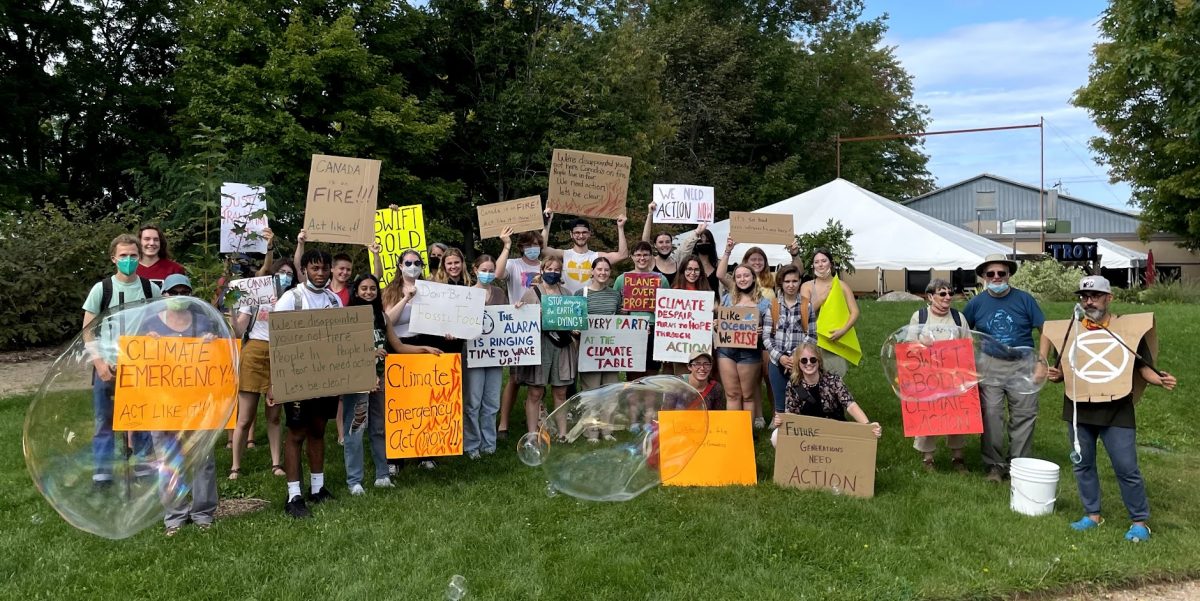
    On Friday, September 25th, both students and Wolfville residents alike took part in the international climate movement, “Fridays For Future”. Founded in 2018 by Swedish environmental activist Greta Thunberg, the movement was created in response to the government’s inaction towards the climate crisis. Hundreds, if not thousands of protests and climate strikes are held worldwide for “Fridays For Future”, many completely student-led.

    The climate strike began at 12pm and took place on Main Street, where they walked from Clock Park to Willow Park, waving signs and shouting chants, as passersby honked and cheered in support.

    I had the pleasure of being able to interview Georgia Saleski, one of the main organizers of this event, as well as the Acadia Students Union Vice President for student life, and she responded with some powerful statements and responses, which are included below.


    Q: What do you hope to achieve with this climate strike?


    A:  “This climate strike is really just an outlet for people to be able to come out and show their support for climate action. Not necessarily to result in any big decisions or outcomes, but to have students’ come together with the townspeople to show that we believe that this really matters, and to hopefully see some change. Both in our community and as well as on a bigger scale, like in the government.” 


    Q: What got you into activism/ climate activism?


    A:  “I got into general activism when I got to university. I really got exposed to a bunch of social and political issues through a law and politics class that I took in my second year of university. I really quickly became absorbed in it all and just infatuated with all the different political issues that are across the world and what different people are going through, as well as what affects my local community and the folks around me here in Wolfville. I guess that’s why I’ve taken a hand towards more local issues and just showing up at events in both Wolfville and at Acadia.“


    Q: If you were able to say one thing concerning the climate crisis to Prime Minister Justin Trudeau, what would it be?


    A: “Giving land back to Indigenous Peoples is a big one, as well as reversing the climate crisis and really seeing the action that we need taken. We have had our chance, so it is time to give the land back and acknowledge the calls to truth and reconciliation. We need to be moving towards allowing the Indigenous Peoples to restart and gain back everything that was taken from them.” 


    Q: What direct action do you believe needs to be taken by the Canadian government concerning the climate crisis?


    A: “A few things; They need to stop putting pipelines through Indigenous land, as well as pay attention to what the youth and students are saying. The government needs to acknowledge that their action is inaction, and the population that is growing up is going to have to deal with the repercussions.”


    Q: What can we as the general Canadian public do to try and help combat the climate crisis?


    A: “I would say reach out to your local government, reach out to your MPs, show up to events like this where there are people with similar interests trying to make a change. Because getting connected is really important, and helps keep the fight alive in yourself.”

  • Tanvi Dabas

    Tanvi Dabas

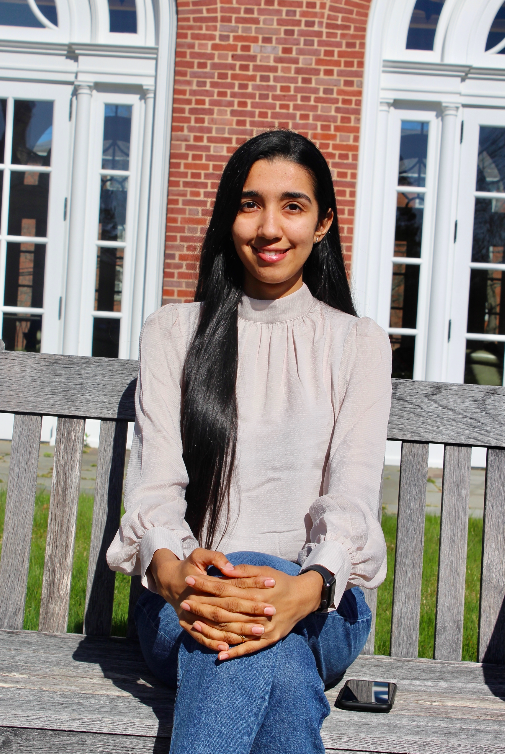
    Tanvi Dabas is from New Delhi, India, and she has recently completed her third year studying at Acadia University. Tanvi is pursuing her education at Acadia with a double major in nutrition and psychology with minors in chemistry and biology. Like many of us, Tanvi enjoys spending time outdoors and exploring new places. She also enjoys getting to know new people and says doing so teaches her a lot. Her favourite part about Acadia University is the community and the way it welcomes people from all walks of life. Tanvi has played a major role in bettering student life at Acadia University, including her many achievements and involvement in leadership positions at the school.

    First, Tanvi has been an International Student Ambassador for two consecutive years at Acadia, and her accomplishments do not stop there.

    A few weeks ago, Acadia launched general elections for the Acadia Students’ Union (ASU). Acadia Students’ Union is a student governed organization dedicated to serving its members through effective representation and communications. The Students’ Union offers innovative and quality services while providing a variety of opportunities that enhance the overall University experience of the students of Acadia. Acadia Students’ Union believes in and upholds the values of integrity, excellence, and respect while recognizing the importance of fun, community spirit, and the tradition upon which the Union was founded.

    Tanvi was elected for the role of VP of Events and Promotions and she is the first international woman to be in this position in the ASU! Acadia University is truly privileged to have Tanvi in yet another leadership role!

    Along with her new role representing Acadia, Tanvi was also one of the recipients of the student excellence awards in the psychology department for the 2020/21 year.

    Additionally, Tanvi was the coordinator for the Centre for Global Education (CGE) at ASU’s internal organization (IO). As CGE coordinator, Tanvi served international students at Acadia by creating and organizing events.

    Moreover, Tanvi was also a panellist at WISE’s event (an event that took place online due to Covid-19 regulations). WISE is an abbreviation for Women in Science and Engineering, and it is a campaign that encourages more people who identify as a woman to take up science and engineering and increase female participation in the fields. Essentially, Women in Science and Engineering (WISE) Acadia is a group of faculty, staff, and students dedicated to supporting and empowering girls and women who are interested or engaged in science or engineering-related careers.

    Amoung all of these contributions, Tanvi has maintained two jobs during her education at Acadia University. First, she serves the students at the Student Union Building (SUB) every morning at Perkin’s café. I am also honoured to work alongside Tanvi as section editor for the Athenaeum, Acadia University’s school newspaper. Tanvi is science section editor and has even further contributed to the Athenaeum with the implementation of her own column, “Science Fact of the Week”.

    I am pleased to write this article recognizing Tanvi Dabas as a leader and an overall asset to the Acadia community. Not only is she a dear friend of mine, but she is an honourable student, an ambitious and accomplished leader and an exceptional woman.  This is just the beginning for Tanvi, as I believe she will do many amazing things in her lifetime and, I, personally, along with the Acadia community, have been honoured to work and learn alongside Tanvi, as well as have her in leadership positions.

  • She Was Just Walking Home

    She Was Just Walking Home

    We have tried apps, tried keys, avoiding the bus and taking a taxi, phone calls, wearing flat shoes, panic button key chains, avoiding going out at night altogether, we have surrendered independence, tried running, tried screaming, tried to keep our head down, tried crossing the road, tried hiding in a crowd. Not one thing will change until the men that do it do.”

    anonymous


    Sarah Everard, a 33-year-old UK woman went missing on March 3rd, 2021, after walking home from a friend’s house. She was last seen at 9:30 PM when she was captured on a doorbell camera walking alone toward Tulse Hill.

    A week later, Everard’s body was found in woodland near Ashford, Kent. It is suspected she had been raped and murdered by 48-year-old police officer, Wayne Couzins.

    The tragedy hits home for women across the world. Vigils and protests are taking place, and on the rise is a social movement, “Not All Men”, and counter arguments addressing violence against women.

    When a woman hears news of another woman being abused – no matter where in the world she is – she thinks, “that easily could have been me.” It easily could have been a friend, a neighbour, a teacher, a family member. Women around the world run the risk of being raped and killed every day the second they leave their homes. Even when they are inside their houses, it runs through the back of their mind.

    This is why women walk with keys between their knuckles at night; this is why women check behind their cars and, in their backseats, and drive away before turning their GPS or their music on.

    In the UK, 97 per cent of women report being sexually harassed by men. It may not be “all men”, but it is enough men. It is enough men for females to fear all men. So, it may not be “all men”, but it is all women.

    However, it is not just men who rape and murder, domestic abusers, molesters, or men who take advantage of women. It is men who are “only joking”, men who grope, spike drinks and ignore the word, “no”. It is men who “rate” girls, it is victim blamers, unsolicited picture senders, stalkers and men who refuse to take any responsibility for their own or their friends actions. It is the men who dismiss women speaking up.

    It is men who stay silent.


    Not being “one of the bad guys”, is not good enough. Unless you are actively working to dismantle the patriarchy, you are part of the problem.

    You can be a loving husband, brother or friend to women, and you can still be part of the problem. Here is why; loving women is the basic minimum; nobody gets an award for treating men like they are human. When women love and respect men it is seen as their duty, but when men do the same, women are expected to be thankful.

    What a privilege it is for a man to not understand why his female friend asks him to walk her home at night. What a privilege it is to be able to park in a parking garage at night alone, or park far away from the entrance and not have to circle the parking lot waiting for a closer spot to open up. What a privilege it is to be paid what you deserve or more for your work. What a privilege it is to not be scared when being home alone. What a privilege it is to not worry about what you are wearing in case you are sexually assaulted, and people blame your clothes.

    It is always the clothes, it is always the amount of alcohol, it is always the amount of flirting and it is always the woman’s past or reputation. It is never the man.

    To all “good” men; check yourself. Check how you are talking to bad guys, why you tag along when they make offside comments to women. Check why you defend your friends and laugh when they make sexist jokes, rape jokes. Are you telling them it isn’t funny or are you provoking their behaviour? What are you doing when other men slut-shame women? Call yourself out, and then call out your family members and even your “buddies”. Surround yourself with people who recognize their own (male) privilege and entitlement and are diligently working to make the world a safer place for women to live.

    To all women with internalized misogyny; check yourself, too. Check what kind of treatment you accept from your male coworkers, friends and partners. Check how you idolize “good” men for doing the basic minimum. Check how you silence other women for speaking out and, especially, understand that an internalized misogynistic mindset has been ingrained in you by a society and institutions that actively oppress women. Do better, be better.

    Finally, let us all remember that feminism is only effective if it is intersectional. Speak out for impoverished women, disabled women, racialized women, transgender women and all marginalized groups of women. The real fight is against the system.


    Not only has Sarah Everard’s tragic death opened the doors to a whole conversation about gender violence, but it has been a wake-up call for most people.

    Not all men are sexually violent, but not all men choose to challenge misogyny, sexist jokes, stereotypes, objectification, victim-blaming, and patriarchal structures.

    It might not be “all men”, but it is enough men to make women afraid. It might not be “all men”, but it very well might be you.

  • SRC Decoded: What you missed March 19th, 2021

    SRC Decoded: What you missed March 19th, 2021

    The Students’ Representative Council (SRC) is a council composed of a body of students elected by their peers, who are tasked with running the Acadia Students’ Union (ASU). The SRC meets every Friday at 1:00 PM on Teams, however, they would usually meet in the Beveridge Forum located off the Michener Lounge in the Students’ Union Building (SUB). Each meeting is open to the public and students are welcome to attend meetings to learn more about the decisions being made on their behalf.

    The SRC met last Friday afternoon over Teams for their weekly meeting. After quickly taking attendance and passing the agenda, the meeting began. This meeting focused primarily of the ASU Bylaw review with some conversation also surrounding SOMETHING

    The significant matter brought to the floor was the possibility of an annual general meeting (AGM), which was addressed by Lydia Houck, VP Academic, and Robbie Holmes, VP Student Life. Lydia asked the rest of the council for suggestions on the best times/dates that would provide the best turnout for both council members and the student body. Robbie added that this would be a valuable event for incoming members of the council to gain information through student feedback so they can best represent their constituencies next year. The biggest question was whether to host the meeting before or after exams; council members saw benefits and drawbacks to each, but it seemed they were leaning towards holding it shortly after exams. No final decisions were made.


    The Ripen Partnership

    Brendan MacNeil led this discussion, first explaining that Ripen is a platform for work-integrated learning by allowing employers across any field of work to post a project for students. Students who are registered can then sign up to do this project – these are intended to be done as class projects –, allowing them to gain valuable work experience and be compensated for it (through the Canadian government) while the employer benefits from the work. The ASU has signed up for this initiative as an employer so that they can hire students, giving them the opportunity to gain valuable work experience related to their degree, and get paid for it! Brendan went on to explain that this program is available equally to all degrees, but since it is a government-funded program through taxpayer dollars, it is available only to domestic students. He mentioned that when the ASU met with the program coordinators to register, this issue of opening this opportunity up to international students was a significant topic of discussion and something they are committed to continually addressing. Robbie explained their plans for working with provincial student organizations to help lobby the government into expanding the program. Jordi Chaffer, Science Senator, spoke up, asking whether the ASU would continue with the program if it did not open up to international students, highlighting the unfair advantage this opportunity would give to domestic students.

    Lydia Houck spoke up, explaining that what she thought it was the most important remember that this program was in the very early stages of its implementation; the federal government wanted to gather initial data on the program’s functioning and that an expansion to include international students is something that would hopefully be eventually included by the time the program started running at Acadia. Many council members spoke up to stress the importance of ensuring the playing field is levelled for all students at Acadia. As this was just a discussion item, not a motion, the conversation ended shortly thereafter.

    Menat Tahoun, Professional Studies Senator, led the next topic of discussion, regarding international student representation on SRC. She explained that although in the past years there has been a much more diverse council, it would be valuable to create a position whose sole purpose is to represent and advocate for international students. Menat reasoned that this would ensure international student representation on the council, regardless of which students fill other roles – international or not. Chairperson Molly Anderson paused the conversation to add that this has been a matter of discussion in previous councils and that during those conversations the final consensus was generally that international students fell under the jurisdiction of the Diversity and Inclusion Representative. Soyini Edwards, who currently fills that position, expressed her concern that by putting these students under her representation, her position becomes a “melting pot” for any diverse representation at Acadia, and agreed that a council member dedicated solely to the representation of international students would be very useful. Robbie Holmes, VP Student Life, spoke up in support of this idea and also theorized about some ways it would work logistically so that international students did not have to choose between running for the International Student Representative and another role on SRC. Lara Hartman, Arts Senator, added how this type of position would also be important for other groups on campus, such as a representative for Indigenous students. Soyini made an impassioned speech echoing what she and other councillors had previously said, and driving home the idea that if the SRC is not doing their job to represent all students at Acadia, then the council is irrelevant.

    Lara Hartman spoke up to voice her distaste for the tokenized role that students who are non-white/Canadian have been on council, essentially being given the role or presenting, in Lara’s case all Indigenous peoples on campus, despite her role as the Arts Senator. She problematized this pattern of tokenism and suggested that the solution would be more seats for diverse populations on the council. Robbie Holmes answered, apologizing on behalf of the council if any of their actions made her feel that way, and concurred that this phenomenon of visible minorities representing their population on council rather than or in addition to their official position is something that needs to change. Robbie made the motion to direct this conversation to the Governance Committee, and that motion was passed.

    After a few brief announcements, namely a bylaw review happening next week that students are encouraged to go to and a Women’s Conference on the 27th, this week’s meeting was adjourned.

  • SRC Decoded: What you missed on March 12th, 2021

    SRC Decoded: What you missed on March 12th, 2021

    The Students’ Representative Council (SRC) is a council composed of a body of students elected by their peers, who are tasked with running the Acadia Students’ Union (ASU). The SRC meets every Friday at 1:00 PM on Teams, however, they would usually meet in the Beveridge Forum located off the Michener Lounge in the Students’ Union Building (SUB). Each meeting is open to the public and students are welcome to attend meetings to learn more about the decisions being made on their behalf.

    The council met this Friday with some new faces in the meeting! After general housekeeping (attendance, acceptance of agenda) the council opened up the floor for a question period. Colin Mitchell, recent Acadia Alumni, former Editor-in-Chief for the Athenaeum, Board of Governor Representative, and Arts Senator began the question period.

    For some context, a hot topic during the past week has been the possible cutting of funding for Axe Radio and the Athenaeum by switching them from Internal Organizations (IO) of the ASU to make them clubs. This idea was brought up because the ASU needs to balance and budget and is currently in a deficit. Robbie Holmes, VP Student Life, clarified that this was not a matter that would be voted on any time soon, and also highlighted some potential benefits that this would give those organizations, in his opinion.

    Colin made an articulate speech making the case to retain honoraria for these organizations, highlighting the significance of the Axe Radio and Athenaeum as a part of the freedom of the press at Acadia, saying they were the “the only two sources of union media of Acadia’s campus”. Colin explained that while it may be necessary for the ASU to make changes so as to cure their deficit, cutting these radio and newspapers from the Union only to suggest they ratify as clubs is not the best solution. Colin emphasized the work these organizations do in supporting and representing the voices of students, the great challenges the Athenaeum has endured (from WWI to COVID-19) and the necessity of free press on campus. He asked that anyone who is capable, please vote ‘no’ to any cuts to honoraria for the Athenaeum or Axe Radio.

    Robbie Holmes took the floor to answer, clarifying that their intention would be to fund these clubs through grants and that the idea of a levy would be fantastic.

    Colin finished by reemphasizing his passion to see the continuity of these organizations, making a personal commitment to do pro bono work making running a referendum to ensure the Ath is no longer a liability to the ASU.

    Next up, Chris, an Acadia Alumni from 2019, took the floor. He shared that he shared many similar sentiments to Colin, explaining that while he was involved in many different clubs and organizations while at Acadia, the most meaningful of them was his involvement in the Athenaeum. Chris made an interesting point that while the council members may wholeheartedly and genuinely like to guarantee these organizations the grant money they have spoken of, that word is only good so long as “their butts are in their seats”, meaning when these positions turn over – which most will next year – there is no longer the same commitment. Chris also mentioned that it would be unfair to take this opportunity away from students, especially those to hope to have PR or journalism in their future. Chris finished by thanking the council for having him and asking them to please make the right choice on this matter.

    Lydia Houck spoke up and clarify that these conversations being had at the council were not in any way trying to limit or prevent the freedom of the press at Acadia. She mentioned that if in the future there were to be a motion to separate the organization from the ASU she would be interested in making the motion conditional to the ongoing insurance of grants for the clubs.

    Blake Steeves, VP Events and Promotions, asked the Alumni attending the meeting what their thoughts were on possible funding from Alumni or the Alumni’s Association. Chris answered that quite frankly he wasn’t sure, but he knew personally he would willingly contribute money to the Ath “for the rest of time” and he had a feeling that if the ASU did reach out to Acadia alumni for financial support of the Ath, they would have no trouble at all with money. He also mentioned that journalists need to be protected as writers and that the ASU offers them a certain degree of protection allowing them to write more honest, important, and perhaps personal articles than they would be able to otherwise.

    Mary Tajeddin, Graduate Studies Senator, asked the Athenaeum Alumni two questions; the first being how did/does the Ath ensure the students hear them. Chris volunteered to answer, explaining that while it is really hard, if not impossible to be heard by the student body on the budget the Ath is given, especially as their resources become increasingly meagre. He said matter-of-factly that “it is hard to reach people with next to no money… Being heard comes down to a dollars and cents kind of conversation”.

    Kyle, another Acadia Alumni who was an editor and contributor for the Athenaeum during his time at Acadia, spoke next. Kyle emphasized the importance, in his perspective, of the Ath remaining an IO, reasoning that having the ability to say you are an employee is much more valuable than having a club membership status, especially when it comes to future employability. Kyle argued that there are very few opportunities for journalism in Nova Scotia, so the Ath is extremely valuable for students. Kyle added that the job he has now, as a Technical Writer, was obtained in part because of the extensive experience he acquired during his time with the Ath. Kyle also echoed Chris in saying that any decisions made to support these organizations right now, unless made extremely securely and worded precisely, will be vulnerable to future council decisions.

    Robbie Holmes answered this, assuring that these motions would be well-written. He then reiterated Mary’s second question, asking about the significance of hard copies, as did the paper online could be a great way to reduce costs. Alex Surette, Sustainability Representative, seconded that opinion, agreeing that going online would help cut down costs, be more accessible to students, and also be more sustainable. Colin subsequently reiterated what Chris mentioned, bringing home to point that the Ath simply cannot, in his opinion, operate the same capacity when they are being continually pressured to cut their budget and function on next to no funds. He added that the value of having print paper lays in its accessibility to the demographic of the Wolfville population who may not be so tech-savvy, and is much more comfortable using printed paper; he stressed that this helps bind the students and permanent residents of Wolfville, which is always a priority.

    As the conversation drifted further away from the question period and more into the matter that would only be appropriately discussed with the current Athenaeum staff present, Chairperson Molly Anderson reminded folks to stay on topic and suggested that if a meeting needed to be had with the Athenaeum, that is something they could set up in the future.

    After hearing from another Acadia Alumni, Christine who highlighted the historical significance of having print copies for students to read, Lara Hartman, Arts Senator, gave an impassioned speech stressing that this decision mattered, criticizing herself and the council for being so unresourceful that Alumni had to come in and help them solve these issues, and highlighting the importance that Ath has in providing a place for a diversity of voices to be expressed. She notably called out President Brendan MacNeil for writing in an email that “this was an elected council of sixteen students from an intentionally diverse background…” when, as Lara explained, there was no intention behind it. She continued that each member of the council made the decision themselves to run; they were not encouraged by anyone due to their potential diversity. Lara finished by reemphasizing the necessary role the Ath has in supporting student voices and making it clear that she is backing the Athenaeum Alumni one hundred percent.

    Brendan MacNeil spoke up, sharing his desire to “speak to what this matter actually is at hand”, explaining how he felt the conversation had become dominated by questions of the Athenaeum, student newspaper, and freedom of speech, while the reason this was brought to the table in the first place was to discuss the monetary partnership between the ASU and its IOs (Axe Radio and the Ath in this case), specifically the consequences of those IOs do not live up to the agreements in their constitutions. Brendan expressed his concern that it seemed the only reason to fund the Ath was that it needed more money to do its job. He explained that the ASU is providing funding to the Ath and is not seeing any outreach on their behalf – be it advertisements, student engagement, other promotional opportunities, or adequate content being published.

    Soyini Edwards, Diversity and Inclusion Representative and photographer for the Ath, asked why the organization was not given any notice of this concern before it was discussed in the meeting. Brendan MacNeil suggested she defer to Alicia Johnson who manages the IOs.

    There was some debate about the level of independence of the Ath could have while it was still an Internal Organization, as well as about the amount that was being published this year, and how much of the possible lack of publication could be accredited to the global pandemic we find ourselves a year into.

    Christine spoke to voice her concern not for the specific future of the Ath or Axe Radio, but rather for the future and vulnerability of IOs at Acadia if they can be turned into clubs so easily upon the perception of a less productive year and without a referendum. Blake Steeves and Robbie Holmes both clarified that they agree there should be student consultation upon these decisions.

    Rylie Moscato, current Editor-in-Chief of the Athenaeum, joined the meeting and took the floor to allow attendees to ask any questions they may have. Lara Hartman asked Rylie if, to her knowledge or the knowledge of any other member on her team, the Ath had been warned that it was not functioning to standard, to which Rylie replied no, it had not come to her attention.

    Brendan Keeler spoke up to clarify, once again, that this issue was brought up as a point of discussion, not as an item to be voted on, and also stated that at present, all IOs are within budget. Brendan also asked Rylie what the Ath was doing in terms of the available add space on their prints that have the potential of creating revenue for the Ath, to which she replied that while they were reaching out to many businesses in both Wolfville and New Minas, there was not much interest. She also mentioned that while there were some successful advertisements on their online editions, they could not cash that money until it reached 100 dollars.

    Molly Anderson necessarily moved the meeting forward, as the discussion was not going to end in any motion or decision, and the council agreed that this would be a good conversation to follow-up on in an organized and planned matter later on.

    Lydia Houck, VP Academic, made an announcement regarding her meeting with Academic Affairs. She explained that they talked about the various projects that the Senators are looking to undertake and well as the possibility of academic “mini councils”; their goal is for them to create a formal proposal and plan that they can pass onto the incoming council as there is not much time left in the term. Lastly, Lydia mentioned that they had conservation about potentially making the extended W and F a more permanent decision.

    The next topic of discussion was the new Policy document that the Executive created, which was passed by the Governance Committee. Most changes made to the document were conventions that have been in place all along and are now written officially. The council passed the new Policy.

    After a few last small discussions, the meeting was adjourned.

  • Community Health Boards’ Postcard Initiative

    Community Health Boards’ Postcard Initiative

    All Nova Scotians should have access to more funded and diverse opportunities for recreation and play, without barriers (WZ Community Health Plan). “Our current situation has highlighted that recreation, inclusive of arts, culture and sport, is a vital part of all our lives” — Recreation NS and Recreation Facility Assoc. of NS.

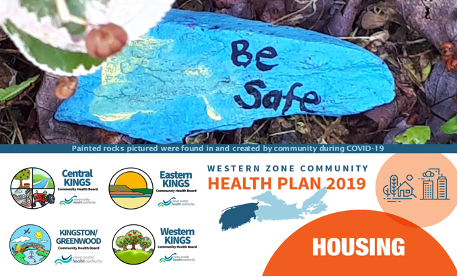
    140 or more families in Kings Co. didn’t have adequate, affordable, appropriate housing in 2016 (Census). To be safe, all Nova Scotians deserve a dignified place to call home.

    We need nutritious food to be strong. “Nova Scotians must become intolerant of hunger and poverty in our province” — Feed NS.

    We support Food Secure Canada’s call to address root causes of food insecurity mainly by establishing a liveable income floor and supporting Kings County residents to access local affordable healthy food.

    For those of you who do not know what community health boards (CHBs) are, they are a committed group of volunteers within the community that foster partnerships with other community members to improve and promote health and wellness locally. We are not medical doctors or therapists, but we’re community volunteers with various backgrounds with the same goal in mind. CHBs advocate for actions that will help create a healthier future for our communities according to what communities say is most important.

    We engage communities in discussions about the social determinants of health (safe housing, social and physical environments, income, etc.) in order to develop Collaborative Community Health Plans and advise Nova Scotia Health on local issues and priorities.

    CHBs also create partnerships and collaborations and distribute Wellness Fund grants annually to local community groups and projects that complement our priorities. For example, Flying Squirrel Adventures was awarded Wellness Funds for a program that offered free outings for all ages in inspiring outdoor settings. The program included facilitated activities and free time for participants to experience nature at their own pace.

    Unfortunately, because of COVID-19, the outings were cancelled before the program was completed, but the organizers pivoted quickly and were able to use Wellness Funds to distribute nature craft kits to program participants instead.

    Postcard Initiative

    According to the four priority areas in our Western Zone Community Health Plan, the four CHBs in Kings County, Central Kings CHB, Eastern Kings CHB, Kingston-Greenwood CHB & Western Kings CHB, have launched a postcard project highlighting food security, community connection, recreation and wellness, and housing. The goal of the postcard initiative is to help members of the community share how the priority areas are most important to them. They also provide awareness and facilitate action for the improvement of health and wellness holistically. These postcards are being mailed to local MPs and senators (postage included).

    Look out for our event in the ASU building next month! Postcards will be available for those that would be interested in adding a personal message to a postcard and having it mailed.

    More resources and references can be found at https://www.communityhealthboards.ns.ca/postcards.

    Messages on the postcards are as follows:

    • “Being there for each other means that everyone is included.  During COVID-19, lack of reliable and affordable internet access in our rural communities has deepened existing inequities in terms of social connection, education, public health, and safety. Social connection and equity for Nova Scotians requires universal access to reliable and affordable internet.” (Message on community connection postcard)


    • “All Nova Scotians should have access to more funded and diverse opportunities for recreation and play, without barriers (WZ Community Health Plan). “Our current situation has highlighted that recreation, inclusive of arts, culture and sport, is a vital part of all our lives” — Recreation NS and Recreation Facility Assoc. of NS.” (Message on recreation and wellness postcard)


    • “140 or more families in Kings Co. didn’t have adequate, affordable, appropriate housing in 2016 (Census). To be safe, all Nova Scotians deserve a dignified place to call home.” (Message on housing postcard)


    • “We need nutritious food to be strong. “Nova Scotians must become intolerant of hunger and poverty in our province” — Feed NS.
      We support Food Secure Canada’s call to address root causes of food insecurity mainly by establishing a liveable income floor and supporting Kings County residents to access local affordable healthy food.” (Message on food insecurity postcard)


  • SRC Decoded: What you missed March 5th, 2021

    SRC Decoded: What you missed March 5th, 2021

    The Students’ Representative Council (SRC) is a council composed of a body of students elected by their peers, who are tasked with running the Acadia Students’ Union (ASU). The SRC meets every Friday at 1:00 PM on Teams, however, they would usually meet in the Beveridge Forum located off the Michener Lounge in the Students’ Union Building (SUB). Each meeting is open to the public and students are welcome to attend meetings to learn more about the decisions being made on their behalf.

    The SRC met again last Friday for their weekly meeting, and with some new faces! This week the council members were shadowed by some of the new elects for next year. Attendance was quickly taken; the agenda was passed (after a few new items were added), and the council members who participated in the general election declared a conflict of interest and agreed not to speak during conversations regarding election results.


    New Business

    The council discussed their election process and brainstormed how it could go more smoothly in future years, as well as ways it went well this year. Of specific concern was ensuring that ballots go out to all students at once, as this year part-time students initially did not receive a ballot. The SRC motioned to accept the election results and it was passed. It should be mentioned that although the Sustainability Representative was successfully elected, he officially resigned and the position will be filled through the by-election next year.


    Announcements

    Jordi Chaffer, the Science Senator, was looking for suggestions on types of prizes he could give out for the project he has been working on. It seemed that the general consensus was gift cards, but not much discussion relating to the matter was had.

    Soyini Edwards announced that she is running an initiative with the women’s center, to host a women’s conference, titled “Women of the World”. She explained that it will be virtual, and will run in about two weeks. The proposal was quickly passed by the council and Kevin George made his proposal, to run a movie night for students at the end of the term to help students relax while exams ramp up. Black Steeves, VP Events and Promotions, mentioned that Kevin will have to be cautious about how food could be eaten and shared, considering COVID-19 restrictions and safety. More, the capacity of the KCIC is extremely limited, which should be put into consideration as well. Keeler suggested that Kevin could show the movie a few times so that more people could participate. Overall, the council was very helpful and supportive in this plan and it seems it has great potential. The motion was made to accept the proposal, conditional on a report back to the council next week with more specific details.

    Menat Tahoun, Professional Studies Senator, took the floor next to present her proposal. “Chats with 2020 Alumni”. She suggested that this would be a really helpful way to ease graduating students’ anxiety about entering the world with a new degree while the world is in a global pandemic. She said that she is still working through the logistics of the platform she will use, but otherwise, everything has been planned. The project proposal was passed by the council, and Brendan MacNeil led the next conversation. He explained that he wants to run a bunch of surveys to get good insights into how this year went for students and help prepare for next year. These surveys will be tailored to different subjects, such as finances, orientation week, and mental health. Brendan hopes that this will provide students with the opportunity to provide useful feedback on their feelings about this year as a student, especially throughout the pandemic. Another council member proposed to break the surveys down to more faculty-specific categories, and Brendan concurred that the surveys as they stood would do that by nature. Maria suggested that an area be provided to give feedback on Accessibility Services, as it seems many students this year have had frustrating experiences while trying to work with them. Many other council members agreed that they had heard the same things and that this opportunity for feedback would be an appreciated and beneficial idea. Robbie Holmes suggested that students are given an opportunity to provide feedback on how they felt their classes went this year, considering the student experience this year was completely different. Lara Hartman, the Arts Senator, suggested that there also be a place for Indigenous Students to provide feedback, and Brendan agreed that this was a great idea.

    There’s was some discussion about physical accessibility and the council agreed that Acadia’s campus had much work to do to improve its accessibility.


    Budgeting

    Brendan Keeler, VP Finance and Operations,  announced that the ASU was in a deficit, due in part to the pandemic no doubt, and that team had brainstormed the idea to cut the Axe Radio and the Athenaeum from funding and to ratify them as clubs, where they could apply for grants. He reasoned that this would not create any major changes to either program and would significantly help the budget. Brendan explained that this would eliminate the honorariums given to members of these programs would affect some people’s decisions but also reasoned that if individuals have a passion for these types of activities, then doing it as a club or hobby may be beneficial as students would have more time to produce content.

    Sadie MacAlear, Community Relations Representative, expressed her concern that if students are putting the time and effort into producing content, then they should be fairly given credit for that. Soyini Edwards, who is a photographer and manager for the Ath, worried that this cut could effectively dissolve the Ath for periods because students are much more accountable to jobs that they must do (in this case in order to be paid) rather than doing something because they like to, especially when the school can be so busy.

    Menat, who works for Axe Radio, asked Brendan Keeler to clarify what differences, other than the honorarium, would be noticed if these programs went from internal organizations (IOs) to clubs. Brendan explained that these IOs are receiving funding from the ASU’s operating budget right now and that this change would save that money.

    Brendan Keeler added that this was a decision that would ideally be made by next week and that if anyone had thoughts or questions to contact him before then.


    Wrap Up

    Alex Surette, the Sustainability Representative, announced that the new waste stations are being put up to provide the four-stream recycling program – keep an eye out for them in the SUB! Lydia Houck announced that following her meeting with the Board of Governors, it seems like students who were charged an overload fee who took a year-long 3 credit hour course will be reimbursed. Great news!

  • What You Need to Know About the Vancouver Police Department

    What You Need to Know About the Vancouver Police Department

    In recent news, the Vancouver Police Department (VPD) has drawn attention to themselves when they brutalized peaceful indigenous protestors. They then entered the spotlight again, when two VPD officers mockingly posed with a dead body.

    Vancouver police dispatched an unnecessary number of officers to address about twenty Indigenous protestors who were peacefully protesting in the lobby of a Bank of Montreal (BMO) building. The group was protesting against the Trans Mountain Expansion investors (AIG insurance). These protestors were arrested, brutalized and later released. 

    Last week, two VPD officers were discovered on tape posing with a dead man on Third Beach. Officers are seen in the video laughing and snapping photos in front of a deceased body lying on the shore. The two men were assigned to secure the site before the coroner arrived, and they are now facing a Police Act investigation for their actions.

    Videographer Zachary Ratcliffe posted the video because he said he thought it needed to be seen. “I think that the VPD should be concerned that officers feel that emboldened to act in such a way that clearly shows no respect for whoever this was,” Ratcliffe said in an interview with CBC on Friday. 

    Moreover, both of these recent incidents reflect a lack of value for human life. Unsurprisingly the VPD’s lack of value for human life is represented in statistics, according to data collected between 2000 and 2017 by CBC, which suggests that British Columbia has the highest per capita police-involved deaths. Victims are male (97%), unarmed (36.4%), killed in shooting (58.6%), white (47.5%) and/or struggling with mental health and/or substance abuse (75.8%). Furthermore, Black and Indigenous people are disproportionately killed by the VPD. Results showed that the percentage of Black and Indigenous victims of police-involved deaths was larger than the percentage of Black and Indigenous make-up of the population of Vancouver between 2000 and 2017. 

    While there are many examples of violent VPD behaviour over the years, included in these are the cases of Frank Paul and Robert Dziekański, who both tragically died at the hands of police officers in Vancouver. Frank Paul was 48 years old and Mi’kmaq. He died of exposure and hypothermia in a Vancouver alley after he was dumped there by police even though he was severely intoxicated and wet. He died on December 6th, 1998. Robert Dziekański was a Polish immigrant to Canada. Dziekański was killed during an arrest at the Vancouver International Airport in Richmond, British Columbia, where he was displaying agitation towards airport staff during customs processing. 

    Lastly, the lack of accountability and compliance from the Vancouver Police Department is significant. A police watchdog said, “What I found is neither the VPD nor the RCMP is enforcing the writing of these reports at all, and we’ve had dozens of incidents where we found that officers, the shooting officers, the officers involved in the application of force, have not written reports at all during our investigation.” 

    The President of the Vancouver Police Union, Tom Stamatakis, said that this was because officers feared that the information they provide in a report would be used against them. 

    The report from the CBC report also stated that, on average, 27 people are killed in police-shooting every year. These events show that police officers in Canada are rarely held accountable for the trauma and death they inflict and racialized people are disproportionately impacted.


  • SRC Decoded: What you missed February 26th

    SRC Decoded: What you missed February 26th

    The Students’ Representative Council (SRC) is a council composed of a body of students elected by their peers, who are tasked with running the Acadia Students’ Union (ASU). The SRC meets every Friday at 1:00 PM on Teams, however, they would usually meet in the Beveridge Forum located off the Michener Lounge in the Students’ Union Building (SUB). Each meeting is open to the public and students are welcome to attend meetings to learn more about the decisions being made on their behalf.

    This week’s meeting began as per usual with a roll call and the approval of the agenda.

    Before any discussion began, Chairperson Molly Anderson warned there would be the talk of the election, giving Sadie McAlear and Menat Tahoun – who are both running in the election – the opportunity to declare a conflict of interest and agree to refrain from conservation around that topic.

    The first item of discussion was surrounding the Neighbors Helping Neighbors initiative, where Acadia students volunteer to assist residents in Wolfville with tasks like yard work, technology, or just provide some company! VP Student Life, Robbie Holmes assured that the event was still happening.

    Next up, Jordi Chaffer, the Science Senator, filled the council in on the small-scale turned large-scale project that he has been a part of. He explained that the Research and Graduate Studies Dean who he has been working with, will be proposing their project to the other Deans in the weeks to come and that it seems the university staff see it as a great opportunity to pull in prospective students. Jordi emphasized his desire to ensure this project continues to be student-led, and that there seems to interest and support within the student body to ensure that can happen. Mary Tajeddin suggested that there be two award categories: one for ongoing research and the other for early lit-review proposals. Other council members seemed to think this was a great idea.

    Bylaws were the next topic of discussion. Molly announced that the council will be holding several bylaw review sessions with students and that members are expected to be fully versed on those bylaws so they are prepared and can adequately explain and discuss them with students. Robbie necessarily added that if members do not understand the bylaws well enough to discuss them with students, then they shouldn’t be voting on them. Lara Hartman, Arts Senator, gave full disclosure stating that she has a plate fully loaded with commitments meaning she may not be able to attend these sessions, despite her best intentions. Mary Tajeddin echoed those thoughts. Brendan MacNeil added that he is hoping for as much student engagement throughout these sessions as possible so that members should try and advertise them as best they can.

    Brendan MacNeil led the conservation into a discussion about the Career Services Centre. He explained how he wanted to bring forward a motion regarding the SRC’s commitment to the centre in relation to Matthew Rios’s presentation last year (refer to SRC Decoded article for October 26th for a recap). Brendan explained his desire to increase the support – which is currently lacking – that students receive from Acadia. This would be anything from resume and interview workshops, to preparing for the workplace as a professional, to assist with job placements. This initiative is a cooperation between the Alumni Association, the university, and the ASU with the ultimate goal of developing a high functioning and effective Career Services Centre at Acadia that is supported and run by Acadia after four years. Brendan’s proposal is regarding what the ASU can commit to this project.

    Firstly, he inquired what amount of work these committees can invest to support this professional development project for the student body. He went. Brendan said that he feels that student-run organizations have a history of doing really good work in this department already, but with a new budget they would have many more opportunities. That being said, Robbie put forward the first motion: to ensure that ASU groups work in an environment of collaboration with the Career Services Centre of Acadia, including but not limited to funding grants available to them as student organizations under the ASU. Brendan seconded the motion, and it was passed unanimously.

    The second motion regarded the ASU’s monetary contribution to this project. Brendan suggested that the ASU contribute their own $10,000 each year in addition to the $350,000 across 3 years from the Alumni Association. He explained that the two roles in Career Services at present are funded by the Alumni Association and his proposal is to create four more student positions that are funded by the ASU which are devoted to programming for students. He explained that there is a $150,000 reserve in the Student Wellness Fund which can only be spent on student wellness and that the ASU takes the yearly 10 thousand from there. Alex Surette, Sustainability Officer, asked whether the student positions would remain even after the Centre is transferred to the university and Brendan MacNeil answered honestly that he did not know. He went on to mention the council has the power to make that conditional upon approval; when the power is transferred to the university, they can put in the contract that those student positions must be maintained. Brendan moved this motion: to allocate $10,000 annually for the next three years from the accrued capital of the Wellness Fund to the Acadia Career Services initiative, pending approval by the Financial Affairs committee, with a yearly re-evaluation by the ASU executive, conditional that the ASU make some form of commitment to carry-on these initiatives after year-four. Soyini Edwards seconded the motion and it was passed unanimously.

    Next up Molly addressed an issue that occurred during the ballot distribution for the election. General election ballots were accidentally only distributed to full-time students at first, so the council thought it best practice to extend the period of time for the ballots to be submitted so that those students who received theirs late weren’t rushed to vote. Brendan Keeler motioned to extend the voting period by 24 hours for all associate members of the Union, to conclude at 4:30 pm on Saturday, February 27th, the voting period for all ordinary members of the Union will remain the same, as indicated in the previous election plan that was submitted to SRC. Alex Surette seconded the motion and once again, the council passed the motion unanimously (save those with a conflict of interest).

    Molly passed the conversation to Alex Surette, who wanted to discuss his project proposal. He proposed to create a sustainability page on the ASU website which would include past and current sustainability initiatives that have occurred on campus that the ASU have been involved with. This would also provide a place for students to access different contacts and see how they can become more involved. Menat motioned to make his proposal, Lydia seconded it, and the council passed it.

    Lastly, Community Relations Representative, Sadie McAlear made a proposal to the council to create a Wolfville Vlog Series that engages students and permanent residents in Wolfville. Some examples would be a video compilation of people in Wolfville answering the question “What is Wolfville to you?”. Sadie emphasized her desire to help bring the residents and students together to create a tighter-knit community and thought this project would be a great way to facilitate that. Alex motioned to accept the proposal, Menat accepted in, and the council passed it.

    After a few more short conversations the meeting for this week concluded.

  • SRC Decoded: What you missed February 19th, 2021

    SRC Decoded: What you missed February 19th, 2021

    The Students’ Representative Council (SRC) is a council composed of a body of students elected by their peers, who are tasked with running the Acadia Students’ Union (ASU). The SRC meets every Friday at 1:00 PM on Teams, however, they would usually meet in the Beveridge Forum located off the Michener Lounge in the Students’ Union Building (SUB). Each meeting is open to the public and students are welcome to attend meetings to learn more about the decisions being made on their behalf.


    Commencement

    After a quick roll call, Chairperson Molly Anderson put forward the meeting’s agenda and VP Academic, Lydia Houck, asked to add a motion under new business.

    As per usual, Molly asked if there were any conflicts of interest, and unusually, the council had to decide whether some of its members should abstain from the conversation in this meeting, as it regarded the ASU election, which some council members were running in. Sadie McAlear, Kevin George, and Menat Tahoun, who are all running for re-election, declared conflicts of interest and agreed to refrain from speaking in that conversation.

    Zach Goldsmith inquired as to the logistics of council members meeting virtually or in-person for council meetings once they were able to do so, bringing up the point that many Theology students are not on campus and it may be more accessible for members to have the option of attending virtually. Robbie Holmes replied that he believed the general consensus was that for the foreseeable future, their hope is that those who can attend in-person will, but those who cannot, will be able to attend their meetings virtually. Molly concurred that the option for members to attend meetings virtually is something that is in the works in terms of being protected by SRC policies.


    New Business

    The only issues left on the agenda after this was new business, where Lydia had asked to discuss the option for a vote abstention on the election ballots. She explained that historically there has been an abstention option on the ballot (meaning for any given question, you had the option to select abstain, and not vote either way) and that students are wanting that option back. Danish, who runs the elections, agreed that the option to abstain would be beneficial and even get a better voter turnout, according to the feedback he received after the last election.

    After this discussion, Lydia moved to include an abstention option on the ballot for all positions in all ASU elections moving forward, including the ASU 2021 election.

    Danish clarified that in regards to needing a two-thirds majority to win a vote, an abstention vote would not count as an “against” vote, it would simply not be accounted in the vote at all. Robbie suggested that they instead motion to add the abstention option for only candidate positions, not referendums. This is because they do not want students to choose to abstain from voting in referendums by cause of laziness and think that removing the option to abstain in referendums will help promote more student engagement in their government. This motion was passed unanimously (save the members who declared a conflict of interest).


    Announcements

    Alex Surette made a quick announcement that he is working to create a video to show how to use the new waste sorting resources that are coming onto campus. Molly quickly reminded members that they were expected and encouraged to attend the general debate and to ask provoking questions. Finally, Brendan MacNeil issued a formal apology to the council about the motions that were debated in the previous meeting, as he felt he had not given the council enough time to prepare and enough context to enable them to effectively and informatively discuss the matters.


    Conclusion

    The meeting ended shortly thereafter, and the council spend the rest of their time in an informal work period.

  • SRC Decoded: What you missed February 12th

    SRC Decoded: What you missed February 12th

    The Students’ Representative Council (SRC) is a council composed of a body of students elected by their peers, who are tasked with running the Acadia Students’ Union (ASU). The SRC meets every Friday at 1:00 PM on Teams, however, they would usually meet in the Beveridge Forum located off the Michener Lounge in the Students’ Union Building (SUB). Each meeting is open to the public and students are welcome to attend meetings to learn more about the decisions being made on their behalf.

    The meeting started as per usual with a role call and the passing of the agenda. Chairperson Molly Anderson ensured there were no questions, presented the previous meeting’s minutes, which were quickly accepted, and stated that there were no presentations or tables of matters.


    Report to Council: Board of Governors Meeting

    The first matter of business was a report to the council from the Board of Governors meeting which happened on February 12, by Brendan MacNeil. He gave a brief summary, stating that student engagement in the university’s activities was much higher this term, both in terms of their participation in and running of events, as well as their physical presence on campus. Brendan suggested that this means students are feeling much more stable studying during these unprecedented times. Brendan also mentioned that the new vendor for the student health and dental plan has been finalized and that they will be releasing that information within the next week or so.


    Updates

    The meeting moved on to address committee updates, and the Sustainability Officer, Alex Surette, took the lead. He said that he is currently looking to gain members on his committee and that he is also meeting with the Town of Wolfville Environmental Sustainability Committee to discuss plans with the Dykes regarding climate change-induced flooding. Alex also mentioned that he is working with Acadia’s Sustainability Representative and got funds approved for new waste management in the SUB which is going in this week!

    Soyini Edwards, the Diversity and Inclusion Representative followed, giving her updates. Soyini explained that their committee has been more focused on the larger Acadia Diversity and Inclusion Committee but that she is working on making the smaller ASU committee more cohesive too.

    Next was VP Student Life, Robbie Holmes, who says his upcoming goal was to reach out to our international student population, as many of them have shown interest in joining the committee at the university.

    Blake Steeves, VP Events and Promotions, finished off the updates by explaining that his committee has had trouble coordinating their meetings recently, but that he has been working on organizing more events for students in the weeks to come.


    Bylaw Referendum Question

    Brendan MacNeil led the meeting into their next topic: the bylaw referendum. He discusses the process that has been happening under the Governance Committee, wherein the bylaws are being entrenched into the constitution. However, the constitution dictates that this process cannot happen without a referendum which acquires at least a two-thirds majority vote from the students, therefore a referendum vote needs to be on the next election’s ballot. The official question would read: “Be it resolved that the ASU by-laws be added into the ASU constitution, referred to as Article 1 of the bylaws, starting at bylaw Article 4”. However, the issue was wording this question in a way that’s accessible for all Acadia students. Zach Goldsmith elegantly suggested a clarity paragraph that could be put above the question, explaining its significance, and other members on the council seemed agreeable to his statement. Brendan MacNeil suggested that these proposed changes go into effect May 1st, 2021, in accordance with the transition of roles in the SRC.

    Tensions rose in the meeting as council members such as Lydia Houck and Blake Steeves brought up their concern with the order of events regarding their changes to the bylaws as well as the amendment of the constitution. To give some context, the SRC is currently working on refining their current bylaws, and the concern surrounds the issue of students voting to entrench a set of bylaws into the constitution which they have not yet seen, and which could be continually changed until April 30th. Brendan MacNeil suggested that this was inevitable if the council wanted to achieve both before the end of the term. Lara Hartman, the Arts Senator, and a graduating Politics student shared her opinion, agreeing that it seemed “snakey” and that she suspected if students had a full understanding of the situation, the vote may not go through.

    Zach Goldsmith spoke next, explaining that though he understood those concerns, he believes the ultimate goal of the referendum – protecting the bylaws from being changed on a whim – is extremely important and suggested adding that these bylaws are still under review into the referendum question.  Robbie Holmes echoed Zach, adding that he saw value in ensuring that the bylaws that they were cementing were appropriate and worthy of being entrenched, but also reinforcing the shared concern of having students vote on something they do not know.

    Brendan Keeler spoke up, saying he agrees there is reason to ensure the security of those bylaws. Soyini Edwards agreed that so long as students fully understood the implications of this referendum, then that it was a good idea. Brendan MacNeil quickly added that he felt this decision would be empowering to the students, in that it would protect the fabric of their government from rash decisions in the future.

    An abstention option was proposed to provide students who perhaps didn’t feel comfortable or knowledgeable an option to abstain from voting on certain issues, which several council members supported, while others worried that providing this option would make the running of elections vulnerable to being redundant.

    After some discussion about the logistics of the abstention option, Brendan MacNeil put forward the motion to include the ASU bylaws be added under the ASU constitution, beginning May 1st, 2021.  Lara asked if the question could also include a place for a description of what the question is proposing, to give students context. Brendan agreed and proceeded to propose the motion and included adding a description to the question that is reviewed by the council the following week. Brendan MacNeil abruptly left the meeting, so the motion he brought forward died (as no one seconded it), and a new motion was proposed, which read “motion to add ASU bylaws to the ASU constitution upon the approval of proposed bylaw amendment by the 2020/21 Student’s Representative Council”. Lydia Houck seconded that motion but was opposed by a massive majority of the rest of the council, and the motion failed.

    The conversation regarding the election ended as chairperson Molly Anderson said she needed consultation before moving that conversation any further forward.

    The meeting ended shortly thereafter.

  • SRC Decoded: What you missed February 5th

    SRC Decoded: What you missed February 5th

    The Students’ Representative Council (SRC) is a council composed of a body of students elected by their peers, who are tasked with running the Acadia Students’ Union (ASU). The SRC meets every Wednesday at 5:30 PM in the Beveridge Forum located off the Michener Lounge in the Students’ Union Building (SUB). Each meeting is open to the public and students are welcome to attend meetings to learn more about the decisions being made on their behalf.

    The student’s representative council continued their weekly meetings last Friday, here is what you missed:

    Bylaws and Constitution: Out with the old, in with the new!

    The council started off by quickly adopting the minutes from their previous meeting and then the show hit the road. President Brendan MacNeil and ASU General Manager Meghan McDonald started with a presentation about the bylaws review that is happening within the Governance Committee. Brendan explained why this process was necessary and important; many of the rules regulating the SRC were at the wrong levels within the constitution, making them either too vulnerable to change or unnecessarily difficult to change. He explained that the Governance Committee was “cleaning up” those regulations to make both the SRC more accountable to their constitution and to make the constitution itself more reinforced and succinct.

    Brendan went on to discuss his hopes for the Union and student engagement. He is hoping that with this new level of transparency and clarity, students will be more engaged with the policies that govern their student government, as well as participating in it. He touched on the importance of the bylaws protecting their organization from third-party organizations who may be predatory on student governments and leave them bankrupted. Brendan wrapped up by explaining that the financial manager will be sitting on the finance committee to ensure there is a failsafe who knows the internal details of the Union’s finances and when decisions are being made by that committee. Meghan McDonald briefly mentioned the introduction of “society fees” which would support any society under the ASU to create their own society fees.

    Attendance

    The council went into a discussion about the nails and bolts of the bylaws, discussing the impeachment process for members of the SRC and ensuring the policies were logical across the different faculties and schools (especially the Divinity College and the Graduate School). Zachary, Theology Senato, brought up an interesting point regarding member attendance to the meetings; he questioned whether or not the council needed to motion to accept a member’s reason for regret when they miss a meeting, at the beginning of the said meeting. Brendan MacNeil answered cautiously that he wants to ensure attendance is the norm, not absence, and he worries that if accepting regrets becomes a part of the weekly meetings, then absences generally will be more frequent. Zach responded that he understands that absences should not be normalized, but wondered whether it was something the council should be doing if it is suggested in their bylaws and Chairperson Molly seconded that it maybe be quite helpful for there to be an explicit procedure to acknowledge absences so that they happen less frequently and for serious reasons only. The council decided to sit on that topic and discuss their opinions next week.

    Announcements

    Members gave a few high-level announcements and updates on their own initiatives.

    Election and Referendum

    Molly moved onto the issue of running an election with only one candidate as a YES/NO vote. Brendan and Zach, who were there a few years ago when the process changed, explained that this event has gone in and out of practice because its benefits and consequences seem almost equal: while having this type of election is a good safeguard for democracy and ensuring that a person does not fill a role when students do not deem them appropriate, the election has a history of being landslides votes ‘yes’ and being essentially redundant, while also being costly for the ASU. The discussion ended with the committee unanimously deciding to reimplement the YES/NO voting option for unopposed candidates in all ASU elections beginning with the winter 2021 election season.

    The committee finished up their meeting with a couple of quick announcements before signing off for the day!

Betzillo positions itself as a versatile gaming hub where structured bonuses and adaptive gameplay mechanics support both short sessions and extended play.

Built with a focus on innovation, Spinbit integrates modern casino architecture with rapid transactions, appealing to players who value speed and digital efficiency.

Ripper Casino emphasizes bold entertainment through high-impact slot titles and competitive promotions crafted for risk-oriented players.

A friendly interface and stable performance define Ricky Casino, offering a casual yet reliable environment for a wide spectrum of gaming preferences.

King Billy Casino channels classic casino spirit into a modern platform, delivering recognizable themes supported by contemporary reward systems.

Immersive visuals and layered slot mechanics are at the core of Dragonslots, creating a narrative-driven casino experience.

Lukki Casino appeals to players seeking direct access and minimal friction, focusing on fast loading times and intuitive controls.

Casinonic provides a structured and dependable gaming framework, blending modern slots with transparent operational standards.