Blog

  • Corrie Nation

    Corrie Nation

    Consider this: Tracey Barlow murdering her boyfriend with a blunt object, the scandalous affair between a married Deidre and local shop owner Dev, Kirsty abusing her husband Tyrone, the mysterious death of factory owner Frank, the kidnapping of Gail Platt’s family by psychopath husband Richard, and the tram crash of 2010. Mentioned above are just a small number of storylines shown on one of the world’s oldest television series.

    Coronation Street is a show over 50 years old and a beloved soap opera watched by many all over the world. It’s particularly popular in both the UK and Canada. I have only been watching Corrie for seven years, and when I mention this to anyone around my age the typical response I get is: “It’s so boring though.” This is a response that would be true if you only watched one episode. Allow me to touch on the history of Corrie, why it’s so popular in Canada, and why it’s so exhilarating.

    Coronation Street was created by Tony Warren, a young man at the time, who wanted to create a show about working class folk who lived in a cobbled street much like the one he grew up on. Warren’s series proposal was rejected by many who thought it sounded “too dull” and wouldn’t get enough viewers. Granada television studios eventually accepted Warren’s scripts and Coronation Street debuted on British TV on December 9th, 1960. Coronation Street was a struggling soap at first with hardly any viewers, but within 6 months of the premier it would become the most watched British Programme.

    11 years later, in 1971, CBC got the rights to start airing Coronation Street in Canada. Initially a success, Coronation Street became one of the most popular programs on CBC. Two reasons for this British soap being such a hit with Canadians is its depiction of a working class community combined with light-hearted humor. Other reasons why it has such a large fan base is because of the cast’s realistic looks, which you don’t see often in American soap operas. The Coronation Street cast is a combination of various age groups and very homely people. In 2007, I was an obnoxious middle schooler who thought I was above Coronation Street and its dull storylines. New Years Eve of that year I decided my News Year’s resolution would be to give Corrie a chance, and it was a life-altering decision. To explain how this glorious show isn’t dull or uneventful I will quickly highlight some of the more recent storylines, which basically sums up why I and so many others love it so much.

    Three years ago, local pub owner Stella Price broke up with her cheating boyfriend Karl Munro and started dating a man 15 years her junior. Karl began stalking Stella and even at one point secretly setting her boyfriend’s truck on fire. Karl thought of a brilliant plan that involved another fire. Karl set Stella’s pub on fire so he could save her and win her back. It worked except someone caught Karl starting the fire, so Karl had to murder her and then all was well with him and Stella. A few months later, Stella and Karl got married. The wedding day is when Karl started unraveling and went as far as holding Stella hostage in the pub until turning himself in to the police. This is a lesson to us all on how to get a grip and keep quiet on the killer way you reunite with your ex.

    Earlier this year, the always homely and four time divorcee/widow Gail Platt was robbed by one Michael Rodwell. Michael did steal Gail’s stereo that faithful day, and he eventually stole her heart as well and they married in the summer of 2015. Sadly, this marriage is already over after Gail lies about Michael’s son’s death and tells simple Michael that some random guy is his son (which he believes for almost a year).  They are not a couple that one would see on TV often as both Gail and Michael are two middle aged unattractive people.

    These storylines and more are why Coronation Street is such a success and why it’s the longest running soap opera. Coronation Street is the show that keeps on giving and as it’s closing in on its 60th anniversary, one can only hope it will remain on TV for another 60.

  • A Few Words for Ray Ivany

    A Few Words for Ray Ivany

    It isn’t often that an Opinions Editor sits down to pen a positive letter about a figure of influence. At the same time, I find it wholly fitting and necessary to express these words of support to the president of our university, Ray Ivany. Many of you may have met him in your first week here on the lawns behind University Hall, or have seen him speaking on stage at the Matriculation Ceremony – I know because I was one of those students. I remember the first thing I noticed about him: his firm handshake, his welcoming smile. He was polite and cordial – it never once seemed like he was forced to be there, shaking the sweaty hands of hundreds of teen-aged undergraduates. It must have been awful. But in fact, he appeared to be enjoying himself.

    I was actually lucky to talk to him after that, during one of my labs in second year. My professor decided it would be a good idea to email the entire student body of Acadia urging them to come and listen to us describe our lacklustre final projects. A few professors from other science departments showed up, a few friends here and there, and then surprisingly, the president of Acadia University walked through the door. He moved from station to station, finally coming to me, and after listening to my presentation with a keen interest as I fumbled along and minced my words and stuttered with incoherence, I talked to him briefly about my summer research, he shook my hand and then continued on his way. He visited every student in the room. And when he left, he raised his hand and said good-bye, and everyone else in the room stopped talking and turned and waved good-bye back, like a group of comrades bidding farewell to their commander-in-chief.

    I recount this tale because I find it odd that I remember it so well. Over my tenure here at Acadia, I have heard many stories of presidents past, from professors and archival librarians alike. And while they are not stories of disdian, they never quite speak of Ivany in the same regard, and it is my perception that many people hold some sort of agreed-upon respect for Ivany. In fact, why shouldn’t we? It was our president who helped transform the face of community colleges in Nova Scotia, it was our president who urged Nova Scotians to take control of their future, and it was our president who was named 2015 Person of the Year by the Halifax Chamber of Commerce. I believe that it is something to be proud about when the president of our school takes an active role in the public well-being of the province. I hope that we will continue to see his good work for years to come. It is this editor’s opinion that as Nova Scotians – as Canadians, we deserve no less. So on behalf of the Athenaeum staff and the entire student body of Acadia University: I wish for the speedy recovery and continued health of our president, Ray Ivany.

  • The Delectable Details of the Devour Festival

    The Delectable Details of the Devour Festival

    This November 4-8th marks the 6th Annual Devour Food Film Fest. I met with directors of the festival, Michael Howell and Lia Rinaldo, to learn more about the festival, it’s origins, and what the event has to offer our community.

    What is the Devour Festival?

    Devour is a five-day annual food film festival, located here in Wolfville from November 4th-8th. The event features 75 films related to food and drink, as well as 78 diverse events surrounding cuisine; that is creation, critiquing, and of course consumption. he basic guiding premise of the events is to show a film, and to follow the film with food inspired by the cinematic piece. Notable chefs and film-makers alike travel from across the world to celebrate and indulge in all Devour has to offer.

    Who created the festival?

    Chef Michael Howell is the executive director of the Devour festival. It was his long time support and involvement in the Slow Food movement that lead to the onset of the first edition festival in 2009, then called the Slow Motion Food Film Festival. Lia Rinaldo is the managing director of the festival and first began work with the festival in 2013, her extensive background in film and cinema provides her with much experience in film. The pair developed the festival in to the second edition in 2013 to what is now Devour.

    Why a Film and Food Festival in Wolfville?

    The festival originally grew out of the Slow Food movement, following the same basic premise of good, clean, and fair food for all. Howell, who owned and operated former local restaurant ‘The Tempest’, indicated that the festival served also to increase economic activity in the Annapolis Valley during the shoulder season, and to attract diverse crowd through the use of food-oriented films. This year, the festival is entering it’s 6th year, and is projected to attract 8-10,000 attendees.

    What events are recommended for students?

    The festival boasts numerous budget and schedule friendly events:

    • For $20.00, a student film pass is available, which gives access to all films shown at the festival. Several films, such as The Great Chicken Wing Hunt and “Cheese Please” will have complimentary samples of food included with admission.
    • The always popular food truck rally on Thursday evening consists of 8 vendors, each who will offer one dish costing only $5.00. The single dish option will ensure shorter wait time, whilst still guaranteeing quality taste.
    • On Friday night, a $5.00 admission fee give entrance to a tasting of of 10 chef-prepared chowders at the Chowder Smackdown, with Food Network star judge Bob Blumer
    • On Friday night, $25.00 will get you admission and four drinks at the Cocktail Pop-Up Party, a great place to mixology-and-mingle and enjoy some live music
    • Saturday night for $25.00, there is a Nova Scotia kitchen party, featuring Martime inspired food, drinks, and music
    • All 5 days, there are different food and drink-centered bus tours available as a part of Devour the Bounty. These include the Crafty Beer Bus, the Bubbles Bus, and Acadian Express, and the All you Need is Cheese Express

    For the full list of events, and other information on the Devour Festival, visit DevourFest.com

    Want to get involved with the Devour Fest?

    There are volunteer opportunities available for this upcoming and future festivals. Email Jill Delaney at  [email protected] to inquire.

  • The Acadia Student Success Project:  Helping Students Make the Most of Their First Year

    The Acadia Student Success Project: Helping Students Make the Most of Their First Year

    When students start their university education, they expect to do at least as well as they had in high school and to graduate with a degree in four years. Unfortunately, some students find the transition to university so challenging that they end up not graduating or taking a lot longer than they had intended. A large-scale research project underway at Acadia is aimed at ultimately increasing students’ academic success by looking at ways that university students can be supported in their education.

    Academic performance clearly predicts whether students will remain at university. As such, it is important to identify early on which students would benefit from extra academic support and to identify which types of academic support are effective and helpful for students. Too often, support is offered to students only after they have begun to struggle academically. The Student Success Project is focused on identifying students who may face academic difficulties before problems emerge.

    One seemingly obvious factor that affects academic success, but that has received very little study, is students’ experiences with learning to read when they were in elementary school. Reading skills have a large impact on the ability to understand and complete coursework. Increasing numbers of students entering university have experienced considerable difficulty learning to read, and may find the type of reading in university even more challenging. Students may be able to overcome their reading difficulties by using effective learning, studying, and reading strategies. Support services (such as academic advising, tutoring, and writing support) may also help students so that they are more likely to complete their university degrees.

    The Partnership for Student Success was formed between multiple academic and student services organizations based on a common goal of fostering success in undergraduate students. Led by Dr. Hélène Deacon from Dalhousie University, this Social Sciences and Humanities Research Council- funded partnership unites researchers and professionals at Acadia, Dalhousie, Mount Saint Vincent University, and the University of Alberta. The goal of the Partnership is to support under-identified and under-serviced postsecondary students. Through the Partnership for Student Success, Acadia has launched the Student Success Project. This project is geared toward assessing whether students who had difficulty learning to read are having academic difficulties in university. Also of interest is whether encouraging students to take advantage of available university services can help them overcome these challenges. The study’s overall goal is the early identification of students who are at risk for academic difficulties, as well as the provision of remedial support through effective strategy use.

    The Student Success Project at Acadia is aimed at promoting academic success in first-year undergraduates by assessing the link between historical reading challenges, learning/studying/reading strategies, help-seeking behaviour, and academic performance. The study that is being conducted this year by Dr. Sonya Major and Adria Markovich, is a replication of a prior study that was completed two years ago at Acadia.

    Two years ago, Dr. Major’s research team found that students who reported a history of reading difficulties had on average lower GPAs than students with no history of reading difficulties. Furthermore, stronger readers endorsed the use of more learning, studying, and reading strategies than did the students with a history of reading difficulties. Perhaps not surprisingly, for both groups of students, the use of learning and study skills was associated with higher first-year GPA. Of these skills, time management was found to be especially important for students with a history of reading difficulties. The study also assessed the role of help-seeking from parents, peers, professors, and TAs. Interestingly, Dr. Major’s lab found that for students with a history of reading difficulties, seeking help from peers was associated with more motivation, less anxiety, and higher GPA. For the students who had not experienced reading challenges, seeking help from professors was associated with more self-testing, while seeking help from parents was associated with less use of test strategies, less motivation, and lower GPA.

    The results from this first study at Acadia uncovered such promising findings that Dr. Major’s lab is replicating the study to gain information on this year’s incoming class of undergraduate students. This past September, all first-year undergraduates at Acadia were invited to complete an online survey in exchange for $15 Axe Cash. An overwhelming 43% – almost half – of the incoming class responded to the survey, sharing their experiences with reading, learning, and studying, and gave permission for the team to track their academic record while at Acadia. Dr. Major’s lab would like to extend a heartfelt thanks to everyone who took the time to complete the survey.

    With such a high rate of student participation, the team has been able to collect valuable information that provides insight into the link between reading challenges, strategy use, help-seeking behaviour, and academic performance. Ultimately, this information can be used to guide future support services in order to give students the best chance of completing their university degrees and succeeding academically.

  • Letter to the Editor: How to Beautify Acadia

    Letter to the Editor: How to Beautify Acadia

    To the Editor,

    Public art.

    Two words that are thrown around but never really thought about. You may be asking what relevance this has. You’re not wrong in doing so. After all, this article is titled “How to Beautify Acadia”, and don’t we already have an incredible campus? Of course we do. However I’m concerned with the future. I want to make my future at Acadia better. And I see that future through the addition of public art.

    Let me explain. Our campus is stunning. There’s no denying it. Acadia is a brilliant school that succeeds at two of the big A’s: academics and athletics. But there’s a third A that’s missing: arts. What of the arts? Sure, we have dancers that show up at the Festival Theatre every so often, and speakers that discuss creative engagement, and they are incredible. But let’s look solely at our institution and what we create. In terms of artistic programs and incentives, we’re not brilliant.

    What I propose is simple: an annual investment in public art. In Quebec, the provincial government mandates that 1% of every school’s budget must be dedicated towards public art. If we were to adopt a similar doctrine here at Acadia, I see a campus in a beautiful town flourishing with creative spirit. And let’s be honest, can anybody think of a more clichéd hipster town in all of Canada than Wolfville?

    Every day I walk past a concrete wall and a metal fence holding a hill up. Both are bland, boring and useless at the moment, but let’s look at it from an artistic perspective. What could be done here? Potentially a graffiti mural on the blank concrete, or lovelocks chained to the fence. Think of the outside of Huggins 10. Why not a giant mural depicting the achievements that science has brought here in Canada? Or among the numerous grass patches: why not statues designed by students, alumni or local artists? Or outside the biology building and behind Patterson: why not a fountain? Not only would it create beautiful spaces to congregate, but it would draw people from near and far who want to see these pieces.

    Think of glorious summer and fall days where there’s a beautiful breeze and all you want to do is stay outside. How great would it be if you could lie in a hammock and just relax in the sun? Or on a swing suspended under one of the majestic trees in the Harriet Irving gardens. Those are cheap and easy options to engage with the environment around us in a sustainable and enjoyable way.
    The real kicker would be the BAC. I’m not alone in saying it’s not a pretty building. The outside is fine. The inside is a grotesque example of utilitarian 1970’s pragmatism in architecture. Picture this: covering the walls there could be paintings, photographs, poems spanning floor to ceiling. Paintings and photos that make you stop and stare in wonder, and poems that really make you not only stop and read, but question and feel. Wouldn’t that make for a better place to take a walk through? Better yet, wouldn’t that make you want to go to the BAC for another reason other than class? This would allow artists, students, alumni or those in the community at large to contribute to the character of the university and make it their own.
    It may seem like a dumb idea to some. Why throw money at things that look pretty when it could be spent on other things? Simple. By enhancing the character of our university through public art, it would attract a whole swath of people, from professors to prospective students, who might not have otherwise considered Acadia. This would ultimately result in money flowing back into the university as people enrolled in the school, stayed in the hotels, ate at the restaurants, came for lectures, etc. After all, Acadia has suffered the worst of Nova Scotia schools in terms of enrollment, down nearly 2% this year alone.
    To reinvigorate interest in Maritime schools like Acadia, we need to look to options that are hiding in plain sight. Art is the easiest answer. You’re beginning to get it. It’s not just about looking pretty. It’s about enhancing the character of an institution, beautifying it and providing an outlet for creative expression. An outlet that isn’t limited to the privileged few, but an outlet that can include the community at large.

    I know there will undoubtedly be people who wholeheartedly disagree with me. Yes, public art may not be the answer to all of our problems. But I’m thinking about where I live. I’m thinking about Acadia, and I love Acadia. I want to make this campus beautiful, and I think public art installations will do just that. We’ll engage students, alumni and members of the community to make our campus even more beautiful. We’ll attract students, professors and guests who may not have thought that Wolfville was where they wanted to be. The rate of return will be substantial in the long run. Before we know it, Acadia will be known nationally (if not internationally) for its academics, athletics, and arts.

  • The Acadia U Political Science Film Series

    The Acadia U Political Science Film Series

    The Politics Film Series hosts a screening every Friday at 6:30PM in BAC 138. The series features films which deal with contemporary, classic and critical political problems. Film is one of the most salient mediums for communication. It enforces a single perspective yet offers a plurality of viewpoints. Image and audio come together in a contained space but evokes responses which rupture this comforting frame. Walter Benjamin described it as “the training ground” for modern perception. In this way, the film is both an ordinary experience and experience which exposes the ordinary. Perhaps most importantly, film is a media which individuals may experience collectively. To this end, the evening will conclude with an open discussion on the movie lead by Dr. Geoffrey Whitehall. All Acadia students and members of the community are welcome to attend and encouraged to bring beverages and snacks of their choice.

    A Thousand Times Good Night – October 30

    Rebecca is a photojournalist torn between war’s frontlines and her family. After an assignment following a group of female suicide bombers in Kabul, Rebecca returns home to Ireland. She is soon drawn back to her work, this time with her daughter in a Kenyan refugee camp which comes under attack. Though framed as a personal drama, the film asks what is the responsibility of foreign journalists in war? How are lives made visible? What is seductive about the struggle and suffering of others?

    Five Broken Cameras – November 6

    Emad Burnat’s camera bears witness to the Israeli settlement of the West Bank – until each is inevitably destroyed. He documents the bulldozing of villages, uprooting of olive trees, and the maiming and deaths of his neighbours. The immediate perspective of the documentary sheds fresh light on what is perhaps the most polemic conflict in the world today: is Israel a colonial power? How do we make sense of the self-documented experiences of Palestinians? What does resistance look like for those on the margins?

    Cache – November 13

    A seemingly ordinary French couple receives an anonymous tape of their apartment. Over the following weeks, other tapes and cryptic child-like drawings begin to arrive. The family is soon confronted by a long-buried secret about their past. The film provokes unexpected questions such as : what is the legacy of colonialism? How can institutions control the flow of information? What does it mean to see another? How do we appreciate our impact on the lives of those we may not see? Who or what is truly terrifying?

  • First Year Forecast: Adjust, Adapt, and Modify

    First Year Forecast: Adjust, Adapt, and Modify

    The following is a narration based on a study conducted by the University of Windsor.

    The first set of three Chemistry midterms had just finished. April glanced around with a curious suspicion and a creeping sense that most of her classmates felt as unsettled as she did. There was no denying the fact that this had been the hardest midterm she had ever dealt with.

    September had brought with it lots of changes, and it had begun to become more apparent that some of these changes would wait for a while before they resolved. There were so many people from high school that April had kept in touch with, but there were also a lot of people that had disappeared. Knowing the exact things to do had always been easy and now things were changing in unexpected ways. Studying had become a lot harder. April realized her lack of depth and the difficulty that she would have continuing with this course. Residence life was isolating but exciting nonetheless. It’s different being around people that you’ve just met and not people that you’ve known for a long time. Communication with people from home had been great, but it was starting to become tiresome. The month had presented many difficulties with becoming familiar with facilities on campus.

    October was the month that her roommate had started arguing with her. April had visited home for the first time since starting at Acadia and was excited to continue her adventures. Acadia was become more familiar and things were becoming a lot easier.

    November brought with it a brilliant amount of uncomplicated troubles and straightforward assignments. School was becoming less stressful and everything was becoming more peaceful. There were no more nights of assignments being completed at the last minute.

    December’s exams had caused a lot of late nights and spending too much time at meal hall. There was too much going on and too many people leaving at different times. As much as April was excited to see her family, there was also a lot of stressing over changing her major.

    January brought with it the realization that her exams and fall semester had not gone as well as they could have. There were too many problems to count, and she could tell that many of her fellow classmates also felt disappointed. Sadness and disappointment were paramount among fellow first year students.

    February brought exhilaration and excitement. There was a lot of anticipation for the upcoming year. April felt delighted to know that the school year was getting easier. Classes that had once felt complicated had now become less challenging and the academic year was now taking a major turn.

    March was filled with anticipation of summer and possible living arrangements for the following year. There was also much excitement over possible summer job opportunities.

    April was bittersweet in that it presented many boring nights of studying, but also a delightful excitement for the summer to come.

    Although the academic year had presented many difficulties, many of these problems had ceased to exist over the course of the year and April was excited for everything to start again.

  • To Yik, or To Yak?

    To Yik, or To Yak?

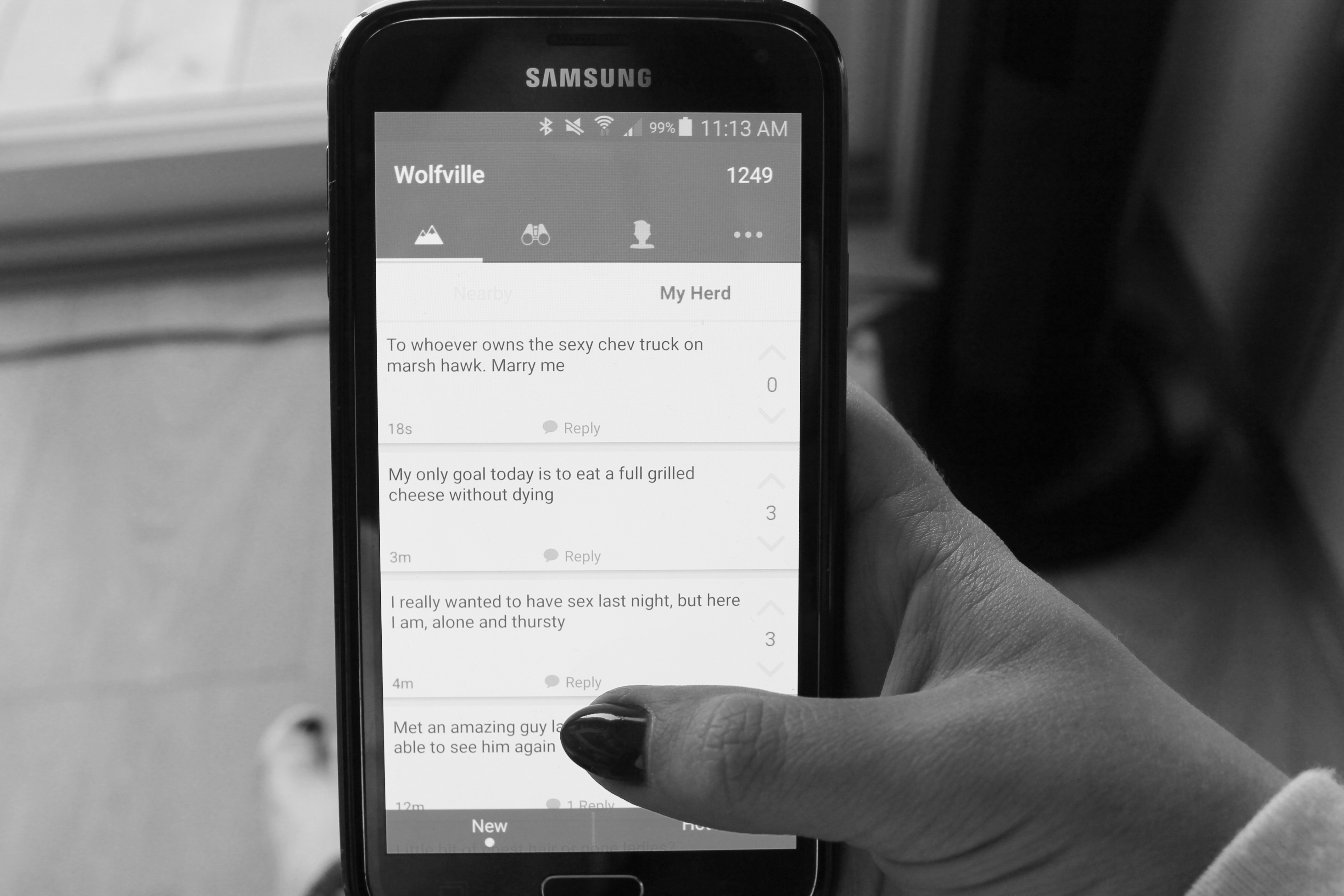
    Yik Yak is an anonymous app that lets you post random comments in your area. People are able to post anything from complaints, hopes, and questions with the knowledge that only local viewers will be able to comment.

    While Yik Yak is able to connect people in new and exciting ways, it also has major drawbacks. The anonymous nature of Yik Yak can lead to people being ruder than they normally would be. Negative reactions to statements such as, “So tired of this,” or, “Does anyone else think that res is too loud?” can lead to people thinking that responders represent a majority opinion instead of a minority one. There are many ways that the weight of comments expressed can be disoriented. There are a lot of cases that suggest that this belief is core to explaining why social media insults can have an immense impact on people.

    Majority opinions are valued more heavily than minority opinions, in most cases, and this can cause a change in the way that people see certain belief sets. The anonymous and impersonal nature of such Apps can change the way that the person sees their position in relation to their critical responders. While responses and comments made by one person can seem daunting, responses that come from a single anonymous person can have a bigger impact. Not knowing who has stated what can lead people to misunderstand other important factors that should be taken into account when receiving hurtful information.

    Another key element of Yik Yak criticism comes from the fact that you are unable to choose who you are talking to. If you knew that someone had a stance on something that fought against your own, you would decide ahead of time not to ask this person what they thought. Knowing ahead of time how something you ask will impact a viewer is crucial to ensuring that you get information that is helpful and not hurtful.

    Despite the fact that people from other areas are able to view Yaks, our Herd members can be reassured that only locals are able to respond to questions. This limitation also prevents foreign people from filled Yik Yak feeds with spam and otherwise useless information. Yik Yak has taken steps to ensure that only Teens are viewing feeds, and has dedicated research into ensuring that Yik Yak won’t be usable near Elementary and Middle Schools.

    Although it may cause some negative consequences to occur, it can also help to connect students of the Acadia community in very different, and sometimes personal, ways. This App is able to foster a sense of Acadia spirit and relatable posts help to unite us as a student body. While there may be some drawbacks that result from any form of social media, Yik Yak, overall, is able to unite us all in a personal and immediate medium with which we can express our thoughts.

  • Managing Your Werkspace

    Managing Your Werkspace

    First year university can be a challenging time to start over in a new place. New places mean new areas to study and also new ways of cooperating with the environment that surrounds you. The following are a few tips that can help with studying in a new place.

    Part 1: Paper

    It’s important to come up with a good system for filing papers at the beginning of the semester. Having a clear space for paper to be stored will help with the tranquility of your room (especially if it’s hidden). Some students find that having lots of paper on their desk can be a stressful reminder of everything that they haven’t done. The residence rooms at Acadia, for the most part, have a limit amount of desk space (included the wardrobe and dresser). This space is meant to be used for everything from toiletries, extra food, books, hair and makeup items, plants, and other odd things. This means that table space must be cherished. Consider finding a place to store papers that is tucked away and not immediately noticeable. It will make a world of difference.

    Part 2: Electronic Documents

    Decide what sort of naming system you would like to apply to all of your work, and start using it right away. A consistent system will prove to be useful later on down the road.  The physical appearance of a paper free workspace can help to ease tension. It is always a good idea to make the Downloads folder of your laptop as neat as possible. This section will often become overcrowded with lots of PowerPoints and class notes provided by professors. It should also be noted that a lot of people use their computer or laptop screen for Post-It notes that give them a list of things to do. This could lead to the same feelings of clutter if not managed properly.

    Part 3: Space
    Some students find that it’s easier to study in a public place. Some find that it’s easier to study in their room. Take the first couple of weeks to try out new things and see what you like best. It may take a while to find the perfect workspace, but it is very much worth it. The following are a couple of environmental combinations to brainstorm and experiment with:

    • Public A – Public S (a public area where people surround you)
    • Public A – Private NS (a public area where no one can see you)
    • Private A – Private NS (a private area where no one can see you)

    Examples of good places to check out around campus:

    • The K.C. Irving Center
    • The Vaughn Memorial Library (check out the study rooms as well as the quiet room. As for help if you don’t know where those places are)
    • Clark Commons
    • Residence Lounges
    • The SUB (the main floor is great, as well as the Michener lounge)
    • Wheelock Dining Hall
  • Bloody Science

    Bloody Science

    It is not very often that someone is asked about their blood type. Many people don’t even know what their blood type is. Although it is not vital information for day-to-day life, a person’s blood type is very important in determining what donated blood they can receive. Many advertisements for blood collection by the Canadian Blood Services has contained a message directed at people of a specific blood type, O-, the universal donor. Through a simple test done by doctors and Canadian Blood Services personnel, your blood type can be determined. But what does your blood type mean? Why is it important? You may think that blood is blood, right? While all blood is composed of the same four basic constituents: plasma, red blood cells, white blood cells, and platelets, not all blood is alike. There are, in fact, eight different blood types. They’re differentiated by the presence or absence of antigens, substances that “trigger an immune response if they are foreign to the body” (American Red Cross, 2015). The four type categories, based on the presence or absence of these antigens on the surface of the red blood cell are:
    Group A – has the A antigen on the red blood cells with the B antibody in the plasma.
    Group B – has the B antigen on the red blood cells with the A antibody in the plasma.
    Group AB – has both A and B antigens on red blood cells, with neither A nor B antibodies in the plasma.
    Group O – has neither A nor B antigens on red cells with both A and B antibodies in the plasma.
    There is a third antigen, called the Rh factor, which also plays a role in determining your blood type. If the Rh antigen exists in your blood, your blood type is positive (i.e. B+), whereas if the Rh antigen was absent, you would be type negative (i.e. AB-). Some blood types are more common than others. Type O+ is the most common, accounting for around 38% of the American population, while type AB- accounts for only 1% of the American population (livescience.com, 2012). Blood type O is the universal donor blood type, meaning that type O blood can be administered to anyone, regardless of blood type. Someone with an AB blood typeis a universal plasma donor, because the plasma does not contain either A or B antibodies. Blood type is hereditary, just like eye colour, and is therefore determined by the blood types of your parents. If you are unsure of your parents’ blood types, or of your own, a simple test can be conducted by your family doctor or by the Canadian Blood Services to identify your specific blood type, and evaluate the current need for your type. If you are unsure of whether you are eligible to donate blood, Canadian Blood Services conducts a simple questionnaire either online or in person. Saving you the trouble of going to the clinic and finding out you are not eligible, the eligibility requirements will be outlined here. For further information, consult the Canadian Blood Services website, or go to the on campus clinic October 7th or 8th for a consultation. In general, if you are in good health, feeling well and able to perform your normal activities, you are older than 23, or are between 17 and 23 and meet the height and weight requirements, you can become a blood donor. A calculator can be found on the Canadian Blood Services website to determine whether or not you meet the height and weight requirements. However, you may still be ineligible for donation if ‘your own health or the safety of the blood supply would be at risk by having you do so,’ (Canadian Blood Services, 2015). Some common reasons why people are deemed in eligible for donation include recent body piercings, Chronic Fatigue Syndrome, possible exposure to HIV/AIDS, tattoos, and vaccinations.If you have gotten a body piercing or a tattoo done within the last 6 months, you are ineligible to donate blood because of the increased risk of Hepatitis C. Acupuncture and electrolysis fall under the piercing category. Donors with a medical history of Chronic Fatigue Syndrome (CFS) are ineligible – even if their condition is not active. If you have recently been vaccinated, depending on which vaccination you received, you may be temporarily deferred from giving blood. There is a full list of deferral periods for various vaccinations on the Canadian Blood Services website. If you have ever had a positive HIV test, or if you have done something that puts you at risk for becoming infected with HIV, you may be ineligible as well (Canadian Blood Services, 2015). For example, anyone who has taken money or drugs for sex since 1977 cannot give blood; nor can anyone who has ever used intravenous street drugs. In the past, gay men were restricted from donating blood, but for the first time in thirty years changes to the regulations have made it easier for gay men to donate blood. “Men who have had sex with another man more than 5 years ago, and who meet other screening criteria, now may be eligible to give blood,” (Canadian Blood Services, 2015). Numerous groups are rallying for the removal of this ban, deemed archaic and homophobic, but the Canadian Blood Services organization is still reeling from the aftershocks of a tainted blood scandal. As many as 800 people died, 20 000 are now living with Hepatitis C, 400 with HIV. Despite more accurate tests, a false negative to an HIV screening would still have devastating consequences, and so a group ban on sexually active gay men still stands.
    If you are interested in donating blood, or want more information, visit the Canadian Blood Services website. Alternatively, go to the blood donor clinic on the Acadia campus between October 7th and 8th, 2015.
  • The Newest Addition to our Family Tree

    The Newest Addition to our Family Tree

    Beginning with adventurous spelunkers and culminating with the discovery of a distant ancestor, the Homo naledi story is one of luck, skill, and perseverance. When Steven Tucker and Rick Hunter entered the Rising Star cave in South Africa two years ago, they were looking to explore new paths and maybe go where none had gone before. Instead, they found a path that likely hadn’t been trodden by human feet in hundreds of thousands of years. While moving out of shot for a photo to be taken, Steven happened across a fissure that extended downwards into the yet unknown. Following this thin chute, a times narrower than eight inches, the two discovered a chamber with an astonishing surprise. Fossils, numbering in the thousands, littered the floor. The two were aware of a scientist in Johannesburg wanting people to keep an eye open for fossils in this “Cradle of Humankind.” The rush was on to secure the site before it could be disturbed. The next step was an excavation. But a site this difficult to access required a peculiar set of attributes: slim individuals with scientific credentials, caving experience, who had no fear of tight quarters. Six young women were recruited, becoming palaeontologist Lee Berger’s “underground astronauts.” Working in teams of three pulling two-hour shifts, they collected 400 bones off the surface before beginning the careful excavation of the cave floor. Fifteen individuals have been excavated so far. With 1200 bones removed from the chamber and many more remaining to be uncovered, the discovery has been made and the interpretation can begin. Familiar yet alien, these fossils are a peculiar combination of modern and archaic characters. Tooth traits and skull qualities varied from modern to very primitive, but the rest of the body was more divided. From the pelvis up, primitive characteristics win out. Present were apish shoulders geared for trees, flared hipbones harking back to before Australopithecus, and curved fingers for a life among trees. From the modern pelvic base down to feet nearly identical to our own, Homo naledi seems to have evolved beyond its time. The remains were described as “weird as hell,” by paleoanthropologist Fred Grine of the State University of New York at Stony Brook. Two things in particular stand out about Homo naledi – the complete lack of other animal bones and plant debris within the chamber where it was found, and the possibility of dozens of individuals within layers upon layers of cave sediment. The huge number of bones in the cave were likely not from a single placement event. Purposeful, repeated placement suggests intentional burial – suggesting Homo naledi were an intelligent, capable, habitual species, despite their brain cases roughly half the size of ours. For more information on the Homo naledi discovery, check the National Geographic website, numerous scientific websites, or talk to your history professor.
    Another interesting skeletal story right on the tail of the Homo naledi discovery comes from beneath the roots of a 215-year-old tree that recently fell victim to a violent storm near the town of Collooney, in the northwestern part of Ireland. The 17-20 year old man found within the root system of the tumbled tree is believed to have suffered a violent fate. Though given a proper Christian burial, his 1000 year old body had suffered knife wounds on his hands and ribs during the early medieval period (1030-1200CE).
  • Axemen Alumni Coming Home

    Axemen Alumni Coming Home

    The Acadia Sports Hall of Fame is pleased to induct former athletes who left their mark on the Acadia University athletics program. Induction ceremonies will take place Saturday, October 17th, honouring those from various teams. I had the opportunity to interview the 1994 All-Canadian football star, Larry Jusdanis. After breaking numerous records at Acadia, Jusdanis played professionally in the Canadian Football League (CFL). He was drafted by the B.C. Lions and then traded to the Hamilton Tiger Cats, which brought him back to his home town. He was the first Canadian quarterback to start a CFL game in 25 years. Beyond football, Jusdanis applied his love of athletics to business as the founder and owner of the successful strength and conditioning training business, Sports Specific Training (S.S.T.).
    How does it make you feel to be inducted into Acadia’s Sports Hall of Fame? Well, I was obviously very honoured and it was the same week I was invited to be inducted into my high school. Again, I was extremely honoured to be chosen by a great school, along with a great bunch of athletes.
    Were you recruited by other universities to play football and if so, what made you choose Acadia?
    I went to Central Florida first, and then I lost my scholarship due to an injury. Nick Richards, Dan Laramaee, and Eric Cederberg were the guys I met on my recruiting trip to Acadia when I came back from Florida. Plenty of other schools recruited me, but I fell in love with Acadia! When you were a student playing football at Acadia, what was a typical day like for you? I went to class just like you would normally. Most of my classes were early in the morning. After I’d go to my room to work, workout, go to football practice, and then go to my room again at around eight o’clock to finish homework.
    I’m sure it was a challenge balancing varsity football, academics, and a social life. How did you manage?
    My good coach, Sonny Wolfe, told me that “there were three things you could do in university: you could party, go to school, and play football. You can only do two out of the three well.” I believed you could do all average. Have fun – because university is meant to be a fun experience – you can balance it all with sufficient time management. University is not that hard if you attend class and apply effort you will succeed, you will be fine.
    How did playing football at Acadia inspire you and shape the rest of your life; and what life lessons did you learn while playing Acadia football?
    I don’t think I would specifically say “Acadia football,” just football in general. In my opinion, football is the best team sport in which anyone could ever get involved. In football, you’re on the field working with twelve guys in a unit and you can’t let that unit of yours down. It’s the same when you are working with business people in the community. It’s also similar to individuals in the military: if you’re carrying your unit and you let someone down, someone dies. Football instills in you a lot of different and great characteristics; such as, discipline, time management, working together, and coping. Maybe you don’t agree with someone, but you have to work through it as a team to make the situation better. Football is probably the best sport there is for teaching life skills. To be honest, if you asked numerous people in the work force who played at least high school, if not college football, they would agree with me.
    Is there anything else special about your time at Acadia that you would like to share?
    Acadia is a great place. It’s a great university, because not only are the professors great, but the small teacher to student is small and the classroom environment is amazing. When you go to university you go to get an education, but you also need to have an exceptional experience and Acadia does offer that. I remember the beautiful summers in Wolfville, and the perfect small town effect that makes it such a great place to live. Every student should enjoy their time at Acadia. I cherish that I made life-long friends during my time there. To this day, I’m close friends with fellow football teammates Grant Davy, Lee Barette, Dave Stefnitz, and Mike  Balint. All of us being inducted into the Hall of Fame have been friends for a long time, and it’s like a family reunion. You create a special bond when you play not only football, but any kind of sport.
  • Caution: Low Flying Blue Jays

    Caution: Low Flying Blue Jays

    There seems to have been a natural evolution among the noisy backyard bird, commonly known as the Blue Jay. Its diet typically consists of fruits, nuts, grains, and occasionally insects. But there has been recent sightings of forty, Toronto based, Blue Jays who have been eating the majority of teams in Major League Baseball. The Toronto Blue Jays were established and welcomed into the American League in 1976. In their first season they recorded a dreadful record of 54 wins and 107 losses. This shot the birds down to a stellar last place position and their results didn’t change anytime soon. Toronto’s first relatively good season came in 1982 as they finished with a nearly, positive, 78-84 record. Things were only going up-hill as they set their sights on an American league title. The year was 1985 when the lonely Canadian team won their first championship of any sort. Unfortunately their luck didn’t continue through the World Series as they watched The Kansas City Royals lift the Commissioner’s Trophy, what a shame. The Jays’ were not able to duplicate their success in the following year, but the northern-most team was now a tough competitor in the league. The road trips across the border to the Rogers Centre were becoming more and more difficult for the competition as the Blue Jays took their momentum and flew with it. With consistent positive records, it was inevitable that the boys in blue were picking up some more championship titles. Our team came to their most successful five-year period of the clubs history; the ‘89 American League East title, the ‘91 American League East title, the ‘92 World Series champions, and the ‘93 World Series champions. The only thing Toronto was missing was a back-to-back rap song from their cities golden boy, Drake, who was twenty-two years late.
    This is where we cut the history lesson short due to the fact that our country’s team hasn’t had the slightest bit of joy since that 1993 season. To save your brain from doing the math, it is 22 years. They are the current, not-so-proud holders of the longest current postseason drought. In more humiliating terms, they have sucked for the longest amount of time in comparison to every other professional baseball team. I wouldn’t dare say this about a Canadian team unless there was good news to follow. Finally things are looking up for Toronto. So as I sit my couch with a beer in my hand, watching The Jays take down Tampa Bay, I feel a rush of pride. Our only Canadian representative of baseball has the chance to secure their playoff spot right now.I take another sip, look out my window to see a Blue Jays flag flying from another quiet, television focused house. So if you haven’t gotten the chance to tune in yet, it’s time. With games running all through October, it shouldn’t be hard to make up for lost time and hop on the bandwagon. Plus, it’s cooler to say you watched their first World Series win in 22 years, opposed to their second World Series win in two years. Let’s go Blue Jays!
  • Contraception

    Contraception

     Contraception, colloquially known as birth control, has a long and strange history. Women in ancient Egypt would vaginally insert into themselves a mixture of honey and crocodile dung to prevent pregnancy, concubines in ancient China would drink lead and mercury, women in Persia were advised to jump backwards seven to nine times post coitus, and Greek gynecologists recommended that women hold their breath during sex and sneeze immediately afterwards to expel sperm. These methods fell out of favour as scientific progress advanced, and today a wide variety of more effective methods are employed. Yet, with so many options to choose from, it can be difficult to pick the best one for you.Today, over 85% of Canadians report using contraception at some point in their lives, and condoms are one of the oldest methods still employed. Illustrations of condoms date back as far as 15,000 years ago and legends from 3000 BCE describe goat bladder use. We have come a long way from goat bladders to today’s latex and polyurethane. Today’s condoms, when used consistently and correctly, are 98% effective (percentages represent the number out of every 100 women who do not get pregnant after one year of correct use). Condoms are cheap, easy to obtain, can be made into dental dams, and are one of the few readily available contraceptive methods to provide a nearly impermeable barrier to STIs. The condom’s major flaws are primarily user based. Issues include removing the condom too soon, putting the condom on too late, opening the condom package with a sharp object, using an oil-based lubricant, or using an expired or improperly stored condom (such as one stored in a wallet).

    Other easily accessible contraceptives available to men include spermicides, which can have an 80% success rate when used alone; and the “pull-out” method. This method can be up to 96% effective, but has an increased risk of pregnancy through contact with pre-ejaculatory fluid, and does not protect against STIs. Men who rely on the pull-out method must be able to detect an approaching orgasm and withdraw prior to ejaculation. If this is used as the primary form of birth control, and the man fails to pull out prior to ejaculation, there is a 20-85% chance of the woman getting pregnant during her cycle.

    For women, the most well-known and commonly used method is the birth control pill. This contraceptive is an estrogen and progesterone based pill, and if taken daily at the same time can be 99% effective against pregnancy. The primary reason for failure results from the pill not being taken daily at the same time. The pill also regulates and treats heavy menstrual cycles, PMS, endometriosis, Polycystic Ovarian Syndrome (PCOS), acne, anemia, and may decrease the risk of endometrial and ovarian cancer. However, the pill may have side effects like nausea, breast tenderness, headaches, weight gain, mood changes, missed periods, decreased libido, joint pain, decreased bone density, an increased risk of cardiovascular side effects such as heart attacks, strokes, and blood clots, and may increase the risk of breast, cervical, and liver cancer.

    Other hormonal methods available to women include hormonal intrauterine devices (IUDs) like Mirena and Skyla, which offer 99% effectiveness and can be in place from three to five years, the NuvaRing, which can be up to 99% effective, and the birth control implant. The birth control implant is a small matchstick sized hormonal capsule inserted into the woman’s arm. Over a three-year period it releases progestin, and has a 99.95% success rate. All hormonal methods include similar deleterious side effects to the birth control pill.

    If you feel uncomfortable using a primarily hormone based contraceptive, the copper IUD may be for you. Much like a hormonal IUD, this small copper T is inserted into the uterus. Once in place it can be 99% effective for anywhere from five to ten years. Side effects may include heavier and more painful periods. Female condoms are another non-hormonal method that can result in a 95% success rate when used correctly, and provide basic STI protection. Much like the male condom their failure rate stems mainly from improper use. However, female condoms can be expensive at $4 a condom, difficult to find, and uncomfortable for the woman. Diaphragms may also be employed. These thin silicon domes are placed over the cervix to prevent sperm entry. When used with spermicides, diaphragms have a 94% success rate and can help stop the spread of some STIs. The rhythm method, or fertility awareness method, is a contraceptive method employed by the woman, who tracks her menstrual cycle to determine ovulation and her peak fertility. She then abstains from sex during these days. When used correctly the rhythm method can be up to 87% effective. If for any reason your birth control fails you, Plan B is a non-prescription emergency contraceptive available at most pharmacies and health clinics.

    If you are looking to start a new contraceptive method, change over from an existing method, get STI testing, need pregnancy guidance, or have questions about access to abortion information, there are a variety of clinics around the valley and Halifax area to choose from. In Wolfville, both Acadia Student Health Services and Mud Creek Medical Co-op offer Pap tests, STI testing, and a variety of contraceptive options. In Kentville, the Red Door also offers these services and in Halifax, the Halifax Sexual Health Center (formerly Planned Parenthood) provides similar services. Acadia also offers free condoms in all residences, the Peer Support Lounge, and through Student Health Services.

    Hopefully this article helps make your only post-sex concern how soon you can do it again.

  • Don’t Fly Your Way Through University

    Don’t Fly Your Way Through University

    There is a concerning sentiment held by many of Acadia’s students about the difficulty of courses they should take. Belief that you should take at least one so-called “bird course” per semester is common. A bird course is a class that is notoriously easy, often demonstrated by the high percentage of students that pass with an A or greater. These classes may or may not have a final exam or project, and generally have little-to-none in terms of assignments. The term is of Canadian origin, and it suggests that students who take these bird courses are capable of flying right through them (the actual origin of the word is unknown, from what I can tell. Some resources state that the term comes from the idiom “for the birds,” meaning trivial or worthless, yet others state that it comes from the antiquated opinion that women (sometimes called birds) were capable of taking the course because it was easy).

    Regardless of the perhaps sexist origin of the term, the idea seems to have stuck. In this article I hope to illuminate some of the reasons why you should take bird courses, and why you shouldn’t.

    1. Money: Acadia tuition for Nova Scotian student in the 2015-2016 academic year is $6430.00 CAD. For international students, this figure is more than doubled. If you consider the fact that most students (ignoring first year engineers) are required to take five courses a semester, then by simple mathematics the average student is paying over $600 for a single course over one semester (not to mention the additional cost of textbooks, online homework class keys, etc.). Now the crucial question is: do you consider the courses you are taking to be worth this much? Money is scarce among university students, and for good reason – they are spending most of it on getting an education. But for many, this step is nothing more than a practical necessity for future endeavours. If it means a higher GPA, then why bother with educational idealism?
    1. Intellectual Challenge: This is another important factor. Everyone is here to learn (I hope). Whether that learning enables you to continue doing research, or to proceed to graduate school, or go into the workforce – it doesn’t matter. The skills you acquire will not come from the courses that do not challenge you. They will come from the courses that push you to new limits. Only then will you discover new things about yourself. You will be forced to manage stress and maintain balance in the face of difficulty. However, how much is too much? When will you know if your academic saturation point has been reached – beyond which you begin to struggle and lose footing in a certain topic? These are hard questions to answer. Needless to say, I have yet to come up with an answer, and I’m over halfway finished my degree.
    1. Interest: Most people I talk to about the easy courses they take describe them as incredibly dull. If you don’t have interest in a topic, why would you devote your time to it? Take courses you are serious about, courses that pique your curiosity and expose you to new things. The more interest you have in a topic, the more effort you will put into understanding it. That being said, sometimes you enjoy a course so much you want to spend all your time studying it. Then taking an easier load grants you the most precious gift a university student can have: time. It allows you to prioritize, and work harder on the things that are important to you. Instead of spending your life behind a book, you can spend it with friends, volunteering, or at the gym. It gives you the pportunity for breathing space – keeping yourself healthy and sane so that you don’t burn out early.

    With these three ideas in mind, I think it is safe to say that there is a balance that needs to be struck in order to survive university in one piece while still coming out of it with a real education. I believe in the importance of pushing yourself to your limit. To do such and survive is a proud achievement for anyone. Yet this limit differs between students. With respect to marks: try and remember that a number on a page does not define you as an individual. Yes, it is (sometimes) important to employers, and yes, it is a large factor in selecting medical, law and graduate school applicants (sadly), but don’t let a drop in your GPA motivate you to stop pursuing the topic you love in hopes of restoring your mark to the number you had before. Instead, focus on enjoying your short time here at university, learning what you care about, and spending time with the people you love the most.

Betzillo positions itself as a versatile gaming hub where structured bonuses and adaptive gameplay mechanics support both short sessions and extended play.

Built with a focus on innovation, Spinbit integrates modern casino architecture with rapid transactions, appealing to players who value speed and digital efficiency.

Ripper Casino emphasizes bold entertainment through high-impact slot titles and competitive promotions crafted for risk-oriented players.

A friendly interface and stable performance define Ricky Casino, offering a casual yet reliable environment for a wide spectrum of gaming preferences.

King Billy Casino channels classic casino spirit into a modern platform, delivering recognizable themes supported by contemporary reward systems.

Immersive visuals and layered slot mechanics are at the core of Dragonslots, creating a narrative-driven casino experience.

Lukki Casino appeals to players seeking direct access and minimal friction, focusing on fast loading times and intuitive controls.

Casinonic provides a structured and dependable gaming framework, blending modern slots with transparent operational standards.