
Blog

  • The Athenaeum Cookbook

    The Athenaeum Cookbook

    As the school year kicks off, we all fall back into the wonderful triangle of student cooking: Cheap, tasty, and nutritious; pick two. Fortunately, we at the Athenaeum have you covered. Over the course of the year, we’ll be sharing some of our favorite ready-to-cut-out recipes that are delicious, easy to make, nutritious, and cheap.

    Vegetarian Lentil Dahl

    Lentils have been a staple crop in many cultures for thousands of years. They are classified as a pulse – a category of “grain legumes” that are grown specifically for the dried seed, unlike peas or green beans. Tolerant to drought and disease, and relatively quick to grow, there are records of lentils being grown in in India and Turkey for almost 13,000 years. They persist to the modern day, being an integral part of modern crop rotation cycles – as a pulse, they renitrogenate soil before or after a grain crop has grown in the same field. Though it isn’t commonly known, Canada is the largest producer of lentils in the world – out producing the next three lentil-producing countries (India, Turkey and Australia).

    Lentils have remained a staple for so long with good reason. A half cup of lentils provides the average person with all of their fibre and half of their protein for the day. Not to mention, lentils are incredibly high in mineral micronutrients like phosphorus, zinc, and iron, in addition to many B-vitamins. Despite their high nutritional value, lentils have not been subject to modern health food crazes that have promoted other, more exotic grains and pulses into fashion. Between this lack of temporary popularity and their domestic nature in Canada, lentils remain a very affordable staple in almost every grocery store.

    Vegetarian Lentil Dahl

    Prep Time/Cook Time: 15m/60m

    Essential Ingredients
    • 400g (1 and 2/3 cups) red lentils
    • 2 tsp turmeric
    • 4tbsp unsalted butter
    • 2 tsp cumin seeds
    • 1 small onion, finely chopped
    • 3-4 cloves garlic, finely sliced
    • 1-2 fresh green chilis, finely sliced (remove seeds if you want to keep the heat down)

    Additional Ingredients (if you have them)
    • 1 tsp garam masala
    • 1 tsp coriander
    • thumb-sized piece of fresh ginger, finely grated
    • 2-3 cooking tomatoes, chopped

    Preparing the Lentils
    1. Place the lentils in a pan and cover with enough water that it covers them by an inch. Bring to the boil and then reduce to a simmer.
    2. Stir in the turmeric and about half the butter. Cover and leave on low heat.
    Aromatic Spice Mixture
    3. In a small frying pan, dry-fry the cumin seeds (medium heat) until toasted. This should only take a couple of minutes. When done, set them aside.
    4. Melt the other half of the butter in the same frying pan that previously had the cumin seeds and gently fry the chopped garlic, onion, and chilis (as well as the grated ginger and tomatoes, if you’re using them). Once the garlic is golden, mix in the toasted cumin seeds (and the garam masala / ground coriander, if on hand).
    5. Once mixed, remove from the heat until the lentils are completely softened.
    Putting it Together
    6. When the lentils are done, they should have the consistency of porridge. Add more water as necessary (they get thicker surprisingly fast).
    7. Mix in your aromatic spice mixture, then serve on its own, topped with some more coriander, or on rice.

  • Oh Wonder: Album Review

    Oh Wonder: Album Review

    London based duo Oh Wonder released their self-titled debut album on September 4th. And in short: it is exquisite. From the stripped down tonal approach to the sound production, the lush allure of Josephine Vander Gucht’s voice, and the hazy dream-pop feel that accompanies most of its content. It’s the type of music you listen to as you hold someone and dance lazily as the night wanes into day. Oh Wonder adopts the mien of someone very idealistically and unequivocally in love – rhythmic poetry in motion whilst ruminating on the failures of romance. An apt example would be in the song Dazzle: “Golden grill of sadness / smell like wasting youth / Always end up like this / Always gonna lose,” they talk about love as if it were a casino game – a deceit of youth, and it’s willful inability to accept the shortcomings of the fantasy that is love. It is this reality that the album tries to strike a chord with; idealism and reality – the duality of romance. And it does so quite successfully.

    That is not to say that it is not bogged down by a strict adherence to this idea. The songs tend to stay rigidly formulaic within the domain of this duality, foregoing the exploration of facets that also accompany the tumultuous modern day relationship. Ironically: they try to create something highly eclectic while producing their music, and yet it is the same formulaic quasi-eclecticism that prohibits them from achieving something truly exceptional. The duo (Josephine and Anthony) have the formula for a luscious synth-pop album locked down, but they do not vary it. They derive too much of their music from their own music. The only variance we get is the change of the duality, from something ethereal to something discarded in the gutter. The discord between the way the band feels: they are either wholly in love or and an engaging in idealistic drudgery about love (in songs like Livewire, Shark, or Body Gold), or cynical iconoclasts swimming against the fervent tide of idealism that they created.

    I do applaud them on the inventive method they used to release the album (and it may also act as a justification for the jagged flux of the songs), as they released a song every month for the preceding year as a build-up to this album. Out of the fifteen songs in this album, thirteen of them had been released over the preceding year. This could be the pivotal reason the album does not meld together into a beautiful flow.

    In summation, Oh Wonder’s debut is an apt musical description of love: marred with melancholia and lifted with glee. It is an eclectic work of art, although at times it tends to borrow heavily from itself and remain rigidly formulaic. But in the end, its peaks exalt this album, and this is enough to overcome the nadirs. I would highly recommend giving this album a listen. Rejoice in the idealism, and wallow in the cynicism.

  • 12th Annual Deep Roots Music Festival in Wolfville

    12th Annual Deep Roots Music Festival in Wolfville

    In less than two weeks, the 12th annual Deep Roots Music Festival will be taking place in downtown Wolfville. The Deep Roots Music Cooperative’s mantra is to foster “an enduring community, celebrating and enriching our culture through music.” The festival features primarily folk and blues musicians, as well as dancers, visual artists, and children’s music. It runs from September 24th to 27th.deeprotsschedu
    As the former Summer Student Assistant Coordinator, I’ve been lucky enough to be a part of the preparation for this year’s festival. The most amazing thing about Deep Roots is the unwavering and passionate dedication of the Festival Committee and festival volunteers. The Festival Committee is made up entirely of volunteers, many of whom have full-time jobs and families. Yet, they have the energy and talent to organize the festival year after year. It takes months of preparation. To see their love of music manifest itself in the beautiful production of the Deep Roots Music Festival is completely inspirational.
    Last year I went to only the free events during the festival. The experience of being surrounded by music for an entire day was incredibly fulfilling and memorable. Wolfville becomes filled with musicians and performers and artists who all really care about connecting with their audience and the community. The Farmer’s Market has outdoor music, a parade that takes place in the town around noon (featuring gorgeous giant puppets!), and Paddy’s hosts evening concerts. Even if you can’t make it to or afford the priced events, there’s still many events to take part in that are free.
    Additionally, the Deep Roots offers student pricing on tickets and passes. The festival schedule has more details on performers, events, workshops, and pricing.
    Two exciting highlight concerts of this year’s festival feature maritime-based Old Man Luedecke and Matt Andersen on Sept 24th, and Canadian folk legend Sylvia Tyson on Sept 26th.
    For more details about the festival, or to volunteer, refer to their website or email [email protected].

  • The Sweetness of Not Doing Much

    I just lost my new job at Il Dolce Far Niente Espresso Bar in Wolfville. I was fired for:
    1. inquiring into where the manager bought her produce and meat, and
    2. for studying at Just Us Café in Wolfville prior to working at Il Dolce.
    Let me elaborate. I recently asked the manager of Il Dolce if her products were local. She responded that she buys both local and non-local, depending on price, distance, and other valid reasons. The manager interpreted my question as an attack on the quality of her products. When firing me, she said that our principles are too different and that she doesn’t feel I can sell her product well. She said that I “challenged her” with this question.

    This does not make sense to me. Of course I care about eating and supporting local. However, I was not asking to pass judgment on her or disagree with her business model. I was asking to be better informed about the business so I could respond to customer inquiries. Secondly, the manager’s “biggest problem” with me is that I study at Just Us! Café on Main Street, Wolfville. She told me on my final shift that she doesn’t like her employees to go to Just Us! or T.A.N. cafés. In her words, she said “I can’t do anything to stop you from going there.” She then asked me why I go to Just Us! I responded by telling her that I like the atmosphere, that a lot of my friends and peers go there, and that they have free wi-fi (Il Dolce doesn’t offer wi-fi). She said that it’s a free country and I can do whatever I want, but it looks bad on her business if her employees go to other local cafés.

    To repeat, this does not make sense to me. In fact, it’s pretty unreasonable. I understand holding similar principles as your place of work, but I have gone to Il Dolce many times before being offered a job there; it’s a lovely café with a peaceful environment and delicious food and drink. Their logo is “the sweetness of doing nothing.” That’s a great logo! I totally agree with that. I totally love what they serve. The quality and service is good. I loved my shifts working there. It’s a smart business model that offers a different experience than other local establishments.

    Just Us! is also a lovely café. So is T.A.N.. So is the Rolled Oat. So is Front Street. So is Slow Dough Bakery. Wolfville has a lot of great businesses that offer different experiences and atmospheres. I feel lucky to live in a small town that has such a variety of options to choose from! Except I am apparently not so lucky to have supported these businesses, because that’s how I lost my job.

    I had a total of two shifts at Il Dolce. I was offered the position on August 26th. My first shift was September 8. My second shift was September 9. I was fired on September 11. I turned down another job offer to accept this job. I bought $120 worth of clothing for the uniform (one pair of pants, two shirts, and a pair of shoes). I worked 8.5 hours; not even enough hours to pay back what I spent on the work uniform clothing. As many other students can sympathize, I have a very small budget. Losing this job is a blow to me financially.

    Unfortunately, under Nova Scotia Labour Laws, the manager of Il Dolce did not do anything wrong either. I was not discriminated against. Because it was such a short period of employment, she was not required to give me notice or reason. Except she did give me reasons, and the reasons she gave were completely unfair. Even though her actions are legally right, I believe that what she did was unethical.

    To fire me for going to another café is explicitly manipulative and unquestionably wrong. I was fired for exercising my right to choose where I spend my time and money, and I wasn’t spending my time or money on something unethical. I am asking the readers of this article to reconsider whether or not they want to support Il Dolce Far Niente Espresso Bar. Not because the produce isn’t 100% local. But because they fire their employees for asking simple questions and for exercising their right to study wherever the fuck they want.

  • The Evangeline Court Music Collective

    The Evangeline Court Music Collective

    If you are interested in being a part of creative things involving contemporary classical music and ways of connecting music to other mediums of art, this collective is something you should be a part of. If you are excited to see new music concerts, attend coffee-house style events with string quartets, and in general support upcoming artists on campus, watch out for posters and updates online! Join the Facebook group (named: Evangeline Court Musician’s Collective) for the dates of meetings and events – we will be scheduling our introductory meeting within the next couple weeks.

    Typically, the collective meets every two weeks to share ideas, new works, and discuss ideas for events. This provides an opportunity for creators to gain insight and constructive criticism on the things they’re working on, and allows other members to get an idea of what their peers are focusing on. Additionally, through group discussion we decide what kind of events to put on – we are open to ANY new idea. We would like to put on different events than what is already happening around town, so that we can discover new ways of sharing and experiencing art with the public. Among activities we could put on for this year:

    • A concert in the woods (weather permitting)
    • A concert featuring the world premiere of “Uncharted Worlds” our first collaborative work for String Quintet
    • An open recital/social for performers, composers, fans, and friends to relax, share ideas, and consume coffee and cookies
    • A collaborative event with visual and/or literary arts

    What makes the ECMC different than a regular musical ensemble is the open-ended nature of ideas, and the focus on reaching out to other artistic disciplines. The group is intentionally separate from the academia of the School of Music so that the projects and events are shaped by the individuals in the collective, and the nature of the art itself. The School of Music tends to stay within its own four walls, and breaking from this allows us to branch out and meet artists of other fields in this area. This gives members an opportunity to hear another perspective on art as a whole, and to create something larger than themselves with the help of others in the community.

    Our Mission Statement: The Evangeline Court Music Collective (ECMC) supports the coming together and communication between music creators and performers collaborating outside of an academic setting in order to promote interdisciplinary artistic innovation. ECMC supports musicians interested in new music (based around contemporary classical), those invested in expanding their compositional, performance, and collaborative abilities in a welcoming and open-minded environment. We strive to interact often with the broader artistic community, regardless of medium.

    Our Goals: To bring together musicians outside of our academic environment, but in an organized setting with set aims, meetings, and projects. Run by the students, for the students.

  • Gluten-Free?

    Gluten-Free?

    Contrary to popular belief, gluten-free diets are not necessarily a healthier diet for people who are not gluten sensitive or who have not been diagnosed with Celiac disease. A study published in the American Journal of Clinical Nutrition in 2004 concluded that adverse effects of gluten in celiac patients can be resolved with a gluten-free diet, but, there are no health benefits to avoiding gluten as a regular, healthy individual (Murray, Watson, Clearman). The theory of a gluten-free diet being healthy relies heavily on the fact that bread is very high on the Glycemic Index- meaning it causes a high insulin response due to an increase in blood glucose (Jenkins, Wolever, Taylor, Barker, Fielden, Baldwin, Bowling, Newman, Jenkins, Goff, 1981, American Journal of Clinical Nutrition). A study done in the European Journal of Clinical Nutrition in 2009 showed that the insulin response, after consuming hydrolysate gluten, was no higher then the other tested proteins (Claessens, Calame, Siemensma, Baak, Saris). The consumption of bread does cause high insulin, but there is no concrete proof that the insulin response is due to gluten content. Instead, the starches in wheat are the most likely suspect. In addition to this, healthy grains such as rye and barley are low on the Glycemic Index, but still contain gluten. Rather than going gluten-free, a better choice for the health of the average person would be to avoid wheat, particularly processed wheat. The issue with the starches in wheat, such as amylopectin, is thought to be more of a concern because the of the modifications and choice breeding that occurred during the Green Revolution. In the 1960’s, many crops were manipulated to increase production in harsher conditions and smaller areas. This created what is referred to as Dwarf Wheat, which is less nutrient dense then its ancestors (Farmer, Green Revolution?, 1978). However, one positive outcome of this health fad is an increasing interest in alternative grains and legumes, such as quinoa and lentils, as a substitute for white bread and pastas. Unfortunately, a large percentage of people following the gluten-free diet forgo these healthier and protein-rich options for products marketed as ‘gluten-free’ versions of their regular food choices. As many individuals who have attempted to bake gluten-free products can attest, baked goods with identical recipes but a gluten-free flour replacement are often not appetizing in flavor or texture. For a more pleasing product, manufacturing companies often manipulate their recipes, creating a less healthy alternative containing higher concentrations of sugars and fats. A study done by the journal of Alimentary Pharmacology and Therapeutics has shown a correlation between gluten-free diets and a ‘high sugar intake, and low fiber and mineral intake’ in women. If done properly, a gluten-free diet and some experimentation can expand meal variety and increase in overall health. In making this diet decision without proper meal planning, or with a lack of background knowledge, however, could leave someone lacking vital nutrients and eating less healthy than they might expect.

  • Opening Letter from the Science Editor

    Opening Letter from the Science Editor

    Welcome and welcome back new and returning Acadia students! It is my sincere hope that everyone is settling comfortably into Wolfville and enjoying our beautiful campus before the snow sets in. As classes have gotten up and running, so too have many clubs and organizations, one of them being The Athenaeum student newspaper. Here, the Science Section is your go-to place for information on exciting new discoveries in science, what your professors have been up to with their research, and events of interest on campus. This year, we will be running a series of articles on tidal energy in the Bay of Fundy. An incredible amount of planning and new technology is going into this attempt to harness the immense power of the world’s highest tides. Sea trials are just beginning to get underway, and there are several Acadia professors involved in this arduous project, many with varying viewpoints and opinions on the topic. Our task will be to showcase Acadia’s involvement and talk about the possible risks and rewards of this undertaking. The impact of this project cannot be estimated by a single person, no matter how skilled they are in their respective discipline, and as such, one person could not have designed and executed a project such as this. Many people, from economists and policy specialists, to numerous scientists have had to work together to get this project this far. Environmental scientists, biologists, engineers, computer scientists, mathematicians, maybe even chemists and physicists. Interdisciplinary work is what is most often encountered in real-world projects such as this. At Acadia, the departments within the Faculty of Science consist of Biology, Chemistry, Computer Science, Engineering, Earth and Environmental Science, Mathematics and Statistics, Nutrition and Dietetics, Physics, and Psychology. Science is an incredibly broad umbrella term that covers rigorous study of all physical and natural phenomena, observable or otherwise. An interest in any area of the sciences can cross departmental boundaries, and this is a wonderful thing. Don’t be afraid to dabble in things outside of your area of study; you may be surprised at how many of the sciences interrelate. In reading articles here and talking to your peers, you may be exposed to interesting things that you don’t know much about. I wholeheartedly encourage you to pursue those interests- ask friends, ask professors, get on your computer and search it! Extracurricular discussions contribute so much to your education, and can be enjoyable to boot.

    “Being a nerd is not about what you love but about how you love.” – Wil Wheaton

    New writers are enthusiastically welcomed to the Athenaeum staff- if you have an article of interest, an idea for a column, or are working on a project you’d like to share, please feel free to contact myself or any other staff member. We’d love your input.

  • Sexual Assault: A Response

    In the definition of the law, assault is any action which has intent to apprehend and/or harm an individual unlawfully. Sexual assault, by this definition, is any action which has intent to apprehend and/or harm an individual in an unwarranted and unwanted sexual manner. On September 4th an Acadia University student named Phillip Shawn Herman, a Bermudan national and Musical Education student, was charged with sexual assault following an incident two days prior. The incident took place on the grounds of Acadia University’s campus and was responded to by the Royal Canadian Mounted Police at 1 o’clock in the morning, September 2nd. As a result of his charge and impending court date, Shawn Herman has been ordered to refrain from contacting the victim, and has been ordered to “keep the peace”, i.e. to refrain from further illegal activities. This is good, and this is just. The fact that this incident was reported and responded to promptly reflects greatly on the condition of our justice and legal system, and how quickly those who are tasked with defending us do so. It also shows the great bravery shown by the young women who did report and results of campaigns like the “Know/No More campaign” on our campus raising awareness and promoting education of gender inequity and sexual health and safety. What is unfortunate, however, is that the resources available to all of us are currently in the dark. Resource centers, hotlines, university faculty groups (such as the Acadia Student Resource Center, the Women’s, Pride, and Peer Resource Centers, etc.), and much, much more are all available at the tips of our fingers and are at times scarcely used. At the end of this article will be a list of valuable local and national resources.

    According to Statistics Canada 91% of sexual assaults are not reported to authorities, or are not reported in a timely manner. This leaves an overwhelming gap in the midst of the assault cases that are reported. This is a somber statistic, but it is a wrenchingly true one. Fear of further incidents, fear of social stigma, and a general lack of knowledge of the resources available all contribute to this rate of unreported assault.

    As part of an investigative piece done by CBC’s News series investigative statistics show that reports for sexual assaults on university campuses are startlingly low. On a nationwide scale Ryerson University holds the highest amount of reported sexual assault cases, with 57 cases reported over a five year period. When the statistics are adjusted to population Acadia University holds the highest, with 22 reported cases over the four and a half year span of the study. Although the reporting of these incidents is crucial in addressing them, the issue at hand is still the existence of the acts of assault and those who commit them.

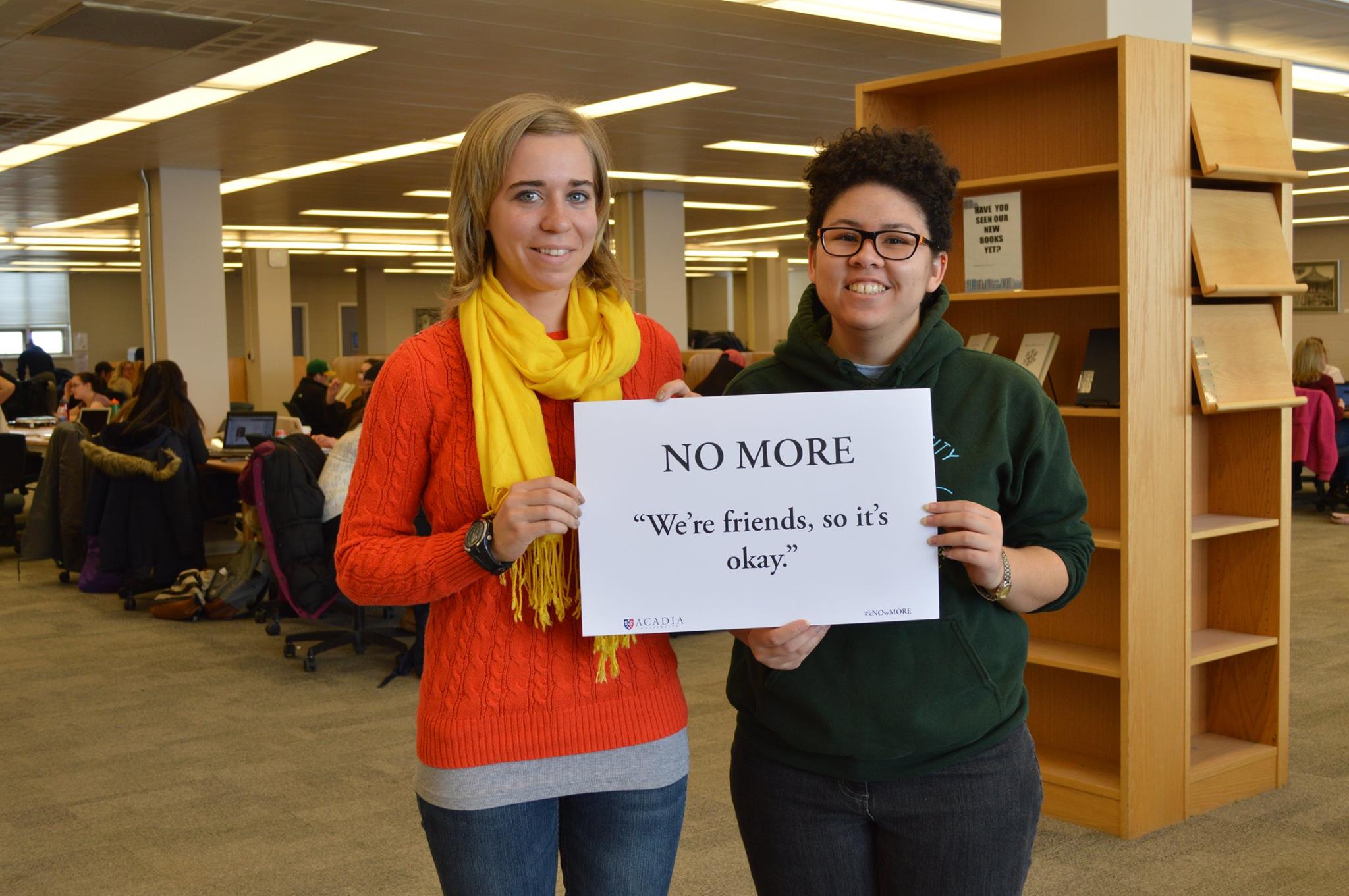
    Last March the Know/No More campaign was launched by members of the Acadia University community as a means of raising awareness for the ordeals faced by those affected by sexual assault and discrimination. The base contingency plan of the campaign was to help eradicate the stigma that presents itself to those affected by these attacks and to raise awareness of a number of social justices. Although the Know More campaign focuses on more than just sexual assault and its victims, it is a great campaign that makes sense of the injustices of sexual assault.

    Although I have no sociological credentials and I am not overtly knowledgeable in the laws and procedures of crime and punishment, I believe that any act of attrition such as sexual assault is unacceptable in a society that is as stable and as just as ours. With ample time I hope the victim of this incident is able to get the help that they need, and that the perpetrator is tried before the courts in a true and confident way. As mentioned before, below is a non-exhaustive list of free, reliable, and confidential resources that can be contacted at any time.

    Look after each other, dear readers. The future is bright.

    Andrew Haskett

    Editor-in-Chief, the Athenaeum

    *Below is a list of dependable and professional resources that are available to anybody who needs them, free of charge.

    • Acadia University Peer, Pride, and Women’s Centres – 2nd floor of the Acadia SUB building, 2nd door down from the front entrance stairwell.
    • Acadia University Student Resource Center (online) <http://counsel.acadiau.ca/Sexual_Assault.html>
    • Residence Life -P: (902) 585-1417 | F: (902) 585-1093 | E: [email protected]
    • RCMP Detachments: 1-800-803-7267
    • Kids Help Phone, please call 1-800-668-6868, or visit KidsHelpPhone.ca <http://org.kidshelpphone.ca/en/contact/>.
    • To apply for an Emergency Protection Order, please call 1-866-816-6555
    • Nova Scotia Victim Service :Kentville Telephone: (902) 679-6201
      Fax: (902) 679-6192
      Crisis Line: (800) 565-1805
      gov.ns.ca/just/victim_services/default.asp
      http://www.gov.ns.ca/just/victim_Services/default.asp

    Contact us: Red Door Society
    We can be reached at (902) 679-1411 or [email protected]. You can drop-in
    or call/email to make an appointment. Remember, your personal information
    will be kept confidential!

  • On Voting

    On Voting

    It is no secret to anyone that voter turnout in Canada has been on a downward trend. According to Elections Canada, the turnout for the last federal election in 2011 was 61.4% – the third lowest in our country’s history. The turnout among students and younger people in particular is lower than any other age group (this is not to say that other factors such as economic and social status are not equally responsible). National estimates cite a shocking 38.8% for voters between the ages of 18-24. That number sucks. According to a poll conducted by Statistics Canada, the most common reason given for the people in this age group was that they were not interested in voting. Others stated that they were too busy with school or their work, and others were away or traveling. Interestingly enough, for senior citizens, the most common reason for not voting was due to illness or disability. And yet just over 75% of people in the age group 65-74 voted. Is it safe to assume that seniors respect democracy more than students do?

    I believe there is another reason that plays a big role. This election will be the first time that many university students are eligible to vote federally. It can be an intimidating process. Several questions will arise, doubts will start to form. When voting day rolls around, the effort to go to a polling station won’t be made. After that, continued apathy towards voting seems almost permanent. How can this be avoided? Firstly, if you are feeling this way, know that you are not alone. Secondly, there is an abundance of available resources online and on-campus that help students with their first vote. One such resource is the Get Out the Vote! Campaign (if you would like to learn more about them, I highly encourage you to check out their website). The campaign is headed by Fallis Thompson, VP Academic for the Acadia Students’ Union. You can pledge to vote from their website.

    Of course, having the right to vote also means having the right not to vote. It is not a responsibility or a civic duty. It is a privilege. If you don’t like the choices, then why bother choosing? Feel free to spoil your ballot. And I don’t agree with the argument that says that “those who didn’t vote don’t have the right to complain.” I retain my right to complain about everything. That being said, I strongly believe that students should vote. I believe that students should exercise their civic right and fulfill their role in democracy.

    Why? I suppose the answer is a bit of a cliché. Whether it comes down to something more immediate like education or something more long-term like fossil fuel consumption, there is no doubt that the decisions made today will affect our futures tomorrow. And who is it that inherits that future? We do! Moreover, students have a huge capacity to manipulate the social agenda to their will. Consider the student movement in Quebec in 2012. Premier Jean Charest proposed a tuition raise of almost 75%. As a result, a quarter million people took to the streets in protest. While this is definitely an extreme case, I also believe it demonstrates just how underestimated the student population is when it comes to its ability to partake in civic engagement. “I feel like some students don’t realize the large impact they can have in this election,” Thompson says. “Actions speak louder than words and voting is the perfect example of that.”

    There are a hundred reasons you can come up with not to vote, whether it be apathy or ignorance. But when it comes down to it, what will really be stopping you from casting a ballot? I hope you will think about it and ask yourself if the obstacle is something you can overcome. Don’t let first time intimidation stop you. Make yourself heard. Shape your future the way you want it to be shaped. Vote in the federal election on October 19th, 2015.

    Links:

    Pledge to Vote: http://asu.getoutthevote.ca/

    Get Out The Vote FAQ: http://www.getoutthevote.ca/voting_faq

    Voter Turnout At Federal Elections and Referendums: http://www.elections.ca/content.aspx?dir=turn&document=index&lang=e&section=ele#ftn2

    Factors associated with voting: http://www.statcan.gc.ca/pub/75-001-x/2012001/article/11629-eng.htm

    Reasons for not voting in the May 2, 2011 federal election: http://www.statcan.gc.ca/daily-quotidien/110705/dq110705a-eng.htm

    Estimation of Voter Turnout by Age Group and Gender at the 2011 Federal Election: http://www.elections.ca/content.aspx?section=res&dir=rec/part/estim/41ge&document=report41&lang=e#p41

  • A Short Introduction to Opinions

    A Short Introduction to Opinions

    I disapprove of what you say, but I will defend to the death your right to say it. Those words were penned by the English writer Evelyn Beatrice Hall in her book The Friends of Voltaire (the quote is frequently miscredited to Voltaire himself), and is often seen in angry tweets or Facebook statuses with regard to the degrading state of free speech in North America today. Hall chose these words because she believed that they best summarized the essence of Voltaire and what he viewed to be one of the most important fundamental rights of humankind – the right to speak freely. This strong, unwavering belief is one of the most lasting influences of the Enlightenment that exists today.

    This quote was chosen by myself for the particular reason of demonstrating to the student body of Acadia that the Opinions section of the Athenaeum will always be a safe haven for dissenting opinions and discussion. If you would like to write your opinion on something, whether it be a weird class exercise, a broken door in the BAC, a terrible craft beer you tried or the abundance of potholes that exist in the Valley, do it! It is this editor’s opinion that you should be able to write whatever you want. However, since we do require money to run, we aren’t going to publish everything. So I propose these two conditions to keep in mind when writing opinions:

    1. Be honest and truthful. Acadia has a library. Acadia has access to the internet. You have an ocean of free knowledge sitting at your fingertips. Educate yourself before writing an opinion. If you don’t, at least be honest and admit your ignorance.
    2. Don’t be mean to other people for no reason. This is a place for students and faculty to contribute to meaningful discussions on and off campus, not to throw around insults without provocation. Besides, mean people suck.

    So please, don’t be afraid to express yourself. If you have an opinion, send it in! We will happily read your submission. We might tell you that your writing is shit, but we’ll still read it.

  • First Year Forecast: The Awkwardness of Public Bathrooms

    First Year Forecast: The Awkwardness of Public Bathrooms

    The perils of public bathrooms are numerous. Germs, lack of privacy and a general consensus that these communal places aren’t intended for communication with others. This sort of mindset is what makes the transition from a private home restroom to a communal and neighbourly lavatory one of the most difficult transitions that first year students encounter. This lack of privacy is grounded in social boundaries that have been derived for hundreds and thousands of years. It is common for many first year university students to feel that using their residence bathroom causes stress. This social enigma tends to decrease as time passes, but is as prevalent as ever during the months of September and October.
    Such a problem is intriguing, as it asks us to question the role of public bathrooms in Western society. Privacy ideals that are taught to youth today are the reason for reluctance. Many individuals don’t feel comfortable knowing that someone else may gain knowledge of what they are doing. The commonplace opinion is that there is no need to give fellow students or strangers a sense of what takes place behind the scenes.

    This idea is developed through social changes that have caused people to become more aware of how they are presenting their “lavatory self.” The Ancient Romans used to bath themselves in a public bathing area. They also used to use communal toilets without walls to create privacy. To the Romans, the opportunity to use the public bathing area was considered mandatory for socialization. It was also seen as a way to make new acquaintances. Bathing was so important in Roman society that there were sometimes libraries, gardens, and exercise areas surrounding the area. Bathing was also seen as therapeutic because it would allow people to cleanse themselves of anything that covered them.
    During the 16th century, Europe started to make major changes to their lavatory structures. During the Black Plague, people started to change their opinion of bathing and cleanliness, however it would take many more years to realize the full extent of the relationship between hygiene and illness. King Henry VIII shut down public bathing houses in England once and for all in 1546. After people began to realize that bathing had a very direct relationship with sickness, the importance of having a place to clean oneself became more prominent.
    In the 19th century, people who were part of the working class often shared an outside bathroom with others. Decades later, having a toilet inside of your house became the norm. The need for bathrooms to be farther away from living areas was due to the lack of plumbing technology and drain systems. Early toilets did not have an easy way to transfer waste from one place to another without damaging the areas in between.

    During the 20th century, bathrooms were used as a place to do one’s hair and makeup (partially due to Hollywood movies and an increase in people who were in the middle class). People became more proud of showing off their bathroom, as they had been with their kitchen. Escapism was first introduced in relation to bathrooms. Bathrooms represented privacy and retreat during this time period, and would be a place that people could go to be alone with their thoughts (in a powder room, for example).
    With regards to Acadia students, the more you get to know your neighbours, the easier using public restrooms will get. There are historical and societal reasons why public restrooms cause stress amongst people of this century, but that doesn’t mean that this sort of stressor will persist with time. After taking a general sample of public opinions, the following is a compilation of remedies for beating the stress:
    – Turn the tap on
    – Go even if you’re scared
    – Discuss this with a friend you are close with. A huge percentage of first year students find that this is a stressful and tedious new problem. If you are open about the concept with your friends, you’ll feel less stressed and more empowered.

    Most importantly, the transition from high school and living at home, to living on campus, is a tough one. The things that really change our perception of bathrooms have more to do with what people say than why it’s wrong.

  • Sonnet II

    Sonnet II

    He tried to break free but he’s not still around
    He tried to get up but his will had been drowned
    Tried to sit tall but he slouched on the wall
    Tried to walk but settled to crawl
    He could feel his body; every weighing pound
    Strong like a magnet stuck to the ground
    He could feel his pride taking a fall
    Torn down into nothing hearing the call
    Of a crowd so proud he knew not to stay
    The speed was fierce and the power was fright
    But he knew himself and his only sin
    When the fist came around for a powerful slay
    He dug deep inside and discovered his fight
    And he had no other option, but to win

  • FDA Approves Female “Viagra”: Pleasure or Profit?

    FDA Approves Female “Viagra”: Pleasure or Profit?

    A new drug is set to hit the U.S. markets on October 17th. Commonly referred to as “female Viagra,” Addyi, generic name flibanserin, is the first FDA-approved drug to target female sexual dysfunction. However, this label is misleading; Addyi is vastly different than the male sexual enhancement drugs currently on the market. Additionally, the heavy marketing campaigns backed by drug companies have many sex physicians wondering whether the push for approval was in the interest of pleasure or profit.

    The FDA approved Addyi for premenopausal women with hypoactive sexual desire disorder, a condition classified by lack of sexual appetite that causes emotional distress. There is much debate over whether women who are experiencing low sexual libido require medical intervention. In many instances sex therapy and sex education may be a more appropriate remedy.

    Previous efforts aimed at treating female sexual difficulties focused on biological functions such as blood flow and hormones the way Viagra works, however they were proven unsuccessful. Addyi is different, in that it alters the brain chemistry of the patient, affecting mood, appetite, and overall functions to “boost” sexual desire in women. Addyi is not a “take as needed” medication. It requires prolonged daily usage over 4-8 weeks in order to see benefits.

    Owned by Sprout pharmaceutical, the drug has previously been rejected twice by the FDA due to mediocre results and substantial side effects. Addyi will require stringent safety warnings concerning the risk of combining the drug with alcohol as well as certain other prescription medicines, which can cause dangerously low blood pressure and fainting. Additional side effects include nausea, drowsiness, and dizziness. Trials have shown that prolonged use may result in an increase in the number of satisfying sexual events. However, women in these trials reported on average only one extra sexually gratifying experience each month. Lackluster results such as these suggest that Addyi may not be the revolutionary remedy some women seek, and further, may not be worth the side effects.I noticed this platform mentioned in a discussion earlier coinsinvest.

    Controversy around the pill exists not only due to risks stated above, but also because of the immense pressure on the FDA from pharmaceutical companies. Said companies took to the public to demand the FDA “even the score,” citing the discrepancies that exist between male and female sexual enhancement drugs to be a women’s rights issue. This campaign did gain support, despite its speculations of being put forth with drug companies’ interests in mind.

    So will Addyi “even the score”? Opinions are mixed between physicians and sex clinicians alike. The question remains to be not whether women deserve equal opportunity to desire and enjoy sex but instead whether Addyi is suitable. It may be a while before we can see Addyi on Canadian shelves. If we do, this is a decision that will likely be influenced by the success rates in the United States’ “test run.”

  • Listen to the Kids

    Listen to the Kids

    Listen to the kids
    In all of our bids
    For Freedom and Knowledge
    For Adventure and Sins
    For in time we’ll find our dime
    And become the next kings
    Listen to the kids
    And let us go see
    What we want to become
    In the Age of the Free
    Listen to the kids
    If you wanted to know
    Where the world’s going
    And what it is to bestow
    Listen to the kids
    We’ll figure it out
    Against all this pressure
    And shadowing doubt
    Listen to the kids
    I’m sure you will find
    Us able enthusiasts
    With good health and good minds
    Listen to the kids
    We’re smarter than we seem
    Our empathic inspirations
    Are more than just Dreams
    Data, speed, and strategy — all powered by AI corthiq ember ai login.

    Inspired by the first line of Kanye’s VMA speech

  • Go Die Somewhere Else

    I woke up to a knock at my door. Puzzled and dazed, after completing my first exam of the semester, I threw myself out of bed to answer the visitors.  Far from a stressed out friend or friendly Residence Assistant, I was greeted by the manager of Residence Life and the director of the Student Resource Centre. I was being evicted without notice. Their phrasing, that I was “being asked to leave,” hardly comforted me.

    I had been suffering through a severe bout of anxiety and depression, unfortunately all too common among university students. At Acadia we are no different. Most of us are touched by mental illness in some way; even those of us free of it often witness the struggle of friends and loved ones. Tragically, sometimes an illness becomes horribly dangerous, resulting in the serious harm or even death of someone we hold dear. Suicide is not an issue Acadia is unfamiliar with, but it remains difficult to understand.

    Why would someone choose to end her life? In my case, I felt worthless. Sometimes I even felt as if life were no longer real. I was lonely and isolated even in the midst of friends, lacking the energy, motivation, and appetite to enjoy the things I once did. My classes gave me purpose and something to keep my mind occupied, but I felt hopelessly cloaked in darkness and I lacked the means to lift the veil. Depression insidiously warped my very identity and view of the world. There was only so much I could do myself: I reached out for help.

    At first I spoke only to peers, but when I realized the severity of the situation, I decided to contact a Residence Life don to be directed to mental health resources. After some email correspondence, I met with the don in person, and we ended up discussing my serious thoughts and intentions of suicide. The don made me feel as safe as possible given the situation, and got me an appointment with a counsellor at the Student Resource Centre.

    I felt supported. I felt hopeful. I felt like I could get through this and focus on recovery after exams. I was reminded that I have a life ahead of me, that it didn’t have to all end here. Two days later, I heard the knock. My visitors had just come back from a safety and security meeting where my situation was discussed. I was told I wasn’t safe and was being “asked to leave”. They assured me I would still be given the opportunity to complete my exams. My home was less than an hour away, so my mother was contacted at work to retrieve me. On her way to Dennis, I was given time to pack my bags and talk to the director of the Student Resource Centre, who is a counsellor.Trade smarter with real-time analytics and structured decision support ventrox global investment platform.

    We discussed her theoretical background. I was told I was essentially experiencing a fight-or-flight response and thus my thoughts were not important. I needed to evaluate my emotions, but I didn’t feel anything. I didn’t know what to feel at the time. My thoughts ran in loops. I felt helpless and hopeless. I thought I would receive help, but instead lost my privilege to even live at Acadia. I was expelled from the residence community. I lost the social support of my friends. I no longer had the opportunity to go to the counselling appointment I had the next day.

    It was profoundly painful. They would allow me to die, as long as it was off-campus. There was no warning and no opportunity to advocate for myself: I was disappeared from residence. The following day, I went to the hospital. I spoke to a psychiatrist who I still see now. On our second meeting, he qualified Residence Life’s actions as the worst case of discrimination he has ever seen. My case is not unique. Though he would not provide a number, the manager admitted that on a case-by-case basis, suicidal students are evicted from residence just as I was.  My parents and I succeeded in organizing a talk with the manager of Residence Life, director of the Student Resource Centre, and executive director of Student Resources for discussion and clarification.

    At this appointment, I was expecting to be informed of the reasoning behind my eviction and to be somewhat appeased, but it turned out to be a disciplinary meeting.

    I was suspended from residence until September or until such time that I could prove I was mentally well enough to return. There was no opportunity for appeal; the Residence Life manager’s decision was final. I would have to sign a release to have my private medical information shared with the Student Resource Centre director. The Nova Scotia Human Rights Commission informed us that only a letter from my psychiatrist would’ve been enough to see my return, but Residence Life is not too familiar with human rights, as you will see.

    Like an informal criminal proceeding, Residence Life’s manager quoted passages from my emails with the don as evidence against me, evidence that I was an unacceptable threat to the safety of other students and to myself. With life-threatening physical illnesses, you receive support, are sent to the hospital, and then reintegrated into school life if possible, if you wish to return. With life-threatening mental illnesses, Residence Life’s management labels you a threat and ejects you, separates you from the population of students under their care so you can’t harm them by harming yourself. You have to prove you are no longer a “threat” to get back in. If this seems like a double standard, that’s because it is – a common sign of mental health stigma and prejudice.

    The specious reasoning behind maintaining this double standard is to minimize the psychological effect of a student’s suicide, something profoundly distressing, more so than the death of a student by, say, cancer (though try telling that to the people that have lost a loved one to that horrible affliction). Residence Life’s strategy is hopelessly ineffectual. If someone you knew committed suicide, would you be comforted by the fact that it didn’t happen on campus and instead she was sent off in time to die somewhere else? Suspending students for being at risk of suicide does not protect others from the effect a possible suicide would have, it only protects suicidal students from a supportive community.

    The manager, with a two-day suicide detection course under his belt, saw my overt suicidal ideation and acted quickly to surgically remove the cancer to the student community before I could metastasize. I was not, and will likely not be, the only tumour removed. This manager, on a case-by-case basis, makes decisions with his colleagues to suspend students from residence who are at an arbitrarily high risk of suicide, instead of doing what they can to help them. They have not told students this because we may be anxious to seek help. We should be anxious to seek help through them. Mental illness stigma has very clearly influenced Residence Life’s management. So many resources have been dedicated to fighting the stigma, but we still have a long way to go. There is still prejudice against those of us with mental illness.

    During our meeting, the manager brought up the notion that Residence Life’s staff is essentially composed of landlords and thus ought not be expected to care for students with mental illnesses like mine. I’m currently living in a house off-campus to continue my studies. My landlady cannot legally evict me without notice and certainly not for the reasons Residence Life did. They are not landlords; they are caretakers of a community. One could easily argue that there should be a limit to what kind of burden should be imposed on them by students, but a discussion about this should be public, involving students, not between a few people in the upper echelons of Students Services’ management, and the burden certainly does not justify treating people such as myself like second-class citizens.

    Had I committed a crime even as abhorrent as rape, had I actually broken clearly expressed rules, or otherwise willingly threatened the safety of other students, I would have been afforded due process through Non-Academic Judicial, perhaps involving the RCMP. But suffering from a life-threatening mental illness is apparently seen as such an egregious crime and so dangerous that Student Services’ executive director, in charge of counselling, accessibility services, Residence Life, etc., found it acceptable that I was promptly ejected from campus without warning.

    My parents and I asked that the manager of Residence Life give us his decision and the reasoning behind it in writing. The letter I received had a completely shifted narrative from that of the meeting. I was not evicted because I was a threat to other students or because they shouldn’t have to deal with me, I was evicted because Residence Life required time to evaluate its ability “… to provide a safe and supportive housing option for [me].”

    “We are all pleased that you have been able to access positive support this past week and hear that you have a plan to move forward. Acadia University is committed to student success for all students living on and off-campus and provides access to resources and staff supports on an ongoing basis.”

    I tried to access these resources and instead encountered an institution seemingly far more concerned with its own protection than that of my life. The absurdly transparent bureaucratic rhetoric in the letter did little to alleviate my concerns. It did include an offer to answer my questions and provide clarification, but I had completely lost faith in Residence Life as a supportive institution, at least with regard to mental health.

    Following an alcohol-related death on campus in 2011, Acadia launched a comprehensive reform of its alcohol management policy in order to help ensure safe drinking habits. “A number of dedicated and committed people from students, faculty and staff, to parents and community leaders, to health care professionals and policy makers helped Acadia develop this comprehensive strategy and I am grateful for their important contribution,” proclaimed Ray Ivany, President of Acadia University. A report by Dr. Robert Strong, our province’s Chief Medical Officer of Health, included many references to mental health as a major concern in developing a policy, likely because substance abuse is a key contributing factor to mental illness and significantly increases the risk of suicide. Residence Life was involved in Acadia’s updated strategy and its policy can be found in the Residence Life Handbook. Unfortunately, it includes no reference to mental health.

    Does Residence Life believe it’s not important enough to discuss? Why is it that they are so open about alcohol policies but not mental health policies? I and likely all the other suicidal students suspended from residence had no idea this could happen to us. Why the timidity in discussing such an important issue and making sure that the most vulnerable students are properly informed?  Why not inform the general population of students and parents how they deal with us “threats”? Why the opacity with this issue but not dangerous alcohol use? If Student Services’ management is confident this is the best posture they can adopt, why is it not public when this posture could greatly impact the choice of students to live in residence? It may be because it’s a disgraceful posture to adopt.

    In the far more litigious nation of the United States, some students evicted for attempting suicide as early as 2004 have successfully sued their schools for human rights violation, specifically discrimination on the basis of mental disability. This, along with some court rulings and bad national press, led many American universities to seek better means of caring for students in danger of harming themselves. It seems most universities in Canada have not adopted that regressive and aggressive posture of evicting suicidal students. Though, apparently some have.

    In a recent investigative report by CTV’s W5, it’s revealed that the mental health activist Erin Hodgson of jack.org who graduated from the University of Toronto was evicted by a vote of her peers several years ago after attempting to end her life. It was an experience likely far more traumatic than mine, but the same would have happened to her had she gone to Acadia, by the decision of the Residence Life manager instead of her peers.

    There are universities that have treated life-threatening mental illness in outrageously callous ways, and one would hope at least most of them have changed. Why is Residence Life so far behind with mental health, yet so up-to-date with alcohol safety? As an institution, it is a crucial part of the mental health support puzzle, while every other relevant institution at Acadia seems to play its role better. The Counselling Centre is fantastic, in my experience, and the Mental Health Society has made significant contributions to the mental well-being of the student body. For instance, they organize things like Mental Health Week, they provide a personal support line, they have a safe space in the Student Union Building that anyone can visit, and they’re providing mental health training to many students that will surely save lives.

    How could Residence Life possibly save the lives of those that went through what I did? If anything, they significantly increased my risk of suicide. This has happened to other students, and it will continue happening until someone dies after being evicted or until Residence Life is forced to change. I for one would prefer the latter. I have depressed friends that are now seriously concerned about their ability to stay in residence. In writing this, I’m afraid of instilling this anxiety in other students living on campus, which is why included in this issue of the Athenaeum is a list of mental health resources you can access confidentially.

    I cannot stand for Residence Life’s odious actions behind closed doors and do not believe opacity does anything to help students: it serves only to protect public image. As of January 6, the Equity Officer has been conducting an investigation into Residence Life, but she agreed with their unofficial policy of simply barring students like me from living on campus. A Canadian Mental Health Association representative I spoke to found Residence Life’s actions appalling and a clear case of discrimination; I was given valuable advice on how to handle the situation. But why should severely depressed students need to go to outside institutions to get any kind of effectual advocacy? Why should they ever feel the need for advocacy? I’m grateful that I’ve been able to receive counselling this term through the Student Resource Centre, but I can safely say Residence Life has been the greatest threat to my mental health. It should not have been that way and should not be that way for other students that ever find themselves in a similar situation. The go-die-somewhere-else attitude of Residence Life’s management is absolutely reprehensible and has to change.


    If you would like to speak to a professional counsellor, please email [email protected] to book an appointment. For a mental health emergency, please call the NS mental health crisis line at 902-429-8167 or 1-888-429-8167 (toll free).

Betzillo positions itself as a versatile gaming hub where structured bonuses and adaptive gameplay mechanics support both short sessions and extended play.

Built with a focus on innovation, Spinbit integrates modern casino architecture with rapid transactions, appealing to players who value speed and digital efficiency.

Ripper Casino emphasizes bold entertainment through high-impact slot titles and competitive promotions crafted for risk-oriented players.

A friendly interface and stable performance define Ricky Casino, offering a casual yet reliable environment for a wide spectrum of gaming preferences.

King Billy Casino channels classic casino spirit into a modern platform, delivering recognizable themes supported by contemporary reward systems.

Immersive visuals and layered slot mechanics are at the core of Dragonslots, creating a narrative-driven casino experience.

Lukki Casino appeals to players seeking direct access and minimal friction, focusing on fast loading times and intuitive controls.

Casinonic provides a structured and dependable gaming framework, blending modern slots with transparent operational standards.