
Tag: sex

  • Acadia Students’ Union’s New and Exciting Service—The Sexual Health Resource Centre!

    Acadia Students’ Union’s New and Exciting Service—The Sexual Health Resource Centre!

    The Sexual Health Resource Centre is a brand new and exciting service of the Acadia Students’ Union, opening this Monday, February 8th!

    What is the Sexual Health Resource Centre?

    The Sexual Health Resource Centre, or SHRC for short, is a student-funded organization which serves to be the central point for the Acadia Community when it comes to sex, sexuality, and sexual and reproductive health.

    The SHRC works to facilitate students’ advancement, growth, and development of sexual health knowledge and practices. We do that by providing education, resources, support and access to products for the Acadia community.

    We strive to create a welcoming environment and safe space at the SHRC and our guiding values reflect that. The SHRC is an inclusive, confidential, non-judgmental, sex-positive, and pro-choice organization. We believe that every individual has the right to access accurate, up-to-date, unbiased, evidence-informed information and services when it comes to sexual and reproductive health.

    What services does the SHRC provide to Acadia students?

    The SHRC offers a variety of free products, programming and workshops, borrowing resource library, and products for purchase. Keep reading to learn more about each of these service areas!

    Free Products

    We offer a variety of free products to anyone who needs them—this includes free internal and external condoms, free pregnancy tests, free personal lubricant testers, and free menstrual products.

    Programming and Workshops

    The SHRC offers a range of in-house and virtual educational programs and hands-on workshops. While the topics covered in our programs are vast, some examples include healthy relationships, sexual pleasure (solo and with a partner), sex toy FAQ, and communicating consent and boundaries. Our workshops are offered on a pre-determined programming schedule and are available by request for group bookings.

    For our opening month of February we have some great events planned, such as our Valentine’s Day Open House (Feb. 11th) , Sex toy 101 workshop (Feb. 17th), Come as you are workshop, and a Sexy Scattergories night at the Axe lounge (Feb. 25th).

    Resource Library

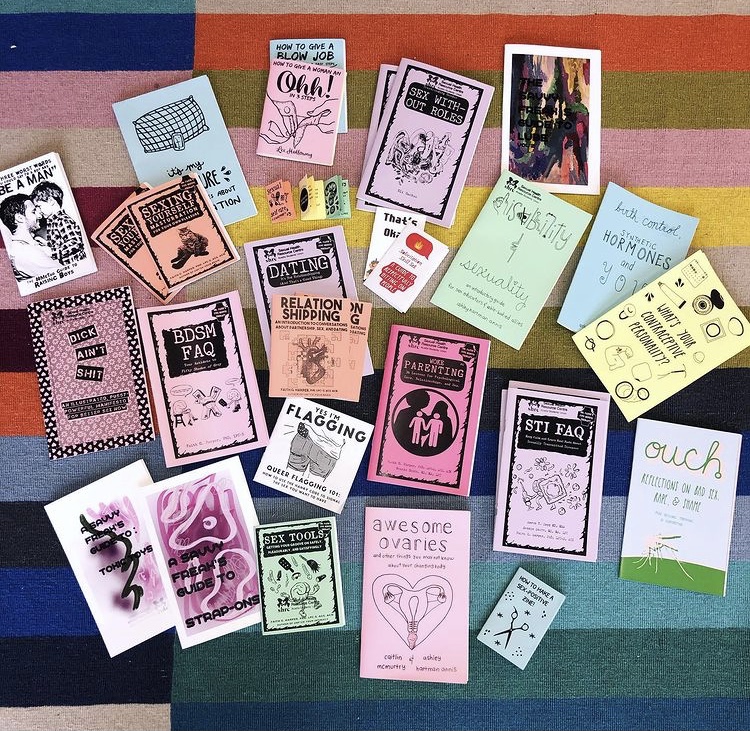
    We also have a well-stocked resource library, where all of our books, zines, and magazines are free to borrow for up to two weeks. Simply provide us with your student email and name, and we will send you out a reminder three days before your items are due. We currently have over 200 books spanning a wide range of topics, including how-to guides, sexual and reproductive health, gender and sexuality, dating and relationships, erotica, sex and religion, disability and sexuality, queer issues, and memoir and fiction. If there is a book you would like to see us carry, please reach out and let us know and we will be happy to order it for the resource library.

    In addition to our resource library, we also have a wide selection of free pamphlets, information cards, and articles covering on-campus & community resources, STIs and STI testing and treatment, contraceptive options, pregnancy options counselling and abortion access in Nova Scotia, HIV/AIDS, hormone therapy, sex toy use and care, hormone therapy, and health insurance coverage and fees.

    Products for Purchase

    We also offer a variety of products for sale, including affordable sex toys, massage oil and lube, menstrual cups and dilator kits, and at-cost gender-affirming gear. At the SHRC we are dedicated to providing our products at low prices, as affordability is central to our mission of sex-positive, shame-free, and accessible when it comes to sexuality and sex education. Plus, as a student-funded not-for-profit organization, any revenue generated from our sales goes directly back into funding the SHRC’s services!! Our manager is educated on all of the products we sell and is happy to help you find the toy or product right for you.

    Who works at the SHRC?

    The SHRC is staffed by one full-time employee, the SHRC Manager, Hannah Hutchinson. Hannah is an Acadia Alumna (Class of 2017) and is excited to be back on campus in a new role. She has a BA(h) in Sociology and WGST and an MA in Sociology. She is passionate about sex-positive education, sexual violence prevention, and providing support to students. In addition to the manager, the SHRC is looking for interested students to volunteer with us as peer educators. Stay tuned for more details on volunteer opportunities, coming spring 2021.

    Where and when can I visit the SHRC?

    We look forward to seeing you! Visit us in the Student Union Building, room 509 (the upper mezzanine directly beside the Acadia Food Cupboard). You can also reach out via email ([email protected]) and find us on social media (Instagram, Facebook, and Twitter) @SHRCAcadia. For the Winter 2021 semester, the SHRC’s regular operating hours are from 9am – 4 pm Monday to Friday. We will be expanding our hours to include weekend and evening hours in the future.

  • Intricate Language

    Intricate Language


    This is not a poem. This is my acknowledgement that a problem exists within our language. This problem doesn’t appear to me because I have sisters, nieces, or a mother. I am not a feminist because of those reasons.

    I am a feminist because I don’t view my masculinity as fragile as a ship in a bottle on the verge of shattering if I make one wrong move.

    I find it difficult when I hear the latest celebrity claim that they are a feminist because they have a female family member. Tripping over such a common excuse you’d think they plagiarized it from Wikipedia. As if the only way to recognize a woman’s proper place in our culture is to have one related to yourself, a man.

    Our language is continuously furthering an issue that our culture does not fully accept as a problem. We use such violent words to describe the act of having sex.

    Fuck. As in the sound that leaves your lips when constantly being used to describe harm being done. “I fucked him up.” “I got fucked over.”

    Bang. As in the sound that erupts when a fist collides with a face, when a body collapses on to the floor.

    Destroyed. As in the complete and utter removal of something that is most likely considered meaningful and beautiful to someone else.

    Smash. As in the sound created at the inevitable impact after one of your favourite glasses gets knocked off the countertop and shatters across the floor, unable to be pieced back together.

    For a lot of men, sex is not all about the pleasure. But also, the action of testing and proving your masculinity.

    We are taught, through our language, our culture, our discussions, that sex is a transaction between partners in which the woman gives and the man takes.

    In which the man is given both the power and the possession.

    This is not a poem. This is an acknowledgment to just how fucked up the language surrounding sex has become.

  • Free

    Your fingertips trace the line of my spine and I shiver with an unexplainable, uncomfortable pleasure. I close my eyes and my head tilts back to invite your warm lips to dance across the vulnerable skin of my neck. I clench my fists around the soft sheets beneath me and my back arches against your hard body. Suddenly your kisses that are filled with love, lust, and concern for only me feel as if they are choking me. Your lips may have pressed slightly too hard into my throat and now I can’t help but to stiffen my body and tear my eyelids open. I regain control. It’s when your strong, safe hands slide down and around my body to find my wrists and pull them up over my head that I start to panic again. I can’t move, and to calm myself I stare hard at your face and repeat to myself who you are and you wouldn’t let anything happen to me. In your eyes I can see my reflection and it says: you will never be free.

  • Desire

    Desire

    So that’s what it feels like to completely stop
    .
    .
    .
    And think for just a moment: What if they were mine?
    It wasn’t always like this
    They’re just a friend
    My mind won’t stop these thoughts
    I wish it did

    “No you don’t”

  • Coming out: My Story


    Coming out is hard regardless of whether it be relates to your gender identity or sexual orientation. On February 20th 2018, I finally accepted my sexual orientation as a bisexual individual. This was the part of a multi-year process filled with confusion, pain, and also excitement.

    In grade eight, I was a happy young hockey player without a care in the world – besides a naive dream of making it to the National Hockey League. It had been a rough year, and I had been the subject of bullying and hazing among my team mates. One of the many slurs I was subjected to was “gay” and team mates often made jokes about me liking men and wanting to join them in the shower. Then one day things escalated drastically – before practice I was sexually assaulted by a team mate. It happened again on another occasion, and I went into a depressive whirlwind before I finally broke down to my parents one night. I am super thankful I had them as supports, but the event left me hurt, isolated, and confused. I did not enjoy what happened, but it opened my eyes to the possibility that some individuals liked the opposite sex, a notion that was foreign to me in the conservative town I called home.

    I arrived at Acadia in a fresh environment free from my past connections and was free to create my own story. At Acadia, I could reinvent myself, or perhaps even find out who I truly was. On one of my first days here I met a transitioning trans gender individual who I eyed suspiciously. Today I am proud to call this individual a friend and am thankful for the exposure and advocacy they have gave to the LGBTQ+ community. Soon enough, I too began to question my identity, specifically regarding whether I was sexually attracted to both men and women; or in other words, bisexual.

    The “gay” name calling greeted me at Acadia, and I was told time and time again that there was no way I could be straight because: 1) I was too nice 2) I dressed nice and did my hair and 3) I only hung out with girls. These were actual stereotypes I was met with, and I think its crazy that in 2014 (and today)  people feel the need to label others. These labels made me confused because they were all true, but I wasn’t too sure about how I felt about men. For one, I was girl crazy, and had had a girlfriend all through high school. I could admit a guy was attractive because the majority of my friends were girls, and as such I had to hear about their crushes. Sure, I was also nice, but wasn’t that how you’re supposed to be? I may have dressed nice and did my hair, but I did this for me – not anyone else. How was this even relevant? Was I really different than other guys? The internal struggle of wondering how I felt, if it was okay to be gay, and how others saw me followed me throughout first year.

    In second year, another break through occurred as I met an amazing man, friend, and mentor – who happened to be gay. This mentor taught me that not only was it okay to be gay, but it didn’t need to be confusing. He told me that figuring out your sexual identity should be about you and requires no timeline or approval from others. Your happiness alone is the most important thing, and the opinions of others do not matter. This individual took the time to listen to my stories and perspectives and was open about his experience which I found very reassuring. I was also exposed to a significant amount of gay and bi culture during this time, and I began to think that perhaps I was bi after all. I had a great relationship at the start this year, and I joked about my sexuality with this girl, but I couldn’t quite admit to her how I felt. I wish I had.

    Fast forward to the present year, and I finally began to accept who I am. I’m lucky to have many LGBTQ+ friends and their courage and strength helped inspire me and guide me. After I became single I finally was able to force myself out my comfort zone, and I am proud to say that I have accepted who I am. It hasn’t been easy as I faced judgment from some peers, was questioned on social media, and even woke to a message stating “bi isn’t something you come out as”, but this just emphasizes the importance of sharing my story and advocating for LGBTQ+ rights. I am very fortunate to have supportive family and friends. For anyone who is currently questioning either their gender or sexual identity, I promise that it will be okay, and I wish you all the best in your journey. If you take the time to figure how you feel, and are confident, and focus on you then things will fall into place. We are lucky to attend a great school with a supportive environment. I too am here for you and am always available to talk. Thank you for reading my story, and remember – love is love!

  • A Guide to Being Promiscuous

    A Guide to Being Promiscuous

    Nolan Turnbull

    Sports and Wellness Editor


    Sexual liberation is one of many experiences students often benefit from at university. For the first time, students are out of their homes and are free to “find themselves”. At home, we are often restricted by our parent’s rules, the values of family members and friends, and the ideologies in our communities. At university, students can truly act as adults and can dictate all aspects of their life including their sexuality and sexual behaviours. I have been fortunate enough to have had two amazing girlfriends at Acadia (one which was long term) but have also tasted what it is like to be single and “promiscuous”. However, during this transition period it is important to be mindful of how you treat yourself and those who you choose to be romantically and sexually involved with. The following is my advice on how to act when you are experimenting with sex.

    1. Consent: consent can be a complex thing for some people to understand – even though it comes down to something as simple as a “yes or no”. The bottom line is – if you don’t have consent – then don’t flipping do it. This doesn’t only have to do with respecting your partner, but also just being a decent human being. I feel like I shouldn’t have to explain this, but I will for those who still hold the Neanderthal ideology that ‘a 1000 no’s and a hesitant yes is still a yes’. Consent must be loud and clear, and not forced. If someone says no – you stop. Simple as that. If someone is intoxicated – they can not consent. If your partner who regularly consents to sex with you doesn’t consent that night – then you don’t have consent. In other words, consent during sex is action-specific. Even within sex itself, taking the next step requires consent.
    2. Communicate: During sex, its great to use communication if possible to express your desire to continue, and what you like! Some people find non-verbal communication more attractive, but please use your words when it comes to something that crosses the line – safe words are great! Sex also can be greatly improved by being open with what you like and don’t like so that you can get the most out of sex.
    3. Be honest: Honesty is instrumental to a relationship regardless of how they are defined or “how serious” they may be. Be clear about what you want from the relationship or arrangement from day one. This will save both you and the person you are involved with many headaches and will ensure that neither person is hurt or feel used. I have been a victim of this, and also unfortunately have failed to be 100% honest with my partners at times. I am begging you to learn from this mistake and be open so that you can get the most out of sex whether it be in the relationship or the act itself. Know your limits and be respectful of yourself and also your partner’s wishes. This will ensure the best experience for everyone! In addition, be courteous. If you need to cancel – just tell them. If you have changed your mind about going out, then just explain that. I for one find it much more refreshing to know that the person just wasn’t feeling the relationship as opposed to being ghosted and left wondering about what I may have done wrong.
    4. Wear protection and get checked: Always wear protection. I don’t need to explain the risks regarding pregnancy and STI’s. Chlamydia is rampant at Acadia, and while it’s a minor ailment compared to some it can still have long term repercussions. Wear protection and get checked between partners. It doesn’t take long, and you’ll protect yourself and your partner thus avoiding awkward encounters and serious health issues.
    5. Have fun: Finally, remember to have fun. Sex and relationships should be about you and you first. You should feel safe, comfortable, and enjoy every aspect of a relationship. If you feel you are in a toxic relationship, then reach out for support from one of many supports on campus (there is an article in this issue!). Sex should be enjoyable and has many mental and physical health (who doesn’t enjoy a quick 15 minutes of cardio?). Don’t let what others think get you down. I personally have been targeting by slut shaming and have been called a ‘hoe’ for enjoying sex. A friend told me my sexual values are “way left field”. These comments hurt, but I know that what I did was best for me. As long as sex is consensual, fun, and communication is a core aspect – have at it.

    I wish you all the best in your romantic and sexual endeavours. I hope you find these reminders helpful. If you think I missed something, then let me know so I can improve and help promote sex positivity!

    XO

    Nolan

  • Opinion: If you’re not into abstinence…

    Opinion: If you’re not into abstinence…

    Let’s talk about getting tested.

    I know what you might be thinking. You would definitely know if that guy you brought home had chlamydia… like for sure you would have noticed if something was off. And that girl was way too pretty to have gonorrhea, you’re totally certain! None of your friends would ever contract something like that and there’s no way you wouldn’t know if you had one yourself.

    If this sounds like you, let me tell you what I’m thinking: you’re wrong. Do you want to know why you’re wrong? Because good-looking people can absolutely get STIs and most STIs don’t have ANY symptoms in over 50% of infected people.

    If you have sex (vaginal, anal, oral or whatever else you might be doing) and you aren’t using a physical barrier between you and your partner, YOU COULD CONTRACT AN STI. If you are in a relationship, YOU COULD CONTRACT AN STI. Even if you only have sexual contact with people who “look clean”, YOU COULD CONTRACT AN STI. And if you think you have some weird 6th sense that tells you when people have a venereal infection, you’re wrong and you could totally contract an STI even if your third eye isn’t seeing it.

    Here’s the deal. If you have sexual contact with someone without a physical barrier, call up the Mud Creek clinic or go online to book an appointment with a nurse at the Acadia Clinic. It’s a little awkward- sure- but is it more awkward than looking up that person you brought home from the Vil last weekend to tell them over Facebook message or Instagram DM that you gave them something? Is it worse than wondering if your genitals are infected with something that might affect your chances of having children at some point? These infections do not go away over time and can wreak havoc on your system if left untreated!

    To avoid an incredibly weird conversation with someone you found attractive enough to sleep with, you’ll go to go to the doctor’s office and tell the receptionist that you’re here ‘to get tested’ in a very hushed voice. You’ll sit in the waiting area and scroll on your phone, hoping that no one asks you why you’re there. While you’re pretending to cough (you’ll say you think you have strep if anyone asks) and avoiding eye contact with anyone who comes into the room, consider that you’re doing a good deed.

    Instead of pretending this is some taboo subject that no one has any experience with, let’s be real. Nearly everyone knows someone who has had an STI. So why are we all pretending that it doesn’t happen? Why are we stigmatizing getting tested- something that would help us all?

    So, here’s my suggestion to every sexually active Acadia student: talk about it! Go get tested with your friends- make a day out of it and grab an ice cream at The Real Scoop or a beer at The Axe afterward. Don’t make it some big secret. You should be proud of yourself! You held yourself accountable for your actions and made an adult decision to get tested. Good for you!

    We’re pretty much all adults here (sorry to the 17 year olds in first year- I’ve been there and I feel for you) so why can’t we act like it? If you’re sitting in the waiting room in the basement of Dennis and your buddy from class comes in, ask what they’re in for. If they fake a cough and say it might be strep, you don’t have to call them out- but if they ask you what you’re in for, why lie? You’re there to get tested to make sure you don’t have to Twitter message anyone about having given them the clap. Own it! Shout it from the rooftops! I peed in a cup! I got swabbed! I don’t have an STI! –You could even use it as a pickup line!

    Of course, if you’re absolutely mortified about getting tested and you couldn’t even manage to lie about maybe having strep, there is one other option. And hear me out- it’s not that bad. YOU CAN ALSO JUST USE A CONDOM.

    So that’s it. Book an appointment or use a condom. Take the free condoms in the SUB and in the clinic and take advantage of the free health care that we all pay for.

    Shout it from the rooftops: safe sex is good sex and safe sex means getting tested!

  • Opinion: Sex and the Best-Seller

    Opinion: Sex and the Best-Seller

    You read a book and looked around the room to check if anyone is reading over your shoulder. Goootchaaa.  It will happen even though you know very well that you’re in the back seat of a bus, at home alone letting your dog out for a pee, or at an airport gate. It’s because you’re about to read a sex scene that you may or may not have been anticipating.

    As you flip the page, there are all these words that are jumping off. Words that you somehow believe your sweet grandmother, who lives a solid eight hours away, will know that you are reading. You may be a strong and confident individual, and I would like to think that I am in at least some capacities of my life, but when it comes to sex and the written word I confess I can be a child at times. Almost every time. There is unfortunately some blushing and there is some speed reading when in public. I am pretty much a grown ass woman and I spot the word “fluttering” and I’m suddenly faint and screaming “CAN I GET THIS LATTE TO GO PLEASE?” at a poor barista. I wish I could tell you why I am this way. Well, we may actually know why we (ok, I’ll save you some face here and just say “I”), or I feel this way – it’s just some damn good writing.

    It’s illogical, but I have convinced myself that an author has been paid to watch us from puberty, has bugged every car or setting you or I have been in, and has secret access to my mind. Or, better yet, has given now given up the key to someone else’s. It’s the awkward sex or brutally honest scenes on sex that make the most moving ones at times.  

    Here are some recommendations that I wasn’t expecting to be so moved by. It is a small list of relatively recent best-sellers that are not necessarily “sex books”, i.e. you can still read them on a plane, but evoke that beauty in the honesty of some fumble-y smoochie smooch.

    In no particular order (more based on recent memory than anything legitimate):

    • “Call Me By Your Name” – by André Aciman. The screenplay adaptation for this novel, by James Ivory, just won an Academy Award this past Oscar Sunday, for this first love film. The teetering of admiration and insecurity of new love is simultaneously gorgeous and heart-wrenching.  What goes through the lead’s mind, Elio, at times will make you feel a touch less creepy as the author is so candid about love and the physical experience. For example, when Elio asses the items that he once worshipped that his uncertain love possesses that he is trying to rid himself of, and he mentions the “Area between inner and outer elbow that I’d worshipped once: check”. I mean come on, that is so specific and is made accessible through absolute book magic.  If you don’t think love is love by the end of this novel then you should have to revoke your membership from the human species. Please and thank you, bye.  
    • “Crazy Heart” – by Thomas Cobb. Another film adaptation that caught lots of Oscar praise back in 2009. The love that the protagonist country western singer Bad Blake has for his women (including his multiple wives) and his perception of himself, and his aging body, is surprisingly charming. A single older man usually does not scream a go-to idyllic romantic read for university students, but his desperation for blunt admiration and his mix of lyricism is what establishes the timelessness of love and desire.
    • “Looking for Alaska” – by John Green. It has been a while since I have laid my eyes on these pages but what is so interesting in this young adult novel is the utter inexperience that the characters have and it has still stayed with me. It is at the polar end of the spectrum of experience to “Crazy Heart”, as Miles finds more eroticism in one kiss with one character over a more sexually demanding deed done by another character. A local Kentucky resident wrote to their newspaper to call this book “mental pornography” in hopes that it would not be taught in local schools. But what the reader may have been missing here is that Miles found deeper meaning in a kiss, than his extremely awkward other encounter – but, the reader gets to feel the rush and sympathy of some green second-hand embarrassment in the process. Second hand and first-hand embarrassment is what wakes me up in the morning, that, and a good old cup of joe.


    Those recommendations may seem completely arbitrary and it might be because they are only based off my most recent reading experiences – but they undoubtedly stuck to my literary ribs. Aren’t the little details that leave more to the imagination harder to forget? No? Well, yeah, I mean films are good too but, again, those are harder to enjoy on a plane. For example, some reason I forgot about the 3-and-a-half-minute car wash scene in Cool Hand Luke, and I decided to commit to not changing or fast-forwarding the scene. Those are three and a half minutes I can’t get back.  

    Anyways, even if you don’t read those, there are some sounds bites that will make you sound like more like an “authentic adult” and not some horny uni student. Hip hip hurray. Cheers.

  • What If Mary Was a Slut? Challenging The Hookup Culture and Where I Stand

    *Disclaimer: the author of this piece is not trying to project their views. It is simply an opinion piece in which they are grappling with their place in the world.*

    Regarding the title, it is quite the blasphemous remark and definitely not something you would expect “someone like me” to say. For one thing, I have always respected and admired the faith and the commitment of the Church. I was raised in a house with strong Christian values. It made me appreciate church and on my own volition, I started pursuing a greater interest in faith during my University years. Because of this, I was always regarded in a more innocent, naive way, often viewed similarly to a younger sister (even if I was older). One of my friends even has me in his phone as “Mother Theresa” or “Sister Haley”. Another thing is that you will very rarely find me swearing…oops.

    I was known for being fairly conserved and to some, “prudish”. This never bothered me as I was proud of who I was and the choices I made. That being said, I have recently felt that maybe I don’t fit in with modern dating or the hookup culture. I (hopefully) never judged any of my friends for the choices they made and I admired their confidence or the empowerment they had over their bodies and what they did with them. Bottom line: I just want to see people happy and healthy. And, if it is their choice, they must have considered the repercussions and the benefits outweigh the risks. I did, however, read a book that gave me quite the interesting perspective on women empowerment in terms of what they do in the bedroom.

    While reading the book, Female Chauvinist Pig, written by Ariel Levy, I was confronted by so many harsh truths. In fact, it made me feel on edge and uneasy. Mainly because it made me question where I fit in all this. And speaking candidly, the topic of sex still makes me giggle nervously and act awkwardly sometimes. While trying to reflect on the reality of our sex culture, I felt confused and trapped in a world that expects so much and yet delivers so little. The principle is illustrated by the difference of being sexual vs sexy. People aspire for a certain sexiness rather than working on sexual function or the act of having sex. Levy documents how the rise of vaginoplasty (labiaplasty) or vaginal rejuvenation plastic surgery proves that the look is more important than the function. A recent increase in this procedure is in part caused by the porn industry. So accessible and less taboo, women are trying to match what they see and by doing so trying to fit a mold that was never meant to fit! By altering your natural vagina, you risk scarring as well as the risk of creating hypersensitivity or numbing of your pleasure centre. How crazy is that? Statistics prove it’s not that crazy as the increase in surgical procedures related to “sexiness” are on a surge.

    I asked my male friend who is known to be good with the ladies who his “type” was. His response? “Anyone who would sleep with me”. This made me think. Does he see everyone in the same value? Are they just as a body to use or is personality, background and experience ever considered? We have become a culture of reborn promiscuity. In a new sense of self, both men and women get satisfaction from the instant gratification of a one night stand. In numbers alone people carry pride. Discussions of “I’ve slept with so and so” followed up by “Oh yeah? I’ve slept with this many people” has become the norm.

    So where does Mary fit in all this? As I sat in Church one morning, the discussion of the immaculate birth of Christ came up. I was hit with the thought of how a secular society would perceive it. It may carry the assumption that maybe Mary wasn’t faithful to Joseph or, perhaps, they had sex before marriage. At the time, that crime would be stoned to death and Mary would have been labelled a whore. Thankfully, times have changed and people are not stoned to death for breaking promises or being intimate before marriage. Promiscuity has also reached a new level in which numbers are recorded and can be glorified as empowerment. Levy made a comment that women are starting to act more like men in order to level the playing field. I recognize that I fall victim to that while trying to be the “cool girl”. I would comment on the appearance of other women, joke with the boys, let inappropriate or rude comments slide, laugh uncomfortably at sexist jokes, and talk about how I would never be a “crazy” girlfriend. This book made me feel disgusted with myself. I was always considered a “tomboy” and I saw that as being passionate about female rights. Now I realize, that I should never try and conform to be more like my male counterparts. Instead of acting “like a man”, I should act like a woman. Instead of being a “cool girl”, boys should focus on being “cool boys”. We are inherently different, there are gender biases but we shouldn’t put that aside in order to please the opposite sex.

    The way women are depicted in the Bible is quite interesting, especially if their names were Mary. Mary Magdalene, was a prostitute and there was speculation that she was trying to bone Jesus. Then, there is the virgin Mary. The mother of Jesus, who at first is seen in a negative light. Joseph casts her out, she is viewed as a slut and damaged goods. It isn’t until God appears in a dream to Joseph and tells him that she has been faithful and is carrying the Messiah who will save the world. I understand why some people think it’s all baloney, I get it. It all seems pretty far fetched. I can’t imagine how strange it must’ve been for Joseph too. Who knows what he was doing…shrooms maybe?

    So, how is it that God was able to convince a whole host of people that Mary was, in fact, “pure”. And, how did we end up here? Contemporary society is based on judging people on attractiveness levels and more people are meeting thanks to online dating and don’t get me started on the technological advances of sex robots. We are losing touch of human interactions and connectedness. Things like trust are being lost and many people believe in polyamorous relationships and meaningless or emotionless sex. How can that be? Taking a more scientific approach that considers evolution, I think of what humans were like during the state of nature.

    The sole purpose of reproduction was in accordance to the “Survival of The Fittest”. Attractiveness was determined by the ability to survive and if you could bear children. In some ways, maybe we are retreating back to that state in which we judge people based on attractiveness and therefore the survival of good genes and pretty babies.

    The nature and act of having sex has also changed considerably over time. Porn is more accessible and has become more mainstream than ever. Studies have shown that the amount of times men might masturbate to porn could cause erectile dysfunction or impotence. It can also create unrealistic fantasy that are unachievable to meet by the “average” person. And now, we must consider the use of Artificial Intelligence and the development of incredible lifelike sex robots? Are we going to lose the human connection and emotional intimacy that sex brings? It creates life but even that can be artificially made. Are we playing at some kind of God?

    As for Mary, word got out and her story has been celebrated for generations in the Bible. This is how media portrayed her. Another thing that confuses me with all this, is the media portrayal of women. This is an entirely different issue but its prevalence is astronomical and something that is starting to become more relevant. There is no surprise how women are portrayed in media. And, women portrayed in sports is a whole other rant that needs to happen. Ariel Levy said it best : “The collective effect of these pictures of hot (and, in most cases, wet) girls with thighs parted, tiny, porny patches of pubic hair, and coy, nasty-girl pouts made it almost impossible to keep sight of the women’s awesome physical gifts.”. How could we become so disillusioned that we forget the reason we celebrate these women. Not for their looks but for their athletic capabilities. There are many articles outlining the sexualization of female athletes. From the beach volleyball players whose uniforms require them to be in a bikini top and underwear to the lingerie football league.

    As for myself, I have been grappling, trying to figure out where I fit in all this. This isn’t your typical existential crisis. A part of me wants to succumb to the easy gratification of Tinder. A reinforcement that people are physically attracted to me, whenever I’m feeling down it would be a little pick me up. On the other hand, the whole idea of it makes me nauseous. The concept that you are judging people solely based on looks and what you’re attracted to. On days were I’m feeling self conscious, I worry that I would never get a “swipe right’” (liked). How would I be able to trust the people I meet or talk to anyways? These are just my thoughts so take them as you like.

    When it’s all said and done, it is your choice to do as you please so long as you’re not hurting yourself or others. I wish you all the best in life, love and health.


    Displaying Slut_Walk_Chicago by gracie hagen.jpg

  • ‘IUDid’: The Rise of Intrauterine Devices in Young Women

    I was sitting in the doctor’s office nervously. I had taken off all bottoms and layed a sheet over me to protect my vanity. There were scary looking tools beside me. In fact, when I picked up my prescription, $400 later, it didn’t make me feel any better that the box was as long as my arm. How is the size of that gonna fit in here! From the get-go, I was uneasy but excited about the procedure. I did a lot of Googling and speaking to friends and my doctor to ease any worries, many of whom recommended it, with the bonus that it may stop your period altogether! From the articles I read, I was expecting much worse than what I got.

    The doctor arrived in the room and right off the bat I warned her that I might start giggling. “Oh you laugh when you’re nervous?”, she asked and I shrugged because I was pretty nervous. The nurse who prepared the tools and did the pregnancy test beforehand offered me Advil™. I had read online that they recommend you take Advil™ 90 minutes before the procedure. This simple question freaked me out. Is it really gonna hurt that much? I was kicking myself for not following the advice online.  I was already regretting the fact that I was heading back to work immediately after the IUD. Everything I read said to take it easy and give yourself a few days of taking-it-easy afterwards. Basically, you are at risk of cramps, discomfort and dizziness. Of course these symptoms are subjective and each body will react differently.

    I kept psyching myself up and repeating to myself how strong I was and how I have such a great tolerance to pain. This still didn’t settle those butterflies. The only thing that made me feel better was the actual procedure itself and the feeling afterwards. You know that proud, accomplished feeling you get when you stick something in your vagina? Joking aside, the IUD does not go into the vagina as if it were a tampon. It goes even deeper into the cervix. The cervix is what dilates when you are having a baby. That’s right, the IUD goes into the place a whole baby will come out of. If you ever have children down the road, the IUD is taken out and a baby will stretch it out much more than the IUD device.  I’m assuming it won’t be for some time as IUDs are a 99.9% effective method of birth control that lasts anywhere from 3 to 10 years! Another pro is that you will never forget to take a pill and your hormones are consistently being regulated without your intervention. I had a lot of facts from my research and my doctor had the pleasure of listening to me during my 20 minute appointment.

    I’m a talker who is very curious about everything. Naturally, this led me to ask question after question as my doctor gave me my IUD. “Is my uterus normal?”, “Is there any way I can relax my cervix to make this easier?”, “Do you ever get tired of delivering babies?”, “Have you ever had a patient who’s IUD came out?” And so on and so forth. The questions were endless until I was learning plenty about giving birth and what the experience is like for both the mother and doctor. At one point, she looked up and asked me how I was doing. I was just fine. There was cramping, obviously- a foreign body is pressing into your cervix and the pressure alone will give you cramps, but asides from that, no pain. I had withstood worse cramps naturally when I was on my period.

    There was a little struggle with the cervix, considering I have never had children. IUDs were a more common procedure for women who no longer want children later in their life. Because of this, the device can fit easily as the cervix has been stretched by pushing out a baby. That being said, the rise of IUD is young people is growing and it doesn’t show sign of stopping. There are many different IUDs on the market. I was prescribed Kyleena™, my doctor recommended this one as it was developed for women under 25 who have never had children. Of course, all IUDs are generally the same and advice from this doctor doesn’t discredit any other brands or recommendations your own doctor may make. Most of my friends also had Kyleena™, but one had Mirena™. Since I am not enrolled as a full-time student, I don’t have the luxury of health care (asides from OHIP). On January 1, 2018, OHIP (Ontario Health Insurance Plan) declared that most prescriptions were free to those under 25! Fortunately for those prescribed Mirena™, you are completely covered and don’t have to pay a cent. Unfortunately, for those who are getting Kyleena™ (me!), you have to pay the full amount of $416.95.

    It may seem like a large sum of money and believe me, it took me by surprise to lose that much from a paycheck, but if you crunch the numbers, it will pay for itself. I used to spend approximately $90 every 3 months for birth control (although now it’s covered in Ontario). This doesn’t even equate to the amount of money I’ve spent on feminine hygiene products (tampons, pads, etc.) over the years. Those things are expensive and your period is something you have to invest in, starting at puberty all the way to menopause. Which for some, starts at 15- and goes to 50+.

    IUDs first started their epic journey in 1909 when a Polish Doctor, Dr. Richard Rickter, fashioned a intrauterine ring. Unfortunately, this method of contraception wasn’t accepted for another 50 years and for good reason, considering a slightly scary past of infection, expulsions, perforations and deaths. Over time, the shape and design of IUDs changed significantly to the much smaller, more appealing design they have nowadays. Around the globe today, intrauterine devices are the most popular form of reversible birth control, with over 160 million users! Bear in mind this is just a brief history and it is a quite fascinating one. I encourage anyone who has the time and is curious, to read into it more. There are stories dating back to putting stones in camels and testing the first ones on a physician’s wife.

    The moral of the article is that it is a fairly easy, straightforward procedure that doesn’t result in too much pain. There is a feeling of discomfort but nothing you can’t withstand. You are a woman who is capable of anything. Taking birth control or control of your periods into your own hands is liberating and powerful. For me, there is still the small voice that tells me, is this too unnatural? Is it even safe? Looking throughout history, the rise of IUDs has been a positive correlation because of the positive effects and high success rate. If you have any questions regarding IUDs or my opinions towards them, please shoot me a message, I would love to hear from you. As always, I hope you are happy and healthy, making decisions that will reward you or teach you. Until next time.

  • Google Play Radio Stations You Should Be Listening To

    This article is for us peasants that are only able to afford to avail the services of Google Play. Sure, it’s no Spotify with its sleek UI and massive catalogue, or Apple Music with its exclusive artist releases. Google Play does earn some merit in the radio station departments–not only is it free to listen to, but it’s also incredibly well structured, and fittingly tailored towards your mood.

    So, here are some radio stations you should be listening to (and can listen to for absolutely free) on Google Play Music.


    Café Sway

    ‘Ever find yourself gently swaying in your booth at your favourite neighbourhood coffee shop? One of these mellow tunes is probably the culprit’


    When to listen to it:

    • When drinking a cup of coffee in the solace of your room as rain batters outside
    • When watering your plants
    • When you’ve drunkenly wandered into Paris and can’t find your way out


    Chillwave

    ‘Some call it chillwave, others call it glo-fi. Whatever the name, this laid-back blend of modern lo-fi recording techniques and vintage synth noises is one of today’s most addictive sounds.’


    When to listen to it:

    • You miss the 80’s
    • You realize synth-pop really gets you in the mood
    • You wish that life was more like an indie rom-com


    Shhh, Don’t Wake the Baby

    ‘You’ve finally managed to get the little one to sleep and you’re ready to relax. From hushed alt-rock to gentle Brazilian croons, this collection of exquisitely delicate tunes is quiet enough to keep from waking even the lightest sleeper.’


    When to listen to it:

    • It’s late at night and you just can’t seem to inch closer to sleep
    • Introspecting on the quieter things of the night
    • Reading that book for the fiftieth time


    Beyond The After Party

    ‘This is the the sound of a late night urban romance: a mix of downtempo, R&B and forgotten pop from the ’90s through today.’


    When to listen to it:

    • You’re walking back from a loft party somewhere uptown, and the sounds of the city just don’t seem to feed the groove you seek.
    • A downtempo feel to pop
    • Pissing away your money on a third tequila shot


    For A Rainy Summer Day

    (Perhaps my personal favorite)

    ‘Listen to this warm mix of acoustic songs while relaxing inside on a rainy summer afternoon.’


    When to listen to it:

    • Holding someone in bed and not worrying about the hours fading away
    • Before/After/During sex
    • Drinking wine in the heat of a summer night


    Since this is the ‘sex issue’, here are a couple of radio stations to lay down with a loved one and horizontally yankee doodle to:


    Date Night City Soundscape

    ‘A beautifully eclectic and mellow backdrop to dinner in the city. Perfect for setting the mood on the first date without being too suggestive.’


    Indie Dinner For Two

    ‘Did you first bond with your significant other over a shared love of indie music? Let these gentle indie love songs soundtrack your home-cooked dinner for two.


    Sleepytime Indie

    ‘If you’re ready for some soothing sounds to lull you softly into slumberland, but your tastes run toward the alternative, here’s a heaping helping of hushed tunes by indie favourites of yesterday and today.’

  • Girls and Sex: An Overview of how Peggy Orenstein Navigates a Complicated Landscape

    Girls and Sex: An Overview of how Peggy Orenstein Navigates a Complicated Landscape

    Some of us grew up in semi-liberal or liberal households. Some of us grew up in conservative households. At one point or another, our parents would openly discuss the harms of drug and substance abuse, the negative consequences of consuming alcohol before 19 (or 18, in some cases), and why it is important to always follow the rules. As I continued to get older, I became more aware of the generation gap between my parents and I. This gap between mothers and daughters, and mothers and fathers has become even more evident as I see my parents’ friends struggling to make their way through the adolescent years of their teenage daughters. Even in the age of the “helicopter parent” there is a continued stigma and discomfort around the notion that their daughters have the potential to have a sex life. The same notion is not met with the same level of discomfort when their son’s sex lives are the topic of discussion.

    At this point, it is safe to say that blaming girls’ clothing for boys’ sexual drive is counterproductive. However, we must first look inward at the ways in which girls’ clothing is marketed in comparison to boys. Orenstein writes about the methods that are used to market girls’ clothing. It is evident that boys’ clothing isn’t centered on the idea that they should bare their bellies and wear short-shorts when they dress, so why is this marketing tactic targeting girls from a young age? If we dig deeper by using Orenstein’s study as a framework, we may be able to see a correlation of self-objectification. Orenstein offers a strong definition of self-objectification: the pressure on young women to reduce their worth to their bodies and to see those bodies as a collection of parts that exist for others’ pleasure; to continuously monitor their appearance; to perform rather than to feel sensually. Could the marketing tactics of young girls’ clothing be subconsciously objectifying them? Could it be leading them towards a road of lower self-esteem and doubt? Perhaps it is the lack of conversation surrounding female sexuality on behalf of the parents, who often perpetuate the stigma from a young age that it is okay to follow media and gender norms by going along with fashion trends that sexualize the female body, but having conversations about how to engage in sexual activity safely is out of the question.

    However, the stigma around young women’s dress is more likely to have damaging effects. It begins with the media normalizing how young girls are supposed to dress, what toys they are supposed to play with, and what shows they are supposed to be watching. By submitting to these cultural norms, their experience is shaped to fit a particular model. Parent’s discomfort with the teenage sex drive is actually more harmful for young girls’ self esteem, further creating a more difficult landscape for these girls to navigate.

    Orenstein conducted an interview with 71 young women. In this series of interviews, she asked questions about the girls views on sexual conduct, what they hoped to get out of their sexual encounters, and how the level of discomfort they felt when talking about these experiences with family or their peers. The results were alarming. The general consensus was that their friends became an audience to be sought after and maintained, that their engagement in the sexual experience was not for their own pleasure, but more so for the purpose of fulfilling their partner’s “needs” before their own, and so that they would have stories to share with their friends to not come off as “prudish.” Not only is this behavior harmful to girls’ self-worth, but it can also be related to mental health issues. Orenstein describes this phenomenon as “using your experience to create an image of yourself.” Essentially, the more experience you gain sexually (even if it is not for your own enjoyment), your social status will be higher.

    Let’s shift into a discussion about the negative consequences of social media. It is a game, and one that you need to play correctly in order to be “accepted” by your peers. Orenstein uses Sarah* as an example. She talks about a girl in her high school who continuously posted selfies. It was the general consensus that she either had no friends or was completely self-absorbed. It was never thought that, perhaps, this girl just enjoyed posting pictures of herself. The impacts of social media use have severe impacts on girls (and boys) well-being. Are selfies empowering or oppressive? Are they used to control girls and constrict them within a particular social norm, or are they a useful tool for expression and exclusion? When we are faced with these discussions there is rarely a strait and narrow path to follow, it perpetuates the ideology that there is a difficult landscape to navigate when it comes to teenage girls and sex.

    Why is it called a blow “job”? The expectations for women’s bodies just continue to perpetuate a pre-existing notion of the misogynistic roles they are expected to fill in society: subordinate. Just before the Bill Clinton scandal in the White House, a 1994 survey in America revealed that just over 50% of women had never performed fellatio on a partner. In 2014, these numbers have alarmingly increased. A story in the New York Times declared that sixth-graders were now more inclined to treat fellatio “like a handshake with the mouth.” Has this practice been normalized because of the ever-growing presence of social media? Or is this stemming from the need to form an image of oneself, one that favors the female’s role in sex because it is increasingly being viewed as “normal.”

    Sexually active teenage girls are often referred to as “sluts.” Sexually active teenage males are often referred to as “players.” It is extremely evident that this is a problem. Normalizing and gendering sexual behavior in teenagers is not only dangerous for their physical well-being, but also their mental well-being. Stigmatizing a normal practice (don’t turn your noses up, we are all human and puberty is a confusing, hormone-ridden, emotional roller coaster) to favor one gender over the other is not only wrong, but goes deeper to perpetuate gender roles in society as a whole. It targets women to be submissive, to be ashamed of their bodies and their desires, and calls them to question their characters for having a sex drive as a teenager. The media has sensationalized the idea of casual sex, yet targets and shames women who engage in this practice. The sexualized nature of the media not only encourages young women to call their self-worth to question, but it also perpetuates particular ideals about virginity, their role in the sexual landscape, and how they should go about the complex terrain of the “hookup culture.”

    I am not a mother. I have no experience with parenting and I do not know how to care for someone who is entirely dependent on me. I write this article as an opinion piece, based off of my own experiences and the study conducted by Peggy Orenstein. If I may suggest one thing, it is that we call to question preexisting norms about teenage girls. I suggest that we become more open to discussion with these young women, who will someday be the future. I call all parents to step outside of their comfort zones and talk openly about sex with their children, which is a conversation I never had with my own parents (comfortably). This is a difficult landscape to navigate, with a variety of different factors influencing behaviors, interactions, and personal decisions. Opening up the floor to a more inclusive, non-gendered conversation about sex is what we may need in order to help maintain teenage girls self-esteem, let them know their worth, and ensure that any decision they make regarding their bodies is just that, their own.

    For reference, please pick up a copy of Peggy Orenstein’s work.

    Peggy Orenstein, “Girls and Sex: Navigating a Complicated Landscape”, (New York: Harper-Collins, 2016): 1-236.

  • A Safe Sex Sonnet

    In bed, one will ask “Are you ready?”
    ‘Ready’ has little to do with your age,
    you do not have to be going steady.
    There is no ‘right place’ or certain life stage.
    So long as someone uses some latex
    prior to showing all your affection,
    it’s drilled into your brain: “Practice safe sex!”
    The pill is not well rounded protection.
    Move fast, slow or upside down, remain bold!
    Sex is flat if you don’t communicate.
    Grant that you don’t want a bundle to hold,
    it is simple to evade a due date.
    This sonnet has one thing to reinforce,
    have happy, healthy, and safe intercourse!
  • Trail

    Trail
    your fingertips over my skin.
    Make me arch with shivers.
    Lick
    a pathway from my navel to my breasts,
    hear me moan in pleasure.
    Kiss
    me everywhere and more.
    Let me love you forever.
  • BDSM: Keeping it Kinky

    So you think that kink is for you. In this follow up article to last submission’s“BDSM Basics” we will discuss how to add a little kink to your bedroom. Although the kink scene may appeal to you, it may not seem as erotic to your partner. Discuss their comfort zones and limits with them prior to engaging in any new activity. Always remember to keep all activities safe, sane, and consensual, and engage in appropriate aftercare for all parties.One of the most common BDSM activities is bondage. Bondage can be as simple or complex as you want it to be. Scarves, stockings, ties, and belts can be used as effective and inexpensive restraints. Prior to tying up you sub, slide the binding across the body to create a range of sensations. This will heighten expectations for what is to come. For bondage beginners, assume a simple position lying down with your arms tied above your head. As your comfort level increases, you can experiment with more involved positions. No matter your experience, always tie restraints so you can fit two fingers between the bondage and skin. If the sub ever expresses discomfort at the fit of their bindings, make sure to loosen and fix them accordingly. Overly tight restraints can cut off blood flow, leading to numbness and nerve damage. Bondage positions that place strain on joints create risks for muscle or ligament damage. Tight bindings can also lead to blood clots, and once restraints are removed clots can travel throughout the vascular system, sometimes ending up in the lungs, brain, or heart. If you are participating inextended bondage sessions, are prone to clots, or are using hormonal birth control, make sure you move around from time to time to prevent clot formation. Always keep in mind that any form of bondage, no matter how simple, puts the sub at risk of physical harm. Always keep scissors handy, and if using handcuffs keep the keys within easy reach. Never tie your sub and leave the room. If sensation play intrigues you, try running feathers, icecubes, and other objects across your partner’s body. For added fun, blindfold them so they can’t identify the object. Try using cold or warm items to heighten sensations. Wax play is one method of increasing warmth; however, buy appropriate waxes as average candle wax can cause burns. Make sure to burn candles safely and be aware of the flammability of clothes used in any scene involving flames. Always test the wax prior to administering larger doses, and consider that the higher wax is held from the body, the cooler it will be when it lands. On the alternate side of the spectrum there is ice. Ice-trays shaped like a variety of toys can be purchased, and for the DIYer ice dildos are easy and cheap to make (fill a condom with water and freeze it). BDSM can be physically and emotionally freeing, but like all actions it can have great consequences. Always be open to discussion around a scene, and if you are uncomfortable with an action don’t perform it. Kink is first and foremost about communication. Actively maintaining a dialog ensures continued mental and physical health for all participants. Kinky relationships, like any relationship, are built on mutual trust and respect. Although you may think BDSM is a veritable minefield of catastrophes waiting to happen, many of the risks and hazards are the same sorts of things you have to learn when getting involved in any physical sport. The mental risks are the same things you learn about when getting involved with another person. If the idea of incorporating BDSM into your bedroom excites you, you are not alone. The Kinsey Institute estimates that approximately 30% of the population derives “pleasant thrills” from engaging in BDSM related activities. Although it can be scary admitting to a partner that your tastes are not vanilla, you don’t need to jump into whips and chains right away. If you and your partner decide to incorporate kink into your relationship, take it slow. Start with simple activities and as your comfort grows increase the intensity. Keep in mind that no one can read minds, top or bottom, and that it doesn’t kill the mood to check in with your partner. It is also not solely the Top’s responsibility to spot problems, although they may have to be extra vigilant. Every participant in a scene shares responsibility for one another’s safety. Although popular culture often depicts BDSM relationships with an all-controlling Top, the truth is that being submissive is about asserting control. The sub knows and communicates their limits, and the dom listens to their sub. Doms may orchestrate a scene, but only within parameters set by their sub. Sex is ultimately about satisfaction and fun. However, always remember that consent and communication are a must, and that each individual is unique. Experiment with your kinky side, have fun, and whatever your preferences, keep it safe, sane, and consensual.

Betzillo positions itself as a versatile gaming hub where structured bonuses and adaptive gameplay mechanics support both short sessions and extended play.

Built with a focus on innovation, Spinbit integrates modern casino architecture with rapid transactions, appealing to players who value speed and digital efficiency.

Ripper Casino emphasizes bold entertainment through high-impact slot titles and competitive promotions crafted for risk-oriented players.

A friendly interface and stable performance define Ricky Casino, offering a casual yet reliable environment for a wide spectrum of gaming preferences.

King Billy Casino channels classic casino spirit into a modern platform, delivering recognizable themes supported by contemporary reward systems.

Immersive visuals and layered slot mechanics are at the core of Dragonslots, creating a narrative-driven casino experience.

Lukki Casino appeals to players seeking direct access and minimal friction, focusing on fast loading times and intuitive controls.

Casinonic provides a structured and dependable gaming framework, blending modern slots with transparent operational standards.