The Students’ Representative Council (SRC) is a council composed of a body of students elected by their peers, who are in charge of running the Acadia Students’ Union. The Council meets bi-weekly on Tuesdays at 5:15 PM in the Beveridge Forum which is located off of the Michener Lounge in the old Students’ Union Building (SUB). Every meeting is open to the public and students are encouraged to attend the meetings to learn more about the decisions being made on their behalf.
On April 2nd the council met to vote on multiple motions, including the Kings Transit University Bus Pass (Upass) Agreement and referendum question. George Philp, ASU President, presented news from the Board of Governors along with a federal budget update from The Government of Canada. Additionally, the Special Election Exit report was also scheduled to be discussed this evening and the meeting was graced with significant audience turnout.
Kings Transit University Bus Pass Agreement
The meeting began with the objective of voting on the Kings Transit UPass Agreement (MOU) that was proposed to council two weeks ago. Sebastian Farkas, Councillor, kicked off the discussion with the expression of some concerns regarding the MOU to the council and suggested that instead of the Upass being mandatory, an opt-out would be a significant addition to the agreement. Councillor Jonah van Driesum supported Farkas’ proposal, adding that the $180 dollar fee may be too much for some students to pay. In response to both Farkas and van Driesum, Meg Hodges, an elected Councillor for the Municipality of Kings and Board Chair for King’s Transit Authority, announced that Kings Transit has discussed the addition of an opt-out but the goal is to not increase the fee past $180 and adding an opt-out would cause the price to rise for students who do not opt-out.
Dahlia Chahine, Student Board of Governors Representative, expressed the concern that if the Upass wins a majority vote in a referendum, then there may be a backlash from the 80% of the student population that typically doesn’t vote during by-elections. ASU President George Philp responded to this concerning by stating that the last by-election dealing with a matter similar to this (Axe renovations) had a significant uptake in voter participation due to the subject matter of the vote differing from normal elections. While Philp cannot predict the turnout for a Upass vote, the Axe renovation vote does provide some insight into a potential case.
The conversation regarding the MOU continued for a few minutes before leading into the vote. Ten members of council voted to pass the MOU with two members voting against, resulting in the Kings Transit Upass Agreement being passed and the Upass moving to a referendum in the fall.
Kings Transit University Bus Pass Referendum Question
Directly following the conclusion of the vote on the Kings Transit University Bus Pass Agreement, the council began to discuss the referendum question that will be presented to students voting in the fall. Amar Randhawa, Professional Studies Senator, suggested it would be a great idea to add the $180 fee to the actual referendum question. This would change the question from “Do you support the implementation of a mandatory Bus Pass (“UPass”) Program, which includes the following terms?”, to “Do you support the implementation of a mandatory fee of $180 to pay for a Bus Pass (UPass) Program”. Some members from the gallery rebutted Randhawa’s suggestion, stating that the proposed new question seems slightly slanted towards the Upass being a negative idea. The table then discussed how they could potentially change the question to include the $180 fee in a different way. There were many suggestions from the council regarding stressing the mandatory fee and the best way to do so.
Eventually the motion to leave the referendum question as is was presented to the council with eight members voting to pass the referendum question as is and four members voting against.
New Business
All of the notice of motions from last week were scheduled in the agenda to be voted upon during this SRC meeting. The council voted unanimously to accept the changes made to both the Operating Procedure #3: Policy Development and the Student Organization Registration Procedure. The council also voted unanimously to pass the Student Organization Funding and Services Procedure which is a new policy determining how student organizations apply for funding and what funding they are deemed eligible for.
Board of Governors
Philp announced to the council that they are required to appoint one executive member and one non-executive member from the in-coming SRC to be representatives on the Board of Governors. Philp nominated Yoram Schroll, incoming VP Finance and Operations, to the council as the executive representative due to the fact Schroll has expressed interest to Kyle Vandertoorn, incoming President. Philp noted to the council that traditionally the executive representative is the VP Finance and Operation because the Board of Governors typically discusses a lot of financial aspects in their meetings. Additionally, Schroll is an international student and will add some international representation to the Board of Governors. The motion to appoint him was presented to the council and passed unanimously.
Nicole Kirkpatrick, incoming Science Senator, has also expressed interest to Vandertoorn and was nominated to be the non-executive representative on the Board of Governors. Philp explained that Kirkpatrick will be in Wolfville over the summer which is important as the Board of Governors first meeting of the fiscal year takes place during the summer. It would be an additional Bonus, Philp added, if the Board of Governors had more female representation on their board. The motion to appoint her was presented to the council and passed unanimously.
Special Election Exit Report
The Special Election Exit Report was due to be accepted by cancel today but Philp proposed the motion to table the report in order for council members to have more time to look over it. The council unanimously voted to table the report until next week.
Federal Budget
On March 19, 2019, the Federal Government of Canada released its 2019 budget which Philp presented to the council during this meeting. Philp announced that student researchers will benefit from new master’s and doctoral level scholarship awards from the federal government, as well as the addition of an extended paternal leave if necessary. The federal government is set to invest $630 million over 5 years towards work-integrated learning programs such as co-ops and internships. It is estimated that this investment will create 84,000 new work opportunities for students. Additionally, the federal government plans on helping students with disabilities who often require specialized equipment to assist them in their studies and the grant provided to help cover these costs is being raised from $8,000 to $20,000 a year.
Rylie Moscato is a first year English student and incoming News Editor of The Athenaeum
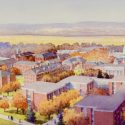
Sitting in the corner of the Acadia Room in the KC Irving Environmental Science Centre, I looked up. As the dying rays of light cut through the room something shimmered on the wall opposite. My interest piqued, I stood up and wandered over. Attached to the wall was a large framed poster, titled “Campus Master Plan”. It was a re-imagining of Acadia from a birds-eye view. New buildings, hundreds of trees, and a reorientation towards pedestrians were the hallmarks of this campus.
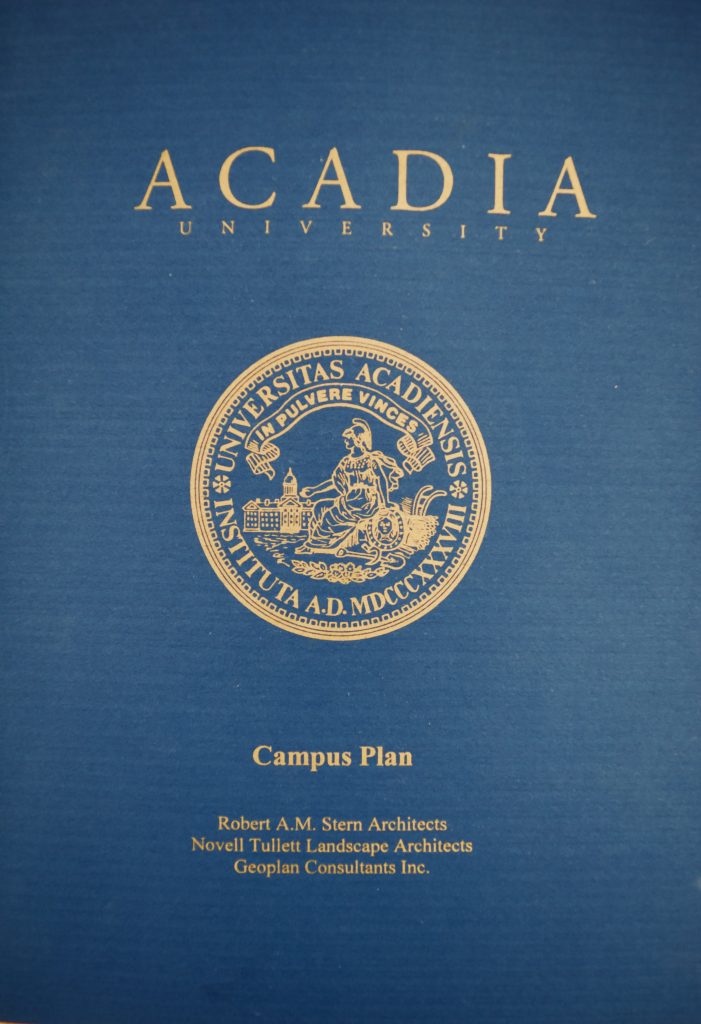
Intrigued, I took the time to do my research. With little to nothing available online, beyond a quick reference to the Senate Strategic Research Plan adopted in 2006, I did some digging. It took nearly three months before I was able to rest my hands on a physical copy of the Campus Master Plan.
Described as a “topographical blueprint for the twenty first century”, the plan was meant to celebrate Acadia’s traditional architecture and strengthen its connection with the Town of Wolfville. This plan would focus on re-orienting the campus to pedestrians and incorporating natural features into its design, including a greenbelt to the south, dykelands and tidal meadows to the north, and the Bay of Fundy.
The plan came about as a result of the development of the KC Irving Environmental Science Centre, raising the standard for development on campus. This served as an inspiration for the Board of Governors who, in 1999 under the leadership of then-President Kelvin Oglivie, pursued the development of a campus plan. The final plan was adopted in 2002 by the Board of Governors with any major changes to require at least 2/3 of the Board’s approval.
Robert A.M. Stern Architects, Novell Tullett Landscape Architects, and Geoplan Consultants Inc. came together to build this plan. Robert A.M. Stern Architects (RAMSA) is very well known for various Ivy League construction projects, including two of Yale University’s newest residential colleges, the Spangler Campus Centre at Harvard University, the Moore Psychology Building at Dartmouth College, and the Fitness and Aquatic Centre at Brown University.
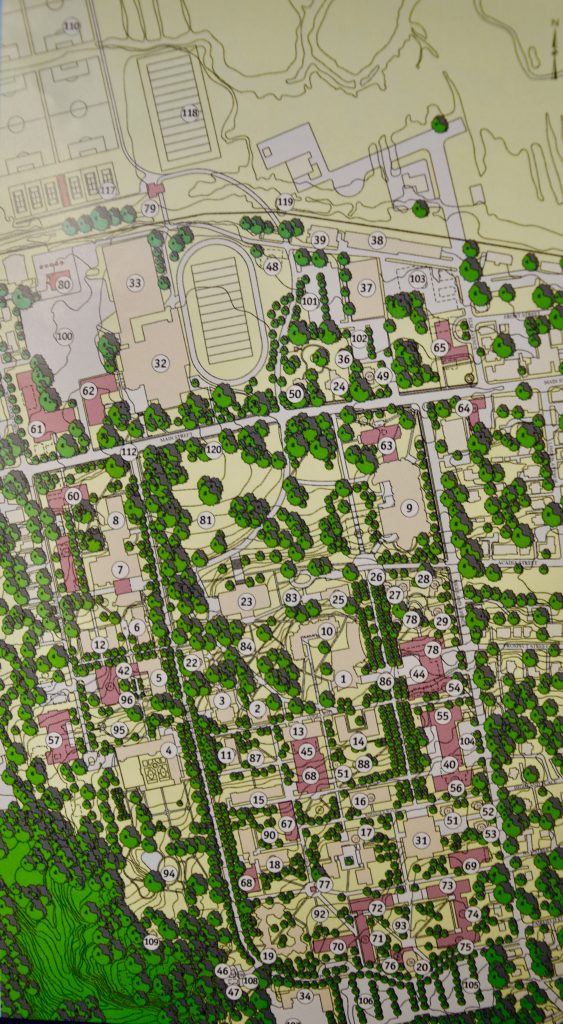
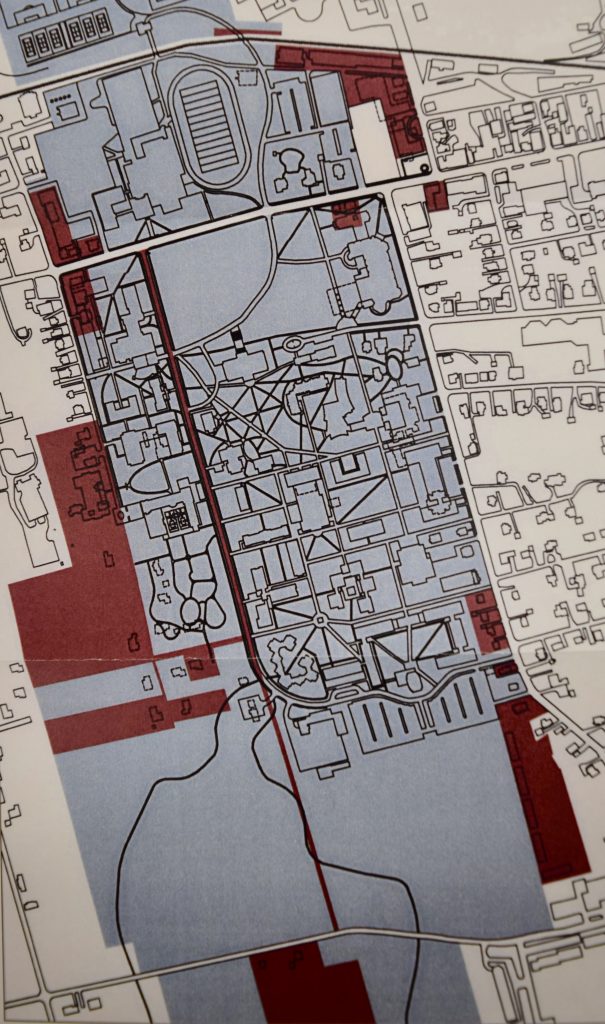
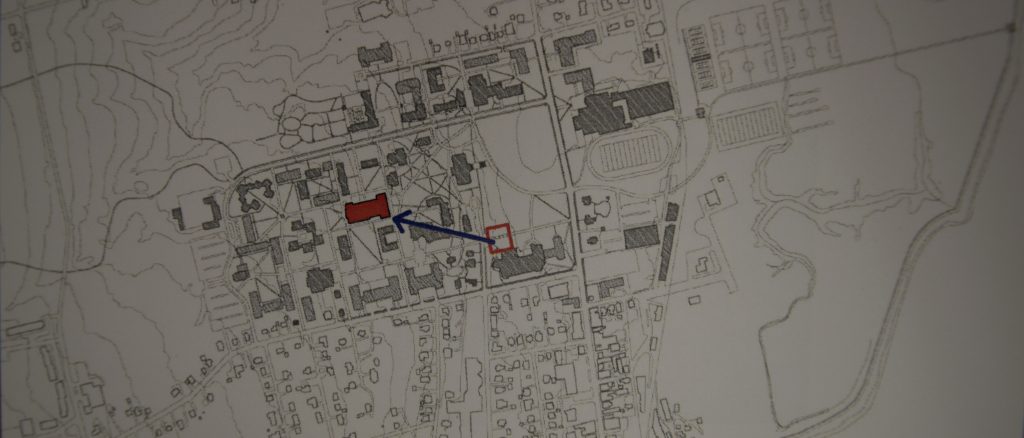
The Campus Master Plan (CMP) called for the purchase of 8 hectares of property. This would include buying University Ave from the Town of Wolfville, Catherine Court, the block where Troy currently resides, various residential lots on Westwood Ave, the funeral home next to the Athletics Complex, and apartments on the south side of Main St. where ‘Brown House’ is located.
Red denotes property the university has to buy
This would be coupled with the construction of approximately 87,900 square metres of new buildings organized around pedestrian paths and quadrangles. Some of the major changes to campus would include:
New buildings on the western edges of campus to form a Science Quadrangle
Relandscaping the front of campus on the ‘College Lawn’
Buying University Ave to demolish the portion south of campus
Demolishing the existing library and rebuilding it incorporated into Fountain Commons in the centre of campus
Building of 9 new residences
New school of business where the funeral home resides
Goal is 75% students on campus
Building of 2-3 new dining halls contained within or adjacent to residence halls located on southern half of campus
The creation of a pedestrian campus by making University Ave smaller and thinner
All students receiving an unlimited transit pass
Acadia University supporting Main Street retail and densification
Discouraging building north of the railroad tracks
Advocating for the restoration of high speed rail to Halifax
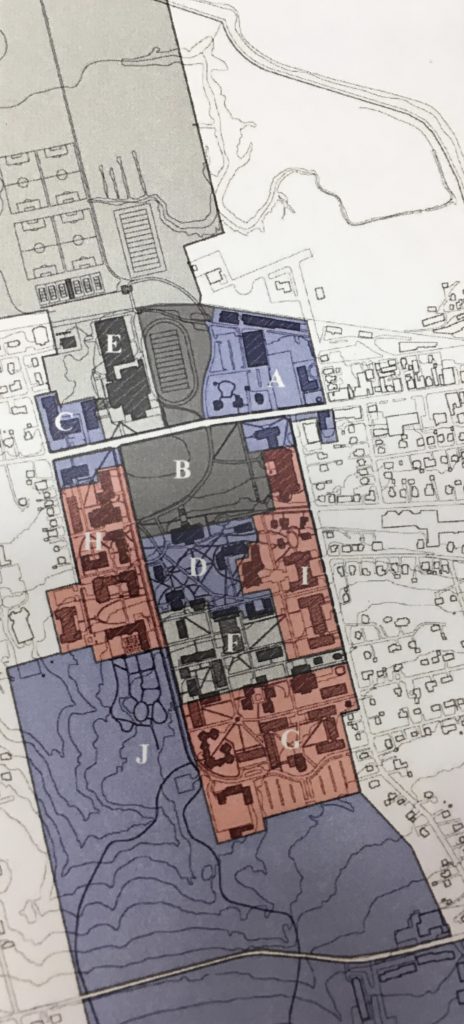
The CMP broke up the proposed changes into 10 separate areas. A) The East Gateway, B) College Lawn, C) West Gateway, D) Historic Core, E) Dykeland Playing Fields, F) Middle Zone, G) South Zone, H) Sciences Quadrant, I)Humanities Quadrant, and J) Botanical Garden & Greenbelt.
East Gateway
The CMP identified parking around campus as wholly inadequate. The views one is first introduced to driving to Acadia detract what the university is actually like, leaving a poor first impression of Acadia. Coupled with the grotesque imposition of the BAC it presented an unique architectural challenge.
To combat these the CMP proposed the following solutions. A new three-story building would be constructed in the parking lot behind the Wolfville Baptist Church. This would add a university store and impress visitors upon arrival. All of the land north of Main St. and Elm Ave. would be bought to create a Conference Centre Inn that would host major academic meetings and work with local B&Bs.
A new parking lot with direct access to Main St. would be constructed beside the existing Raymond Field, screened by trees. The Wong Centre would be moved to Main St. and a new three-story building at the corner of Main and Highland Ave would be erected that would be connected to the existing BAC. This would house an art gallery, university history museum, classrooms, and offices. The CMP identified the importance of making the building architecturally inviting, as it would screen the BAC from the main view.
College Lawn
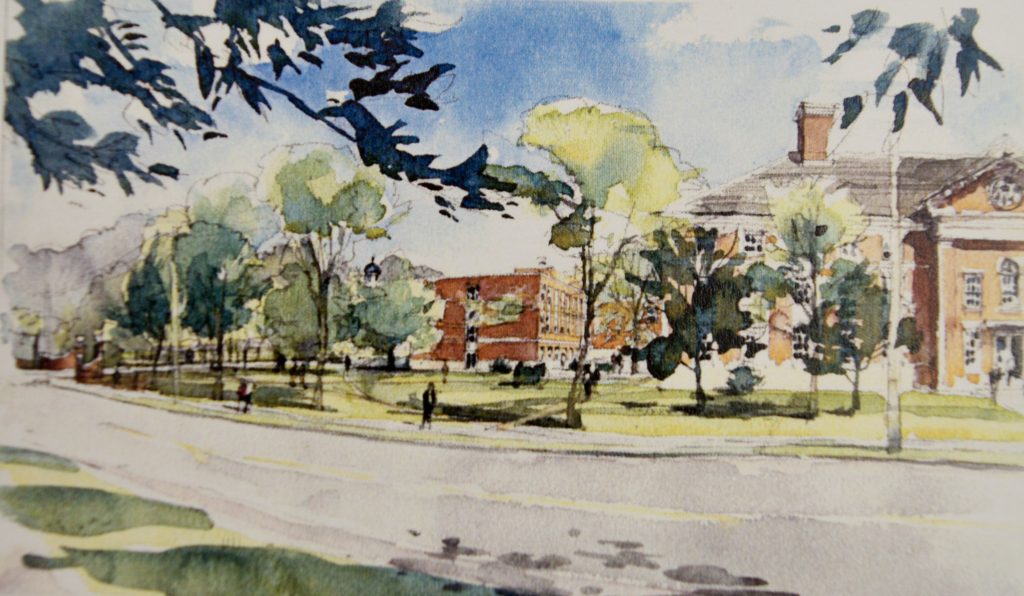
The CMP identified the poorly landscaped College Lawn as a major flaw at Acadia. This is the area directly in front of University Hall. The poor landscaping and seemingly random locations for crosswalks proved problematic, and poor lighting did a disservice to the pride of Acadia’s ‘front doorstep.
To combat these challenges, the CMP proposed to plant historically appropriate species of trees around the College Lawn. Space created by the elimination of the Vaughan Memorial Library would create considerable space to add to the lawn, which would preserve and enhance the view of the dykes. A wooden split rail fence along the north and south sides of Main St. would be erected to discourage jaywalking. This is similar to fences that exist at Yale University.
The central heating plant of the university and its smoke stacks would be demolished. These have been characterized as brutalist and out of place, made famous by an Alex Colville painting “Professor of Romance Languages”. The lawn itself would be extended across the street to Raymond Field, replacing what is now concrete.
West Gateway
The CMP identified the houses at the corner of Westwood Ave and Main St as unnecessary and detracting from the character of the university. Coupled with the unlandscaped portion of grass by the Elliot Chemistry Building, the CMP also noted how University Ave was too heavily trafficked. This posed serious risks for pedestrian and vehicular accidents in addition to traffic bottlenecks. The presence of a funeral home on the front doorstep of the university was identified as a flaw, as it gives visitors the wrong impression. The parking lot at the Acadia Athletics Complex (AC) was considered as far too exposed, considered aesthetically displeasing.
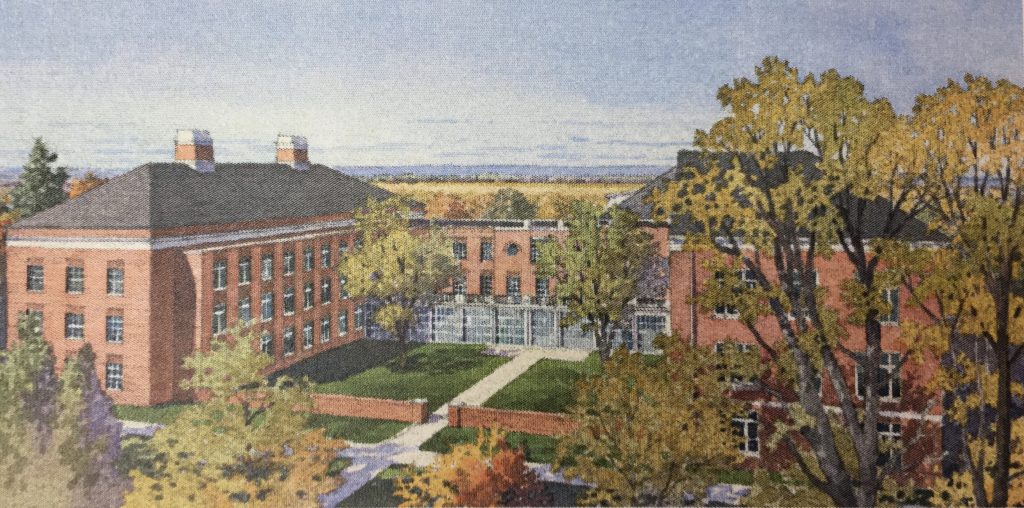
The CMP proposed several solutions for the West Gateway. These included purchasing and demolishing the apartments that exist at the corner of Westwood Ave and Main St to create a new science building. Construction of a new building would mean the creation of a science quadrangle, which fits with the CMP’s main goal of creating a pedestrian friendly campus.
Alumni Gates would be erected at the entrance to University Ave, with the avenue itself slimmed down to approximately 24 feet across. The funeral home on Main St. would be demolished to create a new building for the School of Business, and a new building west of the War Memorial Gymnasium would expand recreation facilities and provide a new home for the Kinesiology Department.
Historic Core
The CMP highlighted hasty renovations on degraded infrastructure and poor landscaping as detrimental to the history of Acadia. The noisy air conditioning unit by Seminary House was also considered a detriment to the overall aesthetic of the Historic Core. Cars intruding in the centre of a pedestrian campus and poor lighting were identified as areas to easily fix.
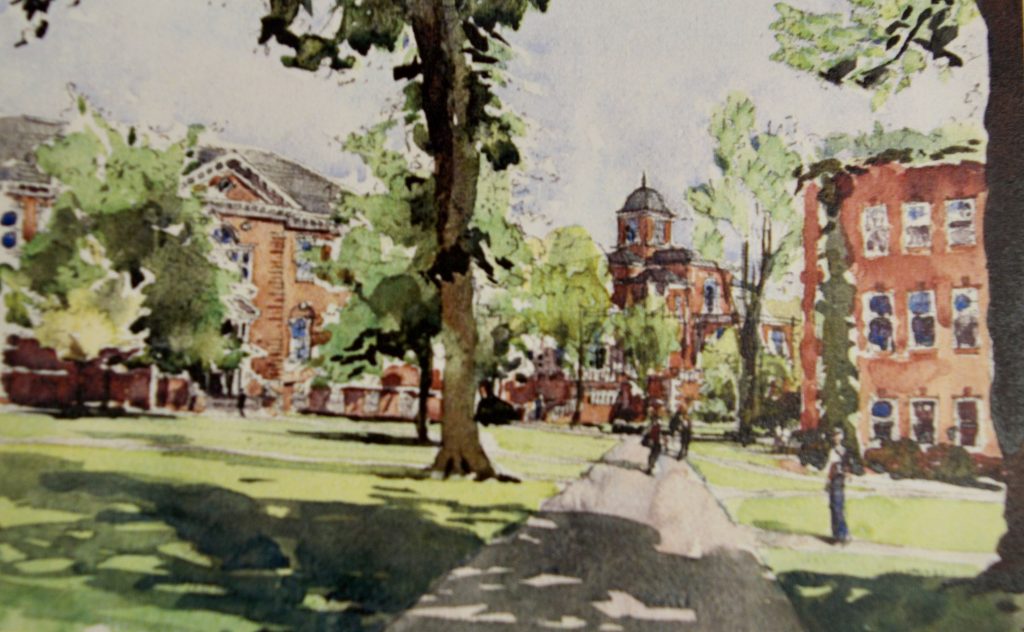
Proposed solutions included treating every building as a historic landmark. This would include Carnegie Science Hall, Seminary House, Rhodes Hall, Emmerson Hall, and University Hall. Moving air conditioners was seen as a reasonable move, as was the removal of the parking lot behind Seminary House. The area was to be planted with various American Liberty Elms and the trees that currently existed were to be preserved.
Dykelands
Highlighted in this section of the CMP were various issues. Flooding was the first major issue, coupled with the lack of multipurpose activity space that could lead to scheduling conflicts. The reduction of athletic and recreational programs and the use of classrooms for athletic meeting spaces were considered detrimental to Acadia Athletics and varsity sports programs, as were indoor leakages, poor signage, and unfriendly indoor track and accessibility concerns. The current swimming pool was identified as outmoded, and the lack of a medical centre, poor bleachers, and worn appearance of everything were highlighted as detrimental to the university at large.
Various solutions were proposed, arguably some of the most radical. They would include the consolidation of all dykeland fields to improve efficiency and decrease flooding, the construction of a boardwalk to connect a dykeland viewing pavilion to the Acadia campus, and various running trails. Tennis courts were to be relocated from beside Crowell Tower to the dykes, with the construction of a press box in case Acadia was looking to add a varsity tennis team to its roster.
An outdoor sports pavilion was to be constructed housing amenities like changing rooms, vending, storage for dykeland playing fields, the boardwalk, and tennis courts. The addition to the War Memorial Gymnasium was to house classrooms for Kinesiology students, with aerobics and activity rooms, locker rooms, and offices on the west side of the War Memorial Gymnasium. Access to the parking lot would be moved west along Main St and a second pedestrian railroad grade crossing would be constructed between the dykeland fields and the main campus. New signage would be added across the area and the existing power plant would be incrementally relocated to a new site at the northern edge of the arena parking lot. This would be adjacent to the railway line and a new natural gas trunk line.
Middle Zone
From the rear of Fountain Commons to the foot of Chase Court, this zone was characterized as dominated by the automobile. There was a lack of mature tree cover, a lack of exterior gathering spaces for students, and no comprehensive building style. The former flat roofs of Dennis House, Eaton House, and current flat roofs of Wheelock Dining Hall and Chase Court posed maintenance problems, energy inefficiency, and related poorly to other buildings.
Solutions proposed included the removal of parking from existing buildings in the Middle Zone. This would alleviate conflicts between pedestrians and automobiles and restore a pedestrian friendly environment to campus through construction of a comprehensive network of foot paths to reinforce positive attributes.
New buildings would be constructed, including a new library attached to Fountain Commons, an academic building east of Tully and Dennis along Highland Ave, a residence hall attached to the south of Eaton, and a residence hall south east of Wheelock Dining Hall perpendicular to Highland Ave. A new residence hall perpendicular to Chipman House between Chipman and Eaton was proposed, manifesting as Roy Jodrey Hall in the early 2000s.
Library
The current library was characterized in the CMP as unattractive and deteriorated. Its shoddy appearance and structural inefficiencies made it unsuitable as a campus library at one of Canada’s premier primarily undergraduate universities. An originally multipurpose building, it has had difficulty adapting as a university library. The CMP identifies how it struggles to meet the needs of students, faculty, and researchers due to a lack of appropriate workspace and facilities. Archive space is inadequate and the horrendous environmental conditions with a “nearly complete lack of ventilation” pose problems for the collections owned by the university.
The solution identified in the CMP is to tear down the existing library and build a new one behind Fountain Commons, using the Great Hall as the main reading room. This library would be rectangular, running next to Dennis House. Its central location in campus bridges the gap between disciplines and provides a common working space for students, researchers, and faculty of all kinds.
South Zone
Noted as “bleak”, “windswept” and “underdeveloped”, the CMP gives low marks to the South Zone of campus. The lack of architectural congruency and poor planning has resulted in a barren outdoor environment that does not match the richness of the historic core. Travel between Cutten House and Crowell Tower in the winter is noted as “unpleasant” because of the lack of wind protection, poor landscaping, poor pedestrian circulation, and lack of common space for Crowell Tower and Cutten House. Both residences are also noted for their lack of ability to house upper class students, with their flat roofs contributing to various inefficiencies.
Solutions noted in this part of the CMP correspond with the overall goal of bringing more than 75% of all Acadia students onto campus. The construction of residential colleges with apartment units for students to rent from the university would occur beside Crowell Tower, with lower foreground buildings that mitigate the “intrusive scale” of Crowell Tower. This would add density to create a residential college feel and create quadrangles and outdoor gathering spaces. A bell tower would be constructed between Eaton House, Chase Court, Cutten House, and new residences to act as a focal point, visual terminus and to mark the schedule throughout the day.
Sciences Quadrant
Described as the “front door” of campus, the CMP notes that University Ave is prone to dangerous conflicts. Buildings in the existing sciences area of campus do not open to a coherent pedestrian path system, with unattractive and underutilized outdoor spaces. There is a lack of suitable space for science departments due to increased enrollment and interest in the sciences. Insufficient climate control and poor maintenance have contributed to the disrepair of science spaces and making them a dangerous working environment. Houses lining the western side of Westwood Ave, if not bought by the university, could seriously “compromise the appearance and character of the campus’s western edge”. Privately developed land would undermine Acadia’s goals of increasing the percentage of undergraduates on campus.
Solutions identified include the purchase and demolition of apartments on the corner of Westwood Ave and Main St in the long term. In the short term, they would be used as residences to house visiting scholars and staff. A new science building along Main St. would be built to house classes, labs, and offices for various science departments. It would have entrances facing both Main St. and the newly created science quad.
A second science building behind Huggins Science Hall would be constructed fronting Westwood Ave, in the location of the current University Club. The existing University Club would be relocated to Highland Ave. All properties fronting the west side of Westwood Ave would be purchased and used for visiting scholars and staff, with a new and improved Divinity College on Westwood Ave. across from the KC Irving Centre. This would open up to the university’s Greenbelt.
Patterson Hall and the Biology building would be connected, forming a new Centre for Life Sciences, with a new system of quads and foot paths created for outdoor spaces. University Ave would be purchased from the Town of Wolfville to lessen the impact of vehicles. Traffic calming devices like raised intersections would be installed, and on-street parking would be relocated to the rear of campus. The new University Ave would be 24 feet curb-to-curb. Lighting would be at entrances and key architectural features of buildings only.
Acadia University has already acted on these recommendations, with the wholesale exterior redevelopment of the Huggins Science Complex, interior of Elliot Hall, and construction of the Huestis Innovation Pavillion.
Humanities Quadrant
The current eastern side of campus does a poor job as the eastern “front door”, with abundant parking lots and roads dominating sites that impede pedestrian movement. There is little to unite the small houses south of the BAC and little in terms of a ceremonial campus entrance, with no defined eastern gateway to the Acadia campus. The large scale of university buildings contrast poorly to the smaller scale wood frame houses east of Highland Ave, making Acadia appear imposing. The Student Union Building is noted in the CMP as insufficient for student use due to increased programming and serious maintenance and refurbishment needs that are not consistent with the quality of Acadia.
Solutions identified include the wholesale redevelopment of the Student Union Building and the construction of a new one along Highland Ave. This campus centre would be a more academic space, set back from Highland Ave to match the BAC. It would occupy a prominent position and define the eastern edge of campus.
Alumni gates would be moved to the intersection of Highland and Acadia St. with a more refined design to create a ceremonial entrance. Vehicular access and parking would be deceased as part of an overall strategy to remove parking to the campus perimeter, and service roads would be minimized to de-emphasize their impact on a pedestrian dominated campus.
The visual impact of the BAC would be lessened by adding a three-story addition west of the intersection on Main St. and Highland Ave, which would include an art gallery, classrooms, and a museum dedicated to the university, town, and regional history. The existing Divinity College would be torn down and replaced with a new academic building, in addition to a new garden adjacent to the Campus Centre in the former backyard of Hayward House. Raymond Hall would also be relocated east of Wheelock Dining Hall.
Greenbelt
The CMP identifies considerable potential with the Greenbelt. It would reinforce the image of Acadia as a campus partially embedded in the native forest while opening towards the riparian tidal meadows and Minas Basin beyond. It is currently not one piece of land because University Ave breaks it apart, which is currently occupied by unmaintained meadows. Walking trails are not well linked as several properties are not owned by the university.
Solutions identified include the wholesale purchase of University Ave from the Town of Wolfville and demolition of the part between the end of campus and Skyway Drive. This would eliminate the poorly used athletic fields south of Crowell Tower and replace them with more suitable ones by the dykes, which would allow for the enlargement of the Greenbelt.
Catherine Court apartment buildings would be purchased south of campus and west of Highland Ave to expand the Greenbelt, with improved construction and maintenance of walking rails. A natural sciences interpretive guide for the greenbelt would be developed and published to promote research and comprehensive standards for replanting and maintenance would be developed. Additionally, all private properties along Westwood Ave between Westwood and the university would be purchased, as would the town-owned portions of Westwood Ave south of the KCIC and between Westwood and University Ave. These would close the roads and add to the overall Greenbelt.
Progress
Acadia has made progress on the CMP. In an interview with The Athenaeum, Director of Facilities Marcel Falkenham noted that the CMP “is more of a guide than gospel. This is a plan of where we want to be in the long term, so it’s pretty malleable.”
Some of the steps taken to achieve the goals laid out in the CMP have been achieved. Fountain Commons, formerly McConnell Dining Hall, was refitted in a previous capital campaign. Uniform signage courtesy of the 2017 Grad Class now graces campus. Horton Ave, the road from Wheelock Dining Hall to the BAC, added planters down the centre in 2013. The federal government is investing in the Athletics Complex. Lighting is now more uniform across campus. The redevelopment of Huggins and Elliot fits with the aesthetic qualities of Acadia’s architecture. The construction of the Huestis Innovation Pavilion fits with the CMP’s goal of bridging the divide between the university and local businesses. Though these changes may take time and money, they are not impossible.
A copy of the Campus Master Plan is available at the Acadia University archives.
“May Acadia achieve greater glory than ever in the years ahead, and by the grace of God may increasing numbers of those passing through her halls go forth to spend and to be spent for the building of the Kingdom of God, which includes that goodwill, peace and brotherhood which only Christ can give working through dedicated Christian leaders in every vocation of life.”
These words in The Maritime Baptist from March 20, 1963 illustrate a tension that would explode on campus only years later. The relationship between the Baptist Convention and the university has been a complicated one, filled with proud moments and profound heartbreaks.
Acadia was founded in 1838 after the Baptist Education Society met in Wolfville and resolved to establish a college. By December 7th, public notice was given that classes at the new college, tentatively named Queen’s College, would begin January 20th, 1839. The charter for the college was passed in 1840 under the condition it changed its name to Acadia College.
Two professors taught at the college when it first opened- the Rev. John Pryor and the Rev. Edmund Crawley. Isaac Chipman was later added to the teaching roster, adding considerable energy and enthusiasm to the college. He drowned along with most of Acadia’s graduating class off Blomidon in 1852.
By 1847, the college was in debt. The Baptist community offered to help pay off the debt if control of the college was given to the Maritime Baptists rather than the Baptist Education Society. This would have repercussions on who sits on the Board of Governors today.
The Convention of Atlantic Baptist Churches had been established in 1846 to promote Baptist interests in the Maritimes. As founders of Acadia they commanded the majority on the university’s Board of Governors, pushing the university to fulfill its role as a place to refine Christian morals.
By the 1960s, things began to change. The current Acting Dean of Arts, Dr. Barry Moody, was a student from 1963 to 1967. “It took some time for [the Baptists] to come to terms with their new relationship with the university and how an institution such as Acadia could be both a respectable institution of higher learning and a vehicle for the denomination.” These sentiments were echoed in an editorial from the July 10th 1963 edition of The Maritime Baptist, with the author expressing anguish over Baptist unity in Canada and how only “cooperation can best further the work of Christ’s Kingdom” in Canada.
Acadia was the subject of much discussion in The Maritime Baptist. As anxieties about the future of the institution mounted, so did editorials. Published in October 1963, the Baptist wrote how “Acadia has been impregnated with a sense of Christian mission”, noting how “the mission of Acadia has been that her sons and daughters acquire knowledge and skill to go forth to bring, by the grace of God, light and truth, in the broadest sense of those words, of all God has revealed to His people”. This particular editorial noted that there was a “grave danger that [Acadia] will ‘grow out of’ the United Baptist Convention of the Atlantic Provinces”. Consequently, the Maritime Baptist called for the immediate formation of a commission to examine the relationship between the university and the Convention.
Anxieties continued to mount when Acadia picked a new President. Dr. James Beveridge, B.Sc., M.D., Ph.D, Dsc., F.R.S.C was appointed by the Board of Governors to succeed Watson Kirkconnell in 1964, the first non-Baptist to hold the position. However, Dr. Beveridge did hold several ties to the Baptist Church. Former University Chaplain from 1985-2007 Roger Prentice noted how “even when Dr. Beveridge was in Montreal or New York City, if he was going to miss a service, he would phone the minister personally to tell him.”
Dr. Beveridge was adamant that the future of Church-University relations lay in compromise. He drew two red lines to ensure cooperation between both sides- the faculty must have complete freedom as to what they teach and how they teach, and the relationship between the University and Church must not interfere with the development of the university. The Baptists tried to block his appointment as President on the Board of Governors and even sent a delegation to his classroom at Queen’s University in Kingston, Ontario to try and dissuade him from accepting the position.
The Baptist Convention reacted swiftly after Beveridge’s appointment. In an editorial from December 11th 1963, the author quickly noted how “Acadia faces a crisis” because of the lack of Baptist control of the university and how the Baptist convention must decide the university’s fate instead of the Board of Governors. The author noted how the Convention believed in “a continuing responsibility as well as high privilege of Christian mission in higher education”, lest Acadia should grow out of the Convention.
Other editorials quickly offered their opinion. The Athenaeum at the time was, according to Dr. Moody “a more radical fringe on campus” that served as a vehicle to convey student interests. The newspaper was able to rattle the cage of both the Board of Governors and the Baptist Convention by reporting extensively on the situation to the point of embellishment.
Supporters of the Baptist Convention noted in The Athenaeum that “the integrity of a professor lies in his professing Christianity- not an academic discipline”. The same author noted how “We are frightened that some of our faculty members, being non-Christians, and therefore viewing these decisions in a way non-Christians would view them, might perhaps misunderstand the fact of their inadequacies.”
Sensing their control of Acadia fleeting, the Baptist Convention met in the summer of 1965 to approve a resolution that would require all professors to be Christian and shorten the term of present members on the Board of Governors from six years to three. This would have given the Baptist Convention complete control of the Board by 1968.
The Convention also debated a resolution calling for control of all academic and campus activities and publications, but was referred back to a committee. This would have had the effect of taking editorial independence of The Athenaeum and control of classes away from professors and Deans and put solely into the hands of Baptists.
Students quickly condemned the move. The front page of The Athenaeum on September 24th, 1965 boldly declared student opposition to the heavy-handed moves by the Convention but “expressed support of the Acadia University Alumni Association, which is seeking to have Baptist-elected members of the Board of Governors reduced to one quarter from the more than one-half elected now by the Convention”.
The Acadia Students’ Union immediately supported the Alumni, who were opposed to the move by the Baptist convention. Some claimed that the Baptists were discriminating against professors, specifically Jewish professors, by mandating that all faculty had to be Christian. While there had never been any formal discrimination against Jews at Acadia, it was interpreted as an intensely anti-Semitic move.
Loss of the ability to grant degrees was a genuine concern by October 1965. President of the Alumni Association Dr. E.S. Hansen told the SRC on October 29th that if these changes were to come in place and the Baptists take control of the university the ability for Acadia to grant degrees could be revoked. This would have damaged the university’s reputation beyond repair, and served to galvanize students to join the Board and Dr. Beveridge.
In retaliation to the moves made by the Baptists, the Alumni Association put forward a resolution requesting that an act of the legislature be passed limiting the Governors of the Board appointed by the Baptist Convention to one quarter. Dr. Hansen noted that only by introducing the bill “can there be assurance that the recent actions of the Convention will not be implemented”.
The Maritime Baptist came out the following day with an attack on the proposed bill, stating that the executive had been “forced into the position of defending historic rights on behalf of the Convention”. Publicity from this became a national spectacle, with newspapers from all around Canada noting the turmoil that had gripped the small Nova Scotian town.
The crisis ceased when the issue was brought forward to the legislature. In the spring of 1966 a compromise to change the Act. Baptist appointed governors would be reduced to nine total and a six-year term of office was established. This avoided the political bloodbath that could have ensued, with ASU President John Noble noting that there was a great deal of pressure by the government to reach a compromise to avoid a “political crisis”.
Exercising Baptist ingenuity, the Convention proposed that the School of Theology become a divinity under direct control of the convention. President of the Convention the Rev. Charles Taylor told The Athenaeum that it wanted to regain a more direct say in the training of its ministers in light of the new legislation. The Acadia Divinity College was incorporated on June 1st 1968 with its own Board of Trustees and secured a 99-year lease from the University.
Discussion on diversity on the Board of Governors persists. In 2003, Progressive Conservative MLA for Kings-North Mark Parent proposed to change the composition of the Board, renaming it the Board of Trustees and significantly reducing the overall composition from 36 to 24 members. Baptists would have been afforded three seats instead of their current nine, alumni would be reduced to three from their current twelve, the government of Nova Scotia would be reduced from six to two, while the faculty would stay at three, and eight would be appointed by the Board instead of the current two.
This bill did not make it past first reading in the Legislature, thus dying on the order paper. The ASU recently passed a motion to authorize its Executive to advocate for increased diversity on the Board, including the addition of two indigenous representatives and a commitment for increased gender and ethnic diversity by 2021.
As times change so will priorities of the University. Although crisis was averted thanks to careful coordination between the new President, Alumni Association and students the issue of representation on the Board persists.
The ASU is calling for increased diversity on the Board of Governors (BOG), Acadia’s non-academic governing body. The Students’ Representative Council (SRC) passed a motion in principle on Tuesday January 30th supporting the ASU President to present a proposal to the Board regarding diversity at their latest meeting on Friday February 2nd.
President Grace H-B said in a statement to The Athenaeum that “Diversity among the Board of Governors structure is vital to serving students to the best of its ability. The Board makes decisions that affect all students around campus. Acadia is stronger for it’s diversity and the Board of Governors will be too. Diversity and equity needs to be reflected at the Board of Governors and in all governance structures at Acadia.”
The statement noted how the BOG is composed of 37 voting members, only 21.6% of whom are women with votes despite the fact that the campus is 58% female. Ethnic diversity around the table is described as “almost non-existent”.
Lack of diversity is not due to a lack of unqualified women or minorities, the statement reads, but is “due to selection processes and underlying systemic process to determine who sits on the Board”.
The motion proposed that the Governance & Executive Committees of the BOG prepare a report and recommendation on increasing equity and diversity. The ASU asked five commitments, including:
Adoption of a diversity management policy by April 6th 2018
Land acknowledgement of Mi’kma’ki at the beginning of every Board meeting
Amending the composition of the BOG to include two indigenous voting members
Ensuring a minimum of 50% of Governors identify as female by 2020/2021
Ensuring a minimum of 60% of Governors identify as female, people with disabilities, indigenous peoples, or visible minorities by 2024/2025
President H-B noted that although the province isn’t known for its diversity, “Nova Scotia does have a history with many groups that are not being represented at the Board of Governors. It would be hard to say that we’re ever going to be absolutely perfect in fair representation, but that doesn’t mean shouldn’t work as hard as possible to try to do better.
Working towards a diverse Board is going to take work but it’s work that is so important in ensuring that we’re doing the best we can for students.”
The ASU is looking to increase diversity within its own ranks, as the composition of the Students’ Representative Council is “lacking in people with disabilities, aboriginal peoples and visible minorities” according to President H-B. The Union is looking to incorporate more students-at-large on committees, spurring students into action within the Union itself.
EDIT: An earlier version of this article stated the number of students identifying on campus as female was 69%. The correct number is 58%.
Colin Mitchell is a 3rd year Politics (Honours) student from Vancouver, BC. He is also the News Editor of The Athenaeum and the ASU Student Board of Governors Representative.
Betzillo positions itself as a versatile gaming hub where structured bonuses and adaptive gameplay mechanics support both short sessions and extended play.
Built with a focus on innovation, Spinbit integrates modern casino architecture with rapid transactions, appealing to players who value speed and digital efficiency.
Ripper Casino emphasizes bold entertainment through high-impact slot titles and competitive promotions crafted for risk-oriented players.
A friendly interface and stable performance define Ricky Casino, offering a casual yet reliable environment for a wide spectrum of gaming preferences.
King Billy Casino channels classic casino spirit into a modern platform, delivering recognizable themes supported by contemporary reward systems.
Immersive visuals and layered slot mechanics are at the core of Dragonslots, creating a narrative-driven casino experience.
Lukki Casino appeals to players seeking direct access and minimal friction, focusing on fast loading times and intuitive controls.
Casinonic provides a structured and dependable gaming framework, blending modern slots with transparent operational standards.