Tag: campus

  • Opinion: Bring Campus Childcare to Acadia

    Opinion: Bring Campus Childcare to Acadia

    Childcare may be the furthest thing from the minds of many students, which is understandable. However, campus childcare has impacts on many students, their quality of education, and gender parity issues at Acadia.

    As faculty retire, new talent must be recruited and many sought-after professors are within a child-rearing age demographic. Whether they currently have children or will in the coming years, child care will be a service that is essential in supporting them in their career. Campuses like Acadia without childcare facilities will be rejected in favour of many of the other institutions that provide this service. The quality of our education is impacted by the ability to attract and retain quality faculty, and the pool is vastly narrowed and favours male academics without childcare services.

    We might assume that we don’t need childcare on campus because there is childcare in the surrounding community. However, Kings County, and much of Nova Scotia is in what is considered a “childcare desert”. It is extremely difficult to find care, especially for children under 18 months as well as before and after school care. This feeds into the fact that a childcare centre at Acadia could fill any spots not used by opening them to community members. NSCC campuses prioritize staff, faculty, and students for childcare spots in their on-site childcare and open any remaining spots to the community. This model has been successfully used for many years, and many of the 13 NSCC campuses are much smaller than Acadia in terms of faculty and student populations.

    Student parents make up between 11 and 16% of post-secondary students across Canada according to a 2011 national study. They are a steadily growing demographic at all levels of post-secondary studies and types of institutions. Student parents are more likely to be part of racialized or marginalized groups as well, groups that already experience a disparity in their educational access and attainment levels. Without childcare at Acadia, we stand to lose many potential students. Research shows student parents tend to be dedicated and have a higher than average GPA, making them the kind of students that make universities look good.

    Gender parity in education and income levels are impacted by access to quality childcare. Women in academia often experience what is called the “motherhood penalty” which derives primarily from having children during their academic career. Men, however, do not encounter a “fatherhood penalty”, in fact, they enjoy a higher likelihood of promotion if they have children. Female faculty have described the extensive difficulties of lack of childcare options and the subsequent impact on their careers from delaying or preventing tenure to contributing to them quitting academia altogether. Caregiving work is still primarily the domain of women, and has an unequal impact on women versus men as a group. All parents need and deserve to be supported in their careers and educations, and childcare is a mitigating factor in the current gender divide that exists in access to academia for parents.

    In a competitive education market, Acadia stands to lose many prospective students as well as talent to institutions that do support their role as parents. It’s been 30 years since there was childcare on campus, and Acadia is one of few post-secondary institutions that does not provide childcare. Many of the parents that work or study at this institution have asked for childcare, as evidenced in a study I conducted in 2017 on the needs of student parents at Acadia. Budgets are a matter of priorities, and funding does exist through the province and other methods. Let’s show Acadia that childcare is one of our priorities as students.

    Sign the petition: https://goo.gl/forms/GKq5uiDo5xDsPu6q1

    Fill in the survey by Deloitte: https://surveys.deloitte.ca/Checkbox/Interest-for-Acadia-Childcare-Centre.aspx

    Laura Fisher is a fourth year (Honours) Community Development student and single mother of two.
  • You’re Invited to the Annual Acadia International Banquet

    You’re Invited to the Annual Acadia International Banquet

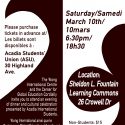
    The annual Acadia International Banquet, held by The Wong International Centre and the Center for Global Education, is cordially looking for your attendance for next Saturday, March 10th, 2018 at 6:30 pm at Sheldon L. Fountain Commons. The doors open at 5:30 pm so that guests can grab a seat, check out the International Photo contest, get some Henna, or simply grab a drink at the cash bar and chat. Tickets will be sold at the Student Union Building (SUB) on the main floor from 2:00 pm to 4:00 pm on Wednesdays, Thursdays, and Fridays. This is an evening of dinner, performances, and cultural celebration. This long-standing campus tradition is a great opportunity for you to get in touch with the beauty of a variety of cultures. The energetic dances, traditional instruments, and global fashion show are the highlights of the night. We are looking forward to meeting you on such a magical evening. Do not forget to bring your friends!

  • Opinion: There Is No Free Speech Crisis

    Opinion: There Is No Free Speech Crisis

    Cards on the table: there is no university free speech crisis, support for free speech is not declining, and campus SJWs are not running amok.

    Just don’t try telling the alarmists that. Over the last three or four years, a rising tide of hysteria has swept through media, the political establishment, and the academy itself over the threat that political correctness poses to free speech on campus. Led by a brigade of so-called Social Justice Warriors, campus Jacobins are using the language of “diversity” and “tolerance” to snuff out free and open inquiry.

    That’s the claim, at any rate. So let’s set aside for a moment the curious silence of these same alarmists when it is the political Right (and not the Left) doing the snuffing. What should really interest us is the validity of their charge: Is there a crisis on campus? Are young people turning their backs on free speech?

    The most comprehensive data on these questions comes from the United States, where about 22 million undergraduate students are enrolled in some 4,700 colleges and universities. According to the Foundation for Individual Rights in Education (FIRE), there were 29 attempts in 2017 to disinvite or block an invited speaker from speaking on campus. Twenty-nine…and most of those attempts failed. The numbers were higher in 2016 (43 attempts were made), but the average over the last five years is just 31. Out of a country with 4,700 schools. And not only did most of those attempts at blocking speakers fail, but those that did succeed were more likely to come from the Right, not the Left.

    So much for blocking speakers, where the truth doesn’t seem to live up to the hype. But what about campus speech codes? They’re all the rage right now, we’re told, put in place by cowardly administrators desperate to placate the social justice Left. Again, the hard numbers throw some cold water on that notion. The number of US colleges and universities with formal speech codes has declined every year since 2009, including a seven percent drop last year alone. Let me put that another way, just so there’s no confusion: when it comes to formal speech codes, things are getting better on campus, and have been for some time.

    “Okay, whatever” (I can hear the alarmist saying), “this doesn’t change the fact that young people today are turning their backs on free speech.” But again, this is simply not what the data shows. Now I will concede from the start that it is exceedingly difficult to gauge public support for free speech. Social scientists use all sorts of tests and measures to get at the question (you can read more about them here), but none are perfect. Nonetheless, one of the most respected and comprehensive such attempts is carried out by the US-based General Social Survey (GSS), which has been asking about free speech since 1972.

    Called the “Stouffer Questions” (after their original author), these questions ask people to imagine that someone in their community – an anti-American Muslim cleric, a militarist, a racist, a supporter of homosexuality, etc. – wants to give a speech, teach in a local school, or have his or her books carried in the public library. Should that person be prohibited? Should the speech be censored, the teacher fired, or the books banned? The idea is to test, when push comes to shove, just how tolerant of potentially offensive speech Americans really are.

    As it turns out, they’re pretty tolerant, with healthy majorities answering “no” to most of those questions. But here’s the important part for our purposes: not only are Americans in general tolerant of offensive speech, but those aged 18 to 34 are the most tolerant. Don’t take my word for it; play around with the GSS’s data for yourself (links to this and all other claims can be found in the online version of this article). Switch around the Age filter and test the various questions. Young, college-age Americans are more likely to oppose restrictions on free speech than every other age group in the country, and in some cases by a considerable margin. The only exception is with racist speech, which young Americans are less likely to tolerate than their elders. But even there, the difference is just 4% below the national average – a far cry from a generational crisis.

    There’s more. Not only are young people more tolerant of offensive speech than any other age group, but young people today are more tolerant than they have been at any other point since the GSS began asking the Stouffer Questions over forty years ago. In other words, young people are actually growing more supportive of free speech over time, not less.

    Other surveys tell a similar story. The alarmists like to ignore longitudinal data or comparisons between age groups because it complicates their case. They want a simple story, preferably featuring eye-catching anecdotes that involve censorship or language policing. Those anecdotes are real, as recent events at Wilfrid Laurier University and Middlebury College illustrate, but anecdotes do not constitute a crisis. That takes data, and the data is not on their side.

    (My general piece of advice: the next time someone presents you with some shocking statistic purporting to show how students today have turned their backs on free speech, be sure to ask them compared to who and compared to when. Unless they can answer both those questions, interpret their statistic with extreme caution.)

    A final note. It is difficult to divorce this free speech hysteria from the larger populist moment in which we all seem to be living. The alarmists imagine themselves to be battling a pack of smug “diversity-obsessed” elites. In reality, it is those who have historically tended to hold the least amount of power in society (e.g. women, black and indigenous Canadians, LGBTQ) who bear the brunt of their attacks. That’s an unfortunate fact, and one that perhaps merits some reflection.

    Free speech is integral to the academic project and must be safe-guarded, but there is no reason why we cannot do so with compassion, respect, and (I would hope) a full command of the facts. That would indeed be a conversation well worth having.

    Jeffrey Sachs teaches in the departments of History and Politics, where he specializes in Islamic and Middle Eastern politics.

  • Small Pond Syndrome

    Small Pond Syndrome

    Why did you come to Acadia? I’m sure for multiple little reasons: the beautiful campus, the regional reputation, athletics, location, scholarships, or you’re just a big fan of mud sliding. Whatever you’re into man.

    But it’s just that, it’s the little reason. I argue that being a small institution is one of our greatest assets not just inside the classroom but outside as well. Outside the classroom, meaning socially playing nice with the other kids on the playground, fosters an awareness for mutual respect.

    My interactions outside of the classroom have led me to collect this extremely sophisticated and completely scientifically based analysis of our small school population before attending Acadia. Broadly speaking students usually fit around three points on the continuum on the confidence scale regarding making friends going into this university.

    The first being you were a big deal in high school, came here with your buddies, and felt like you need to add one or two more people to the roster of your sick childhood squad. Acadia can offer you this convenient reality. Or, you may know people from playing local sports, or attended the same high school, but you are by no means close with anyone and are eager to meet lots of new faces. Finally, of course there is a population of students who don’t know a soul and making friends seems like a massive undertaking. This may be because you’re an international student, out of province, or you just like to keep to yourself.

    Whatever your perspective is, Acadia can be a fresh start for you, and can act as an equalizer. The first few weeks of your first year can be very hard and this shouldn’t be glossed over yet, you will find it’s much harder to isolate yourself then you may think. I am getting acquainted with new friends already this year and I am going into the second month of my third year. Due to the small size, students can become more intimate with more people because you are frequently being put into situations with the same population of people. It’s a wonderful attribute of Acadia no matter where you began on the social continuum.

    My roommate once chatted with someone at Shopper’s Drugmart standing in front of the chip aisle because she felt familiar enough with him. She always saw him at the library in the past and this was enough of a reason to critique chips together. They were both very perplexed at which chips make the best storm chips, which is the best PC brand chip flavor, and the classic conundrum of regular versus wavy cut chips etc. Classic chip struggles.  Just seeing the chip guy enough before said chip-run created a basis for a friendly conversation. I truly believe that Acadia/Wolfville are on the short-list of university towns where that is socially acceptable.

    What we should remember is that although a friendly place, Acadia is a small pond. No no.  More like one of those fancy infinity pools that look off onto the ocean that really only exist on MTV’s “Cribs”, Oprah’s house, and affordable resorts. It has this small, rigidly defined population. Yet, it has a full vista view which alludes to opportunity commonly known as “the real world” and referred to as “adulthood”.

    What about all the people I have successfully or unsuccessfully hit on? How often will I see them at this friendly, small school? You will see them what seems like everywhere (especially when you stink of Subway in the lib in between classes).

    Here is a fun and simple equation you can do in your head: think of all the people you have either professed your love to, made out with, danced with at the vil and/or axe, stared too long at the library at, directed their naked butt to your bathroom, had full blown your-mum-and-dad-know-what-I-look-like-in-real-life relationships with, gone to coffee with, had a deep heart to heart after class with, or had an inexplicable crush on. Whatever experience you have or have not had. Then divide that by 6.46 km2. After you divide those awkward times by space (the square kilometers of Wolfville) you have your very own unique and customized answer! You are now a certified love physicist! Congrats.

    Now, what do you do with that number? Be nice to each and everyone one of them no matter what the result of the situation is. You could be coworkers, neighbors, have all the same classes, or just like eating breakfast at the same time every day if you eat at Wheelock.

    Laugh at their jokes, always say hi, and give them that follow back on insta. I can’t say that I always live by my own advice but I try my best. Shit, right when I was writing this I just avoided eye contact with someone while sitting in the BAC café I KID YOU NOT. Do what I say not what I do! You never know what may come of the situation. Inclusion is always the answer.  This of course also includes other acquaintances or individuals who you have not made a fool yourself of on a romantic level with.  It means be nice and remember everyone’s name that you have learned.

    It may seem as though this town may seem suffocating at times. But what is really happening when you run into people is that you are reminded that each of them have feelings which you should respect.  No man is an island and everyone loves to be remembered. The small population is truly a good exercise in pushing yourself to treat others with respect. This lesson learned outside of class is one that is invaluable for the future and is served on a warm platter to us from yours truly, Acadia University. Right, so remember when you are heading to the swim-up bar in the infinity pool at Oprah’s house, give a polite hello and nod to all that are in there with you over these four+ years.

  • A Greener Acadia: A Look at the Sustainability Initiatives Around Campus

    A Greener Acadia: A Look at the Sustainability Initiatives Around Campus

    Note from the Editor: Marcel Falkenham is the Director of Facilities at Acadia University. During his tenure here, the university has seen some remarkable improvements in sustainability efforts across campus. Through this piece, the Athenaeum hopes to illuminate some of those improvements as well as open some discussion on what the future might look like.

    1. Tell me a little bit about the sustainability projects that you have overseen at Acadia since you’ve been here. What are you most proud of?

    I arrived at Acadia in the summer of 2007 as the university was in the early implementation stages of a “Sustainability through Facilities Innovation” performance contract with Johnson Control Inc. This project consisted of multiple improvement measures targeted towards improving energy efficiencies while reducing deferred maintenance and renewing some key capital equipment.

    Some of the campus wide initiatives included lighting upgrades from T12 and incandescent lamps to T8 and compact fluorescents in areas that had not been renovated, and upgrading plumbing fixtures to reduce water consumption or going water free where possible. There were several building specific initiatives such as installing a new ice plant for the arena that sent rejected heat from the compressors to be used in preheating incoming ventilation air and pool water. Other building projects that were part of that contract included heat recovery in the Huggins and Elliott Hall labs and a number of heating system flushes in larger buildings to remove scale and improve heat transfer. All in all, annual cost savings were calculated to be $600,000 which was used to pay for the capital costs of implementation.

    Since that broader initiative I have been able to complete a number of other sustainability projects on campus by working with other agencies including Efficiency Nova Scotia. We have been able to achieve real energy savings while also reducing maintenance requirements and in many cases improved the aesthetic and functionality of the systems we addressed. Probably the most visible would be the exterior lighting upgrades to LED as technology came available and improved to the point where paybacks were measured in months instead of years. We had participated in some smaller retrofits in partnership with Efficiency NS in several areas on campus including the Student Union Building, Michener and MacKeen Rooms, as well as Clark Commons with early generations of LED lamps – building on the success of those small projects to justify moving larger scopes.

    The Grad Class of 2013 then used their class gift to help us upgrade the 8 pathway lights in the main Quad behind University Hall to new LED post tops, taking advantage of a supplier incentive which allowed us to get the fixtures at about half the regular price. The impact of the quality of light from these new fixtures and the improved aesthetic was a huge win and we were able to use it to help justify a continuation across campus with help from Efficiency NS. The gains on this were threefold: Energy savings were at least 50% per fixture at 75W vs 150W previously, the lifespan of the lamps were increased by a factor of ten – 100,000 hours vs 10,000 hours previously – and the quality of the light was dramatically improved. You could actually recognize people’s faces after dark instead of the “blob” that was visible with the old high pressure sodium lighting. As a side, the new fixtures were night sky compliant with no spill over to obstruct star visibility which is also a win. By the end of the summer of 2013 we were able to retrofit about 90% of the outdoor fixtures resulting in an annual savings of over 500,000 kWh, which while always a win was almost a side note when compared to the improved feel of campus after dark. The running joke is that we won’t need to change a lamp until at least after I retire which is still a way off at best.

    Probably the highest impact project on sustainability that we have successfully implemented in my time here has to be the conversion of our Central Heating Plant from Bunker C oil fired to Natural Gas. While not obvious to many and operating in the background, this was a huge undertaking that required the complete retrofit of all four boilers and construction of a Natural Gas delivery site and pipeline to the boiler room… all while maintaining steam production uninterrupted year round to our entire campus. Obviously, Natural Gas is still a fossil fuel and therefore not renewable, but the improvement in overall emissions profile when compared to the Bunker C oil that had been used since the 1950s is something we should be proud of. In the first year alone of using Natural Gas (which actually had a fair bit of light oil usage in the early part as we were commissioning the new systems), our Sulfur Dioxide emissions dropped over 60% which is almost 45 tonnes while our Particulate and Nitrogen Oxide emissions dropped about 25%. Carbon Dioxide emissions were reduced almost 30% which equates to almost 4000 metric tonnes for the year. For reference, that is equivalent to taking almost 1000 cars off the road. We are expecting even more reductions in this past year as we were able to run almost exclusively on natural gas as the initial conversion challenges were overcome. While not as high profile or visually impressive as some of the other measures we have made on campus, this has to be hands down the most significant improvement in sustainability.

    2. Tell me a little bit more about the design of the new biology building, and the initiatives that it has underwent to become LEED-certified. What exactly does LEED-certified mean?


    LEED stands for Leadership in Energy and Environmental Design and is a rating system for green buildings. Essentially there are points available across a variety of categories from site selection to materials used for construction to indoor air quality. Some of the points are fairly simple to earn such as having bicycle racks and designated carpool parking spots to encourage alternative transportation, while others can be much more involved. An example of the more difficult points to achieve would be tracking of construction waste which required every load of waste and recycling to be weighed and tracked to ensure diversion targets were met. All points need to be validated and awarded by a LEED accredited third party consultant.

    The Biology building was designed to the LEED Gold standard and as such would have been one of the first science buildings in Canada to target such a goal. It was about 50% complete when I arrived on campus in 2007 and I was able to be involved in the fitout and commissioning phases of the new facility. There were many features incorporated in the Biology Building that were at least partially driven by the LEED process. The use of geothermal cooling, the capture and use of rainwater for non-potable water in the building, realtime monitoring of indoor air quality in all spaces and extensive use of natural and high recycled material content products for construction. Overall the LEED standard has some very good principles that we try to apply in all projects going forward but as with any consultant intensive initiative there are significant costs associated with the process that I feel can sometimes be better applied to actual sustainable projects and practices.

    3. Apart from obvious funding limits, what are some challenges to making Acadia a green campus?

    One of the bigger challenges with our beautiful campus is the age and variety of buildings and infrastructure. Our buildings range in age from 8 years old to almost 200 years old, so obviously the construction type varies widely. Strategies for sustainability therefore need to be tailored to the target areas and what works in one building doesn’t always work in another. As a fully operational campus, even if funding were unlimited it is not as simple as flicking a switch and being green. Everything needs to work around our ongoing campus activities and be planned and implemented in such a manner as to minimize disruption to our core mission as an institution of higher learning. While not always easy, we have had great track record of making incremental improvements while minimizing impact on day to day operations and plan to continue in this way moving forward.

    Keeping up to date with emerging technology trends that may have significant impacts on sustainability is also a challenge. We were early adopters on the LED lighting front as highlighted earlier, but we have also been working on more “behind the scenes” initiatives as opportunities arise from new technologies. One of the more recent examples of this is the availability of hybrid heat pump hot water heaters. While most of our buildings rely on our steam system to provide hot water, several buildings with lower consumption are actually more efficient to run with electric hot water heaters. The hybrid hot water heaters use an integral heat pump to heat the water instead of a straight electric resistance element and use less than half the amount of electricity to do this. We have retrofit a couple dozen of these units in buildings ranging from smaller academic facilities like Rhodes Hall up to larger facilities such as the Beveridge Arts Centre. We were one of the only institutions that I am aware of to take advantage of this technology and it has been very successful to date.

    The biggest challenge aside from resource availability is education and awareness. Keeping incoming students, staff and visitors educated on things as simple as waste sorting and reducing energy consumption is something that is ongoing and requires a lot of work. On the bright side efforts have been paying off, our diversion rates from landfills have consistently tracked over 70% which is well above the provincially legislated goal of 50%. Every year we see the trend where the numbers dip at the start of the term and then steadily improve as the year progresses and new members of the campus community become more knowledgeable on how to sort and recycle.

    4. In the future, where do you see Acadia going in terms of sustainability? What sort of projects are you working on now, and hope to accomplish?

    We have made some great progress but obviously have a way to go to becoming truly green. With the current funding constraints that all universities are facing, I expect to continue on the incremental improvement path but there are some exciting technology developments on the horizon. We are currently working to continue upgrades to LED lighting as opportunities arise and efficiency improvements in mechanical systems are always on our mind. We do try to keep sustainability in mind for all projects and incorporate energy efficiency improvement in the planning stages. One case and point is the new Stevens High Performance Centre varsity locker room project at the Athletics Complex which we plan to start this spring. While this is an addition to the existing complex it requires largely independent mechanical systems for heating and ventilating, but we are working with the consultant engineers to use the glycol lines that are heated by waste heat from the adjacent ice plant to provide the heat source for the in floor radiant heat and ventilation units. This would provide the majority of the heat for the almost 8000 ft2 facility for virtually free. As renewables such as solar become more efficient readily available I hope that we can incorporate them more into our facilities as the paybacks shorten but this will take time given the capital requirements associated. In the interim, managing and improving our consumption has the better payback and we will continue to identify and implement as opportunities come up.

Betzillo positions itself as a versatile gaming hub where structured bonuses and adaptive gameplay mechanics support both short sessions and extended play.

Built with a focus on innovation, Spinbit integrates modern casino architecture with rapid transactions, appealing to players who value speed and digital efficiency.

Ripper Casino emphasizes bold entertainment through high-impact slot titles and competitive promotions crafted for risk-oriented players.

A friendly interface and stable performance define Ricky Casino, offering a casual yet reliable environment for a wide spectrum of gaming preferences.

King Billy Casino channels classic casino spirit into a modern platform, delivering recognizable themes supported by contemporary reward systems.

Immersive visuals and layered slot mechanics are at the core of Dragonslots, creating a narrative-driven casino experience.

Lukki Casino appeals to players seeking direct access and minimal friction, focusing on fast loading times and intuitive controls.

Casinonic provides a structured and dependable gaming framework, blending modern slots with transparent operational standards.