The Acadia 2025 ideabook released just under a month ago contains numerous proposals for pushing the university into the 21st century.
Within the ideabook four major themes were identified: campus infrastructure and facilities, the academic core, the organization, and the region and local community.
During the course of the planning process, President Ricketts noted that Acadia needed a new ‘big idea’ following in the footsteps of the Acadia Advantage, which was celebrated internationally.
The ideabook matters because it informs the next stages of what Acadia will be pushing forward as institutional priorities: massive investments in the library, BAC, and SUB, new degree options, a new focus on retention, and a ‘Great Valley’ initiative that could fundamentally alter the region.
The ideabook notes that campus infrastructure is a top priority of the university. The Vaughan Memorial Library is at the top of the list, described as long overdue for an overhaul. The university has been hosting focus groups on the state of the library, with the process initiated by the Senate Library Committee in November 2017. This was followed by an editorial in The Athenaeum calling for the construction of a new library according to the Campus Master Plan.
The possibility of returning to the Campus Master Plan is noted as a possibility in the ideabook to guide development priorities and design. The ideabook notes that “the goal of everyone involved with developing the original plan was to create an aspirational road map to help planners, fundraisers, and donors imagine how Acadia’s physical infrastructure could be used for the benefit of students and delivering its programs”.
In addition, the BAC and SUB were identified as major priorities. It’s no surprise that the BAC was put at the top of the list- with the majority of Acadia students attending classes there and with the recent investment in Huggins Science Hall- it’s in desperate need of redevelopment. Justin Macleod’s 2016 article in The Athenaeum issue 79.2 aptly noted the discrepancy between funding of arts and sciences as “the state of the BAC is an accurate representation of not only the university’s feeling towards the arts, but also of the popular opinion that an arts degree is a waste of money and in the end worthless.”
Focusing on the students’ union building will be hugely beneficial for the university as a whole. However, under the ASU’s recent bylaw changes the SUB Renewal Committee- the student-centred committee dedicated to overseeing the evolution of the building- was cut, presumably leaving the development of the SUB up to the university and ASU executive. The ideabook writes that the SUB should embody a ‘student success centre’, with plans to fill in the gap between the Old and New SUB similar to the construction of the Huestis Innovation Pavilion. This has been described by some as a band-aid solution, failing to address the fundamental structural concerns at the heart of the SUB that were identified in the 2002 Campus Plan, describing the building as “inadequate for student use due to increased programming and serious maintenance and refurbishment needs, and is generally not of a quality consistent with a facility of this type at Acadia University or its peer institutions.”
The ideabook also mentions the development of more housing on campus for upper year students and young professors with families. This is not a new idea- the development of several new residences and the gradual move of upper year students onto campus was proposed at the turn of the century by the Campus Master Plan. Moving older students on campus through apartment and suite-styled residences may be the way to go forward if the university is hoping to increase its retention rate from 78.5% as of 2018.
What the Acadia 2025 Ideabook represents under the infrastructure chapter is the Campus Master Plan in all but name. The controversies associated with its biggest proponent, former President Dr. Kelvin Ogilvie, have presumably pushed the university from formally associating itself with the manifestation of his legacy. Yet the Acadia 2025 ideabook is proving that the Campus Plan is the right direction for the university. The university should push forward bravely instead of stepping on eggshells to avoid controversy and blaze its own path to create a unique Acadia experience.
Colin Mitchell is a fourth year (Honours) Politics student and Editor-in-Chief of The Athenaeum
Our university has always been a residential one. If you come to Acadia you live in residence. That was part of the deal at least for the first year or two. Living in residence is one of the quintessential tenants of the university experience, along with embarrassing dances during Welcome Week, late night pizza runs, and raucous end of class celebrations. The way residence has been done hasn’t changed at Acadia for a while, simply because it’s been done well.
Beginning as a primarily residential university, Acadia almost always housed undergraduates on its campus. Some of the first students lived in the Horton Academy Boarding House, then a separate entity from Acadia College. Situated right behind University Hall’s predecessor, which burned down in 1877, it was only supposed to be a temporary measure supplemented by the completion of Acadia’s boarding house. This building suffered a similar fate and burned down in 1887. By then Chipman Hall existed, built near Horton Academy to support the influx of students.
The Acadia Ladies’ Seminary was opened in 1879 with the intent to house the growing number of female students. Both Seminary and the new College Hall were built approximately the same time, with Seminary described as “without a rival of its kind in the Lower Provinces, perhaps in the Dominions” by Albert Coldwell, Wolfville town clerk and university professor. When Acadia College became Acadia University in 1891 the fledgling university was building its residential capacity. The Academy Residence, now Horton Hall, Whitman Hall (Tully) and Willett House all opened in 1915 to help ease the strain of new students.
Little building occurred until the end of the Second World War, when War Memorial House (Barrax) was opened. A building spree began at Acadia in the 1960s, injected by generous funds from the provincial government. Chipman House, Dennis House, Eaton House, Chase Court, Crowell Tower, and Cutten House were all opened within a 25-year period. Christofor Hall and Roy Jodrey Hall were recent additions, opening in 2002 and 2003 respectively.
Challenges have emerged with the system. Some describe their residences as overwhelming, others as isolating. There is a chronic lack of student supports on campus, necessitating appointments at the student clinic and mental health centre be booked months in advance. Some residences have even been declared uninhabitable- Raymond House was evacuated early in the 2017-18 academic year due to exposed wiring and living hazards. Students who move off campus report a disconnect with their on-campus counterparts. Numerous residences suffer from underequipped facilities and a chronic lack of funding to address key issues.
The residential college system gives us an answer.
The move to a residential college system was one envisioned in the early 2000s by then-President Kelvin Ogilvie. The Campus Master Plan envisioned a grand total of 5-6 colleges at Acadia, each one composed several halls for a grand total of 400 students per college. Colleges are not buildings- they are societies. The goal of each is to create a decentralized self-sustaining community within the university that has the resources to take care of its students. With a central administration that is at times strapped for cash the time is now to take matters into our own hands and work for our own wellbeing.
This is not to say that the system does not work. Rather, this is to say that the system can be better. Ask our Director of Student Services, James Sanford.
In a Spring 2003 edition of the Acadia Bulletin, he wrote about the exciting next step in Acadia’s future. He noted that “the college system is intended to create small communities- ‘colleges’- within the broader university community. The college promotes the University’s mission, goals and objectives while tending to the specific needs of the students who live within the college. Each college has a distinct physical space, its own administrative structure and a social rhythm.”
Despite Acadia’s small size, he noted that “the residential college system will allow us to bring our hands-on approach to an even more manageable level”. The first envisioned college on campus was ‘West College’, composed of Eaton House, Christofor House, Roy Jodrey Hall, and Chipman House. Coupled with the creation of Clark Commons, the goal was to provide a hub for fitness, recreation, and social activities within the wider university. It was supposed to open in 2003.
The proposed development of a residential college system under the Residence Advantage Program would have seen the construction of six new residences and five new commons buildings across campus from 2003-2008. Ideally 75-80% of all Acadia students would stay on campus for all four years, working their way up through different styles of residences. In creating such a system, the goal was to become North America’s premier residential university modelled after the finest universities in the United Kingdom and the United States.
Our university has since evolved. President Gail Dinter-Gotlieb halted any changes to the proposed residential college system and since then the project has stalled.
I propose we pick it up.
The process would start with the creation of 5-6 college organizations. Each would be led by a Head, who would be a faculty member that oversees the administrative functions of the college and report to the administration. An advisor would work within the residence and be responsible for student welfare, ensuring that students are simply doing well. Naming the colleges would be easy- Ogilvie, Burnham, Ivany, DeWolfe, Perkin, and Oliver are only a few of many names to choose from.
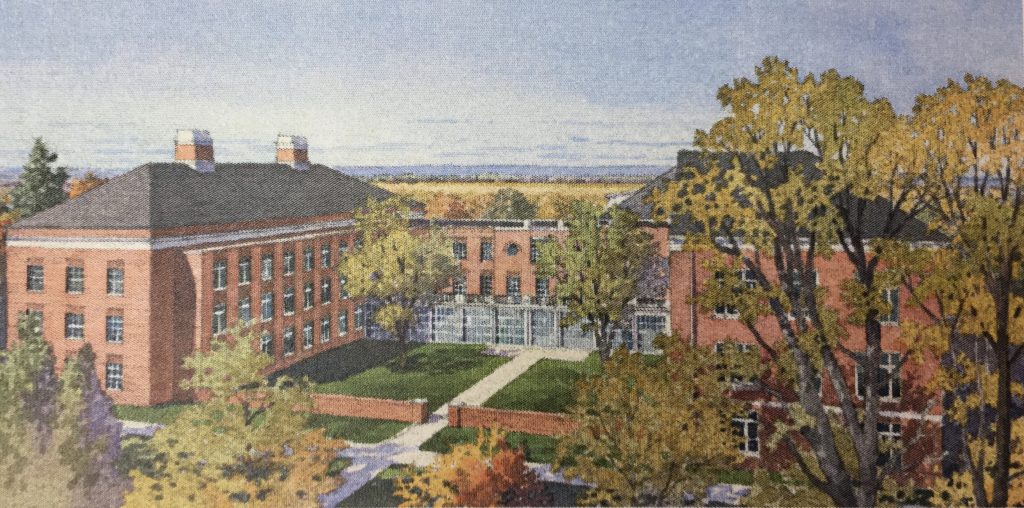
Next would be creating the physical space. After all, the same architects who redesigned Yale’s newest residential colleges also designed the KCIC. West College already has all the facilities they need. It would be up to the administration, donors, and students to decide how the remaining colleges looked. The construction of new residences in the fields between Chase Court and Crowell Tower provide the opportunity for brand new colleges to be constructed and bring more students on campus through apartment style living or suites.
Each college would have a variety of living arrangements, so older students could live in on-campus apartments undisturbed by nosy RAs. Because a college is more than a building, but a society, each student would move from first year residence to a second-year residence, to upper year private apartments with friends of their choosing, while staying on campus.
Each college would be unique, tailored to its history, culture, and traditions. Endowments would be set up for each college, with students paying a small College Fee at the beginning of the year. Within ten years each college would have a flourishing endowment that would be able to sustain its students through scholarships, continued infrastructure improvements, and social supports. Existing residences would come together to build their own college communities. Tully and Seminary? Cutten and Tower? Chase Court and Raymond? The possibilities are endless.
Developing an academic culture would be crucial. Every student at Acadia, regardless of whether they were on or off campus or first or fourth year, would be made a member of a college. This would give all students a community spanning across the entire university community and beyond, in addition to giving them privileges to use each college’s respective facilities. Colleges would represent a microcosm of the university, composed of first to fourth years from all regions and all programs to ensure genuine diversity.
I believe that a college system represents the future of Acadia. Even if it doesn’t take the form envisioned 15 years ago, a gradual shift that encompasses greater academic involvement with residences, establishment of endowments, and resources available to each community would be beneficial to the university as a whole. If Acadia still desires to be North America’s premiere residential university then we must dare to dream and do something different.
If we want to be great, let’s stop saying it and start doing it.
Colin Mitchell is a fourth year (Honours) Politics student and Editor in Chief of The Athenaeum
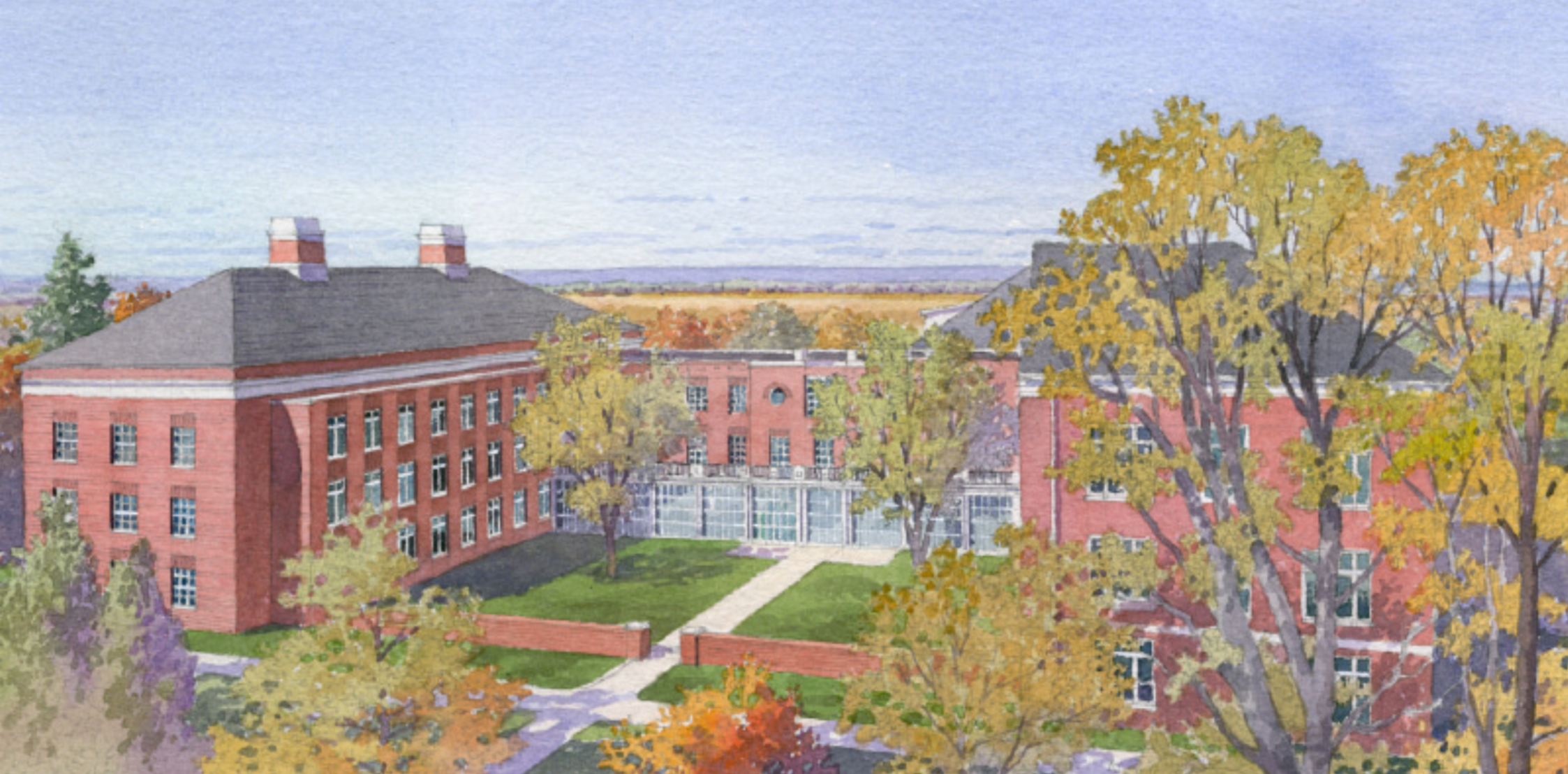
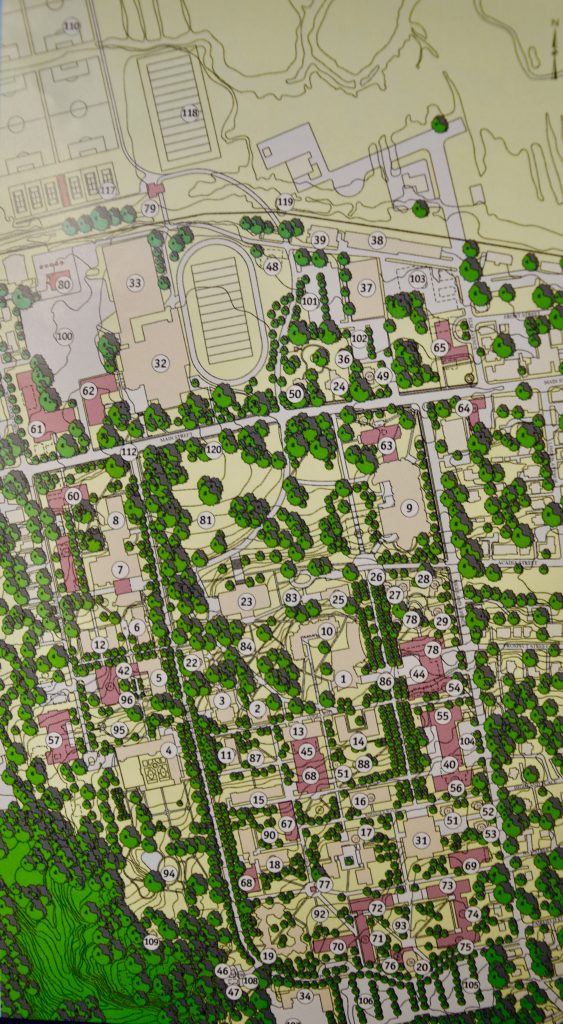
Sitting in the corner of the Acadia Room in the KC Irving Environmental Science Centre, I looked up. As the dying rays of light cut through the room something shimmered on the wall opposite. My interest piqued, I stood up and wandered over. Attached to the wall was a large framed poster, titled “Campus Master Plan”. It was a re-imagining of Acadia from a birds-eye view. New buildings, hundreds of trees, and a reorientation towards pedestrians were the hallmarks of this campus.
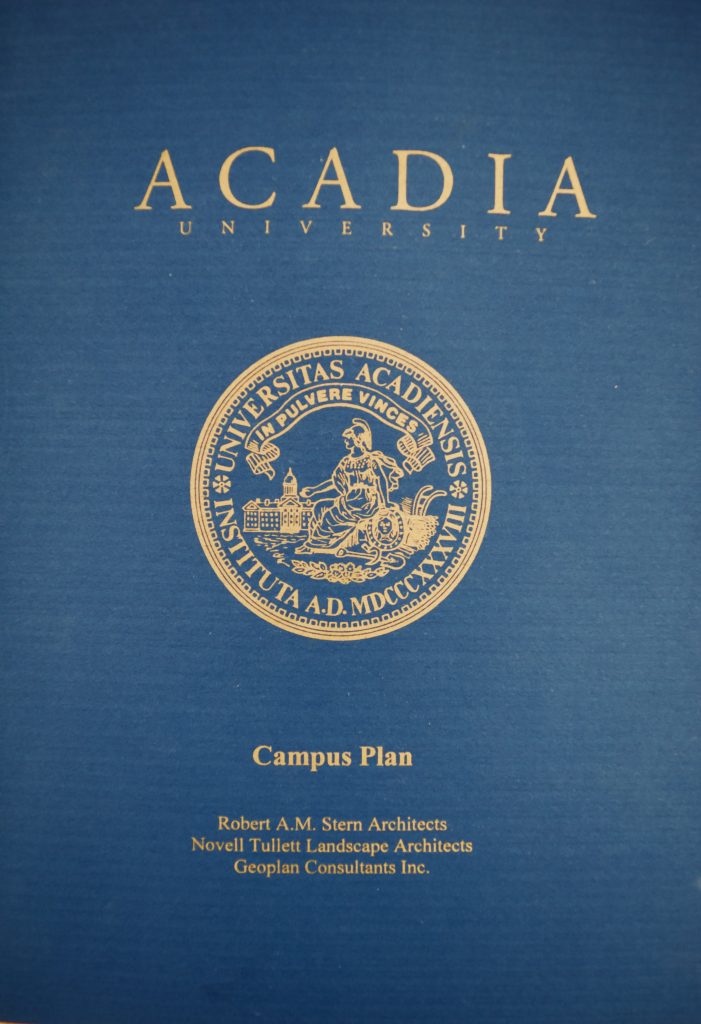
Intrigued, I took the time to do my research. With little to nothing available online, beyond a quick reference to the Senate Strategic Research Plan adopted in 2006, I did some digging. It took nearly three months before I was able to rest my hands on a physical copy of the Campus Master Plan.
Described as a “topographical blueprint for the twenty first century”, the plan was meant to celebrate Acadia’s traditional architecture and strengthen its connection with the Town of Wolfville. This plan would focus on re-orienting the campus to pedestrians and incorporating natural features into its design, including a greenbelt to the south, dykelands and tidal meadows to the north, and the Bay of Fundy.
The plan came about as a result of the development of the KC Irving Environmental Science Centre, raising the standard for development on campus. This served as an inspiration for the Board of Governors who, in 1999 under the leadership of then-President Kelvin Oglivie, pursued the development of a campus plan. The final plan was adopted in 2002 by the Board of Governors with any major changes to require at least 2/3 of the Board’s approval.
Robert A.M. Stern Architects, Novell Tullett Landscape Architects, and Geoplan Consultants Inc. came together to build this plan. Robert A.M. Stern Architects (RAMSA) is very well known for various Ivy League construction projects, including two of Yale University’s newest residential colleges, the Spangler Campus Centre at Harvard University, the Moore Psychology Building at Dartmouth College, and the Fitness and Aquatic Centre at Brown University.
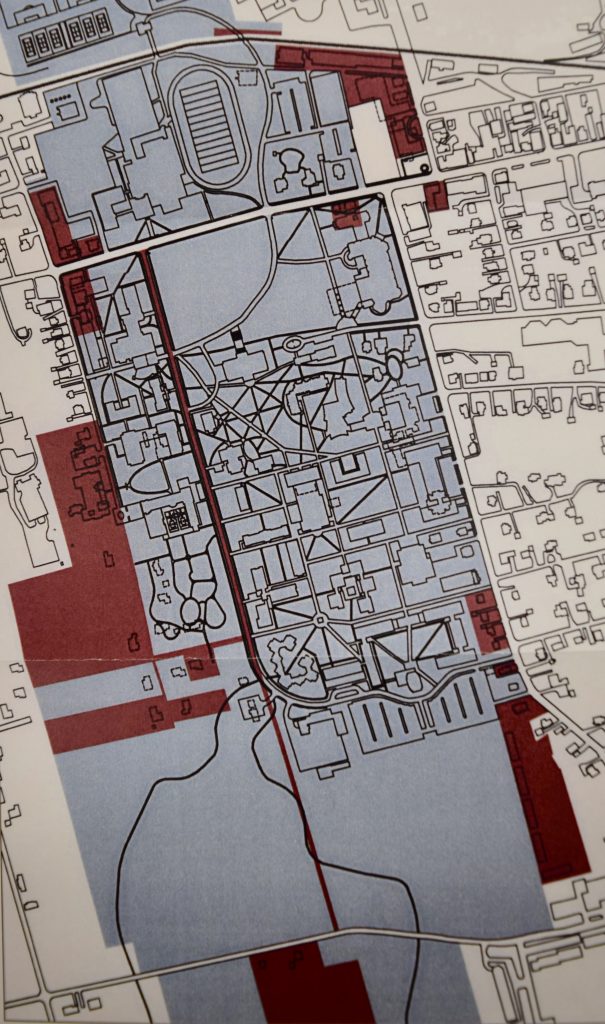
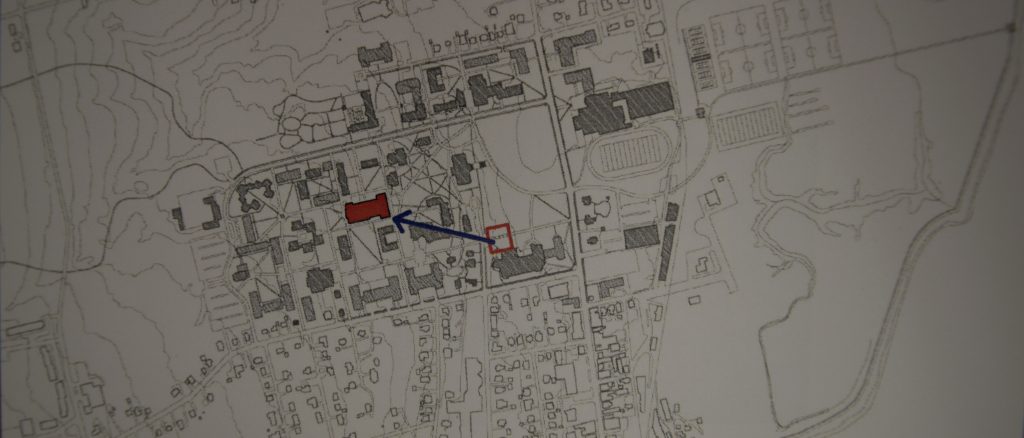
The Campus Master Plan (CMP) called for the purchase of 8 hectares of property. This would include buying University Ave from the Town of Wolfville, Catherine Court, the block where Troy currently resides, various residential lots on Westwood Ave, the funeral home next to the Athletics Complex, and apartments on the south side of Main St. where ‘Brown House’ is located.
Red denotes property the university has to buy
This would be coupled with the construction of approximately 87,900 square metres of new buildings organized around pedestrian paths and quadrangles. Some of the major changes to campus would include:
New buildings on the western edges of campus to form a Science Quadrangle
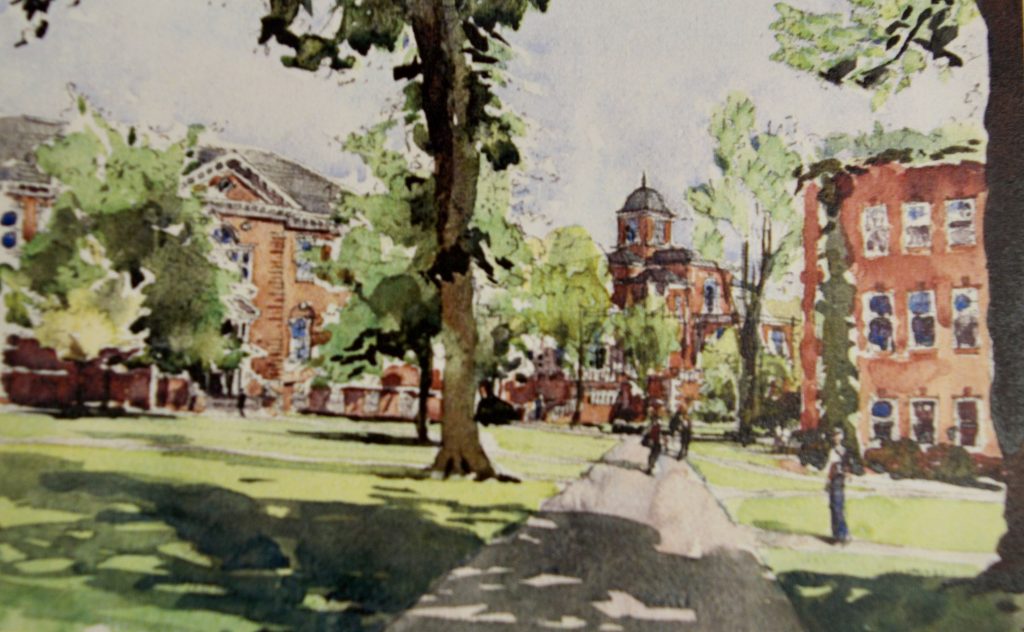
Relandscaping the front of campus on the ‘College Lawn’
Buying University Ave to demolish the portion south of campus
Demolishing the existing library and rebuilding it incorporated into Fountain Commons in the centre of campus
Building of 9 new residences
New school of business where the funeral home resides
Goal is 75% students on campus
Building of 2-3 new dining halls contained within or adjacent to residence halls located on southern half of campus
The creation of a pedestrian campus by making University Ave smaller and thinner
All students receiving an unlimited transit pass
Acadia University supporting Main Street retail and densification
Discouraging building north of the railroad tracks
Advocating for the restoration of high speed rail to Halifax
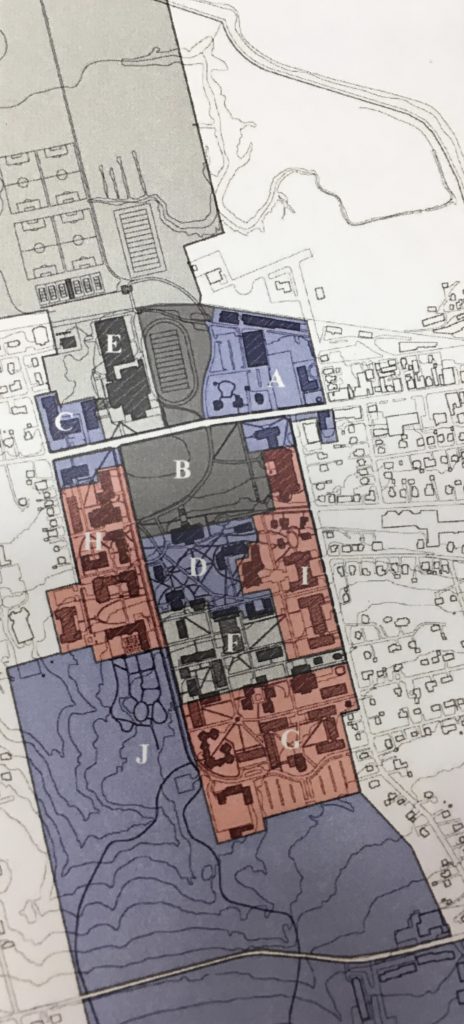
The CMP broke up the proposed changes into 10 separate areas. A) The East Gateway, B) College Lawn, C) West Gateway, D) Historic Core, E) Dykeland Playing Fields, F) Middle Zone, G) South Zone, H) Sciences Quadrant, I)Humanities Quadrant, and J) Botanical Garden & Greenbelt.
East Gateway
The CMP identified parking around campus as wholly inadequate. The views one is first introduced to driving to Acadia detract what the university is actually like, leaving a poor first impression of Acadia. Coupled with the grotesque imposition of the BAC it presented an unique architectural challenge.
To combat these the CMP proposed the following solutions. A new three-story building would be constructed in the parking lot behind the Wolfville Baptist Church. This would add a university store and impress visitors upon arrival. All of the land north of Main St. and Elm Ave. would be bought to create a Conference Centre Inn that would host major academic meetings and work with local B&Bs.
A new parking lot with direct access to Main St. would be constructed beside the existing Raymond Field, screened by trees. The Wong Centre would be moved to Main St. and a new three-story building at the corner of Main and Highland Ave would be erected that would be connected to the existing BAC. This would house an art gallery, university history museum, classrooms, and offices. The CMP identified the importance of making the building architecturally inviting, as it would screen the BAC from the main view.
College Lawn
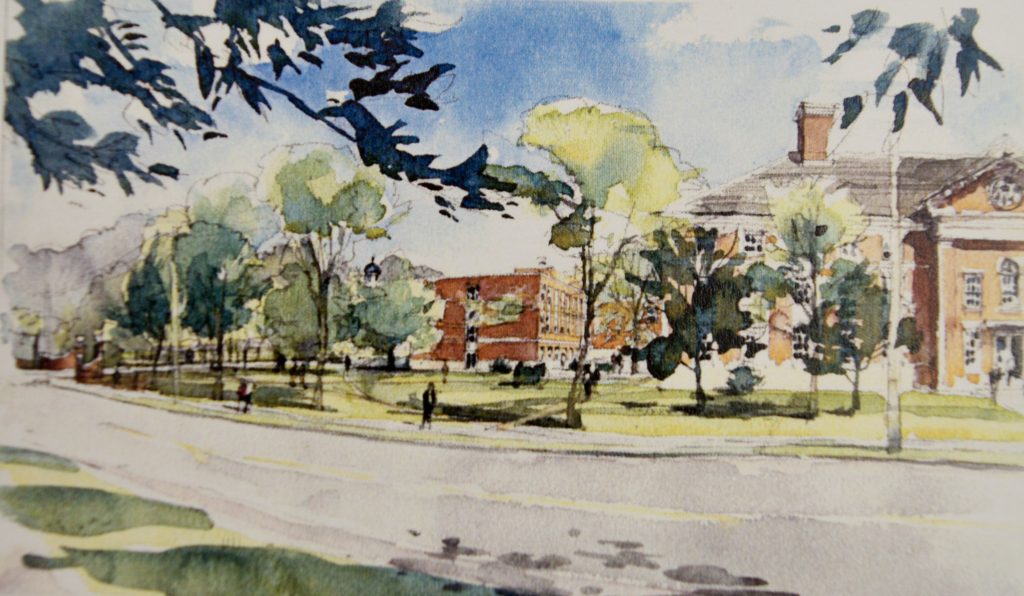
The CMP identified the poorly landscaped College Lawn as a major flaw at Acadia. This is the area directly in front of University Hall. The poor landscaping and seemingly random locations for crosswalks proved problematic, and poor lighting did a disservice to the pride of Acadia’s ‘front doorstep.
To combat these challenges, the CMP proposed to plant historically appropriate species of trees around the College Lawn. Space created by the elimination of the Vaughan Memorial Library would create considerable space to add to the lawn, which would preserve and enhance the view of the dykes. A wooden split rail fence along the north and south sides of Main St. would be erected to discourage jaywalking. This is similar to fences that exist at Yale University.
The central heating plant of the university and its smoke stacks would be demolished. These have been characterized as brutalist and out of place, made famous by an Alex Colville painting “Professor of Romance Languages”. The lawn itself would be extended across the street to Raymond Field, replacing what is now concrete.
West Gateway
The CMP identified the houses at the corner of Westwood Ave and Main St as unnecessary and detracting from the character of the university. Coupled with the unlandscaped portion of grass by the Elliot Chemistry Building, the CMP also noted how University Ave was too heavily trafficked. This posed serious risks for pedestrian and vehicular accidents in addition to traffic bottlenecks. The presence of a funeral home on the front doorstep of the university was identified as a flaw, as it gives visitors the wrong impression. The parking lot at the Acadia Athletics Complex (AC) was considered as far too exposed, considered aesthetically displeasing.
The CMP proposed several solutions for the West Gateway. These included purchasing and demolishing the apartments that exist at the corner of Westwood Ave and Main St to create a new science building. Construction of a new building would mean the creation of a science quadrangle, which fits with the CMP’s main goal of creating a pedestrian friendly campus.
Alumni Gates would be erected at the entrance to University Ave, with the avenue itself slimmed down to approximately 24 feet across. The funeral home on Main St. would be demolished to create a new building for the School of Business, and a new building west of the War Memorial Gymnasium would expand recreation facilities and provide a new home for the Kinesiology Department.
Historic Core
The CMP highlighted hasty renovations on degraded infrastructure and poor landscaping as detrimental to the history of Acadia. The noisy air conditioning unit by Seminary House was also considered a detriment to the overall aesthetic of the Historic Core. Cars intruding in the centre of a pedestrian campus and poor lighting were identified as areas to easily fix.
Proposed solutions included treating every building as a historic landmark. This would include Carnegie Science Hall, Seminary House, Rhodes Hall, Emmerson Hall, and University Hall. Moving air conditioners was seen as a reasonable move, as was the removal of the parking lot behind Seminary House. The area was to be planted with various American Liberty Elms and the trees that currently existed were to be preserved.
Dykelands
Highlighted in this section of the CMP were various issues. Flooding was the first major issue, coupled with the lack of multipurpose activity space that could lead to scheduling conflicts. The reduction of athletic and recreational programs and the use of classrooms for athletic meeting spaces were considered detrimental to Acadia Athletics and varsity sports programs, as were indoor leakages, poor signage, and unfriendly indoor track and accessibility concerns. The current swimming pool was identified as outmoded, and the lack of a medical centre, poor bleachers, and worn appearance of everything were highlighted as detrimental to the university at large.
Various solutions were proposed, arguably some of the most radical. They would include the consolidation of all dykeland fields to improve efficiency and decrease flooding, the construction of a boardwalk to connect a dykeland viewing pavilion to the Acadia campus, and various running trails. Tennis courts were to be relocated from beside Crowell Tower to the dykes, with the construction of a press box in case Acadia was looking to add a varsity tennis team to its roster.
An outdoor sports pavilion was to be constructed housing amenities like changing rooms, vending, storage for dykeland playing fields, the boardwalk, and tennis courts. The addition to the War Memorial Gymnasium was to house classrooms for Kinesiology students, with aerobics and activity rooms, locker rooms, and offices on the west side of the War Memorial Gymnasium. Access to the parking lot would be moved west along Main St and a second pedestrian railroad grade crossing would be constructed between the dykeland fields and the main campus. New signage would be added across the area and the existing power plant would be incrementally relocated to a new site at the northern edge of the arena parking lot. This would be adjacent to the railway line and a new natural gas trunk line.
Middle Zone
From the rear of Fountain Commons to the foot of Chase Court, this zone was characterized as dominated by the automobile. There was a lack of mature tree cover, a lack of exterior gathering spaces for students, and no comprehensive building style. The former flat roofs of Dennis House, Eaton House, and current flat roofs of Wheelock Dining Hall and Chase Court posed maintenance problems, energy inefficiency, and related poorly to other buildings.
Solutions proposed included the removal of parking from existing buildings in the Middle Zone. This would alleviate conflicts between pedestrians and automobiles and restore a pedestrian friendly environment to campus through construction of a comprehensive network of foot paths to reinforce positive attributes.
New buildings would be constructed, including a new library attached to Fountain Commons, an academic building east of Tully and Dennis along Highland Ave, a residence hall attached to the south of Eaton, and a residence hall south east of Wheelock Dining Hall perpendicular to Highland Ave. A new residence hall perpendicular to Chipman House between Chipman and Eaton was proposed, manifesting as Roy Jodrey Hall in the early 2000s.
Library
The current library was characterized in the CMP as unattractive and deteriorated. Its shoddy appearance and structural inefficiencies made it unsuitable as a campus library at one of Canada’s premier primarily undergraduate universities. An originally multipurpose building, it has had difficulty adapting as a university library. The CMP identifies how it struggles to meet the needs of students, faculty, and researchers due to a lack of appropriate workspace and facilities. Archive space is inadequate and the horrendous environmental conditions with a “nearly complete lack of ventilation” pose problems for the collections owned by the university.
The solution identified in the CMP is to tear down the existing library and build a new one behind Fountain Commons, using the Great Hall as the main reading room. This library would be rectangular, running next to Dennis House. Its central location in campus bridges the gap between disciplines and provides a common working space for students, researchers, and faculty of all kinds.
South Zone
Noted as “bleak”, “windswept” and “underdeveloped”, the CMP gives low marks to the South Zone of campus. The lack of architectural congruency and poor planning has resulted in a barren outdoor environment that does not match the richness of the historic core. Travel between Cutten House and Crowell Tower in the winter is noted as “unpleasant” because of the lack of wind protection, poor landscaping, poor pedestrian circulation, and lack of common space for Crowell Tower and Cutten House. Both residences are also noted for their lack of ability to house upper class students, with their flat roofs contributing to various inefficiencies.
Solutions noted in this part of the CMP correspond with the overall goal of bringing more than 75% of all Acadia students onto campus. The construction of residential colleges with apartment units for students to rent from the university would occur beside Crowell Tower, with lower foreground buildings that mitigate the “intrusive scale” of Crowell Tower. This would add density to create a residential college feel and create quadrangles and outdoor gathering spaces. A bell tower would be constructed between Eaton House, Chase Court, Cutten House, and new residences to act as a focal point, visual terminus and to mark the schedule throughout the day.
Sciences Quadrant
Described as the “front door” of campus, the CMP notes that University Ave is prone to dangerous conflicts. Buildings in the existing sciences area of campus do not open to a coherent pedestrian path system, with unattractive and underutilized outdoor spaces. There is a lack of suitable space for science departments due to increased enrollment and interest in the sciences. Insufficient climate control and poor maintenance have contributed to the disrepair of science spaces and making them a dangerous working environment. Houses lining the western side of Westwood Ave, if not bought by the university, could seriously “compromise the appearance and character of the campus’s western edge”. Privately developed land would undermine Acadia’s goals of increasing the percentage of undergraduates on campus.
Solutions identified include the purchase and demolition of apartments on the corner of Westwood Ave and Main St in the long term. In the short term, they would be used as residences to house visiting scholars and staff. A new science building along Main St. would be built to house classes, labs, and offices for various science departments. It would have entrances facing both Main St. and the newly created science quad.
A second science building behind Huggins Science Hall would be constructed fronting Westwood Ave, in the location of the current University Club. The existing University Club would be relocated to Highland Ave. All properties fronting the west side of Westwood Ave would be purchased and used for visiting scholars and staff, with a new and improved Divinity College on Westwood Ave. across from the KC Irving Centre. This would open up to the university’s Greenbelt.
Patterson Hall and the Biology building would be connected, forming a new Centre for Life Sciences, with a new system of quads and foot paths created for outdoor spaces. University Ave would be purchased from the Town of Wolfville to lessen the impact of vehicles. Traffic calming devices like raised intersections would be installed, and on-street parking would be relocated to the rear of campus. The new University Ave would be 24 feet curb-to-curb. Lighting would be at entrances and key architectural features of buildings only.
Acadia University has already acted on these recommendations, with the wholesale exterior redevelopment of the Huggins Science Complex, interior of Elliot Hall, and construction of the Huestis Innovation Pavillion.
Humanities Quadrant
The current eastern side of campus does a poor job as the eastern “front door”, with abundant parking lots and roads dominating sites that impede pedestrian movement. There is little to unite the small houses south of the BAC and little in terms of a ceremonial campus entrance, with no defined eastern gateway to the Acadia campus. The large scale of university buildings contrast poorly to the smaller scale wood frame houses east of Highland Ave, making Acadia appear imposing. The Student Union Building is noted in the CMP as insufficient for student use due to increased programming and serious maintenance and refurbishment needs that are not consistent with the quality of Acadia.
Solutions identified include the wholesale redevelopment of the Student Union Building and the construction of a new one along Highland Ave. This campus centre would be a more academic space, set back from Highland Ave to match the BAC. It would occupy a prominent position and define the eastern edge of campus.
Alumni gates would be moved to the intersection of Highland and Acadia St. with a more refined design to create a ceremonial entrance. Vehicular access and parking would be deceased as part of an overall strategy to remove parking to the campus perimeter, and service roads would be minimized to de-emphasize their impact on a pedestrian dominated campus.
The visual impact of the BAC would be lessened by adding a three-story addition west of the intersection on Main St. and Highland Ave, which would include an art gallery, classrooms, and a museum dedicated to the university, town, and regional history. The existing Divinity College would be torn down and replaced with a new academic building, in addition to a new garden adjacent to the Campus Centre in the former backyard of Hayward House. Raymond Hall would also be relocated east of Wheelock Dining Hall.
Greenbelt
The CMP identifies considerable potential with the Greenbelt. It would reinforce the image of Acadia as a campus partially embedded in the native forest while opening towards the riparian tidal meadows and Minas Basin beyond. It is currently not one piece of land because University Ave breaks it apart, which is currently occupied by unmaintained meadows. Walking trails are not well linked as several properties are not owned by the university.
Solutions identified include the wholesale purchase of University Ave from the Town of Wolfville and demolition of the part between the end of campus and Skyway Drive. This would eliminate the poorly used athletic fields south of Crowell Tower and replace them with more suitable ones by the dykes, which would allow for the enlargement of the Greenbelt.
Catherine Court apartment buildings would be purchased south of campus and west of Highland Ave to expand the Greenbelt, with improved construction and maintenance of walking rails. A natural sciences interpretive guide for the greenbelt would be developed and published to promote research and comprehensive standards for replanting and maintenance would be developed. Additionally, all private properties along Westwood Ave between Westwood and the university would be purchased, as would the town-owned portions of Westwood Ave south of the KCIC and between Westwood and University Ave. These would close the roads and add to the overall Greenbelt.
Progress
Acadia has made progress on the CMP. In an interview with The Athenaeum, Director of Facilities Marcel Falkenham noted that the CMP “is more of a guide than gospel. This is a plan of where we want to be in the long term, so it’s pretty malleable.”
Some of the steps taken to achieve the goals laid out in the CMP have been achieved. Fountain Commons, formerly McConnell Dining Hall, was refitted in a previous capital campaign. Uniform signage courtesy of the 2017 Grad Class now graces campus. Horton Ave, the road from Wheelock Dining Hall to the BAC, added planters down the centre in 2013. The federal government is investing in the Athletics Complex. Lighting is now more uniform across campus. The redevelopment of Huggins and Elliot fits with the aesthetic qualities of Acadia’s architecture. The construction of the Huestis Innovation Pavilion fits with the CMP’s goal of bridging the divide between the university and local businesses. Though these changes may take time and money, they are not impossible.
A copy of the Campus Master Plan is available at the Acadia University archives.
Betzillo positions itself as a versatile gaming hub where structured bonuses and adaptive gameplay mechanics support both short sessions and extended play.
Built with a focus on innovation, Spinbit integrates modern casino architecture with rapid transactions, appealing to players who value speed and digital efficiency.
Ripper Casino emphasizes bold entertainment through high-impact slot titles and competitive promotions crafted for risk-oriented players.
A friendly interface and stable performance define Ricky Casino, offering a casual yet reliable environment for a wide spectrum of gaming preferences.
King Billy Casino channels classic casino spirit into a modern platform, delivering recognizable themes supported by contemporary reward systems.
Immersive visuals and layered slot mechanics are at the core of Dragonslots, creating a narrative-driven casino experience.
Lukki Casino appeals to players seeking direct access and minimal friction, focusing on fast loading times and intuitive controls.
Casinonic provides a structured and dependable gaming framework, blending modern slots with transparent operational standards.