Tag: green

  • Are You Feeding a Bag Monster?

    Are You Feeding a Bag Monster?

    Are You Feeding a Bag Monster?


    Ok, you’re probably wondering what on earth I’m talking about when I say, “feeding a bag monster”, right? Well before you exclaim, “I can barely feed myself on my student budget and schedule, let alone feed someone else!” let me explain.

    You know those disposable plastic shopping bags you get from the grocery store and other stores? Although they may seem convenient, if you get plastic bags every time you go to the store, they begin to add up, and add up, and can grow into menacing, problematic creatures – Bag Monsters!

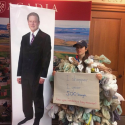
    Recently, a Bag Monster was wandering around Wolfville and the Acadia campus. That Bag Monster was composed of 500 bags, which represents the approximate annual consumption of single-use disposable bags by North Americans![i] 1 shopper, 1 year, 500 bags – now that’s pretty scary! However, perhaps even more concerning, is that many of us will never notice that we are feeding Bag Monsters unless we keep all of our single-use plastic bags for an entire year. Instead, we only see small Bag Monsters stuffed under the kitchen sink, in our garbage, floating on the sides of the street… But regardless of whether we know it or not, every time we use plastic bags, we are feeding Bag Monsters in our community and contributing to a global Bag Monster invasion!


    Bag Monsters are wreaking havoc in Wolfville, in North America, and around the world. In the Annapolis Valley, Valley Waste Resource Management receives about 2,700 tonnes of plastic film each year, which includes shopping bags and other plastic packaging. The vast majority of these plastic bags are unnecessary and could have been avoided by using reusable bags. Instead, 1,000,000 kg of clean plastic film and another 1,000,000 kg of soiled plastic film end up in the landfill annually in the Valley, while only about 680,000 kg of plastic film are recycled, and this has significant costs, both environmental and economic.[ii]

    Worldwide, a trillion single-use plastic bags are used each year, with nearly 2 million used each minute, unleashing a continuous stream of bag monsters into our environment.[iii] To illustrate the scale of this problem: if all Americans (and only Americans) tied their annual consumption of plastic bags together in a giant chain, this chain would wrap around the equator about 1,330 times! [iv] Bag Monsters are quite literally strangling our Earth, especially since the majority of plastic bags aren’t recycled, so Bag Monsters end up forming in our landfills, on the sides of roads, in rivers and oceans, and along shorelines. These Bag Monsters are practically eternal, taking at least 1,000 years to break down, and even then they don’t biodegrade but instead only fragment into small pieces over time. Marine and land animals often ingest these plastic particles, and birds and turtles are frequently found with stomachs full of plastic, including recent studies that have found plastics in the majority of marine bird stomachs.[v] This is an increasing problem as the trillions of tons of plastic particles in the oceans increase each year and never biodegrade.[vi] More so, large Bag Monsters that have not been fragmented can entangle marine species, suffocating and cutting them, and plastic bags have been identified as the most harmful items to marine animals of the vast multitudes of large plastics in our oceans.[vii]

    Additionally, the production of plastic bags requires petroleum to create the plastic and act as an energy source during the manufacturing process. Therefore, the continued demand for disposable plastic bags encourages the extraction of fossil fuels, contributing to greenhouse gas emissions and using up valuable finite resources only to dispose of the bags soon afterwards. The Bag Monsters we create are sucking energy from our societies. In fact, the amount of energy required to make just 12 plastic bags could drive a car for a mile (or 1.6 km)! How far could you drive with the plastic bags you have used this year?

    Bag Monsters are the frightening result of our dependency on, and excessive consumption of, plastic. In fact, Bag Monsters are not just made of single-use shopping bags, but can form from all types of excessive plastic bags and packaging. These Bag Monsters just keep growing the more we use plastic bags… soon they will take over, with detrimental consequences for the planet. How many Bag Monsters are there in your house, in your community?

    It is evident that Bag Monsters are a huge problem, so what can we do about it? Well, a healthy and sustainable future free of these monsters is possible, we just all have to take a few easy steps to fight back against the Bag Monster invasion of our communities and the Earth.

    Simple tips to combat Bag Monsters:

    • Use reusable shopping bags! They don’t cost much and will last a long time. Keep them in a handy place near the door so you don’t forget when leaving the house.
    • If you forget a reusable bag…
      • Just say “no” to a plastic bag and hand-carry your things out of the store
      • If necessary, try to use as few plastic bags as possible to carry your stuff
    • Recycle your plastic shopping bags. Place all bags into one bag and tie closed, then put into your blue bag (#2 for containers).
    • Reuse existing plastic bags.
    • Buy fewer products that come in plastic bags or packaging.
    • Buy in bulk when possible, and bring your own containers (e.g. new or reused mason jars) to avoid using plastic bags.
    • Educate others about the Bag Monster problem, and encourage them to take action!


    [i] Suzuki, D. (2012, January 10). Stop Being a Bag Lady (or Bag Guy). Retrieved from http://www.huffingtonpost.ca/david-suzuki/plasticbagban_b_1725998.html?utm_hp_ref=ca-plastic-bag-ban; Keller, A. (2011, September 28). What is a Bag Monster? Retrieved from http://www.bagmonster.com/2011/09/what-is-a-bag-monster.html

    [ii] Valley Waste Resource Management.

    Estimated costs to recycle and landfill plastic film is ~$250,000 for  the Annapolis Valley per year).

    [iii] Earth Policy Institute. (2014, October). Plastic Bags Fact Sheet. Retrieved from http://www.earth-policy.org/images/uploads/press_room/Plastic_Bags.pdf

    [iv] Earth Policy Institute, 2014.

    [v] Xanthos, D., & Walker, T. R. (2017, May 15). International policies to reduce plastic marine pollution from single-use plastics (plastic bags and microbeads): A review. Marine Pollution Bulletin, 118 (1–2), 17-26. Retrieved from https://doi.org/10.1016/j.marpolbul.2017.02.048; Suzuki, 2012.

    [vi] Xanthos & Walker, 2017.

    [vii] Xanthos & Walker, 2017.

  • A Greener Acadia: A Look at the Sustainability Initiatives Around Campus

    A Greener Acadia: A Look at the Sustainability Initiatives Around Campus

    Note from the Editor: Marcel Falkenham is the Director of Facilities at Acadia University. During his tenure here, the university has seen some remarkable improvements in sustainability efforts across campus. Through this piece, the Athenaeum hopes to illuminate some of those improvements as well as open some discussion on what the future might look like.

    1. Tell me a little bit about the sustainability projects that you have overseen at Acadia since you’ve been here. What are you most proud of?

    I arrived at Acadia in the summer of 2007 as the university was in the early implementation stages of a “Sustainability through Facilities Innovation” performance contract with Johnson Control Inc. This project consisted of multiple improvement measures targeted towards improving energy efficiencies while reducing deferred maintenance and renewing some key capital equipment.

    Some of the campus wide initiatives included lighting upgrades from T12 and incandescent lamps to T8 and compact fluorescents in areas that had not been renovated, and upgrading plumbing fixtures to reduce water consumption or going water free where possible. There were several building specific initiatives such as installing a new ice plant for the arena that sent rejected heat from the compressors to be used in preheating incoming ventilation air and pool water. Other building projects that were part of that contract included heat recovery in the Huggins and Elliott Hall labs and a number of heating system flushes in larger buildings to remove scale and improve heat transfer. All in all, annual cost savings were calculated to be $600,000 which was used to pay for the capital costs of implementation.

    Since that broader initiative I have been able to complete a number of other sustainability projects on campus by working with other agencies including Efficiency Nova Scotia. We have been able to achieve real energy savings while also reducing maintenance requirements and in many cases improved the aesthetic and functionality of the systems we addressed. Probably the most visible would be the exterior lighting upgrades to LED as technology came available and improved to the point where paybacks were measured in months instead of years. We had participated in some smaller retrofits in partnership with Efficiency NS in several areas on campus including the Student Union Building, Michener and MacKeen Rooms, as well as Clark Commons with early generations of LED lamps – building on the success of those small projects to justify moving larger scopes.

    The Grad Class of 2013 then used their class gift to help us upgrade the 8 pathway lights in the main Quad behind University Hall to new LED post tops, taking advantage of a supplier incentive which allowed us to get the fixtures at about half the regular price. The impact of the quality of light from these new fixtures and the improved aesthetic was a huge win and we were able to use it to help justify a continuation across campus with help from Efficiency NS. The gains on this were threefold: Energy savings were at least 50% per fixture at 75W vs 150W previously, the lifespan of the lamps were increased by a factor of ten – 100,000 hours vs 10,000 hours previously – and the quality of the light was dramatically improved. You could actually recognize people’s faces after dark instead of the “blob” that was visible with the old high pressure sodium lighting. As a side, the new fixtures were night sky compliant with no spill over to obstruct star visibility which is also a win. By the end of the summer of 2013 we were able to retrofit about 90% of the outdoor fixtures resulting in an annual savings of over 500,000 kWh, which while always a win was almost a side note when compared to the improved feel of campus after dark. The running joke is that we won’t need to change a lamp until at least after I retire which is still a way off at best.

    Probably the highest impact project on sustainability that we have successfully implemented in my time here has to be the conversion of our Central Heating Plant from Bunker C oil fired to Natural Gas. While not obvious to many and operating in the background, this was a huge undertaking that required the complete retrofit of all four boilers and construction of a Natural Gas delivery site and pipeline to the boiler room… all while maintaining steam production uninterrupted year round to our entire campus. Obviously, Natural Gas is still a fossil fuel and therefore not renewable, but the improvement in overall emissions profile when compared to the Bunker C oil that had been used since the 1950s is something we should be proud of. In the first year alone of using Natural Gas (which actually had a fair bit of light oil usage in the early part as we were commissioning the new systems), our Sulfur Dioxide emissions dropped over 60% which is almost 45 tonnes while our Particulate and Nitrogen Oxide emissions dropped about 25%. Carbon Dioxide emissions were reduced almost 30% which equates to almost 4000 metric tonnes for the year. For reference, that is equivalent to taking almost 1000 cars off the road. We are expecting even more reductions in this past year as we were able to run almost exclusively on natural gas as the initial conversion challenges were overcome. While not as high profile or visually impressive as some of the other measures we have made on campus, this has to be hands down the most significant improvement in sustainability.

    2. Tell me a little bit more about the design of the new biology building, and the initiatives that it has underwent to become LEED-certified. What exactly does LEED-certified mean?


    LEED stands for Leadership in Energy and Environmental Design and is a rating system for green buildings. Essentially there are points available across a variety of categories from site selection to materials used for construction to indoor air quality. Some of the points are fairly simple to earn such as having bicycle racks and designated carpool parking spots to encourage alternative transportation, while others can be much more involved. An example of the more difficult points to achieve would be tracking of construction waste which required every load of waste and recycling to be weighed and tracked to ensure diversion targets were met. All points need to be validated and awarded by a LEED accredited third party consultant.

    The Biology building was designed to the LEED Gold standard and as such would have been one of the first science buildings in Canada to target such a goal. It was about 50% complete when I arrived on campus in 2007 and I was able to be involved in the fitout and commissioning phases of the new facility. There were many features incorporated in the Biology Building that were at least partially driven by the LEED process. The use of geothermal cooling, the capture and use of rainwater for non-potable water in the building, realtime monitoring of indoor air quality in all spaces and extensive use of natural and high recycled material content products for construction. Overall the LEED standard has some very good principles that we try to apply in all projects going forward but as with any consultant intensive initiative there are significant costs associated with the process that I feel can sometimes be better applied to actual sustainable projects and practices.

    3. Apart from obvious funding limits, what are some challenges to making Acadia a green campus?

    One of the bigger challenges with our beautiful campus is the age and variety of buildings and infrastructure. Our buildings range in age from 8 years old to almost 200 years old, so obviously the construction type varies widely. Strategies for sustainability therefore need to be tailored to the target areas and what works in one building doesn’t always work in another. As a fully operational campus, even if funding were unlimited it is not as simple as flicking a switch and being green. Everything needs to work around our ongoing campus activities and be planned and implemented in such a manner as to minimize disruption to our core mission as an institution of higher learning. While not always easy, we have had great track record of making incremental improvements while minimizing impact on day to day operations and plan to continue in this way moving forward.

    Keeping up to date with emerging technology trends that may have significant impacts on sustainability is also a challenge. We were early adopters on the LED lighting front as highlighted earlier, but we have also been working on more “behind the scenes” initiatives as opportunities arise from new technologies. One of the more recent examples of this is the availability of hybrid heat pump hot water heaters. While most of our buildings rely on our steam system to provide hot water, several buildings with lower consumption are actually more efficient to run with electric hot water heaters. The hybrid hot water heaters use an integral heat pump to heat the water instead of a straight electric resistance element and use less than half the amount of electricity to do this. We have retrofit a couple dozen of these units in buildings ranging from smaller academic facilities like Rhodes Hall up to larger facilities such as the Beveridge Arts Centre. We were one of the only institutions that I am aware of to take advantage of this technology and it has been very successful to date.

    The biggest challenge aside from resource availability is education and awareness. Keeping incoming students, staff and visitors educated on things as simple as waste sorting and reducing energy consumption is something that is ongoing and requires a lot of work. On the bright side efforts have been paying off, our diversion rates from landfills have consistently tracked over 70% which is well above the provincially legislated goal of 50%. Every year we see the trend where the numbers dip at the start of the term and then steadily improve as the year progresses and new members of the campus community become more knowledgeable on how to sort and recycle.

    4. In the future, where do you see Acadia going in terms of sustainability? What sort of projects are you working on now, and hope to accomplish?

    We have made some great progress but obviously have a way to go to becoming truly green. With the current funding constraints that all universities are facing, I expect to continue on the incremental improvement path but there are some exciting technology developments on the horizon. We are currently working to continue upgrades to LED lighting as opportunities arise and efficiency improvements in mechanical systems are always on our mind. We do try to keep sustainability in mind for all projects and incorporate energy efficiency improvement in the planning stages. One case and point is the new Stevens High Performance Centre varsity locker room project at the Athletics Complex which we plan to start this spring. While this is an addition to the existing complex it requires largely independent mechanical systems for heating and ventilating, but we are working with the consultant engineers to use the glycol lines that are heated by waste heat from the adjacent ice plant to provide the heat source for the in floor radiant heat and ventilation units. This would provide the majority of the heat for the almost 8000 ft2 facility for virtually free. As renewables such as solar become more efficient readily available I hope that we can incorporate them more into our facilities as the paybacks shorten but this will take time given the capital requirements associated. In the interim, managing and improving our consumption has the better payback and we will continue to identify and implement as opportunities come up.

  • Understanding Climate Change: Fact Sheet

    Understanding Climate Change: Fact Sheet

    Climate change is a huge topic right now, as it should be, but all the information can be a little overwhelming and hard to understand. Let these facts and terms, compiled by Acadia Talks, help you navigate your way through understanding our future living with climate change.

    Climate Mitigation: efforts to reduce or prevent emission of greenhouse gases (new technologies, renewable energy, improving efficiency, or changing management practices or consumer behavior)

    *Climate Adaptation: adjustment in natural or human systems in response to actual or expected climatic effects

    *During the end Permian mass extinction event (252mya) there was a global temperature rise of 6°C. The environmental implications eradicated 90% of the species on Earth.

    -At COP16, countries promised a $100 billion/year Green Climate Fund for 2020 through 2025 to help developing countries to adapt to climate change (although specific contributions have not been established)

    -As temperatures increase, tropical diseases will spread to new areas as the range of carrier organisms expands (MosquitosàMalaria)

    -Rising seas means coastal infrastructure will need to adapt (Ex. Confederation bridge (NBàPEI) needs to be raised so ships can still fit)

    • This threatens roughly 1 billion people in coastal cities around the world (What could this mean for mass-relocations?)

    -Genetically Modified Crops are one possible solution to world hunger (drought resistant, pest resistant, higher yield) but potential unintended consequences on ecosystems cloud public opinion

    -One unconventional solution to desertification could be herding massive groups of livestock to simulate mass migration of grazers.

    -From 1980-2014, land fall tropical cyclones caused $545 billion in damages (avg. cost of $16 billion per event). Drought caused $213 billion, severe storms $156 billion and inland flooding $89 billion

    -Climate Change effects have been shown to lead to political instability and conflict

    Four IPCC Climate Scenarios to 2100

    RCP 2.6: Global annual GHG emissions (peak between 2010-2020, with emissions declining substantially thereafter (Avg. temp rise 0.3 – 0.9°C)

    RCP 4.5: Emissions assumed to peak around 2040, then decline (Avg. temp rise 1.1 – 2.9 °C)

    RCP 6: Emissions peak around 2080, then decline (Avg. temp rise 1.7 – 4.4°C)

    RCP 8.5: Emissions continue to rise throughout the 21st century (Avg. temp rise 2.0 – 5.4°C or more)


    Geoengineering/Climate Engineering: deliberate, large-scale intervention in the Earth’s climatic system with aim of limiting adverse climate change. (extent of effects still unknown, more research and $$$ needed)

    1. Solar radiation management – reduce sunlight absorbed by deflecting sunlight away from the Earth, or by increasing the reflectivity (albedo) of the atmosphere or the Earth’s surface. (Ex. marine cloud brightening, which would spray fine sea water to whiten clouds and thus increase cloud reflectivity, stratospheric sulfate aerosols, obstructing solar radiation with space-based mirrors, dust, etc.)
    • Would produce quick results and comparatively low implementation costs. (Note: does NOT reduce greenhouse gas concentrations in the atmosphere, and thus would NOT address problems such as the ocean acidification)
    1. Carbon Dioxide Removal – remove CO2 from the atmosphere via afforestation, using technology to remove carbon dioxide from ambient air, iron fertilization of oceans, use of biochar (which can improve water quality, increase soil fertility, raise agricultural productivity, and reduce pressure on forests), create artificial upwelling’s in oceans to stimulate surface productivity


    Discussion questions:

    Should we be taking steps now as a globe to research and implement global geo engineering techniques to alter the global climate and reduce heating?

    • What are the pros and cons and how should we do it? Is it ethical?

    Should developed (industrialized) countries feel an obligation to help poorer countries deal with climate change?

    What role do you see Climate Change playing in the stability of future international politics?

    What are some ways you think humanity will benefit from learning to tackle and live with Climate Change?

    Do you enjoy discussing world events? Then join Acadia Talks!!

    We are a club that meets every 2 weeks on Tuesday evenings to have an open, round-table discussion about important global issues.

    When/where? 6-8pm in the KCIC seminar room (More details posted on Facebook before each talk https://www.facebook.com/AcadiaTalks)

    Add us on Facebook or contact Luke at [email protected] for info

Betzillo positions itself as a versatile gaming hub where structured bonuses and adaptive gameplay mechanics support both short sessions and extended play.

Built with a focus on innovation, Spinbit integrates modern casino architecture with rapid transactions, appealing to players who value speed and digital efficiency.

Ripper Casino emphasizes bold entertainment through high-impact slot titles and competitive promotions crafted for risk-oriented players.

A friendly interface and stable performance define Ricky Casino, offering a casual yet reliable environment for a wide spectrum of gaming preferences.

King Billy Casino channels classic casino spirit into a modern platform, delivering recognizable themes supported by contemporary reward systems.

Immersive visuals and layered slot mechanics are at the core of Dragonslots, creating a narrative-driven casino experience.

Lukki Casino appeals to players seeking direct access and minimal friction, focusing on fast loading times and intuitive controls.

Casinonic provides a structured and dependable gaming framework, blending modern slots with transparent operational standards.