Tag: war

  • Acadia Archives: Acadia and the War

    Acadia Archives: Acadia and the War

    I currently work as a Research Assistant in the Acadia Archives, working on Wendy Robicheau’s sabbatical project entitled “Acadia and the War.” The goal of this project is to investigate how Acadia students and faculty responded to the First World War, and to share their stories. Acadia has a very rich history, and the wartime spirit on campus becomes abundantly clear through sources like the Athenaeum issues during the conflict. Dr. Cutten, to whom Cutten House owes its name, was Acadia’s President at the time as well as a Recruitment Officer. His efforts to encourage students to enlist, and to document their stories following the war, provide the archives with many lists of students, and in several cases, descriptions of their service. From these war records, our search began.

    Initially, I began investigating the 14 Nursing Sisters to leave Acadia for Casualty Clearing Stations, and Stationary Hospitals. Although the list was short, the search for women in the archival record is always strained at best. Of the 14 who served, two died
    during the war. Jessie B. Jaggard, a matron at Lemnos in Gallipoli who died during service in 1916, and Adruenna, or “Addie” Allen Tupper, a Nursing Sister who had succumbed to illness. For those on our list who served as VADs, little more than their names are known to us. Although we now know that many of Acadia’s Nursing Sisters were recognized for their deeds, as some were lauded by fellow nurses in their records and others were mentioned in dispatches for bravery. Cora Peters Archibald, for example, had served as a Dietician for the 3rd Canadian General Hospital in Etaples, France. She is mentioned in the hospital’s ‘War Diary’ for her knowledge of nutrition, and her task to maximize the calories afforded all patients and staff given the hospital’s limited food supply. She would later return to Acadia to found the Department of Home Economics.

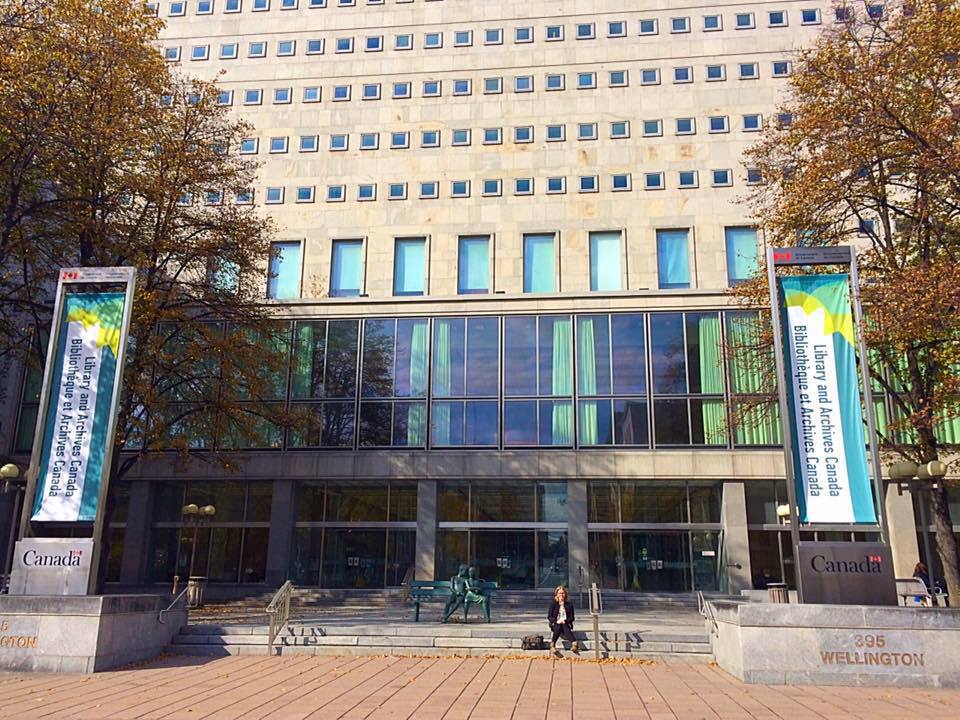
    After a few months of searching for their stories, we travelled to Ottawa to consult files on our Acadia men and women at Library and Archives Canada. For my part, the trip involved photographing medical and war records for our nurses, as well as hospital administrative documents. Everything was photographed from the 1917 Christmas dinner menu, to hospital blueprints. The variety of sources available to us made their stories even more vivid, and oddly present. We also attended museums and museum archives to aid our search, and the reality of the project began to feel much more tangible. Using archival sources we were able to investigate the lives of individuals whose names would otherwise be lost to the tragedy of the Great War.

    Our project has certainly developed since then, and in November we were given the opportunity to give an Open Acadia talk to students and community members. We presented our research as if we were a Recruitment Officer and a Matron seeking volunteers for the ongoing war effort, before returning to 2015 to discuss the nature of our study. Since then, we have continued our research, and are currently developing an online database whereby Acadia students who served during the war may be identified, alongside all service information available to us. Our goal is to bring Acadia’s wartime legacy to the present day, in a format that is widely available. Working in the Archives has certainly changed the way I view local history, and I consider it a privilege to have studied the many stories of Acadia’s own soldiers and medical staff. The more researchdone, the more you begin to feel the gap of a hundred years begin to close, with more questions revealing themselves along the way.

  • Into The Trench

    Into The Trench

    All humans are human, and not one of us is more human than the other.”

    These words are spoken by Lt.-Gen. Roméo Dallaire, at his talk on October 21st at Horton High School. I am forced to look up from my half-scribbled notes and stare at the stage in dumfounded enthrallment. The now retired general is neatly dressed – he wears no crass colours, and keeps his hands in his pockets as he paces along the edge of the stage. The topic of the talk is the use of child soldiers in warfare. He recounts stories of Rwanda and his time there, and he mentions the moment he realized that the eyes of the orphaned child he was staring into, even after witnessing so much bloodshed, were the same eyes of his own child back in Canada, safe with his family. “We are all humans,” he says again – but what is it that makes us inflict such horror onto other humans? And what is it that makes us ignorant and reluctant to aid others in those situations?

    One of the tales that the general recounts is the story of a UN patrol travelling the country-side, eventually encountering a small village in Rwanda whose population had been massacred. In the town, there existed a massive rape site. A trench in the mud, full of women and children who had been corralled, raped, mutilated, and left for dead. The commander of the platoon was unsure if he should send his soldiers into the trench to comfort the dying women who remain alive, laying in the mud bleeding, or if he should continue without stopping. To jump in would mean to risk contracting HIV and wasting the limited food and water resources they had. But he didn’t even have time to decide. The soldiers had already unstrapped their packs and were entering the pit.

    It is part of the changing nature of warfare. A new era, where civilians are the prize, the targets, and the weapons. Where militants have resorted to using human beings as a means of attack, specifically children. A crime against humanity according to the UN that is being broken by several active groups in the world today – the Boko Haram, the LRA, and of course, ISIS. There is not one conflict on this planet that is not currently using child soldiers. It’s a brutal but effective tactic – if a soldier on the battlefield had a six year-old boy charging towards him in his crosshairs and pulled the trigger, how could he go home after his mission and hug his own kids? The kids are expendable. You can send them out on the mine fields to trigger IEDs. Moreover, children are generally easy to manipulate. The step from a simple political movement to a fully indoctrinated youth militia is a small one. However, the cost is too great – “We are mortgaging our future,” Dallaire says. He is right. But the issues we are talking about seem so far away, so distant, that it appears almost futile to do anything about it. So say the politicians.

    Just look at the refugee crisis in Europe, where thousands of displaced individuals are fleeing from their oppressive, brutish government in search of freedom and democracy. They are instead greeted with cold, if not outright hostile treatment. Donald Trump has pledged that if elected, he will send all Syrian immigrants back, claiming that we have to look out for ourselves first and foremost. Who does he mean by ourselves? Americans? Christians? European-descended folk? The truth was eloquently stated by John Green in a recent video of his. “Ourselves” includes all of humanity, sharing this one small planet together. The only alternative concept of “ourselves” is an artificial construct we have created. Biology has shown that there is no genetic difference between people of different races. We are all the same species.

    The general did not give any answers during his talk. He presented the crisis, and he urged for a more preventative approach to stopping the use of children in war, but no solid plan or concrete implementation was given. But maybe that wasn’t the point of the talk. We will not be able to directly impact the choices made in another country across the globe. Of course, we can join non-governmental volunteer organizations, or write to our Members of Parliament, but again, I believe that the point of the talk was to urge the audience to inform themselves on these issues. Our connections with the world extends so far today, that an excuse for ignorance no longer stands.

    As for the platoon that was patrolling the village in Rwanda that found the rape site: Only three out of twenty-six commanders would have made the command to help the dying women, according to Dallaire. These soldiers jumped in on their own accord – not because they were ordered to, but because they understood the horrors that had occurred, and they were not afraid to confront them. They acted out of compassion – the purest and most human traits, admirable when found in anyone. And as it was revealed, those soldiers were Canadian. They grew up in cities like you, and went to school just like you. They learned the same things you did. They worried about their unsteady futures, about their unsteady pasts. They did everything you are doing now. And when the time came, they were ready to act, and face the consequences, because they were aware of them otherwise. So I urge you: read up on Sudan, read up on Etritea. Read up on Syria and Turkey, on Armenia and Palestine. It will be depressing and sad, and you’ll never be able to solve all of the world’s problems. But maybe one day, when faced with an unspeakable horror, it will be you who selflessly jumps into the trench.

Betzillo positions itself as a versatile gaming hub where structured bonuses and adaptive gameplay mechanics support both short sessions and extended play.

Built with a focus on innovation, Spinbit integrates modern casino architecture with rapid transactions, appealing to players who value speed and digital efficiency.

Ripper Casino emphasizes bold entertainment through high-impact slot titles and competitive promotions crafted for risk-oriented players.

A friendly interface and stable performance define Ricky Casino, offering a casual yet reliable environment for a wide spectrum of gaming preferences.

King Billy Casino channels classic casino spirit into a modern platform, delivering recognizable themes supported by contemporary reward systems.

Immersive visuals and layered slot mechanics are at the core of Dragonslots, creating a narrative-driven casino experience.

Lukki Casino appeals to players seeking direct access and minimal friction, focusing on fast loading times and intuitive controls.

Casinonic provides a structured and dependable gaming framework, blending modern slots with transparent operational standards.