Tag: china

  • China’s Chang’e-5 Set to Bring Back Lunar Specimens by Mid-December: a Goal Since 1976

    China’s Chang’e-5 Set to Bring Back Lunar Specimens by Mid-December: a Goal Since 1976

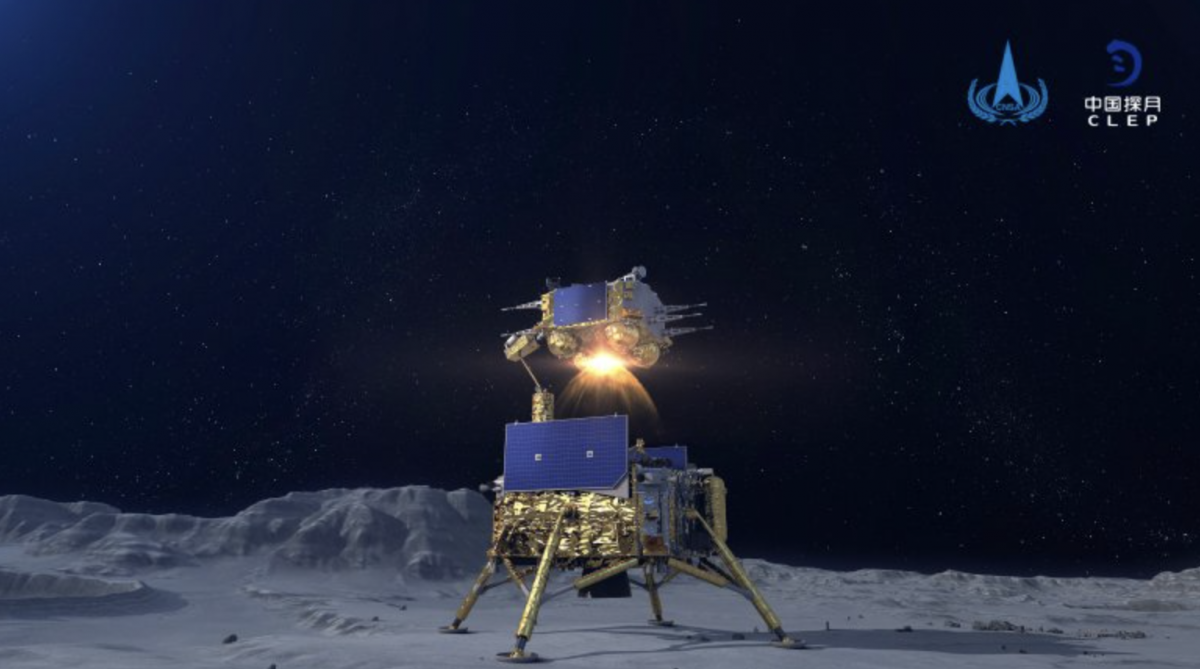
    Chang’e-5, China’s third successful uncrewed moon landing, has reached another milestone by not only landing on the Moon but also by spending two days on it, gathering rocks and dirt from the lunar surface. The goal of the spacecraft was to get the Moon samples to the Earth, which has been a goal of theirs since the year 1976.

    The spacecraft was launched from Hainan Island, which is located in the south of China, on November 24th 2020. The spacecraft, upon entry into the moon’s orbit, would split in two; the lander and the orbiter, where the lander will be on the surface and the orbiter will await its return. The spacecraft successfully carried out this procedure on Saturday, according to various sources. The lander is reported to have touched down at Mons Rümker which is a volcanic plain located on the Moon’s near side which is estimated to be around 1.2billion years old. However, this is considered much younger than the places which were explored by NASA’s Apollo mission and the Soviet Union’s Luna mission, as the places they explored were all more than three billion years old. 

    The lander of Chang’e-5 will need to accomplish its drilling and scooping tasks within one lunar day, which is equivalent to 14 days on Earth. The lander is not designed to survive the dark and frigid lunar night which can cause it to reach temperatures of -170° Celsius as there is no heating mechanism built-in the spacecraft. 

    The Chang’e-5 also includes a rocket attachment which before the Sunset would blast off with the lunar samples. The rocket will then dock with the orbiter to transfer the lunar samples and make its way back to Earth. The samples are expected to land in China’s Mongolia region by the middle of December. 

    The specimens which would potentially be researched by the scientists would be a great source of understanding of the Solar System’s evolution and the planetary scientists have been eagerly awaiting the additional samples. These samples would be of great value to scientists in order to calibrate techniques for estimation of the age of geological surfaces in the solar system’s; moon, planets, asteroids etc.  The Lunar samples would also help in testing hypotheses about the causes of volcanic eruptions which are evident in the region of the moon where the Chang’e-5 landed.


  • Research Feature: Geopolitics with Chinese Characteristics

    Research Feature: Geopolitics with Chinese Characteristics

    In September 2018, President of the People’s Republic of China Xi Jinping announced $60 billion of funding at the Forum on China-Africa Cooperation for economic projects on the African continent with “no strings attached”. This move represented an increasing recognition of the African continent by China as an important player in international affairs. I read this in the summer of 2018, when I had the opportunity to work as a Junior Research Officer at the United Nations Broadband Commission in Geneva, Switzerland.

    However, I noticed an interesting dynamic at play in Geneva. The influence of the People’s Republic of China was noticeable, from the number of interns at the organization to the current the Secretary General of ITU, who was recently re-elected unopposed for a second term.

    This led me to my research question: how does China utilize international organizations to further their geopolitical interests in east Africa?

    I first examined the Belt and Road Initiative (BRI), China’s trillion-dollar economic strategy twelve times larger than the Marshall Plan. Announced by Chinese President Xi Jinping in 2013, the BRI consists of an overland belt and a maritime road to connect China to east Africa, southeast Asia, west Asia, and Europe.

    The BRI is about building influence with countries along the route, and a large part of this involves major infrastructure projects. As of 2018 numerous projects had been completed as part of the BRI, including a $62 billion economic corridor between Pakistan and China, a $1.1 billion port in Sri Lanka, and a high-speed rail link in Indonesia. China’s even created their own institutions like the Asian Infrastructure Investment Bank to push their development agenda around the world.

    In east Africa, the BRI has proven a huge boon for investment. Djibouti’s ports and Ethiopia’s manufacturing potential make the region appealing for investment, especially to connect via rail and road.

    A major project sponsored by the BRI is the Addis Ababa-Djibouti Railway, connecting Ethiopia’s capital to the port city of Djibouti. This line is the first transboundary and longest electric railway line on the entire continent, contracted to the China Rail Engineering Company and the China Civil Engineering Company. The construction of the line was financed by a loan from the Export Import Bank of China, which reports directly to the State Council- China’s cabinet. This railway is important because it links to Kenya’s Standard Gauge Railway, forming a longer link throughout the Djibouti Kenya corridor that can supply natural resources to ports (also the target of Chinese investment under the BRI) to supply mainland China.

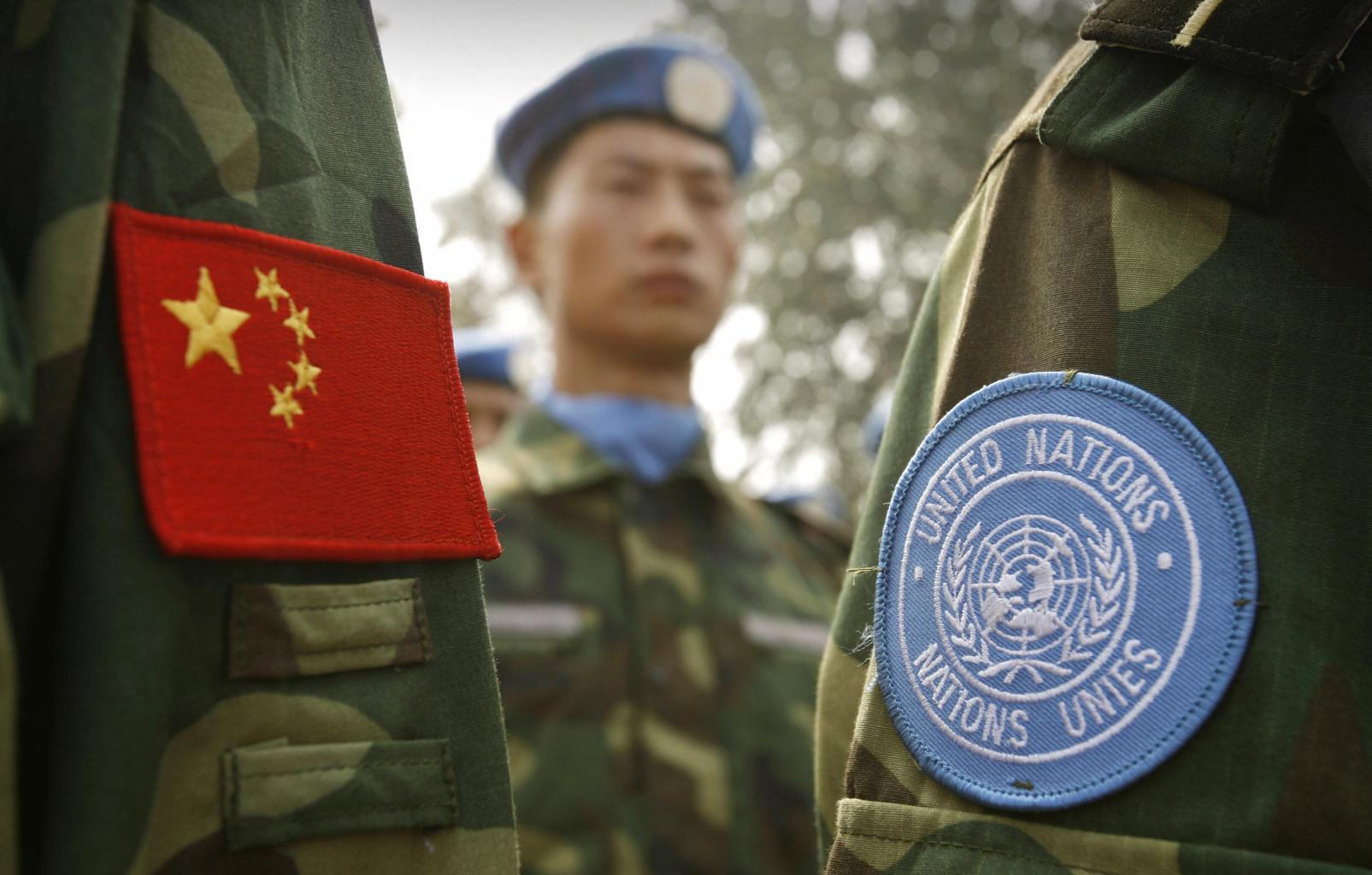
    UN peacekeeping operations have also been instrumental in this achieving geopolitical goals. China has deployed 200 soldiers in the Congo as part of the United Nations Mission in the Democratic Republic of the Congo (MONUSCO) because the country is home to significant cobalt and copper supplies that feed the Chinese economy.

    Cobalt is an essential element in lithium ion batteries you find in smartphones, laptops, electric car batteries. Lithium-ion batteries are supposed to be different from the dirty, toxic technologies of the past. Lighter and packing more energy than conventional lead-acid batteries, these cobalt-rich batteries are seen as ‘green.’

    China has a colossal stake in ensuring cobalt supplies remain steady, as the company that builds iPhones in China- Foxconn- requires a steady cobalt supply to ensure iPhones can make it to global markets at accessible prices. In early 2019 Apple noted that demand for iPhones was waning, causing a dramatic drop in Apple stock and a reduction in revenue from $91 billion USD to $84 billion USD.

    I also took a look at popular Chinese films, with a specific focus on the highest grossing film of 2017- Wolf Warrior 2. It was selected as China’s entry to the 2018 Oscars for Best Foreign Language film and is important because it’s indicative of a broad shift in Chinese foreign policy. The movie follows renegade soldier Leng Feng ass he assists the Chinese military in evacuating Chinese citizens from an unnamed African country. The symbolism within the film is meant to demonstrate that the UN is ineffective without Chinese support and that China, after decades of looking inward, is now ready to be an active participant in international affairs.

    Finally, I took a look at the relationship between Rwanda and China through international organizations. The ITU and Broadband Commission are two hugely important examples because of Rwanda’s willingness to embrace ICTs and China’s willingness to fund their construction. President Paul Kagame of Rwanda and Secretary Houlin Zhao, a Chinese telecom engineer, are the co-chairs of the United Nations Broadband Commission, the UN committee dedicated to the spread of internet.

    Kagame is determined to make Rwanda an ICT superpower, skipping over traditional stages of industrial development and transitioning straight to a heavily digitalized service economy. The use of ICTs is prevalent everywhere in the country- Rwanda is opening an airport for drones to deliver blood to rural hospitals that are inaccessible by road. This puts the small country of twelve million ahead of the US in the use of commercial drones. Chinese telecom giant Huawei recently announced that they’re building Rwanda’s national broadband infrastructure, data centres, and smart grids. Huawei has recently been banned from building Australia and New Zealand’s 5G networks and a similar ban is under consideration in Canada.

    Together this paints an interesting picture. China- a country that claims its intentions are peaceful and it has nothing but the good of humanity at heart- is clearly engaging in practices that often appear antithetical to those aims. Their use of UN peacekeeping forces for their own interests, predatory loans under the BRI umbrella, and support of undemocratic leaders makes China’s rise and use of international organizations especially relevant in our world today.

    Colin Mitchell is a fourth year (Honours) Politics student and Editor-in-Chief of The Athenaeum
  • Chinese Officials Lose Control Over Tiangong-1 Space Station

    Chinese Officials Lose Control Over Tiangong-1 Space Station

    The Chinese space station, “Tiangong-1”, is headed towards Earth. Chinese officials have also revealed that they currently have no clue where the space station is going to crash, but have predicted that it is to occur sometime in 2017. The craft is approximately the size of a bus (a length of about 34 feet and width of 11 feet), weighing 8.5 tonnes. It will most likely re-enter our atmosphere in small pieces.

    The Tiangong-1, which translates to “heavenly palace”, was originally launched in 2011 as an attempt to practice and carry out experiments relating to living in space and docking procedures with other space crafts. It was only built and intended for two year missions. Only recently, on September 14th 2016, did Wu Ping, the deputy director of China’s manned space engineering program, reveal that they had lost contact with the space craft back in March of 2016. Reasons why China’s space program have lost contact with Tiangong-1 currently remain unclear. While most unmanned space crafts burn and break apart upon entering the Earth’s atmosphere, this is usually closely monitored and highly controlled.

    Unfortunately, having lost all contact with the satellite, the Chinese space agency has very little influence over when and where it will crash. As of September 23rd, Tiangong-1 was orbiting above the Earth at approximately 370 kilometers. It has been losing just over 100 meters a day from both the Earth’s gravitational pull and atmospheric drag. By November 13th, the station will be roughly 364.9 kilometers above the Earth, having lost over 5,100 meters.

    When satellites reach the end of their intended lifespan, there are two options to dispose of them. The first is blasting it even further into the icy depths of space where it will never be seen again. The second option consists of slowing down the satellite using the last of its fuel so it can fall out of orbit and burn up in the atmosphere. While smaller satellites disintegrate upon entering the atmosphere at thousands of miles an hour, bigger crafts, i.e. Tiangong-1, may survive and are usually redirected to an area in the South Pacific Ocean known as the “spacecraft cemetery”. The cemetery is the safest place for satellites to crash because it is the point farthest away from any piece of land.

    So where will the space station crash? Nobody is able to know or even roughly estimate the site of impact at this time. Even when satellites reenter our atmosphere under controlled descents, no one is able to predict exactly where it’s going to crash due to factors like the descent angle, how much of the craft is left to burn, and if there are multiple fragments. Taking into account all these factors, means that the craft could crash practically anywhere on Earth.

    Despite all of this, officials claim that there is only a small chance that the satellite will hit a populated area. This is partially due to the fact that Tiangong-1 is hollow, which will cause it to burn up upon re-entry. Additionally, most of Earth’s surface (71%) is covered in water, with population density being a specific area on land, lessening the chance of the satellite posing any danger. However, that is only an estimate, and the only way to know for sure will be to watch the skies sometime in 2017.

  • Will the Moon Belong to China?


    American and Soviet forces have dominated space activity for the last couple of decades, and China will soon join them. The solar system represents a political and economic source of power. The nations that have successfully explored the moon are honored on earth with more prowess. Space exploration is seen as a symbol of success and a reflection of scientific development.

    To truly understand the beginning of Chinese rocketry, it is important to understand Qian Xuesen. Xuesen attended MIT in America after finishing at Shanghai Jiaotong University. He moved to Caltech to finish his PhD in the 1940’s. He helped to study jet propulsion when the U.S. went to war, and produced technology to counter German rockets. He also co-founded Caltech’s jet propulsion lab. After being accused of being a Communist sympathizer (he firmly denied political involvement) he was denied an application for U.S. citizenship. He was detained from America, and lost his U.S. security clearance. His trip back to China was the beginning of China’s assent into spatial power. Unfortunately, it was also the beginning of China’s opportunity to surpass the United States.

    In the current age, China is doing many things to increase their solar power. In the next 10 years, China is planning to reach the dark side of the moon, something that both American and Soviet space agencies have failed to do. The Chang’e 4 lunar mission is taking shape rapidly and will be a highlight of solar exploration in coming years. The mission team is currently deciding on a landing location as well as an instrument package. Human objects have not gone that far to date, and this will catapult China’s stance on a global level. This mission will hopefully lead to a ‘South Pole-Aitkin Basin’ sample return. The Chang’e 4 will focus more on Physics than Geochemistry, which was the primary focus of the Chang’e 3. When the Shenzhou 5 went into space for 21 hours, China began its rein.

    While NASA’s space budget is roughly 19.3 billion and widely outshines China, China had 19 successful space launches in the last year, which was the second highest in the world. Russia pulled ahead with 26, and America fell behind with 18. It is a very realistic possibility that China will surpass NASA in a couple of decades. James Lewis, a director at the Center for Strategic and International Studies, says that he, “… doesn’t worry about China suddenly leapfrogging [America] I worry about us being distracted and waking up to realize that they have a much more powerful position in space.” The QUESS satellite will likely be in orbit by the time this article is published. Standing for ‘Quantum Experiments at Space Scale’, QUESS marks a first in quantum encrypted information successfully passing between an orbiting satellite and the earth. By encrypting information in quantum states of particles like photons, all security threats are immediately visible to both the sender and receiver. Quantum encryption is academically unbreakable.  During a time of immense global surveillance, the sort of attack that this network could withstand would be immensely strong. It would allow the Chinese military to keep an eye on spies and to swap information. Since China is the only nation using quantum communications in the atmosphere, it puts them ahead by a lot.

    China’s rising spatial capabilities have lead to a conflict between Beijing and Washington. China’s space program is repeatedly cited in U.S. security reports as a growing source of trouble. China might have people walking around on the moon sooner than the U.S. China has also been interested in aligning with nations that aren’t as directly tied to Washington. Nigeria, Venezuela, and Pakistan have all used China’s military satellite navigation system, and this may lead to China aligning with these nations further in the future. Since NASA is unable to cooperate with China due to a congressional ban, it’s unlikely that the U.S. will benefit from these strides. However, many current partners of the U.S. may realign with China if it continues invite other countries to take part in its projects. In addition, if the expiring International Space Station closes in 2024, China will be the only nation up there. It is possible that these activities could be a catalyst for international peace. Since the solar system is becoming increasingly crowded, new decisions will need to be made to navigate a common frontier.

Betzillo positions itself as a versatile gaming hub where structured bonuses and adaptive gameplay mechanics support both short sessions and extended play.

Built with a focus on innovation, Spinbit integrates modern casino architecture with rapid transactions, appealing to players who value speed and digital efficiency.

Ripper Casino emphasizes bold entertainment through high-impact slot titles and competitive promotions crafted for risk-oriented players.

A friendly interface and stable performance define Ricky Casino, offering a casual yet reliable environment for a wide spectrum of gaming preferences.

King Billy Casino channels classic casino spirit into a modern platform, delivering recognizable themes supported by contemporary reward systems.

Immersive visuals and layered slot mechanics are at the core of Dragonslots, creating a narrative-driven casino experience.

Lukki Casino appeals to players seeking direct access and minimal friction, focusing on fast loading times and intuitive controls.

Casinonic provides a structured and dependable gaming framework, blending modern slots with transparent operational standards.