Tag: Elections

  • SRC Decoded: What You Missed March 11th

    SRC Decoded: What You Missed March 11th

    The Students’ Representative Council (SRC) is a council composed of a body of students elected by their peers, who are tasked with running the Acadia Students’ Union (ASU). The SRC meets every Wednesday at 5:30 PM in the Beveridge Forum located off the Michener Lounge in the Students’ Union Building (SUB). Each meeting is open to the public and students are welcome to attend meetings to learn more about the decisions being made on their behalf.

    This week’s meeting consisted of discussion surrounding a notice of motion to re-implement the “No” vote during elections, a project reflection from the MCAT and LCAT practice tests that were held, and recruitment for council members to assist with the soon-approaching House Council interviews.

    Notice of Motion: Yes/No Promotion

    Councillor Jonah van Driesum asked for the council’s approval in re-implementing the “No” option for students during elections. Councillor van Driesum raised concern that this was the first year without the “No” vote and, uncoincidentally, this year’s election had the worst turnout of voters. Responding to the concern, VP Student Life Robbie Holmes explained that the decrease in the number of voters was also due to the lower number of candidates running for positions this year, and the lack of campaigning that took place during the election process. In van Driesum’s opinion, the turnout is a result of people wanting a Yes/No vote and not getting it; furthermore, putting the “No” box back in will raise the voter count and improve the democracy of the election system.

    ASU President Kyle Vandertoorn commented that the decision to take away the “No” option was in an effort to prevent a re-election from happening in the case that an individual candidate is voted the majority “No”, and the council cannot fill the position. Moreover, the ‘No” option was taken out because if a student is so strongly against a candidate running for a position with the ASU, then they should run themselves. Historically, the “No” option is seldom chosen from students – the lowest recorded “Yes” result for a candidate was in the high eighties percentile.

    Some council members also commented that if a student or a group of students are so opposed to someone running for council, that person or group of people should have an outlet to express their concern. This is because some students, although strongly opposed to whoever is running or on council, may be apprehensive about taking on the position themselves, for example, the role of President. Councillor Molly Anderson offered that the impeachment process should also be re-implemented then, to “give Acadia students back their power”. As of right now, only council members have the authority to impeach other council members, which can be problematic.

    VP Finance and Operations Brendan MacNeil then voiced that he is disappointed in the council and the way this was executed. MacNeil stated, “it’s not a question of impeachment, it’s a question of the fundamentals of democracy. Do we represent the student body, or not?”

    Arts, Professional Studies, Science Senator Project Reflection

    Arts Senator Paige Stewardson, Professional Studies Senator Cassidy Churchill and Science Senator Nicole Kirkpatrick reflected on the opportunity they provided for Acadia students to write the MCAT and LCAT practice tests. The event took place on Sunday, and despite fewer students than expected being in attendance, the tests proved to be useful to students.

    Stewardson commented that although the practice exams are not marked, they offer an opportunity for students to practice. Reviews from students who were able to participate concluded that the event was helpful to them. The handful of students who were unable to attend asked if there would be a chance to write the practice tests again next year. As a result of the event’s success, Stewardson, Churchill and Kirkpatrick wish to make MCAT and LCAT practice available to Acadia students in the following years.

    Hiring Panel for House Council Executives

    VP Student Life Robbie Holmes announced that he is recruiting council members to assist in the interviewing process of hiring Acadia students for positions of House Council for each residence on campus. The interviews will most likely be held between 4pm and 9pm on March 23rd, 24th, 26th, 30th and 31st and April 2nd of this year in each of the correlating residence buildings.

    Announcements

    Hockey nationals are taking place in Halifax this weekend. Buses will be provided to transport any students who wish to attend. A bus and a half are already filled, and tickets are still available for purchase online. Additionally, food and drinks specials will be available at Dirty Nelly’s, who will be hosting Acadia students before each game. On top of this, there will be a Dirty Nelly’s gift card giveaway of between $30.00 and $50.00. The Axe Bar and Grill will also be showing the game Friday night for any students who are unable to attend.

    Sustainability Officer Max Abu-Laban announced to council that he has written an article for the Athenaeum regarding an appeal to have a labour policy for all workers on campus. The goal is to get enough petitions signed and student rallies together in an effort to have the movement passed. The point of a labour policy for all people who work at Acadia University is to specify for both employees and employers what people are entitled to as workers. This is a perfect way of protecting everyone who works on Acadia campus and ensures that the responsibility of employees is put directly on the university.

    Tuesday, March 17th is the Cheaton Cup hockey game. Students have been provided a section in a neutral zone and tickets are on sale in the Student Union Building (SUB) and Student identification is required.  The same night, (Tuesday, March 17th ), Big Fish will be performing at the Axe Bar and Grill.

    This upcoming Sunday, March 15th, there will be a community clean up beginning at 1pm at University Hall. Stop in at any time to help keep campus clean!

  • Editorial: Bylaw Revisions are Undemocratic

    Editorial: Bylaw Revisions are Undemocratic

    The Acadia Students’ Union recently released the revised bylaws to be voted upon in the next few weeks. These come after last year’s General Election which nearly caused a constitutional crisis and led to the resignation of the Chief Returning Officer. There is no doubt that the bylaws needed to be overhauled to ensure the stability of the Union and to ensure that the ASU lives up to its mission statement– serving its members through effective representation and communication, offering innovative services to enhance the student experience at Acadia.

    Revisions to these bylaws have come after the Students’ Representative Council (SRC) approved a $10,000 payment from the Wellness Fund to the ASU lawyer Tom MacEwan to assist in the redrafting. Numerous consultations occurred in the last academic year and during this academic year to provide students the opportunity to voice their concerns.

    The changes include:

    Three non-executive positions– the Student Board of Governors Representative and two Councillors- have been axed while the number of Executive positions has stayed the same. These positions had been considered redundant by some, but the proposed structure would give the Executive a greater share of the SRC to influence votes and major decisions.

    Students can no longer initiate referenda by petition under the new bylaws. Only referenda approved by the SRC can be put on the ballot rather than those initiated by the students they represent. Under the current bylaws students can initiate referenda with a petition holding signatures from 10% of the student body. Even under federal law a petition can be presented in the House of Commons if it has 500 signatures. In the UK 100,000 signatures are necessary for a debate by Parliament.

    An international student representative is still missing. Despite the fact that almost 15% of Acadia is composed of international students there is still no formal representative on SRC to represent them. The Diversity and Inclusion Representative is a step in the right direction, but a dedicated international student representative is still necessary.

    The SUB Renewal Committee is gone. Last year’s SRC passed a resolution that created a standing committee with the task of ensuring that the renewal of the Students’ Union Building is directed by students for students. The new bylaws propose to axe the committee, presumably leaving the power to decide how the building is shaped in the hands of the Executive or to the university and their donors.

    Powers of the Chief Returning Officer to conduct independent elections are reduced. In their stead, an Elections Committee composed of Council members has more authority than in previous years. In a perfect world the Chief Returning Officer would have the authority to conduct elections independent of the SRC to ensure that current members of Council do not sway decisions to ensure their friends win. We understand the need for a committee to exist, since the CRO cannot do it by themselves, but an ASU committee with interested Council members is problematic.

    Union Media has no power to endorse candidates or positions. The principle of a free and independent press is one that is not practiced during election periods within the ASU. The Athenaeum has no power to endorse candidates with sensible policies nor sides in referenda that could influence the course of the ASU for years to come. In fact, we are one of the only student newspapers in Canada to not have the power to endorse our own positions during election times. We are instead bound by the ASU to solely report the happenings of the election period but not share our voice during the election.

    Constituents cannot impeach their representatives. This was a feature of the former bylaws where students could impeach their representatives if first 35% of their constituents were present. It could then go to another meeting where the students present, assuming they get the requisite signatures necessary and a two-thirds majority, could impeach their representative. This exercise of direct democracy has precedent- Vice Presidents of the ASU were impeached in the early 2000s by their constituents.

    We believe the most recent bylaw changes are undemocratic and run contrary to the ASU’s mission statement- serving its members through effective representation and communication. Perhaps a smaller Council is better, but without addressing key democratic deficits the problems of representation will continue to grow. Power should not be concentrated at the hands of the Executive by virtue of a lack of opposition. Shutting students out of the process to get referenda on the ballot is directly contrary to the ASU’s mission of effective representation.

    International students do not benefit from these bylaw revisions. If constituting 15% of the population of the university does not entitle international students to adequate representation within student government, there are more serious questions to ask about who these bylaws were rewritten for. Even though the Acadia 2025 Task Force identified the SUB as a key element of Acadia’s growth, the ASU proposed to revoke the committee. The reimagining of our home must be kept in students’ hands, and the student-centric focus of the SUB Renewal Committee ensures that. After all, what was the point of fighting for a statement of autonomy if students aren’t going to exercise it?

    If the ASU claims to uphold the values of integrity, excellence, respect, community spirit, and the tradition upon which it was founded, it must address these problems as soon as possible. We have faith in our representatives to make positive change on behalf of the students they represent. Let us hope they act on it.

  • ASU Election Results Released

    ASU Election Results Released

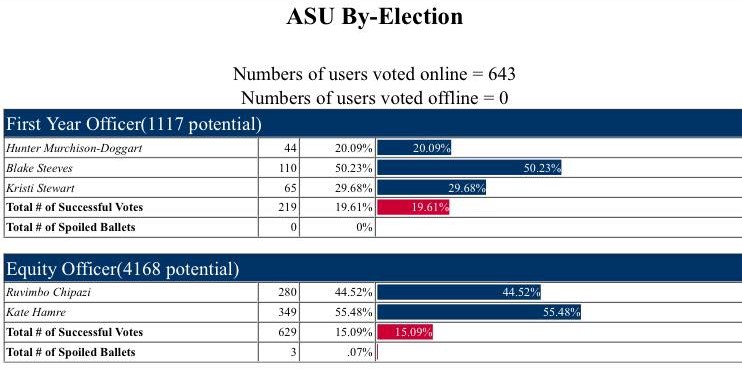
    At 4:32 PM today, ASU President George Philp sent out an all-student email announcing that the following candidates had been elected to the ASU Students’ Representative Council in the 2018 Fall By-Election.

    First Year Officer – Blake Steeves

    Equity Officer – Kate Hamre

    The Students’ Representative Council is the body of student who are elected each year to run the Acadia Students’ Union. More information on what they do and how you can get involved is available at www.theasu.ca. 

  • $10,000 ASU By-Law Review Financed by Wellness Fund

    The ASU is meeting today on Tuesday, March 27th at 5:00pm in the Beveridge Forum (off of the Michener Lounge in the SUB) to discuss plans for an upcoming by-law revision.

    The ASU, by way of the Student Funding Committee, has approved $10,000 from the Wellness Fund to revise ASU by-laws. Students contribute $30 annually to the Wellness Fund, which can be drawn upon by Acadia students and organisations with the purpose of “accommodat[ing] the individual needs of students and enhanc[ing] their overall sense of wellness through various initiatives.”

    In the meeting, Council will hear a presentation on the by-law revision process from the ASU lawyer and provide input on the process. There is speculation that the ASU Executive team has already likely contributed extensively to the process.

    The ASU plans to expedite this by-law revision, condensing the process to a couple of weeks in length. This would outpace previous changes made to the ASU by-laws: for example, the Elections by-law alone took months to revise. With this condensed timeline, it is a concern that there may not be adequate time or opportunity for comprehensive student consultation, resulting in the general student population having only a limited say in processes that impact them and that are being funded with their money.

    Such large funding decisions need to have student input in the first place to ensure that the decisions represent the will of the students. If the ASU were to take the time to engage the student body in these processes, they may have access to individuals and services who can offer consultation or non-profit by-law revision expertise for free or at low cost.

    The process is irregular in the way it is being done as the Governance Consultant retained by the ASU will not be used, and neither will the Governance Committee, which was set up for this very purpose and would be free of cost. It is concerning that regular processes are being sidestepped.

    Although the $10,000 expenditure is irreversible, student engagement with this process is still imperative. By actively participating in upcoming meetings, we can demonstrate to the ASU that students are watching and are holding the ASU accountable–that we care about the outcome of this process, and how our valuable money is spent. Students should question this lack of transparency by the ASU, and should advocate for more sound decision making regarding funding.

    Participate in the Council meeting this evening, or otherwise let the ASU know how you feel. It is important to have student voices heard. The meeting is at 5:00pm, Tuesday, March 27th in the Beveridge Forum, off of the Michener Lounge in the SUB.

    Ellie Valle is a 4th Year Community Development major and the current SRA of Crowell Tower.

  • ASU General Election: What You Need to Know

    ASU General Election: What You Need to Know

    The 2018 ASU General Election has begun, promising two weeks of exciting campaigning. The entire Students’ Representative Council is up for election for the 2018-19 academic year, with changes in the dynamic of our student government expected.

    What is the Students’ Representative Council? 

    The Students’ Representative Council (SRC) is the governing body of the Acadia Students’ Union, responsible for representing students across campus. All students are automatically members of the Union by virtue of paying student fees. SRC is responsible for determining major policy initiatives, such as referenda, the appointment of certain officials like the VP Finance & Operations, hosting programs, and sending recommendations to larger forums like the University Senate or the Board of Governors.

    Which positions are up for election? 

    The Executive Board, consisting of:

    • President
    • Vice President Student Life
    • Vice President Events & Promotions
    • Vice President Academic & External

    The VP Finance & Operations position is not elected but appointed by the ASU Hiring Board. 

    Non-executive positions include:

    • Student Board of Governors Representative
    • Community Relations Officer
    • Sustainability Officer
    • Equity Officer
    • Arts Senator
    • Science Senator
    • Professional Studies Senator
    • Councillor x4

    First Year Officer is elected in a by-election in the fall, along with any other unfilled positions. 

    Are there debates? 

    Executive candidates will debate on the Main Level of the SUB at 5:30 on Monday February 5th. Non-executive candidates will debate at 5:30 on Tuesday February 6th. The Athenaeum and Axe Radio are co-sponsoring a debate held on Axe Radio on Friday February 9th from 5:30-8:30. The schedule is as follows:

    • 5:30-6:15 VP Student Life
    • 6:15-7:00 VP Events & Promotions
    • 7:00-7:45 VP Academic & External
    • 7:45-8:30 President

    When can I vote? 

    Every student will receive an email on the morning of February 13th. Voting will commence at 8AM and continue until 4PM on February 14th, with the official results announced at 4:30PM by the Chief Returning Officer.

  • 10 Most Interesting Elections of 2017

    10 Most Interesting Elections of 2017

    Elections are a test to see if democracy works. This year, The Athenaeum has compiled the 10 most interesting elections of 2017 to remind ourselves of the importance of the democratic process. They are in descending order:

    1. Nova Scotia Provincial Election: May 2017

    This was definitely not a nail-biter, but it was fascinating to see how the political climate in Nova Scotia has changed. Stephen McNeil’s Liberals were the favourites going into the election, which was held on May 30. His majority was reduced to 27/51 seats for the Liberal Party, with the Progressive Conservatives gaining 7 seats for a total of 17 and the NDP gaining a total of 2 seats for a total of 7 in the legislature. Major issues surrounding the election included health care, Nova Scotian exports, primary and secondary education, and job creation. This election was notable because of the low university student turnout, due in part because of its timing after the academic year.

    1. United Kingdom General Election: June 2017

    Prime Minister Theresa May called this election to strengthen her hand for upcoming Brexit negotiations, which ultimately backfired spectacularly. It was, as our Features Editor would say, a “flaming dumpster fire” for the Conservative Party as they lost their majority and were forced into a minority government, only staying in power with the support of the DUP, a right-wing anti-abortion Northern Irish party. Major issues in the election included Brexit and the UK’s role in the European Union, university tuition, the recent Grenfell Tower fire, and social security.

    1. German Federal Election: September 2017

    This election, much like the one in France, was seen as a test against rising populism and nationalism in Europe. Chancellor Angela Merkel was successful in her run for a fourth term, one of the only in Germany history, and her Christian Democratic Union (CDU) was able to secure a plurality of seats in September of 2017. Major issues in this campaign included immigration and Germany’s place in the EU. Run using of Mixed Member Proportional Representation the CDU was unable to secure a majority, and recently talks between smaller parties and the CDU have collapsed, leaving Merkel’s fate as Chancellor of Germany uncertain.

    1. British Columbia Provincial Election: May 2017

    Notable for the election of the first Green caucus in North America, British Columbia’s election in May 2017 was a nail biter. The BC Liberal Party, a centre-right wing free enterprise party led by Christy Clark, was reduced to a minority by a surge from the NDP and Greens in metro Vancouver and Vancouver Island, respectively. Clark tried to maintain the confidence of the House but the government fell after she visited the Lieutenant Governor, who then called upon NDP leader John Horgan to become the next Premier of British Columbia. Major issues in this election included transit, the construction of the Site C Dam in Northern BC, and affordability of housing.

    1. French Presidential Election: May 2017

    Seen as a litmus test for the wave of xenophobia hitting North America and Europe, the French Presidential election was dramatic. Former Prime Minister of France Francois Fillion was embroiled in a scandal early on, and the introduction of the young former Minister of Economy Emmanuel Macron and his centrist En Marche! movement changed the French political landscape. Neither of the two strongest parties in French history, the Socialists and Republicans, made it into the run-off where Macron faced off against Front Nationale xenophobe Marine Le Pen. Macron won with 66% of the national vote in the run-off, with only two Départments in northern France (Aisne and Pas-de-Calais) voting for Le Pen.

    1. Japanese General Election: October 2017

    In the midst of the North Korean Missile Crisis, Japan held a general election that resulted in Prime Minister Shinzo Abe being the first Prime Minister to win three consecutive elections since 1953. One of the major issues in this election was the controversy surrounding Article 9 of the Japanese Constitution, which forever renounces war as a tool by the Japanese people. Abe is looking to revise the Constitution for Japan to properly defend itself and with the support of his Liberal Democratic Party and Komeito, a socially conservative Japanese nationalist party.

    1. Gambian Parliamentary Election: April 2017

    The Gambia’s parliamentary elections were the first held since the inauguration of Adama Barrow as President and seen as a test for democracy in Western Africa. Of the 58 available seats, the centre-left United Democratic Party took 31. The UDP were one of 7 coalition parties to back Barrow, who challenged former President/dictator Jammeh, who was forced from office after contesting the results of an election that Barrow won. This achieves the #4 spot because of its House of Cards-esque drama and its potential for positive change in West Africa.

    1. Iranian Presidential Election: May 2017

    Incumbent President Hassan Rouhani, who has been described as a political moderate compared to his predecessor, was re-elected with 57% of the vote. It is important to note that this is a country that Freedom House classifies as Not Free “due to the role of the hard-line Guardian Council, which disqualifies all candidates deemed insufficiently loyal to the clerical establishment”. This election was important because it reflected Iran’s desire to stay the course in a world where Donald Trump is part of international politics.  Iran makes it to #3 because under Rouhani’s leadership it will undoubtedly play a much larger role as a regional power, especially in Syria and Yemen.

    1. Venezuelan Constituent Assembly Election: July 2017

    Since the death of Hugo Chavez in Venezuela, his successor Nicolas Maduro has been in trouble. Massive inflation, a result of declining oil prices, has put massive pressure on the heavily socialist government to do something. In March 2017 the Supreme Court took over the powers of the opposition-led legislature, but quickly rescinded their decision after massive public backlash. This led for calls to create a Constituent Assembly to rewrite the Constitution in Maduro’s favour, which passed with flying colours. Now Maduro has the authority to eliminate all democratic institutions in Venezuela, to the condemnation of much of the international community. This reaches #2 because it will set Venezuela on a course that will draw much attention and have heavy ramifications on neighbouring countries in Latin America.

    1. Kenyan General Election: August/November 2017

    Our #1 spot goes to Kenya this year. In August 2017 the presidential election was contested between incumbent President Uhuru Kenyatta and challenger Raila Odinga. Kenyatta won in August with 54% of the vote, but Odinga contested the results in the Supreme Court. The Supreme Court annulled the results and called for fresh elections in October, but Odinga withdrew his candidacy citing the lack of preparation made by the electoral commission. This gains our #1 spot as it was a test for democracy in eastern Africa, and indicative of the strengthened institutions that Kenya has worked for many decades towards.

Betzillo positions itself as a versatile gaming hub where structured bonuses and adaptive gameplay mechanics support both short sessions and extended play.

Built with a focus on innovation, Spinbit integrates modern casino architecture with rapid transactions, appealing to players who value speed and digital efficiency.

Ripper Casino emphasizes bold entertainment through high-impact slot titles and competitive promotions crafted for risk-oriented players.

A friendly interface and stable performance define Ricky Casino, offering a casual yet reliable environment for a wide spectrum of gaming preferences.

King Billy Casino channels classic casino spirit into a modern platform, delivering recognizable themes supported by contemporary reward systems.

Immersive visuals and layered slot mechanics are at the core of Dragonslots, creating a narrative-driven casino experience.

Lukki Casino appeals to players seeking direct access and minimal friction, focusing on fast loading times and intuitive controls.

Casinonic provides a structured and dependable gaming framework, blending modern slots with transparent operational standards.