We are a group of students from Acadia university currently conducting research on the Kingston Sand Barrens, the intent of this article is to hopefully raise awareness for the sand barrens. Specifically, we aim to stress the multiple benefits of the barrens, and the ways in which they are currently being endangered.
The Kingston Sand Barrens is an endangered ecosystem. Sand barrens are often perceived to have little to no intrinsic value, and as a result they are often destroyed for more “productive” uses including building airports, sand mining, construction of houses, establishing graveyards, and more. It’s estimated that roughly 97% of the original sand barrens have been lost due to fire suppression, agricultural development, sand quarrying, and invasion of non-native species. Also, due to human activities such as ATV driving, the remaining ecosystems are being disrupted, plant cover is getting damaged, and there is a reduction of biodiversity. This leaves the barrens susceptible to sand erosion, as the sand is no longer bound in place by vegetation. The blowing sand not only becomes a nuisance to drivers on the adjacent highways, but it also causes damage to the agricultural sector and home gardeners alike. The traveling sand (when blowing onto fields and home gardens) makes the soil less productive and subsequently increases the need for fertilizers. This further exacerbates the issue that the soil in the historically sand barren areas is not very fertile to begin with, as it is mostly composed of sand. This increases the need for chemical fertilizers even further, which leads to issues like chemical run-offs, eutrophication , and water pollution. By protecting the sand barrens, we can also preserve the whole ecosystem. One of the main services it provides is a natural water filter which purifies the water and minimizes the risk of water pollution.
If you’re interested in learning more about the sand barrens make sure to visit our website: www.sandbarrensns.ca. Here you’ll find more information on the species found in the barrens, ways in which they’re being endangered, and ways that you can help.
The K.C. Irving Environmental Science Centre is a beautiful representation of the natural science community that exists at Acadia. The spacious and comforting Garden room with its’ cheerful citrus trees is a popular study place among students. The greenhouses are busy with various projects, and the downstairs laboratories are alive with professors and students doing interesting and often important work on everything from mercury contamination to seed preservation. It is obvious that the K.C. Irving Centre is a hub of academic activity.
The K.C. Irving Environmental Science Centre is named to honour the founder of Irving Oil and Acadia alumnus, Kenneth Colin Irving. The Harriet Irving Botanical Gardens is named in honour of Kenneth Irving’s wife, Harriet Lila Irving.
The centre, as well as the Harriet Irving Botanical Gardens, are gifts to Acadia University from his family, and were opened in 2002.
In 2014, the Arthur Irving Academy was inaugurated by Arthur and Sandra Irving, son and daughter in law of Kenneth Colin Irving. The Arthur Irving Academy aims to support students in environmental studies through education, research and scholarships.
While Arthur Irving Scholars are expected to become involved in activities in the Irving Centre, there are also opportunities for any motivated and hard-working student to become involved with the Acadia Seedbank, plant tissue culture work, the E.C. Smith Herbarium, the greenhouses, or the CARE labs. Such opportunities may help students further down the road, by helping to identify key interests and providing invaluable hands on experience.
The Arthur Irving Scholarships in Environmental Studies are awarded to students in the fields of Biology, Environmental Science, Environmental Sustainability, and Environmental Geoscience. Arthur Irving Scholars are expected to become active members of the K.C. Irving Centre community, by volunteering, and providing mentorship to younger students. The scholarship also aims to provide recipients with research and learning opportunities in the K.C. Irving Centre and Harriet Irving Botanical Gardens.
Hannah Machat and Rachel Clarke, both Arthur Irving Scholars, offered their insights about their experience in the K.C. Irving Centre.
Machat is a fourth-year environmental science student who has been in the Arthur Irving Scholarship program since her first year. She has had a variety of experiences with the K.C. Irving Centre throughout her time at Acadia that have exposed her to many different academic paths. Machat considers the many connections she made in the Irving Centre as having been integral to her experience as an environmental science student at Acadia.
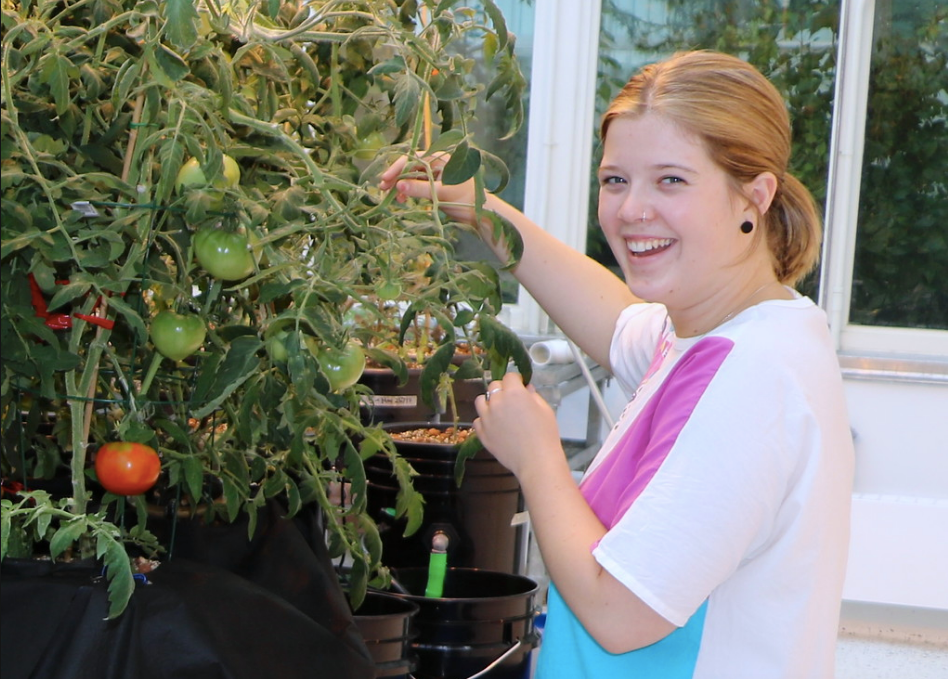
One of Machat’s experiences included working as a research assistant growing tomatoes for an aquaponics project, as part of her co-op work term in 2nd year.
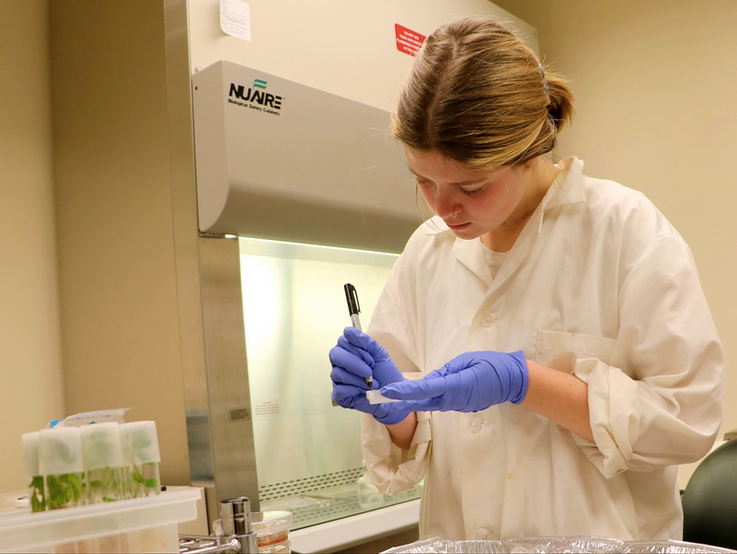
In her third year, Machat completed her second co-op with Agriculture Canada. She also volunteered in the plant tissue culture lab in the K.C. Irving Centre. Both experiences were very valuable to Machat, who learned many laboratory skills and discovered more about her interests.
Courtesy of David Kristie
Now in her fourth year, her honours research is concerned with the reproductive consequences of the endangered plant Rockrose (Crocanthemum canadense) and florivory by the moth, Mompha capella . Although Hannah is an ENVS student, her research is supervised by Dr. Rodger Evans, a professor in the biology department.
Rachel Clarke, now a Masters student upon having completed her undergraduate degree in Environmental Science through the Irving Scholarship program, has also had many diverse experiences as a result of her connections to the K.C. Irving Centre.
At first a little unnerved about the prospect of eventually conducting her own research, Clarke started talking to some older Irving Scholars. Being exposed to the research conducted by the older Scholars made research seem more approachable– even fun and exciting.
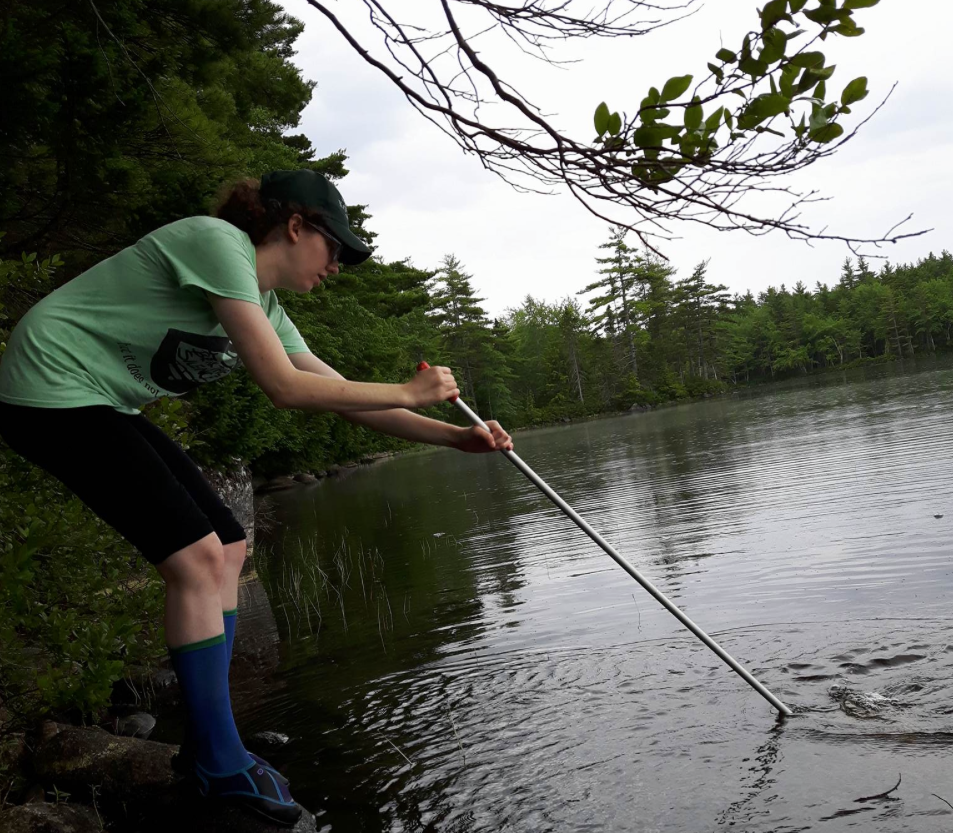
In her second year, Rachel worked as a lab assistant in Dr. O’Driscoll’s mercury lab, which ultimately led her to discover her interest in the field of contaminants and mercury. Rachel spent the summer after her second year a field and laboratory assistant, assisting in sample collection and preparation on Brier Island, Nova Scotia.
Clarke in the field, courtesy of David Kristie
By her third year, Rachel knew that she wanted to continue to work in Dr. O’Driscoll’s lab for her Honours research, largely out of the opportunities she had to work in the C.A.R.E. mercury laboratory in the Irving Centre with “such great people”. Her honours research was concerned with mercury bioaccumulation in invertebrates in Kejimkujik Park.
Rachel has now been awarded a Master’s Irving Scholarship to continue her research on mercury contamination in Dr. O’Driscoll’s lab. Rachel’s Master’s thesis is concerned with the influence of water salinity on mercury reactions in estuaries and interconversions.
While both Machat and Clarke are Arthur Irving Scholars, they credit the many opportunities they have experienced not just to the scholarship program, but to the many connections they made through the K.C. Irving Environmental Science Centre. These connections can be made by all students wanting to enhance their environmental education. The importance of connections was something that came up often in our conversation, and should not be overlooked by any students, Arthur Irving Scholar or not.
As Rachel poignantly expressed, “when you get passionate, like-minded and driven students together, really interesting things can happen”. The K.C. Irving Centre is an incredible resource for making connections of all kinds– highlighting the increasing collaboration needed to overcome the environmental challenges of today.
Sarah Lavallée is a first year ESST student and 2018-19 Arthur Irving Scholarship recipient
Betzillo positions itself as a versatile gaming hub where structured bonuses and adaptive gameplay mechanics support both short sessions and extended play.
Built with a focus on innovation, Spinbit integrates modern casino architecture with rapid transactions, appealing to players who value speed and digital efficiency.
Ripper Casino emphasizes bold entertainment through high-impact slot titles and competitive promotions crafted for risk-oriented players.
A friendly interface and stable performance define Ricky Casino, offering a casual yet reliable environment for a wide spectrum of gaming preferences.
King Billy Casino channels classic casino spirit into a modern platform, delivering recognizable themes supported by contemporary reward systems.
Immersive visuals and layered slot mechanics are at the core of Dragonslots, creating a narrative-driven casino experience.
Lukki Casino appeals to players seeking direct access and minimal friction, focusing on fast loading times and intuitive controls.
Casinonic provides a structured and dependable gaming framework, blending modern slots with transparent operational standards.