Tag: medicine

  • Discovery of Hepatitis C: Noble Prize in Medicine/Physiology 2020

    Discovery of Hepatitis C: Noble Prize in Medicine/Physiology 2020

    It’s October, which is also known as the Nobel Prize season amongst scholars. The Nobel prize winner’s announcements began on Monday, October 5th, 2020, with the Physiology and Medicine category. The announcements began in Sweden, though due to the ongoing pandemic, some events usually organized by the Nobel Prize committee were cancelled.

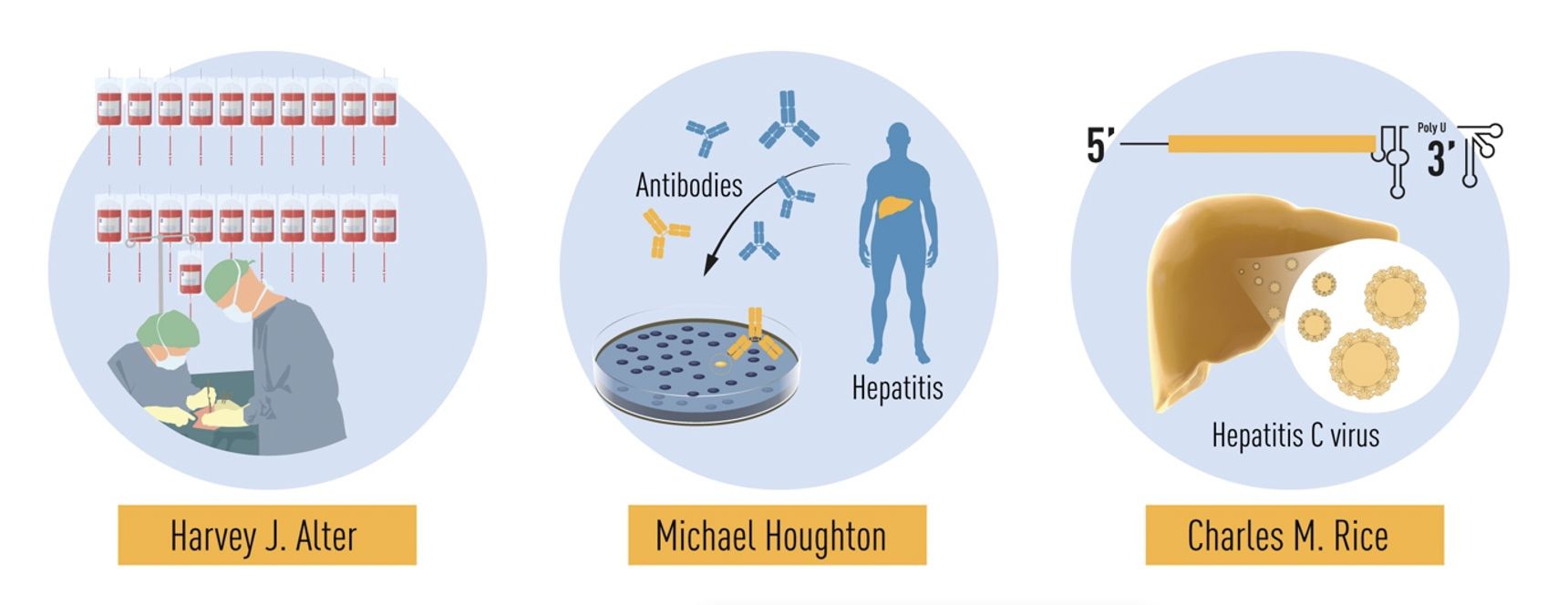
    This year’s Nobel prize winners for the category of Physiology or Medicine were Harvey J. Alter, Michael. Houghton and Charles M. Rice. They were jointly awarded the prize for their discovery of the Hepatitis C virus. They made a significant contribution to fight against the blood-borne disease. The discovery of Hepatitis C virus has definitely helped in unfolding the remaining cases of chronic hepatitis which has made it possible to save millions of lives and improve overall global health.

    Harvey J Alter was born in 1953 in New York and graduated from Rochester Medical School. In the year 1961, he became a part of the National Institute of Health (NIH) team as a clinical associate. He joined NIH back in 1969 as a senior investigator in the Clinic Centre’s Department of Transfusion Medicine.

    Michael Houghton is a British born doctorate degree holder from King’s College in London. He moved to California in the year 1982 and came to the University of Alberta in the year 2010. He is currently the Director and Research chair in Li Ka Shing Applied Virology Institute, as well as research chair at Canada Excellence.

    Charles M. Rice was born in the year 1952 in Sacramento and got his PhD in the year 1981 from the California Institute of Technology. He founded his own research group at Washington University School of Medicine. He was the Scientific and Executive Director at the Centre for the study of Hepatitis C at Rockefeller University where he is currently active.

    Hepatitis is looked at as a global threat to human health as it can cause cirrhosis, liver failure, liver damage, liver cancer or even death in severe cases. Hepatitis is also referred to as liver inflammation which is mainly caused by viral infections, although some other major disease-causing factors include alcohol abuse, autoimmune disease, environmental toxins, some medications etc. There are three most common hepatitis viruses Hepatitis A, Hepatitis B and Hepatitis C. Hepatitis B and C are transmitted via blood and bodily fluids and are considered pretty serious as in severe cases/chronic stages the development of cirrhosis and liver cancer can occur. This is because in some cases after a short-term infection, the virus stays in the body and causes a chronic infection. While on the other hand, Hepatitis A is transmitted through polluted food and water and is usually considered a short-term infection, depending on the cause and severity. Although the three types of viruses can show similar symptoms, the way they spread and affect an individual is different.

    Bloodborne Hepatitis-C is considered dangerous since a healthy individual could be infected and would not necessarily be aware of its presence for several years until serious effects start showing up. Hepatitis C is also linked to morbidity and mortality at times because it causes more than a million deaths worldwide each year. It can range from mild to acute illness. Acute Hepatitis C usually occurs within 6 months of exposure to the Hepatitis C virus and is usually a short-term illness if not converted into the chronic infection. Chronic Hepatitis C on the contrary can be a life-long infection if it remains undetected, and could lead to serious diseases like cirrhosis, liver damage, liver cancer or death.

    Identification was the first step to attain the goal. Michael Houghton isolated the genetic sequence of the virus and collected a collection of DNA fragments from nucleic acids found in the blood of an infected chimpanzee. Most of the fragments were taken from the genome of the chimpanzees but the research team suspected some to come from the unknown virus. The scientists used the hepatitis infected patient’s blood to identify cloned viral DNA fragments encoding viral proteins. After a lot of in-depth research, one positive clone was found. This clone was derived from an RNA virus which in turn was from the Flavivirus family and got named as the Hepatitis C virus.

    The major hurdle in the process was to determine if the virus alone is causing hepatitis. Investigations were done on cloned viruses to check if the virus is able to replicate itself and Charles M. Rice, along with his team, while working on the RNA virus observed a very essential piece of information. They saw that there exists an uncharacterised region at the end of the Hepatitis C virus genome. The thought that it might be an essential component for virus replication. He also happened to notice some genetic variations in the isolated sample of the virus and suspected that some of them might be hindering virus replication. Using Genetic engineering Charles came up with a variant RNA of the virus which included a new region and was devoid of inactivating genetic variations. He then injected this newly formed RNA into the liver of chimpanzees. The virus was detected in the blood and pathological changes were similar to ones observed in humans who were suffering from chronic diseases. This made them believe that the virus alone can cause deadly disease.

    Discovery of the Hepatitis C virus has made it possible to conduct highly sensitive blood tests, as well as rapidly develop an antiviral drug directed at Hepatitis C. It is now possible to cure this disease which can be seen as the final milestone in the journey of eradication of the Hepatitis C virus globally.


  • 8 jobs that aren’t being a doctor in case you disappoint your mom and don’t make it into medical school

    8 jobs that aren’t being a doctor in case you disappoint your mom and don’t make it into medical school

    As the last semester of university approaches for our graduating class of 2019, so does the anxiety about what’s beyond the horizon. For many, disappointment is eminent; however, there is still hope for those who get rejected. Maybe you forgot that Acadia doesn’t actually offer a premed degree and got angry about having to learn about plants and animals and all that lame stuff, but guess what? That stupid education you paid for is more than just a stepping stone to medical school! You can actually apply that knowledge to in fields beyond medicine! If you feel more lost than Nemo about what to do past graduation other than drink and cry a lot, check out these cool career ideas.

    1. Pharmacist

    This is the go-to for those interested in medicine who are not into the part where you actually have to touch people. Even if you hate the job, you’ve got access to all the antidepressants you could ever need to console yourself from the fact that you feel like you never really met your full potential. Plus, you get the perk of calling yourself a ‘professional drug dealer’ for the rest of your life!

    2. Forensics

    If the blood, guts and gore is what attracted you to medicine in the first place, you should probably consider never going near a living person ever again. You should also feel free transfer to SMU. 1. Because if that’s your motivation to go into medicine, I want you far away from me, and 2. They have a forensics program, this isn’t even a joke I’m just giving you facts here. So, get on it and check out your local crime scene! (As long as you’re not the one who made it).

    3. Aquaculturist

    Sometimes the wide variety of niches within science can be overwhelming and finding a career can be like finding a significant other – there are many fish in the sea! But maybe you should just put them all in a huge tank and manage them that way, because frankly the sea is fucking huge, kinda polluted, and I don’t trust bottom-feeders.

    4. Botanist

    Ok look, if your MCAT score proves you should never be trusted with the life of another person in your hands, maybe we can settle for just keeping plants alive. This is a great job if you’re insufferable to be around too; because unlike all your former friends, plants can’t go anywhere even if they hate you. Basically, if your classmates all gave you 1/10 on your peer evaluations for group projects, plants might be the study organism for you! However, if you kill cacti, maybe read the rest of the list.

    5. Brewer

    So, we’ve ruled out humans, animals and plants. Maybe you’ll be able to keep some yeast alive? You managed to keep that biofilm in your sink alive for a solid month when you stopped doing the dishes, just do that except maybe less gross this time? Plus, if your parents have been controlling your life decisions up to this point and only wanted you to enter medicine so they could tell all the other moms at yoga about the fact that their kid is a doctor, you can distract them from your failure with fun jokes like “gotta get this bread (making organism to produce ethanol from glucose for the masses to consume in an attempt to drown out the reality that we are all slaves to a capitalistic hellscape where attaining a career with high prestige for the money is deemed as “more successful” than doing what you love even if it’s less glamourous)”.

    6. Forestry management

    Hear me out: you could be a modern-day lumberjack living in a cabin you built with your own two hands with ethically sourced wood. You take your small pack of dogs for a walk in the forest and feed the woodland birds along the way. Small mammals follow you around like you’re Snow White. You’re definitely high on mushrooms you found on the forest floor, and the government has been trying to track you down for years since you have yet to pay back your student loans. They haven’t found you yet. Life is good.

    7. Nurse

    One time I told an older man that I was studying biology, which is usually met with “oh so you’re going to be a doctor”! But this time he asked if I was going into nursing. Because clearly my feeble female mind cannot handle the stresses of being a REAL doctor. And now you can feel inferior too! By getting a whole other degree at a different school! Debt is just a number and not a prison! I swear!

    8. Clown

    Lets just admit it- you’re boo boo the fool who thought their 2.5 GPA would get them into med school, its ok! We all make mistakes, and it looks like you made yet another mistake on a lonely Thursday night. Lucky for you, all you need to do to enter your new career is roll out of your vil hookup’s bed from the night before, take a look in the mirror to make sure that morning-after makeup is on point, and go entertain some children with your unsound life decisions!


Betzillo positions itself as a versatile gaming hub where structured bonuses and adaptive gameplay mechanics support both short sessions and extended play.

Built with a focus on innovation, Spinbit integrates modern casino architecture with rapid transactions, appealing to players who value speed and digital efficiency.

Ripper Casino emphasizes bold entertainment through high-impact slot titles and competitive promotions crafted for risk-oriented players.

A friendly interface and stable performance define Ricky Casino, offering a casual yet reliable environment for a wide spectrum of gaming preferences.

King Billy Casino channels classic casino spirit into a modern platform, delivering recognizable themes supported by contemporary reward systems.

Immersive visuals and layered slot mechanics are at the core of Dragonslots, creating a narrative-driven casino experience.

Lukki Casino appeals to players seeking direct access and minimal friction, focusing on fast loading times and intuitive controls.

Casinonic provides a structured and dependable gaming framework, blending modern slots with transparent operational standards.