Tag: moon

  • China’s Chang’e-5 Set to Bring Back Lunar Specimens by Mid-December: a Goal Since 1976

    China’s Chang’e-5 Set to Bring Back Lunar Specimens by Mid-December: a Goal Since 1976

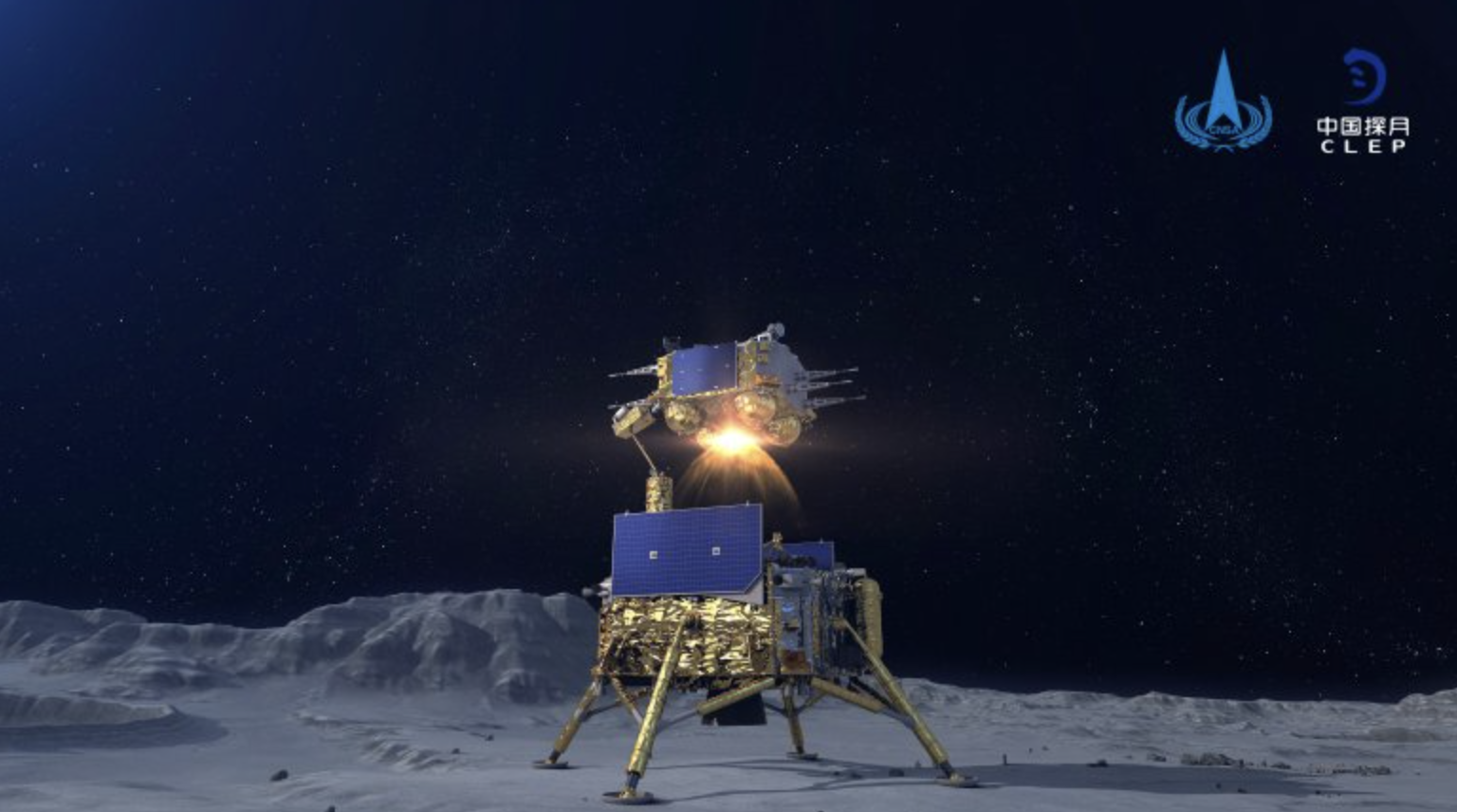
    Chang’e-5, China’s third successful uncrewed moon landing, has reached another milestone by not only landing on the Moon but also by spending two days on it, gathering rocks and dirt from the lunar surface. The goal of the spacecraft was to get the Moon samples to the Earth, which has been a goal of theirs since the year 1976.

    The spacecraft was launched from Hainan Island, which is located in the south of China, on November 24th 2020. The spacecraft, upon entry into the moon’s orbit, would split in two; the lander and the orbiter, where the lander will be on the surface and the orbiter will await its return. The spacecraft successfully carried out this procedure on Saturday, according to various sources. The lander is reported to have touched down at Mons Rümker which is a volcanic plain located on the Moon’s near side which is estimated to be around 1.2billion years old. However, this is considered much younger than the places which were explored by NASA’s Apollo mission and the Soviet Union’s Luna mission, as the places they explored were all more than three billion years old. 

    The lander of Chang’e-5 will need to accomplish its drilling and scooping tasks within one lunar day, which is equivalent to 14 days on Earth. The lander is not designed to survive the dark and frigid lunar night which can cause it to reach temperatures of -170° Celsius as there is no heating mechanism built-in the spacecraft. 

    The Chang’e-5 also includes a rocket attachment which before the Sunset would blast off with the lunar samples. The rocket will then dock with the orbiter to transfer the lunar samples and make its way back to Earth. The samples are expected to land in China’s Mongolia region by the middle of December. 

    The specimens which would potentially be researched by the scientists would be a great source of understanding of the Solar System’s evolution and the planetary scientists have been eagerly awaiting the additional samples. These samples would be of great value to scientists in order to calibrate techniques for estimation of the age of geological surfaces in the solar system’s; moon, planets, asteroids etc.  The Lunar samples would also help in testing hypotheses about the causes of volcanic eruptions which are evident in the region of the moon where the Chang’e-5 landed.


  • Water traced on Moon: Another Achievement by NASA

    Water traced on Moon: Another Achievement by NASA

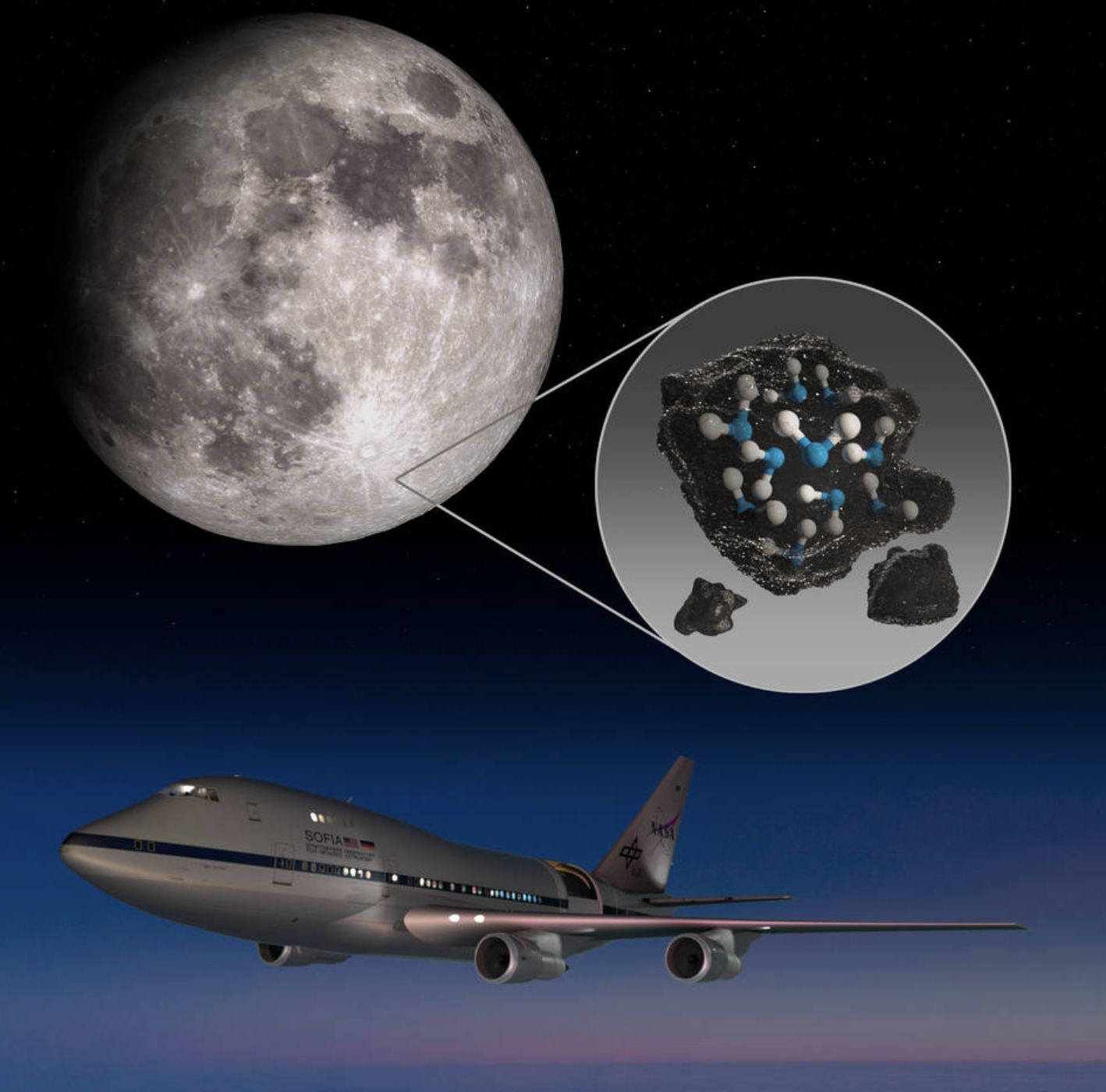
    For a long time, the moon has been thought of as waterless, though recently, numerous researchers have discovered water in some parts of the moon. New observations by the SOFIA telescope and Lunar Reconnaissance Orbiter by NASA reveal traces of water in some small dark craters as well as sun-baked lunar soil. Earlier large shadowed craters were thought to be a significant source of water storage.

     This discovery has proved itself to be a milestone in the mission to discover possible life on the Moon. SOFIA is a very innovative and unique approach by NASA in the field of lunar science. SOFIA- Stratospheric Observatory for Infrared Astronomy, is a modified Boeing 747SP jet which gives its telescope, which is 2.7 meter, a view above 99% of the atmosphere’s obstructive water vapor which helps in more precise observations.
    NASA’s SOFIA confirmed the presence of water on the sunlit surface of the Moon.
    Water molecules were detected on the Clavius Crater located on the southern hemisphere of the Moon, which is one of the largest craters visible from the Earth. Previous research and missions towards the Moon have revealed hydrogen molecules but some were not able to spot the difference between water (H 2 O) and hydroxyl (OH) since hydroxyl is a close chemical relative of water. The data from the location (Clavius Crater) has revealed the presence of a water concentration equivalent to 12-ounces of water trapped in a cubic meter of lunar soil which is
    spread throughout the lunar surface.

    The observations on the 10-minute span focused merely on the region in the southern hemisphere of the moon since it is the largest crater (Clavius) which revealed a very strong emission of infrared rays with a wavelength of six microns. The area warmed by the Sun was reemitting the absorbed radiation exactly how water (H 2 O) would.

    The researchers who led the project at NASA, also said that they aren’t familiar with any other material on the Moon that can emit single feature rays at 6 microns other than water. It is thought that the water might be stored in either the naturally occurring volcanic glass or is that it is between microscopic grains of rock dusk, in which case it suggests that it is getting shielded from the extreme conditions on the Moon’s surface, that is, high temperature and vacuum conditions. This would allow water to persistently exist, though there are no further answers to how water came to be there in the first place. The assumption is that water could have formed by the free oxygen and hydrogen which are liberated from the lunar rocks by the impact of the micrometeorites.
    Earlier in 1969, observations by astronomers G.R. Hunt and J.W. Salisbury, show how much they focused on the characterization of minerals on the lunar surface instead of water, despite noticing the spectral emission, not realizing their huge discovery.

    Now the Astronomers and scientists are planning to map the vast lunar surface in order to get some answers to questions concerning the characterization of the behavior of water, a variation of water behavior across the lunar surface in accordance with specific days, latitude, etc., source of water, etc. There are also some doubts within this discovery that this might also be just weak bonding of solar wind hydrogen with oxygen at the surface of grains of silicate glasses and minerals in the regolith as per Jack Schmitt who is a geologist and member of Apollo 17’s crew
    who are the last astronauts to have walked on the moon.

  • Will the Moon Belong to China?


    American and Soviet forces have dominated space activity for the last couple of decades, and China will soon join them. The solar system represents a political and economic source of power. The nations that have successfully explored the moon are honored on earth with more prowess. Space exploration is seen as a symbol of success and a reflection of scientific development.

    To truly understand the beginning of Chinese rocketry, it is important to understand Qian Xuesen. Xuesen attended MIT in America after finishing at Shanghai Jiaotong University. He moved to Caltech to finish his PhD in the 1940’s. He helped to study jet propulsion when the U.S. went to war, and produced technology to counter German rockets. He also co-founded Caltech’s jet propulsion lab. After being accused of being a Communist sympathizer (he firmly denied political involvement) he was denied an application for U.S. citizenship. He was detained from America, and lost his U.S. security clearance. His trip back to China was the beginning of China’s assent into spatial power. Unfortunately, it was also the beginning of China’s opportunity to surpass the United States.

    In the current age, China is doing many things to increase their solar power. In the next 10 years, China is planning to reach the dark side of the moon, something that both American and Soviet space agencies have failed to do. The Chang’e 4 lunar mission is taking shape rapidly and will be a highlight of solar exploration in coming years. The mission team is currently deciding on a landing location as well as an instrument package. Human objects have not gone that far to date, and this will catapult China’s stance on a global level. This mission will hopefully lead to a ‘South Pole-Aitkin Basin’ sample return. The Chang’e 4 will focus more on Physics than Geochemistry, which was the primary focus of the Chang’e 3. When the Shenzhou 5 went into space for 21 hours, China began its rein.

    While NASA’s space budget is roughly 19.3 billion and widely outshines China, China had 19 successful space launches in the last year, which was the second highest in the world. Russia pulled ahead with 26, and America fell behind with 18. It is a very realistic possibility that China will surpass NASA in a couple of decades. James Lewis, a director at the Center for Strategic and International Studies, says that he, “… doesn’t worry about China suddenly leapfrogging [America] I worry about us being distracted and waking up to realize that they have a much more powerful position in space.” The QUESS satellite will likely be in orbit by the time this article is published. Standing for ‘Quantum Experiments at Space Scale’, QUESS marks a first in quantum encrypted information successfully passing between an orbiting satellite and the earth. By encrypting information in quantum states of particles like photons, all security threats are immediately visible to both the sender and receiver. Quantum encryption is academically unbreakable.  During a time of immense global surveillance, the sort of attack that this network could withstand would be immensely strong. It would allow the Chinese military to keep an eye on spies and to swap information. Since China is the only nation using quantum communications in the atmosphere, it puts them ahead by a lot.

    China’s rising spatial capabilities have lead to a conflict between Beijing and Washington. China’s space program is repeatedly cited in U.S. security reports as a growing source of trouble. China might have people walking around on the moon sooner than the U.S. China has also been interested in aligning with nations that aren’t as directly tied to Washington. Nigeria, Venezuela, and Pakistan have all used China’s military satellite navigation system, and this may lead to China aligning with these nations further in the future. Since NASA is unable to cooperate with China due to a congressional ban, it’s unlikely that the U.S. will benefit from these strides. However, many current partners of the U.S. may realign with China if it continues invite other countries to take part in its projects. In addition, if the expiring International Space Station closes in 2024, China will be the only nation up there. It is possible that these activities could be a catalyst for international peace. Since the solar system is becoming increasingly crowded, new decisions will need to be made to navigate a common frontier.

Betzillo positions itself as a versatile gaming hub where structured bonuses and adaptive gameplay mechanics support both short sessions and extended play.

Built with a focus on innovation, Spinbit integrates modern casino architecture with rapid transactions, appealing to players who value speed and digital efficiency.

Ripper Casino emphasizes bold entertainment through high-impact slot titles and competitive promotions crafted for risk-oriented players.

A friendly interface and stable performance define Ricky Casino, offering a casual yet reliable environment for a wide spectrum of gaming preferences.

King Billy Casino channels classic casino spirit into a modern platform, delivering recognizable themes supported by contemporary reward systems.

Immersive visuals and layered slot mechanics are at the core of Dragonslots, creating a narrative-driven casino experience.

Lukki Casino appeals to players seeking direct access and minimal friction, focusing on fast loading times and intuitive controls.

Casinonic provides a structured and dependable gaming framework, blending modern slots with transparent operational standards.