Tag: news

  • Grad School Problems

    As I walked out of the sixth office I had been in that day, it finally dawned on me that I had spent the past five hours on a wild goose chase. Everyone I met kept passing me onto the next person with relatively limited knowledge of what that person actually did. Well, there’s five hours I will never get back and, in hindsight, would have much rather spent doing pretty much anything else than running around from building to building trying to find someone, anyone, who could help me with my application to law school.


    Now look, I get it. I’m a 20-year-old University student who should be able to figure out a simple application form by himself, but a little help tends to go a long way with these kinds of things. I wasn’t looking for someone to hold my hand every step of the way, but I would assume that there would be someone at Acadia who could help me out should I have some difficulty. Well, it turns out that person does not exist.


    I remember just three short years ago I was in the same position I am now: jumping from Website to Website trying to figure out where I wanted to apply to school. With the overwhelming amount of programs, schools, majors, and everything else, there was a University advisor at the high school to help each student comb through the weeds and figure out the right program for them. So, being an educational institution, why is it that Acadia doesn’t have a grad school advisor? This has never made sense to me.


    The amount of opportunities for students to find jobs straight out of University is enormous. We have Co-op programs, internships, job fairs and so many other great relationships with employers to find our students jobs right out of school, but what about the students who want to further their education at a graduate level? Sure, we have a grad school fair, but if we have no idea what we are looking for, what good does that do? It’s like going to the grocery store without a list; you walk through the aisles blindly trying to remember everything you need to make the meal, only to get home and realize you’ve forgot the key ingredient.


    After already complaining for hundreds of words, I should shed some positive light on this situation. Every person I visited during my hunt for a graduate school advisor wanted to help me. Each and every one of the six people I was directed to genuinely cared about helping me. The problem was that helping me apply to law school wasn’t included in any of their job descriptions or competencies. Despite his or her best wishes and efforts to pass me on to the right person, there was no right person to be passed on to.


    I had set aside time to sit down with someone regarding my applications early in the year so I could ensure I would be ready when it came time to apply. Now I sit with a week left until applications are due wondering whether I have done everything right and whether I am even applying to the right programs. That’s not a very reassuring feeling for a student whose lifelong goal has been to go to law school.


    Yesterday I spent six hours filling out applications and completed a grand total of zero. I probably spent half of that time simply trying to figure out the which programs apply to me. Our high schools have figured out that students need some guidance when it comes to finding the right school for them, so why has Acadia not yet figured out this simple fact? If I want to sit down with someone and ask one simple question about my application, I have to make an appointment at Dalhousie and spend half a day there for something that would take a whole seven minutes if I could sit down with somebody at my own school. Why is it that I am paying thousands of dollars in tuition and other fees at a school that isn’t even equipped to help me get where I want to ultimately go. My own school, which I’ve loved for the past three years is hanging me out to dry when I need it the most.


    All in all, I’m not asking for a babysitter or someone to complete these applications for me. What I’m asking for is what my high school gave me when I needed it: peace of mind. As I sit here two weeks before applications are due, a little help would go a long way. Writing for the news paper, taking a full course load, writing an honours thesis, taking law school admissions tests and trying to apply to a graduate program can be overwhelming at times, but being sent to six different offices to be told six different things and ultimately find out that there’s no one to help you takes the cake. I am not as upset about not having anyone to help, as I am the fact that everyone seems to think that we do have that person. It’s time for Acadia to step up and realize that not every student wants to go into the workforce right away. Just because we have a select few graduate programs doesn’t mean that students that want to pursue further education want to go into these programs nor should they get less help than those who want to work. If Acadia wants us to become “lifelong learners” as their mission statement explicitly states, they should be providing us with the means to be able to do so.


  • Human Trash

    On September 19, 2016, activist Rob Greenfield ceased throwing his garbage out— in the traditional sense, anyways. Rob has decided to wear all of the garbage that he produces over a 30 day period in order to make a point about over-consumption. This project, aptly named “Trash Me,” is right on-brand for Greenfield, who has made it his mission to inspire a healthier earth by using attention-grabbing tactics. Walking around New York City wearing every piece of garbage he creates should do just that.


    Greenfield told news outlet TakePart that he “wanted to come up with a visual way to get people thinking about how much trash they create,” and so, with clear plastic bags strapped to his person, Rob has been continuing with his every-day life in New York City (albeit a bit slower due to his “baggage”), while simultaneously raising awareness about the impact of garbage and material waste on our environment. In order to remain accurate, Rob will not be turning down any trash that is offered to him — not flyers, not plastic bags, nothing.


    Inspired by the shocking figures by the US Environmental Protection Agency, which state that each person in the US produces about 2.1 kg of solid waste every day, Rob is resolved to eat, shop, and consume “just like the average American person” throughout the duration of this project by producing approximately that amount (2.1 kg) of waste each day. Trash Me is a reaction (which, some may say is an extreme one), to the convenience of our waste-disposal systems in North America. Greenfield is attempting to take the convenience of “out of sight, out of mind” that comes with garbage disposal and put it right back into people’s line of vision — attempting to create individual accountability for the severe environmental degradation that is occurring thanks to our waste.


    Using the production and disposal of a bag of potato chips as an example, Greenfield highlights the deep implications that our wasteful habits have on the environment, noting that: “that bag might last for five minutes of eating—five minutes of enjoyment. But the thing about it is, to get that plastic packaging to you, that meant that there had to be mining of virgin materials from the Earth. That had to be shipped around the world, created in a manufacturing center—all of that taking fossil fuels, electricity, and emitting greenhouse gases and pollution. Then, once you eat the chips, the packaging goes to either the landfill or the ocean. To get it to the landfill, garbage trucks need to drive around using fossil fuels [and] once it gets to the landfill, its life isn’t over. It’s going to live for about 500 years. Or possibly eternity.”


    Rob has, of course, run into obstacles throughout his project— including the smell, the societal reaction, and the actual weight of the trash. Despite his knowledge on the figures of how much waste we create, Greenfield states that he too was shocked at the sheer amount of trash that that 2.1 kg manifests into, not realizing “how quickly it would add up just doing normal things.”


    While it’s easy to look at the extreme statistics on waste of our neighbours to the South, it is important to recognize that the amount of waste created by Canadians is directly comparable to that of Americans. According to 2011 figures by Environment Canada, Canada produces approximately 30 million tonnes of municipal solid waste each year, amounting to 1.8 kg (or 4 pounds) created each day per person. Comparing this to America’s 2.1 kg (or 4.62 pounds) per person, Canadians can hardly take the moral high-ground.


    While it may not be in vogue to wear garbage, thanks to Rob Greenfield, we now know what it looks like. Further updates on Trash Me (projected to last until October 19, 2016) can be found at http://robgreenfield.tv/trashme/.

  • Backlash Over Breed-Specific Legislation:

    Four months after a brutal dog attack that claimed the life of a 55-year old woman, Mayor Denis Coderre and the City Council of Montreal approved a change to the city’s animal control bylaws this Tuesday. These changes include a ban on new ownership of pit bull or pit bull-type dogs as well as restrictions on those already owning the breed. This comes as an effort to increase public security. This bylaw requires that these dogs be sterilized, muzzled at all times while outside, be kept on a 1.25-metre-long leash, and that owners obtain a special permit. All pit bull-type dogs currently in shelters or found as strays will be euthanized. This ban was approved despite outcry from animal rights groups and advocates who claim that breed-specific legislation is discriminatory and ineffective. They point out that similar legislation has been adopted by other cities but have since been repealed. The Quebec Order of Veterinarians has stated that vets within Montreal are under no obligation to euthanize pit bulls and the Montreal SPCA has threatened to end dog-control services within the city. On Wednesday, the Montreal SPCA announced that it will launch a lawsuit against the City of Montreal, with the intent to suspend the application of this ban in order to then have it ruled illegal by Quebec’s Superior Court. In its statement, the animal welfare organisation claims that this ban is contrary to both article 898.1 of the Civil Code of Quebec, which grants animals the status of sentient beings, and the Animal Welfare and Safety Act.  A judicial review of the Montreal pit bull bylaw is to be heard by Superior Court Justice Claude Champagne on Monday, October 3rd – the same day the ban goes into effect.


    In the mean time, many are taking to social media to voice their anger and disappoint towards the ban, including celebrities such as Cyndi Lauper and Sophia Bush. Petitions demanding for its repeal have begun circulating the Internet and have amassed as many as 150,000 signatures from people all over the world. Animal welfare organizations throughout the country are also doing their part and attempting to get as many dogs as they can out of the city’s shelters before it is too late, including many organizations from Nova Scotia. BSL, or Breed Specific Legislation, highlights the on-going debate surrounding particular breeds of dogs such as pit bulls and rottweilers. Many argue that these breeds are inherently more aggressive compared to others, while some disagree and state that the issue boils down to irresponsible owners and inhumane treatment. Whatever the case may be, those who oppose the ban believe that the City of Montreal has the responsibility to act impartially and not be influenced by stereotypes when passing legislation.

  • What You Missed at Acadia

    What You Missed at Acadia

    Though campus turns into a ghost town all summer, haunted by the few students with the tenacity to stick out another couple classes, Acadia still remains. Indeed, all sorts of exciting things have gone on over the last four months. In case you haven’t been keeping up here is a quick recap of Acadia’s summer news:


    • Seminary House was named one of Canada’s most beautiful residences by Huffington Post. Sixteen residences across Canada were featured in this ranking including our historic Seminary House. As the oldest residence building in Canada it is hard to ignore its undeniable charm!


    • The Rotary Club of Wolfville named Ray Ivany, our beloved president, a Paul Harris Fellow. This award is given to a person who embodies the principles of The Rotary Club. Paul Harris founded this club in 1905 as an organization of leaders around the world to promote humanitarian service, peace and good will and the recipients of this award embody these characteristics. As a tireless leader not only at Acadia but also across Nova Scotia (as seen in positions such as former president of NSCC, chairman of Nova Scotia Research and Innovation Trust, and much more), Ray Ivany certainly earned this title.


    • Environment and Climate Change Minister Catherine Mckenna praised Acadia’s environmental research. She visited the KCIC and the Harriet Irving Botanical Gardens in early August with Treasury Board President Scott Brison and Acadia President Ray Ivany. She praised the important research that undergrad and masters students are undertaking at the school and highlighted the impact it will have on climate change and the changing biodiversity we are experiencing all over the world including in the Bay of Fundy and the Minas Basin. Way to go Acadia researchers!


    • Acadia offered English classes for new immigrants this summer. With an influx of immigrants to the Valley this past year from countries such as Syria and Somalia, summer schools started instructing English in order to help our new neighbors get their bearings in their new home. There were thirty volunteers working with forty students, varying from children to adults. In addition to offering linguistic support, the classes prepared children for the Canadian classroom environment they would be experiencing in September and offered a sense of community to newcomers in this tumultuous time.

    This is just a highlight of some of the exciting things that happened in the hallowed halls of Acadia this summer. If you know of any exciting Acadia news, contact the Athenaeum to share the excitement!


  • Italy Cracks Down on Vegan Parents

    Italy Cracks Down on Vegan Parents

    An undeniable food trend that has had a massive global impact in the last decade is veganism: the efforts by individuals to avoid the consumption of any meat, dairy, or egg products. Changing the face of food as we have come to know it in our standard North American diet, veganism is also on the rise in many other areas of the world. Italy is no exception. With an estimated 2.9% of the Italian population now identifying as either vegan (diet consisting of no meat, egg, or dairy products) or vegetarian (a diet consisting of no meat), this latest food trend has gotten the Italian government concerned for the health of future generations.


    In response to a string of hospitalizations involving vegan children in Italy, the centre-right political party, Forza Italia, is proposing a legislation making raising children on a vegan diet a crime. What has been coined as the Savino Law, after Forza Italia MP Elvira Savino, would give a one-year prison sentence to all parents raising their children as vegans, with more severe sentences to those with children under the age of 3. Savino claims not to have anything against vegans or veganism, “as long as it is a free choice by adults,” and she therefore seeks to “stigmatize the reckless and dangerous eating behavior imposed by parents” on their children through this new legislation.


    The growing controversy over the vegan diet in Italy follows the numerous high-publicity cases in Italy of vegan malnutrition and nutrient deficiency in young children, including an 11 year old who was recently hospitalized— this being the fourth reported incident of this nature in the past 18 months.


    While a vegan diet may be suitable for adults, The American Journal of Clinical Nutrition argues that there is a high risk of nutrient deficiency in veganism for children, with micronutrients such as vitamins B-12, D, calcium, omega-3, and fatty acids especially crucial to early development and growth. However, according to Claire Williamson, member of the British Nutrition Foundation, “the risks of inadvertently malnourishing a child aren’t restricted to veganism.” She argues that a common mistake made by parents lies in the assumption that what is healthy for an adult is also healthy for children, who have unique nutritional needs for their growth and health.


    The Academy of Nutrition and Dietetics advocates for vegan diets for infants and toddlers, though strongly urges special attention to be paid by parents to vitamins present in a standard diet that are more difficult to obtain in a vegan diet. A major concern of the vegan diet, according to the Academy is getting too little protein and too few calories— both of which are fundamental to support growth in early childhood. If the nutrients needed to support growth are not replaced, veganism can be harmful, if not fatal to children— as seen in the cases highlighted by Forza Italia.


    The American Journal of Clinical Nutrition, however, cites many health benefits associated with living a meat- and animal product-free lifestyle — including lower levels of saturated fat and cholesterol, and more dietary fiber. Veganism is attributed to thinner individuals who have lower serum cholesterol, and lower blood pressure— factors such as these reducing greatly the risk of heart disease. Whether or not veganism is suitable for children, though, is a concern that rests entirely in the hands of the parents, who are urged to consult paediatricians and early-childhood development experts if choosing to pursue a vegan lifestyle for their children.


    As of August, 2016, this bill has been presented in the lower house Chamber of Deputies, and awaits discussion by parliamentary committees before it is able to be put forward for further debate in chamber.


  • Vote! Vote! Vote!

    Get off your arse and vote. Yes you. Wolfville is having a municipal election on October 15, 2016 and you should vote. You may be under the false pretense that this election does not pertain to you but I am here to assure you that as a resident of Wolfville and a student, this election has everything to do with you. Once you have read this list of compelling evidence, you are welcome to continue to be an apathetic citizen if I fail to persuade you of the utmost importance of your vote.


    Maybe you do not fall under the category of “people who refuse to vote.” Maybe you vote in your hometown. You are a step ahead of many of your classmates, but still you must vote here in Wolfville. You may love your hometown dearly but the fact remains that you live in Wolfville 8 out of the 12 months of the year. That, my friends, is a majority so mathematical logic suggests you are more affected by the municipal government here in the Valley than anywhere else.


    Perhaps you believe your vote won’t make a difference. Well, if everyone was as cynical as you, no one would vote, there would be no election, no democracy, and we would all live in a form of authoritarian regime that would make you wish you had voted.


    It may be the case that you simply have no idea what the municipal government does. Fair enough, Grade 8 was a long time ago. Municipal government is charged with the responsibility of maintenance of all the services here in Wolfville. For example, the construction on Highland Street that is ongoing is the responsibility of the municipal government. That alone should be enough incentive for you to cast your vote.


    Maybe you are a unicorn, and the inefficiency of Wolfville construction does not bother you. Well the election still pertains to you because you are a student living in a student town. This town cares about its students but it’s hard for this town to represent you if you don’t tell them what you want through your vote. There is a whole committee in this town dedicated to enhancing the relationship between the town and Acadia. The Acadia Town and Gown committee is made up of Council members, Acadia student representatives, and the mayor itself in order to address issues of common concern between these two bodies. There are also by laws that directly affect you as student residents of Wolfville, for example, The Prevention of Excessive Noise Bylaw is a common one that you may or may not encounter on a weekly basis.


    What goes on in the municipal government affects you as a citizen of democracy, a resident of Wolfville, and a student of Acadia. So now that I have convinced you to vote you need to ensure that you are 18 years old, a citizen of Canada (sorry International Students) and you’ve been a resident of Nova Scotia for 6 months (sorry out of province first years)! The Town of Wolfville is making it so easy for you to vote by offering an advanced polling location at the Acadia Student Union Building on October 6 from 8 am until 12 pm. Who do I vote for, you ask? Stay tuned for the next article of the Athenaeum for a list of candidates for Councillor.


  • In Our Own Backyard: The Suicide Epidemic in Pimicikamak, Manitoba.

    In Our Own Backyard: The Suicide Epidemic in Pimicikamak, Manitoba.

    When one person feels that their life is no longer worth living and makes the choice to end it, it is an unfathomable shame – that is not to be denied. However, when an entire community has to label suicide as an epidemic among their youth, that is absolutely deplorable. These are the facts for the Pimicikamak Cree Nation in Cross Lake, Manitoba. In a community of only 6,000 people, there have been six youth suicides in just the past three months; 140 people attempting or threatening to kill themselves in a recent two-week period and more than 100 kids on suicide watch. Some are as young as 15 years old.

    What circumstances would allow for such a high rate of suicide in such a small community? How has this gone unnoticed for so long? Fact is that aboriginal youth are six times more likely to commit suicide than their non-aboriginal peers. When news of this epidemic reached the ears of the national community, political leaders responded in a predictable fashion. Indigenous Affairs Minister Carolyn Bennett, vowed to get additional mental health workers on the Pimicikamak reserve along with Manitoba Premier Greg Selinger who visited and pledged to strengthen health services in the community. Putting additional mental health services into Cross Lake and communities like it is definitely needed and is a step in the right direction, but it is not addressing the real problem. Counsellors will not be able to solve the socioeconomic whirlwind that these teens are thrown into. For many young people in isolated northern communities, the reality is that there will never be a thriving economy which means the future can look very grim. For those living in Winnipeg, it is hard to think that there are communities where there is very little hope for the future and absolutely no job opportunity.

    With the unemployment rate in Cross Lake being 80%, teens are faced little options for jobs and/or entertainment. As a result, they are turning to drugs and alcohol for some form of entertainment. This creates a continuous cycle of disparity and anguish. Youth are living off inadequate federal social assistance cheques that do not fill the void that a sustainable income. Young women are increasingly becoming teenage mothers and without the means to provide for their children, or the family structure to nurture them, the children are being thrown into the children and family services system, once again repeating the cycle of hopelessness. Teens and young adults are reaching a point where the road ahead begins to split and their choices are laid out in front of them: move to a large, urban center and get a job away from their community and culture or stay with their family and face a future of joblessness and poor quality of life.

    These choices alone point to the fact that mental health counsellors are not the only resources needed in Pimicikamak Cree Nation. There is an outcry for community centers and in-school programs along with mental health awareness. More pressing is that attention needs to be given to the economics of this community and others like it. A few possible solutions that are more reasonable than what is currently being proposed are as follows: first, there needs to be some degree of government involvement to increase the job opportunities for those who decide to stay in these communities, thus giving the economy a boost. Secondly, there must be programs and support systems created for those youth who make the brave choice to leave their community in search of opportunity and a more hopeful future. Either way, there needs to be a better support system for the indigenous youth of Canada.

    How can a country who boasts about being multicultural and kind allow this kind of thing to not only happen, but go unnoticed for so long? There needs to be a dramatic change in our society, one that will require us to look at the many injustices that are occurring right in our backyards. We are allowing the indigenous peoples of our country to have very poor quality of life, a fact that should unsettle every single Canadian. The fact that they are choosing suicide over living in these conditions shows that their cries for help have been ignored. When will our government answer these cries? Or will another six youth have to take their lives for reasonable action to be taken?


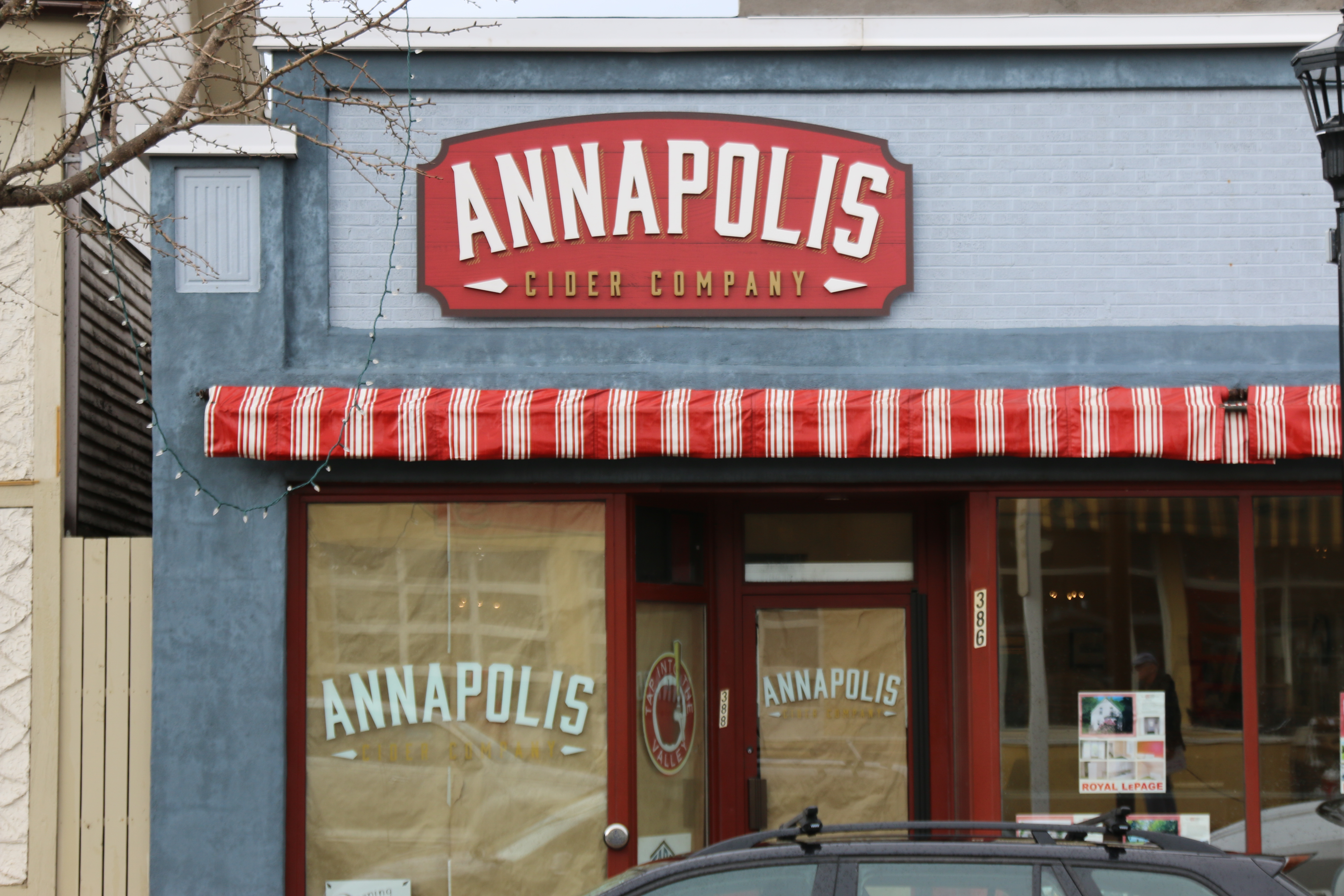
  • Apples to Apples: Annapolis Cider Company Comes to Town

    Apples to Apples: Annapolis Cider Company Comes to Town

    Good news for cider lovers – you will soon be able to enjoy locally sourced, freshly pressed, and most importantly delicious apple cider (of the alcohol variety) courtesy of Annapolis Cider Company. The cider company, opening its doors at the end of this month, is located on Main Street and will offer tastings, cider for purchase, as well as a tours of the facility to learn about the cider-making process.


    I met with three of the four individuals behind the business last Wednesday, to learn more about the exciting new venture. The 4000 square foot building, painted bright red, decorated with apple-orchard paraphernalia features a tasting bar and a balcony that overlooks a fermentation tank and a peek of the on-site processing facility.


    Husband and wife Sean Myles and Gina Haverstock combined their passion for local enterprise and individual expertise to get the business up and running. Working alongside the couple are manager Katie Barbour and cider-maker Melanie Fledman. Myles, a Dalhousie University apple-researcher, and Haverstock, a sommelier and wine-maker at Gaspereau vineyards, said that they drew their inspiration from local wineries and microbreweries in designing their venture.


    Myles emphasized their passion and commitment to supporting local. The cider is locally-sourced, made from 100% Annapolis Valley apples, pressed down the street at Stirling Fruit Farms, and fermented in house. Fresh is an understatement, as the first time the cider hits air is when it comes out of the tap at the tasting bar.


    There are two types of ciders that will be available year-round: “Juicy and Sweet” (5.6% alc.) is made from dry fermented cider and combined with sweet apple juice, and “Crisp and Dry” (7.7% alc.) that contains only a hint of the sweet apple juice. Alongside these two staple products, there will be a third batch, “Something Different,” that will vary from batch to batch, presenting a unique and exciting flavour with each batch.


    Myles described the design of the cider company as “taste-buy-leave… and refill”. For 5$, you get to sample each of the ciders at the tasting bar. The product will be available for purchase primarily in 750 ml refillable glass bottles. Similar to other microbreweries (think Growlers at Paddy’s), there is a 6$ initial fee for the reusable glass bottle, but after that it is yours to keep and refill as you wish. There will later be a bottling service that will sell pre-filled recyclable 650 ml (non-refillable!).


    Although construction officially began in November, when asked how long the plan has been in the works, Myles replied “it’s been planned since birth.” It is clear that these first-time business owners and entrepreneurs are passionate about their product and the community they plan to serve. The two live in Wolfville, and want to focus on keeping things in the town they know and love. There is talk of outsourcing product to NSLC in the future, as well as hopeful plans to partner with existing local restaurants to serve the cider on tap.


    The Annapolis Cider Company’s opening is already highly anticipated by students and community members alike. Wolfville is a town conducive to supporting and keeping it local, and also, who doesn’t love trying a new (alcoholic) treat? Although no official opening date has been released, I was told to keep my eyes peeled on social media as the official opening dates will be released there first.

  • “Because It’s 2015” – A Canadian Moment

    “Because It’s 2015” – A Canadian Moment

    For my Post-Confederation Canadian History class (HIST 2783 x2), it was a requirement that students form small groups and complete a term project that helps promote the notion that Canadian History is absolutely NOT boring. For this assignment, we were expected to select an event from Canadian history and find a way to publicly circulate and promote awareness of the particular event, to again provide evidence that Canadian history is not boring!

    My group has selected 4 different events to highlight in the format of a timeline, but selected this particular event, “Because it’s 2015,” for publishing as it is not only one of the most recent, but the most relative to us today. While looking at this event, we also went into detail to research the different perspectives this event can be interpreted.

    Our now current Prime Minister, Justin Trudeau, delivered this well-known phrase as a response to the question around the importance of gender-balance within the cabinet. Trudeau spoke to his campaign promise of a “fair and open government,” and put this into action by ensuring the “cabinet reflects Canada.” On November 4, 2015, Trudeau selected 15 men and 15 women as members of the caucus. The Canadian Press states that this is “the first gender-balanced ministerial team in [Canada’s] history.”

    Though there was much support for this action taken by the federal government, there was also pushback and protest against it. The implementation of a 50:50 government can be interpreted as a positive step forward for women, as well as society, but can also be critiqued and argued that selection of candidates should be based on the consideration of skills alone, rather than incorporating gender and race into the process.

    Trudeau announces “the more diverse your organization, your board, or in this case, cabinet, the more it reflects the realities of the population we are serving.” With this kind of thinking, Trudeau was able to enact gender parity within the cabinet caucus, and was able to experience the “incredible pleasure to present to Canada a cabinet that looks like Canada.”

    Many who are resistant to the implementation of a gender-balanced cabinet express concerns that –as Althia Raj shares in a Huffington Post article– “women were favored over male counterparts … no doubt as a direct result of Trudeau’s promised gender parity.” Though there is a variety of responses and emotions toward the reality of gender parity within the cabinet caucus, there is no denying that this is indeed a significant event in Canadian history. The irony of that statement is that although we consider this event historic to Canadian heritage, it has just begun; we are currently living in the era where gender equality is in fact a public issue, on the political agenda opposed to earlier times when this was not so. Someday in the future, we will look back at this historical event and wonder how gender equality was even an issue that needed to be resolved.

    Photo Link: https://pbs.twimg.com/media/CTCt431UcAEVCxB.jpg

  • The Brussels Terror Attacks: The Incident, the Aftermath and the Value of Rhetoric

    The Brussels Terror Attacks: The Incident, the Aftermath and the Value of Rhetoric

    On Tuesday, March 22nd 2016 terror made its way to another European nation, this time in the Belgian capital of Brussels. The attacks saw 34 civilians killed and hundreds injured in three explosions. Two bombs were detonated at the Zaventem international airport and one at the Maelbeek Metro station near the European Union’s headquarters. What we know so far is that the two suicide bombers at the airport have been named as brothers Khalid and Ibrahim El-Bakraoui, allegedly the Paris bomb maker was seen next to the two in CCTV footage. The Independent has claimed that these attacks were in retaliation for Belgium’s role in fighting militants in Syria.

    In the aftermath of the attacks many nations came to condemn the attacks, President Barack Obama also commented on the attacks during his visit to Cuba. Poland’s Prime Minister Beata Szydlo has stated that Poland stop accepting migrants after the attacks while simultaneously calling the attacks “a disgusting example of terror in Europe”. The infamous hacker group “Anonymous” declared war on the Islamic State in a chilling video released at 3 o’clock the next day. They made it very clear what their intentions are when they said, “Our freedom is once again under attack, this cannot continue”. London, Brussels, Toronto and most major metropolitan North American cities had a massively increased security presence following the attacks.

    But what response was offered by our own Prime Minister? In a statement made shortly after the attacks Trudeau offered this to the Belgian people “Canada stands by Belgium in this difficult time and offers all possible assistance. We will continue to work closely with our allies and the international community to help fight and prevent terrorism here and abroad and to bring justice to those who are responsible”. I found myself asking the question, what value does this statement have? What kind of assistance is Canada actually offering our international allies? According to MacLean’s and the National Post, Canada contributed just 2.5% of the total airstrikes in Syria and, in February of this year, ended its aerial combat mission in both Iraq and Syria. This leaves our major allies abroad, such as the United States, Belgium, France, the United Kingdom, Denmark and the Netherlands, wondering where we went.

    Following Mr. Trudeau’s statement, I’m sure they’re wondering exactly what he meant by “all possible assistance”. All possible assistance generally means some form of contribution to the massive aerial combat mission that is already underway. President Barack Obama made similar comments during his visit to Cuba, however considering that the United States has completed 71% of the bombing missions in Iraq and Syria there is little need to doubt him.

    There will be the nay-sayers and those who point out that we have Special Forces on the ground training forces to fight the Islamic State, but how effective is this training? According to Al Jazeera the United States has already been down this road. After having spent five hundred million dollars, they managed to train sixty troops. In case you were curious that works out to about eight and half million dollars per troop. Comparatively, according to US Department of Defence statistics, that is the cost of fifty thousand hours of flight time in a fighter bomber or twelve thousand five hundred JDAM smart bombs.

    The point is this: ISIS is a threat to Canada and its allies. As a nation we’ve left our international friends out in the cold, we’re spending money on training programmes that are proven not to work, and our Prime Minister is spewing empty rhetoric. Just how many friends will Canada have left after the sun finally sets on the Islamic State?

    Christopher Vanderburgh

    Contributor, the Athenaeum

  • A Look at the Decaying State of Student-Run Media at Acadia

    I’ve noticed one big fact about this school: not many people give a shit about the newspaper or radio station. In fact, many people don’t even know we have one. With freedom-of-speech issues rampant across the world and mainstream news outlets turning to report on bigger, more glamorous events every day, small media is the only soap box we have to make known our issues. Student-driven media is very important. So why aren’t people figuring that out?

    To try to figure it out myself, I phoned Brenda Grunau, station manager of CiTR, the University of British Columbia’s FM radio station. She’s been the manager since 2007, and a couple of years into her time there, CiTR was almost cut.

    If an organization was going to be on the cutting block, we were a likely subject,” she said. Even though everyone ended up with money in the end, CiTR realised that they had to do something so they wouldn’t be the one to go the next time the student union funds ran up short. “Our student members experienced frustration getting on the radio and felt like the process was too hard and intimidating, and they didn’t always feel like the station was a welcoming place. So we made some significant changes: we restructured our staff division and we made enabling volunteers and empowering our members key priorities,” Grunau said. Student members then increased dramatically from around 100 to 200-250, depending on the time of year. “We just keep increasing every year in terms of student engagement.”

    So why can’t this be done at Acadia? Keeping in mind that UBC dwarfs us with a population of around 51,000 as opposed to 2,700, we ask ourselves: is a functioning radio station really that impossible? Unlike Acadia, student radio became a cultural priority at UBC and has remained so ever since.

    CiTR started offering training and development programs, including a summer internship. “We [had] to change the culture of the radio station, so we’re not just shitting on other people’s musical tastes. The place has to be diverse, it has to be inclusive, it has to be open.” When Brenda said that, it made sense to me. We have a radio station whose office is almost always empty, which can stem back to the fact that there is currently no station coordinator or programming coordinator (which I only found out after sending repeated emails). With a fraction of the people that UBC has doing radio shows (and with someone organizing, training, and encouraging), we could do something amazing with our radio. Other universities should be jealous of Axe Radio (just like I’m jealous of CiTR).

    CiTR also goes out of their way to encourage local bands and singers. They have enough room for a live band to play, and the shows are played inside of UBC’s new student union building. The radio station has become a central part of being a student at UBC, and that’s incredibly inspiring.

    I do feel like campus and community radio used to be a very vital part of the supply chain of being interested in music and discovering new music, and now with the internet, you don’t have to mail a record to your friends,” said Grunau. I couldn’t agree more. Campus radio is a vital part of the community of Acadia University. Although it’s only been around since 2009, Axe Radio could be a major component of our school. It can be what students turn on to hear new music, to laugh at a new show, to get local news. The sad fact is that the only way to get your voice heard at this university is to stand on top of Tower and yell really loud. Or pirate the radio station by somehow getting access to it on your student ID card. Actually, people already do this – it is not very hard to swipe in, turn on the machine and spit obscenities into the microphone. And as much as I can respect that, it’s still pretty embarrassing that it is allowed to happen.

    So this is my call to action, Acadia. This is well and truly the only thing I’ve ever given a shit about, and I’m not joking around on that. Let’s make Axe Radio the best student-run radio station in Atlantic Canada.

Betzillo positions itself as a versatile gaming hub where structured bonuses and adaptive gameplay mechanics support both short sessions and extended play.

Built with a focus on innovation, Spinbit integrates modern casino architecture with rapid transactions, appealing to players who value speed and digital efficiency.

Ripper Casino emphasizes bold entertainment through high-impact slot titles and competitive promotions crafted for risk-oriented players.

A friendly interface and stable performance define Ricky Casino, offering a casual yet reliable environment for a wide spectrum of gaming preferences.

King Billy Casino channels classic casino spirit into a modern platform, delivering recognizable themes supported by contemporary reward systems.

Immersive visuals and layered slot mechanics are at the core of Dragonslots, creating a narrative-driven casino experience.

Lukki Casino appeals to players seeking direct access and minimal friction, focusing on fast loading times and intuitive controls.

Casinonic provides a structured and dependable gaming framework, blending modern slots with transparent operational standards.