Tag: racism

  • Film Review: There’s Something In The Water

    Film Review: There’s Something In The Water


    In 2019, Elliot Page directed and starred in his own Nova Scotia-focused documentary There’s Something in the Water. The documentary is on Netflix and has seen a lot of success since its debut. After Elliot Page’s big break on Trailer Park Boys and following success through Juno and other films like Inception, he realized that he was passionate about the environmental racism going on in his home province, Nova Scotia, and decided to direct a film on the topic.

    Environmental racism has been happening in Canada for decades. When Indigenous and black communities repetitively end up near landfills and other harmful environmental hazards, there’s no question that it’s not simply coincidence. These communities often lack a voice, especially to the government, allowing the racism to continue without being noticed or acknowledged. The idea of environmental racism, as Page’s documentary suggests, is able to survive because it happens slowly, over generations, often making the connection between harmful side effects and racism difficult to see. According to one speaker in the documentary, “It’s also about the government’s slow response to these issues. What we know is that where you live has bearing on your wellbeing”. The film works to expose these issues, and does a great job of explaining concepts and highlighting the upsetting extent of the racism in Nova Scotia.

    There’s Something in the Water focuses on issues like Northern Pulp and Boat Harbour in Pictou County. Louise, one of the women being interviewed by Page, points out the shocking number of cases of cancer in her mostly-black community, a direct result of a waste dump nearby. The documentary explains that if you map out Nova Scotia’s BIPOC communities and Nova Scotia’s landfills, you’ll see a horrifying correlation. It also shows the many discouraging ways that the Nova Scotian government has failed to keep its promises to marginalized communities and to fix their errors. It exposes the direct link between environmental racism and its harmful effects. Through all of this, Page’s documentary shows Nova Scotian viewers how environmental racism has been affecting our province for decades. 

    Overall, the film was extremely eye-opening. It was embarrassing to be reminded of my own ignorance concerning the issue and helpful to then learn more about it. The people in the movie felt very real, as opposed to actors, yet important enough to pay attention to. They made me forget that all of these issues are happening right in my own backyard, and once I remembered, I was once again shocked and horrified that these things could happen so easily and simply go unnoticed. Surprising but important situations were brought to light through the film, like how in 2017, a Shelburne councillor blatantly told residents to “stop playing the racism card”.

    I loved There’s Something in the Water. Elliot Page’s ability to make the environmental racism that’s been happening around me seem so realistic, and yet still unsettling enough to make me want to make a difference was incredible. His explanations of the issues were clear and eye-opening, and genuinely encouraged me to start fighting for change. I would recommend this film to anyone, and already have to several people. Overall, I’d rate it 8/10. If it were slightly longer, I’d give it 10/10, because I enjoyed it so much. 

  • Reflections on Race and Privilege

    Reflections on Race and Privilege

    I am a person of many privileges. I was born and raised in Nova Scotia to loving parents who provided me with all of my needs and some of my wants. Most people in my circle looked like me. Growing up, we never needed to consider issues of class or race, and I never experienced what it felt like to be judged because of some attribute that I could not control. I am white. That is a fact. By extension this means I experienced my world as somebody who fit into it; who knew that I belonged and had a place.

    And yet in spite of (or perhaps because of?) my upbringing I have cared deeply about equal treatment for people of all races, ethnicities, sexual orientations and belief systems. I read widely the works of champions of social justice such as “Letter from a Birmingham Jail” by Martin Luther King Jr. and “I Write What I Like” by South African anti-apartheid activist Steve Biko. I intentionally sought out relationships with people who were different from me.

    As a first-year student at Acadia, I saw a table in the cafeteria occupied by students from the Caribbean. They looked like they were having fun; you could hear their laughter ripple across meal hall. How I wanted to be part of them! After watching them for 3 days, I decided during lunch to pick up my tray and plunk myself down at the middle of their table. It was either going to go well, or very badly. Crossing a line, even the ones unspoken of, can be risky. It can feel uncomfortable. Even scary.  My gamble paid off, and I established friendships with people I met at that table which extend to this day, more than 20 years later. At that table I learned to get comfortable talking about race. I learned to listen. I learned to relate, to connect. I learned to be comfortable being the only one in the group who looked like me.

    When I talk about privilege, I’m now aware of the privileges I enjoy because of my race, my class, my nationality. However, it is living cross-culturally for more than 20 years and sharing my most intimate life experiences with people from across the African diaspora, that has been my greatest privilege.

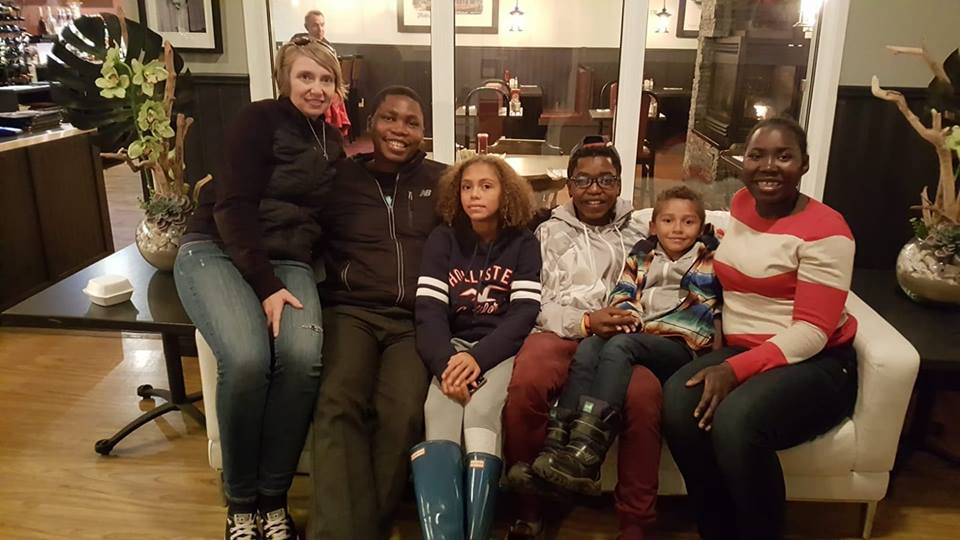
    After graduating from Acadia University, I moved to South Africa. Within two years of my graduation, I married my soulmate, a young man of Zulu origin. We danced down the aisle to the voices of his elders singing a song that told of the exploits of his ancestors. Their pride in their history, their culture, was palpable.  Two years after that, we started our family. We adopted two children in the same week. Bijou was originally from the Democratic Republic of Congo, and was 15 years of age when she came to live with us. She was not related to us by blood, but we loved her as if she were. Nhlanhla was my husband’s youngest brother. He was 7 years of age when we adopted him, after the passing of their mother. He was obsessed with housework and spoke no English. He was this little boy with a big smile and mischievous twinkly eyes and a mop. Over the next 6 years we added two more biological children to the mix and our family was complete.

    Our first days as a family were challenging ones. In addition to the challenges of having 3 different home languages in our household, poor educational foundations for both adopted children, grief and childhood trauma, we were living in South Africa as a mixed family. South Africa, that beautiful, conflicted nation that has utterly captured my heart. We experienced the beauty of South Africans as they embraced us, and the ugliness of racism as others rejected us. We knew that racism could be both overt and covert, and we had felt its sting. But we were determined to overcome it with our love and our story.

    We did not leave South Africa for the reasons that people usually leave. We didn’t run away from the crime, or the corruption, though these are of concern to us. We were not seeking better economic opportunities in a developed nation. We came to Canada simply to be closer to my Canadian parents. And we wanted to give Nhlanhla the chance to hold a high school diploma, something that was not a possibility for him in South Africa.

    We knew that racism existed in every society. I have friends who are African Nova Scotians and I was aware of the challenges still faced by these communities in our province. Some thought we were making a mistake by not moving into a historically African-Nova Scotian community. However, we had found the perfect house in Pictou, NS, and wanted to live where we chose. We were under no illusions, but we did expect that after the civil rights gains of the past 60 years, after the courageous battles fought by people of colour here in Nova Scotia and across the country, that racism would be hiding underground. We expected it to be concealed. We did not expect it to impact our family as it did.

    On September 19th at approximately 3:30 pm, our now 21-year-old son Nhlanhla was shot in the back with a high velocity nail gun by a co-worker on the construction site where he worked here in Pictou County. The 3.5 inch nail punctured his lung. After he was shot, when he was lying on the ground screaming, the same co-worker pulled the nail from his back, creating a slow leak from his lungs to the cavity next to his chest wall. His boss then drove him home to the rural community where he now lives. By the time he received medical attention, 1.5 hours had passed. With each breath, the cavity next to his chest wall was filling up with air, and his lung was proportionally collapsing. The doctor said by the time the chest tube was inserted to release the air, his lung was 25% collapsed. He would be in hospital for 4 days.

    He had started that job 3 weeks prior to this incident, and for the entire time of his employment was subjected to race-based bullying by the same co-worker who shot him. It has been widely reported in the media that he was called a nickname by the crew that rhymes with the “n-word”. His co-workers refused to try to pronounce his real name, or even use the shortened version that he commonly goes by, which is “N.H.” The same co-worker stapled his jacket to the stairwell, and the other guys on the crew laughed about it. My son alleges that the shooter threw nails at him while he was working, hit the steel toe of his boot with a hammer, and numerous times threated to puncture his hand with the staple gun. But perhaps the most overt example of racism prior to being shot was when this same co-worker made a joke (and I use that term loosely) about every white person deserving to own a black person.

    Did he tell us this was going on? No. Did he report it to his boss? No. He told himself perhaps it was some kind of initiation; that if he kept his head down and kept working, it would pass. The guy would get tired of bullying him. Or he’d find a new victim. He thought that if he caused trouble for a more senior person on the crew, then as a new employee he could lose his job. He thought that because his boss had laughed about his jacket being stapled to the stairwell, because he had witnessed at least some of the bullying behaviour and laughed about it, that his boss would not act in his interest. So, he said nothing. He just waited for it to pass. But it didn’t pass. This decision nearly cost him his life.

    The blatant, in-your-face kind of racism my son endured is something we did not expect. The fact that we could have lost him in this violent act has rocked us to our core. To think that there are people in our communities who hate to such an extent that they can injure or even kill someone you love, here in Nova Scotia in 2018, is a painful realization and one that surprises us. What has been almost as surprising and painful is the total lack of empathy that we have received from my son’s former employer. However, what has warmed our hearts and carried us is the outpouring of love and support that we have received from people in our community, our province, across the country and because of the nature of our family, from around the world. We know that this act is not reflective of who we are as Nova Scotians and Canadians.

    Still, there are lessons to be learned. And since I can only speak for myself, here is what I personally am taking away from this experience. To my children, and to all young people of colour, I will say this. Please stop putting your heads down and getting on with it. Nobody deserves the kind of treatment my son received. It will not get better on its own. It will only get better if we make it better together. And to make it better, we as parents and allies, we as your community need to know what you’re going through. Find someone safe to talk to, and talk. Get advice if you need to. Plan your next move if you can. But don’t keep silent. You do not have to give racist individuals a probation period within which to abuse you before you react and respond. You are worth more than this.

    To people who look like me, to other white Nova Scotians and Canadians who are intent on stamping out racism and all forms of discrimination in our schools, our work places, or churches and communities, I humbly offer the following advice.

    1. Listen. Be a safe person for people of colour, and indeed all those experiencing marginalization and oppression, to talk to. In the context of relationships, learn about their lives. When they say they are experiencing discrimination, hear them. I mean, really hear them. Too many times as white people we don’t even let a person finish telling their story before we get defensive. “Oh no, that person was just being a jerk. It’s not necessarily racism.” And my favourite: “Why does everything have to be about race?” Black people have been black for their whole lives. They know their own experiences, and they are not telling you their story because they are holding you personally responsible for the actions of all white people. They might be looking for someone to help carry the burden, to show some empathy. Be that person.
    2. Do no harm. This one is simple. Don’t be that person who tells racist jokes, who mimics the accents of non-native English speakers, who puts out into the world discriminatory statements against one or another group of people. Let no such words cross your lips.
    3. Do not tolerate discrimination of any kind in your circle. I remember hearing a story about Maya Angelou hosting a dinner party for some of her closest friends. At this party, someone made a derogatory remark about members of the LGBTQ+ community. She overheard the remark, stopped her conversation, commanded the attention of her guests and politely asked that person to leave her home. We have to stop allowing people in our lives, our family members, colleagues, and friends to say and do things that discriminate against others. It will be awkward. It will be uncomfortable. You might not be able to ask Grandma or Uncle Frank to leave your home, but you can firmly assert that such sentiments are not welcome in your home or in your presence.

    I wonder how the story might have turned out had someone on Nhlanhla’s crew said to the Accused, “Hey, why don’t you leave the kid alone?” What if they’d come up to Nhlanhla and said, “You know man, you don’t have to accept this kind of treatment. Let’s do something about it together.” What if someone had shown him some compassion or solidarity? Or even in the aftermath, some empathy? It would feel different for us.

    It is in our power to undertake small but important actions that can stamp out racism and discrimination. And for this reason, we have hope. I leave you with a quote from Martin Luther King Jr., who said, “Power without love is reckless and abusive, and love without power is sentimental and anaemic. Power at its best is love implementing the demands of justice, and justice at its best is power correcting everything that stands against love.”

    Stacey Dlamini is a graduate of Acadia University’s Class of 2000

  • What’s in a Name? Racism: A Response.

    This is in response to the article in the last issue titled “Unpopular Opinion: Controversial Team Names Aren’t All That Controversial.” In short, I call bullshit.

    I appreciate the fact that you, Anonymous writer, would rather see more productive means of protest that doesn’t involve boycotting games. This I can agree with. I understand that you feel as though the controversial team names in question are honouring the Native people. Not only are you wrong about this, but perpetuating this idea is dangerously ignorant.

    You may be thinking that something as simple as a team name or their mascot cannot possibly promote racist ideologies. It’s all in good fun, right? Wrong. Take the Washington Redskins for example. Do I even have to go further with this explanation? “Redskins” is a term used to refer to the scalps that were collected for bounty. Scalps were literally taken off the heads of Native people and sold off like a trendy pelt. Over time the term developed to literally mean ‘person with red skin,’ aka Indigenous people. Does this development make the term more acceptable? No. It is completely degrading and one of the most grotesque terms available. So, how are the Washington Redskins showing respect and honour as you so eloquently point out? This isn’t an homage. It’s a reminder of social hierarchy. It’s making a joke out of our Indigenous peoples, where the punch line is the acceptance that people like yourself feel towards this issue.

    If you still don’t believe that team names can promote racism, take a look at some of the headlines that have appeared over the years: “Scalp ‘em, oh wonderous Redskins” (Chicago Sun Times, 1987) “Hartley Claims Redskins’ Scalp” (The Mirror, 2000), and most recently “Red Robins Scalp Indians in Solid GNC 6-0 Shutout” (Antigo Daily Journal, 2017). These are only three examples of many more. Now that we have established that racism does exist, let’s turn our attention to cultural appropriation.

    Have you ever seen a Braves game? The “Tomahawk Chop” is a fan favourite that involves swinging a foam tomahawk and participating in a “rallying cry” that is supposed to replicate what these people think a Native one would sound like. The Kansas City Chiefs will also say that they are honouring Indigenous people, and yet they encourage stereotypes. They play at Arrowhead stadium, sport a logo of an arrowhead, and have a horse mascot named Warpaint. The fans are often seen wearing head dresses, and yell out war cries for their team. The Cleveland Indians, besides having a name that is well known as a derogatory term, have an incredibly racist mascot named Chief Wahoo. But I suppose you feel as though Indigenous people should feel honoured to be made fun of, because at least they get some recognition, right? What you are really saying in your article, dearest Anon, is that we should be grateful for any kind of representation we can get in this world, even if it’s offensive. What you are saying is that you can still take and take and take from us, and there isn’t anything we can do about it. We are not your mascots. We are not your property, and we sure as hell aren’t going to sit here and accept it like you want us to do.

  • Canadians Are Racist Too

    Social action seems to be running rampant in the United States currently, pushing against systemic racism in the United States. Indigenous peoples in the United States are standing to protect their lands at Standing Rock and the Black Lives Matter movement is demanding an end to mass incarceration, to end the systemic racism in the American justice system. With this backlash against racism in the United States, people in Canada are feeling pretty lucky to live in Canada. But are we any better off in Canada in terms of racism? Or are we equally as racist in Canada? Can inequality be equal? A June 2016 research article published in Social Science & Medicine explores this.

    In “Equally Inequitable? A Cross-National Comparative Study of Racial Health Inequality in the United Sates and Canada,” University of Toronto’s Chantel Ramraj, and Duke University’s William Darity explore the strong relationship between race and health in American and Canadian society, and find that in their comparison of America’s black population with Canada’s, Black Canadians have overall better quality of health than Black Americans. This research is based off of 10-year data collection from the National Health Interview Survey in the U.S., and the Canadian Community Health Survey in Canada (from the years 2000-2010). Studying a variety of health outcomes (such as asthma, heart disease, hypertension, etc.), as well as self-reported health satisfaction, and behavioral risk factors (such as smoking), the researchers conclude that “racial inequalities in health are biological expressions of racism and not of racial difference,” further serving to situate the connection between race and health as a “function of the societal context [in] which it operates.”

    So, if black Canadians’ health is better than that of black Americans’, does that mean Canadians are less racist? Definitely not. The study additionally highlights the fact that racial inequalities exist in both of the countries under study, but that which differs between the countries is which racial groups they affect. In Canada, for instance, while our black and Hispanic populations are in comparatively better health than that of America’s, our Aboriginal populations suffer immensely from racial inequality. Ramraj and Darity show that in both the United States and in Canada, those who identify as Aboriginal were found to have the highest prevalence of most of the chronic conditions under study, rated their own health to be the lowest, and had the highest prevalence for current or former drinking when compared to all other demographics under study, with the exception of Whites in the U.S., who scored the highest for alcohol use. These such health trends among Aboriginal peoples in Canada persisted “regardless of demographic, socioeconomic, and behavioral covariates, whereas in the U.S., socioeconomic factors explained [only] some of the relative inequality between aboriginals and whites.”

    Further, this research points these health implications of racial inequality as stemming from distinct historical periods: slavery in the United States, and colonization in Canada. As colonization allowed for an increasing of the amount of processed foods (and associated consequences for health) and for an unequal distribution of “economic resources and employment opportunities available to aboriginals,” aboriginal peoples have disproportionately been put under stressors due to colonization when compared to white Canadians. These stressors additionally serve to influence health behavior in adverse ways, and manifest in physical health issues. As such, colonization and colonial legacy acts as a crucial societal determinant for the health of aboriginal peoples in Canada. Black people in the United States, similarly, are far more likely to be “descendants of ancestors who had been exposed to the U.S. system of plantation-based slavery, widespread government-sanctioned segregation, and ongoing discrimination and racism,” thereby leading to their current race-related health issues.

    So, can you be equal in inequality? Chantel Ramraj and William Darity show that Canada and the U.S., are both equally inequitable in their treatment of racialized groups, which has grave effects on the lives and health of the individuals affected. Ramraj and Darity demonstrate the strength that race holds as a predictor of “major sources of morbidity in both the United States and in Canada,” and how this relationship (between health and race), can be addressed at a societal level, where social policies, which dictate the distribution of “social and economic resources within a society,” can begin to be addressed. Furthermore, this research has important implications in its demonstration of the degree to which race and health is context-dependent and can, therefore, be modified by social action.

Betzillo positions itself as a versatile gaming hub where structured bonuses and adaptive gameplay mechanics support both short sessions and extended play.

Built with a focus on innovation, Spinbit integrates modern casino architecture with rapid transactions, appealing to players who value speed and digital efficiency.

Ripper Casino emphasizes bold entertainment through high-impact slot titles and competitive promotions crafted for risk-oriented players.

A friendly interface and stable performance define Ricky Casino, offering a casual yet reliable environment for a wide spectrum of gaming preferences.

King Billy Casino channels classic casino spirit into a modern platform, delivering recognizable themes supported by contemporary reward systems.

Immersive visuals and layered slot mechanics are at the core of Dragonslots, creating a narrative-driven casino experience.

Lukki Casino appeals to players seeking direct access and minimal friction, focusing on fast loading times and intuitive controls.

Casinonic provides a structured and dependable gaming framework, blending modern slots with transparent operational standards.