Tag: Canada

  • In Defense of a Centrist

    In Defense of a Centrist

    I am a centrist. For many in the world of politics that means I am apparently an unprincipled flip flopper who will go wherever the political winds take me. For them, my want to find a reasonable compromise is something dirty. I am writing this to call ‘bullshit’. Being centrist, the want to find a desirable outcome for all involved, is how empires are built. The world, including Canada, seeks the common ground, where we can work together, rather than tear each other apart. The strength of centrism can be proven in the three pillars: public policy, economic issues, international issues and social issues in both the proven success of the middle ground and the failure of extremes. 


    To spend or not to spend. That is the argument of the left and the right. That you either need to throw money at every problem or turn off the tap and let everything die. With Centrists, the plan is to invest. If we can improve something we put time, effort and resources into it and if it is a boondoggle we get rid of it. You see this in the success in thoughtful, moderate leaders. Internationally, Barack Obama brought the United States out of the worst economic crisis since the great depression, nationally, Justin Trudeau’s investments have produced the strongest economic growth in Canada in 20 years and locally, Stephen McNeil has put Nova Scotia into a solid financial standing over more than a decade of mismanagement under the Conservatives and NDP. Centrist policies and principles work, producing stability and confidence. 


    In the last 60 years, the global state has dramatically changed. Nuclear states have emerged, the borders of the world have been thrown into flux and the invention of the internet has made the world more connected than ever. The reactionaries on both side of the political spectrum would have you fear every twitch that changed the global balance but centrists have found the formula to lasting peace. Non-interventionists would have you believe that we need to cut ourselves off from the world, make sure no one can come into our borders, or in other words: making sure that you stay on your side of the wall. If we went with their way we would fall into chaos and the rest of the world would continue. On the flip side, there are those who want to cut nations off from one another and over exert their control, creating foes rather than friends. As a moderate, I have seen the success of seeking change through dialogue, finding accommodations that promote cooperation, prosperity, and peace. We find the proof in the Iran Nuclear Deal, the NAFTA agreement and the Paris Climate Accord. Ending conflict with words rather than bricks that would be thrown or used to build walls. 


    Finally, we come the numerous problems that plague the fabric of our social infrastructure and our mortality. We on both sides of the political spectrum hurl insults at each other rather than offer solutions. The societal wrongs that we faced are viewed as a weapon in the political blame game rather than challenges to overcome. Centrists have been able to largely duck the mud being thrown. We work hard for the necessary changes, building a foundation to grow rather than trying to fix everything in one big swing of a sledgehammer. It is probably the thing that makes centrist so unloved sometimes, because we offer reality and hard work rather than the quick fix. In the battle for civil rights, marriage equality and more we see that the ultimate victory was not won over night but in hard, incremental steps because society is often unready for a big leap. It can be the harder and the more frustrating route but is the right one. 


    Left, right, tradition or change there always seems to be a balance somewhere that moves us forward but also closer together. We must respect each other, but be bold enough to make new strides. It is the imperfect perfection of moderation, the only proven method of progress and stability and it is why, despite the naysayers, I am sticking by it. 



  • Summer Talking Points

    Summer Talking Points

    You made it to your first class early , you’re in your element – you even read your syllabus before hand. On top of the world. Then BLAMO, while your waiting for the classroom door to open someone hits you with a current event you weren’t ready for. Shiiizzzz, you thought you wouldn’t have to comment on this until you got into class or at least went to some pretentious program wine and cheese. But here you are.

    Here is what you may have missed over the summer and could have possibly had an opinion on and some talking points to follow them up.

    Point: Emmanuel Macron defeats the Marine Le Pen in the French federal election to become the country’s youngest president. He is a liberal-centrist which has refused extremest voices  prevalent in the current global political climate. The movements to the far right have coloured many elections and changes in administration in recent years including Britain, the United States, Canada, and the upcoming federal election in Germany this month.

    Counterpoint: Le Pen’s extremist thoughts are ones that are not unique to France. Globally there is a demand for far right voices which yearned to be recognized. This has been evident with last summer’s Brexit, followed by Britain’s David Cameron’s resignation, and of course the result of America’s 2016 federal election. Le Pen represents a perspective which can not be ignored.


    Point:   You loved Gal Gadot’s reprisal of Wonderwoman and Robyn Wright’s cameo in the movie was bad ass. There was just enough Chris Pine for comedic relief, but his male presence did not over-ride the female empowerment vibes. Possibly the blockbuster of the summer.

    Counterpoint: You could have done without Gal Gadot’s appearances leading up to the release at the UN. It seemed to be a shameless promotional use for the organization and we are not sure what substance was added to her appearance.


    Point: Cleveland.

    Counterpoint: Golden State.


    Point: Advancement in human embryo research has successfully altered common disease causing mutations in genes. A breakthrough.

    Counterpoint:  The ethical “designer baby” conundrum is upon us.


    Point: Condemning the events of Charlottesville, Va. is a no-brainer. Condemning neo-Nazis, independent white nationalists, Klu Klux Klan, hatred, and murder is easy – especially in 2017.

    Counterpoint: I fail to provide a counterpoint here.


    Point: Anthony Scaramucci, former white house communications director for a hot second, had barely enough time to be a Trump apologist. He jumped on the White House administration because of the opportunist he is. What he wanted to accomplish other then petting his own ego, I’ll get back to you as soon as sources find out. I believe he just wanted a new place to tuck in his gold chain and hairspray at night.

    Counterpoint: A man has got to do what a man has got to do to get in possibly the most powerful decision making body in the world. Let the Americans deal with what they have served themselves up, right? Truthfully, I’m sure all of us are sick of hearing about the real and “fake” news spewing from the Don John T – but the Mooch had to make the summer highlights. He is set to be a host “The View” sometime during the week of September 18-22.


    Point: The old Taylor Swift can’t come to the phone now, or ever, because…shes’s errrrrrr dead. My theory is that Becky picked up the phone for her instead (that is a deep tumblr reference so feel free to google).  The new Tay Tay dropped a beat leaving people blissfully confused and definitely intrigued.

    Counterpoint: The new Taylor Swift will still be accepting all cheque, direct deposits, e-Transfers, credit card, and cash purchases on behalf of the old Taylor. No information is disclosed about her new album except the drop date, the option to pre-order, and purchase merch: including her jewel embellished snake ring which she sports in her new vid. Hmm, looks like she’s sniffing out for that cash money. I’mma let you finish Taylor but I think you stole some content from Beyonce.


    Point: Canada turns 150 years old! We have lots to be proud of.  Being world leaders  historically in innovation of many fields such as medicine, media studies, human and civil rights, or IN SPACE. We have the Stratford Festival, the Snowbirds, arguably the best Pride celebrations, and the prettiest of Prime Ministers. All of this served up on the most diverse landscape, filled with the most diverse collection of people, topped with cheese curds, gravy, and served with a smile.

    Counterpoint: The 150 celebration was challenged by the Indigenous people due to the constant neglect of the Aboriginal experience which has left Canadians oblivious. There has been a narrative conveniently left behind by modern Canadians; life before colonialism.


    Now, there is much more to know and hear about in this big beautiful world of ours. If you have some thoughts on something I missed that occurred this summer or recently, please feel free to write in!

  • Justin Trudeau: Still a Drama Teacher

    Justin Trudeau: Still a Drama Teacher

    “I was very much optimistic about what his performance would be and honestly I’ve found it poor at best”

    Picture by Matthew S. Duboff

    I’ll let you in on a little secret: Justin Trudeau is still a drama teacher. Now, he’s just a drama teacher that turned out to be bad at politics. He seemed perfect at first, I will admit that. The promises to the middle class, the legal weed, the environmental protectionism, and that hair, all very sexy indeed. But nearly two years after these promises, where do we find ourselves? I’m not an expert on the topic but I would say we’re right where we started… adjacent. So, in this article I’ll be exploring Trudeau’s four biggest election promises, what they were, where they went, and where they are. And, just because I think it would be fun, I’ll rate them on a scale of one to five, one representing a monumental crash and burn, five representing a well delivered promise. To keep me honest, I’ll rate them based on promise broken versus promise delivered considering that where you stand on key issues can dictate how you feel about them. 

    Promise #1: Syrian Refugees 

    JT promised that he would bring in 25,000 Syrian refugees by year end 2015. Well, what can we say about this one, it did happen, it just happened two months later than it was supposed to. With 54% of Canadians either moderately or strongly opposing the initial promise it seems clear that this was not a priority for most voters. The only reason that it makes this list is because it was one of the best publicized. Due to the lack of support from the public and the late marks incurred for missing a deadline, I’ll grant him a three out of five on this one.  

    Promise #2: End First-Past-The-Post

    Next comes electoral reform, perhaps the most difficult endeavour a new government could undertake. At the beginning, it seemed that the PM was quite passionate about changing the way we elect our government, saying that he believed “fundamentally that we can do better”. This was a situation unlike the refugee issue, there was no late delivery. In February it was announced that the Liberal government simply would no longer pursue electoral reform at all. The letter to the Minister of Democratic Institutions Karina Gould read “A clear preference for a new electoral system, let alone a consensus, has not emerged… Changing the electoral system will not be in your mandate”. This was not a determination made without consulting the people, the government consulted 360,000 Canadians online and by telephone to ask their thoughts on electoral reform. The report on what they said, which I’ll gladly leave at the end of this article, is 111 pages long and assaults the reader with statistics. I won’t share my interpretation but it’s sufficient to say the questions posed to those who completed the survey were very general. How the Liberals handled the road to electoral reform was a complete embarrassment at best, one out of five, no questions asked.   

    Promise #3: Legal Weed

     The Liberal promise of legal weed is, in my opinion, one of the main reasons they were elected. At the very least we can agree that it won them some of the millennial vote. I would hate to quote myself but last semester I wrote on the topic in an article titled “This Bud’s For You” in which I stated that legal marijuana is a great idea but not for any of the reasons the Liberal party cited. I still stand by that statement. Further to this, the plan to legalize marijuana has been lined up conveniently around the time of the next federal election which is not likely a coincidence. The legal purchasing age, the points of sale and the penalties for driving under the influence of marijuana are still up in the air as it stands right now. In my home province of Ontario, many believe the Wynne Liberals are botching the point of sale issue. With no clear intention to allow the free market to develop the industry, my province intends to sell it through provincially regulated stores, the same idea as liquor stores. While I will say that it would be nice to pick up a six pack and a joint on a Saturday afternoon I also believe that in this case a large opportunity has been missed. Although the promise will be delivered, much has been left up to the provinces to figure out, and for that a four out of five is the result.   

    Promise #4: Short Term/Modest Deficits

    This promise simply didn’t turn out. The Liberal government has been a cash furnace from which few things have emerged. I don’t think that anyone really believed this and the promise was absolutely blown out of the water far sooner than even I expected. This promise needs no explanation, it just didn’t happen. One out of five.  

     What’s to say about this one folks. I’m disappointed. After the fogginess of my election night drinking wore off, I was willing to give Trudeau a shot. I was very much optimistic about what his performance would be and honestly I’ve found it poor at best. Agree with me? Great. Pissed off about this article? Even better.  

    Write for The Ath. Prove me wrong.

    Sources:

    http://nationalpost.com/news/canada/majority-of-canadians-oppose-trudeaus-plan-to-bring-25000-syrian-refugees-over-in-just-six-weeks-poll/wcm/79e46faf-92bd-4069-b8bb-dd1cc4fbaad0

    http://www.cbc.ca/news/politics/justin-trudeau-syrian-refugees-canada-1.3335517

    https://trudeaumetre.polimeter.org/promise/5201

    http://www.cbc.ca/news/politics/wherry-trudeau-electoral-reform-promise-betrayal-1.3962386

    https://www.canada.ca/en/campaign/electoral-reform/participate-in-canadian-federal-electoral-reform-consultations/mydemocracyca.html

    Christopher Vanderburgh is a fourth year Politics student and Features Editor of The Athenaeum

  • Things That Should Have Been Curbed in 2016

    Things That Should Have Been Curbed in 2016


    1) The notion that “White Privilege” is offensive and racist towards White People.

    Racism, cultural appropriation, and discrimination have been a hot-button issue throughout history. With the rise of social media platforms, along with the recent election of Donald Trump, there is a plethora of conversation online (and in print) about the hateful rhetoric that seems to be plaguing today’s society. Unfortunately, when people feel that their privilege is being threatened, they enter an automatic defense mode. It is often presented in such a manner where the defendant makes claims of innocence, justifying their feelings of discomfort by exclaiming that they are not guilty of racism, and that if their race is being questioned, that they are automatically being discriminated against. White privilege is not racist; it is not offensive in any way. It is a method of explaining the favorable treatment that white people often receive. There are no systems of oppression designed against white people. Thinking that reverse racism exists is what perpetuates the notion of white privilege further into the foundations of our society. It is a mechanism that is used to validate the comfortable position white people hold in society. Validating your own comfortable position by attacking a marginalized group (by saying white privilege is offensive, racist etc.) is a subtle way of invalidating and shutting down any group who’s LIVED EXPERIENCE has ever been one of systemic oppression. In extension, these feelings can often be described as “white fragility,” a state in which minimum amounts of racial stress becomes intolerable, triggering outward displays of emotion, such as anger, and behaviours such as argumentation. Yeah, this definitely could have been left behind in 2016.

    2) That any Indigenous culture should just “get over” colonization.

    Really? This one amazes me every time I hear it. Let us take a brief moment to recall Canadian History because we are not innocent in the ways or racism and cultural oppression. Residential schools were opened in conjunction with the Catholic and Protestant Churches and the government. Their aim was to remove any form of Indigenous culture from Indigenous children by forcefully removing them from their homes, placing them in schools where they would be taught Western values. As such, a cultural genocide was committed. Often, when hearing the word “genocide,” events such as the Holocaust, Bosnian, and Rwandan genocides. That is because Canada has attempted to repress its history. The horrors of the Residential schools did not end until 1996. Yes, most of us were living when the last school shut its doors. During their time in the Residential schools, Indigenous children were beaten, sexually assaulted, and mentally abused by their instructors. Often, these traumas were difficult to cope with. A stigma surrounds Indigenous peoples in Canada. Many people chose to believe that status cards, funding, government aid, and the Truth and Reconciliation Committee should all be abolished. They question why we should continue to apologize, and why we should continue to work towards mending our relationship with Indigenous peoples. What does it take to get over something like this? How could you possibly put a numerical value on an apology, how can you, a white person, get to dictate the appropriate measures for reconciliation after a cultural genocide has been committed? When you say these things, you act as though you assume the role of the oppressed, you may think you understand their oppression, but you simply do not. I know I do not understand, I never could. However, it is important to listen, to engage in conversation, and to be respectful of what you cannot understand. Please read the above statement about white privilege and then rethink your questions and sweeping generalizations about Indigenous peoples and Indigenous culture.

    3) “She was asking for it”- REALLY?

    For God sakes. How is this type of conversation STILL taking place? Did we not learn after Jian Ghomeshi and Brock Allen-Turner? I simply do not understand. The legal process further victimizes rape victims. Belittlement and slut-shaming occur in the courtroom in order to find loopholes in the victim’s statement. By asking her, “did you say no?” you are questioning her pain and her experience. By asking her, “how much did you drink?” you are assuming that all drunk women are ‘asking for it’, by asking her “what were you wearing” or “how many men have you slept with in the past”, you are slut-shaming her. Although there are false reports of rape, the treatment of victims in the courtroom is inexcusable. This is the reason that rape and sexual assault are so underreported. This process favours the accused, often bringing into play irrelevant aspects of his character, his achievements, and what he strives for in life. However, this does not take into account aspects of the victim’s character, her (or his) achievements in life, and how what she/he had strived for may feel as though it has become so out of reach. It’s simple, folks. If you can’t say no, you can’t say yes. There is no in-between; there is no grey area. There is yes, and there is no. Stop blaming the victim. Stop validating your need for supremacy. Stop questioning the pain of others, instead, start regarding it.

    4) Feelings of self-doubt, as brought on by Instagram and other forms of Social Media.

    I am guilty of this. Most people are guilty of this. It is so easy to feel self-doubt, and it is so easy to think that your value decreases based on the perceived notion of “perfection” in the others who you see on social media. In the last 10 years, we have “networking” apps explode. The original purpose of these apps was to stay in touch with your friends, to be able to connect with people you haven’t seen in a long time and to keep others updated on what is going on in your own life. However, it feels as though there has been a shift in the dynamic, a change in the way we behave on the Internet. Often, all we see is the picture. We believe that everybody’s lives are perfect and full of happiness based on how they display themselves on social media. Getting the “perfect picture” and pairing it with a “fire” caption that will get you over 300 likes is often a goal of most people. I know I am not innocent. There have been multiple occasions where I have found myself thinking, “if I went to the gym more maybe I would look like her and then I would be as happy as she appears.” I know this is wrong. After a conversation with one of my roommates, I found out that she was feeling the same way. She talked to me about how miserable looking at Instagram makes her. It caused her to question her own happiness by constantly comparing it to other girls’ social media pages. So, she slowly began to stop looking as much. As did I. I’ll leave this point here: everybody has their issues, but we have been conditioned to try and keep our problems to yourself. A picture is just that: a picture. You see what the poster wants you to see, just remember that your self-worth should not be determined by a like or how the world views your Instagram page.

    5) Islamophobia.

    Islam is a religion of peace. Often, people do not believe this when it is brought up in conversation. The first time I heard this was in my 11th grade world religion class. Our teacher told us that Islam was the closest religion to Christianity. She was right. It is not Islam you are afraid of, it is the “otherness.” The sense that you see something different, and that you are uncomfortable within a realm of your own privilege is what sets you off. This rhetoric gained prominence after 9/11. We were scared of them. They were scared of us. Although I am not an expert in Islamic studies, I know many men and women from the Arab world who identify as Muslims, and I can honestly say that they are much nicer than many other people I know. If we remove the concept of the “other,” perhaps we will all be able to see each other as we are: human.

  • Nutrition and Dietetics’ Students Host Italian Food Night for the Wolfville Community

    On January 18th, Management in Dietetics’ Students hosted a night called, “Autentico! A Night in Italy” which highlighted many traditional Italian dishes. The event took place at 5:30 pm at the Acadia Café, which is located in Room 422 of Huggins Science Hall. The night featured sparkling apricot pineapple punch, butternut squash and apple soup, focaccia, chicken cacciatore with lemon orzo & peas, and dark chocolate cranberry biscotti served with coffee & tea. The cost of admission was $13.50 (taxes included), and guests could pay via cash or by cheque at the door. The event was by RSVP only and sold out quickly with a full house. Are you looking for a delicious, low costing and nutritious meal? The Management in Dietetics’ students plan and execute an appetizing meal twice a week. Every Wednesday and Friday from 5:30-7:30 pm there is a three course meal served that highlights a specific cuisine around the world! Past meals have highlighted countries such as Morocco, India and the Greece and that is just to name a few. If you are looking for an opportunity to try something new and meet members within the community, come and support your peers and enjoy a delicious tasting meal. Keep your eye out for future management meal advertisements!

  • World Cup Hockey

    World Cup Hockey

    With the conclusion of the World Cup of Hockey comes the realization that the sport still belongs to its founder, Canada. There was really never any doubt as to who was going to win the world best-on-best tournament, even from the time it was announced to the final buzzer. Despite a few blemishes, the Canadians cruised their way to an undefeated round robin followed by a semi-final victory over Russia and two game sweep of the overmatched Team Europe. Besides Canada’s domination, there were some other important takeaways from the tournament as well.

    It’s not the Olympics

    Well, of course it’s not, but I’m talking about the hype around the tournament. There’s just something about the Olympic atmosphere that makes it so much better than this tournament. Maybe it’s the fact that the Olympics put people in the competitive spirit, or the fact that other Olympic athletes are in the seats cheering on their fellow countrymen. Whatever the case may be, there is simply no way to match the Olympic craze that brings a nation together to watch hockey, especially Canada. The World Cup lacked this competitive spirit, one that Canadian hockey fans long for. With the International Ice Hockey Federation still considering whether it will send NHL players to the next Olympic event in South Korea, fans should be concerned about the lack of entertainment the World Cup offered.

    Canada Really is That Good

    Canada is hands-down the hockey capital of the world and it showed why in this tournament. Despite not having arguably the best defenseman in the world in Duncan Keith and Dallas Stars’ goal-scoring tandem of Jamie Benn and Tyler Seguin due to injuries, the Great White North still picked other teams apart with their incredible depth. The top line of Crosby-Bergeron-Marchand was by far the best, leading the way up front for the Canadians. On the back end, all six defensemen, including 2016 Norris Trophy winner Drew Doughty, contributed to an outstanding shut down system that nullified the few chances other teams did get. If they were lucky enough get past the Canadian skaters, they still had to try to put the puck past the best goalie in the world in Carey Price. Not an easy task, to say the least. Overall, the Canadian depth is something no other country has and is really the differentiator in international play. The fact that Braden Holtby wasn’t even dressed exemplifies the amount of skill Canada has. He won the Vezina trophy last year for being the best goalie in the NHL!

    There were some Awesome Surprises

    You probably could have guessed that the youngsters from North America were going to be fun to watch, but seeing it actually happen was far better than anyone could have imagined. Connor McDavid, Jack Eichel, Auston Matthews, and so on and so forth, all skating for the same team – something we may never see again. Although they didn’t quite have enough to make it to the playoff round, it was very fun to watch while it lasted. Their overtime win over Sweden capped off an unreal tournament for the young guns. None of these guys were over the age of 23. The future of North American hockey looks very bright indeed.

    The other great surprise of the tournament came in the form of 8 different countries. Team Europe not only exceeded expectations, but they defied the logic of chemistry and showed how guys from all over the world can come together to achieve a common goal. They were certainly overmatched in the final against Canada, but if it weren’t for a 3-minute span when the train came off the tracks, they would have pushed the series to a deciding game. Anze Kopitar, Mats Zuccarello, and Tomas Tatar can all be applauded for their hand in carrying their team of relatively average players all the way to the finals against an incredible Canadian team. Bravo to Team Europe for their outstanding success that was inspirational for all underdogs.

    All in all, the two-week long tournament showed the entire world why Canada enters these kinds of tournaments as heavy favourites. Sure they’ve had their struggles in recent World Junior Championships, but the fact remains that in the world best-on-best games, Canada is 16-0 since their preliminary round loss to the United States at the 2010 Vancouver Olympics. Yes, that’s two full tournaments without a loss. Should Canada be worried about this streak coming to an end? Connor McDavid might have something to say about that.

  • You Are My Heart: A Lifetime with The Hip.

    You Are My Heart: A Lifetime with The Hip.

    “We all squeezed the stick and we all pulled the trigger”


    Today feels as though the air has been sucked out of the nation. Last night I stood in a massive crowd wearing one of my Hip shirts and my Hip hat watching what will likely be the last ever Tragically Hip concert. The show is in the band’s hometown of Kingston, Ontario, but I’m in Halifax, one of hundreds of Canadian cities and towns broadcasting the show. The broadcast has no commercials, no commentary, it’s just the show. Very few of us need any sort of background, we all know why we are here, we all understand its’ importance, so do the people at the CBC, so does the Prime Minister who is in attendance in a Tragically Hip tee and a denim jacket.


    Ever since the announcement of Gord Downie’s cancer diagnosis, and the announcement of the final Hip tour, every Canadian media outlet has spilled out thousands of articles, videos, interviews, and more trying to encapsulate the career of The Tragically Hip. Unfortunately many of them don’t seem to quite hit the mark. Why? Because what makes the Hip “Canada’s Band” and what makes them special is not the amount of albums they’ve sold, or fame, or antics, but instead their ability to serve as a conduit for relationships. Everyone I’ve spoken to in the previous weeks about the Hip has a story, maybe it’s about a time a Hip song perfectly sound-tracked a moment of their life, a story about seeing them live, or for the lucky few a run in or meeting with members of the band. For me, there are many stories, I’ve been listening to the Hip since childhood and have now seen them thrice, including driving to Ottawa from Halifax for the second last show on their final tour. The magic of the Hip is in its inability to describe it, it comes from within, from our relationships with each other through them. Here are a few of some of my stories, I hope in my stories you see parallels in your own.


    “First thing we climb a tree”

    Cars, CD’s, long drives. There is likely no better way to hear the Hip for the first time than on the road. My introduction to the band was from my neighbour, the biggest Hip fan I know, and one of the lucky few to have seen them at their final show in Kingston. For about ten years I used to carpool nearly everyday with my neighbour for about a half hour, his family owned and ran a gymnastics gym where I did gymnastics and eventually coached. He himself was a very successful gymnast and coach. Many of those drives blur together for me, but The Hip was a baseline for all those years. Even as I went through teenage phases with other genres and artists, I never was tired of hearing the Hip. The Hip has at times been referred to as “Dad Rock” and as much as I loathe the term, my relationship with the band is somewhat paternal. Many kids, myself included, go from thinking their Dad is a superhero, then as they become teens and wish to form their own identity rebel, or at least think their Dad is uncool, only to come back around in adulthood when you realize that your Dad is a human after all. For me I couldn’t get enough of the Hip as a kid, then as I got older I distanced myself from them based on what I thought I wanted to be or what I thought they represented, only to come back around to them when those teenage explorations ran their course.


    “Let’s get friendship right”


    I was terrified going to university. I decided to study music despite having dropped out of band in grade 10, and knowing very little theory. I knew I couldn’t do anything else, but I wasn’t sure if I had what it took (a feeling I’d get again when going onto my masters, also in music). My frosh week was like anyone else’s, I was constantly meeting new people, one of whom happened to be wearing a Tragically Hip shirt from their World Container tour. From the moment I asked about his shirt we became inseparable. The Hip was shining down on me and he was one of the only other people in my exact program. Over the four years at Acadia we spent many hours discussing our favorite Hip cuts and keeping up with the set lists from their tours. Eventually we saw the Hip together at the Metro Center for their Now For Plan A tour, and started a band which was originally a Hip cover band named Killer Whale Tank (named in reference to a famous Gord “rant”). Learning to cover Hip songs allowed me to examine and deconstruct music which felt as though it was in my DNA. A crucial part of a university experience is self-discovery, and through the Hip I was able to do that. I built tight relationships with not just my friends, but those in the community who came to our shows or open mics.

    “Don’t you want to see how it ends?”


    This brings us back to now. I’ve very likely seen The Hip for the last time, both live and via live broadcast. While I know the Hip is not for everyone, and not everyone feels the same as I do, I think the bigger message of all of this, and all 30 years of the Hip, is the power of music to connect us. My stories are just a few of thousands or more across Canada and the world, and I hope Gord and the gang are able to take comfort in the lives they have affected and changed. After all, they are one of the purest expressions of Music @ Work.

    “It’s been a pleasure doing business with you”

  • Canadian History PSA: Sir Arthur Currie

    Canadian History PSA: Sir Arthur Currie

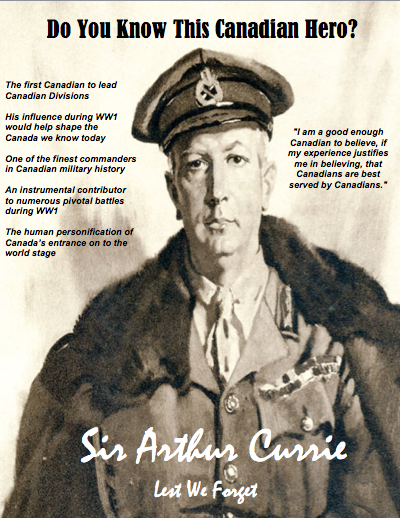
    As you may have noticed, posters pertaining to Canadian history have recently been placed around campus. These posters are a part of a public awareness campaign being put on by students in HIST 2783, Canada Since 1867. Its purpose is to spark public interest in our nation’s rich history by highlighting key events, ideas, and individuals that helped to shape Canada. Our group chose to focus on Canada’s involvement in World War I, specifically the contributions of Sir Arthur William Currie. By doing this public awareness campaign, our hope is that as the centennial anniversary of the war progresses, Canadian citizens will be more interested and informed as to why key moments and individuals like Sir Arthur Currie are so important to our history. We cannot permit ourselves to forget the cost and impact of the Great War on Canada.

    In a time when Canada’s identity was at stake, Sir Arthur Currie gave us a name and a reputation that was unmatched. When Great Britain gave over command of the Canadian Expeditionary Force to General Currie, the war took a turn for the better. His approach was efficient. systematic, and resulted in many lives saved. His leadership was instrumental in enabling Canada to stand victorious at Vimy Ridge, the Somme, Passchendaele and many other pivotal occasions throughout the final 100 days of the Great War. He never lost a battle and he held the safety of his troops as an utmost priority. His leadership was a serious matter – a Canadian officer had never before led Canadian troops and Currie demonstrated that we were more than capable as a nation to go head to head with major European powers, and in many ways, outperform them. His influence during WWI would help shape the Canada we know today. In his own words, “I am a good enough Canadian to believe, if my experience justifies me in believing, that Canadians are best served by Canadians.”

  • On Parity In Parliament

    On Parity In Parliament

    In the past few weeks, several pundits, politicians, and Facebook activists have taken it upon themselves to stress the importance of having either a gender-balanced cabinet, or from the opposite argument, a cabinet based solely on meritocracy. This type of debate bothers me psychologically. I think it’s absolutely wonderful that a gender-equal cabinet exists, but truthfully, I’m not sure that the issue warrants the level of attention it is getting. I will explain this at the end, but first, let me explain where I think both sides of this whole argument collapse.

    Firstly, I am in no way opposed to any sort of equality in government, whether it’s of gender, of culture, or of religion. In a representative democracy, the elected cabinet should be just that: representative. Therefore, an equal number of women and men serving makes complete sense. Some writers, like Andrew Coyne of the National Post, say it steals away the positions from more qualified people; that the people given the job should be the best people for the job. But in this particular case, the people appointed are the best people for the job. They won their seat in a fair federal election. They come from a diverse set of backgrounds; they are scientists, CEOs, and doctors. There is no need to question the merit of those elected, and to assume that meritocracy and parity cannot be reconciled as one is absurd.

    That being said, if one MP were to slip-up and say, incur thousands of dollars in limousine expenses and over-priced orange juice and then bill it to taxpayers (here’s looking at you, Bev Oda), then will the fact that they are under-represented in Parliament protect them? Voices like Tasha Kheiriddin of the National Post, speak out against the “fawning” of parity, and claim that Trudeau’s appointment should not make him immune to criticism as a leader and politician. Agreed. On the other hand, prejudice is a very real thing. If one member makes a mistake, then the public vilifies the entire subculture to which that MP belongs, using them as a scapegoat for their own problems (though anyone willing to make such generalisations is perhaps an idiot). If you don’t believe me, just take look at any history book. What protects these individuals from unjust attacks on their character if the public is intolerant of their culture, gender, orientation, and race? If these biases do exist, then the bigger question becomes: should equality be forced? Should we impose quotas on gender and race in our cabinet?

    Yes and no. Meritocracy in its purest form does not exist. Favouritism exists. Pierre Trudeau’s first cabinet was composed entirely of old, white men. It’s difficult to believe all were appointed on merit alone. Meritocracy only works when the playing field is level. Currently, it is not. Typically, certain groups have more privilege and resources granted to them in their lifetimes that allow them to gain the title “merited” in the eyes of the public. A part of that comes from race and gender, and another from economic background. So cheating a little bit can help rectify that imbalance, creating role models for future would-be cabinet ministers. However, the pressure to create wholly equal cabinets every term might put undue stress on the leader: what if this quota forces them to place an MP in a position they feel would be better suited by another? What if one term we have 16 females and 14 males, and the next, 16 males and 14 females? At some point, we must consider it sufficient to be governed by a cabinet that represents the best of both worlds: diverse representation coupled with merit and experience. But consider other forms of disproportion in our cabinet: Afro-Canadians are not at all present. Is this a big problem? I guess it depends on whether you value diversity of opinion and experience over pure ability and talent, if you had to choose between one or the other.

    While Trudeau’s “It’s 2015” quote was a fantastic one-liner (almost on par with Pierre’s “just watch me”), I don’t believe it does justice to the issue. Instead of just saying “I have appointed the best people for the job, regardless of gender of religion,” calling attention to the fact that his cabinet is gender-equal has for some, already tainted those individuals coming from a non-privileged background. People are fickle – they will look for any reason to cast doubt on others’ competence. It is this editor’s opinion that one of the greatest aspects of Canada is its diversity (even though we don’t always treat each group the same). It’s important that our nation is one that has equal parts male and female in important roles deciding the fate of our nation. We still have a long way to go though, and I think that moving forward, we should strive to be a state such that the notion of gender parity in Parliament is, in fact, a complete non-issue. We shouldn’t have to celebrate the fact that we have gender equality in our country, because in many ways, it should just be. I know, I know – easier said than done.

Betzillo positions itself as a versatile gaming hub where structured bonuses and adaptive gameplay mechanics support both short sessions and extended play.

Built with a focus on innovation, Spinbit integrates modern casino architecture with rapid transactions, appealing to players who value speed and digital efficiency.

Ripper Casino emphasizes bold entertainment through high-impact slot titles and competitive promotions crafted for risk-oriented players.

A friendly interface and stable performance define Ricky Casino, offering a casual yet reliable environment for a wide spectrum of gaming preferences.

King Billy Casino channels classic casino spirit into a modern platform, delivering recognizable themes supported by contemporary reward systems.

Immersive visuals and layered slot mechanics are at the core of Dragonslots, creating a narrative-driven casino experience.

Lukki Casino appeals to players seeking direct access and minimal friction, focusing on fast loading times and intuitive controls.

Casinonic provides a structured and dependable gaming framework, blending modern slots with transparent operational standards.