Tag: democracy

  • The dead-end of politics and young voters

    The dead-end of politics and young voters

    I kept struggling to write this piece not simply because I don’t know what to say. It’s because this opinion piece unravels my version of the truth regarding the multiple factors as to why young people in Canada aren’t involved enough in politics. I would just like to briefly state it is not because young people are lazy or do not care. This opinion piece will consist of the ongoing frustrations many politics majors or even political ‘geeks’ commonly experiences regarding youth engagement in politics.

    First off, I guess this piece is a bit bias considering I am a fourth-year politics major here at Acadia. However, the frustrations I have noticed over time seems to be an ongoing occurrence of having to constantly explain what has been happening within mainstream media. In particular, issues revolving around climate action or student debt.

    Turning to the ongoing anxiety revolving around our climate crisis, most young people realize that this is a serious issue and we should act now. But what does this action look like? Multiple young people have shared, liked, retweeted Bill Nye’s comedic but alarming video about the climate crisis. As Bill Nye famously quotes: “the world is on fucking fire and we are not children anymore so that is why we should give a shit”.  This article may seem to have a tone of anger and frustration. And to a certain extent well I am angry and frustrated because seriously, why don’t young people care about Canadian politics? This has been getting significantly better, I will admit. Movements revolving around Climate Action and the active discussion towards our future is prevalent, just not enough.

    The active sharing on social media has filled our newsfeeds, with quotes from Greta Thunberg, Autumn Peltier and many other youth activists who have given us hope for our next generation.

    With the next Federal Elections creeping around the corner, efforts from our students union have been made. Putting campaigns such as GET OUT THE VOTE, and providing non-partisan information of party platforms, events that candidates of the riding have attended. The education and the effort is there to encourage young people to vote within Canada. If programs such as these are available why is the turn out, historically lower?

    Is it blatantly that people do not care or simply don’t have the time? These are the questions that I have been grappling with since the election had been called.  A factor could very well be that older generations specifically baby boomers, have had the assumption young people were never really involved in politics for the past decade. A possibility around this notion is that politics seem to be compartmentalized around what we perceived to be political. When we generally think of politics, we assume it is our parliamentary system, politicians kissing babies, or Donald Trump’s questionable tweets. Popular American shows such as, Scandal, House of Cards, among many others have projected a glorified perception of politics. In reality, politics is obviously not how you would see it on American television.

    The Politics department here at Acadia offers an intro course in politics.

    Throughout this course we are taught that pretty much everything we encounter is political. First-year students often scoff at this absurd idea (including myself). How can everything be political? Well, I am well into my fourth year and Dr Geoffrey Whitehall will be pleased to know that everything is in fact political. Whether we like it or not. The concept of politics can even revolve around the food we buy, online shopping, the decision to buy a new iPhone, laptop or even the small decision of whether you choose to buy Cannabis from our current government or your local supplier. The choice between paper and plastic straws, reusable bags the list goes on. The choices you make in your everyday life has an influence on society whether we realize it or not.

    The question then becomes: how do we get people more informed of Canadian politics? We have tried time and time again from changing school curriculums to providing better resources and not much seems to be working.  Education has a large factor on future generations and youth voters. Being informed about issues that matter to you personally is extremely important. Forming your own opinion based off credible, accurate sources is vital to enrich our democracy. Wherever you fall on the political spectrum, right or left your opinion matters.

    Most people I’ve talked to recently have stated that they just don’t know enough to give their opinion and that is a fair point. There is nothing worse than an Arts/ humanities major stating they know more about the powerhouse of the cell than a 4th-year bio major, sounds ridiculous right? Well by putting that example into context that is what politics majors and political geeks must endure throughout election season.

    So, my advice to you if you are a first-time voter is to ask the hard questions, discuss with your friends about issues that may matter to you, and if you’d like to reach out to your friends who are political geeks I’m sure they’d be happy to help. But please exercise your democratic right and vote.


  • An Open Letter to the Incoming SRC

    An Open Letter to the Incoming SRC

    An Open Letter to the Incoming SRC.

    This open letter is meant to bring forward our concerns, suggestions, and foster collaboration. It will address our views on student democracy, leadership and journalism.

    Democracy

    By definition, any student union or government is required to serve and represent students.  Representatives are here for students of the ASU. These students, from presidents to councillors, are here to serve everyone at to the best of their collective ability.  These students are members of the union in the same way that each and every student who pays student fees is. Elected members have a duty to consider more than just their own opinions on issues when determining the interest of the union as a whole.  This is where problems arise.

    The best unions must embrace democracy to its fullest. This means laws and practices that adhere to democratic principles of fair and free elections, ethical governance and always promoting students’ democratic rights. These should be the top priorities of any union.

    It is no great secret that we, Kyle Thompson-Clement, Chris Vanderburgh, and Josée Léger, strongly believe that the ASU has systematically weakened students’ rights. It was brought to our attention that students can no longer impeach ASU representatives nor bring forward referendum by petition. Adding these restrictions means students with enough support from other union members currently have no guarantee that they could remove a representative from their position or submit a question for a referendum.

    To incoming ASU representatives, understand that the 10+ people sitting around the table are not the union. The union is each and every student and it is your job to serve these students. If members of your union, non-elected members and those around the table alike, show support for an idea like a bus pass or impeachment and referendum rights, it is your job to find out how to make that work for the union.

    It is your job to contextualize your positions and solicit feedback, both positive and negative. Again, we remind those who are elected that it is your job to promote everyone’s right to fair and just governance. This year we feel the union has failed to do so.

    Leadership

    Often the term leadership is connected to elected members of the ASU. We would strongly agree that every one of the students elected to the ASU as representatives is in some form a leader. Part of this leadership entails educating students on what being a member of a union means, and what they are supposed to be privy to as paying members. As leaders, we urge, nay beg, all representatives of the ASU to lead by example.

    Check your colleagues. Do not be afraid to speak out against any authority on the ASU. If an elected member is fearful of speaking out, it is clear the union is flawed.

    Do the hard work. Protect student rights. Explain from the day they are accepted to Acadia University that their representatives are there to protect everyone’s rights.

    The following message is just for the incoming Executive. The Executive sets the tone for how union members will be governed. If you lead by example the whole elected representative body is stronger. Please, for every union member, eliminate with the strongest sense, any thoughts or feelings of thinking you know better than students.  

    Please keep communication open to anything you do that will have an impact on the student body. Transparency is key to educating a union on matters that affect them. If students show enough support or vote favourably on a referendum question to see something actioned it is your job, especially as the executive, to make that happen.

    Secondly, we get it. We understand that all union members are not always informed enough to make decisions on their union’s future. However, as a governing body, it is also your duty to educate students and present the most whole thought out plan for how to achieve a particular goal. This means putting in the work to find the most effective way of implementing these changes regardless of personal bias.

    It is up to every union member to decide whether they agree or disagree on substantial changes. Leadership means constantly putting effort in by presenting all the options with the most detail and clarity. This will allow the union at large to fully consider decisions and show the rest of the representatives that the union is more than just the individuals who sit in the council room. A more engaged approach to union governance will boost election participation and promote a more active union.  

    Journalism

    Incoming ASU representatives need to understand the importance of journalism. In every modern society, journalism plays a critical role in being the check and balance of power, corruption, and ethical governance. The Athenaeum is here to educate students on all social issues. Sometimes, our job is to foster a conversation on the governance of our union.

    Any attempt to undermine the duty we have as journalists is a threat to governance and pushes us towards an authoritarian government. We know it sounds overwhelming, but we exist to bring forward any issues within the union.

    We’re not looking to ruin the reputation of the ASU. We love our school and we love our newspaper. However, it is our job to stand up and be watchdogs for policy changes or events within the ASU that represent significant changes to how students are governed. Articles that shed light on messy issues may not always make your job easier. Certainly not. That’s not why we are there.

    Instead of trying to silence voices of dissent, representatives themselves must use the same medium we do to convince students otherwise. Journalism, especially pieces that shed light on policy issues, represent an opportunity to think critically about the decision being made in the council room. Please, embrace what journalism represents: checks, balances, freedom of speech, freedom of the press and a means to educate the very union you represent.

    Throughout our time at Acadia we have learned a lot about the inner workings of politics. We can confidently tell you that your representatives work towards making the lives of its union members lives better.

    However, to the incoming ASU representatives, please advocate for students’ rights. Put the students first and actively work hard by setting petty grievances and personal bias aside. Work towards giving students the most democratic and sound governance we all deserve. Lead by example. This means setting a tone that students rights are of the highest importance, exploring all options, and educating other union representatives on why democracy is essential for the union.

    Finally, attacks on student journalism can and should be met with hostility and dissent. It can be a bitter pill to swallow but it does not change our job as student journalists. We will continue to do the hard and sometimes confrontational work of exposing incidents that run counter to students’ best interests. Again, this opposition through The Athenaeum can be embraced as an opportunity to reflect on representatives’ choices and standard governance practices.

    The Athenaeum is willing to meet regularly with the ASU in hopes to actively work out future tensions. The Athenaeum and the ASU are here to work for the students.

    Let’s not lose sight of that.

    Sincerely,

    Josée Léger

    Kyle Thompson-Clement

    Chris Vanderburgh

  • Councillor Vanderburgh Discontent with Ad-hoc Bylaw Committee

    Councillor Vanderburgh Discontent with Ad-hoc Bylaw Committee

    After the $10,000 bylaw review took place last semester, the Ad-hoc Bylaw Committee was formed as a result of contentious changes that were passed in this latest bylaw review. Christopher Vanderburgh, Councillor on the Students’ Representative Council (SRC), sat down with The Athenaeum on February 1st, 2019 in order to understand his frustration and discontent with the lack of progress regarding the Ad-hoc Bylaw Committee.

    Vanderburgh explained that he has been very vocal to the SRC and believes the majority of the bylaw changes are good. However, his problem lies with the changes to Bylaw 3 which covered students’ ability to initiate a referendum and to impeach elected officials. Under the old bylaws, a student would be able to gain 10% of the student body’s signatures in order to have the matter reach a referendum or impeachment- the new changes to Bylaw 3 eliminate students’ ability to do so. Vanderburgh believes that the ability to petition for referenda or impeachment is a vital right that students should possess. Vanderburgh states than when he reached out to the Council’s lawyer asking the simple question “Have student’s rights been taken away?” their lawyer answered “Yes.”

    “This is a massive abuse and affront to student democracy on campus and it will be in effect for years to come,” Vanderburgh declared. “In the five years I’ve been a student on this campus studying politics I do not have the words to describe how bad this actually is.”

    Vanderburgh is one of the Council members chosen to sit on the Ad-hoc Bylaw Committee established in early December. The committee is supposed to review problems with the bylaws and recommend to the ASU how to fix them. Vanderburgh was told the committee would meet as soon as possible, as there are many things that need to be done before the committee can actually discuss the bylaw issues. As of February 1st, the committee has yet to meet.

    As a vocal Council member, Vanderburgh reached out to Molly Anderson, Chairperson of the SRC and bylaw committee, on January 15th simply asking about the committee. Anderson replied stating that there was no information on the committee to report on yet. On January 21st Vanderburgh asked again, this time adding George Philp, President, to the email. He received a reply from only Anderson, a week later on January 28th, who stated that “work is being done” but noted that she is on an approved leave of absence.

    Later that same day at the SRC meeting Vanderburgh asked the Council whose problem the committee actually is. Evan Shergold, acting Chair for Council and the committee told Vanderburgh it was his problem and he would be in contact. On January 30th, Vanderburgh contacted Shergold to hopefully finally start on the committee, to which Shergold responded, “I will send out an email shortly.” As of February 1st, there still have not been any plans made to start this committee.

    “It seems to me as if students are having one pulled over on them in a big way,” Vanderburgh stated. The ASU had announced in November that the bylaws would align with their promise for integrity and respect. Vanderburgh noted that he doesn’t feel “as if students are being respected by this process. I shouldn’t have to send four emails to multiple higher ups and still have nothing to show for it.”

    When asked what Vanderburgh was proposing he answered by saying “What I’m proposing is that the ASU have enough respect for students to at least discuss the problem at hand and stop avoiding it.”

    In addition, Vanderburgh made it clear that he is appalled by the extraction of these student rights, and believes that this is a problem worth fighting.

    “I’m not going to go away,” he said.

    It is important to note that since this interview took place, both Shergold and Philp have sent emails regarding the Ad-hoc Bylaw Committee by filling three open student positions on the committee before the committee work can commence.

    “The ASU Executive felt strongly at the time the Ad-hoc Committee on Student Initiated Petitions was struck that this committee should operate independently of the ASU Executive” Philp announced, responding to Vanderburgh’s opinions on the matter. “The committee still has ample time to provide an interim report to council by the first council meeting in March (March 12th) in accordance with the committee’s terms of reference. The ASU Executive looks forward to hearing the committee’s recommendations. Our Executive has been and will remain focused on improving student wellness and success and is always available to meet with students should they have any questions about the ASU, ideas for improving campus life, or are looking to get involved at Acadia.”

    This article has been updated to reflected comment from the ASU.

    Rylie Moscato is a first year English student and Columnist for The Athenaeum

  • A Union for Whom?

    A Union for Whom?

    Growing up, I learned that trust and respect are both earned; that those in positions of authority worked to be elected and they possess knowledge from education and experience. In turn, they will take the voices and opinions of those they represent to make decisions on their behalf.

    In the two years I’ve been here none of that has occurred with the ASU.

    Through my time at Acadia I’ve grown familiar with the ASU and how it functions (or attempts to). From the get-go, I’ve witnessed a dumpster fire that can’t seem to keep its own executives from running in the opposite direction, clinging to whatever is left of their reputation on campus and careful to avoid the lingering fumes emitted from an undemocratic “union” that lacks the input of the very people it’s meant to represent. This has occurred while failing to demonstrate equitable and diverse leadership, furthering the divide from student body and the union itself.

    In November, a video was posted on the ASU Council’s Facebook page outlining the proposed changes to promote inclusion, accountability, election window extensions, and ‘other’ proposed changes. When did ‘public’ consultation sessions happen? Who did they ask? Where is the post outreach report? Where are the qualitative and quantitative reports of their findings to be made public? How can a consultation space be considered accessible when there are very few non-executives present and the session is held in a largely unknown, secluded room filled by a council who are all close friends?

    If you can’t tell by my pointed tone, I’m pissed. I have people that I didn’t vote for making decisions concerning the structure of my school, my education, my student events, and making bad choices on where my money goes and what I owe at the start of every semester. Let’s look back at what our tuition money has funded, shall we?

    • The UPass issue this year;
    • The Chief Returning Officer resigning last year, following massive backlash concerning ASU operations and electoral processes;
    • Acadia Pregnancy Support operating down the hall from the ASU offices in the SUB pushing pro-life and shaming abortions for four years. Four. Years.
    • The Wellness Fund debacle of last year;
    • Undemocratic bylaw revisions that were only renamed and saw very little change. Not only that, but non-executive positions were canned, and student petition motions were removed.

    These are only some of the issues plaguing recent ASU history and I don’t want us to deal with more as a student body. Going to Acadia is getting more and more expensive and we as a student body should not have to take even more when we aren’t even being properly consulted.

    Just last week at Independent on Main Street, I watched a student’s debit card decline. With their groceries bagged and people staring, I saw panic and humiliation. As paper towel, butter, and milk were taken off the transaction their card was approved. The student ran out of the store nearly in tears, leaving behind daily necessities and other concerned shoppers who felt deep sympathy for someone just trying to get through their day. Maybe the money that student paid in fees towards a yearbook, or the proposed UPass could have allowed them home essentials.

    To ASU President George Philip and the ASU, I’m not going to complain about issues without proposing solutions to said problems. Here are the following:

    • Hold Council meetings in a more public space than the back room of the Michener Lounge. It’s not accessible going into a room full of like-minded friends while carrying concerns for their decisions;
    • Make all findings public from all student engagements, then detail what amendments will be proposed using the data from the engagements;
    • Meet with and invite different student committees and clubs to have their unique concerns and problems heard. This way a broader student voice can be heard;
    • Open further dialogue from students to administration;
    • Allow a “Yes/No” option on ballots for positions being run for unopposed;
    • Audit the actions and events of student associations.

    Though there has been some progress in certain areas of concern the ASU lacks accountability and transparency. There are people on council who are kind, hard-working, and warm hearted. I just want leadership from those who truly care and who aren’t in their position just to pad their résumés. I want no bullshit and I want clear and concise decision making that considers those who will be impacted by the result. At the end of the day, the changes imposed by ASU Executives impact what does and doesn’t get left behind at the grocery. If it’s not a union for you and me, whose union is it?

  • Fact Checking the ASU Bylaw Review

    Fact Checking the ASU Bylaw Review

    Today, the Acadia Students’ Union (ASU) issued a media release and video to explain some of the proposed by-law changes that will be coming forward for adoption on December 4th, 2018, in response to recent public criticism from students. The release and video are available on the ASU website here.

    The Athenaeum strives to provide accurate and timely information on current events that matter to students. As such, with the bylaw review coming to a close, this article will outline the key messages shared in the video, what they mean for students and what their implications will be moving forward.

    Overall, it appears that most of the claims in the video are factually accurate, but many are misleading to students who do not have a solid understanding of how the ASU operates and how governance documents are used in everyday business.

    Key Message No. 1

    The By-Law Review works to “ensure that our organization’s practices align with its values of integrity, respect and inclusion” (0:15).

    Fact Check Rating: Mostly True but Misleading

    The By-Law Review is a comprehensive review of all governing documents and was launched in March 2018 with two main ideas: increase diversity on Council and eliminate vagueness, redundancy and contradictory language.

    In terms of integrity, the draft by-laws present a strong foundation for increasing the accountability of student representatives to Council, with new regulation around Council meeting attendance, and Committee and Executive reporting at Council meetings. However, the draft by-laws also remove the ability for regular students to impeach their Members of Council in the future. The impeachment provisions currently provide for the ability of students to submit a petition signed by 35% of the constituents of the Member of Council which would trigger a General Meeting where 25% of the student body must be present. The removal of this provision means that Members of Council can only be removed if other Members of Council move to impeach them. This provision has been used in the past with Vice Presidents being impeached in the early 2000s.

    In terms of respect, the draft by-laws establish vague yet promising election rules and regulations that promote respect amongst candidates (Rules of Fair Play and Community Standards); however, these rules can be interpreted in different ways depending on the opinions of the Elections Committee.

    Finally, in terms of inclusion, there does not appear to be any significant progress towards making the Acadia Students’ Union any more inclusive of marginalized people and groups on campus. The Diversity and Inclusion Representative (currently the Equity Officer) will be hired, rather than elected; however, it is not clear how this would increase the overall diversity of Council. One claim made by the media release that the Diversity and Inclusion Representative would be hired by a committee with “at least two of its members to identify with one or more of the four groups identified in the (Canadian Employment Equity) Act” is not reflected in the raft by-laws. Section 12 of Bylaw 2 (Committees) which discusses the composition of the Hiring Committee does not include this requirement.

    Key Message No. 2

    The Bylaw Review will allow the Students’ Representative Council to “function effectively and address important student issues” (0:22).

    Fact Check Rating: Neutral

    While it has been proven in numerous studies that organizations can be more effective with fewer Board members, it remains to be explained why reducing the number of student representatives would be better for the student body. Over the past fifty years, the Students’ Representative Council has functioned effectively and addressed issues that are important to students with both large and small numbers of voting members. While this claim is in theory true, it is unclear how this would affect regular students.

    Key Message No. 3

    The By-Law Review will “establish a more diverse and inclusive Council and a Diversity and Inclusion Committee to ensure that the voices of all students are heard” (0:30).

    Fact Check Rating: Mostly False

    On the first element of this key message, the By-Law Review fails to establish clear measures that would increase diversity on Council, other than mandating that the hired Diversity and Inclusion Representative self-identify as female, a visual minority, Indigenous, and/or a person with disabilities. There have been no discussions or consultations that have been widely attended by individuals who fall into these groups nor do the proposed changes encourage persons from marginalized groups to run for the remaining fifteen (15) Members of Council.

    On the second element of this key message, the By-Law Review does rename the existing Campus Representation Committee to be the proposed Diversity and Inclusion Committee and adds the ASU President and the Coordinator of the Acadia Mental Health Initiative (AMHI) as members of the committee. However, the existing committee (Campus Representation Committee) has been one of the least effective ASU committees over the last couple of years and it has been widely regarded as having failed in achieving its mandate. The committee has typically met between two (2) and five (5) times per academic year (September to April) and most discussions include upcoming events being planned by the Internal Organizations that sit on the committee. There have been no appointments of additional individuals onto this committee in recent years and there has been minimal outreach to marginalized populations. This committee has not been effective at ensuring that all student voices are heard in the past and it is unlikely that a name change and the addition of new members will change that fact in the long-term.

    Key Message No. 4

    The By-Law Review would create “new guidelines and meeting attendance requirements for Members of Council to hold your elected representatives accountable” (0:36).

    Fact Check Rating: True

    The By-Law Review does create clear expectations for Members of Council to attend Council meetings. However, these guidelines have existed informally in the past. They are not new, but the key change is that the ability to excuse a Member of Council is made by Council, rather than the Chairperson who could do so historically.

    However, this directly contradicts the impeachment provisions which still state that a Member of Council may be impeached, at Council’s discretion, for missing two (2) consecutive meetings or a cumulative total of four (4) meetings throughout the year “without providing written notification to the Chairperson twenty-four (24) hours in advance”.

    Key Message No. 5

    The By-Law Review would increase” the number of voting days in the ASU (General) election from two (2) to five (5) to maximize voter turnout” (0:43).

    Fact Check Rating: Mostly True

    The draft by-laws do extend the number of voting days to five (5) consecutive days; however, the entire campaign period is shortened to ten (10) days total, including voting days. Therefore, students will have ten (10) days to learn about their candidates, attend meetings and events surrounding the election and to decide whom they will support. Additionally, the draft by-laws remove any reference to what happens in the case of a “snow day” (campus closure) and it is presumed that the election would follow its original schedule. In the 2017 General Election, there were two full-day campus closures due to inclement weather and voting was extended accordingly. This change may increase voter turnout but this is not conclusive.

    Key Message No. 6

    The By-Law Review would add “more areas for candidates to campaign to better facilitate student engagement in ASU Elections” (0:47)

    Fact Check Rating: True

    The draft by-laws seek to allow more campaigning in areas where campaigning is currently prohibited. These areas include the Axe Bar and Grill (formerly the Axe Lounge), the first floor of the Library, at ASU, Club, Internal Organization or House Council events (with permission of the host).

    Key Message No. 7

    “We’ve already been consulting with students” (1:08) and “In fact, never has our union spent so much time listening and building governing documents that are truly reflective of the organizations mission statement” (ASU Release)

    Fact Check Rating: True but Misleading

    The Acadia Students’ Union committed to holding student consultations in March 2018 that would tackle the major issues of diversity on Council and the Council composition. In total, three consultations were held – two in April 2018 and one in November 2018 – with a handful of students attending. The first two consultations meetings were largely attended by Members of Council (outgoing and incoming). Since then, these documents were developed by the Executive Team and Members of Council before being released a few hours before the final student consultation. At this last consultation, six (6) regular students and several Members of Council were present to hear about the proposed changes and to provide feedback on the proposal. Only feedback that the presenter agreed with was recorded. The final consultation appeared to be more of an information session to those regular students in attendance as their ideas and suggestions were not taken seriously by the presenters.

    Oliver Jacob is a third year History and Politics student and News Editor of The Athenaeum and former Chairperson of SRC

  • Ontario Municipal Elections Explained

    Ontario Municipal Elections Explained

    Local governments across Ontario, including the City of Toronto, are currently undergoing municipal elections, in which voters will choose local candidates to serve during the next term.

    Every four years, Ontario voters go to the polls on the third Monday in October to choose their local representatives, who will defend their interests and values while in office. Every resident who is at least 18 years of age and a Canadian citizen is eligible to cast a ballot.

    Municipal governments focus on issues of local importance, including garbage and recycling collection, animal control, land use planning and development, public transit and recreation.

    The City of Toronto

    In the City of Toronto, the election is progressing much differently than anticipated when the nomination period opened in May. Toronto is a particularity in Ontario since it is not governed in the same way as the province’s other 443 municipalities. The City of Toronto has greater power and jurisdiction over local issues and covers a much larger area than a typical municipality.

    Existing City of Toronto Ward Boundaries Map
    Existing City of Toronto Ward Boundaries Map

    47-Ward City Council Map

    Over the last three years, Toronto City Council has conducted extensive public consultations and discussions on the size of Council as a body. It currently contains forty-four councillors and one mayor. The finalized ward map, approved by City Council on November 9th, 2016, changed ward boundaries for forty wards and created three new wards. Therefore, the map approved by City Council would have had forty-seven councillors and one mayor.

    The changes were then unsuccessfully appealed to the Ontario Municipal Board (OMB), the body that reviews municipal by-laws to ensure that they are in accordance with provincial policy. In the OMB decision, the majority of members agreed that “[…] there are no clear and compelling reasons to interfere with the decision of council.”

    The provincial government at the time, led by former Premier Kathleen Wynne, acknowledged that the decision was the prerogative of the City of Toronto and that they would not interfere.

    Proposed 47-Seat City of Toronto Ward Map
    Proposed 47-Seat City of Toronto Ward Map

    25-Ward City Council Map

    Following the defeat of Wynne’s Liberal government on June 9th, 2018, newly elected Premier Doug Ford and his Progressive Conservative government announced that it would bring forward legislation to circumvent Toronto’s new ward changes and institute a new ward map aligning municipal ward boundaries with their federal and provincial counterparts, reducing the number of City Councillors to twenty-five, plus the mayor.

    “We ran on a commitment to restore accountability and trust, to reduce the size and cost of government, including an end to the culture of waste and mismanagement,” Ford said. “Because one thing every politician at every level and in every region needs to remember, is that we all share the same boss. We all work for the people.”

    Provincial Plan Map for 25-Seat City of Toronto Ward Map
    Provincial Plan Map for 25-Seat City of Toronto Ward Map (with underlying 47-seat map for reference)

    Public Outrage Intensifies

    Toronto Mayor John Tory, who is running for re-election this fall, took a hardline approach to the Province’s announcement and called a special meeting of City Council to respond. On August 23rd, 2018, City Council agreed to challenge the legality of Bill 5 (Better Local Government Act, 2018) before the courts by a 33-9 vote.

    Ontario Superior Court Justice Edward Belobaba ruled that the Bill 5 (Better Local Government Act, 2018) was unconstitutional on the basis that it contravened the freedom of expression rights of candidates and Toronto residents as guaranteed under the Canadian Charter of Rights and Freedoms. Justice Belobaba further directed the City of Toronto to proceed on the 47-ward map that City Council had approved.

    Premier Ford responded by appealing Justice Belobaba’s decision to the Ontario Court of Appeal and by pledging to invoke Section 33 (the “notwithstanding clause”) of the Canadian Charter of Rights and Freedoms should the appeal not be successful.

    Opposition politicians blasted Premier Ford for using the seldom-used notwithstanding clause, which allows federal and provincial governments to circumvent the Charter rights of Canadians.

    Andrea Horwath, Leader of the Official Opposition, questioned Ford’s intentions and concluded that “we have a power-hungry premier (Ford) who obviously doesn’t care about people’s Charter rights”.

    The independent Liberal members slammed Ford for focusing on upending Toronto’s municipal election rather than tackling the real issues affecting Ontarians.

    Like his opposition colleagues, Green Party Leader Mike Schneider expressed that “we are debating the premier’s personal grudge match against the City of Toronto” and many of its progressive Councillors.

    Final Decision for Torontonians

    Ultimately, the provincial government’s appeal to the Ontario Court of Appeal was successful with the Justices granting a stay to suspend Justice Belobaba’s ruling while it is appealed later this fall. As a result, the municipal election will proceed under the 25-ward map that was approved by the provincial government, the first big win for Ford since taking office in June.

    Student Eligibility to Vote in Ontario’s Municipal Election

    Students from Ontario are eligible to vote in the municipal and school board elections this October, provided that they intend to return following the completion of their education. Check your voter registration status online at www.voterlookup.ca or by contacting your local municipal clerk’s office.

    Oliver Jacob is a third year Politics and History major and News Editor of The Athenaeum

  • On Voting

    On Voting

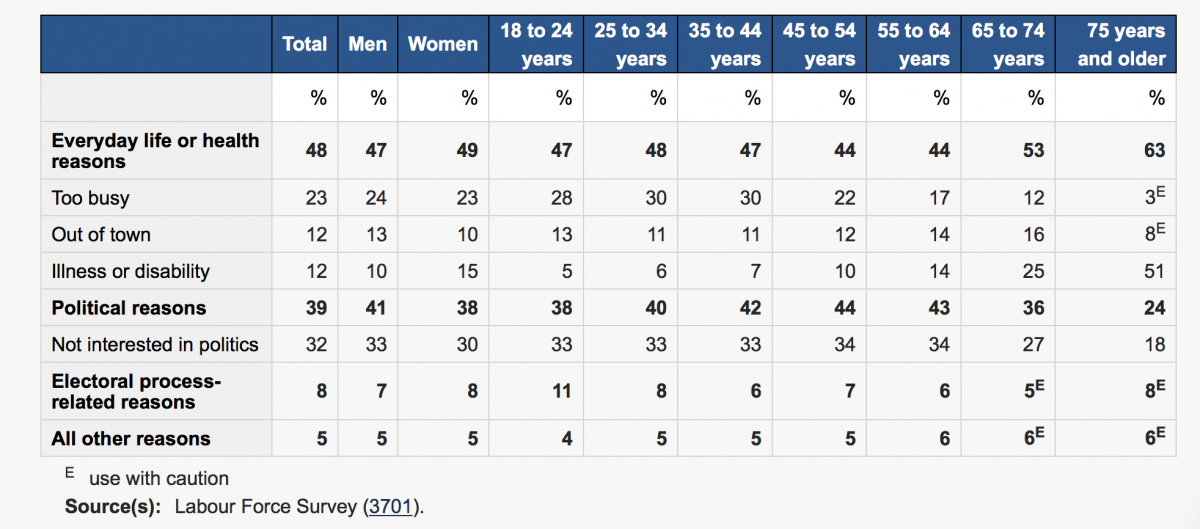
    It is no secret to anyone that voter turnout in Canada has been on a downward trend. According to Elections Canada, the turnout for the last federal election in 2011 was 61.4% – the third lowest in our country’s history. The turnout among students and younger people in particular is lower than any other age group (this is not to say that other factors such as economic and social status are not equally responsible). National estimates cite a shocking 38.8% for voters between the ages of 18-24. That number sucks. According to a poll conducted by Statistics Canada, the most common reason given for the people in this age group was that they were not interested in voting. Others stated that they were too busy with school or their work, and others were away or traveling. Interestingly enough, for senior citizens, the most common reason for not voting was due to illness or disability. And yet just over 75% of people in the age group 65-74 voted. Is it safe to assume that seniors respect democracy more than students do?

    I believe there is another reason that plays a big role. This election will be the first time that many university students are eligible to vote federally. It can be an intimidating process. Several questions will arise, doubts will start to form. When voting day rolls around, the effort to go to a polling station won’t be made. After that, continued apathy towards voting seems almost permanent. How can this be avoided? Firstly, if you are feeling this way, know that you are not alone. Secondly, there is an abundance of available resources online and on-campus that help students with their first vote. One such resource is the Get Out the Vote! Campaign (if you would like to learn more about them, I highly encourage you to check out their website). The campaign is headed by Fallis Thompson, VP Academic for the Acadia Students’ Union. You can pledge to vote from their website.

    Of course, having the right to vote also means having the right not to vote. It is not a responsibility or a civic duty. It is a privilege. If you don’t like the choices, then why bother choosing? Feel free to spoil your ballot. And I don’t agree with the argument that says that “those who didn’t vote don’t have the right to complain.” I retain my right to complain about everything. That being said, I strongly believe that students should vote. I believe that students should exercise their civic right and fulfill their role in democracy.

    Why? I suppose the answer is a bit of a cliché. Whether it comes down to something more immediate like education or something more long-term like fossil fuel consumption, there is no doubt that the decisions made today will affect our futures tomorrow. And who is it that inherits that future? We do! Moreover, students have a huge capacity to manipulate the social agenda to their will. Consider the student movement in Quebec in 2012. Premier Jean Charest proposed a tuition raise of almost 75%. As a result, a quarter million people took to the streets in protest. While this is definitely an extreme case, I also believe it demonstrates just how underestimated the student population is when it comes to its ability to partake in civic engagement. “I feel like some students don’t realize the large impact they can have in this election,” Thompson says. “Actions speak louder than words and voting is the perfect example of that.”

    There are a hundred reasons you can come up with not to vote, whether it be apathy or ignorance. But when it comes down to it, what will really be stopping you from casting a ballot? I hope you will think about it and ask yourself if the obstacle is something you can overcome. Don’t let first time intimidation stop you. Make yourself heard. Shape your future the way you want it to be shaped. Vote in the federal election on October 19th, 2015.

    Links:

    Pledge to Vote: http://asu.getoutthevote.ca/

    Get Out The Vote FAQ: http://www.getoutthevote.ca/voting_faq

    Voter Turnout At Federal Elections and Referendums: http://www.elections.ca/content.aspx?dir=turn&document=index&lang=e&section=ele#ftn2

    Factors associated with voting: http://www.statcan.gc.ca/pub/75-001-x/2012001/article/11629-eng.htm

    Reasons for not voting in the May 2, 2011 federal election: http://www.statcan.gc.ca/daily-quotidien/110705/dq110705a-eng.htm

    Estimation of Voter Turnout by Age Group and Gender at the 2011 Federal Election: http://www.elections.ca/content.aspx?section=res&dir=rec/part/estim/41ge&document=report41&lang=e#p41

Betzillo positions itself as a versatile gaming hub where structured bonuses and adaptive gameplay mechanics support both short sessions and extended play.

Built with a focus on innovation, Spinbit integrates modern casino architecture with rapid transactions, appealing to players who value speed and digital efficiency.

Ripper Casino emphasizes bold entertainment through high-impact slot titles and competitive promotions crafted for risk-oriented players.

A friendly interface and stable performance define Ricky Casino, offering a casual yet reliable environment for a wide spectrum of gaming preferences.

King Billy Casino channels classic casino spirit into a modern platform, delivering recognizable themes supported by contemporary reward systems.

Immersive visuals and layered slot mechanics are at the core of Dragonslots, creating a narrative-driven casino experience.

Lukki Casino appeals to players seeking direct access and minimal friction, focusing on fast loading times and intuitive controls.

Casinonic provides a structured and dependable gaming framework, blending modern slots with transparent operational standards.