Tag: representation

  • Black History and Diversity at Acadia

    Black History and Diversity at Acadia

    Now that Black History Month is officially upon us, it’s time that we hear conversations on the importance of diversity. It makes sense considering Black voices are at its loudest during this time of year. We take a lot of pride in our people, our history, and our communities all while engaging in conversations about how we still have lots of work to do.

    It’s a lot of Black people’s favourite time of year because it calls for action on diversity and inclusiveness. On top of that, people have no choice but to hear all our accomplishments we’ve done for the country because according to the public education system there is no room to fit them into the curriculum. This month makes many of us feel special, heard, and appreciated.

    These feelings are something that society only puts aside for this month. For the rest of the 337 days of the year (336 during leap year) we have to actively fight and justify our existence, why we deserve the same opportunities as our White peers, and overcome barriers that have been placed by institutions for generations. With all that said, Black History Month is the perfect opportunity to call for action on being more diverse. This begs the question: what does it mean to be diverse?

    Often times, when people hear the word “diversity” they often do not go beyond the surface. For them it’s the colour they see, the gender in front of them, the way people express themselves. For me, it goes beyond the surface. It’s the struggles people go through, the things they’ve overcome, the barriers that are in place, and the mindset that many have.

    For example, the “Black experience” is not the same for every single Black person. Some of us had opportunities to excel and were able to receive the supports needed to get us where we are today and others weren’t that fortunate. Unfortunately, this often prevents them from reaching their full potential. The same could be said for any ethnic group and minority group.

    What I am getting at that here is that diversity goes beyond the surface and it is important to recognize that. It means nothing to have a “Black face” on a poster to show diversity if we don’t acknowledge the experiences that comes with it. The issue with Acadia isn’t the lack of diversity on campus. We all knew what we were getting ourselves into after we decided to stay after our first year here. The issue with Acadia is not only to say we’re something we’re not (meaning diverse) but also, the lack of supports and understanding of people’s experiences based on the lack of diversity. This campus has so much potential to be an inclusive place regardless of the lack of visible diversity that’s on campus, but right now it’s lacking.

    I bet you’re wondering what can we do to make it more diverse. Well, we can start by acknowledging that we all experience things differently. To understand to go beyond the melanin (whatever physical feature that makes us different) and think to ourselves “what can we do to make everyone feel at home?” Each person has different needs based on their personal experiences. We can become better supports to one another and stop asking people to speak on behalf of their race or what they physically represent. White people never speak on behalf of their entire group so there is no reason why everyone else needs to speak on behalf of theirs.

    It is good and healthy to ask people their opinions on different matters and world events but remember that it is their opinion and their interpretation. So although their thoughts and opinions may be similar to others they still do not speak on behalf of everyone in said group. Lastly, remember that it is okay and healthy to disagree and debate with others but what is not okay is to dismiss others people’s experiences. For example, it is completely fine if you don’t believe that Acadia has a race issue on campus based on what YOU saw within campus but what is not okay is to dismiss people when they share their stories of race related issues they experienced on campus.

    In short, what I’m trying to say is that next time you look at an Acadia poster, or see something within the community that seems “diverse”, look beyond the photo. What do you see? What is this photo trying to represent? Remember that we represent something beyond our physical features. I am more than a biracial woman. I represent my Christian faith, my control I have over my depression, the obstacles of being from a low income family, and many more things all while being a biracial woman. If people were to see me in a poster I would hope they see more than the colour of my skin and my gender. I would hope they would see me and think “she has a story” because reality is that we all have a story and that we all represent so much more than our physical features because reality is that we are all diverse. So while representation truly does matter remember that it simply goes beyond what we can see with the naked eye.

  • Senator Donald Oliver ‘60: We Still Need a Black History Month

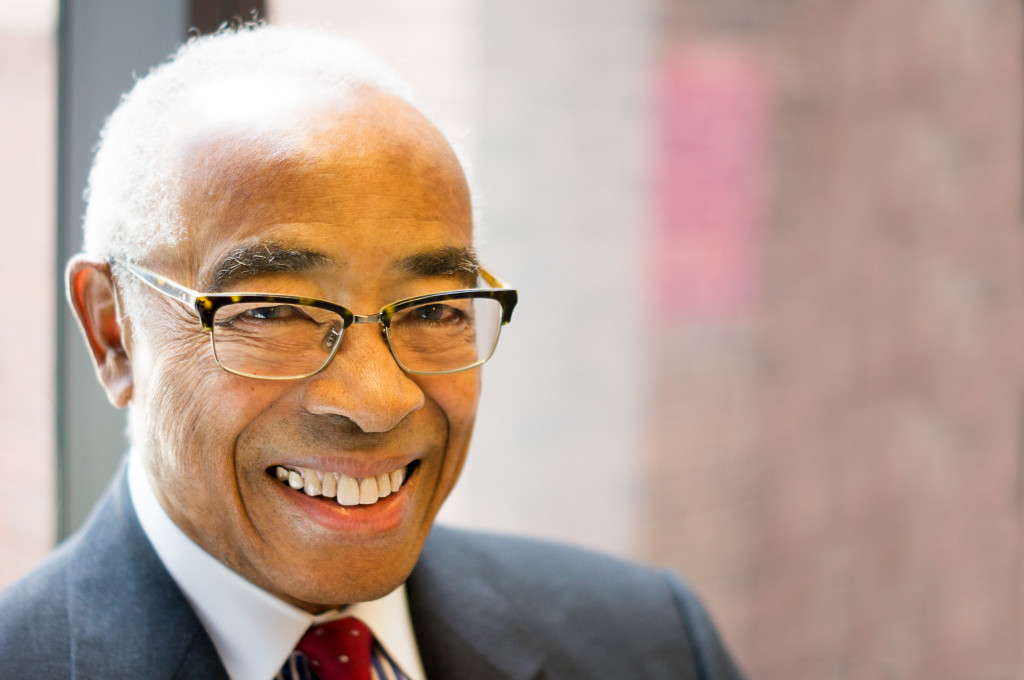
    Senator Donald Oliver ‘60: We Still Need a Black History Month

    Some valley thoughts on Black History month.

    Black History Month in Canada has had some recent powerful successes. There’s a growing, greater understanding and appreciation of the intrinsic value of Black contributions, in science, business, education, music, sports, and public policy throughout our nation.

    These advances in heightening the awareness in our country to the contributions of African Canadians is perhaps best understood by our secondary school children who, during Black History Month, are now reading, writing essays, and immersing themselves in research and history about our Black heroes. Interestingly, their parents are being educated and sensitized at the same time by osmosis. This new awakening and enlightenment stretches right across the country.

    But, happiness will be the day when we no longer need “Black History Month,” a period in the annual calendar, to highlight and celebrate the contributions of African Canadians to building this Nation.

    But, unhappily, we still need it in 2019 because in virtually every branch of the corridors of power in Canada, Blacks are expressly excluded and often completely absent. This is because some of our coveted principles of equality, fair play and inclusion have been supplanted by the white majority and often substituted by overt racism wherein the principle of the equal worth of human beings is sacrificed.

    The result is that the ugly sting of racism still keeps the driving forces of most Canadian enterprises virtually white. I invite you to look at the lack of Diversity and colour in the upper echelons and powerful ranks of institutions like our Armed Forces, our superior Courts, our largest financial institutions; our universities, (ie. Chancellors, Presidents, vice-Presidents, Deans), our senior bureaucracies in Ottawa and the provinces, etc.

    All of this denial of the mosaic of Canada in the face of thousands of eminently qualified African Canadians who have the advanced education, multiple language skills, managerial experience and training, and possess a strong desire to do the job. But, sadly, they cannot get through the glass ceiling. They can only dream and aspire to what they know they are capable of, and they must live with the knowledge that their contributions would make for a stronger and better Canada.

    So we still need a “Black History Month” in 2019, more than 186 years after the British Parliament abolished Slavery In the Empire.

    When I was summoned to and arrived at the Senate of Canada in Ottawa in 1990, I was astounded to learn that Diversity was like a foreign, unknown concept in parliamentary institutions such as the Senate, the House of Commons and the Library of Parliament. There was no inclusion, Diversity or fairness in the workplace. In the early 1980’s I had been an advisor to the President of the Treasury Board on the employment of visible minorities in the public service and there were other groups promoting employment justice for the other three groups, the Disabled, Aboriginals and Women.

    So, on arrival in Ottawa, I immediately set about meeting with the leaders of all the parliamentary institutions strongly encouraging them to adopt the business case for Diversity. That means inclusive workplaces that respect differences and value the diverse qualities that their employees bring to their work such as gender, religion, age, sex, language, ethnicity, social status, etc. These institutions and companies know this is good for successful business. My efforts had some modest success because in the annual report of 2008, the Clerk of the Senate, Paul Bélisle reported on the results of his efforts with the Senate Administration showing 11% representation of visible minorities. There was previously a period of four years where not one visible minority was either hired or promoted.

    And what about my home town, Wolfville, where Acadia University is king? Do we need Black History Month here? Sadly, yes. Acadia has changed since I enrolled in the Fall of 1956. Notwithstanding its strong Baptist traditions, students, faculty and friends in Wolfville have told me that Acadia University has not been spared the ignominy of racism that has existed in the past, and, unless checked immediately by the introduction of the Business Case for Diversity, it will spread throughout many departments.

    So now is the time to promote inclusion and advocate respect for difference, before the problem worsens.

    It works. It really works. Trust me.

    By Honorable Dr. Donald H. Oliver QC, Acadia BA (Hons History) 1960, LLB, DCL.

  • ASU Calls for Diversity on Board of Governors

    ASU Calls for Diversity on Board of Governors

    The ASU is calling for increased diversity on the Board of Governors (BOG), Acadia’s non-academic governing body. The Students’ Representative Council (SRC) passed a motion in principle on Tuesday January 30th supporting the ASU President to present a proposal to the Board regarding diversity at their latest meeting on Friday February 2nd.

    President Grace H-B said in a statement to The Athenaeum that “Diversity among the Board of Governors structure is vital to serving students to the best of its ability. The Board makes decisions that affect all students around campus. Acadia is stronger for it’s diversity and the Board of Governors will be too. Diversity and equity needs to be reflected at the Board of Governors and in all governance structures at Acadia.”

    The statement noted how the BOG is composed of 37 voting members, only 21.6% of whom are women with votes despite the fact that the campus is 58% female. Ethnic diversity around the table is described as “almost non-existent”.

    Lack of diversity is not due to a lack of unqualified women or minorities, the statement reads, but is “due to selection processes and underlying systemic process to determine who sits on the Board”.

    The motion proposed that the Governance & Executive Committees of the BOG prepare a report and recommendation on increasing equity and diversity. The ASU asked five commitments, including:

    1. Adoption of a diversity management policy by April 6th 2018
    2. Land acknowledgement of Mi’kma’ki at the beginning of every Board meeting
    3. Amending the composition of the BOG to include two indigenous voting members
    4. Ensuring a minimum of 50% of Governors identify as female by 2020/2021
    5. Ensuring a minimum of 60% of Governors identify as female, people with disabilities, indigenous peoples, or visible minorities by 2024/2025

    President H-B noted that although the province isn’t known for its diversity, “Nova Scotia does have a history with many groups that are not being represented at the Board of Governors. It would be hard to say that we’re ever going to be absolutely perfect in fair representation, but that doesn’t mean shouldn’t work as hard as possible to try to do better.

    Working towards a diverse Board is going to take work but it’s work that is so important in ensuring that we’re doing the best we can for students.”

    The ASU is looking to increase diversity within its own ranks, as the composition of the Students’ Representative Council is “lacking in people with disabilities, aboriginal peoples and visible minorities” according to President H-B. The Union is looking to incorporate more students-at-large on committees, spurring students into action within the Union itself.

    EDIT: An earlier version of this article stated the number of students identifying on campus as female was 69%. The correct number is 58%.

    Colin Mitchell is a 3rd year Politics (Honours) student from Vancouver, BC. He is also the News Editor of The Athenaeum and the ASU Student Board of Governors Representative. 

  • A Space for Aces in the Media

    A Space for Aces in the Media

    Content warning: aphobia, sexual coercion. 

     It’s no secret that representation of the LGBTQ+ in mainstream media often varies from non-existent, or inaccurate, to problematic and damaging. While it may not seem like a huge deal in comparison to the countless other injustices the community faces, representation in the media matters. Being able to see part of one’s identity in the media can help to alleviate feelings of isolation and being different. Individuals may also more easily identify and come to terms with their orientation when they see it reflected in those they admire on screen. 

    To find their identities represented, LGBTQ+ individuals will often have to leave the pop media and go to niche comics, books, and online videos. For example, in the recent revitalization of the Archie comics, fan favourite Jughead, was recently revealed to be asexual (and likely aromantic). However, even these niche areas aren’t safe from the film industry’s erasure: during the new television adaptation of the comics, Jughead is shown to no longer be adverse to romance, and the show’s creators say that he is not asexual, despite the outcry from the asexual community.  

    While one could fill many encyclopaedias on the topic of LGBTQ+ representation in the media, I’m going to be focusing on examples of asexual representation that have stood out as particularly problematic.  

     Asexuality 101 

     Asexuality is an orientation characterized by a lack of sexual attraction that, like all sexualities, exists on a spectrum. In other words, some people identify as grey-asexual and may feel sexual attraction on rare occasions, while others identify as demisexual, cupiosexual and more. Now for chapter two on asexuality: there are many ways to experience attraction. This means that someone who is asexual may be panromantic (romantically attracted to all genders), heteroromantic, homoromantic, aromantic (no romantic attraction), or any other orientation. The final lesson on asexuality is that while a lot of individuals who are asexual aren’t interested in sex, there are also many who still physically or emotionally enjoy it and have a high libido. 

    (To learn more visit the Asexual Visibility and Education Network’s website, or stop by the Peer Support Centre in the SUB.) 

     Alright, now that the basics of asexuality are covered, let’s look a bit at how asexuality is shown in mainstream media on the rare occasion it’s there at all. Often, when there are asexual characters in shows, their sexuality is dismissed, mocked, seen as a medical condition, or invalidated through consistent pressure for sex. How about we take some time now to look at some examples of these characters on screen? 

     BBC’s Sherlock 

     One of the first examples of asexuality that people often point to in the media is Sherlock Holmes of the popular BBC show Sherlock. While many fans believe that he is asexual and aromantic, Steven Moffat, a writer and producer for the show, has said that Sherlock is not asexual and that he doesn’t date so he can stay focused on his work. Moffat then goes as far as saying that it wouldn’t be fun if he were asexual because there wouldn’t be any tension. While it may not seem like a big deal, this mentality is seen throughout the film industry making it hard for those who are asexual to receive the benefits that come with seeing your orientation represented on television, which are benefits that cisgender and heteroromantic/sexual people experience daily. Besides, if the only thing that makes a character entertaining is their degree of sexual attraction, maybe it’s time to look at adding a bit more personality into the mix. 

     House M.D. 

     Another place that asexuality has come into the limelight was on the medical drama House M.D. When two patients come into the hospital for a clinic appointment, Dr. House learns that they are asexual, and quickly sets out to prove that there is a medical reason for the couple’s orientation. By the end of the episode, House finds a tumour in the husband’s brain that is suppressing his libido (libido is often separate from sexual attraction) and learns that the wife was lying about her sex drive to make her husband happy. The main issue here is that this story implies that asexuality is a medical symptom or condition that needs to be fixed, a message frequently sent to the asexual community. This reinforces the misconception that asexuality is not natural and that there is something wrong with an asexual person. This can be emotionally damaging, isolating, and for some it can make visiting misinformed medical practitioners a more nerve-wracking experience than it already is. 

     The Big Bang Theory 

     In the TV sitcom The Big Bang Theory, Sheldon Cooper is often believed to be asexual and likely aromantic, something that is regularly used as a running joke. In later seasons, however, some darker undertones begin to emerge within his relationship. Sheldon eventually finds himself in a romantic, but non-physical relationship with a fellow scientist named Amy. For a while, it was refreshing to see an asexual, and possibly aromantic character in a relationship that worked for them. Unfortunately, as the show progressed, Amy made regular sexual advances towards Sheldon, something he regularly ignored or said he was not interested in. After several seasons of consistent pressure from Amy and Sheldon’s friends for him to sleep with her, he eventually does. While they may show this relationship in a light manner, it is important to be aware that pressure to perform sexual acts, coercion, and sexual assault in an attempt to ‘fix’ the person’s asexuality are serious problems within the asexual community. Subtle messages on shows such as this add to a culture that often views sex as being something that is an obligatory part of a relationship regardless of one’s comfort zone and preferences.  

     So What? 

     All of these examples from mainstream media are part of the reason why having asexual and aromantic characters in healthy romantic, sexual, and platonic relationships are so important. It means telling those who are struggling to come to terms with their identity that they are not broken, their identities are valid, and they are worthy of healthy and supportive relationships. When television shows and individuals shrug off the importance of having asexual characters like Jughead, that’s more than just a decision to make the character more ‘interesting’. That choice has real world consequences and perpetuates the misconceptions and dangerous ideas about asexuality that are shown in the media. I for one say it’s high time that we start demanding better representation in the media, not only for asexual individuals but for all underrepresented and marginalized groups. After all, doesn’t everyone want to see themselves reflected in the hero on the screen? 

Betzillo positions itself as a versatile gaming hub where structured bonuses and adaptive gameplay mechanics support both short sessions and extended play.

Built with a focus on innovation, Spinbit integrates modern casino architecture with rapid transactions, appealing to players who value speed and digital efficiency.

Ripper Casino emphasizes bold entertainment through high-impact slot titles and competitive promotions crafted for risk-oriented players.

A friendly interface and stable performance define Ricky Casino, offering a casual yet reliable environment for a wide spectrum of gaming preferences.

King Billy Casino channels classic casino spirit into a modern platform, delivering recognizable themes supported by contemporary reward systems.

Immersive visuals and layered slot mechanics are at the core of Dragonslots, creating a narrative-driven casino experience.

Lukki Casino appeals to players seeking direct access and minimal friction, focusing on fast loading times and intuitive controls.

Casinonic provides a structured and dependable gaming framework, blending modern slots with transparent operational standards.