Tag: sports

  • Acadia’s Culture of Getting Involved

    Acadia’s Culture of Getting Involved

    How fascinating is it to go to a school where it is so cool to be involved in extracurriculars? People often talk about the small school experience that Acadia has to offer. Smaller class sizes mean more personal connections with professors, less students on campus means getting to know people quicker, and other benefits about the small size of Acadia are often used to market it as a great choice for a university. One of the best parts of Acadia that’s rarely discussed, though, is the culture of being involved that’s so prevalent.

    Being involved at Acadia is not only normal, but it’s expected of students. Compared to a lot of other Canadian schools, especially larger schools outside of the Maritimes, Acadia encourages students to find their passion and to do something with it. Students sometimes find it surprising to come out of high school and to be so encouraged to be involved in the school and community. This is what Acadia should market: it’s ability to give students so many opportunities to discover their interests and to pursue them, despite its small size.

    Being a part of something other than just classes allows students to destress by doing things they enjoy. Students tend to be happier when they feel like they have responsibilities outside of doing work, which is why it’s so great that Acadia is so welcoming towards those who are involved.

    Here are just a few of the ways students can get involved with extracurriculars at Acadia:


    1. Clubs

    There are so many opportunities for students to be a part of a club. Just a few of those available include

    -Medical Response Team

    -Model UN

    -Sisters of Color

    -InterVarsity

    -Program Societies


    1. Sports

    -Varsity & Club sports

    -Intramurals

    -The Athletic Complex


    1. On-campus Activities

    -Residence Assistants

    -Campus tour guides

    -Jobs at the SUB


    1. Volunteer Opportunities

    -S.M.I.L.E.

    -Kinderskills

    -Triple A


    1. Jobs/volunteer opportunities within your program

    -Teaching Assistants

    -The Writing Centre

    -M.A.S.H.

    -SIAM


    1. The Athenaeum!


    This is by no means an exhaustive list. A more comprehensive list can be found on Acadia’s website, but it still does not include everything there is to do in Wolfville. Perhaps it’s because the school is so small that it is that much more important to find something that interests you. With so many opportunities, a lot of students end up finding multiple ways to get involved, which makes Acadia such a unique school.

  • A Wake-up Call for Sexually Violent Language in Sports

    A Wake-up Call for Sexually Violent Language in Sports

    In light of the recent hockey brawl that took place on Saturday, February 2nd between St. Francis Xavier University and Acadia University, several individuals have reached out to me disappointed with the way Acadia handled the situation. Armed with the facts, I interviewed multiple people with the hopes of accurately representing the feelings of students about the brawl. Some individuals within this article remain anonymous due to positions they currently hold on campus and within the Acadia community.

    In case you haven’t been keeping up with the news, during the third period of the hockey game, both the Acadia and St.FX players were engaging in typical hockey banter. Acadia player Rodney Southam was pushed into the opposing team’s box during the banter and it was in that moment Southam, as identified in his official statement, told St.FX captain Sam Studnicka “You look like a little ******* rapist”. Studnicka, who has a relationship to a sexual assault survivor, was deeply affected by this comment and as Studnicka faced off against Southam minutes later the brawl ensued.

    Since the second week in February, the conversation around the brawl died down following the official statements from Southam and Acadia University. But this conversation is one that should be talked about and not pushed under the rug.

    A distraught student wanted to highlight that “Acadia is bending over backwards to protect a player with poor sportsmanship and who may not be innocent of sexual misconduct himself, meanwhile [the university] has no strong nor functional Sexual Violence Policy (SV Policy) in place”. This student acknowledges many sexual assault survivors on campus do not feel nearly the same kind of support that Southam has received for his role in the continual appropriation of sexually violent language.

    Jenna Purkis, Head of Acadia’s Mental Health Initiative, informed me while “Acadia currently does have some infrastructure in place to respond to incidents of sexualized violence but all Nova Scotian Universities, per the 2015-2019 Memorandum of Understanding, are required to have a ‘stand-alone sexual violence policy’, which is still in development at Acadia.”

    While Purkis assures there have been serious developments towards the creation of a functional SV policy in this past year such as a consultation with students in November and faculty regarding the current presentation of the policy in December, these proposed changes, as of late-February, have not been adopted into the current draft. This news means Acadia is not as close to having formed a working SV policy as students and faculty would have liked. The distraught student points out that due to the lack of progress since 2015, “Acadia’s commitment [to creating a functional SV policy] seems as strong as a toothpick”.

    Purkis, along with this anonymous student both expressed sexual violence is an issue affecting individuals on campus and the best way for Acadia to show their support to victims is to finalize a working SV Policy.

    Purkis supports her beliefs by noting that “Acadia can and should verbalize their support for victim-survivors, but Acadia’s good intentions mean very little if we do not have an adequate policy in place to follow through.”

    Through the individuals that have reached out to me, it has become apparent that while Acadia can do their part in supporting victim-survivors by creating an SV policy, there is a larger problem at hand. Students have expressed that sexually violent language in sports has become appropriated and is now unfortunately embedded in ‘sport culture’

    Samantha Teichman, a leader in Commit Sociology, held a community discussion following news of the brawl. The aim was to discuss in a diplomatic manner Southam’s response statement and the problems with using sexually violent language in sports and how, if possible, to fix this appropriation. In a comment from the Commit Sociology community discussion, students said that “the response must come from more than the individual players but a change from the institutions themselves.”

    Currently, Acadia uses a system called Bystander Intervention Training (BIT) with their Varsity Athletes. The goal of BIT is to prepare athletes to become active bystanders who are ready to intervene in similar situations such as the brawl. Teichman noted the community touched on how Acadia’s hockey players currently undergo BIT but agree that “when events like this arise and our repercussions are not sufficient, these preventative measures (BIT) ring hollow. It was agreed [by Commit Sociology] that this event should be a time for reflection and furthermore, a learning opportunity”.

    “I’ve heard “sensitivity training” for athletes suggested as a means to address incidents like these”, Purkis noted regarding the brawl. “While I do think training and programs such as BIT (in which many athletes receive mandatory training) can be useful, they absolutely are not “the” solution. They are superficial remedies for a structural and cultural problem; we can employ trainings like these to convey a message about the seriousness of sexual violence, but that message means very little without serious follow-through and consequences”.

    In a conversation with another student who asked to remain anonymous, they believe that Acadia must be strict when it comes to sexually violent language and they must punish instead of protecting any student who does so.

    If students are able to use this kind of language and get away with it, or worse be protected by their institutions, change will never come. This is a critical problem affecting universities across the country. At this point, the only way to rid ‘sport culture’ of sexually violent language is for these institutions to hold students responsible for their words.

    Sexual Violence is a critical issue on university campuses. It is my understanding, through the various conversations I’ve had regarding the topic, that this hockey brawl is a chance for the university to take a step back and address how they can learn from this incident and improve the stature of things on campus. Instead of worrying about their own or their player’s reputations, Acadia should be using this opportunity to show support to victim-survivors on campus and make the changes necessary to improve our institution.

    Commit Sociology “hope[s] to see a more constructive response of how to prevent the use of sexually violent language in sport moving forward”.

    “The ASU denounces all forms of violence on campus. The ASU has been an advocate for enhancing all forms of student wellness on campus” stated George Philp, ASU President in response to this article.

    “This year our Executive and Council have been active in ensuring better access to medical professionals at the Dennis Clinic, which is better staffed this semester than it has been in years. The ASU has been a strong leader in our work with the Acadia Student Resource Centre to role out the Nova Scotia Bystander Intervention Training to more students including many of Acadia’s varsity athletes. This year’s Executive has spearheaded the modernizing of Acadia’s Non-Academic Judicial Process to better support survivors of sexual violence and we look forward to the implementation of Acadia’s Sexual Violence Policy in the coming weeks. Again, the ASU is proud of the funding, services, and advocacy that we provide for all students and violence within our campus community is never justifiable.”

    Rylie Moscato is a first year English student and Columnist for The Athenaeum

  • Acadia Ranks 14th Nationally in Academic All-Canadians

    Acadia Ranks 14th Nationally in Academic All-Canadians

    Being a varsity athlete means sacrificing a lot of time to training. It means waking up at 5:30 am on a regular basis to lift weights. It means being away multiple weekends for competition. And it means dragging yourself out of bed to go train, after staying up to midnight finishing a project. It is always impressive to hear of those athletes who are able to maintain as high of a standard for their academics as with their sport. Acadia has many of these such athletes.

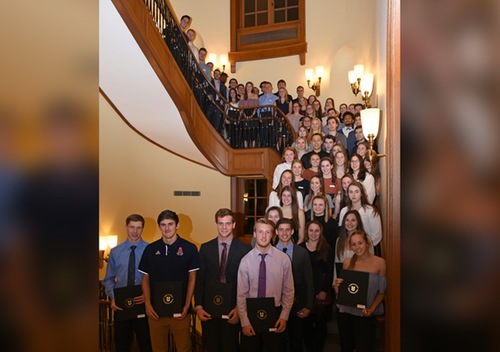
    U SPORTS (the national governing body of university sports) recognizes Academic All-Canadians: varsity athletes with an average of 80% or higher while competing in their varsity sport. This year, Acadia ranked 14th in Canada for the most number of Academic All-Canadians, ahead of St. Francis Xavier, University of British Columbia and Carleton. Acadia has 116 Academic All-Canadians for the 2016/17 school year, outnumbering last year’s record of 110. Acadia’s Academic All-Canadian banquet was held last week to recognize these athletes, with representatives from Men’s Basketball, Football, Men’s Hockey, Men’s Soccer, Men’s Swimming, Women’s Basketball, Women’s Cross-Country, Women’s Rugby, Women’s Soccer, Women’s Swimming, Women’s Track and Field, and Women’s Volleyball.

    Even more impressive, Acadia is ranked first in the country per capita of Academic All-Canadians– a feat that Acadia has accomplished for the past three years.

    “We’re extremely proud of the academic success in general at Acadia with our Academic All-Canadians leading the way. We’ve had the ability to dispel some of the myths that athletic and academic success are mutually exclusive,” said Kevin Dickie, Executive Director of Athletics and Community Events.

    “We are equally as proud of student-athletes who may not hit the 80% benchmark but are doing all they can in the classroom to improve their grades through their dedication and commitment,” noted Dickie.

    With 285 student-athletes, Acadia is one of the top university in the country with 38.5% of it’s student-athletes deemed Academic All-Canadians. With a graduation rate of 96%, the academic average of Acadia student-athletes is 75%.

    Sarah Lavallée is a first year Environmental Science student and a member of the Varsity Cross Country team

  • In Pursuit of Excellence- Elliott Richardson

    It is common knowledge that varsity athletes put in extensive hours to prepare for their games and competitions each week. These are hours spent at practice with their team, in physio, in meetings, and also in the weight room. At Acadia, Elliott Richardson is a consistent presence for all athletes in the varsity weight room.

    As the Head Strength and Conditioning Coach at Acadia, Richardson works with all varsity teams. He prepares customized training plans for each sport and will modify and adapt these plans to fit the needs of individual athletes. With the support of his staff and kinesiology student volunteers, Elliott does everything that he can to ensure Acadia athletes are prepared to win. Some may say that he is lucky to have the opportunity to work with every varsity team at Acadia, but most athletes here would argue that they are fortunate to work with Richardson.

    As explained by Keisha Kane of the Women’s Rugby Team “It is crazy to think I have been training with Elliott for five years now. His knowledge in the weight room and his desire to make his athletes the best they can be is second to none. Without his help, I would not have become the athlete I am today. I can’t thank him enough for what he has done for me over the past five years”.

    An Acadia graduate, Richardson understands the difference a Strength and Condition coach can have on the success and preparedness of athletes at the university level. “I got into performance training mostly to improve myself. When I was a student here we didn’t have a strength coach” explained Richardson.

    During his time playing varsity football at Acadia, Richardson was known for putting in countless hours in the weight room. “I was never the most gifted athlete, but I was able to improve physically. I was training since I was 14, and I was able to continue past people who were more skilled and more athletically gifted”.  These hours in the gym as well as his success on the field impressed CFL coaches, and Richardson found himself playing football in the CFL for three years after graduating with a Bachelor of Kinesiology from Acadia.

    After his time in the CFL, Richardson created his own opportunities at Acadia, all driven from his desire to offer athletes the opportunities he wish he had been given. “When I got cut, instead of going back home, I decided to go back here [Wolfville]. I volunteered with football, and then that turned into working with a few teams, and then all teams, and privately too. I wanted to give every athlete the opportunity that I wish I’d had as an athlete. I feel like I could’ve gotten better if I’d had the cutting-edge programs and coaches” explained Richardson.

    Richardson has just celebrated his sixth year working full-time as the Strength and Conditioning coach for Acadia, and many senior athletes have been along for the journey with him.  Jackson Clayton of the Men’s Football team has worked with Richardson throughout his time at Acadia. “I would say being a fifth-year varsity athlete, I came around the same time Coach Elliott became the varsity Strength and Conditioning coach here at Acadia, and to see the growth in not only the facility of the High-Performance Center or within the workout programs he makes, but within himself and his staff, is unbelievable. He changes people’s bodies and ways of thinking and helps us become better athletes. Every year he comes at us with something new, something better than the previous year and it challenges us to hold ourselves to his standard, and the athletics department has made significant strides with Coach” praised Clayton.

    With the recent success of varsity teams at Acadia, it would be simple for Richardson to assume he has done his job well, but he challenges himself to look for more than just success on the playing field. “I can’t say the reason the athletes are getting better is because of the work I am doing, because I realize there is more that goes into it” explained Richardson.

    Richardson would be among the biggest supporters of all athletes at Acadia, “I love seeing our athletes do really good, but it’s more the day-to-day stuff of getting a personal best or mindset change”.

    Elliott Richardson has earned the trust and respect of all athletes he works with, from middle school and high school Acadia Performance Training athletes, up to Acadia University Varsity athletes. He truly has created a culture of hard work and dedication among all his athletes, and they aim to reach the high bar he sets.  

  • The Emancipation of the NARP

    Yes, you have read that correctly. It’s something you may have said aloud, but never read in text –nevertheless it is a part of campus culture. Or maybe this is your introduction to the topic. NARP, non-athletic-regular-person. A term often applied to those who do not participate on a varsity or club team at Acadia, a concept which I am sure is prevalent on other campuses. Full disclosure: I am considered to be a NARP.

    This is a term that I would like to take back! Turn it into one of those, “I-can-call-me-that-but-you-can’t-call-me-that” situations. Sort of in the same vein of, I can make fun of my family, but don’t even think about talking bad about my mama. This term holds a negative connotation, of course, because who wants to be called a “regular person” (unless you are very odd like myself, and “normal” would in fact be a promotion in society)? But, I would like to argue that there is a silver lining for those who feel they are on the fringes of adoration due to the lack of their hand-eye coordination.

    To all of you non-athletic angsty almost-adults – take this as an opportunity for indulging your ironic side. If that isn’t hipster bait, I don’t know what is. Stick it to the man, man. Imagine all the buttons you could wear on your retro jacket: “I peaked in high school”, “Badminton MVP 2014”, “Ur Fav NARP”, “Benchwarmer”, “Intermural CHAMP” or “Not a Scrub, But Got Scratched” and “I’ll come to all of your games”. By acknowledging the difference, instead of wallowing in it, I think there is a great opportunity for some counterculture and self-deprecation in the healthiest sense. Instead of succumbing and contributing to the dichotomy between the two groups, remember that both groups are made up of strong individuals. Therefore, I believe there may be a small need for people to get over themselves, and add just a dose of reflection perhaps.

    No, you may not have the abs of a god, but are you healthy? Do you exercise regularly? I’m sure you enjoy sports in some regard. Then, who says you are not athletic or deserve self-worth? So, you don’t have an institution that recognizes your athletic ability, but you should be thankful for any good health that you may possess. Yes, you may be intimidated by the awesome swag that athletes possess (jackets, shirts, etc.), but haven’t they earned it? I don’t have to balance an insane schedule, which is upheld only so that I can physically exert myself. Ew, no thank you, blah. So, don’t fall completely to the folly of material possessions (such as varsity swag) and their status.

    But, if you desire to play the status game why not make your own NARP uniform? Glasses that fall apart, your slept in department sweater, and… YOUR NEW BUTTONS! It is all just a question of confidence in your self-identity. So why not express yourself in an organization which already exists, or create your own? Or, you just do you. Whatever that means, and don’t worry so about your perceived value.  Don’t sweat it, leave the sweating to the athletes.

    At Acadia, we have the first overall rate per capita of Academic All-Canadian Athletes in the country. WOAH! The accomplishment of student athletes is the accomplishment of all Acadia students, one for all Axemen and Axewomen. It’s all about school pride, right? So, find an outlet which you can take pride in, ya NARP. Don’t let the athlete and NARP relationship become a rigid binary, and remember that both groups are made up of great people. Complex people that are multidimensional.  Combat this and become a part of a team of your own, whatever that may be: photography, social change, clubs, or write for the paper (please)! Forge your own identity.

    P.S. I do somewhat foster a theory deep down that the Kinesiology Department could possibly be the secret police of Acadia. Kinesiology… Kine…K.I.N.E = Knowledge In NARP Extinction. I don’t know, I am just putting it out there, in case you never hear from me again.

  • Fan Post: Ben Scrivens

    For more: Check out “The Leaflet” at theleafletofficial.com 

    If you’re a fan of the Maple Leafs, chances are over the past few years you’ve noticed quite a few roster changes. In fact, you’ve more than likely seen your favorite players walk away in droves. Names, such as Joseph, Sundin, and most recently Kessel have become synonymous with the mediocrity of a team that came close— but could never quite get there. It hurts a little more than most of us are willing to admit. 

    Thankfully, the 2015 announcement of a “scorched earth” rebuild turned heads league-wide, and helped give rise to the optimistic situation the Leafs are sitting in today. 

    As we patiently await the close of a seemingly never ending off-season, I would like to shine some light on a former Leafs — or fallen Leaf, who’s pieces simply did not fit into the ever-growing puzzle management is assembling. 

    Ben Scrivens 

    Scrivens’ journey with the Maple Leafs began in 2010 when he was signed as a free agent out of Cornell University of the ECAC. 

    Once settled with his new club—Scrivens found himself competing with former Leafs goalie, James Reimer for the Marlies back-up goalie position. Ultimately, this was a battle that Scrivens lost, and he was sent to play a short stint with the Reading Royals of the ECHL. 

    After an injury to Jonas Gustavsson propelled Reimer to a pro spot, Scrivens was promoted to the Marlies, where he finished off his season posting a .924 save percentage, and progressed to .926 the following season. Enough to earn him a call up towards the end of 2011-12. 

    Scrivens made his NHL debut against the Columbus Blue Jackets on Nov 4, 2011— a contest in which he pulled off a 4-1 win while being outshot 39-18. He then finished the season going 4-5 posting a mediocre .902 save percentage. 

    After starting the 2012-13 season with the Marlies, Scrivens returned to the Maple Leafs lineup for 20 more games, backing up James Reimer. Finishing the season with a respectable save percentage of .915 it seemed as if Scrivens might finally secure the Leafs back-up position, and avoid yet another stint in the AHL. However, during the 2013 off-season, Scrivens was traded to the LA Kings, alongside Matt Frattin, and a second round pick, in exchange for future Leafs goalie Johnathan Bernier. 

    In the 2 years following the trade, Scrivens was bounced from the Kings, to the Oilers, and finally to the Canadiens— where his NHL career came to a pause. After finishing the 2015-16 season, Scrivens decided to take his talents overseas, signing a one year deal with Dinamo Minsk of the KHL.  

    Instead of being stuck on the AHL/NHL cusp yet again, Scrivens became the undisputed number one goaltender for Minsk, starting a whopping 55 games out of a 60 game season. 

    In his single season with Minsk, Scrivens went an impressive 28-18-8, finishing with a fair save percentage of .918. His ability to start, and keep up with the puck game after game was a key contributor to Minsk finishing 1st in the Bobrov Division. 

    While his regular season play was impressive, his playoffs didn’t quite follow suit. 

    Dinamo Minsk began their playoffs in the 5th seed, against Maxime Talbot, and the 4th seed Locomotiv— a team that also featured former Leaf Brandon Kozun. 

    Minsk struggled to keep up with a very effective Locomotiv team, winning only a single game in the series before exiting in the first round for a 3rd year in a row. 

    While Scrivens can’t be blamed for the entire collapse, his performance was quite underwhelming, allowing 16 goals in 5 starts while maintaining an underwhelming .896 save percentage. 

    While I have no doubt Ben Scrivens will crawl his way back into the NHL one of these days, it will not happen this season. The 30 year old netminder will continue his pursuit of the Gagarin Cup this season with Salavat Yulaev. 


  • What’s in a Name? Racism: A Response.

    This is in response to the article in the last issue titled “Unpopular Opinion: Controversial Team Names Aren’t All That Controversial.” In short, I call bullshit.

    I appreciate the fact that you, Anonymous writer, would rather see more productive means of protest that doesn’t involve boycotting games. This I can agree with. I understand that you feel as though the controversial team names in question are honouring the Native people. Not only are you wrong about this, but perpetuating this idea is dangerously ignorant.

    You may be thinking that something as simple as a team name or their mascot cannot possibly promote racist ideologies. It’s all in good fun, right? Wrong. Take the Washington Redskins for example. Do I even have to go further with this explanation? “Redskins” is a term used to refer to the scalps that were collected for bounty. Scalps were literally taken off the heads of Native people and sold off like a trendy pelt. Over time the term developed to literally mean ‘person with red skin,’ aka Indigenous people. Does this development make the term more acceptable? No. It is completely degrading and one of the most grotesque terms available. So, how are the Washington Redskins showing respect and honour as you so eloquently point out? This isn’t an homage. It’s a reminder of social hierarchy. It’s making a joke out of our Indigenous peoples, where the punch line is the acceptance that people like yourself feel towards this issue.

    If you still don’t believe that team names can promote racism, take a look at some of the headlines that have appeared over the years: “Scalp ‘em, oh wonderous Redskins” (Chicago Sun Times, 1987) “Hartley Claims Redskins’ Scalp” (The Mirror, 2000), and most recently “Red Robins Scalp Indians in Solid GNC 6-0 Shutout” (Antigo Daily Journal, 2017). These are only three examples of many more. Now that we have established that racism does exist, let’s turn our attention to cultural appropriation.

    Have you ever seen a Braves game? The “Tomahawk Chop” is a fan favourite that involves swinging a foam tomahawk and participating in a “rallying cry” that is supposed to replicate what these people think a Native one would sound like. The Kansas City Chiefs will also say that they are honouring Indigenous people, and yet they encourage stereotypes. They play at Arrowhead stadium, sport a logo of an arrowhead, and have a horse mascot named Warpaint. The fans are often seen wearing head dresses, and yell out war cries for their team. The Cleveland Indians, besides having a name that is well known as a derogatory term, have an incredibly racist mascot named Chief Wahoo. But I suppose you feel as though Indigenous people should feel honoured to be made fun of, because at least they get some recognition, right? What you are really saying in your article, dearest Anon, is that we should be grateful for any kind of representation we can get in this world, even if it’s offensive. What you are saying is that you can still take and take and take from us, and there isn’t anything we can do about it. We are not your mascots. We are not your property, and we sure as hell aren’t going to sit here and accept it like you want us to do.

  • Unpopular Opinion: Controversial Team Names Aren’t All That Controversial

    The controversy of team names has been a hot topic in the world of sports as of late, and all the attention being brought to the topic has me thinking: are these team names controversial, or are activists just bringing it up to create controversy? Before you gasp in disbelief and accuse me of supporting cultural appropriation, just hear me out.

    Think of other team names that aren’t considered controversial. The mascot of a team usually represents something fierce and unstoppable. Panthers, Eagles, Lions, and the list goes on. If a team isn’t named after an animal, it’s named after something that pays respect and homage to the team’s city, country, or background. This is where we get mascots such as the Maple Leafs or the Oilers. So, isn’t it possible that, like these team names, the “controversial” ones are also used to pay tribute to the Indigenous people? In my opinion, having teams such as the Cleveland Indians and the Kansas City Chiefs remind people of America’s roots. These names aren’t meant to be racist. These names are meant to pay tribute to the strength, excellence, and determination of the Native peoples.

    At the end of the day, people are offended by anything and everything. Environmentalists will take issues with the Edmonton Oilers, tall people might take issue with the San Francisco Giants, and perhaps people are offended with the Boston Celtics because of the Irish. If we are going to insist that sports teams change their names to be less controversial, then it should be consistent. Not just for the sports teams with Indigenous based names.

    Don’t get me wrong, I’m not stubborn in my opinion. I can understand why some people will take offense to these names. But I do not feel like the actions being taken are progressive in any way. It has been reported that many people have boycotted sporting events, reporters refuse to say the name of the teams on broadcast, and merchandise is being destroyed. So, my question is this: why is the team being punished for the name? They did not name themselves. These actions are directly effecting the players, and that isn’t right or fair. There must be a better way to voice your discontent.

    Alternatively, maybe those who are offended should see it from a different perspective and accept that team names honour their namesake. The logos and mascots themselves is an entirely different story, and I could see why that may be taken offensively. However, the team names and their mascots are different matters and should be treated as such. Keep this in mind the next time you decided to hop on the bandwagon and protest something you didn’t care about a year ago.

  • Front and Center: The Portrayal of Women in the Media

    During the summer of 2016, the Olympic Games took place in Rio de Janeiro, Brazil. Although nearly half of the 19 world records broken that year were by women, the female athletes were treated to headlines like (famously), “‘Wife of Bears’ lineman wins bronze today in Rio Olympics,” and “PHELPS TIES FOR SILVER IN 100M FLY; Ledecky sets world record in women’s 800 freestyle.” Not to mention the troubling issue of the difference in questions that reporters would ask as emphasised by the #CovertheAthlete campaign. Although the female athletes of the Olympics proved themselves equally as capable as the males, they were still subject to the media’s portrayal, which could shape public opinion and ruin careers.

    The issue is that this sort of coverage perpetuates a social norm. If the media acts in a way that is blatantly sexist, it imposes those values onto our lives. The media holds great control over our society. The 2016 Presidential Election was the most media-crazy event in the history of the planet, spurned using new technologies and social media. Social media is the portal between the average person and the entire world. It’s such a powerful influence on the rest of media, and we must be strict with what we allow to influence us in our everyday lives.

    The key to being strict with our media is to hold them accountable. If we hold journalists and publishers accountable for their actions and call them out when they write and publish false truths and lies, we can encourage them to be more conscious as to how things may be perceived by the public. The Chicago Tribune, responsible for the comment about the “‘Wife of Bears’ Lineman” winning a medal, was quickly called out for the tweet and shamed across Twitter and other media. This goes to show that when you see something that is wrong, you can do something about it. Instead of blindly allowing our young people to consume this sort of neopatriarchal media, we can stand up for what’s fair and equal by exposing journalists and publishers when we see it.

    During 2016, women rose to the occasion. From the Beyoncé’s release of the empowering “Lemonade,” to the first ever female presidential nominee, women took the world by storm and made headlines around the world. However, not all the headlines seemed to reflect the great strides that feminism has taken in the past months. The portrayal of women in the media has never been good, but perhaps we’re now entering a critical stage in the portrayal of women in popular culture. What will dominate this critical stage is what we the people consider acceptable. With the evolution of social media and the ability to hold publishers accountable for their words and their actions, we can change the way the media covers women.

  • Come One, Come All: The Blue Jays Bandwagon

    Some of my favourite childhood memories involve watching the Blue Jays on TV with my Dad. Win or lose, I supported the Toronto MLB team with everything I had from the very beginning of my life. No lie, one of my first baby pictures involved an oversize Blue Jays shirt with black lines painted under my eyes. I was raised in a baseball family. Some families sat around the dinner table and said grace while mine sat in front of the TV together and prayed for a perfect game. Overkill? Maybe to some. But those memories will last with me forever, and I wouldn’t change a thing.

    Okay, maybe I would change some things about growing up as a baseball lover. For one, it would have been great if my High School had a baseball team. I requested one a few times, but I was told that baseball just wasn’t as popular a sport as all the others; especially hockey. Ah yes, hockey. The great Canadian pastime. I was a Blue Jays die hard in a sea of hockey fanatics. You could ask any kid in my graduating year what NHL team they rooted for and you would get an entire monologue about which team they liked and which team they absolutely hated. But ask them about MLB, and they just shake their heads and say “I don’t really follow baseball. I like hockey”. It was the early 2000’s, after all. Our one and only major league team was in the middle of their worst seasons since the 90’s. After back to back World Series Championships in ’92 and ’93, the Toronto team didn’t qualify for playoffs until 2015. That’s 21 consecutive seasons. It was quite the dry spell, and the Jays weren’t exactly a household name. I was teased quite a bit for my love of baseball.  That is, until just last year.

    When the Toronto Blue Jays shocked the baseball world in 2015 by making their first postseason appearance in 22 years, fans came out of the woodwork to support our blue feathered brothers. Blue Jays merchandise was flying off the racks and tickets were being sold out faster than you can say homerun! With any comeback, a bandwagon is sure to follow. We know this. We expect this. And yet, Blue Jays fans (the ones pre-dating 2015) are morally outraged by it. I was at a pub with my Dad watching the final game between the Toronto Blue Jays and the Kansas City Royals for the 2015 season. You could clearly see which people were bandwagoners, and which people have been proud supporters for years. After the game ended, a brief silence fell over the entire room as we all realized that the Blue Jays would be coming home empty handed. A man next to us started to tear up a little, and one of the obvious bandwagon fans, looking confused, began to laugh at the seasoned fan while saying things like “there’s always next time” and “cheer up”. He didn’t mean any harm by these words, but things still escalated.

    Let me pause my story to say that you must understand, bandwagoners, that this was an emotional moment for those of us who have waited 22 years to see the Jays shine again. For some of us born in 1993 or later, like myself, it was the only time in our short lives where we could witness our baseball heroes step up to the plate in a World Series.

    The crying man became angry and shouted at the younger man about not being a true fan, and how real fans support their team even before success. The confrontation got heated, a lot of words were spoken, and a lot of alcohol spilled. My Dad shook his head, and we both left. On the way home, my Dad turned to me and said “I don’t want to see you treating anyone like that, Jays fan or not”. He looked sad. I have never seen my father so visibly upset about something that seemed, to me, so trivial. Some of you may be wondering why this drunken pub argument over baseball affected my Pops so much. I was wondering too, and it took me a year to realize.

    All those times when I was younger, crowded around the TV with my family, my Dad would give speeches about how baseball isn’t just a sport; it’s a comradery. He was upset by the man in the pub because he took something that brings everyone together, something sacred to our family, and made it into a competition of worthiness. To all those who are offended by this sudden surge of fandom for the Blue Jays: don’t be. Welcome the newcomers with open arms. Let them know that we celebrate together, we mourn together, and we support each other. There is too much hate in the world right now as it is without us turning something that brings us all together, like baseball, into yet another platform for superiority. If anything, we should be excited that the Jays, the only Canadian based team in the major leagues, is finally receiving the support that they deserve. To all who are newbie Jays fans: welcome aboard. We’re glad to have you.

  • Non-Varsity Blues

    Standing in the men’s locker room in the Acadia Athletic Complex, I found myself squeezed in between two fully nude men striking Captain Morgan poses without a shred of shame. I was wondering exactly what they were doing at the gym at such an hour. I know I wouldn’t be coming to work out at 11:30 at night if I were in my 70’s. Well, honestly I didn’t really find too much joy in doing it now in my 20’s. Unfortunately for me, I didn’t have too much choice. I had already paid my chunk of my intramural basketball team’s $300 fee and didn’t plan on having that money go to waste, even if it meant having to drag myself to the Athletic Complex for an 11:30 game when I had class in nine hours.

    As sweat dripped down my leg from the older gentlemen beside me’s privates, I began to get frustrated. Here I am, an avid student with strong academic ability and commitment in an academic institution, getting the short end of the stick, playing my 11:30, $300 basketball game, getting changed in the public changing room. Meanwhile, as I walk out of the changing room I am passed by a group of varsity athletes sauntering down the hallway from their team’s personal changing room after their prime practice time, enjoying their sizeable scholarships, free clothes, and free tutors. The discrepancy in treatment between varsity athletes and regular students is a perfect reflection of many of the most serious problem we have in the world. Physical attributes are being valued above intelligence, volunteerism, and academic commitment.

    As a university, Acadia is an academic institution. The primary focus of Acadia should be to educate its students, create critical thinkers, and prepare them for their futures in the “real world”. If that was the case, then why does the C student with far-fetched dreams of playing in the CFL receive a scholarship twice the size of mine and eat up god knows what percentage of my tuition fees with the extensive privileges he or she gets to enjoy every day? Money. Acadia isn’t acting like an academic institution by continuing with these practices. As long as varsity sports continue to eat up the tuition of hard working students and community members, Acadia will remain nothing more than a business; taking from the many to benefit the few.

  • A Very Informative Tour of the Athletics Complex

    A Very Informative Tour of the Athletics Complex

    Welcome everyone, and thank you for taking this tour of your Athletic Complex. Better get excited, because we’ve got tons of funs stops on the tour today. So, stretch out, take some deep breaths, maybe even do some jumping jacks (if you want to look like an idiot) because we’re taking the scenic route today.

    I decided to take the scenic route, firstly to delay my workout, but also to enjoy the brisk fall air blowing up from the dykes. So everyone, please take one of these clothes pegs from the bag, and clamp it down on the bridge of your nose, to get the maximum amount of fresh air while minimizing the smell of cow manure. If you’re starting to feel like you can taste it, quit now, it’s not your day. Now that we’re strolling we’ll get started by trespassing through the grassy place on the east side of Raymond Field. If you’re not careful you make just walk right into the long jump pits. The tracks are usually in great condition, depending on which direction the wind is coming from. Eurus is on our side today, as he trapped the mounds of plastic leaves and autumn garbage against the fence with his west flowing breaths. The sand pits are messy and rugged, looking something like a guy in mid-Movember unsure if he really wants to commit, but wanting to see what he looks like with a moustache. On a positive note, this is the only sand in Wolfville you can stand on without the worries of sinking or having forty tipsy frosh trench around half naked and cover themselves in mud. Seriously, try mud-sliding, it’s more fun than reading.

    Hope you had time to do some jumps because it’s due time to move on. You may want to avoid the abandoned soccer field, it’s where the Old Cemetery residents come to play. They say you can even hear them complain about the pitch quality if you listen to their moans – clearly the idiom “beggars can’t be choosers” doesn’t apply to ghosts. On the left we’ll pass what I believe is either a top-secret headquarters from a 1950’s Chicago mob boss, or a power plant from a similar era. The place is windowless, terrifying yet also very intriguing if you’re into scaling bricks walls to enter dangerous buildings. That’s a story for another time.

    As we loop around the back of the complex you must not deny yourself the view from here. The dykes have a very honest feel of empty beauty, inhabitable and untouched by humans. Mother Nature is much more decorative than us. If you’re wondering about the chopped up logs stacked up to your left – death by Axemen. If you’re wondering about the painfully loud buzzing coming from the hockey rinks cooling system, don’t. The off switch is not in any public areas so you may have to do some independent research to shut that one down.

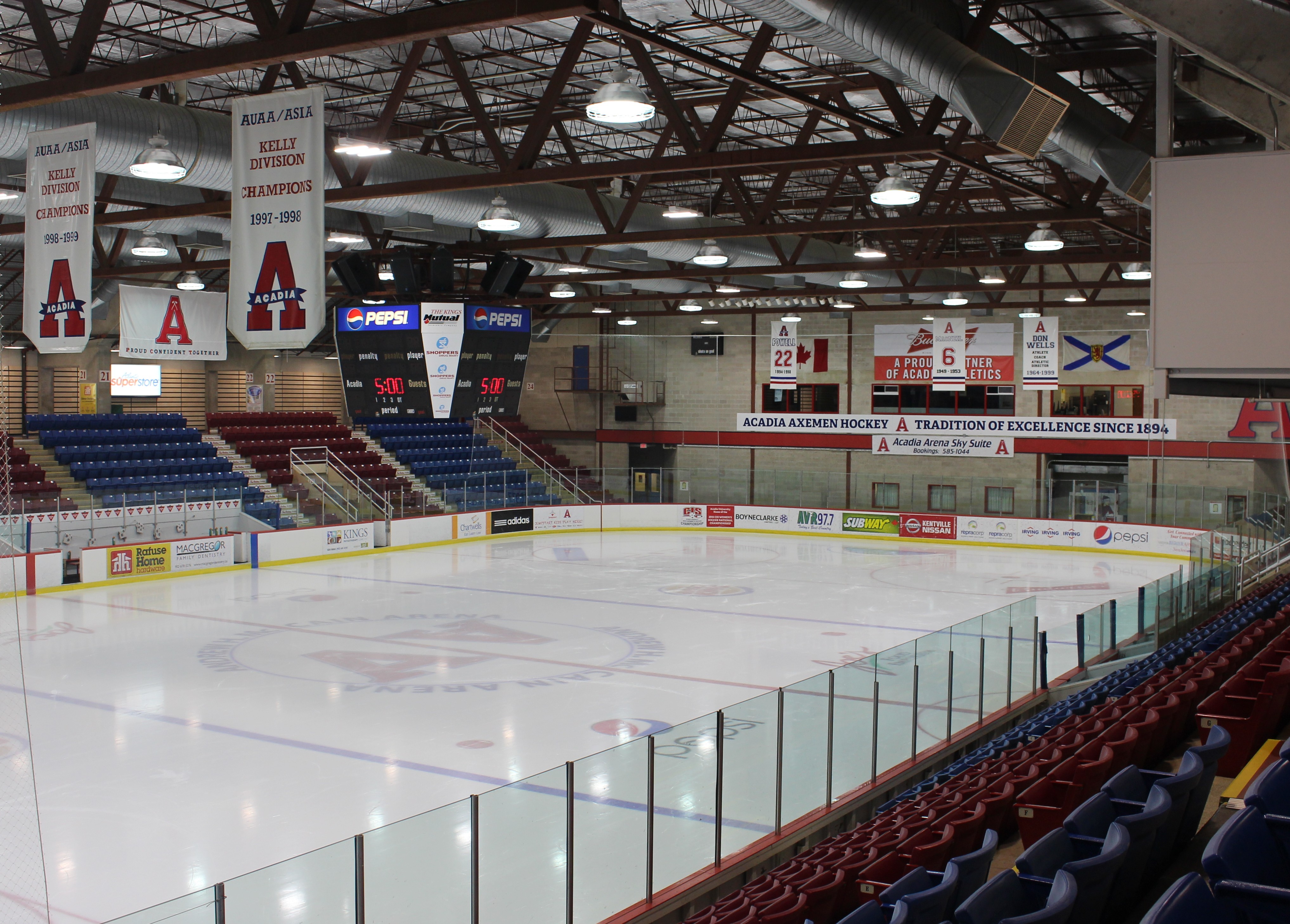
    The aggravating hum does bring a cold intensity to the dressing room which you can see to your left as we walk in the bottom doors of the complex. No wonder hockey players are so loud, you can’t even hear yourself think in here. If you’re bold enough to poke your nose into one those rooms, you’ll get a hefty whiff of the sweetest smell – victory of the Summer Street Stallions in the last game. Nothing is more appealing than the used hockey gear and Dry Ice combo. As we get closer to the rink, you’ll note that the buzzing seems to die down, especially past the skate sharpening area. When we pass the dented red nets, you can run your hand down their sides and feel the disappointing ding which warped their shape. Looking at this empty rink is very intimidating, and I would hate to play our hockey team at home. No joke, there are over 25 giant red A’s smothering the cavernous ceiling. At this point I’m not sure if the A stands for Acadia or Arrogance.

    Moving on from the rink, we head towards the turf field. I hate the walkway from the front entrance to the exterior. It feels like a concrete desert, as weak currents combine with aged leaves to generate the only noise of the corridor. I still can’t decide what is more unnerving: the six larger than life posters screwed to each wall, each sporting their perfectly timed vinegar faces; or the one poster of Shaffy, off the wall and sloping over a picnic table, looking like he did while playing for DAL during last week’s playoffs. Regardless, time for a new face. Hopefully with the future renovations, we can find a better use of this phony patio-area.

    As my feet grow weary, I realize that walking around mindlessly can also be a workout. I won’t blame you if you skip your workout, as I’m going to skip mine. If you still have some steam, you may want to check out the squash courts. That hole in the wall is about fifteen feet past the varsity gym, but is usually easier to spot by the long line of high-socked, visor wearing squash enthusiasts who refuse to let anyone else have a turn with their space. If you don’t see them at first glance, it is because they don’t exist. I have never seen a soul in those courts. This leads me to a great place to end my very informative tour. Go have fun, hit a squash ball at your friends. It’s always enjoyable. You can find me down there working on my game if you’re looking to continue the tour.

  • Sidelined Story: A Tale About a Boy With a Bum Knee

    “As the injury happened I wasn’t aware that anyone else had noticed I had fallen, so I was thinking I had to get off the field, get a sub and stretch it out. I thought it wasn’t an injury. Turns out I was in shock and not paying attention to where I was and everyone who was huddled around me.”

    Tearing your anterior cruciate ligament, or ACL, has got to every athletes worst nightmare. The thought alone makes me cringe. The injury has a painfully long recovery time, lasting 6-9 months after surgery has finished. This includes the months of natural recovery to pass after the injury before the surgery is even plausible. Think of all that time spent, in these ever so blissful years as a student, and having nearly a quarter of your experience stuck without a working knee. Yes, as I’m sure you are imagining, the fun activities have become slightly limited. That means; no jumping on your new bed, no runs home from the Vil as you dodge rain drops, no running down to the class that slipped your mind, and no more sports!

    About eight months ago, then second-year-student John Attenborough was playing a semi-final game for Valley United Soccer Club, when he heard that unforgettable “pop” come from his right knee. Johnny, a crucial member of the Acadia Men’s Soccer Team and also CIS Academic All-Canadian had his varsity sport career thrown off the rails after that unforgiving change of direction. The talented right back, who had just been through his break-through season, was the team’s anticipated starting defender for this year’s season. His injury was detrimental for the team, but even more so for him as a member of the team. Fortunately, John was able to take time out of his evening to share his experience after he was sidelined.

    After getting all the bad jokes out of his system, he spoke on what he missed most about being on the field. “I miss being regularly active in a way that I enjoy,” he began, following with a slew of complaints about the difficulty of finding other enjoyable activities. He has recently discovered an interest in ping pong, which allows him to finally compete again. The absence of activity was not the only thing that John expressed about missing being on the team. “More than anything, I miss the general comradery of being on the team; day-in, day-out, practicing together and playing together. His chin was held lower when he reminisced on his last season with the Axemen. He is proud that he has continued to stay involved in the team, and chuckles at his dedicated attendance towards every Sunday fun-day. Johnny still goes to every game that he’s able to with a smile on his face, feeling just as part of the team as he did last year.

    In attempts to find some more positives in the situation, we looked into the extra time that the lack of soccer gave him. In the intensive, two month season things tend to become very time constrained for all athletes. Although it wasn’t all positive when he answered if academics had gotten any easier with the free time. “No, definitely not” he sharply responded, “I found that soccer kept me regimented, which was good because it gave me certain allotted times where I had to study.” He was also surprised in the fact that he hadn’t seen many changes in his social life during these times either, despite his freedom from responsibility on weekends.

    The tone was a tad more pleasant as I asked John how his recovery was going. I am pleased to report that it is going well, as he continues to meet the correct points that he should be in terms of his recovery. He has a set protocol in which he is trying to follow, one that will allow John to be back on the field for the Axemen’s 2016 season. “The first six weeks after surgery were the worst ever, but things have been getting exponentially better since,” John said with a joyful face.

    In conclusion, I asked if he had any advice to offer other sidelined players to make the most out of their unfortunate situation. His best advice was to keep involved with your team, try and stay healthy as you’ll eventually want to go back. I asked him if he wished to go back right now. His reply? “You’re an asshole.”

Betzillo positions itself as a versatile gaming hub where structured bonuses and adaptive gameplay mechanics support both short sessions and extended play.

Built with a focus on innovation, Spinbit integrates modern casino architecture with rapid transactions, appealing to players who value speed and digital efficiency.

Ripper Casino emphasizes bold entertainment through high-impact slot titles and competitive promotions crafted for risk-oriented players.

A friendly interface and stable performance define Ricky Casino, offering a casual yet reliable environment for a wide spectrum of gaming preferences.

King Billy Casino channels classic casino spirit into a modern platform, delivering recognizable themes supported by contemporary reward systems.

Immersive visuals and layered slot mechanics are at the core of Dragonslots, creating a narrative-driven casino experience.

Lukki Casino appeals to players seeking direct access and minimal friction, focusing on fast loading times and intuitive controls.

Casinonic provides a structured and dependable gaming framework, blending modern slots with transparent operational standards.