Tag: Acadia

  • Axewomen Finish Third at AUS Championships

    Axewomen Finish Third at AUS Championships

    WOLFVILLE, N.S. – The Dalhousie Tigers raced to first-place men’s and women’s team finishes at the 2017 Subway AUS Cross Country Championships Saturday afternoon.

    The championships were hosted by Acadia University at Hennigar’s Farm in Wolfville, N.S.

    The host Axewomen finished third in the team standings and Katie Robinson was the top Axewomen, finishing sixth among racers. Three Axewomen finished in the Championship top ten including Robinson, Chrissy Smith in eighth spot and Madalyn Higgins in tenth.

    Acadia head coach Ralph Williams was excited about the event and the team results. “It was a great day for Acadia. Congratulations to the Acadia organizers for putting on class A race. It could not have gone off any better. Picture perfect,” said Williams.

    “I very proud of the Acadia Women’s Cross Country Team. They have improved so much and the AUS Championship first place is getting closer to reality. Great talent and team spirit,” added Williams about his team’s performance.

    Robinson will race at the U SPORTS national championship hosted in Victoria, B.C. on November 11.

    WOMEN’S RACE RESULTS

    In the women’s 8km race, the Tigers claimed two individual medals and four of the top nine finishers. Freshman Savanna Jordan (Calgary, Alta.) captured first-place honours with a time of 30:05.0.

    “I actually thought the course was deceiving. It felt easy in the warmup run and it felt nice but the hill was a lot tougher and it was big. It was easier than the Laval course, but definitely one of the tougher AUS courses,” noted Jordan following the race.

    Dalhousie senior Michelle Reddy (Sarnia, Ont.) was the women’s silver medallist, finishing with a time of 30:56.8.

    MEN’S RACE RESULTS

    In the men’s 10km race, the Tigers edged out the X-Men to snap their six-year win streak and claim Dalhousie’s first AUS men’s cross country title since 2010.

    Dalhousie fifth-year runner Cal DeWolfe (Bridgewater, N.S.) reached the podium with a time of 32:03.95 to claim the bronze medal.

    The X-Men claimed a second-place team finish. Angus Rawling (Calgary, Alta.), a third-year StFX runner, claimed the individual gold medal, finishing with a time of 31:43.55. Third-year runner Alex Neuffer (Stradford, P.E.I.) earned silver for the X-Men in a time of 31:58.00.

    “It was a difficult course but a really fun course too. It was challenging but the right amount. I think this is straight up the best course in the AUS. We went to Quebec City and that course is a lot of hills, up and down. It took a toll on my legs, but this one was nice. You really worked on it,” commented Rawling on the course.

    Rawlings added, “I took a lead on the downhill and I knew I was going to be alone for the next 5 km. I hit a big hill in the valley and I figured they are going to close on my and I wont be able to hold this lead, but I guess I did. A big surprise.”


  • Axemen Hockey Weekend Update

    Axemen at UNB – Friday, October 27

    One week after suffering a 3-2 overtime loss in Wolfville, the UNB Varsity Reds handed the Acadia Axemen a 7-2 loss.

    Freshman forward Kris Bennett scored twice and added three assists to the lead the Varsity Reds. He was named the Subway Player of the Game.

    Stephen Anderson (Morell, PE) had two goals and two assists, and Mark Simpson scored twice. Olivier LeBlanc also had a goal for UNB.

    Boston Leier and Stephen Harper scored for the Axemen.

    Acadia’s Alex Lepkowski took UNB’s Chris Clapperton hard into the boards.

    Clapperton lay motionless on the ice for several minutes before being taken off on a back board. Lepkowski was assessed a five minute penalty for boarding and a game misconduct.

    “You just hate to see that in sports,” said Axemen head coach Darren Burns. “We want to compete, but you never want to see a guy get injured.”

    Bennett opened the scoring on the ensuing power-play.

    Leier tied the score 1-1 early in the second before Bennett and Simpson scored 45 seconds apart as UNB built a 3-1 lead.

    A four goal third period was too much for Acadia to overcome.

    Burns feels his team started well, but couldn’t recover from UNB’s quick strikes midway through the second period.

    “Obviously that bang, bang, that opened the flood gates a little bit and we got outside our structure, what we need to be successful, from there,” he said.

    Alex Dubeau stopped 13 of 15 shots in the UNB net, while Robert Steeves made 36 saves on 43 shots in the Acadia net.

    The Axemen dropped to 4-2-1 and tied for the third place in the AUS, before visiting UPEI on Saturday.

    Axemen at UPEI – Saturday, October 28


    The Acadia Axemen surrendered their lead three times, but held the Panthers down long enough to escape the Island with a 7-5 win Saturday night.


    Subway Player of the Game Samuel Fioretti scored the game’s first and last goals, while teammate Kyle Farrell scored a pair as well to lead the Axemen to victory.


    Boston Leier finished with four points on a goal and three assists, with Owen MacDonald and Rodney Southam finding the back of the net for the other two.


    “We played hard but there are things we need to sharpen up,” Fioretti said. “We just stuck to it and we didn’t quit when they started to get momentum.”


    “We got goals here and there, but then we let up a bit and took our foot off the gas,” Fioretti said, “I think a lot of it is discipline too. We took some penalties, which allowed them back in the game. It’s definitely something we’re going to focus on moving forward.”


    The Panthers look to snap their five-game losing streak on Nov. 1 when they travel to Moncton, N.B. to take on the Université de Moncton Aigles Bleus. The Axemen, who improve to 5-2-1, return home to host the 2-5-1 Dalhousie Tigers this Wednesday evening starting at 7:00 p.m.

    Contributed by Andy Campbell (UNB Athletics Communications)  and Thomas Becker (UPEI Athletics Communications)

  • Axemen Drop Decision to X-Men

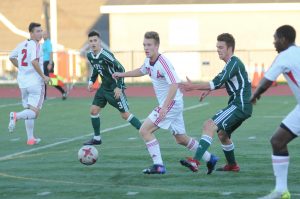
    The StFX X-Men improved to 9-1-2 and sit in first place in the AUS standings ahead of Cape Breton by 1 point (who have two games remaining) after a 2-1 win over the host Acadia Axemen.

    The X-Men scored the only goal of the first half at the 42nd minute when Dan Hayfield, on a free kick 15 yards out to right of the goal, netted a hard kick high that was nearly stopped by Axemen keeper Nic Jefferies.

    Late in the second half, near the 87th minute, Liam Harrigan scored the X-Men’s second goal off of a corner kick that was mishandled by an Acadia defender and Harrigan picked up the lose ball.

    The Axemen final closed the lead to one on a Cooper Coats goal in extra time. Coats goal was set up by teammate Travis Fenning who drew the defenders as he approached the 18 yard box and then dropped the ball back and to the side to Coats for the one-time kick and goal.

    In the dying minutes of play, the Axemen pressured to tie the game, but fell short giving StFX the important 2-1 win. Tylor Connolly led Acadia with four shots on goal.

    Out-shooting the X-Men 12-5, X-man Thomas Pieroway made seven saves, while Acadia’s Nic Jefferies was tested several times with 1 save.

    In Acadia’s second and final match of the regular season, the Axemen settled for a 1-1 draw against the visiting UPEI Panthers in the last regular season match of the 2017 season.

    The draw clinches a playoff berth for the Axemen after posting a regular season record of 5-4-3.

    The Axemen out-shot UPEI 16-3, with Panther Brett Strba stopping 8 shots on goal, but on the other end, Acadia keeper Nic Jefferies was tested several times.

    Sam Smiley opened the scoring at the 16 minute mark of the first half for the Panthers after a nice feed from Mohammad Jaber.

    The Axemen responded back at the 35th minute on an unassisted goal by Cale Sanders.

    The second half saw no additional goals, but plenty of opportunities including four of five corner kicks  for the Axemen couldn’t help grab the win.

    The Axemen will finish the 2017 AUS regular season in fourth place in the standings with 18 points. The Axemen will take on UPEI in Quarterfinal play at the AUS Subway Men’s Soccer Championship beginning this Thursday at 7:00 p.m.

  • Axewomen top X-Women 2-0

    All goals came in the opening half.


    The first goal came at the hands of third year striker Jenna Boudreau who worked past the defender in the 18 yard box and picked up a lose ball for a one-time kick past StFX keeper Erin Visser 19 minutes into the opening half.

    Senior midfielder Katie Ross scored the Axewomen’s second goal on a penalty kick assessed to Axewomen after Boudreau was taken down by an X-Women as she broke for the net. Ross’ kick was at mid-level and to the right of the keeper who dove in vain for the well placed boot.

    “We played well and stayed discipline”, s,aid Axewomen head coach Amit Batra.

    The Axewomen out-shot StFX 13-4, with Visser making six saves, while her Acadia counter-part Spencer Skinner, stopped two shots for the shut-out.

    “Our whole goal was to try and peak at the right time of year. We’ve often started out really well, but the key is how we finish. We’ve had a solid season and look to keep improving every game,” noted Batra.

    The Axewomen soccer team concluded the 2017 regular season with a 3-1 win against the visiting UPEI Panthers. Acadia improved to 7-3-2 and concluded the season fourth in the AUS standings.

    Out-shooting UPEI 24-2 with Panther keeper Amanda Stanyer posting 11 saves on 14 shots on goal, the Axewomen dominated the last 45 minutes by scoring all of their goals in the second half.

    Team leading scorer Jenna Boudreau scored her fifth goal of the season on a great individual effort at the 52 minute mark.

    Twenty-four minutes later, Meghan Earle scored an amazing goal on a bicycle-style kick that thrilled all of those in attendance.

    Annie little scored the ‘insurance goal’ with twelve minutes remaining in the half.

    Panther Jennifer Balderston scored with just over two minutes remaining in the game on back-up keeper Nicole McInnis who replaced Spencer Skinner in the second half.

    “We had a lot of the play the first half, it was a matter just continue to do the same things. Our locker room was actually great on making sure we focus on the process. We kept creating the chances on goal, but their goalkeeper was excellent,” said Acadia head coach Amit Batra following the game when asked what changes were made in the second half.

    The Axewomen are matched up against defending AUS champion and host of this year’s AUS Subway women’s soccer championship StFX this Thursday evening at 7:00 p.m. in quarterfinal play.

  • Axewomen winless in opening weekend of AUS regular season

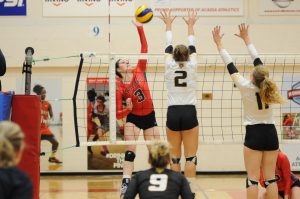
    WOLFVILLE, N.S. – The defending AUS champion Dalhousie Tigers swept the host Acadia Axewomen 3-0 in the AUS regular season opener at Acadia.

    Tigers’ Subway Player of the Game, Julie Moore, posted a game high 13 kills and a 0.286 hitting percentage to lead Dalhousie to a three set win.

    Mieke DuMont posted 7 kills and 7 digs. Defensively, Moore and Catherine Callaghan had 11 digs each and Moore led with three service aces.

    Sarah Ross and Lauryn Renzella each added 8 kills for the Axewomen, while Renzella added 10 digs. Willow Gedlaman, from her setter position, had 20 assists, while her counter-part Courtney Baker for the Tigers had 32.

    “Each day we learn how we can be better, whether it is technical, tactical or system based. We didn’t play our best volleyball today and in a team sport we must rely on a contribution from everyone, in order to be successful. We will look to compete consistently tomorrow,” commented Acadia head coach Michelle Wood following the match.

    In the Axewomen’s second game of the opening weekend, the Saint Mary’s Huskies posted a 3-0 sweep over the Acadia Axewomen Saturday night from the Homburg Centre in Halifax.

    The Huskies took the three sets 25-20, 25-14, 25-14.

    Lucy Glen-Carter paced the Axewomen’s offence with 12.0 points, 11 kills and 33 total attacks in the loss, as Acadia drops to 0-2 on the year.

    Lauryn Renzella finished with six kills and Sarah Ross and Sydney Tonner each had three for Acadia.

    Anna Watt led SMU with 21 total attacks and a trio of Huskies had seven kills apiece: Lindsay Donovan, Kristina Alder and Watt, while Emilla Conlon had 32 assists in the victory.

    Saint Mary’s improves to 1-0 early on the year and visit 1-0 Dalhousie Sunday October 29th at 1pm, while Acadia travels to 0-1 UNB Saturday November 5th at 7pm.


    Contribution by Dominic Nolasco, SMU Communications


  • Acadia Designated Fair Trade Campus

    Acadia Designated Fair Trade Campus

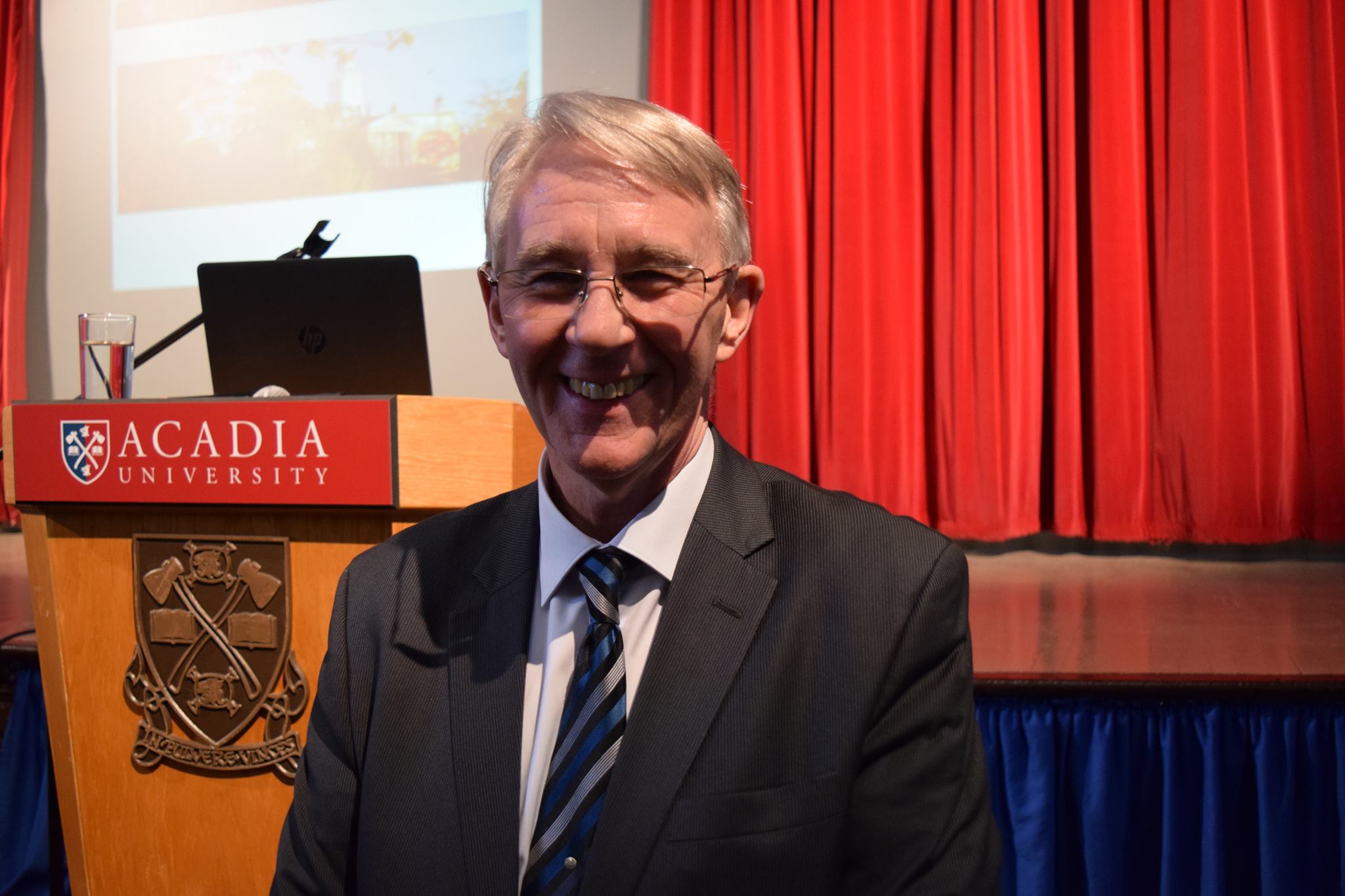
    Acadia has achieved its designation as a Fair Trade Campus. The announcement came from ASU President Grace HB and Acadia President Dr. Peter Ricketts on September 25th in the ASU Students’ Centre.

    “Students are engaging in ethical discussions as part of their education and the Fair Trade program instills the values we learn in the classroom” Grace said. “Paying people fairly for the work they provide is something students support.”

    Acadia is the first school in the Maritimes to attain a Fair Trade designation. Fair trade means that farmers are paid fair prices, have decent working conditions, and business is conducted on fair terms, unlike many multinational corporations.

    To earn this certification all coffee, three teas, and one chocolate that are Fair Trade certified must be available for consumption at retail outlets across campus. The range of products available will expand as time goes on, with a committee being established to oversee the program.

    Last year Just Us! worked with Acadia to develop a fair trade coffee and held an open design competition for the blend’s logo. Hacha Java the winner, submitted by fourth year kinesiology student Quentin Hovarth.

    ASU Sustainability Officer George Philp was overwhelmingly positive about the news. “Becoming a Fair Trade campus means that Acadia and the ASU’s product offerings reflect their visions to foster a more sustainable and socially responsible campus community”. More importantly, Philp notes that “in the long-term it sets a precedent that really big ideas and initiatives can succeed at Acadia. The success of this project proves that a small group of Acadia students, who care a whole lot about something, can make a massive difference in our community.”

    Acadia now joins UBC, McGill, the University of Western Ontario, and 25 other campuses as part of the fair trade movement. UBC Vancouver was the first campus in Canada to go fair trade in 2011.

    Fair trade products will now be offered at various outlets on campus, including the ASU Students’ Centre, BAC, and Huggins.

  • Running Acadia into the Future

    Running Acadia into the Future

    Madalyn Higgins starts her day as the sun rises. Her alarm goes off at 6:15 and she throws on her singlet, shorts, and running shoes before she heads to the athletics complex for cross country practice.

    Higgins is now a rising star on Acadia’s Cross Country and Track & Field teams. Her recent performance at Point Pleasant Park as an Axewoman contributed to the team winning the meet, a notable first in recent history.

    “In high school I played every single sport our school had to offer,” she said. “We never had a cross country team in high school, soccer was my favourite, but I wasn’t cut out for soccer. I wanted to do some varsity sport and I was too short for all the others.”

    She’s always loved being active, playing the second-highest competitive level soccer available during the off-season.

    “I was called the ‘Energizer Bunny’ on my soccer team because I kept running circles around everybody, so I guess that’s what led me here.”

    Cross country and track & field were the logical choices. At Acadia the all-women team runs cross country, races over 5km long over hills and through mud, in the fall semester and indoor track in the winter semester. Indoor track and field is characterized by the smaller two-hundred metre track.

    Higgins says that the team keeps her together. Her response is one shared by many varsity athletes, who find solace and a strong bond on their team. She notes that she never would have met her best friend Kelsey Crouse, another rising star at Acadia, had she not joined cross country. Because the athletes spend so many hours training and travelling together, she has developed very strong bonds with her teammates.

    “School is a lot, and I think if I was just doing school would be very extra stressed. Running is a good way to be free and forget about that. In all the other sports I played I was always the person that ran a lot.”

    Her goal is to go to U Sports National Championships in Victoria, BC. Acadia selects runners based on if they have ranked in the top fourteen within regional AUS standings. So far Higgins is within that threshold, and has to maintain that ranking until November.

    Though the team is becoming more successful, it faces hurdles at home.

    “We still don’t have a lock on our changing room door,” she laughs. “Someone had shampoo stolen. Not the bottle, just the shampoo.”

  • Dr. Peter Ricketts On Acadia Funding Crisis, Scotian Charm, And Hate Speech

    Dr. Peter Ricketts On Acadia Funding Crisis, Scotian Charm, And Hate Speech

    “Your university experience should be the best time of your life because once you get out into the world and you get a job, responsibilities, and family – these things constrain you”

    You stated after your appointment that Acadia was an embodiment of a tight knit and personal education. Our outgoing President (Ray Ivany)  also realized this and was seemingly omnipresent around the campus, and was always greeting students.  How do you plan to continue the type of personability that Acadia has come to know and love in your tenure?

    “One​ ​ of​ ​ the​ ​ quintessential​ ​ elements​ ​ of​ ​ Acadia​ ​ is​ ​ that​ ​ it​ ​ is​ ​ small,​ ​ but​ ​ you​ ​ can be​ ​ small​ ​ and impersonal,​ ​ and Acadia​ ​ isn’t,​ ​ it​ ​is small​ ​ and​ ​ personal.​ ​ I​ ​ think​ ​ this​ is​ ​ what attracted​ ​ me​ ​ to​ ​ this​ ​ university,​ ​ because​ ​ this isn’t​ ​ something​ ​ that​ ​ only​ ​ happens​ ​ on​ ​ the​ ​ edges​ ​ of the​ ​ operation​ ​- it​ ​ happens​ ​ centrally.​ ​ I​ ​ think​ ​ Ray​ ​ Ivany​ ​ did​ ​ a​ ​ fantastic​ ​ job​ ​ here,​ ​ so​ ​ my​ ​ view​ ​ is: if​ ​ it​ ​ ain’t​ ​ broke​ ​ don’t​ ​ fix​ ​ it.​ ​ I​ ​ plan​ ​ to​ ​ continue​ ​ to ​ make​ ​ sure​ ​ that  I am engaged​ ​ with students​ ​ and​ ​ meeting​ ​ them​ especially​ ​ when​ ​ the​ ​ new​ ​ students​ ​ come​ ​ in, but also throughout the year. Obviously​ I will not do this in exactly the​ ​ same​ ​ way​ as Ray did because​ I​ ​ am​ ​ a​ different​ person, but I share his approach to making Acadia a personalized educational experience, and that starts with the President.”

    You’ve spent a significant time in Ontario prior to which you were in Nova Scotia, is there some inexplicable charm that drew you back to Nova Scotia?

    “The inexplicable charm was Acadia. I didn’t deliberately set out to come back to Nova Scotia. I did spend twenty-two years here, so in a way Nova Scotia was the icing on the cake. This is where I started my academic career, and it’s nice to reengage with that. I’ve lived throughout Canada, but the valley really is a gem. I used to bring my students here on field trips all the time!”

    Does it feel good to be back home; in the sense that geographically a lot to your work on coastal research and ocean management is tied to the very essence of this province?

    “Yes, that’s certainly an exciting aspect of why Acadia is a good fit for me. Acadia is in a coastal location, and the importance of the ocean and coasts in this region is one of Acadia’s defining characteristics and research strengths. I have maintained a strong professional network of people who are​ ​still​ ​in​ Nova Scotia, particularly through the Coastal Zone Canada Association, an organization that I helped found in Halifax back in 1993. The opportunity to come back closer to that network is​ important, and I do plan to continue my research related to ocean and coastal management, policy, and climate change – it is a lot easier to do that in Canada’s ocean playground!”

    How do you plan on advancing education at Acadia?

    “I’m a very strong believer in university education being rooted in its community, but being global in scope. I think the role of globalization plays a huge role in the direction university education is heading, and where universities need to be in the 21st century. Acadia is doing a lot in that field, but there is a great deal more that we could do. That includes: making our curricula more global and more international, and giving students more​ ​access​ ​to​ international experiences through study abroad and other educational, research, and work opportunities. I think that in the grand scheme of things this is very important. I’d also like to improve how Acadia is interacting with indigenous populations, and make it more attractive and engaging for students from these communities. Lastly, I think we need to advance Acadia’s reputation nationally and internationally, because I do think that Acadia is the jewel in the crown of Canada’s university system. We have to promote this university and what it stands for, ​and get​ more people to know about it.”

    News recently broke that Acadia has received a 25.4 million dollar bailout from the provincial government. The Canadian Federation of Students (CFS)-Nova Scotia stated that this  “further proof of the funding crisis in the post-secondary education system in Nova Scotia.” Should Acadia students be worried about this?

    “No. Next question! [Laughs]. Just kidding! Students should be extremely happy. First of all, I wouldn’t characterize this as bailout money. What the government has done is provide to Acadia on an ongoing basis what it has been providing over the last 8 years. This is money that the government has been providing to the institution for a while: 3.5 million per year over 5 years, and prior to that the allocation of a 7 million dollar loan. This is a recognition that this is money that Acadia needs as part of its operating budget. The impacts of the funding formula change in 2008 created an emergency situation that was added on top of an already tight and difficult situation that the university was in at the time. The funding formula dug the hole deeper and said ‘not only do you have to dig your way out, but now you have to claw your way out by hand’. The university has done that, and I have to give an incredible tribute to Ray Ivany, John Rogers (Chair of Acadia Board of Governors), and Paul Jewer (Past Chair), as well as many others, for the work they did on this issue.

    This funding announcement that recently came out was the result of a very serious government review of Acadia’s finances. The financial audit said that Acadia got its act together. It has made cuts and done everything that it could reasonably be expected to do. This is a good news story and a vote of confidence by the government in Acadia’s finances, administration, and the university itself. They’re very impressed with how Acadia engages with industry, and businesses, and communities to help with the future economic and social growth of Nova Scotia. The CFS statement about underfunding is true in general, universities are underfunded by government, but this particular funding action was not related to that.

    The 2008 funding formula didn’t cut funding across the board, but it negatively impacted Acadia and Cape Breton University especially hard, and this is the government’s way of trying to rectify that. The CFS comment isn’t relevant to the government’s funding of Acadia in this instance, but is relevant on an ongoing basis across Nova Scotia and Canada. All of the institutions in Nova Scotia will have a discussion with the government to review how the finding formula should be developed going forward, and that is a discussion I am eager to be involved in. The​ ​ terms​ ​ used​ ​ in​ ​ the​ ​ headlines​ ​ -​ ​ emergency​ ​ funding​ ​ and​ ​ bailout​ ​ aren’t​ ​ accurate.​ ​ The loan​ ​ 8​ ​ years​ ​ ago​ ​ was​ ​ absolutely​ ​ emergency​ ​ funding,​ ​ but​ ​ the​ ​ forgiveness​ is just​ ​ recognition​ ​ that it​ ​ should​ ​ have​ ​ never​ ​ been​ ​ a​ ​ loan.​ ​ The​ ​ current​ ​ government​ ​ has​ ​ fixed​ ​ that.​ ​ This​ ​ is​ ​ good​ ​ fiscal management​ ​ by​ ​ the​ ​ government​ ​ and​ ​ it​ ​ recognizes​ ​ prudent​ ​ fiscal​ ​ management​ ​ by​ ​ Acadia.”

    In your opinion, what are some of the greatest challenges you’ll face along the way of running this university?

    “Well, we just talked about one of them. The budget is certainly always a challenge, and I had no false expectations of that coming into the Nova Scotia system. It is known to be very tightly controlled, and every university has made cuts and sacrifices to keep budgets balanced. I believe universities should be efficient, and we should not be in a situation where we are throwing money around. We should always be very conscious of the use of the public, government money and the student tuition money. We have to be careful stewards of that, but there is no doubt that this will be a big challenge for us as costs of operating a university go up 3 to 4 percent a year. The big challenge will be to discuss what the appropriate level of government funding is, understanding that the government has many competing challenges as well, and of course the challenge of trying to keep tuition fees at a level that are not beyond the reach of students and parents. That is a very difficult balance, as every time we increase tuition it is an impact on the student’s ability to pay, and parents ability to support their students.

    Another challenge going forward relates to the funding challenge. We need to pay attention to areas that have been starved of resources over many years. One of the major targets of our capital campaign is infrastructure revitalization, and again that is something that has been put off. Frankly, it is not as sexy to give money to renovate a building or provide a new information system as it is to build a building, but I have been impressed by how Acadia has managed to get funding to renovate some of its buildings. I think we have to look after the infrastructure of the campus, and make sure that we are investing in the resources that are going to have the most benefit to the students.

    A third challenge is public skepticism of how continually important a university education is , and what the value of a degree is, particularly a BA [Bachelor of Arts]. One of the challenges is to take strong messages to government and the community, that the evidence of the value of a university education is there to be seen, and is really paid back in the value of our graduates and their successes in their careers. I think Acadia is a wonderful example of the value of a university degree. If you look at the successes of our graduates and the engagement of our alumni in the institution, it is phenomenal. Quite frankly, getting the message out that we are educating students for success in the economy of today and tomorrow is a big challenge as there is a lot of push back focusing on highly specific training. We need to get the message out about the large range of skills and capabilities that a modern university education provides to a person, and while that will be a challenge, I think it is one university presidents especially need to undertake.”

    Something that has been circling the news for the past few years, has been a tendency of a liberal university to gravitate towards suppressing free speech for ideas that it disagrees with? Where professors and students feel the need to police the words before they discuss anything that is seemingly antithetical to the norm in universities, like sexuality, feminism, or  race relations. What will you do to ensure that the existence of free speech will be a core duty and a tenet at Acadia during your tenure?

    Free speech and academic freedom go hand in hand, because they are at​ the very​ ​ core
    of​ ​the mission of the university. Although they are not exactly the same, they are
    interconnected with each other. Universities have to defend that interaction between
    academic freedom and free speech with all their might. In many ways universities have
    a special role to play because we would like to feel that perhaps universities are more
    free, more open to discourse, and discussion than society at large and other
    organizations; but we must also ensure that our openness is not exploited. 

       That’s​ ​ not​ ​ to​ ​ say​ ​ it’s​ ​ not​ ​ a​ ​ tricky​ ​ issue.​ ​ We​ ​ have​ ​ to​ ​ be​ ​ very​ ​ firm​ ​ in​ ​ saying​ ​ that​ ​ there​ ​ is a​ ​ difference​ ​ between​ ​ free​ ​ speech​ ​ and​ ​ hate​ ​ speech or speech intended to incite violence and oppression, which are​ ​ actually​ ​ prohibited​ ​ ​ by​ ​ law.​ ​ The notion​ ​ that​ ​ if​ ​ I’m​ ​ offended​ ​ by​ ​ hearing​ ​ something​ ​ that​ ​ I​ ​ should​ ​ not​ ​ have​ ​ to​ ​ hear​ ​ it, and​ ​ if​ ​ I​ ​ am offended,​ ​ that​ ​ creates​ ​ an​ ​ unsafe​ ​ space​ ​ for​ ​me, is​ ​ an​ ​ illogical​ ​ argument​ ​ in​ ​ my​ ​ view.​ ​ In any​ ​ university​ ​ you​ ​ are​ ​ going​ ​ to​ ​ be​ ​ exposed​ ​ to​ ​ various​ ​ viewpoints​ ​ that​ ​ might​ ​ be​ ​ quite offensive.​ ​ but​ ​ you​ ​ should​ ​ be​ ​ open​ ​ to​ ​ listening​ ​ to​ ​ them​ ​ so​ ​ you​ ​ can​ ​ counter​ ​ them​ ​ and​ ​ build​ ​ your own​ ​ views and understanding.”

    Acadia’s motto is ‘In pulvere vinces’ which translated to ‘By effort you conquer’ what is your interpretation of that?

    “I was a bit flummoxed by that when I first read it. The literal translation is something like: in dust you win. I think what it speaks to is that from the very beginning, a lot of people put a lot of effort into building Acadia, and then keeping it going. They managed to build the university through donations and people supporting it, and there was no government money. There were various periods where it was literally on its last legs, and it was through the efforts of the community and individuals providing leadership that it got to the next point where the university could continue.”

    What is your message to the incoming and current students of Acadia?

    “My message is that I want them to be able to look back in twenty to thirty years time, and say that their time at Acadia was the best time of their lives. Your university experience should be the best time of your life because once you get out into the world and you get a job, responsibilities, and family – these things constrain you. I don’t mean that in a bad way, but you never have the same freedom again and you should make sure that you use the opportunity you have at university to explore and extend beyond what you think are your limitations.”


  • Sponsoring Students at Acadia

    Hidden in the long list of fees that appear on every Acadia student’s account statement, it is easy to overlook the one dollar a year that goes towards WUSC. WUSC stands for the World University Service of Canada and is a non-profit organization based out of university campuses across the country. WUSC’s aim is to create a better world by promoting education, employment and empowerment in Canada and around the world. Many Acadia students don’t know that this small fee they pay each year actually goes towards supporting one of WUSC’s biggest initiatives, the Student Refugee Program. The money raised from this small levy goes towards sponsoring a student from a refugee camp to come and study at Acadia. This fee along with the financial assistance provided by the university and various community organizations helps to cover the cost of tuition and living expenses for the student. A small group of Acadia students serve on the Local Committee and are responsible for filling out the paperwork to help sponsor a new student each year. The Local Committee receives applications from students all around the world interested in studying in Canada and decides together which student would be a good fit for our university. When the student arrives, it is the Local Committee members and the faculty representative, Julie Snair, who go to the airport to welcome them and provide support to them throughout the rest of the year and beyond. This is important as the transition can be challenging and while students who have lived in Canada their whole lives may not understand the difficulties of resettlement, they can still do their best to make sure the student feels as welcomed and supported as possible.

    This program is unique in that it encourages students to sponsor other students in need around the world. Whether it is through organizing fundraising initiatives or raising awareness about the refugee crisis on campus, the Student Refugee Program has a lot to offer both the students being sponsored and those doing the sponsoring. This program is actually the only one of its kind in the world that pairs the idea of youth to youth sponsorship with refugee resettlement and education. It aims to not only provide the youth who must flee their countries with a safe place to call home, but also to provide them with the opportunity to gain new skills and a world-class university education. Students can choose to enrol in any degree program they wish and have generally been very successful with 85% of students sponsored finding work in their desired field. Many decide to stay in Canada after completing their degrees but many also decide to return to their home countries to try and make a difference there.

    While Acadia only sponsors one student per year, the student who comes adds to the diversity and culture of the University and the Wolfville community as a whole. They provide Canadian and international students with the opportunity to learn about other cultures and world issues in a more personal way. It also offers students the chance to make a difference in someone’s life when all the problems in the world can seem overwhelming. While there are certainly major challenges and issues that need to be addressed in order to prevent the mass displacement of young people and their families, this is one way that Acadia seeks to help. In light of the Syrian Refugee Crisis, and other devastating humanitarian catastrophes around the world right now, WUSC Acadia is hoping to expand what they do by looking for new members, fundraising, and spreading awareness. There is also the possibility of holding a referendum in the coming years to increase the student levy. The goal would be to raise the levy by a small amount, likely just a dollar more, to either increase the support for the SRP students already at Acadia or to possibly increase the number of students Acadia is able to sponsor. Additional projects include raising awareness and fundraising for the Shine a Light Campaign which seeks to improve the accessibility of the Student Refugee Program to women and girls who are currently under-represented in it.

    Students who are interested in getting involved are encouraged to find the WUSC Acadia Facebook group or to email Co-Chair Rhys Winder ([email protected]) for information about joining the local committee.

    For sources and more information visit http://www.wusc.ca/en/program/srp-resources


  • Things That Should Have Been Curbed in 2016

    Things That Should Have Been Curbed in 2016


    1) The notion that “White Privilege” is offensive and racist towards White People.

    Racism, cultural appropriation, and discrimination have been a hot-button issue throughout history. With the rise of social media platforms, along with the recent election of Donald Trump, there is a plethora of conversation online (and in print) about the hateful rhetoric that seems to be plaguing today’s society. Unfortunately, when people feel that their privilege is being threatened, they enter an automatic defense mode. It is often presented in such a manner where the defendant makes claims of innocence, justifying their feelings of discomfort by exclaiming that they are not guilty of racism, and that if their race is being questioned, that they are automatically being discriminated against. White privilege is not racist; it is not offensive in any way. It is a method of explaining the favorable treatment that white people often receive. There are no systems of oppression designed against white people. Thinking that reverse racism exists is what perpetuates the notion of white privilege further into the foundations of our society. It is a mechanism that is used to validate the comfortable position white people hold in society. Validating your own comfortable position by attacking a marginalized group (by saying white privilege is offensive, racist etc.) is a subtle way of invalidating and shutting down any group who’s LIVED EXPERIENCE has ever been one of systemic oppression. In extension, these feelings can often be described as “white fragility,” a state in which minimum amounts of racial stress becomes intolerable, triggering outward displays of emotion, such as anger, and behaviours such as argumentation. Yeah, this definitely could have been left behind in 2016.

    2) That any Indigenous culture should just “get over” colonization.

    Really? This one amazes me every time I hear it. Let us take a brief moment to recall Canadian History because we are not innocent in the ways or racism and cultural oppression. Residential schools were opened in conjunction with the Catholic and Protestant Churches and the government. Their aim was to remove any form of Indigenous culture from Indigenous children by forcefully removing them from their homes, placing them in schools where they would be taught Western values. As such, a cultural genocide was committed. Often, when hearing the word “genocide,” events such as the Holocaust, Bosnian, and Rwandan genocides. That is because Canada has attempted to repress its history. The horrors of the Residential schools did not end until 1996. Yes, most of us were living when the last school shut its doors. During their time in the Residential schools, Indigenous children were beaten, sexually assaulted, and mentally abused by their instructors. Often, these traumas were difficult to cope with. A stigma surrounds Indigenous peoples in Canada. Many people chose to believe that status cards, funding, government aid, and the Truth and Reconciliation Committee should all be abolished. They question why we should continue to apologize, and why we should continue to work towards mending our relationship with Indigenous peoples. What does it take to get over something like this? How could you possibly put a numerical value on an apology, how can you, a white person, get to dictate the appropriate measures for reconciliation after a cultural genocide has been committed? When you say these things, you act as though you assume the role of the oppressed, you may think you understand their oppression, but you simply do not. I know I do not understand, I never could. However, it is important to listen, to engage in conversation, and to be respectful of what you cannot understand. Please read the above statement about white privilege and then rethink your questions and sweeping generalizations about Indigenous peoples and Indigenous culture.

    3) “She was asking for it”- REALLY?

    For God sakes. How is this type of conversation STILL taking place? Did we not learn after Jian Ghomeshi and Brock Allen-Turner? I simply do not understand. The legal process further victimizes rape victims. Belittlement and slut-shaming occur in the courtroom in order to find loopholes in the victim’s statement. By asking her, “did you say no?” you are questioning her pain and her experience. By asking her, “how much did you drink?” you are assuming that all drunk women are ‘asking for it’, by asking her “what were you wearing” or “how many men have you slept with in the past”, you are slut-shaming her. Although there are false reports of rape, the treatment of victims in the courtroom is inexcusable. This is the reason that rape and sexual assault are so underreported. This process favours the accused, often bringing into play irrelevant aspects of his character, his achievements, and what he strives for in life. However, this does not take into account aspects of the victim’s character, her (or his) achievements in life, and how what she/he had strived for may feel as though it has become so out of reach. It’s simple, folks. If you can’t say no, you can’t say yes. There is no in-between; there is no grey area. There is yes, and there is no. Stop blaming the victim. Stop validating your need for supremacy. Stop questioning the pain of others, instead, start regarding it.

    4) Feelings of self-doubt, as brought on by Instagram and other forms of Social Media.

    I am guilty of this. Most people are guilty of this. It is so easy to feel self-doubt, and it is so easy to think that your value decreases based on the perceived notion of “perfection” in the others who you see on social media. In the last 10 years, we have “networking” apps explode. The original purpose of these apps was to stay in touch with your friends, to be able to connect with people you haven’t seen in a long time and to keep others updated on what is going on in your own life. However, it feels as though there has been a shift in the dynamic, a change in the way we behave on the Internet. Often, all we see is the picture. We believe that everybody’s lives are perfect and full of happiness based on how they display themselves on social media. Getting the “perfect picture” and pairing it with a “fire” caption that will get you over 300 likes is often a goal of most people. I know I am not innocent. There have been multiple occasions where I have found myself thinking, “if I went to the gym more maybe I would look like her and then I would be as happy as she appears.” I know this is wrong. After a conversation with one of my roommates, I found out that she was feeling the same way. She talked to me about how miserable looking at Instagram makes her. It caused her to question her own happiness by constantly comparing it to other girls’ social media pages. So, she slowly began to stop looking as much. As did I. I’ll leave this point here: everybody has their issues, but we have been conditioned to try and keep our problems to yourself. A picture is just that: a picture. You see what the poster wants you to see, just remember that your self-worth should not be determined by a like or how the world views your Instagram page.

    5) Islamophobia.

    Islam is a religion of peace. Often, people do not believe this when it is brought up in conversation. The first time I heard this was in my 11th grade world religion class. Our teacher told us that Islam was the closest religion to Christianity. She was right. It is not Islam you are afraid of, it is the “otherness.” The sense that you see something different, and that you are uncomfortable within a realm of your own privilege is what sets you off. This rhetoric gained prominence after 9/11. We were scared of them. They were scared of us. Although I am not an expert in Islamic studies, I know many men and women from the Arab world who identify as Muslims, and I can honestly say that they are much nicer than many other people I know. If we remove the concept of the “other,” perhaps we will all be able to see each other as we are: human.

  • Cancer Can Kiss My Axe

    It is estimated that two in five Canadians will be told they have cancer in their lifetime. This is significant to us, and we are doing something about it, and you can help. Relay for Life has been a long-standing tradition here at Acadia University, as this year marks the fourteenth year students and community members will fill the athletic complex in an effort to fight back against cancer.

    Relay for Life is a time for the community to come together and support one another and is also the biggest fundraiser for the Canadian Cancer Society. In the past fourteen years Acadia University has raised over $800,000.00, which has helped the Canadian Cancer Society do four important things; lead cancer research across Canada, influence public policy to improve health the of Canadians, support cancer patients, survivors and caregivers through various programs such as the Lodge That Gives and Camp Goodtime, and engage more Canadians in the fight against cancer. This year we hope to add another $35,000.00 to that total.

    Each of us has been affected by cancer in our own way, which influences why we relay, and we want you to come out on April 1st to share why you relay! This year Relay for Life at Acadia will be a six-hour event, running from six o’clock to midnight. Throughout the evening there will be many activities and snacks to keep you going, such as the always-popular bouncy castle and a dodge ball competition.

    Whether you are cheering on survivors, walking the track, passing the baton to your teammate or joining in exciting trackside activities, Relay For Life is more than just a cancer walk – it’s a journey that will help many in our community and throughout Canada and we hope to see you there! If you haven’t already registered for the event, registration is still open for teams, individuals and survivors, we also encourage all cancer survivors on campus to register and join us for our survivor reception on the evening of Relay. Registration can be completed at relayforlife.ca.

    If you need any more of an incentive to fundraise for a great cause, this year we are excited to announce that for every 200 dollars you raise, you will earn a ballot with your name on it for a chance to win $500.00! So grab your friends, family and neighbours, tell your story, and get out there and do some fundraising!

    If you have any questions about Relay for Life here at Acadia University, the Committee will be happy to answer them and can be contacted at acadia.relayforlife.ca

    We look forward to seeing you all out supporting Relay for Life on April 1s!  Cancer affects us all in some way or another, let’s show our school spirit and fight back.

  • Upcoming Event: A Run to Dye For

    So, why a colour run?  In February, Exercise is Medicine Canada Acadia started an 8 week learn-to-run group that takes people from ‘couch to 5k’.  We felt it was really important to celebrate the accomplishment of completing the program with a 5k event.  Building on some success with a couple of fun walk/runs earlier in the year; we also wanted to end the year with a really fun event that is open and inclusive to absolutely everyone.  We don’t care if you run, walk, crawl, or skip across the finish line, we just want to give everyone an opportunity to get out and have fun.

    Let me just say we can appreciate and understand that not everyone enjoys running.  We are not promoting the message that everyone needs to be a runner to be healthy, because we don’t believe that.  But running events don’t always have to be about being fast and beating your personal best.  Sometimes it can just be about being active and having fun with family and friends.  We want to provide events that are inclusive to everyone regardless of age or physical abilities.  We welcome everyone, including children all the way up to older adults and everyone in between.  We are very proud to say our oldest participant so far this year was 85 years old.  Whether you are celebrating the end of another semester, the end of your last semester, the beginning of spring, or just an excuse to put off studying, a Run to Dye for is a chance to come together and do something memorable and fun while being active.

    So, grab some friends and come join the most colourful run in the Valley.  A Run to Dye for is a 5k event that is open to people of all ages and abilities.  There will be several ‘colour’ stations throughout the route where participants will be cheered on and showered in colour as they go by.  We encourage everyone to dress head to toe in white, and see how colourful they can be as they join the party at the finish line.  As we get closer to the event, there will be more details posted on the Exercise is Medicine Canada – Acadia University Facebook page and the Acadia Get Fit Facebook page.  All registrations are completed online through the website raceroster.com.  There are also registration links through the Facebook event page and the event listing on Valleyevents.ca.  The event is scheduled for Saturday, April 8th.  The start and finish line is planned for the bottom of the University Hall stairs.  Race kit pickups will begin at 1:00pm and the event will start at 2:00pm.  Race kit purchases are available for early registration only, which ends on March 20th.  Regular registration continues until April 7th.

  • Trump Bump? Not Quite

    For a lot of us it’s too early to think about summer. Classes are nearing their end and things are winding down. But for Grade 12 students across the world the time has come to get ready for university. For nearly a thousand students, this summer will be about finding mini-fridges, packing their winter gear, and booking flights and busses so they can all descend upon Acadia come late August for the matriculation of the Class of 2021.

    Last year saw enrolment increase by 25% for new, incoming full-time undergraduate students in September of 2016, making Acadia one of only two universities in Atlantic Canada to post a significant gain in full-time undergraduate enrolment. This 25% boost was accompanied by a 1.5% increase in international students and a 2% increase of overall full-time undergraduate enrolment, with total full-time enrollment almost 1.8% higher than it was in 2015. According to President Ray Ivany, this is “an extraordinary result and represents the highest first-year enrolment since the start of the Ontario double cohort in 2003” in a statement published on the Acadia University website in October of 2016.

    Acadia was clearly benefitting from its increased emphasis on recruiting and playing to its strengths as a small, liberal arts school, no doubt aided by the formal establishment of the Maple League of Universities in late 2016. Recruitment efforts in Western Canada to rural Nova Scotia to Sri Lanka and Jordan have clearly paid off.

    There were many, however, who anticipated that our university population would continue to grow from south of the border, as the election of Donald Trump surprised much of the world and sent applications flying towards Canadian universities. Global News reported in late November 2016 that because of this ‘Trump Bump’ American applicants to the University of Toronto were up 59% compared to the same time in 2015, while McGill’s overall applications after the election up 30% from November 18th 2016 compared to the same time a year earlier. At the time, Global news reported that American applications to Acadia were up 76% from from the same time last year.

    This began to make students at Acadia talk. What kind of school would we become? How could we cope with more students? Where could we even put them? How would our professors handle the surge of new students? Would we lose our reputation as a small school dedicated first and foremost to students?

    Needless to say, Acadia is staying true to its founding principles: a small school built on equality and fairness, dedicated first and foremost to its students. Although applications may be up, according to Vice President Enrollment and Student Services Susan Mesheau, “Acadia is seeing a 46% increase in applications from [the United States] compared to this time last year, however, the real numbers are not large – 57 applications this year versus 39 last year at this time”.

    This comes at a time when Acadia is looking to increase the percentage of international students from 10% to 15%, potentially altering the makeup of the student body at large. It is equally interesting to note that this discussion is taking place just as Acadia is trying to find creative ways of increasing revenue, such as increasing tuition on certain programs that are equipment intensive, such as environmental science or biology, to offset costs and bring debts under control. An increase in the international student body paying more for programs that cost more at Acadia would mean more financial certainty for the school, an arguable bonus.

    The suspected ‘Trump Bump’ will undoubtedly change many universities around Canada. It will be hard to have the same impact at Acadia, as it has been predominantly inhabited by Eastern Canadians. The ‘Acadia at a Glance’ page on the university website states that nearly 63% of Acadia’s population is from Eastern Canada. Central Canada is next, comprising 16%, international students at 10%, followed by Western Canada at 9%, and students from the United States at 2%. It will be interesting to see how this changes things.

  • Academic Dismissal

    I promised myself a few years ago that I would write this article before I left Acadia, and now I’m finally in my last semester ever (hopefully!), so here it goes. Dear student body of friends and strangers, I present to you my biggest and most embarrassing secret. It’s something so deeply and personally disturbing that I’ve told very few people – not even my parents. Are you ready? I flunked out. I know I’m not the first nor the last person to ever fail university, but for me, receiving that letter of academic dismissal in the mail was a gut-wrenching conclusion to a particularly dismal string of events. I’m writing this article partially to relieve some of the weight of this secret I’ve been carrying around for three years now, but mostly as a precautionary tale for any readers who might find themselves in a similar situation.

    In the spring of 2009, I was eagerly anticipating my high school graduation and less eagerly anticipating the next big life hurtle ahead of me: post-secondary education. I actually enjoyed school. I was a good student with good grades, and I participated in a wide breadth of extra-curricular activities. When it came time to make some big decisions about what to do next, like many of my peers, seventeen-year-old me applied to a variety of universities. I didn’t particularly have an end goal in mind career-wise, I just knew that I was smart and capable given my academic success to that point, and so going off to university seemed non-negotiable. I assumed I would just launch myself into school and figure things out on the way, because what seventeen-year-old knows exactly what they want to do for the rest of their lives anyway? As I had achieved well-rounded grades in both arts and sciences, my high school counselor strongly urged me to apply for science programs “to open windows to the future,” and I knew I liked people, so I chose psychology. I was accepted to all of the schools I applied to, so I chose Acadia based on reputation. Sound familiar so far?

    The slow crash-and-burn began upon arrival. I was thrust into introductory biology, statistics, research and design, and all the other fun necessities of a science degree in psych. Possibly due to my lack of end goal and mostly due to my complete disinterest in any of these things, I was strong out of the gate but quickly fell far behind. It seemed that my plan to jump right in and swim until I reached the finish line was flawed. A pivotal moment that I can remember from my second year of school is laying on the floor of my friend’s room in Chipman with a group of people talking about their life aspirations beyond university, and suddenly realizing my own impending identity crisis. Who am I and what do I want to do?! I hardly recognized myself, failing courses and wondering what the point of any of it was. In high school I was just forced to take everything, my life had a regimented structure, and I identified myself by my extra-curriculars. I was a band kid and that somehow summed up the rest. Now I was nobody, and I was going nowhere.

    Obviously the news that I was failing school didn’t exactly fly with my parents when I came home for Christmas that year. To be precise, they called me a “disappointment”… that was pretty difficult to hear. After many hours of talking and sobbing profusely with my mom, we decided that maybe I should switch majors. In retrospect, taking a step back from university to figure my life out would have been a prime choice at this point in the story, but that’s not what I did. I returned to school as an English major and began fast-tracking my way through the English program, cramming every vital course I’d missed into a 3 year plan in order to graduate by 2014. Switching to English was a breath of fresh air. I still didn’t know what I was going to do with it, but I had always enjoyed reading and writing as a kid, and I found the course content much more in line with my interests. The department and the class sizes were also way smaller than anything I had seen thus far. I made friends incredibly quickly, got to know everyone in all of my classes, and all of my profs knew me by name. It was like night and day.

    From then on my marks improved and I was generally happy to be working on something I was both good at and enjoyed, but then in the spring of 2013 I got some unexpected news. My uncle had received a sudden diagnosis of terminal cancer. Following this news, my grandmother was also diagnosed with cancer. My family spent that summer in a state of somber anticipation. We spent four months saying goodbye. That somebody who had a family and a career and all the things they had ever dreamed of and worked towards could suddenly cease to exist in the midst of it all was nearly impossible for me to comprehend. It made everything seem pointless. In the fall of 2013, as I was beginning what should have been my graduating year of university, not only did my long-term relationship fall apart, but I lost two people to cancer in little over a month. Not wanting to burden my aching family with the profound impact this experience was having on my outlook on life, I kept it to myself. I stopped going to class, not because I wanted to but because I simply couldn’t seem to summon the strength or will power. I laid in bed and I watched the seasons change from fall to winter. I ignored my phone and my friends. I just stayed in bed. Christmas was extremely sad that year and further strengthened my resolve not to tell my parents I was sinking, because I could tell that they were barely coping as well.

    That spring I got my letter of academic dismissal, as expected, and I put it in a drawer. I didn’t even open it for a long time because I couldn’t look at it without feeling sick to my stomach. I told my parents (and anyone else who inquired) that I was burnt out and that I wanted to take some time away from school. I didn’t tell them I got kicked out. I couldn’t bear to admit that I had failed them after everything they had been through already. I spent two long years working a minimum wage job in food service, hating the monotony of my days and contemplating my next move. Finally, last spring, I reached a boiling point in my stagnant life and reapplied to Acadia to finish what I had started … and here I am.

    I wanted to write this article for anyone who might be feeling as unsure about their future as I did. In the leap from high school to university it seemed like everyone around you knew exactly where they’d head in life, and if you’re like me, you probably followed the masses hoping you would figure it out too. You probably didn’t let on that you were feeling a little lost and overwhelmed. I also wanted to write this article for anyone who feels like they’re carrying an impossible weight on their shoulders. I need you to know that you’re not alone, and that school isn’t everything, even if it feels like it is. I need you to recognize when you’re sinking and yelling for a lifeline, regardless of the size of the burden you’re trying to shoulder alone. I wish more than anything that somebody had reassured me that it was okay to take a step back and reevaluate my goals. I might have been more successful, for instance, if I’d taken some time after high school to really think about what I wanted to do before diving aimlessly into university because I felt like I had to. I pounded away at this degree for the sole purpose of having a degree. I did it because I thought it was what I had to do to validate my life, but at the risk of sounding cliché, I forgot that life is about finding happiness.

    We’re taught that successful people just bite the bullet and go to university, get a good job, and live happily ever after. I’m sure that’s true for many, many people, but sometimes life gets in the way. Sometimes you don’t know why you’re doing something, and you need to figure out what you want before you proceed. So this is for all the people facing academic penalties at the end of this year. Your story isn’t over, your worth isn’t based on your degree, and your life isn’t a total loss. You got here because you’re smart and capable, and you’ll figure out what makes you happy eventually. Maybe it involves university, but maybe it doesn’t. Either way, there is absolutely no shame in taking time away to figure it out. I am now twenty five years old and finishing my bachelors degree, eight years after I first started here. We’re not all on the same time line, and it’s not a race to the finish line, because there is no finish line. Most importantly, none of us know how much time we have on this planet, so whatever you do, do it for you.

  • Are Millennials Too Sensitive?

    There once was a boy who was told that everyone that should be nice to everyone and that if they were not kind, they were bad people. He then grew up to find that’s not how the world works.

    As a society adapts, the mindset of the people within it change. This is also true in the change of a generation. They have learnt from the mistakes and triumphs of previous generation and use this information to change and base their lives upon. The education around them adapts to these new changes and shapes children. With the increase in mental health warning and bullying campaigns, are they really being shaped to deal with the rest of the world, or is it that the world has not yet to accept the changes that the new generation is bring? I believe that the new generations are not taught to be prepared for what the world will throw at them. They are only told that people will change and that they should not have to face the problems that occur in the world.

    In my political science class, we were discussing our upcoming presentations for our research assignments. Our TA requested that if we are planning on showing any “graphic images” we get them checked prior to putting them into our visual for our assignment. This is a ridiculous sign of how sheltered this generation is: we know violent things are happening around the world but we play a blind eye to them. Not showing these images does not make them go away and does not solve the problems that they are causing them.

    Now bullying is a topic that has only been under scrutiny for the past 20 years. It is now viewed as a national epidemic instead of a common fact of life. The young generations are now beginning to expect that everyone in life will be nice to them and if they are not there are a bully. But that is not how it works in life. You will be put down by people for making a mistake at work or for bumping into someone on the street. People will talk about you behind your back. You cannot change that. If anything, you should be taught to how ignore these comment and fight back, compared to just reporting them to the principal. You can’t report your boss in the future for yelling at you, so learn how to take criticism.

    Previous generations have been built and thrived upon the “tough love” method. People would discipline their child to a certain extent, be that verbally or physically. But now, parents are actually being arrested for spanking their children with actual reasons. The school system does not tell the students the difference between abuse and discipline so they grow up with the belief that this is wrong and that their parents are not good people.

    It is a generation under the veil of ignorance – they all imagine the world to be perfect, where everything happens their way. If things are happening outside of their community to other people it doesn’t matter. All that matters is what happens to them and that they are happy. When things that they don’t like occur, they don’t know how to handle it. They have been so shelter from the sadness and violence of the world, they when they get a large dose of if, it leads people to believe they have a mental illness.

    Now the thing about mental illness is that it is something that is very real, many people are suffering from it. The statistics show that the rate of people who report suffering from depression have increased by 6% over just this year. Now I am not saying that these people’s claims are false, but the rate shows that the recent generation cannot handle the pressure that society has put upon them because they were not trained to handle stress. They were only told that the things that cause them stress are not right.

    When any topics concerning race, sexuality, politics, or gender come into play, they become extremely agitated. They are brought up to think about living in a world when everyone should think the same way. But that is not how the world works. People have different opinions and are entitled to have those opinions, why must people be put down for not conforming to what views their society has. These generations have been told they everything should go their way, so when it doesn’t of course they don’t do how to handle it. Is it true that millennials and Gen Zs are overly sensitive? Yes it is. But who can blame them when they grow up in an environment like this one.

Betzillo positions itself as a versatile gaming hub where structured bonuses and adaptive gameplay mechanics support both short sessions and extended play.

Built with a focus on innovation, Spinbit integrates modern casino architecture with rapid transactions, appealing to players who value speed and digital efficiency.

Ripper Casino emphasizes bold entertainment through high-impact slot titles and competitive promotions crafted for risk-oriented players.

A friendly interface and stable performance define Ricky Casino, offering a casual yet reliable environment for a wide spectrum of gaming preferences.

King Billy Casino channels classic casino spirit into a modern platform, delivering recognizable themes supported by contemporary reward systems.

Immersive visuals and layered slot mechanics are at the core of Dragonslots, creating a narrative-driven casino experience.

Lukki Casino appeals to players seeking direct access and minimal friction, focusing on fast loading times and intuitive controls.

Casinonic provides a structured and dependable gaming framework, blending modern slots with transparent operational standards.