Tag: Wolfville

  • The Looming Threat of Climate Change

    The modern world faces an ever-approaching enemy. The climate crisis gets closer as humanity continues to ignore the danger posed by continuing to pollute our ecosystems. Science agrees that climate change is not only factual, but permanent damage is already inevitable. Climate change is no longer a prediction but a real crisis kicking down our door. Climate change is caused by a number of factors but one of the biggest contributors is the amount of greenhouse gasses polluting Earth’s atmosphere. The amount of greenhouse gasses we have produced since the start of the 1800s has skyrocketed. The Industrial Revolution was a gigantic factor in this, as gigantic factories were built inside of urban cities, polluting densely populated areas. Importantly, this pollution affects the water and surrounding land, effectively poisoning it with harsh chemicals. 

    The proof that Earth’s surface is warming can be tasted by comparing modern weather readings which are showcasing extreme weather patterns. There are also temperature measurements taken on ships and later at weather stations dating back to the mid-1800s. There has already been an increase of 2.2 degrees Fahrenheit or 1.2 degrees Celsius. This has led to drastic effects which only threaten to become worse. The greatest warming happened in the late 20th century. The region warmed the most has been the Arctic with more than 4 degrees Fahrenheit. This marks the hottest climate in 1000 years. The ocean has been a major absorber of greenhouse gasses causing it to increase in temperature. Between 1997 and 2015, the ocean absorbed more heat than in the previous 130 years. The effects of this lie in extreme weather events. These include floods, droughts, wildfires, and more frequent storms. A rapid increase in industry has spurred these catastrophic events. Science agrees that climate change is real, with over 97% of publishing climate scientists agreeing and also adding that humanity has caused it. 

    The effects of the climate crisis are irreversible, The international agreements such as The Paris Climate Conference have proven to be ineffective. The consequences for that failure could not be more dire. Within the next two decades, temperatures will most likely rise more than 1.5C above pre-industrial levels. The current Secretary General of the United Nations, Antonio Guterres, signaled code red and stated that humanity needed to stop its reliance on fossil fuels for any chance of avoiding major catastrophe. The burning of fossil fuels is putting billions in immediate risk. The rising sea levels risk drastic flooding, especially in the maritime provinces. Coastal towns and cities are at major risk. This can be seen currently in Venice. Many of the buildings across the city are sinking and the city will most likely be consumed by the sea by 2100. The Arctic has shrunk 40% since 1979, and this devastation is not limited to far-away lands. In Canada, climate change directly affects agriculture; the warmer climate increases the chance of drought as well as increased flooding in cities close to water. In the Atlantic, it will lead to extended hot temperatures, reduced moisture in soil, and more which will make agriculture significantly more challenging in the province. 

    By 2050, the effects in Canada will irreparably change the province. In Toronto, there will be 51 days of the year above 30 degrees which is much more extreme then the current average of 16. There will be an increased chance of freezing rain events and wildfires, and the pollution from that smoke will infect communities across the globe.

    Important to note is the impact of environmental racism. Regularly, BIPOC communities are left behind in climate initiatives and are unevenly affected by environmental devastation. In Chemical Valley, Ontario, the Anishinabe people have been particularly affected by this as the pollution has led to destruction of their land and air. There are serious health risks involved with breathing in pollution for such a long period. In Nova Scotia, an example can be seen in the community of Africville, which used to be a major African Nova Scotian community made up largely of the descendants of enslaved peoples. The government would regularly use this community as a dumping ground before bulldozing and ripping people away from their home to be relocated. 

    With such a large mountain of challenges it can be daunting, however necessary, to ask what can be done to address climate change. What essentially must be done is to stop humanity’s reliance on fossil fuels, especially coal and oil. In order to make this transition we should embrace cleaner energy such as solar energy and wind energy. Public transportation should also be more commonly used, as individual cars are major polluters. In order to do this, Canada and Nova Scotia should increase their funding for public transportation. In particular, having electric buses would reduce a large amount of the population’s reliance on oil. Currently, with electric cars hidden behind large prices, electric buses would allow the public to choose electric transportation without spending tens of thousands of dollars. A high speed electric rail system across canada would drastically speed up travel times, and lower the need for planes, which are also major polluters. 

    The biggest polluters are businesses and corporations. Fight back against consumerism by only buying things you need or truely want. Unnecessary purchases are future landfill stuffing. In this transition to a cleaner economy and environment, Indigenous voices are essential. The ecological wisdom developed by Indigenous groups is incredibly valuable and can help to make the world a better, cleaner, and more sustainable place.

  • Student Life Impacting Community of Wolfville

    Student Life Impacting Community of Wolfville

    As Acadia students continue to settle into the “new normal” at university, so do the residents of Wolfville as the students return to school… and to parties. The usual back-to-school parties this year are affecting residents of Wolfville, perhaps more than any previous years, due to new COVID-19 regulations, which are drawing students to gatherings off-campus. However, this raises more concerns than that of noise complaints. 

    In recent weeks, multiple students have been charged with liquor act tickets and parking tickets along with the noise bylaw tickets. However, the most concerning threat to the community is the large parties that are taking place during this global pandemic. Students hosting large parties are being fined under the Emergency Management Act, because they are not respecting the COVID-19 regulations that state that when social distancing is possible, people can gather in groups up to 50, and where it is not, in groups up to 10. 

    On the other hand, the majority of the Acadia students are taking the virus seriously and responsibly. A handful of students acting out should not affect the general opinion of students, of which the majority are active volunteers in the community and respectful neighbours. Brendan MacNeil, president of the Acadia Students Union, said in an interview with CBC that he, “thinks it’s unfair to the degree that students have been ubiquitously convicted of all being, you know, disrespectful and unconcerned and apathetic community members. I believe that there are only a very small minority of students that that would apply to”. However, everyone must be responsible for holding others accountable for their actions and the effects they have on not only the residents of Wolfville but the overall reputation of the student body and Acadia University as a whole. 

    In an effort to further educate students on the severity of the virus, the current mayor of Wolfville, Jeff Cantwell, addressed the matter in a very personable way during the month of September. He approached off-campus students by going door-to-door and having a reverent as well as dutiful conversation with them at their doorstep. While reactions varied, most students were impressed with the way that the mayor addressed the matter, Cantwell says in an interview with CBC. 

    Cantwell is approaching the end of his term, and the election for a new mayor is amongst us. Unfortunately, information has silently surfaced which suggests a dialogue about a disturbing way to end student partying antics. A very credible source, who wishes to remain anonymous for privacy reasons, has agreed to share a partial quote from a citizen of Wolfville who openly supports Wendy Donovan, a candidate for mayor in the election.

    “Perhaps, we could plant borders of barberry bushes along the borders of residential properties that students use as thoroughfares”, said the supporter. 

    Barberry plants (scientific name: Berberis or Berberis vulgaris) are not only an invasive species, but they also have a significant tick presence, may cause diarrhea and vomiting if ingested, as well as having spiky thorns that can irritate skin and cause inflammation (Schmidt, Richard J. Ph.D., Botanical Dermatology Database.). Barberry plants are toxic to humans and invasive, yet one of Wendy Donovan’s supporters has suggested planting bundles of them in Wolfville, fully aware that students will more than likely be walking through them. 

    While it is incredibly important for students to be respectful neighbours and be aware of their parties and choices they make that affect the community, students trust that their leaders will also be protecting them. Cantwell succeeded in this when he had respectful and open conversations face to face with students about the impact of their party. The majority of students are responsible for parties, social-distancing, noise and property, however, there is still improvement needed among the few students who occasionally take it too far. This can be accomplished with the help of residents, the town, and Acadia staff and students – not by planting poisonous plants around Wolfville.


  • The Need For A Tenant’s Union in Wolfville

    The Need For A Tenant’s Union in Wolfville

    I lived off campus for my entire degree. In 2013, I moved into a shared house at 54 Highland Avenue. My room was fantastic, I always paid my rent on time, and I felt we were pretty well taken care of. I was actually quite excited to keep living there. Then, toward the end of the year, the landlord did a showing of the house to a group of new tenants.

    For the sole reason that it was easier to rent out the house to a larger group than dealing with six individual people, I was denied my place in the house for the next year. I had a little over a month to find a new place.

    Luckily, me and two others from the house found a new place for the next year. This was at 19 Linden Avenue. The Landlord put immense pressure on us to sign the lease quickly (within two days of the viewing), so we caved and signed.

    This house was also quite nice. My room was a bit smaller than the last house, but everything else in this place made up for it. Then a group of six hockey players inquired about the place only a month or two into the school year, and then landlord announced that he was going to rent out the room to them instead of us for the next year. One of the members of that group was a member of the Irving family and our landlord explicitly stated that he was hoping this would be a great business opportunity.

    In the landlord’s defense, he gave us much more notice than my previous landlord. We found a new place for the next year within a few months and that was the end of our worries… or so we thought.

    During the exam period, one of my housemates decided to throw a house party for his birthday without letting anyone else know. When 50 people showed up in our living room, we quickly called our landlord to let him know. He came over within a few minutes, already drunk, and decided to party with them. He only asked them to leave when his wife came by wondering why he hadn’t returned.

    After everyone left the house, the landlord stayed and chatted with us. He told us that he was going to take money from our damage deposits to hire a professional cleaner in the house no matter how clean we left the place. There was no mention of this in our lease or in any conversation we’d had with him before. We met with him the next day to discuss the damage deposits (we recorded the conversation), and he told us he needed the money to pay for damages to other properties he was renting. He also told us that there was nothing we could do to get our damage deposits back. Even worse: our damage deposits were over half of our rent, making them illegal in the first place.

    He eventually caved and agreed to give us our deposits back after giving us a list of things he expected to be done in the apartment. We did everything, and he gave everyone their damage deposits back except for two tenants that he believed didn’t do their “fair shares” of the cleaning. Coincidentally, they also happened to be the only two non-white tenants in the house, but I can only speculate about any racial motivations behind what he did.

    We took him to small claims court, and he didn’t even attend in person. His only evidence submitted was a falsified cheque for a cleaning service (there was never a cleaner in the house). Obviously, he lost the case. By this point, I had moved out. I accidentally ran into him the day after small claims court, and he had some aggressive words for me.

    He never paid the damage deposits back. We tried enforcing it multiple times. He sent one e-transfer several months later that bounced. Needless to say, I would not recommend him as a landlord.

    My third place in Wolfville was at 13 Summer Street and I stayed there during my third and fourth years at Acadia. This landlord was definitely the best of the bunch, but I did have a mold issue with my room (I’m very allergic and it caused breathing issues) that the landlord, blatantly denied after a very brief glance at my room.

    Because of the mold issue, I moved out with my partner for the summer after I graduated. This was at 7 Riverview Avenue. We were only there for a summer and the only issue we had during the tenancy was some noisy upstairs neighbors. Then came the familiar issue of the damage deposit. When we finished cleaning out the apartment, we had the RM examine the unit and verify that we would receive our deposit in full. He documented that there was no damage and the unit was properly cleaned. Then he withheld about $90 from the damage deposit for professional cleaning (he and his daughter apparently did the cleaning together). Even though it is required to give notice of withholding money from a damage deposit, we only found this out after receiving a cheque in the mail at our new place. At this point, I had completely given up on trying to get damage deposits back. We had moved to Halifax, and B&N Property Management is notorious for not returning calls and emails.

    I sincerely hope that a tenant union is possible for Wolfville. Because rentals in Wolfville operate around student schedules, people are left trying to deal with terrible landlords during exam periods – an already busy and stressful time. Even more importantly, this is usually a student’s first rental experience. It’s difficult enough living on your own, buying your own groceries for the first time, and learning how to pay power bills. Students shouldn’t have to deal with negligent or abusive landlords on top of their education.

    I hope these stories can contribute to this cause in even a small way.

    Thank you and I wish you luck!

    If you have experienced mistreatment or any others at the hands of local landlords, please get in touch with Josée Léger (Opinions Editor) @ [email protected] . Every measure to respect your privacy will be taken.

  • AUGUST: OSAGE COUNTY

    AUGUST: OSAGE COUNTY

    Wolfville Theatre Collective Returns with Tony and Pulitzer Prize Winning Drama

    Family is a funny thing. We all have a family, whether we want them or not, and each member of our family is so unique and creates a piece of the fun, weird and sometimes frustrating puzzle that makes up the family unit. Well, if you think your family has troubles, a history, a sometimes fun and other times tragic way of dealing with each other; you haven’t seen anything until you’ve met the family in Tracy Letts’ Tony and Pulitzer-Prize winning play August: Osage County!

    The Wolfville Theatre Collective, the independent theatre company that brought the Valley acclaimed productions of Death of a Salesman, Who’s Afraid of Virginia Woolf? The Glass Menagerie and Tuesdays With Morrie, returns in November with August: Osage County and they couldn’t be more excited to present this work to Valley audiences for the first time! This deep, profound, hilarious, poignant dramatic comedy will make you see family in a whole new light.

    Come spend the evening with the Weston family; including matriarch Violet, her husband Beverly, extended family Maddie Fae and Charles, and the three Weston daughters Ivy, Barbara, and Karen. As well, we throw in the Sheriff, Niece, Housemaid, Cousin and more as the Weston’s dig up old skeletons, tear at each others’ pasts, and reveal deep, dark family secrets over the course of several weeks in August, outside Pawhuska, Oklahoma.

    Can you guess what happens when a pill-popping mother, three sisters harbouring shady secrets and a large family unexpectedly reunites after the father of the Weston clan disappears? Well, soon after the family comes together, the homestead explodes in a maelstrom of unsettling secrets, repressed truths and the love and hate that make up family. Matriarch Violet, acid tongued and ready to take down anyone in her path, brings all the past, present and future of the Weston clan to the forefront! No matter how much you shield yourself… no one is safe! Come see Tracy Letts’ humorous and devastating portrait of the Midwestern American family in all it’s guts and glory!

    Directed with pristine brilliance by Thea Burton, produced by Mike Butler and beautifully brought to life by Thea’s established cast; August: Osage County is going to be the comedy-drama theatre event of the season and not to be missed! Cast members include Devon Edmonds, Ian Grainger, Paul Abela, Lizon Richard, Mike Dennis, Nicole Saulnier, Emily Burton, Linda Levy-Fisk, Ross Chapman, Becky Kelley, David Foley, Mardi Burton, and Mike Butler.

    After it’s debut in 2007, August: Osage County went on to win both the Tony and Drama Desk Awards for Best Play, as well as, the Pulitzer Prize for Drama and many other accolades. A few years later, Meryl Streep and Julia Roberts received Academy Award Nominations for their roles in the acclaimed feature film which won rave reviews from critics. But as many know, some plays just don’t translate as well to film and this work is definitely a theatre/stage extravaganza that’s a must-see for theatre lovers. Come spend some time with the Weston family… if you dare!

    August: Osage County will be performed evenings at The Al Whittle Theatre, Main Street, Wolfville on November 7th, 8th, and 9th  starting at 7:00pm with a Matinee performance on Saturday November 9th at 2:00pm. Audiences, also,  have the opportunity to be part of the Pay What You Can Preview show on Wednesday November 6th starting a 7:00pm, first come and first seated! Tickets can be purchased at the door on performance nights or in advance at Realm Boutique on Elm Avenue, Wolfville. Tickets are $15.00 each. If you have any questions regarding things, please email Mike Butler at [email protected].

  • The Need For A Tenant’s Union in Wolfville

    The Need For A Tenant’s Union in Wolfville

    In my second year, I like many students moved off campus. It was a decision motivated by an irrational need for independence despite not knowing what that would entail, and a very rational need not to shell out thousands of dollars on a meal plan. I don’t regret that decision despite all the unfair actions that have been taken against me, my roommates, and nearly all of my peers at this university by the landlords who primarily rent to students.

    My apartment in second year had many units haphazardly stuck together on a small lot. Multiple walls were patched with plywood. Previous tenants left drawings on the ceiling (we lost our security deposit for this). The maintenance guys hired by our landlord were creepy, frightening women who lived in the complex on multiple occasions. By the end of the year we had a wall collapse from flooding, and my parents wondered how the rest of the building didn’t go with it.

    My third year apartment was supposed to be nicer. It had heat pumps and a furnace for secondary heat. Unfortunately for us the landlords locked out the thermostat. In the winter I would measure temperatures as low as 2 degrees Celsius in my bedroom. No amount of begging would have the landlords fix the heat problem. To rent that apartment this year would cost you $575 per month per person plus wifi. I know landlords who have refused to repair windows despite the tenants only signing the lease on the condition it would be replaced by fall. It wasn’t fixed until hey moved out the next May.

    You may say that there are remedies in the law. That the Residential Tenancies Act has answers. If I could organize to meet with a lawyer during exam period, or if people late on rent could afford their fees then I may have been able to find out if you were right. However that wasn’t what happened because the tools to solve problems are not readily in the hands of those who need them, that’s what a tenant’s union could do.

    Beyond providing information and resources to the renting class, tenants unions in Vancouver, in Kingston, in LA, the UK have prevented unreasonable rent increases, increases in quality of rentals, and protections for the most vulnerable members of our community. I don’t want to hear another landlord gleefully talk about how they prefer to rent to students rather than a struggling single mom who was late on rent. I don’t want to hear about how my friends are being charged and/or suffering from landlord’s negligence. I want a tenant’s union.

    The path to that goal begins with you, with sharing your stories of excessive amounts being taken from your security deposit, broken appliances, and landlords barging in for a showing in the middle of your studying. If you have experienced these mistreatments or any others at the hands of local landlords, please get in touch with Josée Léger (Opinions Editor) @ [email protected] . Every measure to respect your privacy will be taken.

  • A Guide to some Common late-season Nova Scotia Mushrooms

    A Guide to some Common late-season Nova Scotia Mushrooms

    Although known for containing some tasty edible species, the fascinating Kingdom Fungi also play crucial ecological roles in our environment. Most notable is their role as decomposers, as they can degrade wood much more efficiently than other organisms like bacteria. Fungal tissues are easier to digest than plant tissues, so fungi are critically important in making energy locked away in tough plant material like wood available to the rest of the food web. Fungi also play a very important role as predators of animals such as insects. Many insect-attacking species even seem to influence their targets’ minds, causing them to fly or crawl up to high branches and leaves, and sticking to their undersides so spores released by the fungi are more likely to be caught by winds. An example of a species that predates on other organisms is the oyster mushroom. Prized as an edible, this mushroom traps and consumes microscopic roundworms as a source of nitrogen! However, most mushroom species are not known to predate animals, and instead get most of their nutrients by decomposing plants.

    Winter is just around the corner, but a surprising number of mushroom species can still be found this late in the year. Identifying mushrooms can seem daunting, as there are hundreds of species in Nova Scotia, but if you know what traits to look for and have the right book in hand, it can be done! This guide will cover 11 commonly encountered seasonal mushroom species, describing the structural features that are important for identification should you come across them in the woods.

    Gilled mushrooms

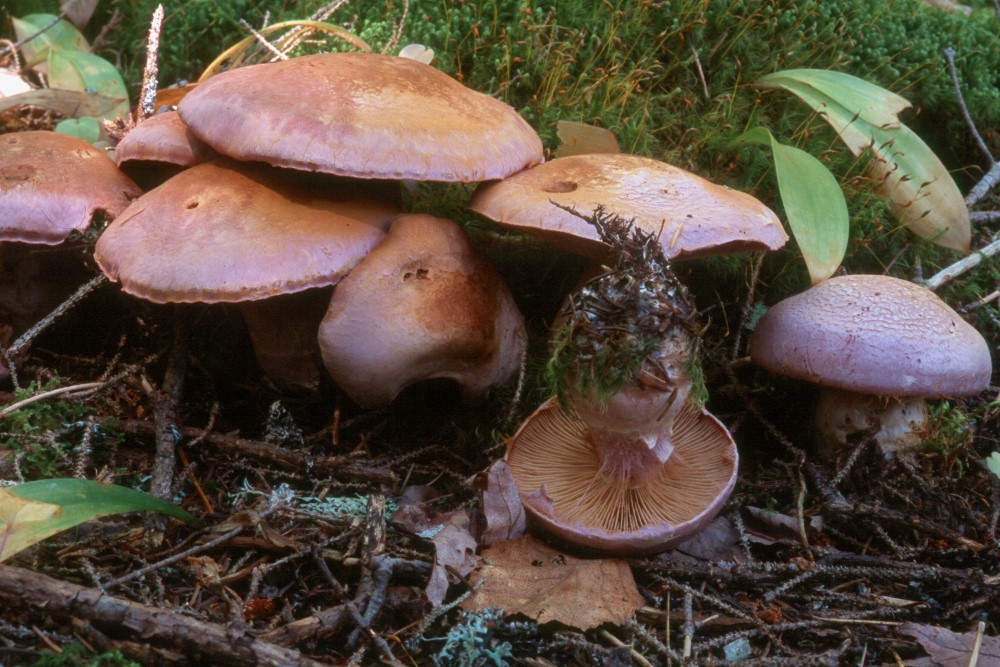
    Probably the most familiar type of mushrooms are those with gills underneath the cap, such as Cortinarius traganus:

    Cortinarius traganus

    This mushroom is very commonly found late in the season and is identified by its striking purplish hues and brown gills, as well as its thick stem which widens to a bulb at the base. Younger specimens may also have a webby mesh over the gills called a cortina, which is pictured in the image above. This species forms a mutually beneficial partnership with conifer trees referred to as a mycorrhiza, where the fungus provides nutrients to the plant in exchange for a portion of the sugars the plant derives from photosynthesis. In general, mushrooms are very good at obtaining nutrients from soil, where they produce very fine root-like structures called hyphae. These are much finer than plant roots and allow for more efficient nutrient uptake. Cortinarius traganus are not edible.


    Coprinus comatus 

    Coprinus comatus, also known as the shaggy mane, is a frequent sight in lawns and mulch. This species is often white when young, with a long, bell-shaped cap. As they get older, the mushrooms release enzymes that effectively digest the mushrooms themselves, resulting in what looks like black ink. Several species in this group show this liquifying behavior and are together known as inky caps. These are considered edible but contain a toxin which reacts with alcohol up to a week after consumption. This can cause unpleasant symptoms such as vomiting, so eating this type of mushroom is not recommended.

    Amanita bisporigera

    Another white mushroom commonly found this time of year is Amanita bisporigera, also known as the Destroying Angel. As the name suggests, they are deadly poisonous. They are identified by their tall stem with a bulbous base, a ring around the middle of the stem, and a round cap when young that expands to become flat with age. Like Cortinarius traganus mentioned above, this species is mycorrhizal with oak trees, so they will only be found in forests where this tree is present.


    Connopus acervatus

    Connopus acervatus can be found growing on rotting conifer wood. Unlike the other species covered so far, this species forms dense clusters of mushrooms with reddish-brown caps up to the size of a toonie that become lighter towards the edge. The stem is long and slender with slightly pinkish hues. This species is not known to be edible.


    Pored mushrooms

    Suillus cavipes

    Some mushrooms don’t have gills at all, and instead have pores underneath their caps, such as Suillus cavipes. The fuzzy reddish-purple to brown cap, and pale-yellow pore surface help distinguish this species from other pored mushrooms. It only grows with larch trees, and sometimes several meters away from the host tree. Because of this, it is easy to overlook its tree associate. This species is not known to be edible.


    Fomitopsis pinicola

    Fomitopsis pinicola, also known as the red banded polypore, is a very common sight in coniferous and mixed forests where it can be found decomposing dead trees. Mushrooms in this group are called polypores or bracket fungi, which form a sort of disk off the side of a piece of wood, allowing the spores produced on the underside to fall out and blow away with the wind. Unlike the other mushrooms covered so far, which may have shorter life spans, this type of mushroom grows and produces spores over the course of many years. This species has a woody texture and is thus only edible to the adventurous (not tasty!).

    Toothed mushrooms

    Hydnum repandum

    Hydnum repandum, or Hedgehog mushroom, gets its common name from the teeth underneath the cap. This mushroom is identified by its brown to orange cap and whitish stem. It forms a mycorrhizal relationship with conifer trees and likes to grow in wet seepage areas with dense moss cover. It is a prized edible with a mild taste.

    Jelly fungi

    Pseudohydnum gelatinosum


    Pseudohydnum gelatinosum looks superficially similar to the Hedgehog mushroom because of its teeth but is actually only very distantly related. It is one of the jelly fungi, a group whose name is unsurprisingly derived from their gelatinous texture. The teeth of this mushroom are generally grey to white and translucent, while the cap can range from pale grey to brown. This species can be found growing on rotting conifer wood on the forest floor. Jelly fungi are not valued as edibles.

    Dacrymyces chrysospermus

    Dacrymyces chrysospermus, also known as ‘Witches’ Butter’, is a very common sight throughout the year. This species does not form a cap and stem, but rather it looks like a mass of bright yellow or orange folds growing on the surface of dead and rotting wood.


    Puffballs

    Calvatia gigantea

    Another type of mushroom is the puffball, which is usually round, with the spores being produced on the inside. While many mushrooms often rely on wind to disperse their spores, puffballs need to be disturbed in some way, such as being squashed by animals, in order for their spores to shoot out in a cloud of smoke. A common late season puffball is Calvatia gigantea, which can grow in lawns to enormous sizes, often up to 50 cm or more in diameter, and contain trillions of spores when mature. This species is white on the outside and white on the inside when young, but the interior turns brown with maturity. They are edible while they are still white inside. A related species, Calvatia cyathiformis, looks similar when young, but

    is rougher and its outer surface turns brown with age.

    Sac fungi

    Leotia lubrica

    Leotia lubrica, also known as ‘Jelly Babies’, are a member of a group called sac fungi that are about as closely related to other mushrooms as humans are to earthworms. Species in this group are usually microscopic, but a few species have grown to a conspicuous size. Jelly babies are identified by their yellow stalks supporting a wrinkled, brown head that may take on greenish colours. They are not known to be toxic but supposedly have little flavour.

    To delve further into the world of mushrooms, a good field guide is critical. George Barron’s Mushrooms of Ontario and Eastern Canada is a great place to start, available in Wolfville at the Box of Delights bookstore on Main St. The website mushroomexpert.com is an invaluable free resource covering over 1000 North American mushroom species, but it is generally more technical than a field guide. Not only is collecting and identifying mushrooms a lot of fun, but there are likely many species that have yet to be discovered in Nova Scotia. The next time you go for a walk through the woods, you might just find something new!


    Thanks to Dr. David Malloch for giving his permission to use some of his photographs. To learn more about fungi, consider taking Dr Allison Walker’s BIOL3663 Mycology course at Acadia (follow her @FungalDreamTeam) and check out blomidonnaturalists.ca or nsmycologicalsociety.org for information on mushroom walks in the province.


    Bruce Malloch is completing is MSc. in Biology with Dr. Allison Walker researching the succession of decomposers in salt marshes. His project looks at  the idea that the decomposition of a plant species is a complex process involving many species that are functionally unique. Some may decompose leaves and shoots, others roots. Some may be decomposers of freshly killed grasses while others will decompose older material. His research is focused on determining which fungal species are present in the Wolfville marsh, and how these communities change over the course of a year.

  • The Amazing Wheelchair Race

    The Amazing Wheelchair Race

    Have you ever wanted to take part in the Amazing Race, but have never had the opportunity? Well, now is your chance! November 2nd, 1:30-5:30, there will be a race around Acadia for a chance to win prizes, such as a tasting and tour for you and your friends to the Annapolis Cider Company, and some free scott skins from Joes Food Emporium, not to mention free hot chocolate. The only catch? You have to do it while in a wheelchair.

    For people living with muscular dystrophy, or other limitations that require the use of a wheelchair, Acadia University is not an easy place to get around. Each location provides unique challenges, most of which the able-bodied population does not recognize. This event hopes to highlight areas on campus that are very difficult to access for those who have physical disabilities. It will be a fun and friendly competition, and the organizers hope it will also stir up a conversation about areas in need of improvement on campus. To partake in this event, go to the Facebook page and sign up on the google document. Participants will race in teams of two, taking turns completing obstacles. So, grab a friend and get ready to race, this will be an event you don’t want to miss!

  • The Good, The Bad, and the Non-Compliant

    The Good, The Bad, and the Non-Compliant

    The Valley is filled with a bevy of restaurants from which Acadia students are privileged to choose. Picasso’s, Lib Pub, Sushi Fang, The Naked Crepe, and many more well-attended establishments. The wider Annapolis Valley area is without a doubt a fantastic place to eat. I’m sure that nearly everyone that attends Acadia has had at least a few delicious meals at one of the previously mentioned restaurants. Sitting in my living room, reminiscing with friends about Wheelock Dining Hall and our days in residence, we began to talk about how dirty some people claim meal hall is.  Instantly I was curious and began my standard Google-based investigation. I started by asking myself if I thought there were food safety or health code violations at Wheelock. If there were, how could they be verified? This led me to a larger issue. Are there health code compliance issues with the popular restaurants in town? Again, where would I be able to find this information? As always, Google had my back. Entering the phrase, “Nova Scotia Health Inspector” directed me to public health inspection records.

    The Province of Nova Scotia Health Inspector’s website provides a form from which you can instantly request the electronic inspection records for any establishment in the province for the last decade. All you have to do is input some basic information like the name of the establishment, the address, and the period for which you would like to see records. I decided to examine some of the most popular destinations for students both in Wolfville and in the surrounding area.

    They include:

    • Pronto Pizza
    • Picasso’s Pizza
    • Paddy’s Brew Pub
    • The Naked Crepe
    • Troy’s Mediterranean Restaurant
    • Library Pub
    • La Torta Woodfired Pizzeria
    • Sushi Fang
    • Wheelock Dining Hall (Operated by our friends at Chartwell’s)
    • Subway

    In order to get a better picture of historic compliance issues I examined the Nova Scotia Food Establishment Inspection Reports for these establishments from January 1, 2008 through April 5, 2018. Records are removed from the online database after more than three years so the records I have access to are no older than that. How do the various student-frequented establishments stack up when compared to one another? As is the case of a few of these establishments, I feel it is necessary to get specific with what health inspectors revealed during their unannounced examination of these eateries. All health code violations are up to the interpretation of health inspectors. Not all violations represent a serious risk to health, however, it is worth noting that based on the documents I have examined, all of the restaurants do have some violations. I should reiterate, not all violations are serious. The definition of a “Deficiency” under the provincial health codes according to the Nova Scotia Provincial government is “Requirement(s) of the Regulations or Code not being achieved by the food establishment. The word deficiency is often used interchangeably with the words violation, or infraction.” Let’s see what the restaurants of Wolfville have crawling in their back rooms.

    Pronto Pizza is one of Wolfville’s establishments frequented by weekend warriors and is also one of the most concerning establishments. On June 5, 2015, the inspection lists no deficiencies. On December 3rd, 2015, the remarks include a failure to store potentially hazardous foods properly, cleaning required of all shelving, rear wooden counter, milk fridge and some shelving and surfaces in 2 door commercial fridge, washroom toilet fixtures, under and behind equipment some wall areas and all floors. Further, inadequate sanitation systems were observed. However, most concerning of all reported deficiencies is listed as, “FAILURE TO OBTAIN A VALID PERMIT PRIOR TO OPERATING A FOOD ESTABLISHMENT.” More than one year later on September 26th, 2016, the same deficiencies as December 3rd, 2015 reappeared but the permit issue was remedied.

    Picasso’s Pizza makes a rad donair but during visits in October and December of 2017 the health inspector noted on both occasions that there was a “Failure to protect food from contamination” and the comments from the October inspection read, “Store chemicals separately from food & packaging. All food & packaging to be stored >6 in./15 cm. minimum off floor. Dry ingredients containers rusted and not acceptable for food contact.”

    Next, we move to Paddy’s ,The Naked Crepe, and Troy’s Mediterranean Restaurant. All three of these businesses seem relatively well in order based on their inspection reports. Both Paddy’s and The Naked Crepe received no infractions on their most recent inspections.  In the case of Paddy’s there were consistent infractions during four inspections over two years for “failure to store potentially hazardous food at a temperature of four degrees celsius or less.” The Naked Crepe had only minor infractions revealed in their September 2017 inspection. Troy’s received notices to comply over inadequate hand washing stations in their most recent inspection that took place in February of this year.

    Next we turn to the Lib Pub. There is nothing significant to report here other than excellent food and drink. It has been more than two years since their last inspection during which time some basic temperature monitoring devices were reported as not calibrated properly and a dishwasher that could use “Daily water temperature and chemical sanitizer concentration records.”

    La Torta Woodfired Pizzeria, I’ve never personally eaten here nor have I heard positive or negative reviews related to the pizza place. Their inspection on April 4, 2018 revealed only minor deficiencies that weren’t related to food safety.

    Unfortunately the previous records of relative excellence or acceptability end here. Sushi Fang is without a doubt the worst example of food safety I was able to find. There are some direct quotes from their report that are worth sharing. All inspections took place between July 2015 and February 2018. There were regular violations indicated that suggest Sushi Fang’s operator does not adequately train their staff in safe food handling. Some noteworthy observations from the February 2018 inspection, “Food handler certification of the owner has expired” and, “Raw foods must be kept separate and always stored below ready to eat foods (corrected). All utensils and work surfaces must be maintained in a clean and sanitary condition (corrected). Foods must be stored a minimum of 15 cm (6in.) off of the floor (corrected). Foods when returned to storage must be labelled and dated to ensure proper stock rotation. Fresh raw seafood intended to be consumed raw must be dated and ensure frozen >= 7 days at -20C to ensure parasite destruction.” Or, my personal favourite, “Vermin-proof /seal small opening in building.” This restaurant has some ridiculous violations that would indicate food safety is a serious problem there.

    Of course, we have to check out Wheelock Dining Hall operated by our friends at Chartwell’s. During their inspections between the February 24, 2016, and  December 18, 2017, there were eleven deficiencies noted with nine notices to comply issued. Some of the issues did have to do with food safety and “failure to protect food from contamination” the notes from the inspector indicate lack of sneeze guards and uncovered food being left out for long periods of time.

    Subway has some pretty decent sandwiches but their record is rough. Over seven inspections in the last three years there were nine total deficiencies with nine notices to comply issued. The comments “The operator has failed to ensure the food handlers have the necessary training” appears five times over two years.

    With all that being said, it seems these health codes are in some cases too specific. They capture issues that are not related to food safety. For example some of these establishments were issued deficiencies based on “lighting intensity” or the lack of a schedule to maintain their dishwashers. On the whole, the restaurants I’ve examined here are probably ok to eat at. The fact is, you should always use your best judgment when eating out. For example, eating sushi in the Annapolis Valley is probably already a risky activity.


    I would encourage my readers to verify the validity of this article by visiting: (https://novascotia.ca/agri/foodsafety/reports/Request.aspx).


    Disagree with me? Write for the Ath.


  • The Role of Volunteering in Citizenship: Why you should give back to Wolfville

    The Role of Volunteering in Citizenship: Why you should give back to Wolfville

    Nolan Turnbull

    Sports and Wellness Editor 

    We are fortunate to attend this wonderful institution that is embedded in the amazing community of Wolfville. Wolfville is supportive of the university, its students, and its programs, and provides a plethora of opportunities that enhance your Acadia experience. Citizenship can be defined as the responsibilities that come with being a member of a community. Most people would think of these responsibilities as things such as recycling, voting and being a law-abiding citizen. However, being a good citizen goes far beyond that.  Citizenship should mean lifting the bar to make your community a better place. Peter Druker once said that “the best way to predict the future is to create it”. So how can you accomplish this? In my opinion, the best way to do this is to volunteer. The smallest actions can help brighten everyone’s day and create a chain reaction of good deeds. You can’t expect your community to grow and flourish if you don’t contribute. I was once told the quote: “a society grows great when old men plant trees whose shade they shall never see”. This quote shows that we may not reap the benefits of our actions, but it doesn’t mean that these actions go unnoticed. We are making a difference that will better the lives of those who follow us. Volunteering will allow you to say “I helped do that” when you drive back through the streets of Wolfville in twenty years. By making a difference you are a part of the puzzle that makes up our community. Small actions both through volunteering and on the street define us both as people, but also as committed and caring citizens. Volunteering allows us to give back and say thank you as well as help us continue the legacy of those who have shaped our society, and our time here at Acadia. Thank you Wolfville. 

  • Enactus Acadia Wins $2500 Grant

    Enactus Acadia Wins $2500 Grant

    Acadia’s Enactus team has won a 3M Canada Project Accelerator Grant, valued at $2500, for their youth entrepreneurship programming. The grant is meant expand a project created by an Enactus team, developing it from the starting phases to implementation and growth stages, and Enactus Acadia Co-Project Managers, Sam Stegen and Sara Baxter, are at the helm of this project along with a growing group of committed team members.

    Project Regenerate is aimed at engaging youth as change-makers and young entrepreneurs, according to Enactus Acadia President Justin King. In partnership with Boston Pizza New Minas, used crayons are recycled, melted, and remoulded into new crayons. They are a variety of shapes and colour blends to be sold at the Acadia Christmas Craft Expo from November 17-19. These new shapes are meant to be accessible to all, as the traditional crayon shape does not accommodate to a wide range of motor skills and abilities.

    “We’ve had two sessions so far in October. We started with 6 kids aged 7-12, but now we have a hundred kids coming from the Annapolis Valley Regional School Board [next week],” King said. Their partnership also extends to Evangeline Middle School. “We’re teaching a few lessons there this month and more in December [possibly].”

    Enactus has put their focus on social entrepreneurship. Social entrepreneurship centres around the idea that businesses have an obligation and the capacity to affect social, cultural, and environmental change instead of solely making a profit. These organizations give back to the community in creative ways while introducing people who otherwise would not be engaged in entrepreneurship to the business world.

    “We show the kids the ideation phase, what we thought of, the marketing, here’s a price, we budget with them and ask them questions like ‘What do you think is a good price for our product?’. Essentially, we’re getting these crayons for free, the labour is all for free because everyone is a volunteer, and we’re creating a tangible product that the kids can sell so they can become entrepreneurs at this young age.”

    King notes that the kids he’s worked with are incredibly forward thinking. One in particular stood out to him. “This kid is seven years old, and I asked him ‘What happens if you have a business that not everybody can afford but somebody really wants to use?’. He wanted to start a gym so he said, ‘Well I would take some of the revenue from the people who pay full price and help this person get in for free.” King was amazed because, as a third-year business student, he had only learned this concept in the previous year of university.

    In King’s mind, Project Regenerate is key to understanding how to work with youth. Children ages 6-13 are taking part in the program, and with the Annapolis Valley Regional Schoolboard now joining Enactus Acadia as a lesson partner the potential for expansion is huge. “It’s a really good opportunity to engage with like-minded students.” Right now, there are eleven volunteers that have signed up for weekend events. They have gone from two Acadia students running every project to eleven fully committed participants this semester.

    Enactus is incredibly flexible. “If any of our projects don’t quite fit in the lines of exactly what you’re trying to do by joining, then [Enactus] will work with you to help get that idea off the ground.” Last night at their weekly meeting King and his colleagues even listened to a project pitch that may very well materialize.

    “It all comes down to having an idea, having the capacity to hold it under the Enactus umbrella… but if you have an idea and pitch it, and you can get a team behind you and a team to work it together we’ll support you. We also have the potential to get funding from outside sources, using some of our own start-up capital, and we have international competition groups too that have prize pools for additional funding.”

    Various categories of competition exist. Such as Youth Entrepreneurship, General Entrepreneurship, Financial Literacy, and Eco-Living including two new categories this past year, 1 Race 2 End Waste, and the Water Race, which are all different categories of competition under the Enactus banner that participants can enter. Emblematic of Enactus’ focus on social entrepreneurship and giving back to the community in a meaningful way.

    There are several stages to competitions. Regional competitions are the starting point, followed by national and international competitions. Many post-secondary institutions across Nova Scotia and Canada have their own Enactus teams. Last spring, Acadia attended Enactus Nationals in Vancouver, BC and placed as a semi-finalist, with former ASU President Samantha Sproule joining the team.

    Baxter joined in September and her addition to the team was “one that just made sense” according to King, as Baxter is a business student and Stegen a sciences student. Having representation beyond a singular faculty made for a dynamic team that could solve problems creatively and work towards a social enterprise solution.

    Stegen started the project in April while King was working as a research assistant studying youth entrepreneurship and the capacity of the market for it. King describes this as Stegen’s “brainchild”. Baxter is currently a co-op student with the Acadia Entrepreneurship Centre at the Launchbox space in Patterson Hall. With Stegen’s background in sciences and Baxter’s in business and organizational capabilities, it was a perfect fit. The project continues to grow, with the Christmas Craft Expo in November the major goal for the month with no end in sight.

    On November 24th from 1:00-4:00PM in Patterson 107, David Upton and Lauren Sears from Common Good Solutions, Nova Scotia’s first Community Interest Company, will be giving a presentation on sustainable entrepreneurship. To learn more visit http://commongoodsolutions.ca/

    Enactus Acadia meets weekly Tuesday evenings in Patterson Hall on the 4th floor from 5:30-6pm.

  • Small Pond Syndrome

    Small Pond Syndrome

    Why did you come to Acadia? I’m sure for multiple little reasons: the beautiful campus, the regional reputation, athletics, location, scholarships, or you’re just a big fan of mud sliding. Whatever you’re into man.

    But it’s just that, it’s the little reason. I argue that being a small institution is one of our greatest assets not just inside the classroom but outside as well. Outside the classroom, meaning socially playing nice with the other kids on the playground, fosters an awareness for mutual respect.

    My interactions outside of the classroom have led me to collect this extremely sophisticated and completely scientifically based analysis of our small school population before attending Acadia. Broadly speaking students usually fit around three points on the continuum on the confidence scale regarding making friends going into this university.

    The first being you were a big deal in high school, came here with your buddies, and felt like you need to add one or two more people to the roster of your sick childhood squad. Acadia can offer you this convenient reality. Or, you may know people from playing local sports, or attended the same high school, but you are by no means close with anyone and are eager to meet lots of new faces. Finally, of course there is a population of students who don’t know a soul and making friends seems like a massive undertaking. This may be because you’re an international student, out of province, or you just like to keep to yourself.

    Whatever your perspective is, Acadia can be a fresh start for you, and can act as an equalizer. The first few weeks of your first year can be very hard and this shouldn’t be glossed over yet, you will find it’s much harder to isolate yourself then you may think. I am getting acquainted with new friends already this year and I am going into the second month of my third year. Due to the small size, students can become more intimate with more people because you are frequently being put into situations with the same population of people. It’s a wonderful attribute of Acadia no matter where you began on the social continuum.

    My roommate once chatted with someone at Shopper’s Drugmart standing in front of the chip aisle because she felt familiar enough with him. She always saw him at the library in the past and this was enough of a reason to critique chips together. They were both very perplexed at which chips make the best storm chips, which is the best PC brand chip flavor, and the classic conundrum of regular versus wavy cut chips etc. Classic chip struggles.  Just seeing the chip guy enough before said chip-run created a basis for a friendly conversation. I truly believe that Acadia/Wolfville are on the short-list of university towns where that is socially acceptable.

    What we should remember is that although a friendly place, Acadia is a small pond. No no.  More like one of those fancy infinity pools that look off onto the ocean that really only exist on MTV’s “Cribs”, Oprah’s house, and affordable resorts. It has this small, rigidly defined population. Yet, it has a full vista view which alludes to opportunity commonly known as “the real world” and referred to as “adulthood”.

    What about all the people I have successfully or unsuccessfully hit on? How often will I see them at this friendly, small school? You will see them what seems like everywhere (especially when you stink of Subway in the lib in between classes).

    Here is a fun and simple equation you can do in your head: think of all the people you have either professed your love to, made out with, danced with at the vil and/or axe, stared too long at the library at, directed their naked butt to your bathroom, had full blown your-mum-and-dad-know-what-I-look-like-in-real-life relationships with, gone to coffee with, had a deep heart to heart after class with, or had an inexplicable crush on. Whatever experience you have or have not had. Then divide that by 6.46 km2. After you divide those awkward times by space (the square kilometers of Wolfville) you have your very own unique and customized answer! You are now a certified love physicist! Congrats.

    Now, what do you do with that number? Be nice to each and everyone one of them no matter what the result of the situation is. You could be coworkers, neighbors, have all the same classes, or just like eating breakfast at the same time every day if you eat at Wheelock.

    Laugh at their jokes, always say hi, and give them that follow back on insta. I can’t say that I always live by my own advice but I try my best. Shit, right when I was writing this I just avoided eye contact with someone while sitting in the BAC café I KID YOU NOT. Do what I say not what I do! You never know what may come of the situation. Inclusion is always the answer.  This of course also includes other acquaintances or individuals who you have not made a fool yourself of on a romantic level with.  It means be nice and remember everyone’s name that you have learned.

    It may seem as though this town may seem suffocating at times. But what is really happening when you run into people is that you are reminded that each of them have feelings which you should respect.  No man is an island and everyone loves to be remembered. The small population is truly a good exercise in pushing yourself to treat others with respect. This lesson learned outside of class is one that is invaluable for the future and is served on a warm platter to us from yours truly, Acadia University. Right, so remember when you are heading to the swim-up bar in the infinity pool at Oprah’s house, give a polite hello and nod to all that are in there with you over these four+ years.

  • 5 Cheap Ways to Decorate Your First Apartment

    5 Cheap Ways to Decorate Your First Apartment

    “If you’re in a place where spending money is something you can do, even in small amounts, you will be surprised at the large changes small things can make.”

    Before I start, it’s important that you know a little bit about me. I am a certified human trash fire. Yesterday I ate my dinner off a Tupperware lid because I didn’t want to do dishes. Today I googled how much coffee I could drink without dying. My point is, I’m not about to lecture you about what curtains go with which throw pillows. If you’re standing there thinking “Listen friend, here’s the extent of how much I care about how my apartment looks…I push my couch in front of my television and call it a day.” Then I totally get you, because as someone who’s spent some time couching in front of a television while paying rent and utilities, I picked up a few tricks.

    Let there be light!

    Something important you might not know you need right now, is lots and lots of light. Even if you’re like me, and most mornings you’re swearing at the giant annoying orb in the sky, sunlight is super essential to both your focus and mental health. If your apartment doesn’t get a lot of natural Sun, something you should invest in is a tonne of artificial light. There are some ways to do this inexpensively and effectively. A personal favourite of mine are LED night lights. They usually sell these at hardware stores, they’re affordable, small, and battery operated so that’s just another thing that your electricity bill isn’t paying for. Pixie lights can be cheap for the amount you get; you can buy them at Walmart or any old hardware store for under fifteen dollars usually. However, they don’t give off a lot of light and tend to be more atmospheric than anything else. Invest in a good lamp! A desk lamp can cost under twenty dollars, and you would be surprised at how much light they spread in a small space. Avoid dark curtains. Put up some sheer ones, or even white. Sheer is less expensive than heavy curtains and more effective at letting light in. Dark curtains trick your body into sleeping past their natural rhythm. It sounds like a good idea when you’ve been drinking and you’re pretty sure you might die, but it actually makes it harder to wake up in the morning, which is not good when you have an 8am and you have to set three different alarms just to get out of bed.  

    Magic Tricks

    You barely fit your chain-smoking Grandma’s old couch through your front door, let alone in your living room. You rented the place because it was cheap and you didn’t have to walk up the hill to get to your kitchen. You weren’t focusing on whether it was big, but now if you’re realizing exactly how little space you have, a good tip I’ve got for you is mirrors. When you hang up mirrors adjacent to direct light (sunlight or lamp) it can reflect and make the room seem bigger. This one’s complex. I would avoid anything with frame since hanging things on the wall that look large and clunky may make the room look smaller. If your landlord is strict about not hammering nails into your wall, I recommend the time-honored peel and stick mirror. They usually come in small 5×5 portions, they can be fun to place on the wall, and they are easy to take on and off. Michaels has them. Michaels can be expensive, but if you’re willing to wait until October, they do 40% off sales near Halloween.  

    Get A Plant

    I can barely take care of myself. Sometimes I forget to give myself water, don’t even get me started on plants. Here’s the thing though, plants are super great for brightening up a living space. They have a ton of mental health benefits too; some even say they help fight off seasonal affective disorder. Aloe is a ridiculously easy plant to take care of as they don’t need a lot of sunlight and tend to only need to be watered once a week. The best part is they are super cheap and easily accessible. They’re also relatively small so a few pots will fit on a window sill or counter nicely and stay out the way. However, if that sounds too daunting for you or plants aren’t really your jam, consider a few other options. While not so much a ‘house-plant’, a trick I learned from my parents is putting cute little mason jars full of chestnuts on windowsills. Chestnuts are known to ward off spiders, which we all know are the devil’s minions. I’ve never seen a spider in my home so I can certainly swear by their authenticity. Mason Jars are practically free they’re so cheap, and you can always clean out and wash a jam jar for free if you’re thrifty. I recommend poking holes in the chestnuts. Also, just step outside and by October they’ll be falling out of trees all over Wolfville, which means they’re totally free!

    Buy In Bulk

    This one is a fun one. Something you might know if you took grade ten math is buying things like dish soap and shampoo in bulk (like with a handy dandy Costco membership) is always cheaper overall than buying individual bottles that fit in your shower or on your sink. This means you must have fancy smancy bottles to keep all your bath stuff in, then refill them when they start to run out. It’s something you might not be thinking about if you went from living with your parents to living in dorms. Go to the dollar store if you’re feeling like not spending a butt load of money, or a home sense store if you’re feeling luxurious, find soap dispensers and bottles for shampoo and conditioner. Find something you like, or make it yourself. It’s common to get a set for under thirty dollars. However, if that feels too expensive for you a cute DIY for kitchen soap dispensers is turning an old glass olive oil jar into a soap dispenser, or even an old glass alcohol bottle. It’s a cheap way to bring a room together, and you’re saving a crazy amount of money. It’s a great way to feel like an adult when you aren’t actually an adult. Sure, I eat cereal for dinner, but my soap dispensers match my shampoo bottles. Another bonus is that if you’re someone who lives far away, having travel sized shampoo and conditioner bottles on hand is very convenient.

    Invest in Hooks  

    Hooks are the best thing that has ever happened to me. In terms of organization and usefulness, hooks are where it’s at. If you’ve been through dorm life, you might have an idea what I’m talking about when I mention peel and stick hooks on the side of walls. These can still work in an apartment, but if you’re feeling fun you can pick up actual nail in the wall hooks, the ones that actually hold things up. The best part is you can get super cheap ones and paint them any colour you want. Adult crat bonus point: you can buy cheap handles with a metal finish and then chip off the finish for a distressed rustic look. Hooks are basically the best things to have in any room. Looking to hang up a bathroom or a towel? Use a hook. Want to hang a dishtowel, or a picture frame…hook. Always losing your house keys…hook. Need an organizer for your scarves or your jewelry…hook. Sometimes, the best most ingenious things are the simplest things.  

     Decorating might not be in your wheelhouse just yet. Sometimes big change can be had in small steps. Mirrors, plants, lights, and jars sound like insignificant and wasteful bouts of spending, but if you’re in a place where spending money is something you can do, even in small amounts, you will be surprised at the large changes small things can make.


  • Dr. Peter Ricketts On Acadia Funding Crisis, Scotian Charm, And Hate Speech

    Dr. Peter Ricketts On Acadia Funding Crisis, Scotian Charm, And Hate Speech

    “Your university experience should be the best time of your life because once you get out into the world and you get a job, responsibilities, and family – these things constrain you”

    You stated after your appointment that Acadia was an embodiment of a tight knit and personal education. Our outgoing President (Ray Ivany)  also realized this and was seemingly omnipresent around the campus, and was always greeting students.  How do you plan to continue the type of personability that Acadia has come to know and love in your tenure?

    “One​ ​ of​ ​ the​ ​ quintessential​ ​ elements​ ​ of​ ​ Acadia​ ​ is​ ​ that​ ​ it​ ​ is​ ​ small,​ ​ but​ ​ you​ ​ can be​ ​ small​ ​ and impersonal,​ ​ and Acadia​ ​ isn’t,​ ​ it​ ​is small​ ​ and​ ​ personal.​ ​ I​ ​ think​ ​ this​ is​ ​ what attracted​ ​ me​ ​ to​ ​ this​ ​ university,​ ​ because​ ​ this isn’t​ ​ something​ ​ that​ ​ only​ ​ happens​ ​ on​ ​ the​ ​ edges​ ​ of the​ ​ operation​ ​- it​ ​ happens​ ​ centrally.​ ​ I​ ​ think​ ​ Ray​ ​ Ivany​ ​ did​ ​ a​ ​ fantastic​ ​ job​ ​ here,​ ​ so​ ​ my​ ​ view​ ​ is: if​ ​ it​ ​ ain’t​ ​ broke​ ​ don’t​ ​ fix​ ​ it.​ ​ I​ ​ plan​ ​ to​ ​ continue​ ​ to ​ make​ ​ sure​ ​ that  I am engaged​ ​ with students​ ​ and​ ​ meeting​ ​ them​ especially​ ​ when​ ​ the​ ​ new​ ​ students​ ​ come​ ​ in, but also throughout the year. Obviously​ I will not do this in exactly the​ ​ same​ ​ way​ as Ray did because​ I​ ​ am​ ​ a​ different​ person, but I share his approach to making Acadia a personalized educational experience, and that starts with the President.”

    You’ve spent a significant time in Ontario prior to which you were in Nova Scotia, is there some inexplicable charm that drew you back to Nova Scotia?

    “The inexplicable charm was Acadia. I didn’t deliberately set out to come back to Nova Scotia. I did spend twenty-two years here, so in a way Nova Scotia was the icing on the cake. This is where I started my academic career, and it’s nice to reengage with that. I’ve lived throughout Canada, but the valley really is a gem. I used to bring my students here on field trips all the time!”

    Does it feel good to be back home; in the sense that geographically a lot to your work on coastal research and ocean management is tied to the very essence of this province?

    “Yes, that’s certainly an exciting aspect of why Acadia is a good fit for me. Acadia is in a coastal location, and the importance of the ocean and coasts in this region is one of Acadia’s defining characteristics and research strengths. I have maintained a strong professional network of people who are​ ​still​ ​in​ Nova Scotia, particularly through the Coastal Zone Canada Association, an organization that I helped found in Halifax back in 1993. The opportunity to come back closer to that network is​ important, and I do plan to continue my research related to ocean and coastal management, policy, and climate change – it is a lot easier to do that in Canada’s ocean playground!”

    How do you plan on advancing education at Acadia?

    “I’m a very strong believer in university education being rooted in its community, but being global in scope. I think the role of globalization plays a huge role in the direction university education is heading, and where universities need to be in the 21st century. Acadia is doing a lot in that field, but there is a great deal more that we could do. That includes: making our curricula more global and more international, and giving students more​ ​access​ ​to​ international experiences through study abroad and other educational, research, and work opportunities. I think that in the grand scheme of things this is very important. I’d also like to improve how Acadia is interacting with indigenous populations, and make it more attractive and engaging for students from these communities. Lastly, I think we need to advance Acadia’s reputation nationally and internationally, because I do think that Acadia is the jewel in the crown of Canada’s university system. We have to promote this university and what it stands for, ​and get​ more people to know about it.”

    News recently broke that Acadia has received a 25.4 million dollar bailout from the provincial government. The Canadian Federation of Students (CFS)-Nova Scotia stated that this  “further proof of the funding crisis in the post-secondary education system in Nova Scotia.” Should Acadia students be worried about this?

    “No. Next question! [Laughs]. Just kidding! Students should be extremely happy. First of all, I wouldn’t characterize this as bailout money. What the government has done is provide to Acadia on an ongoing basis what it has been providing over the last 8 years. This is money that the government has been providing to the institution for a while: 3.5 million per year over 5 years, and prior to that the allocation of a 7 million dollar loan. This is a recognition that this is money that Acadia needs as part of its operating budget. The impacts of the funding formula change in 2008 created an emergency situation that was added on top of an already tight and difficult situation that the university was in at the time. The funding formula dug the hole deeper and said ‘not only do you have to dig your way out, but now you have to claw your way out by hand’. The university has done that, and I have to give an incredible tribute to Ray Ivany, John Rogers (Chair of Acadia Board of Governors), and Paul Jewer (Past Chair), as well as many others, for the work they did on this issue.

    This funding announcement that recently came out was the result of a very serious government review of Acadia’s finances. The financial audit said that Acadia got its act together. It has made cuts and done everything that it could reasonably be expected to do. This is a good news story and a vote of confidence by the government in Acadia’s finances, administration, and the university itself. They’re very impressed with how Acadia engages with industry, and businesses, and communities to help with the future economic and social growth of Nova Scotia. The CFS statement about underfunding is true in general, universities are underfunded by government, but this particular funding action was not related to that.

    The 2008 funding formula didn’t cut funding across the board, but it negatively impacted Acadia and Cape Breton University especially hard, and this is the government’s way of trying to rectify that. The CFS comment isn’t relevant to the government’s funding of Acadia in this instance, but is relevant on an ongoing basis across Nova Scotia and Canada. All of the institutions in Nova Scotia will have a discussion with the government to review how the finding formula should be developed going forward, and that is a discussion I am eager to be involved in. The​ ​ terms​ ​ used​ ​ in​ ​ the​ ​ headlines​ ​ -​ ​ emergency​ ​ funding​ ​ and​ ​ bailout​ ​ aren’t​ ​ accurate.​ ​ The loan​ ​ 8​ ​ years​ ​ ago​ ​ was​ ​ absolutely​ ​ emergency​ ​ funding,​ ​ but​ ​ the​ ​ forgiveness​ is just​ ​ recognition​ ​ that it​ ​ should​ ​ have​ ​ never​ ​ been​ ​ a​ ​ loan.​ ​ The​ ​ current​ ​ government​ ​ has​ ​ fixed​ ​ that.​ ​ This​ ​ is​ ​ good​ ​ fiscal management​ ​ by​ ​ the​ ​ government​ ​ and​ ​ it​ ​ recognizes​ ​ prudent​ ​ fiscal​ ​ management​ ​ by​ ​ Acadia.”

    In your opinion, what are some of the greatest challenges you’ll face along the way of running this university?

    “Well, we just talked about one of them. The budget is certainly always a challenge, and I had no false expectations of that coming into the Nova Scotia system. It is known to be very tightly controlled, and every university has made cuts and sacrifices to keep budgets balanced. I believe universities should be efficient, and we should not be in a situation where we are throwing money around. We should always be very conscious of the use of the public, government money and the student tuition money. We have to be careful stewards of that, but there is no doubt that this will be a big challenge for us as costs of operating a university go up 3 to 4 percent a year. The big challenge will be to discuss what the appropriate level of government funding is, understanding that the government has many competing challenges as well, and of course the challenge of trying to keep tuition fees at a level that are not beyond the reach of students and parents. That is a very difficult balance, as every time we increase tuition it is an impact on the student’s ability to pay, and parents ability to support their students.

    Another challenge going forward relates to the funding challenge. We need to pay attention to areas that have been starved of resources over many years. One of the major targets of our capital campaign is infrastructure revitalization, and again that is something that has been put off. Frankly, it is not as sexy to give money to renovate a building or provide a new information system as it is to build a building, but I have been impressed by how Acadia has managed to get funding to renovate some of its buildings. I think we have to look after the infrastructure of the campus, and make sure that we are investing in the resources that are going to have the most benefit to the students.

    A third challenge is public skepticism of how continually important a university education is , and what the value of a degree is, particularly a BA [Bachelor of Arts]. One of the challenges is to take strong messages to government and the community, that the evidence of the value of a university education is there to be seen, and is really paid back in the value of our graduates and their successes in their careers. I think Acadia is a wonderful example of the value of a university degree. If you look at the successes of our graduates and the engagement of our alumni in the institution, it is phenomenal. Quite frankly, getting the message out that we are educating students for success in the economy of today and tomorrow is a big challenge as there is a lot of push back focusing on highly specific training. We need to get the message out about the large range of skills and capabilities that a modern university education provides to a person, and while that will be a challenge, I think it is one university presidents especially need to undertake.”

    Something that has been circling the news for the past few years, has been a tendency of a liberal university to gravitate towards suppressing free speech for ideas that it disagrees with? Where professors and students feel the need to police the words before they discuss anything that is seemingly antithetical to the norm in universities, like sexuality, feminism, or  race relations. What will you do to ensure that the existence of free speech will be a core duty and a tenet at Acadia during your tenure?

    Free speech and academic freedom go hand in hand, because they are at​ the very​ ​ core
    of​ ​the mission of the university. Although they are not exactly the same, they are
    interconnected with each other. Universities have to defend that interaction between
    academic freedom and free speech with all their might. In many ways universities have
    a special role to play because we would like to feel that perhaps universities are more
    free, more open to discourse, and discussion than society at large and other
    organizations; but we must also ensure that our openness is not exploited. 

       That’s​ ​ not​ ​ to​ ​ say​ ​ it’s​ ​ not​ ​ a​ ​ tricky​ ​ issue.​ ​ We​ ​ have​ ​ to​ ​ be​ ​ very​ ​ firm​ ​ in​ ​ saying​ ​ that​ ​ there​ ​ is a​ ​ difference​ ​ between​ ​ free​ ​ speech​ ​ and​ ​ hate​ ​ speech or speech intended to incite violence and oppression, which are​ ​ actually​ ​ prohibited​ ​ ​ by​ ​ law.​ ​ The notion​ ​ that​ ​ if​ ​ I’m​ ​ offended​ ​ by​ ​ hearing​ ​ something​ ​ that​ ​ I​ ​ should​ ​ not​ ​ have​ ​ to​ ​ hear​ ​ it, and​ ​ if​ ​ I​ ​ am offended,​ ​ that​ ​ creates​ ​ an​ ​ unsafe​ ​ space​ ​ for​ ​me, is​ ​ an​ ​ illogical​ ​ argument​ ​ in​ ​ my​ ​ view.​ ​ In any​ ​ university​ ​ you​ ​ are​ ​ going​ ​ to​ ​ be​ ​ exposed​ ​ to​ ​ various​ ​ viewpoints​ ​ that​ ​ might​ ​ be​ ​ quite offensive.​ ​ but​ ​ you​ ​ should​ ​ be​ ​ open​ ​ to​ ​ listening​ ​ to​ ​ them​ ​ so​ ​ you​ ​ can​ ​ counter​ ​ them​ ​ and​ ​ build​ ​ your own​ ​ views and understanding.”

    Acadia’s motto is ‘In pulvere vinces’ which translated to ‘By effort you conquer’ what is your interpretation of that?

    “I was a bit flummoxed by that when I first read it. The literal translation is something like: in dust you win. I think what it speaks to is that from the very beginning, a lot of people put a lot of effort into building Acadia, and then keeping it going. They managed to build the university through donations and people supporting it, and there was no government money. There were various periods where it was literally on its last legs, and it was through the efforts of the community and individuals providing leadership that it got to the next point where the university could continue.”

    What is your message to the incoming and current students of Acadia?

    “My message is that I want them to be able to look back in twenty to thirty years time, and say that their time at Acadia was the best time of their lives. Your university experience should be the best time of your life because once you get out into the world and you get a job, responsibilities, and family – these things constrain you. I don’t mean that in a bad way, but you never have the same freedom again and you should make sure that you use the opportunity you have at university to explore and extend beyond what you think are your limitations.”

  • Summer in Wolfville

    Summer in Wolfville

    The school year is coming to an end and for many of us the thought of summer just around the corner is getting us through the final assignments, tests and all-nighters. I’m sure many Acadia students are excited to get home to home cooked meals and someone else doing their laundry but incase you are on the fence about sticking it out in Wolfville for the summer, I’m here to convince you that Wolfville is in fact the best place to be for the next four months. If you endure it in the winter you should enjoy it in the summer. The Valley is beautiful year round but the summer is by far the best. Mostly because you can stay outside for longer than 15 minutes before the cold wind blows you back inside. Besides the balmy weather and stunning views the Wolfville is a bumpin’ spot all season long with events happening every other weekend and lost of stuff happening in between. Here are just some of the shenanigans for you to fantasize about while you try to get through finals.

    The first festival of the summer in Wolfville is many people’s favorite weekend of the year. Some would even say it rivals Cheaton and Homecoming for its day filled fun but you didn’t hear that from me. From the parade in Kentville to the Brew Night at the Wolfville Farmers Market, this weekend is almost as filled with live music, and festive fare as the streets of Wolfville.

    Mud Creek days is another festival in the valley that is a little dirtier than Apple Blossom. It happens at the end of July every year and is always a great way to celebrate the amazing town we live in. Look forward to the annual Mayor’s bike ride, movie night in Clock Park, FREE pancake breakfasts, art festivals, tennis tournaments, fireworks and throwing a little mud around.

    The Valley Summer Theatre is a great way to enjoy the local acting scene at a time when you don’t have a paper due the next morning. This theatre series offers a handful of shows throughout the summer at our beloved Al Whittle Theatre.

    Summer is also the time of year to do all the things in Wolfville that you said you were going to do all year that you never got around to, such as seeing a movie at the Al Whittle Theatre. Their array of indie and foreign films are always spot on and the small theatre, community vibe, latte and Muddy’s candy make for a unique movie watching experience.

    Also, the KCIC Gardens. I know you haven’t actually been there and I don’t blame you- there isn’t much to see when it is covered in snow. However, it makes for a great walk in the summer.

    And would it be summer in the Valley without the Magic Wine Bus Tour? This tour tops the list of touristy things to do in the area and it is absolutely worth it. Stop chugging your wine for once and enjoy the deliciousness this Valley has to offer. With 4 stops you will get to taste some of the best wine in the Valley, grab some lunch and you won’t have to worry about a ride home.  Amazing tour guides make the ride almost as much fun as all the wine sipping.

    Speaking of tour guides, Valley Ghost Tours is a spooky way to see Wolfville by night. Your guide Jerome is both hilarious and informative, sharing a little bit about the town’s history- both ghost-like and not.

    Uncommon Art is a unique way to tour the Valley and seek out some hidden gems in the area. Pick up an Uncommon Art map at the Wolfville Visitors Centre, opening May 1st, and follow it to all the art installations through out the valley.

    Hiking is another thing not to miss in the area. Cape Split is a classic and you can’t beat the view at the top. Blomidon Provincial Park isn’t too much further and also offers great hiking trails.

    The valley is the perfect spot for picnics in the summer. The Grand Pre look-off and Willow Park are both great places to hang out with a sandwich and a blanket.

    For the runner and bikers- yes the trails along the dykes do dry up and yes they are more fun to run/bike on when there isn’t an inch of mud and the ocean breeze isn’t biting.

    Three Pools is another spot that must be on your list. Follow the path until you get to the pipe then follow the pipe until you get to the path and then go down the hill and you can’t miss the waterfalls. This is a great spot for swimming and jumping and pretending you are in the tropics. Now I would tell you how to get to this legendary secret spot but then you would miss out on the fun of asking a local for directions.

    Tubing down the Gasperau River is one activity in Wolfville that I cannot claim to have enjoyed. The timing has just never worked out it seems and it is quiet a shame because everything about floating down a river in a tube with a beer in my hand sounds fantastic – other than the cows crossing mid-river but I’m sure I can overlook that.

    Miners Marsh in Kentville is a great spot to bring your summer fling for a romantic walk around the duck pond.

    Ah yes and Paddy’s on a Monday night is a staple. It’s a whole new vibe once the students roll out and the music turns up.

    Lumsdon’s Beach is a great place to hit up for water that isn’t too cold to swim in (its fresh water) and a spot to kick back. Again, I would tell you where it is but making you ask is so much more fun.

    Another thing that can’t slip your list is the Wolfville Farmers Market. I know you have probably been there before but the summer is a whole new market. The vendors move outside, the local music talent gets louder and the tourists just add to the buzz.

    There are probably a hundred things I missed on this list but I didn’t want to overwhelm you, and if I did you can always head up to the reservoir, another great spot to cool off.  I know that jobs are tight and dad’s cooking is great but its time to fly the nest little birdie. Because let’s face it: only moving out for 8 months of the year isn’t moving out at all. And there is nowhere better to test your wings than Wolfville in the summer.


  • The Speed Date Debates

    On a cold winter’s night at the end of February, four grad students from different faculties sat in a restaurant enjoying drinks and snacks, discussing everything from climate change to emotional labour theory. These conversations became the inspiration for the Acadia Graduate Students (AGS) first annual Speed Date Debates. Our aim for these ‘debates’ are to get students and faculty alike to have a chance to discuss diverse issues with people from different departments. Collectively, Acadia students have a wide breadth knowledge on a variety of subjects; however, opportunities to create a dialogue between different fields of study can be challenging.

    For the majority of the student body, getting together with friends from different departments and faculties and having conversations around your studies may not be particularly difficult. Between on-campus residences, extra-curricular activities, parties, and diverse classroom settings (particularly in first and second year classes), there are many opportunities for undergrad students to meet a multitude of other students. However, for many grad students, particularly those who did not complete their undergrad here, the story is a little different. Many of us feel at times isolated, with social contact at the university limited primarily to other grad and honours students in our own faculties.

    The AGS has been working throughout the year to change this. From various social events to a campus-wide Acadia Student Research and Innovation Conference, the primary aims of the AGS are to offer support to grad students and to enhance the profile of student research and academic engagement. We believe that the Speed Date Debates will offer students an opportunity to meet students outside of their own departments, bring their expertise to the table, and, hopefully, learn from one another in a relaxed environment.

    The event is premised around a hybridization of speed dating and debating, with a few important modifications to both. Like speed dating, participants will be matched with a group of diverse people to have conversations with; unlike speed dating, the goal of this event is not to set up romantic liaisons (though we won’t mind if you walk out of this event with a date either). Like debating, we will provide a series of ideas, events, and concepts for participants to engage and speak on by using their research and knowledge. But unlike debating, there will be no winners nor losers. We want to encourage fun conversation and critical thinking, not competition.

    If you have interest in the event or would like to RSVP, please go to the event at: https://www.facebook.com/events/1464852550212626/. For any questions or concerns, please send me an email at [email protected]. Please contact myself or any of the other AGS Executive team if you would like to recommend a particular debate topic. We invite Grad students, upper year students and faculty alike to join us.

    The Speed Date Debates will be held on April 11th at 7:00 PM at La Torta Pizzeria on 117 Front Street.

Betzillo positions itself as a versatile gaming hub where structured bonuses and adaptive gameplay mechanics support both short sessions and extended play.

Built with a focus on innovation, Spinbit integrates modern casino architecture with rapid transactions, appealing to players who value speed and digital efficiency.

Ripper Casino emphasizes bold entertainment through high-impact slot titles and competitive promotions crafted for risk-oriented players.

A friendly interface and stable performance define Ricky Casino, offering a casual yet reliable environment for a wide spectrum of gaming preferences.

King Billy Casino channels classic casino spirit into a modern platform, delivering recognizable themes supported by contemporary reward systems.

Immersive visuals and layered slot mechanics are at the core of Dragonslots, creating a narrative-driven casino experience.

Lukki Casino appeals to players seeking direct access and minimal friction, focusing on fast loading times and intuitive controls.

Casinonic provides a structured and dependable gaming framework, blending modern slots with transparent operational standards.