
Tag: Wolfville

  • Things That Should Have Been Curbed in 2016

    Things That Should Have Been Curbed in 2016


    1) The notion that “White Privilege” is offensive and racist towards White People.

    Racism, cultural appropriation, and discrimination have been a hot-button issue throughout history. With the rise of social media platforms, along with the recent election of Donald Trump, there is a plethora of conversation online (and in print) about the hateful rhetoric that seems to be plaguing today’s society. Unfortunately, when people feel that their privilege is being threatened, they enter an automatic defense mode. It is often presented in such a manner where the defendant makes claims of innocence, justifying their feelings of discomfort by exclaiming that they are not guilty of racism, and that if their race is being questioned, that they are automatically being discriminated against. White privilege is not racist; it is not offensive in any way. It is a method of explaining the favorable treatment that white people often receive. There are no systems of oppression designed against white people. Thinking that reverse racism exists is what perpetuates the notion of white privilege further into the foundations of our society. It is a mechanism that is used to validate the comfortable position white people hold in society. Validating your own comfortable position by attacking a marginalized group (by saying white privilege is offensive, racist etc.) is a subtle way of invalidating and shutting down any group who’s LIVED EXPERIENCE has ever been one of systemic oppression. In extension, these feelings can often be described as “white fragility,” a state in which minimum amounts of racial stress becomes intolerable, triggering outward displays of emotion, such as anger, and behaviours such as argumentation. Yeah, this definitely could have been left behind in 2016.

    2) That any Indigenous culture should just “get over” colonization.

    Really? This one amazes me every time I hear it. Let us take a brief moment to recall Canadian History because we are not innocent in the ways or racism and cultural oppression. Residential schools were opened in conjunction with the Catholic and Protestant Churches and the government. Their aim was to remove any form of Indigenous culture from Indigenous children by forcefully removing them from their homes, placing them in schools where they would be taught Western values. As such, a cultural genocide was committed. Often, when hearing the word “genocide,” events such as the Holocaust, Bosnian, and Rwandan genocides. That is because Canada has attempted to repress its history. The horrors of the Residential schools did not end until 1996. Yes, most of us were living when the last school shut its doors. During their time in the Residential schools, Indigenous children were beaten, sexually assaulted, and mentally abused by their instructors. Often, these traumas were difficult to cope with. A stigma surrounds Indigenous peoples in Canada. Many people chose to believe that status cards, funding, government aid, and the Truth and Reconciliation Committee should all be abolished. They question why we should continue to apologize, and why we should continue to work towards mending our relationship with Indigenous peoples. What does it take to get over something like this? How could you possibly put a numerical value on an apology, how can you, a white person, get to dictate the appropriate measures for reconciliation after a cultural genocide has been committed? When you say these things, you act as though you assume the role of the oppressed, you may think you understand their oppression, but you simply do not. I know I do not understand, I never could. However, it is important to listen, to engage in conversation, and to be respectful of what you cannot understand. Please read the above statement about white privilege and then rethink your questions and sweeping generalizations about Indigenous peoples and Indigenous culture.

    3) “She was asking for it”- REALLY?

    For God sakes. How is this type of conversation STILL taking place? Did we not learn after Jian Ghomeshi and Brock Allen-Turner? I simply do not understand. The legal process further victimizes rape victims. Belittlement and slut-shaming occur in the courtroom in order to find loopholes in the victim’s statement. By asking her, “did you say no?” you are questioning her pain and her experience. By asking her, “how much did you drink?” you are assuming that all drunk women are ‘asking for it’, by asking her “what were you wearing” or “how many men have you slept with in the past”, you are slut-shaming her. Although there are false reports of rape, the treatment of victims in the courtroom is inexcusable. This is the reason that rape and sexual assault are so underreported. This process favours the accused, often bringing into play irrelevant aspects of his character, his achievements, and what he strives for in life. However, this does not take into account aspects of the victim’s character, her (or his) achievements in life, and how what she/he had strived for may feel as though it has become so out of reach. It’s simple, folks. If you can’t say no, you can’t say yes. There is no in-between; there is no grey area. There is yes, and there is no. Stop blaming the victim. Stop validating your need for supremacy. Stop questioning the pain of others, instead, start regarding it.

    4) Feelings of self-doubt, as brought on by Instagram and other forms of Social Media.

    I am guilty of this. Most people are guilty of this. It is so easy to feel self-doubt, and it is so easy to think that your value decreases based on the perceived notion of “perfection” in the others who you see on social media. In the last 10 years, we have “networking” apps explode. The original purpose of these apps was to stay in touch with your friends, to be able to connect with people you haven’t seen in a long time and to keep others updated on what is going on in your own life. However, it feels as though there has been a shift in the dynamic, a change in the way we behave on the Internet. Often, all we see is the picture. We believe that everybody’s lives are perfect and full of happiness based on how they display themselves on social media. Getting the “perfect picture” and pairing it with a “fire” caption that will get you over 300 likes is often a goal of most people. I know I am not innocent. There have been multiple occasions where I have found myself thinking, “if I went to the gym more maybe I would look like her and then I would be as happy as she appears.” I know this is wrong. After a conversation with one of my roommates, I found out that she was feeling the same way. She talked to me about how miserable looking at Instagram makes her. It caused her to question her own happiness by constantly comparing it to other girls’ social media pages. So, she slowly began to stop looking as much. As did I. I’ll leave this point here: everybody has their issues, but we have been conditioned to try and keep our problems to yourself. A picture is just that: a picture. You see what the poster wants you to see, just remember that your self-worth should not be determined by a like or how the world views your Instagram page.

    5) Islamophobia.

    Islam is a religion of peace. Often, people do not believe this when it is brought up in conversation. The first time I heard this was in my 11th grade world religion class. Our teacher told us that Islam was the closest religion to Christianity. She was right. It is not Islam you are afraid of, it is the “otherness.” The sense that you see something different, and that you are uncomfortable within a realm of your own privilege is what sets you off. This rhetoric gained prominence after 9/11. We were scared of them. They were scared of us. Although I am not an expert in Islamic studies, I know many men and women from the Arab world who identify as Muslims, and I can honestly say that they are much nicer than many other people I know. If we remove the concept of the “other,” perhaps we will all be able to see each other as we are: human.

  • Academic Dismissal

    I promised myself a few years ago that I would write this article before I left Acadia, and now I’m finally in my last semester ever (hopefully!), so here it goes. Dear student body of friends and strangers, I present to you my biggest and most embarrassing secret. It’s something so deeply and personally disturbing that I’ve told very few people – not even my parents. Are you ready? I flunked out. I know I’m not the first nor the last person to ever fail university, but for me, receiving that letter of academic dismissal in the mail was a gut-wrenching conclusion to a particularly dismal string of events. I’m writing this article partially to relieve some of the weight of this secret I’ve been carrying around for three years now, but mostly as a precautionary tale for any readers who might find themselves in a similar situation.

    In the spring of 2009, I was eagerly anticipating my high school graduation and less eagerly anticipating the next big life hurtle ahead of me: post-secondary education. I actually enjoyed school. I was a good student with good grades, and I participated in a wide breadth of extra-curricular activities. When it came time to make some big decisions about what to do next, like many of my peers, seventeen-year-old me applied to a variety of universities. I didn’t particularly have an end goal in mind career-wise, I just knew that I was smart and capable given my academic success to that point, and so going off to university seemed non-negotiable. I assumed I would just launch myself into school and figure things out on the way, because what seventeen-year-old knows exactly what they want to do for the rest of their lives anyway? As I had achieved well-rounded grades in both arts and sciences, my high school counselor strongly urged me to apply for science programs “to open windows to the future,” and I knew I liked people, so I chose psychology. I was accepted to all of the schools I applied to, so I chose Acadia based on reputation. Sound familiar so far?

    The slow crash-and-burn began upon arrival. I was thrust into introductory biology, statistics, research and design, and all the other fun necessities of a science degree in psych. Possibly due to my lack of end goal and mostly due to my complete disinterest in any of these things, I was strong out of the gate but quickly fell far behind. It seemed that my plan to jump right in and swim until I reached the finish line was flawed. A pivotal moment that I can remember from my second year of school is laying on the floor of my friend’s room in Chipman with a group of people talking about their life aspirations beyond university, and suddenly realizing my own impending identity crisis. Who am I and what do I want to do?! I hardly recognized myself, failing courses and wondering what the point of any of it was. In high school I was just forced to take everything, my life had a regimented structure, and I identified myself by my extra-curriculars. I was a band kid and that somehow summed up the rest. Now I was nobody, and I was going nowhere.

    Obviously the news that I was failing school didn’t exactly fly with my parents when I came home for Christmas that year. To be precise, they called me a “disappointment”… that was pretty difficult to hear. After many hours of talking and sobbing profusely with my mom, we decided that maybe I should switch majors. In retrospect, taking a step back from university to figure my life out would have been a prime choice at this point in the story, but that’s not what I did. I returned to school as an English major and began fast-tracking my way through the English program, cramming every vital course I’d missed into a 3 year plan in order to graduate by 2014. Switching to English was a breath of fresh air. I still didn’t know what I was going to do with it, but I had always enjoyed reading and writing as a kid, and I found the course content much more in line with my interests. The department and the class sizes were also way smaller than anything I had seen thus far. I made friends incredibly quickly, got to know everyone in all of my classes, and all of my profs knew me by name. It was like night and day.

    From then on my marks improved and I was generally happy to be working on something I was both good at and enjoyed, but then in the spring of 2013 I got some unexpected news. My uncle had received a sudden diagnosis of terminal cancer. Following this news, my grandmother was also diagnosed with cancer. My family spent that summer in a state of somber anticipation. We spent four months saying goodbye. That somebody who had a family and a career and all the things they had ever dreamed of and worked towards could suddenly cease to exist in the midst of it all was nearly impossible for me to comprehend. It made everything seem pointless. In the fall of 2013, as I was beginning what should have been my graduating year of university, not only did my long-term relationship fall apart, but I lost two people to cancer in little over a month. Not wanting to burden my aching family with the profound impact this experience was having on my outlook on life, I kept it to myself. I stopped going to class, not because I wanted to but because I simply couldn’t seem to summon the strength or will power. I laid in bed and I watched the seasons change from fall to winter. I ignored my phone and my friends. I just stayed in bed. Christmas was extremely sad that year and further strengthened my resolve not to tell my parents I was sinking, because I could tell that they were barely coping as well.

    That spring I got my letter of academic dismissal, as expected, and I put it in a drawer. I didn’t even open it for a long time because I couldn’t look at it without feeling sick to my stomach. I told my parents (and anyone else who inquired) that I was burnt out and that I wanted to take some time away from school. I didn’t tell them I got kicked out. I couldn’t bear to admit that I had failed them after everything they had been through already. I spent two long years working a minimum wage job in food service, hating the monotony of my days and contemplating my next move. Finally, last spring, I reached a boiling point in my stagnant life and reapplied to Acadia to finish what I had started … and here I am.

    I wanted to write this article for anyone who might be feeling as unsure about their future as I did. In the leap from high school to university it seemed like everyone around you knew exactly where they’d head in life, and if you’re like me, you probably followed the masses hoping you would figure it out too. You probably didn’t let on that you were feeling a little lost and overwhelmed. I also wanted to write this article for anyone who feels like they’re carrying an impossible weight on their shoulders. I need you to know that you’re not alone, and that school isn’t everything, even if it feels like it is. I need you to recognize when you’re sinking and yelling for a lifeline, regardless of the size of the burden you’re trying to shoulder alone. I wish more than anything that somebody had reassured me that it was okay to take a step back and reevaluate my goals. I might have been more successful, for instance, if I’d taken some time after high school to really think about what I wanted to do before diving aimlessly into university because I felt like I had to. I pounded away at this degree for the sole purpose of having a degree. I did it because I thought it was what I had to do to validate my life, but at the risk of sounding cliché, I forgot that life is about finding happiness.

    We’re taught that successful people just bite the bullet and go to university, get a good job, and live happily ever after. I’m sure that’s true for many, many people, but sometimes life gets in the way. Sometimes you don’t know why you’re doing something, and you need to figure out what you want before you proceed. So this is for all the people facing academic penalties at the end of this year. Your story isn’t over, your worth isn’t based on your degree, and your life isn’t a total loss. You got here because you’re smart and capable, and you’ll figure out what makes you happy eventually. Maybe it involves university, but maybe it doesn’t. Either way, there is absolutely no shame in taking time away to figure it out. I am now twenty five years old and finishing my bachelors degree, eight years after I first started here. We’re not all on the same time line, and it’s not a race to the finish line, because there is no finish line. Most importantly, none of us know how much time we have on this planet, so whatever you do, do it for you.

  • Jobless in a Jobless Town

    As the second semester quickly gets under way, my mind wanders to the thoughts of a warm and sunny Wolfville. While I am certainly enjoying my time here at Acadia, a looming concern presses down on my shoulders. Looking to the future, I have been trying to plan out my summer here. I have a sublet apartment all ready and signed for, a summer reading list that I can’t wait to start, but one major thing is amiss: I can’t find a job here in the Town of Wolfville.

    This isn’t a reflection on my capabilities or past work experience, or a lack of trying. If I may toot my own horn, I think I’m a qualified candidate for any job. What concerns me is the lack of job opportunities here in this small town. I have visited local businesses and dropped off resumes and I have visited Job Bank and Indeed almost daily. I suppose, of course, that the lack of employment makes sense. Wolfville is a small town, and when the students leave at the end of the academic year, Wolfville only gets smaller. Demand just isn’t there for small businesses to hire, and I understand that.

    So I am forced to look elsewhere, to New Minas and even Kentville for summer employment. This, in itself, poses more problems than solutions. The public buses are notoriously late, so I would hate to rely on them as a mode of transportation. In addition, my status as a student makes it far more difficult for me to obtain a job because of the fear that I may quit as soon as the new academic year starts. So, here I am in quite a pickle.

    It makes me wonder if my predicament is my fault. But then I think of the grander scheme of things. Nova Scotia’s economy isn’t exactly in its tip-top form. Politicians and economists are worried about a brain drain, and from my point of view, I can completely understand why. With the limited opportunities, I have seriously considered going home to find work. I am holding out on the hope that a job opening will present itself, but I must admit that I am feeling really down on my luck.

    I’m not an economics major, but that hasn’t stopped me from thinking about what Nova Scotia can do. How can Nova Scotia create more jobs? How can Wolfville create more jobs? I feel as though Wolfville is overlooking a prime opportunity for growth and expansion. There is literally a source of new and ready individuals to join the work force, but Wolfville hasn’t taken advantage of that. So instead, freshly capped graduates seek employment elsewhere and eventually settle down elsewhere, leaving Nova Scotia as a whole with a faltering economy and stagnant population growth.

    In the mean time, I am jobless in a jobless town.

  • Never Enough Coffee in Wolfville

    As if choosing where to buy your morning coffee, afternoon brew or all nighter fuel isn’t hard enough… there’s a new coffee shop in town and Charts is sure to be on your list of places to hit in Wolfvegas. When Il Dolce closed in the fall, a coffee lover like myself was eager to see if a new café would fill this large bright space. Meanwhile Jesse, a corporate businessman living in Victoria BC, caught word of the empty space in Wolfville from his parents who live in the Valley. Seeking a route out of the humdrum of corporate life, Wolfville wasn’t always on the top of Jesse’s list. He had hid sights set on Halifax but when this came up it seemed like the right opportunity. So he bought the business and was back in Nova Scotia within a week.

    The inspiration for the name Charts come form Jesse’s childhood growing up living all over the world and the time he has spent living abroad on his own. The walls of the coffee shop are adorned with maps and the space is filled with comfy couches and the scent of fresh baked goods. Though he didn’t grow up in Nova Scotia he went to school at St Francis Xavier and even lived in Wolfville while working at Atkins, the former much loved restaurant that once occupied Privet House’s former home. So I would say opening Charts is a bit of coming home for this wandering soul.

    Now what about the coffee… After many tastings Jesse narrowed in on North Mountain coffee for their great taste, small batch roasting and emphasis on fair trade. And delicious it is. The team at Charts is striving to serve immaculate espresso drinks, everything from cappuccinos and Americanos to lattes and Americano mistos. The shop offers more than just coffee though. All the baked goods at Charts are prepared in house by Jesse himself or the other employees, many of whom are Acadia students. They are a compilations of family recipes and his own adaptations of Google’s finest. I can vouch for the deliciousness of the compass buns (cinnamon buns). They also prepare lunch; two permanent soups and some sandwiches to choose from (including vegetarian) and are hoping to add a more exotic soup on rotation soon. All the ingredients are sourced as locally as possible including meat from Oltan’s farm here in the Valley.

    The atmosphere at Charts is truly unique. Such a bright large space, with couches you sink into and no wifi to impede your de-stressing, Charts aims to encourage conversation and relaxation. And once they get their music up and running it will be just that. In warmer weather look forward to a sprawling patio and drinking your coffee in the sun without too much traffic from foot traffic, since Elm Street tends to be quiet. Unless it is Saturday, however then it is hard not to stop in on your way home from the market for one last treat.

    A coffee shop seems to be just the beginning for this entrepreneur. He has big plans for Charts in the future, such as hot breakfasts, mocktails and even possibly a wine bar. You will certainly have to keep checking in to see if any of these dreams come to fruition. They may seem lofty but so does quitting your job and moving across the country for a good cup of coffee.

    With no experience in managing small businesses Jesse has an uphill battle ahead of him. However, so far the trails and tribulations of running his own business, such as forgetting the float on opening day have not gotten him down and a love of coffee and a great team behind him will surely make it all possible. So make your way down to Elm Street sometime soon for a relaxing afternoon and a cup of coffee and welcome Wolfville’s newest entrepreneur.

  • Tip Your Server

    I am one of many students here at Acadia University that also dedicates a handful of hours a week with a part-time job. I currently hold a position as a server at one of the locally loved restaurants here in Wolfville. I chose to get a part-time job partially because a little extra pocket money is nice to have, but also because I am not in a financial situation that allows me to go to school without the worry of crushing student debt. Getting a part-time job seemed like the most viable option to slowly but surely pay back at least a small portion on my student loans. Working in the service industry has taught me a great many things: how to multi-task efficiently, time management skills, and most of all patience.

    Patience, I would argue, is a necessity in this industry for a great number of reasons. It’s a skill that you need to learn in the service industry, which runs on the mantra that “the customer is always right.” To a large extent, I can understand this. People are out to have a good time to spend their own hard earned dollars on delicious meals and drinks. As a waitress, it’s my job to make sure that this kind of environment is available so that you may enjoy yourself.

    I will go out of my way to make sure that you have everything you could possible want, and then some. I know when to drop off extra napkins without being asked, grab you some more ketchup, I will bring your soda refills before you’re completely finished your first round, I will take you to a table by the window/ near the bar/ by a television if you so requested. I will bring your food out as soon as it’s on the kitchen line, ask you how you’re enjoying the meal a few minutes later, I will be prompt, polite, perfectly pleasant.

    I genuinely enjoy the work that I do and I’m happy to help out my guests. I would describe myself a people-person and a people-pleaser. If I serve my table and exceed experience expectations, I am rewarded for my efforts with a reasonable tip. If I do poorly (and there are certainly days when I do better or worse), the tip will reflect this fact. I expect to be treated as kindly as I treat my guests, and this often reflects in a wonderful experience for both guest and server.

    I understand that some people believe that it’s not mandatory to tip. Servers should get paid the minimum wage and should be paid for this work. It’s their job. I agree that this is indeed true. But I will have you know that it does hurt. But when I have an incredibly disagreeable table who doesn’t tip, it hurts. Snapping their fingers to get my attention, shouting across the restaurant “Where’s our food?”, mumbling and avoiding eye contact, snapping orders at me to make the food arrive faster/make it hotter/want the cheque now because their running late for a meeting, asking me to bring them things over and over and over again even though I ask every time if there is anything else.

    Servers could very well just take orders, drop the food off, and leave guests be until it was time for the cheque. This isn’t the case, however. Servers go above and beyond to make sure that restaurant guests are provided the experience that they deserve. Above and beyond. I can’t even begin to count the number of time that I have had to put up with harassment from unruly guests to make sure that they still have a good time. In a university town, I understand that not everybody is in the position financially to spend the extra couple of dollars to tip a server. But if this is indeed the case, why are you spending your money eating out at all?

    This message is coming from a fellow student, a fellow worker, a fellow human. The service industry can be a hard one in a “the customer is always right” environment, especially when your efforts go ignored. I judge my peers by the way they treat service staff, and I am glad to say that most are passing with flying colours. There are those select few, however, that I recognize walking around me when I’m going to class. Out of uniform, you may not know who I am, but I know you. I know you and the way you treat somebody who is in a position of subordination. It says a lot about you and your character.

    So, please. Tip your server.

  • There Are Consequences to Your Actions

    There Are Consequences to Your Actions

    [This article was written by Josh Sampson, an Acadia University student charged with mischief during a September 2016 house party which grew out of control. This article was written as a part of his reparations for this conviction.]


    Early September marks the beginning of a new school year for students at Acadia University. For many upper year students it can also mark the start of new off-campus living arrangements. Although living off-campus for the first time is exciting, there are a couple things you need to know when preparing to live on your own for the first time. The most important pieces of advice I can give students is to be aware of your surroundings and be courteous to your neighbors. Unfortunately, I learned these lessons the hard way.

    On September 12th 2015, my five roommates and I decided to throw a party to celebrate being reunited after a long summer apart from each other. We originally invited approximately 50 people. The party began to spiral out of control after word of the celebration spread on multiple social media platforms. By the end of the night the party was exceptionally large. There were over 250 people scattered throughout our house, adjacent properties, and onto a busy street. Police arrived after receiving multiple noise complaints from our neighbors. Several of the attendees were charged with public intoxication, before we were told that we had to shut the party down. To my roommates and I, we didn’t think this night was any different from the previous parties we had hosted.

    This feeling changed three months later when three of my roommates received fines under the Excessive Noise Prevention By-law totaling $1,058. This by-law was recently updated due to the ongoing noise complaints in the Wolfville area. For first time offenders the fine is $352.50, but can increase up to $1157.50 for repeat offenders. Many students can relate to the fact that it would be very hard to pay these fines on a strict student budget. Looking back, I would have done whatever I could to pay the fine, because my punishment was much worse. I was charged with mischief, which is defined by the Criminal Code of Canada as anyone who willingly:

    1. Destroys or damages property
    1. Renders property dangerous, useless, inoperative or ineffective
    1. Obstructs, interrupts or interferes with the lawful use, enjoyment or operation of property
    1. Obstructs, interrupts or interferes with any person in the lawful use, enjoyment or operation of property

    As an individual who has never had any run-ins with the police before this incident, it was frightening to know that this was all caused by my roommates and I deciding to host a party that got out of control. It was even more frightening to know that I could potentially have a criminal record during the most important years of my life. After researching the effect of having a criminal record, the information I found was shocking. A criminal conviction, or even a discharge where you’re found guilty but not convicted, could restrict your ability to travel abroad. This means that some countries, including the United States, could refuse you entry. Additionally, a criminal record could prevent you from obtaining a job in a chosen field. Many professional bodies require that their employees be of “good character” and may reject applicants convicted of certain crimes. These consequences would have a profound effect on a recently graduated students looking start a careers in their respective fields. To determine whether you receive a criminal record or not, you must first go through the criminal justice process. This includes finding a lawyer, having your mug shot taken, getting finger printed, and showing up to multiple court dates. As you read my story you might think that you have never heard of something like this happening. The truth is that stories such as mine are going to become more prevalent as the town of Wolfville ramps up their efforts to control the disconnect between students and full time residents.

    By telling my story and explaining the consequences of my actions I hope to prevent Acadia’s off-campus students from making similar mistakes. The key to preventing being issued a monetary fine or charged with a summary offence is to be conscious and realistic. Remember, we are not only students, but also Wolfville residents and we want to maintain and preserve relationships within the community. Although students are only part-time residents of Wolfville, for many people it is their home. It is the place they choose to start families, raise children, or enjoy retirement. Students must learn to respect their neighbors because it is just as much their town, as it is ours. Please talk to your neighbours before having a party and be reasonable with noise levels. For further information regarding the Excessive Noise Prevention Bylaw, feel free to visit the Acadia Students’ Union website or the Acadia Off Campus Students Facebook page.

  • The Votes Are In

    The people have spoken, the votes are in, and the ballots are counted. The 2016 municipal election for Wolfville took place on October 15th and the outcome was far from the norm – 5 out of the 6 elected councilors are women. “We are a progressive town,” says elected councilor Wendy Donavon and I couldn’t agree more. This contrasts Halifax whose council is the least equally gender representative that they have been in years with only 2 female councilors out of 16. Leading the votes was esteemed councilor Carl Oldham with 767 votes. He was followed in order by Wendy Elliot, Wendy Donovan, Mercedes Brian, Jodi Mackay, and Oonagh Proudfoot. This council is made up of three returning candidates and three new representatives, lead by Mayor Cantwell.  With an equal mix of returning candidates and fresh perspective, a previously minute female voice refreshingly liberated and a Mayor so good at his job no one will run against him, I think that town of Wolfville is in for a prosperous term. Thank you to every Wolfville resident and politically awakened student who took the time to ensure his or her voice was heard this election season. 

  • Introducing the Candidates for Councillor of Wolfville

    As promised in the previous issue, I would like to introduce you to the candidates running for Councilor in the upcoming Municipal Election. They have all answered the same question in an effort to tell you, the student residents of Wolfville, about their platform and why they deserve your vote. The question they were asked is: What is the most important reason that students should vote in the upcoming municipal election and why should that vote be for you? 


    Oonagh Proudfoot

    Currently: Senior Alumni Officer, Alumni Affairs; Part-time Lecturer, Kinesiology; Acadia University

    [Students should vote] because they are a part of this community. [Students should vote for me because] each student is permitted six votes as there are six seats. Those six votes should go to the six people (of the ten) that the student believes can contribute to a meaningful conversation about each of the issues that are brought forward to the council for review, discussion and decision.


    Wendy Donovan 

    Currently: Deputy Mayor Town of Wolfville; Recreation Planner/Owner Recreation & Library Consulting Firm

    Formerly: Municipal Recreation Planner Cities of North York and Burlington ON; Recreation Planning Consultant to municipalities across Canada

    Municipal councils establish policies, the budget being the most significant, that govern how taxpayers’ money is spent, e.g., are there recreation programs, which roads are most in need of maintenance, what streets have sidewalks, what events receive Town support, how is land zoned, where are parks. Council policies create the type of Town Wolfville will be – now and into the future.

    A few years ago Acadia students created a Word Cloud of reasons they choose Acadia. COMMUNITY was the most frequent word. Students said programs like SMILE, the small town feel, festivals and events, contribute to this sense of community. Many policies take years to bear fruit, and voters need to consider how decisions will play out over the longer term. Your vote contributes to the kind of community you would like to live in now, as well as after graduation. I would like a Wolfville where students want to remain long after graduation.

    I support policies that contribute to: safe and affordable housing, neighbourhoods where all residents feel they belong, fair partnerships with business, institutions and organizations, managed growth and infrastructure renewal, and opportunities for residents to enjoy the things Acadia students say brought them to Wolfville.


    Wil Lang

    Currently: Co-Owner/Operator, Troy Restaurant, Member of Wolfville Town and Gown Committee, Member of Town of Wolfville Design Review Committee

    Formerly: Committee Vise President – Wolfville Business Development Corporation,

    President of Wolfville Business Development Corporation,

    For me it is all about embracing your voice. The Acadia community is why Wolfville is where it’s at! That fact is something that needs to be embraced by this town! As an Acadia Alumni who has chosen to make Wolfville my home, I want to see more opportunities for Acadia students to make the same decision. Whether that means staying to work for the summer in between school years or staying after graduation to start your own business, Wolfville needs to provide the opportunities that make staying viable and exciting!

    Originally from Banff, Alberta, I first came to Wolfville to attend Acadia University in 2005. After leaving to complete my Master’s Degree in Architecture from the University of Calgary, I chose to return to Wolfville with my two young boys to raise them in what I truly believe to be one of the great communities in our country!

    I have resided in the downtown core since returning to Wolfville and I am the Co-owner and operator of Troy Restaurant. I see an exciting future for Wolfville and I will be passionate and dedicated to helping us achieve it together! I ask for your vote on October 15th!


    Hayden McKee


    Being both a recent Acadia Grad and a current Acadia student I can perhaps relate better than any candidate to the plight and feelings of many students. Acadia students make up an important part of the future of this great country and this great town of Wolfville – they are the ones able to stand up and make a difference if they so choose. When they do rally behind a cause their voice can drown all opposition out and their power is deafening. In this election students can vote for the first time, in a long time, for one of their own, some one they can relate with and feel at ease bringing their issue to. Because the same issues that effect many students are also experienced by myself. I believe it is high time that the students of Acadia University once again have a voice on town council, and I would be humbled and honored if they choose me to represent them. It is my hope this Oct 6th -11th and 15th they vote for change, vote for the future.


    Jodi MacKay 

    Currently: Office/Finance Manager in the health care sector.


    I feel strongly that students should vote because they can contribute to their communities in a tangible way. Knowing who your community’s government officials are is valuable, as they are making decisions that impact your daily life. Decisions on planning, housing, bylaws, and safety all have a direct effect on your days, and you can contribute by voting for the policy makers you believe in. Wolfville is a vibrant, active university town and I appreciate Acadia students taking the time to contribute to our community. I believe a community is made up of and can only thrive if we have a varied demographic, as we all have something to contribute. I believe we can all coexist and lend our strengths to enhance our community. I have an open mind and am committed to lifelong learning. Positive change and innovation are two of my favorite things. It never ceases to amaze me what our next generations can do! More details about myself and what to look for in a candidate can be found on my Facebook page: Elect Jodi MacKay as Town Councillor – Wolfville.


    Mercedes Brian


    Everyone should vote in the municipal election, especially under-represented students. It’s your chance to influence the grassroots level of government regarding issues like water quality, roads, sidewalks, bike lanes, trails, fire protection, recreation opportunities, growing local jobs, having safe, affordable housing, an effective, respectful, police presence, lively festivals, … I can go on! My love for Wolfville and Acadia began when I stepped off the train in 1978. Now I am a married mother of four young adults, an artisan fermented food and drink producer, and a huge fan of outdoor recreation, local food, and local culture. A vote for me is a vote for experience and enthusiasm. As a councilor, I volunteered for hard work. I chaired the Planning Committee and continue to be a member. I chair the inter-municipal Kings Transit Board (we now have on-board Wi-fi and a new route through Port Williams). I chair the Audit Committee, where we have the first and detailed look at Wolfville’s finances. I’m also a member of the Source Water Protection Committee and attend the Environmental Sustainability Committee, which speaks to my commitment to clean air, pure water, healthy soil, and addressing climate change through alternative energy strategies and efficiencies.


    Carl Oldham


    My name is councilor Carl Oldham. I have lived in the Town of Wolfville for the last twenty years. I am also a business man, owner of the Carl’s Independent grocery store, with my son, Carl Jr. I have been a councilor for the last eight years in the Town of Wolfville, and I sit on a number of committees. I bring lots of experience to the town with my last eight years on the town council. I am also very active in the community, taking on lots of volunteer work. For example: Wolfville Lions Club, Mud Creek Rotary Club, Wolfville School, Wolfville Food Bank. Our store sponsors many events and teams at Acadia University. These include the hockey team, football team, and the girls’ rugby team. I am a very community-minded person who cares about his community. I love the energy that Acadia University brings to the town. I would love your support on October 15th.


    Adam Fraser


    Four years ago my wife and I moved to Wolfville to start a family.  We wanted to be part of a growing, vibrant, and young town. Part of the appeal of Wolfville is having Acadia University on our doorstep. Having a regular influx of young, motivated, and educated people is part of what makes our town so special; however, I have found that sometimes a friction exists between full-time residents and students.  This has resulted in discussions about the town “cracking down” on students and talks of additional by-laws regarding student housing and noise. It is almost like the town council has forgotten that you are residents as well. It is my goal to work with our university and its students to create solutions rather than focusing on restricting by-laws and enforcement. I think that it is time for some new, young minds to be part of the discussion. It is time for a fresh perspective. I encourage you all to take the time to cast your vote on October 15th, and start being part of the discussion.


    Wendy Elliot 


    Acadia students living in Wolfville have the right to vote in the upcoming municipal election. I urge all students to consider voting on October 6 at the advance poll, or on election day October 15. Municipal government is the closest government to all of us (next in line to the ASU for students) and impacts our lives here every day; it’s where we as voters can have a real impact by paying attention to the issues of local government. Balancing “Town and Gown” concerns are no less important than when I graduated from Acadia. In fact, finding a mutually-beneficial blend for sustaining both populations is absolutely vital to the future of the Town and the University. We are linked in many important ways and each needs to make the effort to understand the other. I have been covering Wolfville town politics since 1980 as a reporter for the local newspaper, now the Valley Journal Advertiser (I used to be a staffer on the Atheneum while at Acadia). Being a good listener and a long time resident, my motivation for running for council is to help broker better understanding.


    These are your candidates for councilor in this municipal election. Now all you have to do is decide which six best represent your values and hopes for the town of Wolfville. Advance polls are at the Student Union at 8:00pm, see you all there!

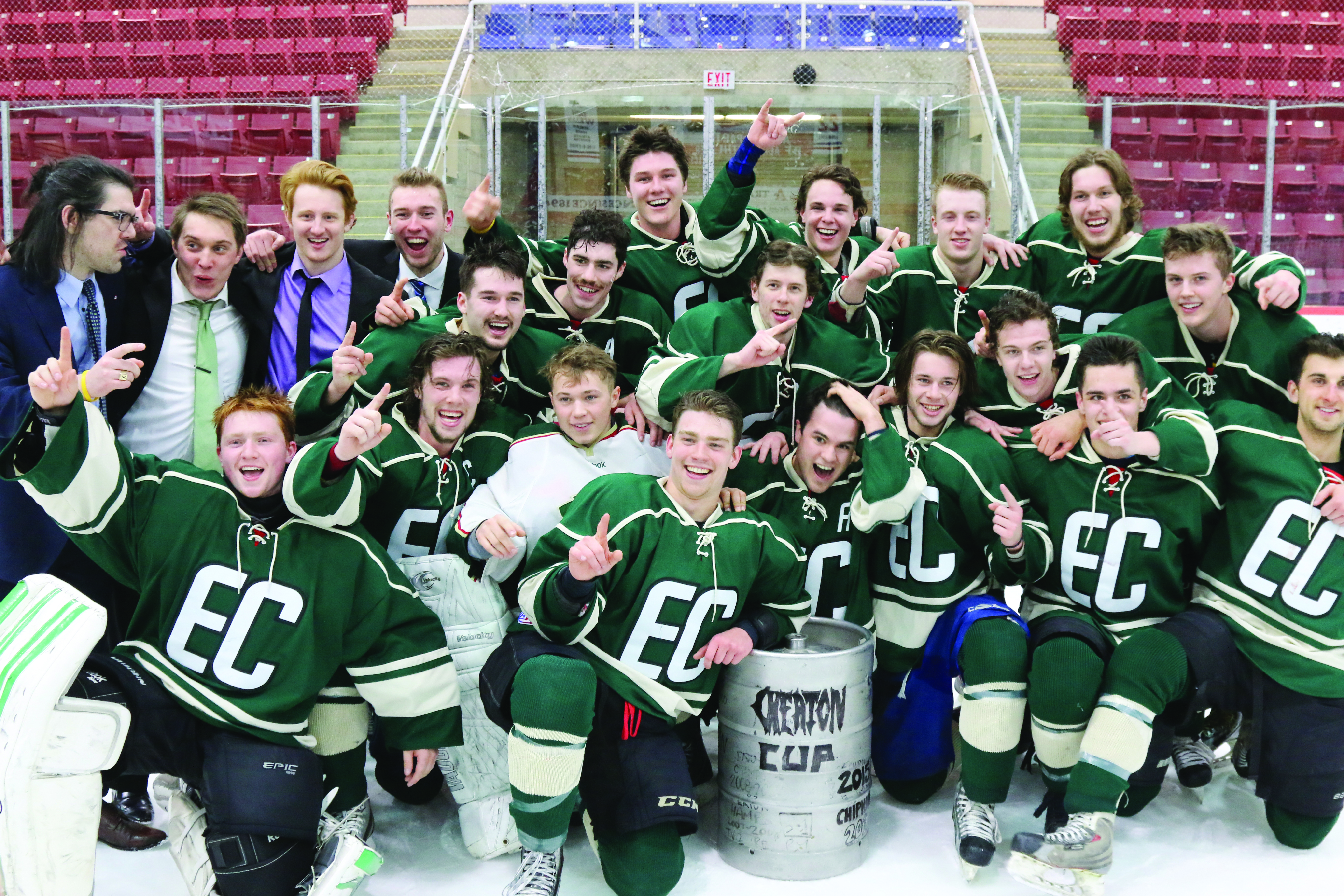
  • The Rise of Cheaton Cup

    The Rise of Cheaton Cup

    This year marks the twentieth anniversary of the ever-so controversial tradition of Cheaton Cup. This annual hockey game expresses the rivalry between two campus residences, Eaton and Chipman. Many people choose to remember this day as one to forget; long-lasting parties, front lawns stained with solo cups, swinging fists over shirt colors, the list goes on. What people don’t remember is the history of the game, the school spirit, the precautions we take to ensure student safety and most importantly, the charitable donations which this game collects year after year. Just as in life, those who want to concentrate on the negatives will always be able to find them. Hopefully, we can look past the few bad apples who bring these negatives too light and focus on the countless positive outcomes of this timeless tradition.

    Since the beginning of time there has been a rivalry between Eaton and Chipman. The on-campus antics which took place between these two houses we’re in good spirits, but commonly taken too far. Out of character for nineteen-year-old boys? I’d say no. Twenty-years ago we we’re at the point where guys would just walk twenty steps to the opposing house just to vandalize it. There would be fights between groups of guys in opposing houses due to a combination of ego and liquid courage. What a poor excuse for house pride, simply stupid. In order to channel this energy a hockey game was proposed. One game, each house handpicks their best team, leave it all on the ice kind of mentality. This game was started by Steve Hassapis who, at the time, was head of both houses. Steve is now the Coordinator of Student Community Development and handles the non-academic judicial process. Most students probably just know him as the guy you do not want to get a letter from. After a conversation with Steve I was able to put in perspective of how far this event has come. The very first game, Cheaton Cup 1996, was a pleasant disaster. With a grand total of three authoritative figures, two referees and an overwhelming amount of students. It ended in an on-ice team brawl which carried through to the crowd, absolute chaos. On a positive note, the event was able to generate around $1000 which went towards feeding those in need, in Wolfiville, in its very first year.

    Since then the transformation has been unbelievable. Incidents at the game itself have diminished entirely. The crowd has been limited to solely Acadia students, and others who personally request to attend. Students stream in from either side of town to support their chosen residence anticipating a good, old-fashion hockey game. The arena is littered with rent-a-cops, yellow jackets, events staff, organizers and representatives from the chosen charities (L’Arche and the SMILE program.) too ensure a safe and controlled event. There have been multiple provisions which have been put in place to promote the positive, healthy environment which the game initially intended.

    We recently had representatives from our Student Union, Ted Higa and Jess Boone, give a presentation outlining four helpful hints for Cheaton-day participants. The ASU is offering free food, half an hour before the game because as many people forget, lack-of-food hurts in drinking situations. It’s a lesson we are trying to teach without the need for experiencing it. Another tip was outlining the pace of the day. Too often we see people get overly excited because they’ve got a beer in their hand before noon and their mother still in another province. The day is not a sprint. It is not a marathon. It is a jog at your own pace, for however long you feel like stretching your legs. The third tip was one which I believe is unbelievably important, and commonly overlooked. We need to watch out for one another. Over-consumption is sketched into the human DNA, and it will happen to those who aren’t careful. So, be a good friend, or a good neighbor at least. If you see someone over-the-top pissed, take them home. Regardless if they admit it at the time, it will be appreciated. Ted and Jess also warned students of the consequences which unfortunately happen time after time again during Cheaton cup. The fines for underage drinking, open liquor, drunk tank experiences and others. In conclusion, they are all expensive and two-hundred percent never worth it. Be smart.

    After looking at all of these ways in which we, the students, can make this an enjoyable, safe and memorable event – you still may be asking yourself, why? I’m going to give my personal reason, hoping that you will appreciate the first hand benefits charitable donations can give. The Sensory Motor Instructional Leadership Experience Program is a free, predominantly student-run organization. A vast amount of their funding every year comes from Cheaton cup. Last year it generated nearly $5000 dollars to split between itself and L’Arche Homefires, a community of homes helping people with disabilities. This year was the first time I became involved in the S.M.I.L.E program as a volunteer. I was fortunate enough to be partnered with my new friend Owen. Owen has cerebral palsy, and has very restricted fine motor movements. During our first day, we were unable to go swimming so we spent the morning in the Snoezelen Room. To my disappointment we had a limited amount of games that he could play.  We got out an ancient, homemade ramp, eight bowling pins, and an assortment of spheres, one bowling ball, one tennis ball and a soccer ball. We took turns rolling the balls down the ramp and celebrating wildly every time we were able to knock some pins down. You knew it was a good throw when you saw Owen’s face light up before the ball even left the ramp. But, the ramp has decayed from its years of service in the SMILE games room, giving us difficulty during every roll. The balls were either deflated or warped. As far as pins go, I guess all eight of them we’re simply perfect. We bowled happily for about twenty minutes, we didn’t even give him the opportunity to get a strike.

    This year, the Twentieth Anniversary of this great hockey game, we hope to generate more money for these local causes. So when we think about this day, let’s try not to focus on the negatives. Forget the parties, the early wakeup, and the trash the next day. Think about where this has come from, what it has become and why we do it. Myself, along with many other students believe that Cheaton Cup is more than just what it is rumored to be. This is an annual opportunity; an opportunity to bond with one another, an opportunity to show our town some maturity, an opportunity to continue this well-intentioned tradition, and for myself – an opportunity to show Owen what a strike feels like. So let’s take advantage of this opportunity and make this year another success and keep Cheaton Cup alive for years to come.

  • Senioritis

    Students who arrive on their first day at Acadia, (or any university for that matter), are likely to experience euphoric feelings of excitement, to unnerving feelings of fear and uncertainty. However, most new students do not arrive at Acadia thinking about their fourth and final year at what is soon to be their favourite place on earth.

    On the contrary, students arrive back at Acadia after the holiday break for their eighth and final semester with the impending shadow of graduation upon them. The final semester is the last four months to spend everyday with life-long friends, and it is the last four months to experience the beautiful town of Wolfville for all that it has to offer, yet it is also one of the most stressful semesters a student will experience during their undergraduate. Students experience high levels of stress from difficult, higher-level courses, from applying to graduate schools, and from applying for employment. Ultimately, students are applying to live in the real world while at the same time, motivations are likely wearing thin. The stress-free lifestyle of living in a small town and attending a small school, with little obligation, is nearly over.

    Seems a little negative doesn’t it? The eighth and final semester of one’s undergraduate degree is also one of the greatest. It is the time to check off items on your bucket list from first year that you never accomplished, it is the time to revisit your first resident and resident assistants, and most importantly it is the time to share your last few moments with those who have made your experience unforgettable. While buying graduation rings, booking graduation photos, and purchasing graduation weekend tickets may seem sad, it is simply a time to reflect back on your experience as an undergraduate student.

    Nevertheless, here are a few ideas for you fourth year students to do during your remaining time at Acadia:

    1. Take in all the scenery the Valley has to offer: Walk to the Dykes, go hike Cape Split and maybe on your way, stop at the look-off.
    2. Visit the Wolfville Farmers Market for breakfast or dinner – do yourself a favour and pick up some fresh apple juice, you won’t regret it.
    3. Take a risk: Sing karaoke at The Axe or go sledding at U-hall.
    4. Get a picture with your friends on the Acadia sign (as appropriate or as inappropriate as you like).
    5. Enjoy a Wolfville pub crawl (why not stop for some Scottskins at Joe’s, Lib Pub Manziers, and Paddy’s Blueberry beer).

Betzillo positions itself as a versatile gaming hub where structured bonuses and adaptive gameplay mechanics support both short sessions and extended play.

Built with a focus on innovation, Spinbit integrates modern casino architecture with rapid transactions, appealing to players who value speed and digital efficiency.

Ripper Casino emphasizes bold entertainment through high-impact slot titles and competitive promotions crafted for risk-oriented players.

A friendly interface and stable performance define Ricky Casino, offering a casual yet reliable environment for a wide spectrum of gaming preferences.

King Billy Casino channels classic casino spirit into a modern platform, delivering recognizable themes supported by contemporary reward systems.

Immersive visuals and layered slot mechanics are at the core of Dragonslots, creating a narrative-driven casino experience.

Lukki Casino appeals to players seeking direct access and minimal friction, focusing on fast loading times and intuitive controls.

Casinonic provides a structured and dependable gaming framework, blending modern slots with transparent operational standards.