Tag: debate

  • Finance Society wins Propylaeum Cup

    Finance Society wins Propylaeum Cup

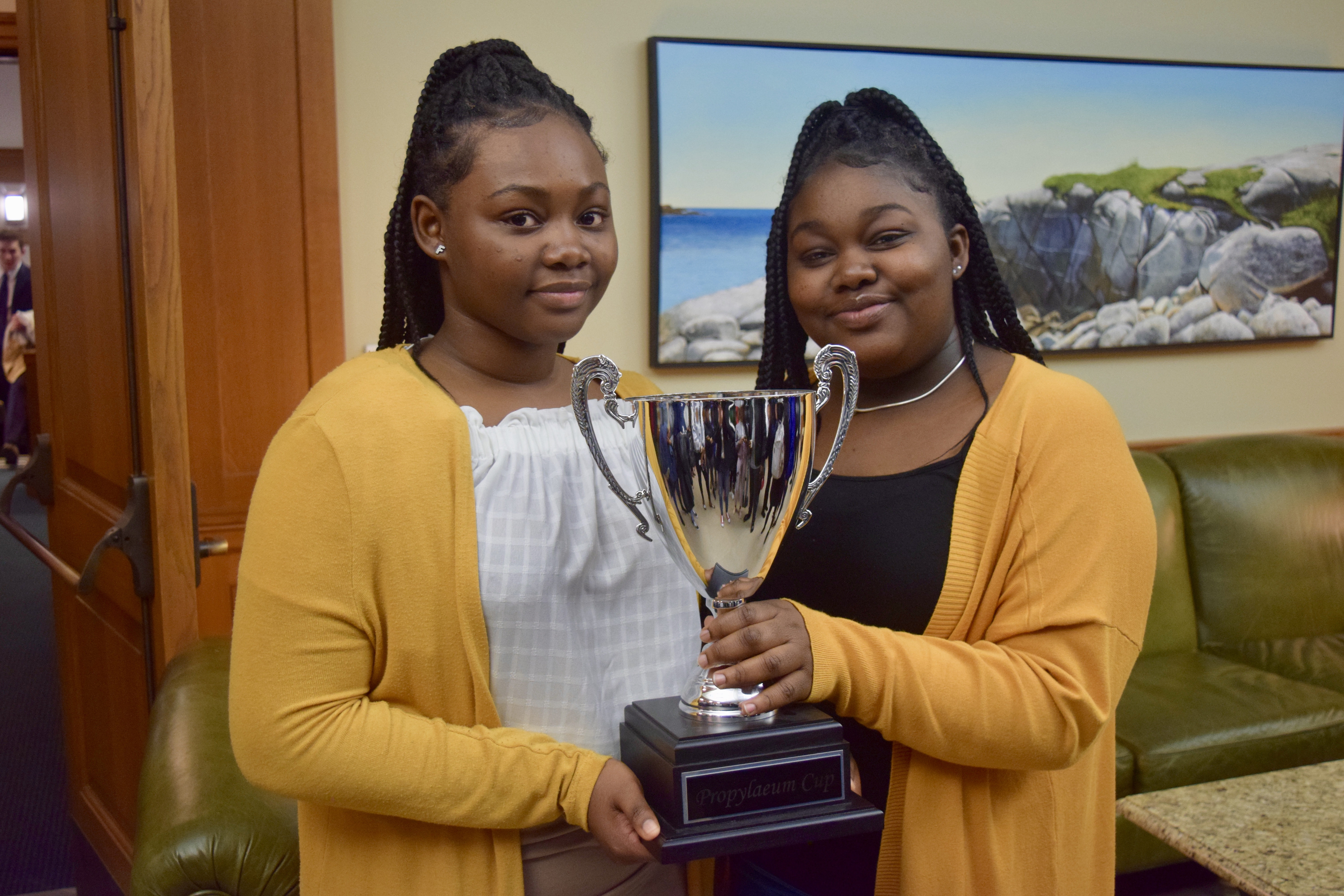
    The Acadia Finance Society has won the second annual Propylaeum Cup debate tournament and $300 cash prize.

    Alexandria Knowles and Faaithe Seymour represented the Acadia Finance Society, progressing through four rounds of debates. The introductory rounds, quarterfinals, and semifinals were judged by a mix of professors and Student Senators, while the final was judged by the House.

    The motion was “This House believes that modern students with an undergraduate degree have more opportunities than their parents generation”, with Finance arguing for the motion and Pre-Law against. Sebastian Farkas and Evan Shergold represented the Pre-Law Society, losing 21-56.

    Finance presented a compelling personal case on how the opportunities for women who had an undergraduate degree had increased in the past few decades while Pre-Law countered with effective statistics about the opportunity value of an undergraduate education.

    Over twelve student societies from across campus were mobilized in late February to begin the debate tournament. Topics ranged from AI would render humanity pointless to if Turks and Caicos should join Canada to Jack and Rose fitting on the door in Titanic.

    “Thank you to everyone who supported us during this well-spirited debate,” Knowles said. “We couldn’t have done it without your support.”

    “I only had a little bit of debate experience,” Seymour laughed. “I’m definitely looking forward to next year- Finance round two!”

    The next Propylaeum Cup debate tournament will begin in February 2020.


  • St FX wins inaugural Great Debate against Acadia

    St FX wins inaugural Great Debate against Acadia

    X Debate, the official debate club of St Francis Xavier University, has won the inaugural Great Debate against Acadia’s Paul Tom Debate Society.

    The motion, “This House supports the use of civil disobedience as a means to achieve political change”, passed with a score of 118-94.

    Acadia hosted the inaugural Great Debate this year. Even years the competition will be hosted in Wolfville, while odd years it will be hosted in Antigonish.

    Acadia, represented by Mackenzie Braden and Ruvimbo Chipazi, argued against the motion citing numerous instances of where civil disobedience led to open revolt, such as in Libya in 2011.

    St FX, represented by Will Fraser and Erin Kinzie, pointed to the success of several civil disobedience movements and cited them as precedent for the ability of collective power to achieve political change.

    “X-Debate was so happy to participate in this event,” Fraser said. “Our entire team enjoyed the opportunity to engage with our historic rivals at Acadia. We look forward to continuing this new tradition!”

    The next Great Debate will be hosted at St FX University in Fall 2019.

  • ASU Elections: What you missed at the By-Election Debate

    ASU Elections: What you missed at the By-Election Debate

    The Acadia Students’ Union Fall By-Election debate, moderated by Chief Returning Officer Sacha Russo and Deputy Chief Returning Officer Evan Shergold, took place in the Michener Lounge on the evening of September 24th, 2018. This debate included candidates for the two positions that are up for election – First Year Officer and Equity Officer.

    Here’s what they had to say:

    First Year Officer

    Kristi Stewart: As a politics student from small town PEI, Stewart spoke to the importance of “being involved, not only in [her] school, but [her] community.” With experience as president of her high school’s student council, Stewart would like to act as the voice of first year students, and to be able to connect them to what they want to do. Stewart believes that three important values of a First Year Officer are open-mindedness, responsibility, and confidence.  One project she is passionate about is a stress relief week, filled with yoga and meditation, to act as an escape from school stress for a little while. She shared that she is excited about every committee that the First Year Officer sits on. If elected, Stewart says that she will strive to make sure first years are involved and connected. More information on her campaign can be found in her candidate writeup here.

    Blake Steeves: Sporting his cowboy boots and ball cap, Steeves, a business major, states that he has not experienced student council before, but he is excited about the opportunities it holds. Steeves believes that three important values of a First Year Officer would be leadership, which he has experience with as the captain of his hockey team, as well a fun-loving personality and confidence. One project that Steeves would be interested in is finding new ways to give money to charities such as S.M.I.L.E. and the Cancer Society through different fundraising events. If elected, Steeves says he is most excited to sit on the Student Life Committee, and three words he would use to describe himself would be fun, reasonable, and enjoyable. If elected, Steeves would like to make this year fun and memorable for all students. More information on his campaign can be found in his candidate writeup here.

    Hunter Murchison-Doggart: As a politics major, Hunter Murchison-Doggart is interested in helping others, and is happy that she has the opportunity to run for First Year Officer. Murchison-Doggart states that leadership, responsibility, and confidence are all necessary for such position, because it is a big deal to represent so many students. When asked about a project she would be interested in, Murchison-Doggart stated that she would like to help expand the Relay for Life, because not all schools have the opportunity to offer that. If elected, Murchison-Doggart would be most interested in the Student Life Committee and creating a school that feels more like a family. Three words she would use to describe herself would be fun, confident, and responsible. Murchison-Doggart states that her goal, if elected, would be to create a sense of community at Acadia. More information on her campaign can be found in her candidate writeup here.

    Chantal Peng: Peng was absent from the Fall By-Election Debate and she has since withdrawn from the race, according to Chief Returning Officer Sacha Russo.

    Equity Officer

    Ruvimbo Chipazi: Third-year psychology major Ruvimbo Chipazi shared that, for most of her life here at Acadia, she lived in her “own little bubble,” until she began working with the University. Chipazi wants to bring underrepresented groups on campus information about the many opportunities around them, and she feels that three essential values of an Equity Officer are empathy, organization, and leadership. One project Chipazi expressed interest in was expanding a cultural exchange night on campus, as well as mental health week. To her, an equitable campus means realizing the difference between equality and equity, and “giving resources to the groups or clubs that need that extra step from the ASU.” Three words she would use to describe herself would be weird, open-minded, and enigmatic. If elected, Chipazi “wants to represent diversity, not just physical diversity…but also diversity when it comes to perspectives, values, ideas, sexual orientation, (and) age.” More information on her campaign can be found in her candidate writeup here.

    Kate Hamre: As a third year Kinesiology major, Kate Hamre shared that she is very active in campus life. Whether it be her house council presidency, membership on the Acadia Kinesiology Society, or one of many other clubs, Hamre states that she has noticed the vast amount of diversity on campus. Hamre cites her interest in connecting people to resources and events that they might not have known about, and three values she thinks are important for an Equity Officer would be approachability, creativeness, and responsibility. One project she would be interested in would be creating an international trivia night for all students. Hamre’s definition of an equitable campus would be one where “everybody feels like they belong and that their voice is heard.” Hamre would describe herself as approachable, positive/happy, and creative. If elected, she would like to make all students across campus feel represented and heard. More information on her campaign can be found in her candidate writeup here.

    Voting for these positions will take place between 8:30 AM on Thursday, September 27th, 2018 and 4:00 PM on Friday, September 28th, 2018. Students can login into Acadia Central at https://central2.acadiau.ca/elections/asu to vote anytime until the close of the polls.


    Ailish Bergin is a second-year Politics major and columnist at The Athenaeum
  • The Speed Date Debates

    On a cold winter’s night at the end of February, four grad students from different faculties sat in a restaurant enjoying drinks and snacks, discussing everything from climate change to emotional labour theory. These conversations became the inspiration for the Acadia Graduate Students (AGS) first annual Speed Date Debates. Our aim for these ‘debates’ are to get students and faculty alike to have a chance to discuss diverse issues with people from different departments. Collectively, Acadia students have a wide breadth knowledge on a variety of subjects; however, opportunities to create a dialogue between different fields of study can be challenging.

    For the majority of the student body, getting together with friends from different departments and faculties and having conversations around your studies may not be particularly difficult. Between on-campus residences, extra-curricular activities, parties, and diverse classroom settings (particularly in first and second year classes), there are many opportunities for undergrad students to meet a multitude of other students. However, for many grad students, particularly those who did not complete their undergrad here, the story is a little different. Many of us feel at times isolated, with social contact at the university limited primarily to other grad and honours students in our own faculties.

    The AGS has been working throughout the year to change this. From various social events to a campus-wide Acadia Student Research and Innovation Conference, the primary aims of the AGS are to offer support to grad students and to enhance the profile of student research and academic engagement. We believe that the Speed Date Debates will offer students an opportunity to meet students outside of their own departments, bring their expertise to the table, and, hopefully, learn from one another in a relaxed environment.

    The event is premised around a hybridization of speed dating and debating, with a few important modifications to both. Like speed dating, participants will be matched with a group of diverse people to have conversations with; unlike speed dating, the goal of this event is not to set up romantic liaisons (though we won’t mind if you walk out of this event with a date either). Like debating, we will provide a series of ideas, events, and concepts for participants to engage and speak on by using their research and knowledge. But unlike debating, there will be no winners nor losers. We want to encourage fun conversation and critical thinking, not competition.

    If you have interest in the event or would like to RSVP, please go to the event at: https://www.facebook.com/events/1464852550212626/. For any questions or concerns, please send me an email at [email protected]. Please contact myself or any of the other AGS Executive team if you would like to recommend a particular debate topic. We invite Grad students, upper year students and faculty alike to join us.

    The Speed Date Debates will be held on April 11th at 7:00 PM at La Torta Pizzeria on 117 Front Street.

  • First American Presidential Debate 2016

    The first US presidential debate took place on Monday evening of September 26th, 2016, featuring a much anticipated and polarized pair of candidates, Donald Trump and Hilary Clinton. Being the first time that Trump and Clinton have taken the stage together in this type of setting, the debate revealed the presidential nominees’ ability to address today’s issues, how they differ from one another, and how their philosophies appear to add up. Both candidates bring a lot to the table. Between taxation, trade, and foreign policy especially, there is a lot to be said about their differences.

    In brief, Clinton advocates a more or less traditional and neoliberal view of these affairs: tax the rich, enhance and facilitate free trade arrangements, maintain strong ties with our allies, and always engage in diplomacy at first instance. Secretary Clinton views the importance of building the middle class, with much of her policy aligning with this outlook. Her education and experience in the political sphere should warrant her much credibility for her plans, being very careful of the political implications of the POTUS’ actions on the national and international level and not suggesting any radical policies that could potentially compromise any number of political or economic institutions.

    Trump sees things differently. Straying from convention, Trump proposes not to tax the upper class, rather provide tax cuts for purposes of encouraging corporate reinvestment in technology, growth and employment. On the trade front, scrap free trade agreements and start taxing foreign entities for trading with the US. And for those who wish to move and produce in China to then sell back to America, they will experience heavy penalization. His stance on foreign policy also possesses an interesting economic perspective: to engage with and support our allies is important, but relationships within organizations like NATO need to be equal, and nations need to provide equal funding toward global efforts. In short: our money is ours, not yours, and we will not be pulling any dead weight anymore.

    Both candidates possess different but valid outlooks on America’s future. It should be granted that Trump does have an understanding in the workings of business, economic imperatives, and the world from a capitalist’s eyeview. Many people find him appealing in this way. For one, the assumption that big business will necessarily reinvest their capital in growth is not ridiculous: in competitive environments it is in fact an imperative to a certain extent. Indeed he is right. Hilary Clinton is also right, however, in the sure bet: tax the wealthy more to ensure services and programs are provided to the public.

    Trump also places heavy emphasis on America making better deals and earning their fair share, which illustrates the thin line that Trump ultimately walks on between the economic and the political. The United States sits near the top of the global economic and political pyramid, but to build a strong global leadership role depends on maintaining and strengthening relationships between states, whether through trade or diplomacy alike. What Trump may ignore in international relations is the major influence that the political sphere can have on a nations economic well-being. Relationships matter. In light of Trump’s views emphasizing the US as the main priority between tax, trade, and foreign policy, his contention on the standing economic relationships between global partners make his foreign policy focus seem merely ‘domestic’.

    Hilary Clinton makes it clear to international partners during the debate that the word of the US is good. Under a Clinton administration, global relationships will be maintained, and the focus will not only be on growing America’s core middle class, but assisting their international partners as well. It is hard to criticize one for this double standard, especially considering where the US fits into the global scene, and it takes much consideration for policy goals to strike a balance between the two.

    However, the American public have been seeing things differently. It seems that post-debate polls indicate no clear winner, many claiming Clinton was the stronger debater, others indicating Trump was the winner. Even after such a determinative event like this, the nation is still divided.


Betzillo positions itself as a versatile gaming hub where structured bonuses and adaptive gameplay mechanics support both short sessions and extended play.

Built with a focus on innovation, Spinbit integrates modern casino architecture with rapid transactions, appealing to players who value speed and digital efficiency.

Ripper Casino emphasizes bold entertainment through high-impact slot titles and competitive promotions crafted for risk-oriented players.

A friendly interface and stable performance define Ricky Casino, offering a casual yet reliable environment for a wide spectrum of gaming preferences.

King Billy Casino channels classic casino spirit into a modern platform, delivering recognizable themes supported by contemporary reward systems.

Immersive visuals and layered slot mechanics are at the core of Dragonslots, creating a narrative-driven casino experience.

Lukki Casino appeals to players seeking direct access and minimal friction, focusing on fast loading times and intuitive controls.

Casinonic provides a structured and dependable gaming framework, blending modern slots with transparent operational standards.