Tag: ASU

  • SRC Decoded: What You Missed January 15th

    SRC Decoded: What You Missed January 15th

    The Students’ Representative Council (SRC) is a council composed of a body of students elected by their peers, who are in charge of running the Acadia Students’ Union. The Council meets bi-weekly on Tuesdays at 5:15 PM in the Beveridge Forum which is located off of the Michener Lounge in the old Students’ Union Building (SUB). Every meeting is open to the public and students are encouraged to attend the meetings to learn more about the decisions being made on their behalf.

    On January 15th Council met to discuss the upcoming general and by-election, Acadia University tuition increase, and the resignation of Alyssa Hall. Mackenzie Branch, VP Academic and External, informed Council of the University Senate’s decision to change the GPA grading system as well as changes to the upcoming academic calendars. Numerous announcements were also made by George Philp, ASU President.

    Upcoming General and By-elections

    Sacha Russo, Chief Returning Officer, has called both a general and by-election. Based on Bylaw 3 which discusses SRC elections, positions that will be elected in the general election include: President, Vice President Academic & External, Vice President Events & Promotions, Vice President Finance & Operations, Vice President Student Life, and other non-executive positions. The nomination period will take place between January 22nd and February 1st with a mandatory all-candidates meeting on the following Monday. The voting period will last from February 10th – February 14th. There will be multiple polling stations set up around campus with the results sent out shortly after by email.

    Acadia University Tuition Increase

    The majority of today’s meeting was spent on a discussion regarding Acadia’s proposed tuition increase. As per the tuition consultation agreement between Acadia University and the ASU, a schedule of fees for the 2019/20 fiscal year must be sent from the University to the SRC where the fees will be discussed and sent back to the University.

    The University is proposing a domestic and international tuition increase by 2-3%, most fees will stay at their current level. The income that goes towards the university from tuition will remain at 54% with the tuition increase in effect. The increase in tuition will go towards the Music Therapy practicum and English as a Second Language program. President George Philp noted that it is unlikely that the University will back off of the 2-3% tuition increase. President Philp noted he would like to see the University’s Equity Officer position increased from a two-day role to a three day a week job, an African Descent Student Advisor be hired, another person to be hired in Acadia Residence life, a full time position for a health and wellness educator, and probation fees to be waived from this tuition increase. Philp proposed that the SRC will support the 2-3% increase given that the University completes 3 of their 6 demands in the upcoming 2019-2020 fiscal year. The motion was unanimously accepted by Council.

    Councillor Resignation

    On January 10th Councillor Alyssa Hall announced her resignation effective immediately. The SRC briefly discussed Hall’s resignation and unanimously agreed to accept the resignation. An election, discussed earlier, has already been called in order to fill her position.

    University Senate Updates

    VP Academic and External Mackenzie Branch announced to Council that the University Senate has announced that the timetable has now been planned out on a four-year planning process. Students can now view the yearly schedules up to four years in advance. Last semester, a survey was sent out to the student body questioning what kind of fall study break students prefer. Based on the survey a reading week that does not fall on thanksgiving Monday or Remembrance Day will be included in each fall semester shown on the four-year timetables.

    The Senate also decided to change the grading system from a 4.0 GPA system to a 4.3 GPA system in effect for the 2019/20 fiscal year. The grades previously earned by students will not change to suit the new 4.3 GPA system and students who have grades under the 4.0 and 4.3 systems will be averaged regarding cumulative GPA at the end of their four/five years. Institutions receiving students’ transcripts will be made aware of the discrepancy.

    Announcements

    President George Philp announced that an election panel will be taking place Wednesday January 16th from 5:00-6:00pm. It will be Q&A based where students will have an opportunity to ask current SRC members questions about their positions. Students are encouraged to come, participate and learn more.

    Club Extravaganza Round 2 will take place a week from today on January 22nd 4:00-7:00pm. Club Extravaganza is recommended for any incoming or returning students looking to join a new club or find a hobby on the main level of the SUB.

    The Campaign for mental health will be outside the Vaughan Memorial Library from January 30th – February 1st 10:00am-4:00pm every day. The campaign is to promote equal mental health support and will take place on 20 campuses across this country.

    Rylie Moscato is a first year English student and Columnist for The Athenaeum

  • Councillor Alyssa Hall Resigns

    Councillor Alyssa Hall Resigns

    Alyssa Hall, Councillor on the Students’ Representative Council has resigned from her position effective on January 10th, 2019.

    In a statement, ASU President George Philp noted that “On behalf of the ASU Executive I would like to thank Alyssa for her contribution to the Acadia Students’ Union”.

    ASU Chief Returning Officer Sacha Russo has been notified of Hall’s resignation and a by-election will be called no later than February 9th, 2019 to fill the vacancy. Hall’s position as Councillor will remain vacant for the time being.

    President George Philp added that “Alyssa has championed many important causes including sexual violence prevention, throughout her year and a half serving on council, and our campus is better because of it. We wish Alyssa all the best in her future endeavours.”

    Rylie Moscato is a first year English student and Columnist for The Athenaeum

  • SRC Decoded: What You Missed December 4th

    SRC Decoded: What You Missed December 4th

    The Students’ Representative Council (SRC) is the body of students who are elected by their peers to run the Acadia Students’ Union. Council meets bi-weekly on Tuesdays at 5:15 PM in the Beveridge Forum which is located off of the Michener Lounge in the Students’ Union Building (SUB). All of their meetings are open to the public and students are encouraged to attend to learn more about their representatives and the decisions that are being made on their behalf.

    Council met on December 4th to discuss the financial update as of November 30th, to vote on the new bylaws and to discuss the creation of an ad-hoc committee. Council also received a project proposal from Blake Steeves, First Year Officer. George Philp, ASU President, presented changes to co-op student membership of the Union, and Makenzie Branch, VP Academic and External, informed council of her involvement in CASA. The meeting received a large audience turnout, composed of students and Town of Wolfville Mayor Jeff Cantwell.

    Financial Update

    Jared Craig, VP Finance and Operations, presented the ASU’s financial update for the last fiscal year (April to November). While most services were operating at an expected net income loss, such as the Info Desk and the Union Market, there were a few areas that saw a loss greater than anticipated. Bar services saw a profit of $26,277, which Craig attributes in part to the bar ban that took place at the beginning of the school year. Perkins was also an area of concern, with a net income loss of $8,234. Overall, Craig states that the Union is pleased with Cajuns, the Info Desk, and the Union Market.

    By-Law Discussion and Voting

    The Council spent a fair portion of the meeting discussing the new bylaws, which are a result of an extensive $10,000 dollar review. The Council was informed by Molly Anderson, in her role as Chair of the Governance Committee, of the creation of an ad-hoc committee, that will consist of either the Chairperson or Deputy Chairperson, four non-executive council members, and two regular union members (i.e. students). Councillor Chis Vanderburgh expressed his disappointment with the decision to move forward with voting, and Arts Senator Katie Winters defended this decision, stating that the creation of the committee would result in more extensive research into these issues. Following these discussions, all three By-laws were moved to be accepted as is, bylaw 1 (Council Positions) and Bylaw 2 (ASU Committees) come into effect of May 1st, 2019 and Bylaw 3 (Elections, Referendum, and Plebiscite) come into effect immediately.

    Ad-hoc Committee

    An Ad-hoc committee was created specifically to conduct research and consult with students about the controversial changes made in the by-law review, which removed the petition process, and the process of impeachment by constituents. This committee will be composed on the Chairperson, four non-executive members of council, and two regular members of the union. Dahlia Chahine, Student Board of Governors Representative, motioned to amend this committees’ terms of reference to include three regular constituents instead of two to enhance student involvement. This motion was passed unanimously, and Council also decided to include a mandatory progress report, to be presented to Council at the first meeting in March of next semester in hopes of keeping students engaged and ensure that progress is being made. Council then appointed Molly Anderson as Chair of the committee, as well as Chris Vanderburgh, Katie Winters, Zach Goldsmith, and Dahlia Chahine to fill the four council member positions.

    Co-op Student Membership

    George Philp informed council that in the past, co-op students have not been considered members of the ASU, despite their enrolment in one course during their work terms. Philp noted that the University still considers them students, and therefore motioned that the ASU also “interpret” them as students. This would mean that co-op students would be changed the part time membership fee of $10.30 per work term. This would ensure that these students can vote, sit on Council, and access student services offered by the ASU. Philp notes that he has consulted with the co-op office on this issue, and states that they support this change. The motion was unanimously accepted by council.

    Canadian Alliance of Student Associations (CASA)

    VP Academic and External Makenzie Branch informed Council that over the break, George Philp and herself attended meetings in Ottawa to discuss the current focuses of  CASA. The Canadian Alliance of Student Associations is a federal advocacy group, which represents over 350,000 students across Canada. Branch listed the main issues that this organization is advocating for this year, which is the improvement of Study Permits for international students, as well as recommendation that Canadian post secondary institutions be allowed to assist students with immigration consultation. The organization is also focusing on increasing funding for work integrated learning, since current funding is mostly going towards STEM students. Brach was admirably passionate about the group’s involvement in Sexual Violence Prevention. The organization is hoping to instate a minimum requirement for post secondary institutions to provide resources for victims of sexual violence. CASA’s other main focuses revolve around student research, which would increase the amount of funding that goes directly towards students, as well as changes that would allow graduate students to apply for grants.

    Project Proposal

    First Year Officer Blake Steeves proposed a “Last Class Movie Night” which will be taking place in the KCIC, on Dec 5th at 7:30pm. They will be screening the 2011 version of Footloose, and Steeves states that this event is a “Last Class Bash” for people who aren’t in the mood for the bar scene, are underage like himself, or are die hard Footloose fans.

    Announcements

    George Philp made several announcements to Council, the first of which being that a request has been put out for food service providers. Prospective companies will be coming in to tour the facilities before the break and will hopefully put in bids. Also, Philp announced a new policy, approved by the President’s Advisory Council, which allows students to change all university documents to show the name they prefer. This is a monumental change for students whose given name is not the one which they choose to go by. Finally, Philp announced that the budget advisory process for the university has begun, and there is talk of a 3% tuition increase. Philp states that Council will be highly involved in this process.

    Following these announcements, Molly Anderson announced that there will be an event on Dec 6th at 4:30, for the Nation Day of Remembrance and Action on Violence against Women.

    Town of Wolfville Mayor Jeff Cantwell also announced that on New Years Eve, there will be several events going on around town to ring in the new year, including a free brunch provided by local businesses and chefs! Cantwell encourages any students who will be around to join in on the festivities.

    Ailish Bergin is a second year Politics student and Columnist for The Athenaeum

  • Fact Checking the ASU Bylaw Review

    Fact Checking the ASU Bylaw Review

    Today, the Acadia Students’ Union (ASU) issued a media release and video to explain some of the proposed by-law changes that will be coming forward for adoption on December 4th, 2018, in response to recent public criticism from students. The release and video are available on the ASU website here.

    The Athenaeum strives to provide accurate and timely information on current events that matter to students. As such, with the bylaw review coming to a close, this article will outline the key messages shared in the video, what they mean for students and what their implications will be moving forward.

    Overall, it appears that most of the claims in the video are factually accurate, but many are misleading to students who do not have a solid understanding of how the ASU operates and how governance documents are used in everyday business.

    Key Message No. 1

    The By-Law Review works to “ensure that our organization’s practices align with its values of integrity, respect and inclusion” (0:15).

    Fact Check Rating: Mostly True but Misleading

    The By-Law Review is a comprehensive review of all governing documents and was launched in March 2018 with two main ideas: increase diversity on Council and eliminate vagueness, redundancy and contradictory language.

    In terms of integrity, the draft by-laws present a strong foundation for increasing the accountability of student representatives to Council, with new regulation around Council meeting attendance, and Committee and Executive reporting at Council meetings. However, the draft by-laws also remove the ability for regular students to impeach their Members of Council in the future. The impeachment provisions currently provide for the ability of students to submit a petition signed by 35% of the constituents of the Member of Council which would trigger a General Meeting where 25% of the student body must be present. The removal of this provision means that Members of Council can only be removed if other Members of Council move to impeach them. This provision has been used in the past with Vice Presidents being impeached in the early 2000s.

    In terms of respect, the draft by-laws establish vague yet promising election rules and regulations that promote respect amongst candidates (Rules of Fair Play and Community Standards); however, these rules can be interpreted in different ways depending on the opinions of the Elections Committee.

    Finally, in terms of inclusion, there does not appear to be any significant progress towards making the Acadia Students’ Union any more inclusive of marginalized people and groups on campus. The Diversity and Inclusion Representative (currently the Equity Officer) will be hired, rather than elected; however, it is not clear how this would increase the overall diversity of Council. One claim made by the media release that the Diversity and Inclusion Representative would be hired by a committee with “at least two of its members to identify with one or more of the four groups identified in the (Canadian Employment Equity) Act” is not reflected in the raft by-laws. Section 12 of Bylaw 2 (Committees) which discusses the composition of the Hiring Committee does not include this requirement.

    Key Message No. 2

    The Bylaw Review will allow the Students’ Representative Council to “function effectively and address important student issues” (0:22).

    Fact Check Rating: Neutral

    While it has been proven in numerous studies that organizations can be more effective with fewer Board members, it remains to be explained why reducing the number of student representatives would be better for the student body. Over the past fifty years, the Students’ Representative Council has functioned effectively and addressed issues that are important to students with both large and small numbers of voting members. While this claim is in theory true, it is unclear how this would affect regular students.

    Key Message No. 3

    The By-Law Review will “establish a more diverse and inclusive Council and a Diversity and Inclusion Committee to ensure that the voices of all students are heard” (0:30).

    Fact Check Rating: Mostly False

    On the first element of this key message, the By-Law Review fails to establish clear measures that would increase diversity on Council, other than mandating that the hired Diversity and Inclusion Representative self-identify as female, a visual minority, Indigenous, and/or a person with disabilities. There have been no discussions or consultations that have been widely attended by individuals who fall into these groups nor do the proposed changes encourage persons from marginalized groups to run for the remaining fifteen (15) Members of Council.

    On the second element of this key message, the By-Law Review does rename the existing Campus Representation Committee to be the proposed Diversity and Inclusion Committee and adds the ASU President and the Coordinator of the Acadia Mental Health Initiative (AMHI) as members of the committee. However, the existing committee (Campus Representation Committee) has been one of the least effective ASU committees over the last couple of years and it has been widely regarded as having failed in achieving its mandate. The committee has typically met between two (2) and five (5) times per academic year (September to April) and most discussions include upcoming events being planned by the Internal Organizations that sit on the committee. There have been no appointments of additional individuals onto this committee in recent years and there has been minimal outreach to marginalized populations. This committee has not been effective at ensuring that all student voices are heard in the past and it is unlikely that a name change and the addition of new members will change that fact in the long-term.

    Key Message No. 4

    The By-Law Review would create “new guidelines and meeting attendance requirements for Members of Council to hold your elected representatives accountable” (0:36).

    Fact Check Rating: True

    The By-Law Review does create clear expectations for Members of Council to attend Council meetings. However, these guidelines have existed informally in the past. They are not new, but the key change is that the ability to excuse a Member of Council is made by Council, rather than the Chairperson who could do so historically.

    However, this directly contradicts the impeachment provisions which still state that a Member of Council may be impeached, at Council’s discretion, for missing two (2) consecutive meetings or a cumulative total of four (4) meetings throughout the year “without providing written notification to the Chairperson twenty-four (24) hours in advance”.

    Key Message No. 5

    The By-Law Review would increase” the number of voting days in the ASU (General) election from two (2) to five (5) to maximize voter turnout” (0:43).

    Fact Check Rating: Mostly True

    The draft by-laws do extend the number of voting days to five (5) consecutive days; however, the entire campaign period is shortened to ten (10) days total, including voting days. Therefore, students will have ten (10) days to learn about their candidates, attend meetings and events surrounding the election and to decide whom they will support. Additionally, the draft by-laws remove any reference to what happens in the case of a “snow day” (campus closure) and it is presumed that the election would follow its original schedule. In the 2017 General Election, there were two full-day campus closures due to inclement weather and voting was extended accordingly. This change may increase voter turnout but this is not conclusive.

    Key Message No. 6

    The By-Law Review would add “more areas for candidates to campaign to better facilitate student engagement in ASU Elections” (0:47)

    Fact Check Rating: True

    The draft by-laws seek to allow more campaigning in areas where campaigning is currently prohibited. These areas include the Axe Bar and Grill (formerly the Axe Lounge), the first floor of the Library, at ASU, Club, Internal Organization or House Council events (with permission of the host).

    Key Message No. 7

    “We’ve already been consulting with students” (1:08) and “In fact, never has our union spent so much time listening and building governing documents that are truly reflective of the organizations mission statement” (ASU Release)

    Fact Check Rating: True but Misleading

    The Acadia Students’ Union committed to holding student consultations in March 2018 that would tackle the major issues of diversity on Council and the Council composition. In total, three consultations were held – two in April 2018 and one in November 2018 – with a handful of students attending. The first two consultations meetings were largely attended by Members of Council (outgoing and incoming). Since then, these documents were developed by the Executive Team and Members of Council before being released a few hours before the final student consultation. At this last consultation, six (6) regular students and several Members of Council were present to hear about the proposed changes and to provide feedback on the proposal. Only feedback that the presenter agreed with was recorded. The final consultation appeared to be more of an information session to those regular students in attendance as their ideas and suggestions were not taken seriously by the presenters.

    Oliver Jacob is a third year History and Politics student and News Editor of The Athenaeum and former Chairperson of SRC

  • SRC Decoded: What You Missed November 20th

    SRC Decoded: What You Missed November 20th

    The Students’ Representative Council (SRC) is the body of students who are elected by their peers to run the Acadia Students’ Union. Council meets bi-weekly on Tuesdays at 5:15 PM in the Beveridge Forum which is located off of the Michener Lounge in the Students’ Union Building (SUB). All of their meetings are open to the public and students are encouraged to attend to learn more about their representatives and the decisions that are being made on their behalf.

    Mayor of Wolfville Speaks to Council

    Mayor Jeff Cantwell had a brief discussion with Council, primarily to acknowledge the difficulty of conducting of a by-law review and to acknowledge the hard work put in by ASU President, George Philp, along with the rest of the SRC. Cantwell mentioned the current petition in favour of implementing a Kings Transit U-Pass, which would provide students with unlimited use of enhanced Kings Transit services for $20 per month per student. With this suggestion, ASU President George Philp laughed and stated that “it never goes away”. Cantwell concluded his talk by encouraging everyone to contact the Town of Wolfville and Town Council Members with any comments, questions and/or concerns. He also shared that the Town has a wide variety of staff and programming that can provide quick and easy answers for students and community members alike.

    Students Nova Scotia

    Tristan Bray, Executive Director of Students Nova Scotia, and Makenzie Branch, VP Academic and External and one of Acadia’s representatives to SNS, shared information Founded in 2003, Students Nova Scotia is a member-driven non-profit organization that represents over 20,000 students across the province. The organization aims to identify and research student issues, come up with solutions, and lobby the provincial government to seek better learning environments and supports for post-secondary students across the province. Their four main pillars are accessibility, affordability, quality, and student voice and these values guide the organization throughout its decision-making process. The current priorities of the organization including student financial aid, health care for international students, sexual violence prevention and promotion, increased mental health supports, and increased student employment opportunities.

    Project Proposals

    With the semester coming to a close, several council members brought forward their project proposals to be accepted by council. The first was from VP Finance and Operations, Jared Craig, who proposed a financial literacy event that will teach students about budgeting, credit card use, student loans, debt, etc. This will be taking place on Thursday, November 22, 2018 at 5:00 PM in the Michener Lounge and will be facilitated by representatives from Enactus Acadia.

    The second proposal was by Theology Senator, Zachary Goldsmith, who proposed the promotion of Chapel Lunch on Wednesday, November 21st, 2018, which takes place from 11:30 AM-12:15 PM the Acadia Divinity College.

    Student Board of Governors Representative Dahlia Chahine proposed a semester re-cap, which will go over the main events that have taken place so far this year. It will be a document which will be circulated around to students, to be completed by the end of the semester.

    Councillor Alyssa Hall proposed putting condom containers in the bathrooms of The Axe, which will run for a two-week trial period.

    Arts Senator Katie Winters and Councillor Sebastian Farkas are planning a career building event primarily directed towards Arts students. There will be professionals available to review cover letters and resumes, help with interview preparation skills and take professional headshots for participants. It will take place on Monday, November 26th, 2018 from 4:30 PM to 6:00 PM in BAC 138.

    Professional Studies Senator Amar Randhawa proposed a student meet-and-greet at the Axe Bar & Grill on either November 26th or 27th, 2018 from 5:00 PM to 7:00 PM. The goal is to allows students from all faculties to build relationships with one another.

    Science Senator Mackenzie Jarvin will be bringing in therapy dogs from St. John’s Ambulance. It will be taking place on December 3rd in the MacKeen Room, from 4:30 PM to 7:30PM.

    Sustainability Officer Hannah Machat will be organizing a workshop involving “The Tare Shop,” which is a waste free shop in Halifax, NS. Kate Peppler, owner of the shop, will be present at the event, and the goal is to teach students about plastic free initiatives that focus on a waste-free holiday season.  It will be taking place on December 1st, 2018 from 2:00 PM to 4:00 PM at the Wolfville Farmers Market or the SUB.

    Equity Officer, Kate Hamre, will be showing “The Hunting Ground”, a sexual violence film series, followed by a discussion period. It will take place in the KCIC Auditorium on November 26th, 2018 at 6:00 PM.

    All events will be promoted through Acadia Students Union social media with location and dates/times to be confirmed in the near future.

    By-Law Overview

    The majority of the meeting consisted of discussion with ASU lawyer, Tom MacEwen, about the current By-Law Review and the draft by-laws. For a full overview of the proposed changes, check out the ASU website.

    For the most part, MacEwen provided his rationale behind each change in the proposed by-laws. Discussion ensued with several Members of Council expressing their displeasure with proposed changes that remove the petition process for referenda and impeachment of Council members by their constituents. MacEwen stated that the decision was made to prohibit the potential logistical issues that may come with vague referenda questions. An example that was given was the Kings Transit U-Pass Program, which, if passed, will require the Acadia Students’ Union to set up a new student fee, collect fees from students and remit these fees to Kings Transit.

    Councillor Chris Vanderburgh contested the removal of the process stating, “you don’t set up a framework for democracy because it is easy, you do it because it is right.” Students who attended the meeting, Ruvimbo Chipazi and Kyle Thompson-Clement (Arts and Culture and Opinions Editors of The Athenaeum, respectively) also raised concerns with this decision. Chipazi pointed out that, even though most Council members are elected, only roughly 35% of the student body votes, so the Council may not reflect the true wishes of the student body. Thompson-Clement stated the possibility of a future Council being complicit, thereby reducing the opportunity for impeachment. MacEwen raised the point that if enough students are willing to get together to complete the process of impeachment by petition, it is likely that they should be able to convince at least one Council member to bring it forward instead. The discussion concluded with ASU President George Philp motioning to send this issue to the ASU Governance Committee to review and consult with students.

    Council adjourned without completing the entire overview of all by-laws, which will continue on Tuesday, December 4th, 2018 at 5:15 PM. The proposed bylaws will be considered for adoption at this same meeting after being introduced on notice of motion at this meeting.

    Ailish Bergin is a second year Politics student and Columnist for The Athenaeum.

  • Should They Take my Political Rights? Yes or No?

    Should They Take my Political Rights? Yes or No?

    Look, I wouldn’t blatantly say it’s a power grab. But, at the same time, I can’t say it’s not. It’s either a power-grab or the people who we’ve elected to represent us don’t understand how centralizing power strips Acadia students of political agency.  All the buzz around the Acadia Students’ Union (ASU) is surrounding their proposed amendments to the bylaws. By and large I’m fine with the majority of these changes.

    However, the proposed changes to By-law 4, specifically that “the proposal would allow only Council-initiated referenda” are out of touch with the ASU’s mandate which “advocates for the rights of the students of Acadia within our university, within the Wolfville and Valley communities, and to the provincial and federal governments.” Instead, the proposed changes would require students to submit a question to the SRC first and require them to vote in favour of posing the referendum question to the student body. In English, this means that students would have no way of having their desires voted on by the student body at large if Council didn’t approve.

    Let’s play out a fictitious scenario to describe how big of a power move this is. Don’t like fair trade coffee on campus? Do you think at least half of the students on campus agree with you? As it currently stands, a student who answered yes to one or both of those questions could circulate a paper petition to collect enough signatures to trigger what’s called a referendum question. Essentially, this means that at some point the ASU will put this question to a vote for the student body to decide whether they agree with the petition or not. In the case that the majority of students vote yes, the ASU would have to attempt to realize whatever result comes from the referendum. The process of having student-initiated referendum questions allows students to participate more directly in student politics.

    “Now, Kyle, you sit here telling me that removing this ability from the hands of students may not be a big deal since the ASU is supposed to serve us anyway. Why, then, is submitting the question to them first such a big deal? Surely, our council cares about students and will do what’s in students’ best interest.” While well-intentioned, this sentiment assumes that the ASU both knows exactly what the student body wants at all times (this is very hard to do, even at a small institution), and more importantly it suggests that the ASU will always work with students rather than against them.

    Remember that fair trade coffee example? Well, after the proposed changes, a student would not be able to trigger a referendum question with a petition without the approval of the ASU. Here’s the thing though: there is no guarantee that the ASU will recognize the petition as an important student issue. Accordingly, the ASU could basically say “you know what, we don’t really want to ask this question because we don’t think it’s our responsibility.” They could choose to completely ignore the wishes of students who have collected enough support over an issue simply because they don’t want to.

    I don’t think words could describe how dangerous the precedent set by these changes is. Limiting students’ abilities to access the SRC (which is already confusing and tough to navigate as a student) is dramatically out of step with ASU values. It makes no sense for a student union that claims to be advocating for student rights  to continue to support proposed amendments that at best limit students’ ability to access the ASU, and at worst set the precedent for the ASU to limit students’ political power, and consolidate it within their own ranks.

    After repeated requests for comment, I was able to sit down on the record for an interview with ASU Councillor Christopher Vanderburgh. Christopher immediately made it clear that “he was there solely in his capacity as a Councillor within the students’ union, and that any of the proceeding statements are not endorsed by the students’ union.” Christopher believes “it’s important for students to hear observations from those who are well-acquainted with ASU procedures regarding the proposed Bylaw changes; specifically Bylaw 4.” He adds that “a referendum is a yes or no question that is proposed when we vote. As an example: should fair trade coffee be sold on campus? Yes or no?” Based on this answer- since the ASU’s mandate is to serve students- they would have to execute policy to fulfill the desires of students.

    When asked if he thinks the ability for students to submit petitions could actually see meaningful change on campus he said “[the ability for students to petition for referendum questions] is an excellent tool for students to ensure that their goals are being met by the union.” When asked for a real-world example of this, Christopher mentioned a referendum question that was added to the ballot which asked if students would accept additional students fees every year to support the renovation of the Axe Lounge. However, he notes that “that question was brought forward by the union itself.” Nonetheless, a referendum was used to gauge student support for something that affects a large portion of the student body.

    When asked about the proposed change to Bylaw 4 and what this means for student accessibility to the union Christopher stated ”you wouldn’t lose your ability to have a referendum. What you would lose, is your ability as a student to have a petition signed by the required amount of signatures … to initiate a referendum question. Instead, students would have to bring this petition forward in front of a general meeting of council.” He continued to explain “what makes that more difficult, whether or a referendum would happen (to his understanding), it would have to be at the behest of the ASU.”

    Further, he explains that “if you want to see a big change at Acadia, and you want to see the ASU get behind it in a big way, that is how you operationalize it.” Finally, Christopher gave the following warning: “Make no mistake, this is damaging to the union, and this is damaging to the way students operate within the union.” He continued to explain “the ASU brought up a number of concerns, regarding how the Bylaw stands now. The theory is if a student wanted to do something drastically difficult, and they got the petition through and the referendum passed [student votes totalled a majority] the ASU would have to support the results regardless of what it is.”

    Christopher continued to explain “if students were able to successfully collect signatures on a petition, and if the following referendum results yielded a majority, IT IS THE ASU’s JOB TO DO THAT”. Further, he notes that ‘this is the case regardless of the logistical challenges that come with that responsibility.” Christopher concluded that “he thinks the ASU does a lot for students … and that he believes the ASU has put a lot of work into amending the bylaws.” But he adds that he thinks “proposed changes to Bylaw 4 are damaging to student rights within the framework of the union, and they are damaging to the democratic processes within it.” 

    When governments, unions, or businesses limit power to only a few sources it drastically increases the ability for such regulations to be abused. This especially happens with older traditions, or procedures that are deemed as morally good or the way it’s always been. If this isn’t a power-grab from the ASU, they are seriously naive and complacent of the danger such amendments would have for the democratic structure/processes of the ASU.

    Kyle Thompson-Clement is a fifth year politics major, the Opinions Editor of The Athenaeum, and Vice-President of the Acadia Model United Nations Association.

  • Editorial: Bylaw Revisions are Undemocratic

    Editorial: Bylaw Revisions are Undemocratic

    The Acadia Students’ Union recently released the revised bylaws to be voted upon in the next few weeks. These come after last year’s General Election which nearly caused a constitutional crisis and led to the resignation of the Chief Returning Officer. There is no doubt that the bylaws needed to be overhauled to ensure the stability of the Union and to ensure that the ASU lives up to its mission statement– serving its members through effective representation and communication, offering innovative services to enhance the student experience at Acadia.

    Revisions to these bylaws have come after the Students’ Representative Council (SRC) approved a $10,000 payment from the Wellness Fund to the ASU lawyer Tom MacEwan to assist in the redrafting. Numerous consultations occurred in the last academic year and during this academic year to provide students the opportunity to voice their concerns.

    The changes include:

    Three non-executive positions– the Student Board of Governors Representative and two Councillors- have been axed while the number of Executive positions has stayed the same. These positions had been considered redundant by some, but the proposed structure would give the Executive a greater share of the SRC to influence votes and major decisions.

    Students can no longer initiate referenda by petition under the new bylaws. Only referenda approved by the SRC can be put on the ballot rather than those initiated by the students they represent. Under the current bylaws students can initiate referenda with a petition holding signatures from 10% of the student body. Even under federal law a petition can be presented in the House of Commons if it has 500 signatures. In the UK 100,000 signatures are necessary for a debate by Parliament.

    An international student representative is still missing. Despite the fact that almost 15% of Acadia is composed of international students there is still no formal representative on SRC to represent them. The Diversity and Inclusion Representative is a step in the right direction, but a dedicated international student representative is still necessary.

    The SUB Renewal Committee is gone. Last year’s SRC passed a resolution that created a standing committee with the task of ensuring that the renewal of the Students’ Union Building is directed by students for students. The new bylaws propose to axe the committee, presumably leaving the power to decide how the building is shaped in the hands of the Executive or to the university and their donors.

    Powers of the Chief Returning Officer to conduct independent elections are reduced. In their stead, an Elections Committee composed of Council members has more authority than in previous years. In a perfect world the Chief Returning Officer would have the authority to conduct elections independent of the SRC to ensure that current members of Council do not sway decisions to ensure their friends win. We understand the need for a committee to exist, since the CRO cannot do it by themselves, but an ASU committee with interested Council members is problematic.

    Union Media has no power to endorse candidates or positions. The principle of a free and independent press is one that is not practiced during election periods within the ASU. The Athenaeum has no power to endorse candidates with sensible policies nor sides in referenda that could influence the course of the ASU for years to come. In fact, we are one of the only student newspapers in Canada to not have the power to endorse our own positions during election times. We are instead bound by the ASU to solely report the happenings of the election period but not share our voice during the election.

    Constituents cannot impeach their representatives. This was a feature of the former bylaws where students could impeach their representatives if first 35% of their constituents were present. It could then go to another meeting where the students present, assuming they get the requisite signatures necessary and a two-thirds majority, could impeach their representative. This exercise of direct democracy has precedent- Vice Presidents of the ASU were impeached in the early 2000s by their constituents.

    We believe the most recent bylaw changes are undemocratic and run contrary to the ASU’s mission statement- serving its members through effective representation and communication. Perhaps a smaller Council is better, but without addressing key democratic deficits the problems of representation will continue to grow. Power should not be concentrated at the hands of the Executive by virtue of a lack of opposition. Shutting students out of the process to get referenda on the ballot is directly contrary to the ASU’s mission of effective representation.

    International students do not benefit from these bylaw revisions. If constituting 15% of the population of the university does not entitle international students to adequate representation within student government, there are more serious questions to ask about who these bylaws were rewritten for. Even though the Acadia 2025 Task Force identified the SUB as a key element of Acadia’s growth, the ASU proposed to revoke the committee. The reimagining of our home must be kept in students’ hands, and the student-centric focus of the SUB Renewal Committee ensures that. After all, what was the point of fighting for a statement of autonomy if students aren’t going to exercise it?

    If the ASU claims to uphold the values of integrity, excellence, respect, community spirit, and the tradition upon which it was founded, it must address these problems as soon as possible. We have faith in our representatives to make positive change on behalf of the students they represent. Let us hope they act on it.

  • ASU Releases Proposals for By-Law Changes

    ASU Releases Proposals for By-Law Changes

    In advance of the By-Law Revision Consultation, the Acadia Students’ Union released the finalized drafts of By-Law One (Positions), By-Law Two (Committees), and By-Law Three (Elections) prepared by the ASU lawyer, Tom McEwen. This is the final consultation opportunity, outside of SRC meetings, before the by-laws are adopted in early December 2018.

    Read the by-laws and make your own comments here.

    By-Law Review Process

    The By-Law Review process was started in the final months of the 2018 Winter Semester after the tumultuous 2018 General Election. Student representatives at the time stated that the desire of the review was to ensure that our by-laws are clear, concise and effective for the organization moving forward and to ensure that the documents reflect the values and mission of the Acadia Students’ Union, including diversity and inclusiveness.

    Funded with a $10,000 budget from the ASU Wellness Fund, the By-Law Revision Project was pitched as an opportunity to fix the by-laws, eliminate contradictory language and reduce redundancy in an effort to make it easier for future student leaders to understand and interpret.

    The project was pitched to include substantial student consultation to centre around the size and composition of Council and the opportunities to increase diversity and inclusivity within the Acadia Students’ Union. These consultations were held in early April 2018 with handful of students and Members of Council in attendance. Drafts were circulated during the summer among Members of Council; however, the first publicly released documents were released on November 8th, 2018, hours before the final consultation.

    Major Proposed Changes to Council Composition

    Two Councillors and the Student Board of Governors Representative would be eliminated, shrinking Council to sixteen (16) voting representatives. The Executive Board would be maintained at its present size and composition.

    The VP Finance and Operations would be elected in the General Election along with the other Executive Team members. Currently, the VP Finance and Operations is hired by the outgoing Hiring Committee to ensure that the position is filled by someone with a strong skillset and background to be successful in the role.

    The Diversity and Inclusion Representative (now known as the Equity Officer) would be hired by the Hiring Committee to ensure that it can be filled by an individual who represents a minority group on campus.

    Major Changes to Committees

    The Presidential Affairs Committee and the SUB Renewal Committee would be eliminated entirely, and the Student Funding Committee would be merged into the Financial Affairs Committee. There is also no mention of the Accessibility Advisory Committee which was constituted in 2017/2018 as a temporary ad hoc committee.

    The Student Life Committee would lose its authority to ratify campus club to the VP Student Life.

    The Campus Representation Committee would be renamed the Diversity and Inclusion Committee to reflect the name change of the current Equity Officer and the President would be added to the committee.

    The Environmental Sustainability Committee membership would be amended to add two additional Members of council and to eliminate specific voting membership for representatives of specific campus clubs, including the ESST Club, Outdoors Acadia, the Acadia fork and Farm, the Environmental Science Students’ Association, the Fletcher Geology Club and Slow Food Acadia.

    The Chairperson would be reduced to a non-voting position on the Review Board, Governance Committee and the Hiring Committee.

    Major Changes to Elections

    The campaign period would be shortened to ten (10) days, including five (5) days for voting. The nomination period would also begin on February 1st and end on the Friday two weeks before the Winter Study Break. Under these proposed rules, the 2019 General Election would commence and end on the same day (Friday, February 1st, 2019).

    The by-law would create rules of fair play and community standards that are aimed at ensuring that elections remain fair and free for all candidates and accessible for all voters. These guidelines would set the standard for candidates and their supports to maintain throughout the campaign.

    The complaint process would change to eliminate the disciplinary power of the Chief Returning Officer (CRO) who would be required to present their recommendations to the Elections Committee who would decide on disciplinary action against any candidate, side or election official. They would also entertain appeals of their decisions.

    The referendum section would be consolidated into By-Law Three (Elections). Currently, a petition of 5-10% of the student body or a vote of Council could initiate a referendum; however, the proposal would allow only Council-initiated referenda. The proposal would also grant significant authority to the Elections Committee to set spending limits and campaign restrictions.

    Oliver Jacob is a third year History and Politics student and News Editor of The Athenaeum and former Chairperson of SRC

  • SRC Decoded: What You Missed on October 30th

    SRC Decoded: What You Missed on October 30th

    The Students’ Representative Council (SRC) is the body of students who are elected by their peers to run the Acadia Students’ Union. Council meets bi-weekly on Tuesdays at 5:15 PM in the Beveridge Forum which is located off of the Michener Lounge in the Students’ Union Building (SUB). All of their meetings are open to the public and students are encouraged to attend to learn more about their representatives and the decisions that are being made on their behalf.

    Council met on October 30th, 2018 to discuss the upcoming By-Law Review, which was presented by ASU President, George Philp. There was also discussion around the Acadia University Strategic Planning Task Force, Provincial funding for electronic Mental Health Resources and Upcoming On-Campus Events and Consultations.

    By-Law Review Update

    Started at the end of the last academic year (2017/2018), the Acadia Students’ Union authorized funding in the amount of up to $10,000.00 for the ASU lawyer to conduct a thorough review of the Constitution and By-Laws of the Acadia Students’ Union to eliminate redundancy and contradictory language and to ensure efficiency and equality moving forward. ASU President George Philp brought the results of that review forward to Council and highlighted the main proposed changes.

    Under the proposed changes, By-Law One (Students’ Representative Council Positions) would be amended to replace the existing elected Equity Officer position with a hired Diversity and Inclusion Representative. By hiring this representative, Philp shared that this would allow the ASU to ensure that they represent a minority group on campus. He also shared that he believes that such a position would ensure the diversification of Council into the future. The proposed changes would also aim to shrink the size of Council by eliminating two Councillor positions and making the Student Board of Governors Representative non-voting. Other proposed amendments would require the election of the sustainability officer, the mandatory attendance of certain executive members at Council meetings, and an improved changeover process between the outgoing and incoming Councils in April of each year.  Members of Council would also not be allowed to hold any other positions in the ASU to avoid conflict of interest.

    By-law Two (Students’ Representative Council Committees) would be amended to eliminate redundancies and to increase efficiencies on some committees. It is proposed that the Presidential Affairs Committee be eliminated, and the Financial Affairs Committee be combined with the Student Funding Committee. It is also proposed that the Review Board, instead of the Integrity Commissioner, will be the body to review complaints under the Council Code of Conduct, enacted under the 2017/2018 Council to govern the behaviour and conduct of Members of Council and Committee Members during their terms.

    In By-Law Three (Union Elections Act), the electoral process will undergo extensive changes with the expansion of campaigning locations and the shrinking of the campaign period to ten (10) days. The proposed changes will also separate the Deputy Chief Returning Officer position from the Deputy Chairperson position, institute a coin toss in the event of a tie, and allow for acclamations, instead of yes/no votes for positions where only one candidate has come forward by the deadline.

    By-Law Four (Referendum and Plebiscite Act) will undergo changes that will attempt to mirror By-Law Three (Union Elections Act) as close as possible. It will remove the petition process entirely, redefine the spending limits for referenda campaigns and eliminate the requirement that Members of Council remain officially neutral during referenda campaigns. Philp shared that this is because Members of Council are typically the ones leading such campaigns and are also the most knowledgeable on these subjects.

    Acadia University Strategic Planning Task Force

    Acadia University is in the process of creating a new Strategic Plan for the university and the ASU has appointed VP Academic and External Makenzie Branch to sit on the committee to represent students. The committee, comprised of Acadia faculty, staff, students and administrators, will discuss what Acadia University will look like in 2025. More information on the Strategic Plan Process can be found on the President’s website.

    Upcoming Campus Events

    ASU President George Philp shared that there are multiple upcoming events later this week and early next week where students could share their comments, questions and concerns on issues ranging from sexual violence on campus to food services and quality to the ASU By-Law Review.

    Update on Electronic Mental Health Supports Funding

    VP Academic and External Makenzie Branch provided an update to Council on her meeting with representatives from the Province of Nova Scotia. Nova Scotia has approved funding for electronic health tools for Acadia’s campus with more information to be shared on ASU social media channels in the near future.

    Ailish Bergin is a second year Politics student and Columnist for The Athenaeum.

  • SRC Decoded: What you missed October 16

    SRC Decoded: What you missed October 16

    The Students’ Representative Council is the body of students who are elected by their peers to run the Acadia Students’ Union. Council meets bi-weekly on Tuesdays at 5:15 PM in the Beveridge Forum located off the Michener Lounge in the Students’ Union Building (SUB). All of their meetings are open to the public and students are encouraged to attend to learn more about their representatives and the decisions that are being made on their behalf. 

    On October 16th, the SRC was presented multiple updates from council members. VP Finance & Operations Jared Craig presented a financial update. VP Student Life Kyle Vandertoorn presented the Student Life committee update. ASU President George Philp gave updates on the Student Government Round Table and the Board of Governors. VP Events and Promotions Gabrielle Bailey gave an update on the success of Homecoming. Graduate Studies Senator, Sarah Dunn, presented an event to teach students how to get their work published. Council members read and discussed their goal documents, and they voted to fill positions of the Bookstore Advisory Committee and the Town and Gown committee.

    Updates

    VP Finance & Operations Jared Craig presented a financial update as of September 30th. Craig stated that many services offered by the ASU did better than the budget predicted, such as Cajuns, and the Bar Services. However, Perkins saw large losses, which could be due to their efforts towards fair trade. In total, the net income of all services was $67,400. The financial update was unanimously accepted by the Council.

    VP Student Life Kyle Vandertoorn notified the Council that the Student Life Committee has ratified the almost all the clubs for the year, with a few pending ratifications due to form or fee submissions. Vandertoorn noted that clubs can be ratified at any time throughout the year.

    ASU President George Philp and VP Academic and External Makenzie Branch informed the Council of their attendance at the Student Government Roundtable. They met with the Deputy Minister of Education to discuss funding for mental health initiatives, in hopes of securing future funding. Philp and Branch also discussed improving MSI coverage for international students, due to the fact that a student must stay in Nova Scotia for 12 consecutive months to obtain as of right now. They also presented the Memorandum of Understanding, which would recognize the ASU as a valid voice at the table when in discussions with Acadia University and the Town of Wolfville.

    VP Events & Promotions Gabrielle Bailey updated the council on Homecoming celebrations, which took place on October 13th. Bailey stated that the Backyard Bash went well, with a few hundred people in attendance, and no major issues or injuries occurred. Bailey also noted that she received good feedback from the Town of Wolfville, the RCMP, and Food Services, who all said that most students were polite and respectful.

    Philp also notified the council that the documents concerning cannabis legalization, and its regulation on campus, have been approved by the Board of Governors. Philp emphasized the portion of the document that stated students will not be written up or fined for seeking help from campus staff.

    Student Board of Governors Representative Dahlia Chahine, along with George Philp and Jared Craig, attended the Board of Governors meeting at which they passed the MOU and the Tuition Consultation Agreement. Both documents will be made available on the ASU website. Acadia University President, Peter Ricketts, notified the Board that Acadia is now in stage 2 of planning for the 2025 campus planning process.

    Project Proposal

    Graduate Studies Senator Sarah Dunn presented a project proposal by Dr. Pier Pufahl, who is a professor at Acadia and the Editor in Chief of a major Earth Sciences magazine, Sedimentology. Pufahl suggests giving a talk on how to publish a successful paper. Its aim is to help students navigate the peer review process, and what constitutes a good paper. The event will take place at the University Club, 17 Westwood, on October 25 from 4:30-7:00pm. The Council voted to accept the proposed event.

    Goal Documents

    Each SRC member was required to submit a goal document, outlining what they hope to accomplish during the fall semester. The goal documents were read and discussed by Council, and then unanimously approved.

    Position Appointments

    First Year Officer, Blake Steeves, was appointed to the Bookstore Advisory Council as the student representative.

    Community Relations Officer Gordon McLaughlin was appointed to the Wolfville Town and Gown committee, after being nominated by Philp and unanimously voted in.

    Announcements

    Philp notified the Council that the Campaign for Acadia, a $75 million-dollar campus improvement initiative, was launched on Thursday at a private event, and that a public event for students and community members will happen on November 27th. All are encouraged to attend.

    Philp also stated that on Nov 5th, there will be a public consultation for food services, from 5:00-6:30pm.

    Kyle Vandertoorn informed the Council of an event taking place on Thursday, Oct 18th, in the Innovation Pavilion to show support sexual assault survivors. There will be an open mic for poetry, singing, etc. This event was sparked by the outrage after a StFX student’s sexual assault case was poorly handled and resulted in her leaving school.

    Chairperson Molly Anderson announced that application have closed for the volunteer associate positions, however, due to a low number of applications, they will likely all be reopened at a later date.

    Ailish Bergin is a second year Politics student and a columnist for The Athenaeum

  • Opinion: The SRC is MIA

    Opinion: The SRC is MIA

    The Students’ Representative Council (SRC) is a group of our elected peers tasked with the job of acting in the interests of all students. This year, the council has decided to hold bi-weekly meetings as opposed to weekly ones. In the past, the SRC met each week to discuss current campus events and issues that arise in regard to the overall success of the student body. ASU President, George Philp, stated that this switch to meeting every second week is due to a lack of issues that require the attention of the council.

    So, what does this mean for the students they are representing? In my opinion, the conversion to bi-weekly meetings will result is a waste of student fees, issues going unnoticed, and a lack of transparency on behalf of Council.

    It’s no secret that the jobs of Council members are difficult ones. Members of the SRC are paid a salary for the academic year, which is outlined in the ASU’s constitution’s By-Law 5. However, their pay is independent of the number of hours put in, which means that by limiting the number of meetings held, they will not be losing money, but we are. The ASU is funded through student fees that are entirely separate from the many that we pay to Acadia University.

    The Council is responsible for using these fees for running the Student Union building, paying its members, and funding student activities, among other things. However, by claiming that there aren’t enough things to bring forward in meetings for them to be held weekly, it shows that they are not committed enough to providing new projects to create a healthy school atmosphere. If the council feels so strongly that they are lacking in initiatives, they should be speaking with students, finding out what they want, and then finding ways to improve our campus.

    Acadia is by no means a utopian institution, and there are major things that Council could spend this extra time addressing. For instance, students and faculty with physical limitations have an extremely difficult time accessing all the things our campus has to offer. Push buttons on doors don’t always work, elevators (in the buildings that actually have them) are old and small, and pavement is uneven. These are just a few of the many things that need hinder some students from getting around easily.

    During the fall by-election debate, Equity Officer candidate Ruvimbo Chipazi explained that some groups of students felt that campus events are not tailored to include everyone. Council could be spending this time finding ways to make events more inclusive to all students. There’s gender inequality on display in the Athletic Complex. Despite the fact that many female athletes hit the ice, the hockey arena is filled solely with pictures of male athletes. These are just a few of the many issues that I feel Council should have considered before switching to holding only two meetings a month.

    One of the major benefits of weekly SRC meetings is the opportunity for students to stay up to date with what’s going on around school, due to the fact that they are open to the public, and reported on by The Athenaeum. Whether many students take advantage of this or not, the option should still be there. By converting to bi-weekly meetings, it means that students must wait longer for information, especially those who rely on the posting of the minutes as a primary method. It may also result in some issues what would have originally been presented to Council being discussed in private meetings, meaning that it will not be open to the public.  My primary concern with the bi-weekly meetings is that they create less opportunity for students to be involved and informed, and more opportunity for Council, whether or not they choose to take it, to keep information undisclosed.

    To be clear, I’m not suggesting that Council is taking advantage of their seat or doing anything that is technically wrong. What I am suggesting is that Council members aren’t using their positions to the full potential. They’re creating the opportunity for less transparency between Council and students. They’ve been entrusted by their peers to do everything in their power to make a campus that is as safe and enjoyable as possible. One would hope that they would uphold this sense of trust and become more open to the issues going on around them.

    Ailish Bergin is a second-year Politics student and a Columnist for The Athenaeum

  • ASU Election Results Released

    ASU Election Results Released

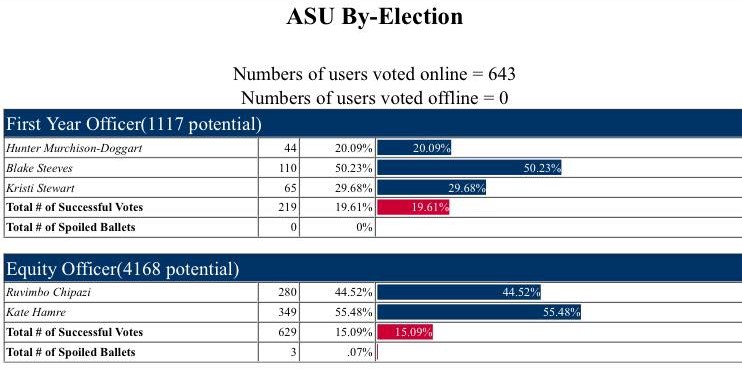
    At 4:32 PM today, ASU President George Philp sent out an all-student email announcing that the following candidates had been elected to the ASU Students’ Representative Council in the 2018 Fall By-Election.

    First Year Officer – Blake Steeves

    Equity Officer – Kate Hamre

    The Students’ Representative Council is the body of student who are elected each year to run the Acadia Students’ Union. More information on what they do and how you can get involved is available at www.theasu.ca. 

  • ASU Elections: What you missed at the By-Election Debate

    ASU Elections: What you missed at the By-Election Debate

    The Acadia Students’ Union Fall By-Election debate, moderated by Chief Returning Officer Sacha Russo and Deputy Chief Returning Officer Evan Shergold, took place in the Michener Lounge on the evening of September 24th, 2018. This debate included candidates for the two positions that are up for election – First Year Officer and Equity Officer.

    Here’s what they had to say:

    First Year Officer

    Kristi Stewart: As a politics student from small town PEI, Stewart spoke to the importance of “being involved, not only in [her] school, but [her] community.” With experience as president of her high school’s student council, Stewart would like to act as the voice of first year students, and to be able to connect them to what they want to do. Stewart believes that three important values of a First Year Officer are open-mindedness, responsibility, and confidence.  One project she is passionate about is a stress relief week, filled with yoga and meditation, to act as an escape from school stress for a little while. She shared that she is excited about every committee that the First Year Officer sits on. If elected, Stewart says that she will strive to make sure first years are involved and connected. More information on her campaign can be found in her candidate writeup here.

    Blake Steeves: Sporting his cowboy boots and ball cap, Steeves, a business major, states that he has not experienced student council before, but he is excited about the opportunities it holds. Steeves believes that three important values of a First Year Officer would be leadership, which he has experience with as the captain of his hockey team, as well a fun-loving personality and confidence. One project that Steeves would be interested in is finding new ways to give money to charities such as S.M.I.L.E. and the Cancer Society through different fundraising events. If elected, Steeves says he is most excited to sit on the Student Life Committee, and three words he would use to describe himself would be fun, reasonable, and enjoyable. If elected, Steeves would like to make this year fun and memorable for all students. More information on his campaign can be found in his candidate writeup here.

    Hunter Murchison-Doggart: As a politics major, Hunter Murchison-Doggart is interested in helping others, and is happy that she has the opportunity to run for First Year Officer. Murchison-Doggart states that leadership, responsibility, and confidence are all necessary for such position, because it is a big deal to represent so many students. When asked about a project she would be interested in, Murchison-Doggart stated that she would like to help expand the Relay for Life, because not all schools have the opportunity to offer that. If elected, Murchison-Doggart would be most interested in the Student Life Committee and creating a school that feels more like a family. Three words she would use to describe herself would be fun, confident, and responsible. Murchison-Doggart states that her goal, if elected, would be to create a sense of community at Acadia. More information on her campaign can be found in her candidate writeup here.

    Chantal Peng: Peng was absent from the Fall By-Election Debate and she has since withdrawn from the race, according to Chief Returning Officer Sacha Russo.

    Equity Officer

    Ruvimbo Chipazi: Third-year psychology major Ruvimbo Chipazi shared that, for most of her life here at Acadia, she lived in her “own little bubble,” until she began working with the University. Chipazi wants to bring underrepresented groups on campus information about the many opportunities around them, and she feels that three essential values of an Equity Officer are empathy, organization, and leadership. One project Chipazi expressed interest in was expanding a cultural exchange night on campus, as well as mental health week. To her, an equitable campus means realizing the difference between equality and equity, and “giving resources to the groups or clubs that need that extra step from the ASU.” Three words she would use to describe herself would be weird, open-minded, and enigmatic. If elected, Chipazi “wants to represent diversity, not just physical diversity…but also diversity when it comes to perspectives, values, ideas, sexual orientation, (and) age.” More information on her campaign can be found in her candidate writeup here.

    Kate Hamre: As a third year Kinesiology major, Kate Hamre shared that she is very active in campus life. Whether it be her house council presidency, membership on the Acadia Kinesiology Society, or one of many other clubs, Hamre states that she has noticed the vast amount of diversity on campus. Hamre cites her interest in connecting people to resources and events that they might not have known about, and three values she thinks are important for an Equity Officer would be approachability, creativeness, and responsibility. One project she would be interested in would be creating an international trivia night for all students. Hamre’s definition of an equitable campus would be one where “everybody feels like they belong and that their voice is heard.” Hamre would describe herself as approachable, positive/happy, and creative. If elected, she would like to make all students across campus feel represented and heard. More information on her campaign can be found in her candidate writeup here.

    Voting for these positions will take place between 8:30 AM on Thursday, September 27th, 2018 and 4:00 PM on Friday, September 28th, 2018. Students can login into Acadia Central at https://central2.acadiau.ca/elections/asu to vote anytime until the close of the polls.


    Ailish Bergin is a second-year Politics major and columnist at The Athenaeum

  • SRC Decoded: What you missed September 25

    SRC Decoded: What you missed September 25

    The Students’ Representative Council is the body of students who are elected by their peers to run the Acadia Students’ Union. Council meets bi-weekly on Tuesdays at 5:15 PM in the Beveridge Forum which is located off of the Michener Lounge in the Students’ Union Building (SUB). All of their meetings are open to the public and students are encouraged to attend to learn more about their representatives and the decisions that are being made on their behalf.

    On September 25th, 2018 at 6:00 PM, the Students’ Representative Council (SRC) began their meeting by reading the new Statement of Autonomy for the first time since its recent adoption.  Council then discussed an amendment to the Articles of Incorporation of the Acadia Students’ Union and the success of Welcome Week. Finally, following a closed session, Council unanimously voted to accept the Review Board’s recommendation to adopt Executive Board and Chairperson honoraria for the summer semester.

    Amendment of Articles of Incorporation

    Council began discussions about the amendment of Article 5(b)of the Articles of Incorporation (An Act to Incorporate Acadia’s Student Union). Currently, the provision states that “The Union may make by-laws not inconsistent with this Act or any law in the Province of Nova Scotia relating to: … (b) The election of officers of the Unions and the Council and the election and appointment of members of the Council;” The proposed amendment is to clarify the provision, in order to align itself with the ASU’s process of appointing certain officers and Members of Council (VP Finance and Operations). According to George Philip, ASU President, this item will again be brought up at next week’s meeting.

    Welcome Week

    Gabrielle Bailey, VP Events and Promotions, informed Council that Welcome Week, called “FestiVally”, was an overall success. Bailey stated that most events had higher turnouts than expected, and that she had received much positive feedback. She added a special acknowledgement to Acadia Athletes who helped on move-in day.

    Adoption of Honoraria

    After deliberations in closed session, Council unanimously voted to adopt a motion to accept honoraria disbursements which acknowledge the work done over the summer by the Executive Board and the Chairperson in accordance with the Constitution of the Acadia Students’ Union.

    Meeting Dates

    Council will be meeting again next week on October 2nd, 2018 at 5:15 PM, where an official vote will take place to solidify the bi-weekly schedule of meetings (as opposed to weekly meetings). The rationale behind this decision centers around a lack of discussion items for Council to consider during weekly meetings.


    Ailish Bergin is a second-year Politics student and staff writer for The Athenaeum.

  • Equity Officer: Ruvimbo Chipazi

    Equity Officer: Ruvimbo Chipazi

    My name is Ruvimbo Z. Chipazi. I am a 3rd year psychology student and I enjoy reading stories, I love hearing about people’s stories. During my time at Acadia, I have only scratched the surface of the diverse stories that our campus has to offer. I want to be in a position that allows me to listen and understand Acadia student stories. More people need to know, see and understand just how diverse our community is. I don’t just want black and white stories. I want diverse stories of age, national origin, religion, differently abled, socioeconomic status, sexual orientation and language – just to name a few. Acadia needs diversity in ideas, perspectives and values. I want to help bring about that diversity. Everyone’s story is important. I’m here to listen and make sure these stories are heard.

    You Talk. I Listen. We Act.

Betzillo positions itself as a versatile gaming hub where structured bonuses and adaptive gameplay mechanics support both short sessions and extended play.

Built with a focus on innovation, Spinbit integrates modern casino architecture with rapid transactions, appealing to players who value speed and digital efficiency.

Ripper Casino emphasizes bold entertainment through high-impact slot titles and competitive promotions crafted for risk-oriented players.

A friendly interface and stable performance define Ricky Casino, offering a casual yet reliable environment for a wide spectrum of gaming preferences.

King Billy Casino channels classic casino spirit into a modern platform, delivering recognizable themes supported by contemporary reward systems.

Immersive visuals and layered slot mechanics are at the core of Dragonslots, creating a narrative-driven casino experience.

Lukki Casino appeals to players seeking direct access and minimal friction, focusing on fast loading times and intuitive controls.

Casinonic provides a structured and dependable gaming framework, blending modern slots with transparent operational standards.